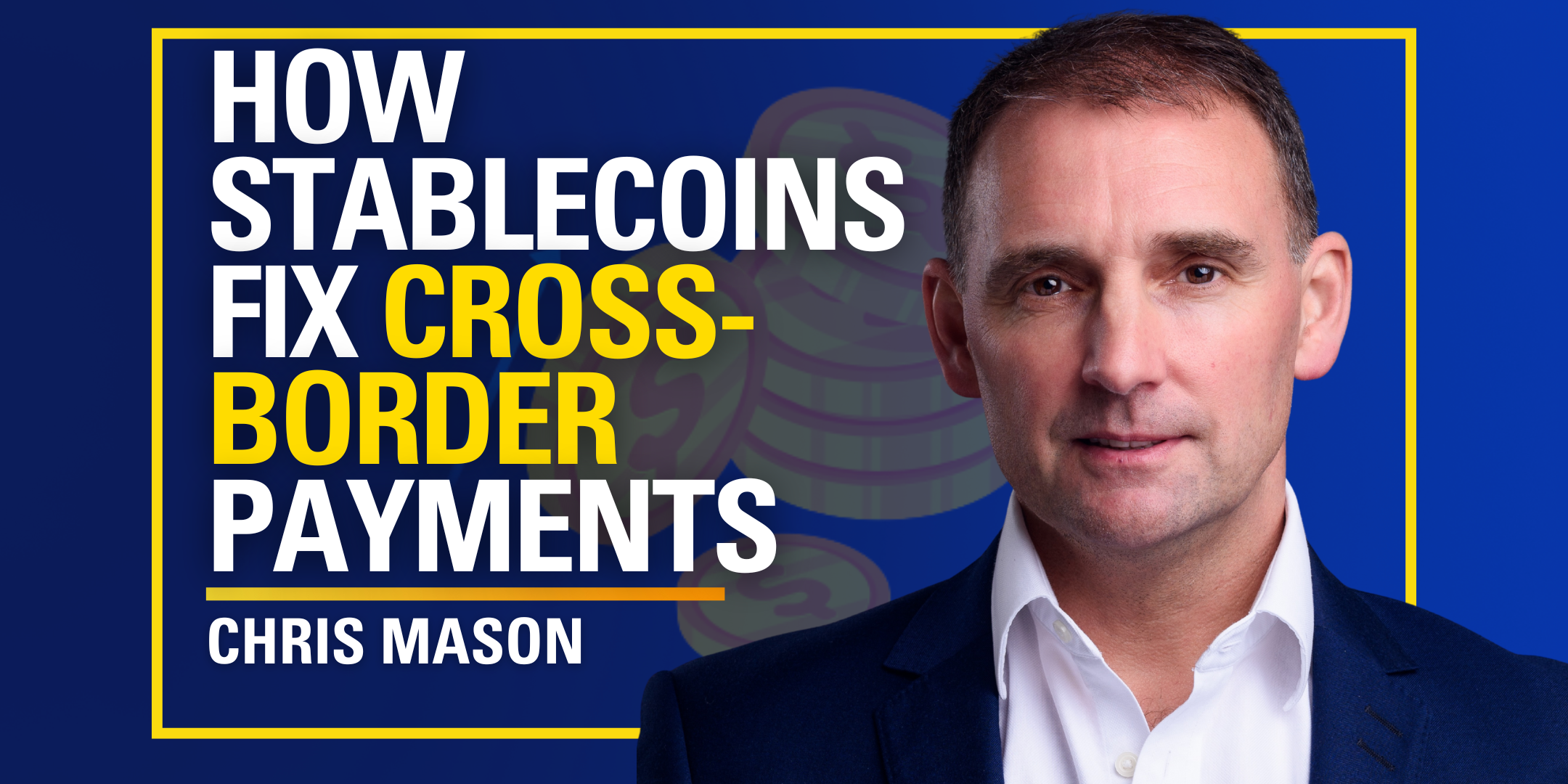
How Stablecoins Fix Cross-Border Payments - Chris Mason | ATC #615
Host Stephen Sargeant interviews Chris Mason, founder and CEO of Orbital. With a resume that covers leading roles at Citigroup, AIB Merchant Services and Worldline, Chris Mason is a payments veteran. During his time in these roles, he saw firsthand how cross-border payments are broken. In 2017 Chris co-founded Orbital, a payments platform that orchestrates stablecoin and traditional payments for global businesses, to solve this problem.
Host: Stephen Sargeant
Guest: Chris Mason
We are also available via:
Buzzsprout • YouTube • Quora • Medium • X • Facebook • LinkedIn • Soundcloud • Apple Podcast • Spotify • Player FM
Episode Transcript
Stephen: This is your host, Stephen Sargeant, the Around The Coin podcast. We go deep into the infrastructure orchestration layer of stablecoins.
We have Chris Mason, the founder and CEO of Orbital. What's so interesting about Orbital, they're almost nine years old, and they started stablecoins over seven years ago when the market was extremely soft, and they put in the infrastructure, and they're helping merchants and businesses all around the world be able to transfer value using stablecoins.
We talk deep about regulations, what are the challenges and some of those advantages with stablecoins, and where he sees the industry going.
What are some of the common use cases and some of the jurisdictional arbitrage that stablecoin companies have been playing over the last decade.
This is such an interesting conversation. Check it out and reach out to me or Chris if you have any questions about stablecoin infrastructure.
This is your host, Stephen Sargeant, the Around The Coin podcast. Today we have Chris Mason, founder and CEO of Orbital. You know the Around The Coin podcast loves our stablecoin infrastructure conversations, and we love the stablecoin processes and procedures that are actually touching merchants and helping them expand their offering.
Chris, why don't you give us a quick background of where you are, where you've been, and where you are today?
Chris: Hi, Stephen. Yeah, thanks for inviting me to the show. Uh, very, uh, very good to be here. Uh, yeah, my background's very much in the, the traditional financial services space. You know, when I started my career, uh, crypto hadn't been invented, so, uh, so yeah, I spent, uh, the early part of my career, uh, at Citibank, I think I said thirteen, fourteen years, uh, and then worked for other large institutions like First Data.
So yeah, I, I've worked in various parts of, uh, uh, financial services from card issuing to card acquiring, uh, transaction banking. Uh, so I, I've, uh, over my time, I think I've had the good fortune to, uh, have experience in all sorts of different businesses. So we started Orbital, uh, about nine years ago now and have been, uh, in the stablecoin space for, for seven of those nine years.
So I guess we were one of the earlier firms to start to process stablecoins. So that's a bit about me. Yeah.
Stephen: 20 years, you know, even before you got to Orbital in the space around payments, card solutions, what's been the reoccurring hurdle for getting payments right over the last couple of decades, and what's the current hurdle today that you're hoping to solve with stablecoins?
Chris: Yeah, yeah. I think you, you could, you could easily say that from a retail point of view, you know, m-many years ago, re-retail payments didn't work. Uh, and I'm talking domestic retail now. So, you know, your likes of, you know, your B2C transactions, whether it's Visa, MasterCard, or, you know, obviously there's five to six hundred payment methods around the world.
But I think domestic payments are, you know, now work extremely well around the world, and there's so many options and, you know, that, that are highly efficient. I think the-- I think it's the cross-border payment that has been the one that's been most difficult to solve, you know. And, you know, there's, there's a heavy reliance on Swift, there's a heavy reliance on, you know, US dollar banking and the correspondent mo-model that's, uh, associated with that.
Uh, so I'd say, you know, the, the, the unsolved, uh, or the, the being solved, uh, problem is cross-border payments and how we interact between countries. But I'd say domestic retail payments is pretty much sorted even, even in places like Africa these days.
Stephen: And I'm curious, you know, w- you know, on your website at Orbita it says, "Move money smarter." What are some non-smart ways that we've been moving money between retail users and merchants over the last few decades?
Chris: Yeah. Yeah, I think, I, I think it's, you know, y-you can't say it's, uh, it's not smart if it's, if it's the only, if, if it's the only way possible. But, you know, the traditional banks have very much used SWIFT as we know, you know. And SWIFT, uh, SWIFT has its limitations. You know, there's, uh, uh, there's, you know, there's bank opening hours, there's, uh, you know, there, there's, there's a whole host of issues that don't work particularly well with SWIFT and when it's kind of visibility of the transaction.
But, you know, in general it is, it is, uh, lack of speed, um, and it's, you know, unknown costs and, you know, being unsure of what you're actually gonna receive at the end of the chain. And I think particularly when it comes to, you know, the emerging markets, when, when funds are coming in and out of emerging markets, you've got, you know, issues around currency control and, uh, but also where US dollars are concerned.
You know, the US dollar correspondent model is extremely complex. So, you know, if you're a, a bank in Malaysia, let's say, you've got to hold a Nostro account with one of the big, uh, providers, generally, you know, Citigroup or JPMorgan or Wells or someone. So you've got to hold an account in the US and then, uh, then the fun starts basically.
So, you know, from in terms of instructions, uh, flying around between banks with kind of different opening hours, you know, that bank in Malaysia may not have enough funds with, with Citi to complete the transaction. So then they've got to transfer funds, um, into their correspondent, um, you know, which would be Citi, and then they have to be, uh, you know, they have to be borrowed maybe, or if it's, uh, if they need to be quick or...
So, you know, it's extremely complicated and, you know, you could probably break it down into like seven or eight steps to, to make that transaction. And at the end of the, end of the day, if you add in compliance checks with all these different correspondents that are in the loop, you know, it could be six institutions in the loop.
They can't-- The, the, the visibility's poor. So, you know, there's probably like only one institution that really has a really good view of that transaction, and everyone else has got this regulatory obligation to look as well. So when you add it all up, then, uh, you know, sometimes it can take five days, sometimes it can take 20 days if there's, uh, if there's compliance hold up.
So it is an extremely complicated process and, uh, yeah, the, the, the actual physical funds, the movement of US dollars in, in country between correspondents is very quick, but everything around it is, uh, is kind of broken, isn't it really, to be honest?
Stephen: Right. And how are you using stablecoins to allow, you know, both end users and merchants to move money globally? 'Cause I think we've seen, we've had a lot of, you know, guests on the podcast, but even in my own experience, a lot of people got into crypto. For example, one friend of mine, he was moving from London to Canada, and, and and he couldn't, he c- yeah, yeah, needed a way to transfer funds, but he couldn't do that unless you had a, a, a personal address in Canada.
But he couldn't get a personal address in Canada 'cause he couldn't rent 'cause he didn't have a bank account open. It was like this circle, and he found the best way to move funds was, uh, through, through crypto and through Bitcoin, and that's how he got into crypto. How is Orbital using this kinda same fundamental thought process to move funds around globally, especially you're talking about in emerging markets that might not have the same infrastructure as the UK and Canada?
Chris: Yeah. I mean, the funds, uh, you know, the, the funds flow, say, for... You know, so we, we, we only deal with corporations. Now we deal with corporations that talk to comp-- to, to consumers or have, uh, consumer correspondence. So, you know, the, the principles of the transfer are, that you, you've just described are, are very similar.
I think, you know, but when you get a corporate involved, then a lot of other things become, you know, important, whether it's computer security, certainly transaction control is a big deal. You know, you've got, you've got compliance considerations in terms of, you know, uh, visibility of those transactions now under travel rule.
So, you know, the... If you look at, say, a typical transaction banking platform in the traditional world with traditional currencies, um, you know, they will, you know, someone like Citi or J.P. Morgan will have a huge plethora of functionality that will help a, a large corporate control those transactions. It's not just one person that might be, you know, managing treasury at Shell.
They may have, you know, 200 people in their treasury department. I'm sure they've got more. But, uh, you know, so some of the controls that you need to orchestrate a traditional currency transaction are no different really to, uh, orchestrating a, uh, a stablecoin transaction. So, you know, we, we think of our product as, you know, c- probably a, a dual product between, you know, that supports traditional and, and crypto and, you know, nearly all of our crypto is stablecoin.
Uh, but some of those transaction controls that our customers require and, you know, the controls over authorizations and maker-checkers and, and all of those things have become, like, extremely important. You know, payment intelligence, uh, management information. So, you know, the, the, the fundamentals of a transaction banking platform are, are no different as we see it.
Uh, but of course, the speed with which you can transfer those funds and the number of parties involved is, is significantly less. So that's what makes it so much faster and, and with, uh, and with less friction. But the fundamentals of compliance and all of those controls are the same.
Stephen: And, you know, we've had so many different stablecoin providers from Borderless to BVNK to Sphere Labs. Uh, there's so much different parts of the orchestration and infrastructure layers. Are you building on top of rails? Are you becoming the rail that these businesses, um, rely upon for payments? How would you position your organization into this, you know, wide range of applications that we just bucket all into stablecoins?
Chris: Yeah. I mean, I think we're, we're very much a, a, uh, a stablecoin PSP or s- stablecoin and traditional currency combined. I think our, our traditional currency side is generally very strong compared with the competition just because that's where we come from. You know, that's where I, I come from, from a, a career point of view.
So we have a, we have a numerous banks supporting our traditional side, which is, which is very important as far as we're concerned because, you know, there's, there's few people that just want to, uh, operate in, uh, in the stablecoin world. I mean, we are seeing it more and more. We see commodities firms and people like that, that just wanna do stablecoin, you know, and they're happy to hold it, happy to send it, they're happy to receive it.
So it's almost like a proxy dollar. But, you know, I, I, I think it's impossible to ignore the fact that you are gonna need those on and off ramps in, uh, in traditional currency. But we also position ourselves as being able to make third-party payments in traditional currency and do all the things with traditional currency that you can do with crypto.
Because, you know, I think there's not-- although stablecoin drives, uh, a, a lot of our business traffic, I think, you know, our, our traditional currency capabilities are, you know, becoming stronger and stronger. So, you know, we, we like to strike a balance. Uh, but I think the other strand of it is that, you know, obviously everyone's partnering up now, so all the other financial institutions are running for a partner on stablecoin and, uh, you know, they wanna, they wanna be in the game.
You know, I think, I think, uh, you're seen as behind if you don't have a, a stablecoin strategy. All the big banks have crypto departments, et cetera. So we're seeing, um, a lot of kind of requirements on the, the infrastructure side. And I think thankfully, as we, as we've been around so long, uh, that, you know, we, we see a great opportunity to, uh, support, you know, many of the major traditional institutions with a, with a, an, an infrastructure layer.
And that infrastructure layer could, could include a, a license, uh, as well, because generally a lot of these, these, these guys aren't licensed, and even if they were, they may not have the, the, the whole compliance infrastructure to support all the transaction monitoring. Uh, and you know, and it, and it could even be, you know, that, you know, the banking appetite could be, could be slightly different.
So we could s- we could support them with some of our, uh, with our banking rails as well. But in general, yeah, we, we are seeing ourselves more and more as a infrastructure provider as well, because that's what everybody needs in the market. And if you want to, if you wanna build it yourself, then I'm kinda saying good luck 'cause it'll take a while.
Yeah.
Stephen: You have several different use cases for your customers, including payments, payouts, stablecoin wallets. What's the most common use or the, the, the use case, case study for Orbital? And then do you see any emerging cases coming out based on the increase of stablecoin usage around the world? You know, like it's not quite, uh, you know, a trend, but it's getting there.
You're seeing more uses in this specific niche.
Chris: Yeah. I mean, I think, you know, the, the really standard kind of payments you've already kind of mentioned. You know, you've got pay-ins, payouts. You might have auto conversions. So you may have, say, companies that says, "Look, I don't want a stablecoin wallet on my balance sheet. I'm publicly listed. I'm licensed here.
I, you know. But so I, I, I only wanna receive a fiat currency." You know, that tends to be a fairly, uh, common request from the next generation. It's just like, we want the stablecoin speed, but we don't want it on our balance sheet. So there's a lot of kind of, let's say, uh, auto conversions in and out. So, you know, kind of on and off-ramps are, are automatic.
Uh, but you know, they're, they're fairly basic transactions, I suppose. I think what we're starting to see more of is, uh, demand for, you know, on and off-ramps in emerging market currencies. Uh, but we are finding that, you know, very often that once the customer's into stablecoin there and there's a-- it's much higher brightness in those markets, then they're really just looking to, say, the European end sometimes.
Uh, but you know, I think, I think the big thing that we're seeing is that there's a, there's a move now from, say, the original stablecoin adopters to a whole new wave of stablecoin adopters. So, you know, it, it, it hasn't happened yet, but if it's someone-- some massive marketplace like Amazon, I think what they're going to want is an awful lot of transaction control, and they're gonna wanna feel safe, aren't they?
They're gonna want computer sec. They're gonna want, you know, probably their, their, their own gate in terms of how they can control the transactions and how they can keep themselves safe. But, you know, there's definitely a perception that a crypto transaction is more risky than a, a fiat transaction, even though I would argue, uh, slightly differently.
So I think the next wave of stablecoin adopters is, uh, are, you know, are gonna have different requirements because they tend to be the bigger organizations now, and those bigger org-organizations have very tight controls
Stephen: You know, you talked about, you know, some of the regulatory stuff. We saw-- I was just at ECC in France, and there was a lot of discussions around regulations and compliance, especially around stablecoin and real-world asset tokenization. It almost feels like there, there was a hangover from the Genius Act, but a little excitement into what's to come with the Clarity Act in the US and emerging regulations in financial hubs from Singapore to Hong Kong to Dubai.
What are your regulatory compliance requirements operating a payments firm with crypto integrations, especially going from B2B?
Chris: Yeah. I mean, they're vast, yeah. So they-- You know, we're, we're licensing. We have five different licenses now. We have two Fiat licenses and three, uh, three CASP or VASP licenses. Uh, every jurisdiction's a, a little bit different, I would say. But the, the fundamentals are the same. Uh, you know, I think the, I think the mistakes, uh, out there at the moment and the things that, that are difficult, particularly on the crypto side are things like client segregation of funds and making sure you can, you can track, you know, whose funds are whose over, you know, millions of wallets that we might have out there at the moment for our, for our customers.
So that tends to be, you know, a common requirement, but a difficult one to, to, to manage. And we've had continual team of people that are always, always improving that and, uh, you know, so that everything kind of, you know, uh, reconciles out to the dime. So that's a big, that's a big area. I think the fundamentals, um, of AML and financial crime are, are very similar between the two worlds.
But I think the, the, the differences between, in terms of how you manage that, uh, financial crime risk are, are, are different on the crypto side. And obviously there's tools like Chainalysis and Elliptic and Coinfirm and some of those guys that, uh, provide that kind of screening service. Uh, you know, and, and in some ways there's a larger, there's a larger burden isn't there, that on the, on, on compliance teams with, with crypto because you have this ability to, to look back in the chain, which you can't do with the, the traditional world, you know.
But personally, I don't know what you think, but personally I think that crypto could really become a, uh, a, a great tool for, for avoiding financial crime because you have got that visibility. You know, the, the, the challenge historically has been, you know, the name on the account, who owns the wallet, et cetera.
But now the travel rule is coming in and things, it's, uh, which is a huge challenge in itself given the infrastructure everywhere has to improve and catch up. But I think once, uh, once that's truly solved and we can truly identify every single wallet owner, then I don't see why crypto can't be a, uh, a, a more compliant solution than the, than the traditional world where you just don't get that visibility downstream, you know?
Stephen: No, I agree. And to be able to assess risk in real time I think is important. Like, if you have a sanctioned entity at a large financial institution, well, unless they report it right away, how would you even know unless there's an audit or you report it? Whereas if somebody's sending funds from Grindex, the Russian-based crypto, uh, exchange, I use that in quotations, uh, you already know they're sanctions.
You see, hey, this fund's just deposited at a compliant exchange, regulators, law enforcement, the exchange, other companies. And we've seen a lot of these investigations, FTX were one of them, was done by crypto, you know, crypto Twitter investigators that didn't need to go inside the institution, that didn't need to have access to special paperwork.
They were able to do it transparently on the blockchain, which is I think a huge success for law enforcement who's at a capacity, and regulators of the world that are, you know, severely, you know, capacity, I would say the lack of capacity that they have for everything to do on the blockchain is important
Chris: No, for sure. Yeah, I think, I think, you know, uh, this perception of, uh, crypto being the, the higher-risk solution and, uh, you know, maybe, maybe in the past, you know, people have, have viewed crypto as being much, much higher risk and a money laundering tool, et cetera, et cetera. You know, my advice, not that I should be providing advice to a money launderer, but you wouldn't wanna use crypto because there's so much visibility and, you know, law enforcement are all over it.
You know, we get, we get queries sometimes, you know, and we-- You know, there's this two-way flow between law enforcement and, uh, and organizat-organizations like, like ours and, you know, you kinda help each other out in terms of what you're seeing on the, the platforms. But yeah, the visibility's huge. So yeah, as you say, automatically you can see if a, if a, you know, transaction's coming out of a, a sanctioned exchange and whatever immediately, and you can, you can block that transaction and do what you need to do with it.
Yeah. But yeah, I think it's a way forward actually. Hmm, I, I, I, you know, personally believe that's why a lot of governments are, are kind of excited about crypto because I think they see this, this, this potential to, to really stamp out a lot of, you know, terrorist financing and sanctioned stuff and whatever it is.
It
Stephen: with publicly available blockchains, you know, and all that data, and now with AI, you can really see a lot of outliers. You can see transaction behavior where that's really hard to do if you're outside of a bank trying to assess, you know, certain risks of an, an internal banking institution. That's almost impossible to do.
But on the blockchain, you can utilize a lot of that data, and now with the use of AI, get a lot of those answers and intelligence I think we lack. You know, with somebody that holds licenses, as many licenses as you do, you said multiple licenses there in Europe, is this heavily regulatory burden maybe pricing out some of the smaller crypto payment service providers?
Have you seen a negative impact on all this clear... Although clarity is something that we're looking forward to when it comes to regulation, you know, it is still burdensome to meet the requirements of several regulators around the world.
Chris: Yeah, it is. Yeah. I mean, I, I think it's, I think it's huge actually. And, you know, I, I think even when we started out nine years ago, you know, you could probably run a fintech with, you know, 10 people or something like that if you really had your systems together. I think there's a, I think there's a m- minimum critical mass of people that you need to, to support sufficient systems and, uh, and, and, and screening, et cetera.
You know, and I think there's more and more pressure from, uh, from governments, uh, you know, particularly the US to, uh, to stamp out terrorist financing and things like that. And then that obviously, uh, trickles down to regulators and, you know, no one wants to be caught out on their next, uh, you know, Moneyval audit or whatever.
So yeah, it's, it's intense. It's, it's really intense. And I think, I think one of the challenges is that, you know, regulators are just a, a bunch of people as well, yeah. So the regulators have gotta catch up and, you know, we have plenty of instances where, you know, we, we may be, uh, you know, educating the regulator, you know, in terms of what they're asking you and what, you know, what we're both seeing and stuff like that.
So I would say that a lot of institutions will, will not make it, yeah. You know, particularly if your DNA is very much like from a technology kind of, you know, kind of background, which many firms are. You know, I think there's more technologists than traditional finance people that have gone into, gone into crypto and like, you know, running these PSPs.
So there's an awareness thing there and a, you know, a natural fear that you would have if you've come from the- Mm-hmm ... the traditional world. So yeah, I think there's, there's, there's so many holes to fall down and, uh, yeah, you f- you have to be all over it, otherwise you will not make it. So I would, I would say, you know, it, it won't stop people starting, but they will get...
I think we're seeing it everywhere actually, you know. I think particularly some of these, some of these jurisdictions let's say that have, uh, opened up and, you know, provided 4,000 registrations to crypto firms and things, you know, we're, we're seeing it over and over again. Whether it be, I won't name the jurisdictions or I'll get myself into trouble.
But, you know, the, the, the, the hammer's fallen pretty fast on, on many, many firms, you know. Happened on the, in the EMI space in some of the Baltic countries and, and, uh, and I think it's, uh, it's certainly happening on the crypto side. So yeah, you need to be-
Stephen: I'll name names. Estonia went through that process where they're issuing less licenses. In Canada, a lot of the registrants for FINTRAC, which is the FIU, uh, had their registrations revoked cause they weren't
Chris: it's happening now.
Stephen: Yeah,
Chris: all happening now, yeah. And
Stephen: So, and it's all a licensing process in Canada, which is I think a lot of people are like, "Hey, maybe it should be a li- maybe they shouldn't have been able to register in the first place unless they met a certain regulatory requirement."
But, uh, FINTRAC is definitely putting the hammer down when it comes to their penalty systems as well.
Chris: Yeah, big time. It's happened in Estonia. I mean, we, we were one of those that went the easy route and years and years ago in Estonia, I think we're one of maybe 20 left, uh, from 4,000. So, you know, so it's, uh, yeah, it's a real problem and I think... But it's, you know, it's become a real problem for the regulator because, you know, it's a lot of hard work weeding out 4,000.
I mean, how do you even start, you know? And I think that's the, that's, that's been the issue. And, you know, people will continue to play regulatory arbitrage around the world until, you know, uh, I don't know, until
Stephen: regulators will continue to wanna attract business and capital to their country. So, you know, uh, the regulators are also... And these jurisdictions are like, "Hey, we wanna flip on the switch. We wanna be the crypto hub of," you know, insert, insert the continent, um, or the country. And I think that's tricky too, because then companies are like, "Hey, you're crypto-friendly?
Sure, we'll apply here." But I don't know if those regulators, to your point, have the expertise to deal with some of those submissions that they're gonna be getting.
Chris: Yeah. And just the volume as well, if they're asking any requirements in the first place. But, you know, as soon as Moneyval comes in and, and gives you a hard time on you and you're on the FATF list, then, you know, then it all changes, and then it goes the other way. So then it becomes extremely difficult and like everybody gets kicked out even if they're doing things right or largely right.
And so, you know, for me, the, the most important thing from a regulatory standpoint is predictability. I don't care how difficult it is. Um, generally the requirements are the same, but the, the, a predictable regulator and a stable environment is, is really what you need because it's, it can be a two-year process and, and a lot of investment around people.
Uh, and, uh, yeah. So it's, uh, yeah, so I, I, I personally think it is, it will become the competitive advantage, uh, for the ones that win. Um, the competitive advantage will be the infrastructure that you've built around transaction management, transaction control, how you understand your customers perfectly so that you know you're not letting the bad guys through the door and you can do the business with the, uh, with the guys that could have a perceived higher risk.
But, uh, but you can deal with, you know, and you know how to mitigate that risk if it exists at all. But yeah. So yeah, it's an interesting world.
Stephen: Right. This podcast has a lot of entrepreneurs, payments, crypto founders. I want you to put-- I want you to take me back to 2017 when you're building Orbital. Um, you look at it, the market was hyped on Bitcoin, the market crashes. 2019, you start to implement stablecoins or around that time. There's really no market for crypto.
Nobody wants to talk about crypto. You know, people have leveraged mortgages to buy crypto at its all-time high at that time. There's not a regulation in sight, maybe outside of maybe the ADGM and, you know, places like that that's even discussing crypto or stablecoins. What makes you start your stablecoin journey seven years ago when people are looking like now it makes sense with all the regulation, but back then it looked like, you know, the cr- all those crypto departments that you're talking about, the big traditional institutions, you know, those, those boardrooms were shut down pretty quickly.
What makes you start a business or making sure that your business is revolving around stablecoins so early?
Chris: Yeah. I mean, I think it was market opportunity. I mean, we were, we were, we were bootstrapped and we always had-- have been. You know, we've never... Although we're a fairly considerable size today, we'd never raised more than I think we raised six million dollars at one stage. So we were bootstrapped and we saw, uh, you know, we saw an, an opportunity to, to, to make money and, uh, yeah, we, we, we really started out trying to, you know, replicate a model that was very similar to, to WorldLink and Citi that I used to run, but for the next kind of wave down.
You know, obviously the cities and JP Morgan serve the really big guys, yeah? So we wanted to serve the, uh, the smaller guys, and we started to build out in that way, but we, we quickly latched onto a particular problem that, uh, a customer had, and we solved that problem for them using stablecoin. Um, we weren't necessarily handling it ourselves at the time, but we were orchestrating the transactions between, um, between, you know, regulated entities in various markets and, you know, leveraging, you know, someone with a, an institution with a license in the UK.
And yeah, we may-- we actually, we, we actually floated the business all on, all on that really. So the, the business, you know, started that way from that revenue stream and, um, and we just built out from there. But yeah, it was really, it was really to, you know, solve an acute problem that, uh, a customer had. But I think, yeah, nowadays it's a very different world, isn't it?
And, uh, but, uh, but at that time, yeah, it was, uh, opportunistic, I would say, rather than strategic.
Stephen: Do you, did you ever vision what would happen as, you know, when Trump comes in and there's immediate, you know, acts like, uh, the Genius Act passing, Clarity Act in the works. We had, you know, crypto reserves. Like could you imagine like the industry getting to this point? Was that ever a vision that you had?
Or was your thought we're, we'll keep solving this problem and service our customers, and stablecoins will always kind of be in the background. Nobody... There'll be no hype around it, but it'll get the job done?
Chris: I think, I hate, you know, I, I don't know whether it sounds immodest or whatever, but, uh, absolutely. We-- once we started to see how efficient it could be, uh, we absolutely saw that opportunity. And, you know, we, we started to build, we started to build proper infrastructure around, uh, around stablecoin really, really early.
So yeah, I mean, it, it, it was a bet. Uh, you know, we were building the traditional side as well. Uh, but we, yeah, we did start to see that, uh, that opportunity really early. Yeah. And, and, uh, yeah, you know, I think it's hard. I mean, can you ever really say if, uh, if things will catch on in the way that they do? I think, I think regulation's helped enormously.
You know, if you look at-- if you compare, say the US, uh, and what, you know, you could say Trump has done for the US then, you know, the, the floodgates have kind of opened there. You know, the rates that you can convert, say USDT to euros in the, uh, in the UK and in Europe would almost mirror, uh, you know, a, a US dollar to, to euro rate, you know?
So regulation has enabled those markets to really work in a really efficient way. I think where stablecoin's not yet, um, sufficiently efficient is where, you know, you still don't have lack, lack of clarity generally in the currency control markets because there's this quandary, isn't there? You know, it's like, it's like crypto's like a leaky bucket for their currency controls.
Um, so how do they set, how do they set their regulation? And some of it's silent, some of it's like China, we-we-- it's banned. Uh, so, you know, I think, I think once that, that thing sorts itself out, uh- Then it will become super efficient, and then I think it then can completely dominate, dominate, uh, cross-border payments worldwide.
But until that happens, you know, there's the, the whole stablecoin sandwich people talk about. It, it is a real thing for sure, you know. So you buy, uh, you know, you sell euros, let's say, and then you, you buy Nigerian naira and, you know, you make that transaction in five, ten minutes or whatever. It is a real thing, uh, but it's not the best pricing certainly in every single transaction.
There's-- We run this index that shows all the premiums in market by market. Sometimes like there's a huge benefit to sending, say, funds into Colombia, uh, less benefit taking funds out of Colombia. So it's until, until those-- that regulation comes in and the, uh, then the markets won't start to mirror the, the, the traditional markets. Just one more thing. Sorry, I feel like I'm, uh, saying too much here. But the, the, the, the markets in from a traditional currency standpoint in the emerging markets are extremely expensive and extremely cumbersome. So, you know, like the, the example that I, I, uh, talked about earlier. You know, if a Malaysian bank needs, needs to fund Citi in New York to do a-- to make a, a transaction, they may have to borrow money to, to fund that transaction.
They may have to send money, and it takes two days. And, you know, it's all, it's all a massive pain, and they may not even have proper systems to do it. It might be some operational manual thing going on probably, you know. Uh, so it's expensive. It's really expensive in and out, even in, in, in traditional currencies.
So, you know, I, I don't think it's gonna be that difficult once we-- once, once you've got regulation to surpass or vastly improve, uh, on those kind of traditional rates that maybe exist in these emerging markets because the complexity of what happens to make that transaction is huge, and then that makes it costly.
They're al-- They also take advantage, of course, of, uh, you know, being the only game in town often. So once that complexity's gone and the FX markets have kind of become a bit more, uh, a bit more like, uh, you know, they are in Europe and the US, then I think stablecoin could really dominate here
Stephen: You've worked in the merchant space for over a decade. What is the biggest reason why some merchants might not wanna participate with stablecoin payment avenues? Is there, like, something holding certain companies on the sidelines, um, that they wouldn't wanna be, you know, involved with stablecoin-type transactions for payments?
Chris: Yeah, I think, I think there's a, a lack of understanding. I mean, even, you know, even in the crypto world, there's a lack of understanding, isn't there, really, in, in, in a lot of ways. But, you know, if you go into these very big corporations, y- you would say, "Well, what, what's the-- Is there a..." You know, unless they're a, a very innovative corporation, uh, then, you know, sometimes it's a little bit why, you know, people like Revolut are cleaning up at the moment.
You know, making big, bold moves, uh, is risky, isn't it? So, you know, I think you, you-- or there's a perceived risk there and there's a lack of understanding. You know, your compliance team probably aren't experts in Chainalysis and, you know, so you, you hear the, you hear the rumors. Uh, so there's an education, there's an education process to go through.
But I think it's improving fast. Uh, but yeah, I, I, I think that's the principal reason, really. Uh, but then there will be other big companies that just have so many, so much funds around the world and they can pool funds, et cetera. You know, so the likes of people like Wise and things have done a really good job 'cause they, they, they have pools all around the world, and they can, they can just do ledger entries to move funds, you know.
But for, for big numbers, that's not gonna work. So I think there's very-- Uh, yeah, there's a lot of, there's a lot of reasons why, why people wouldn't use stablecoin, but I think most of it is, is an education problem as opposed to a real issue.
Stephen: You've expe-- you have experience in cards. That's like your background's around cards, and it appears like crypto cards are at an all-time peak. Everyone's coming out with their own crypto
Chris: Yes
Stephen: What's the biggest challenge in integrating cards into your existing infrastructure and platform? Is that something you're thinking about?
Is that something you're already doing behind the scenes? Like how difficult or easy is it to implement this kind of card infrastructure that you have so much experience in?
Chris: Yeah. I don't think it's that difficult, to be honest, but we haven't done it yet. So it's not a-- it, it hasn't been a priority for us. I think, I think what's driving cards, so you're, you're, you're really talking about cards that y- you know, uh, that kind of bump against a, uh, a, a crypto balance as, as opposed to a fiat balance, yeah.
I mean, yeah, I think, I think we have to ask ourselves w- why, why someone wants a, to use a, a card. Uh, because, you know, if it's like Visa, Mastercard, Visa, Mastercard works really well everywhere. So why do you want to take against your fiat balance rather than your crypto balance? Could just be that you're a crypto nerd, or it could be that, you know, when that, when that, you know, when that bank statement comes in or the card statement comes in, uh, uh, at the end of the month, you know, which tends to happen, it's like, you know, maybe you don't want your partner to see how much you've been gambling.
I don't know, you know. But there's a, there's a certain amount of kind of discretion still, isn't there, I suppose, around, around what people do with their c- c- crypto money, I suppose. So I, I think it tends to be more of a, uh, a consumer-driven requirement. You know, we support merchants on the whole. Um, but certainly all the crypto exchanges out there are looking for that infrastructure right now.
Uh, I think the, the, the o- the other complexity that you have to consider is regulation. So, you know, if you are providing a product like this to an individual in a market, you better be regulated, and you've gotta have a Visa, Visa or Mastercard if it-- let's say it could, could work off any, any card network, I suppose, uh, or card-based network.
But, uh, yeah, you've gotta have a license generally for that network, and you've gotta have a local, you know, regulatory license. So it's not as easy as, as saying, "Well, you know, you guys in kind of Australia, we'll, we'll give you the, the infrastructure," because we would need to partner with someone that's got a retail license there and, uh, and of course a, a license to issue a Visa or a Mastercard.
But in terms of that transactions in the, the backend, in terms of the conversions, um, between fiat and crypto, which obviously need to happen, that's something we could do tomorrow, yeah.
Stephen: You know, your company has been quoted in Forbes around how stablecoins are constantly used, especially when it comes to crisis economies, um, especially where foreign currency is restricted. You talked about some of the currency restrictions, uh, with Venezuela, Iran, Ukraine, many countries in political turmoil all around the world.
Can you shed some light on some key takeaways of this thesis where stablecoins are kind of like powering some of these, uh, ins- unstable political regions?
Chris: Yeah. Yeah. I, I think it's, uh-- Yeah, it, it's difficult because, you know, a l- a lot of these firms or sorry, a lot of these countries would be on, on, uh, on lists, yeah. Be on, you know, sanctions lists and things like that. So, uh, but there, there are a lot of, say, great use cases. So, you know, it could be foodstuffs or pharmaceuticals coming out of one of these, uh, sanctioned countries or going into these sanctioned countries.
So let's just say grain out of Ukraine or something like that, yeah. So, you know, that might be something that, say, Citibank and JP Morgan would say, "Well, you know, we just don't do Ukraine," yeah, basically. But you know, the, the alternative for, you know, the, the, the commodities provider, Glencore or Trafigura or something, is to say, "Well, I can use stablecoin for that transaction," you know.
'Cause it's effectively a digital dollar and, uh, you know, firms like ourselves, uh, uh, can take the time to look at the individual cases and see whether we can mitigate risk and, you know, do the necessary documentation and keep everyone safe. So I think a lot of those kind of humanitarian transactions, it's, uh, it's a great solution, you know, and there's, uh, there's nothing wrong with it.
Uh, yeah. But you know, that it's, uh-- What was-- What, what were some of the other examples, Stephen? You,
Stephen: Venezuela, anywhere there's oil seems to be a, a common theme of political instability. Anywhere there's oil and natural resources, it seems to be a hot button
Chris: Yeah. I think it just depends whether it's a sanctioned good or not, you know what I mean? Rather than a-- But obviously, you know, stablecoin would be the ideal, the ideal solution, uh, to a lot of the movement of these kind of non-sanctioned items out of, out, out, out of sanctioned, uh, jurisdictions.
But, you know, it's a bit of
Stephen: even saw in the Strait of Hormuz, Iran wanted crypto to be paid in order to let the shipping tankers go through, so... And then he said they probably wouldn't accept Bitcoin, it probably would be in some form of, sort of form of stablecoin. Uh,
Chris: didn't hear
Stephen: uh, yeah, but those are all, as I said, those are... I don't know if anyone's been paid, but they were charging millions of dollars a shipping tanker.
Uh, after seeing the acquisition of Bridge by Stripe, BVNK by Mastercard, I think there was reports last year that Ripple was making offers to acquire Circle. How does that impact the way you run your business when, like, the reality of an acquisition, I know we went through maybe four years, especially in the US, of no M&A, but that reality has come true over the last 18 months.
How do you operate your business? How do you, like, especially when you're starting at the same time or even before some of these other companies, how do you view that as an entrepreneur, as a founder? And there's just as, like, a practical business owner where you've been doing it for nine years. Maybe it's a time like, "Hey, you know, maybe there's something else that you, another mountain you want to climb."
Chris: Yeah. I do enjoy the odd kind of building renovation and things like that. And I was, uh, I was building a roof for the weekend actually. But, uh, I think, I think we see it-- we think it's great for the industry, obviously, you know. The BB&K acquisition, like hats off to those guys, you know. They've, uh, they've got a, they've got a great deal, I think and, uh, you know, it's, uh, it's good for the industry and it shows the confidence in, in the industry.
I think from our point of view, we've got, you know, we've got a lot of, uh, strategic i- well, I wouldn't call them ideas, plans right now. Certainly around some of the, the, the power of AI that could accelerate our business, uh, in a really significant way, you know. And I think we feel as though the, the market hasn't necessarily...
You know, obviously there's loads of entrants. Everyone's announcing a stablecoin. Sorry, my light's gone off here in my booth. It's supposed to go back on. There we go. Uh, but, uh, yeah, so we're-- we just see, we just see the opportunity being, being bigger, uh, over the next eighteen, twenty-four months. I think the market will start to get
You know, I talked about the education thing earlier and the reasons why people might not wanna do stablecoin. I think that e- that education still needs to catch up a bit. So, you know, if you look at the amount of fiat transactions versus stablecoin, if you really like did analysis on those transactions, you would probably say that the vast amount of those, those transactions could be done far more efficiently without a doubt, with less friction and without a doubt cost sometimes much better, sometimes, you know, uh, the same, sometimes worse.
Uh, so, you know, so but, but, but I think, you know, more regulation, more education of the market. I think the market's still got a way to go. So from our standpoint, we're happy to keep developing, keep building stuff. I think we've got the foresight to know what the next stablecoin adopters want more, more from our traditional experience, I suppose.
And yeah, the power of AI in terms of how you can run your internal processes and develop product quicker and things like that, I think, you know, we see that as a real, real benefit. You know, we're, we're, we'll announce a, a US partnership relatively soon, which will enable us to operate in the US. I think that's really important.
Uh, obviously that's where the, uh, the big frenzy is at the moment. Uh, so, you know, we see-- we're just not there yet, basically. We're just, we're just not ready. I think there's, uh, there's plenty of runway.
Stephen: I would love to know, like if somebody was listening to this podcast, never heard of Orbital before, what's the one thing you'd want them to leave the podcast understanding about Orbital?
Chris: Uh, I think the, I think the, uh, the real understand-- I think the one thing would be that, you know, we're a very experienced, solid, capable provider. You know, you may have seen a FXC intelligence report. You know, it put us like at the far end in terms of our, our capabilities and, you know, we're very, very focused on, uh, on good service.
And as, as I said, you know, things work, yeah. So, uh, we do have the experience and, uh, having, you know, having had so much experience in financial services, you know, I'm acutely aware that if things don't work well and the service isn't right, then you're not gonna do very well. So, you know, I think we are the-- probably the most reliable, uh, and functional provider in the market, uh, both on the fiat and the crypto side combined.
And I think that's, that's really, uh, where we think our, our sweet spot is.
Stephen: Chris, where's the best place for people to find you? I'm a-- you sound more of a LinkedIn than a crypto Twitter person, but I'm not sure. You might have to keep your ear to the street on crypto Twitter
Chris: do too much on Twitter. If, if I do, it's my marketing team that's doing it, and I'm approving it before it goes out. But no, generally, uh, generally I'm, you know, we're on LinkedIn and, uh, yeah, it tends to be our main platform. You know, we're kind of corporate-only business. But, uh, yeah, that's where to find us.
You can contact us through our website. You can see our, our crypto intelligence reports and, uh, a lot of that stuff. So yeah, that's, uh-- I think we're easy to find anyway, yeah
Stephen: I think the stablecoin dashboard's pretty interesting that you have there and showing, you know, the insights from that, uh, especially, you know, that's actually pretty cool. That's one of the things I found super interesting
Chris: Yeah, yeah, it is really cool. It's my, uh, the brainchild of Luke, my, uh, my, my founder. So he's the, he's the guy that's, uh, analyzing everything in the market and things. So he's a, he's a clever man. Clever man, yeah
Stephen: Good data in, clever data in, you know, good, good data out. That's awesome. Chris, thanks so much for joining the podcast today, and we'll definitely be, you know, maybe circling back at the start of next year to see where we are in the stablecoin, see how much e-education has happened in the market, and to see where we stand, especially after the midterms here, uh, in the US
Chris: Yeah, absolutely. Yeah, it's a pleasure to be on the show. Thanks for inviting me, Stephen. So, uh, yeah,
Stephen: All the best
Chris: Cheers.