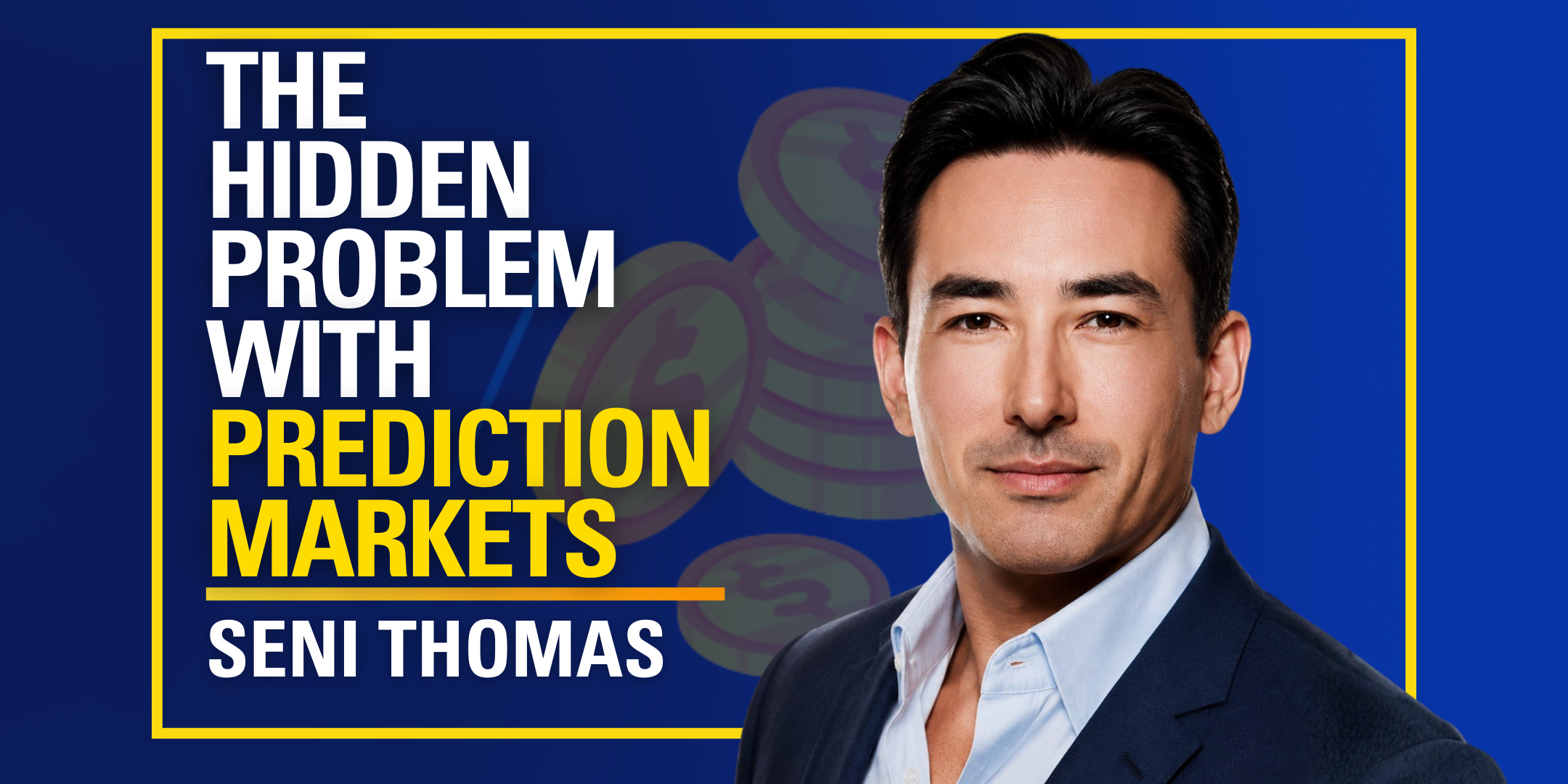
The Hidden Problem With Prediction Markets - Seni Thomas | ATC #619
Join our host, Stephen Sargeant, as he welcomes Seni Thomas, CEO and founder of EDGE Markets and a fintech entrepreneur with a background in algorithmic trading, digital advertising, and financial infrastructure. After studying at NYU's Stern School of Business, he helped build one of the first large-scale liquidity platforms for programmatic media, generating over $180 million in revenue. Inspired by the rise of retail investing and sports betting, Seni founded EDGE Markets to modernize money movement and build safer, more scalable financial infrastructure for consumers.
Host: Stephen Sargeant
Guest: Seni Thomas
We are also available via:
Buzzsprout • YouTube • Quora • Medium • X • Facebook • LinkedIn • Soundcloud • Apple Podcast • Spotify • Player FM
Episode Transcript
Stephen: This is your host, Stephen Sargeant, the Around The Coin podcast. We're gonna talk a lot today about prediction markets. Actually, we're gonna talk about EDGE Markets as we have their CEO and founder, Seni Thomas, on the episode. We're gonna go deep into his background. We're gonna talk about their recent partnership with Kalshi, the predictions market, but also their $29.2 million Series A raise, where they're gonna get into the market with their EDGE Boost and EDGE Connect product, trying to bring more of the digital asset and the gaming environment to traditional financial products This is gonna be a fun discussion with somebody that's been building for over the last six years, especially around infrastructure, and where EDGE is placing itself and adding capital into these markets, especially these markets where it's so hard to access in evenings and weekends, where much of the gaming, the gambling, and the sports action and betting is happening. So he's telling us how he's providing these rails to put capital in people's pockets when they need it the most.
This is gonna be a fun conversation. Tune in and let us know what you think at the end of the episode. This is your host, Stephen Sargeant, Around The Coin podcast. We're gonna talk a little bit about prediction markets, moving in heavily regulated markets like the one w- we have here with Seni Thomas, CEO and founder of EDGE Markets. Seni, why don't you give us a little bit of a background, and then we're gonna go into some, you know, career aspirations when you were in business school and all the things that you were planning to do, and how you got to this point here at the intersection of gaming and digital assets.
Seni: Yeah. Uh, you know, it's always a winding road. Um, but yeah, so you know, we, we recently just announced our, our Series A. Uh, it was led by, by CoinFund. You know, we've had, you know, phenomenal partners honestly from, from the beginning, you know, on the investor side. And, uh, you know, it takes a lot of patience to kind of, you know, work your way through, uh, you know, a lot of the kind of, uh, the regulatory regimes.
And we're probably the most, like, highly regulated company now in the space. We have all the banking stuff and crypto, and now also, uh, uh, you know, with the CFTC. But, uh, it's fun. Like I, I, I kind of define the constraints. I think in, you know, uh, innovating within constraints I think is, uh, uh, is really fun.
But yeah, we've been at this for, for six years. Um, you know, first three and a half of that was, uh, kind of building that banking layer, uh, first on the gaming side. But I, I always kind of like looked at these as, uh, trading. I mean, you know, like DraftKings and FanDuel are just marketplaces where they're taking the other side.
And, you know, uh, you know, we can kinda get into this a little bit later, but, you know, my first two companies were in ad tech, and there's a lot of really interesting similarities, you know, to what's happening now in prediction markets. Uh, so you know, we kind of, uh, you know, moved pretty, uh, aggressively into that space.
But no, I mean, you're, like I said, you're the perfect guy to talk to. I love these long form, uh, podcasts where we do get a, a chance to kind of really dig into the meat of it. But I, I think the real headline here, and I think what we're so excited about on the prediction side is we're really moving now from a, a single marketplace environment to a multi-liquidity pool world, right?
So you know, up to date, Kalshi's kind of been like 90% of the market. You know, you know, Polymarket got their launch done. But there's so many of these DCM. I'm, I've been so impressed with how quickly, you know, they've been actually getting approved. It's about a five-month time period now. So by the end of the year, you know, we could, uh, probably be at, like, seven to 10.
I think there's, uh, almost 30 DCM applications in the pipe right now. Uh, so that's really, you know, the problem that we're here to solve is how do you move, you know, high throughput, high velocity funds, uh, in a compliant way on real banking rails, um, in regulated markets? And there's a lot of challenges there, but also a lot of opportunity.
Stephen: I'm curious 'cause you, you mentioned your background in ad tech and, you know, you worked at the company Maven, that's an Arena group company that seems like they were focused on brand data IP, which is really relevant today, right?
Seni: it, it is, uh, but, you know, probably take one step back, you know, in terms of kind of my career per- uh, trajectory a-and my perspective that I bring here. I think that, you know, the main opportunity was fantastic. Actually, uh, the gentleman that was the president there, uh, Josh Jacobs, you know, I'd known for a long time.
Uh, I was kind of bored and, you know, in between, uh, my, my previous company, and he, he brought me in there and, you know, it was a great kind of learning experience just from a maturity standpoint. You know, we were-- I was helping doing a lot of the support, uh, for corporate development. And then we, uh, you know, ended up, uh, doing a deal where we ended up acquiring the editorial media rights for Sports Illustrated.
And that's really kind of when I started thinking about, you know, sports betting obviously is very timely and I was, you know, getting excited. There was some licensing deals that occurred around the brand, uh, content. And I'm actually not-- I don't, I don't gamble at all. You know, I'm not even a big sports guy.
Um, actually I went to the Derby. I placed my first, you know, couple bets in my entire life. Um, I'm down 180 bucks now lifetime. Uh, but you know, it was a blast. Um, but taking it one step further, right, it was, uh, really, I think kind of the, the biggest parallels and the most important, uh, kind of concepts that I learned that I've been able to apply, uh, for kind of the direction of EDGE Markets was in ad tech.
And ad tech kind of in, in the heyday, what was fascinating is, you know, uh, I was, uh, part of a group called Varick Media Management, started one of the first kind of agency-side trading desks, and everybody, you know, was kind of calling it trading, which, you know, really isn't in for, for ad tech. But I ended up actually breaking off on my own and creating one of the larger liquidity layers, uh, you know, across all the major ad exchanges like Google, AppNexus, and all that.
And there were so many of these. This is kind of the same kind of, um, you know, Cambrian explosion that we're going through now. Uh, and there was just all these price differences between it, you know. So we're kind of market-making and arbitraging and, you know, I mean, at our peak, I mean, we were doing like, you know, two and a half billion ad impressions a day with a two-man team.
Um, but the real key to this is effectively what we were trading across exchanges was something that was fungible. So, you know, if I bought a CNN banner here, but I could, you know, you know, you know, resell it over here for a profit, that is effectively the same, you know, because it's, you know, as the website loads. And that was what was really interesting. And, um, I actually met Josh. You know, we were, we were doing so much volume. He was actually the global CEO of Accuen at the time, which is Omnicom's digital media buying unit. They're one of the single largest media buyers on the planet, right, for digital. And, uh, he found me on LinkedIn.
He kind of, uh, I got like called into the principal's office. I was like, "Uh-oh," like, "am I in trouble?" Uh, and he's like, "We're the biggest media buyer on the planet, and every time we try to buy an ad, you've already bought and sold it like three times. Like, what the hell is going on here?" And that's actually the key insight that people, um, don't really understand about what's happening right now on the predictions end.
And, you know, the-- I think it's Bernstein, uh, Research, you know, pr- uh, published this, uh, kind of projection of prediction markets getting up to about a trillion dollars, uh, in annual volume by 2030. We actually think those underlying assumptions are, are wrong. We actually think it's gonna be $5 trillion plus. And the reason for that is if you can actually, uh, fix a lot of the capital constraints and the banking and the money movement rails and all that, y-you know, uh, if you have 30 of these exchanges, now, now you're actually moving money in between them, right? So their projections today are just based on, "Oh, we can use volume market calculus, kind of draw a line."
Um, but this is so unique because, you know, a sports contract in that, you know, event is basically fungible, and gonna be the second-largest market on that side is crypto, which is also fungible, right? We have, you know, there, there's no settlement dispute on whether Bitcoin went up or down or, you know, Ether or whatever.
But that's not the case when you look at traditional financial markets. You know, if I wanna buy SpaceX, I have to go to Nasdaq or VIX or trade oil. Those are actually all concentrated in a single exchange. So there hasn't really been this infrastructure and capital constraint need for this cross-trading.
Uh, even DraftKings and FanDuel have said that their, their trading teams are actually trading now on other exchanges too. So when you start really thinking about, you know, high-velocity money movement, like the transaction volumes are actually gonna be much, much, much higher than I think, uh, what people are even projecting.
Stephen: Can you take us back to 2020? You know, we're in the middle of a global plandemic. I'm assuming you had the idea in advance about EDGE Markets, but what is EDGE Markets and what gap were you trying to or void you were trying to fill in the industry that you weren't seeing? And were you worried? Because this is four years before prediction markets
Seni: got laid off from Maven. You know, media took a big hit during that period. My wife was like, "You have 24 hours to figure something out." You know, we were doing IVF, like, and we were planning to have our first kid and all that too. Um, but I think like everybody, it did give us a lot of, I think, uh, pause to just kind of really dig into something and kinda, um, you know, get the brain going.
And at the time I was really fascinated on, on the sports betting side, but I think that addressable market was really misunderstood, uh, in terms of kind of the investable space. 'Cause you, you kind of consolidated, let's say like, you know, four or five big sports books, you know. Um, but then it all kind of bottlenecks with them and, you know, and they weren't casually positive at that time.
So there's this ecosystem, like compliance companies and affiliates and all that. It's very hard to grow that, you know? It wasn't like ad tech or like DraftKings buying, you know, technology vertically. It's hard to move into other industries. So I was like, that part of it wasn't as interesting for me. But the, kind of the handle, the amount of money moving at the top, right, was a big number.
Um, I believe it's, uh, something like, uh, I think combined for gaming this year, it'll be like 180 or 190 billion, you know, in money movement. That's only on the legal side. And that's... And then so that, that was a big number. That kinda got me excited. And then I kind of, you know, we're digging into the friction points, and you really go to first principles on that, and all, you know, all bro- all kind of roads, uh, lead to banking.
You know, it's like the average American can't get more than $800 out on a debit card in Vegas. Uh, moving money is also expensive in these high, you know, kind of, um, you know, higher risk locations. And so, you know, the, the first product actually, and this was I think, you know, we've been, we've had probably two major pivots.
But the first one was, again, I'm thinking of this like financial markets. A lot of the guys that I was talking to are very, very smart folks, uh, kind of capital constrained. And then I also talked to like the regulators and a bunch of folks too on what those problems are. And a lot of it was just there's still so much kind of illegal gaming occurring.
Um, so you know, buy now, pay later was kind of in the heyday at that point. So we actually initially started as a trading product to provide leverage, uh, for sports betting, and we're kind of using this zero interest, you know, kind of buy now, pay later type of model. Uh, but I think what we've been really, really good at, uh, in this company is, you know, very close relationships, you know, with, uh, with our end customer.
You know, we have about 20% of our company is customer support and VIP host. And what they kept coming back to us with was like, you know, "I can care less about this later. I already have the money. I was just moving it so hard." And, and so, uh, you know, we kind of, again, kind of went to that banking constraint and which totally makes sense, right?
Even though, like gambling is legal, like I can still go, you know, to Dra- uh, V- uh, Vegas or whatever. Those transactions get, you know, flagged all the time, and banks don't like these transactions. You know, a lot of these guys we were talking to just have been debanked multiple times. So we were like, "All right.
Let's build from there, and then I think we can kinda build up from the middle and provide these additional services." But you have... If you wanna move money at high volume and high tr- uh- Uh, and high, and high amounts, and you really only need to solve that banking problem. And we've seen that in crypto, you know, historically as well. Uh, so that's kind of when I started noodling on all of this and, uh, it took us three and a half years. It was pretty, a pretty tough process. We were denied by four banks. We ended up finding a phenomenal partner, uh, at Cross River Bank, and they've been... You know, I mean, honestly, I, I can't praise them enough.
I mean, across the board, you know, for fintech, crypto, everything, that they've been extremely kind of innovative and forward-leaning. Uh, so that was a, a great partnership. But the key innovation, and I think, you know, you'll kind of dig this on, on the AML side, is that we launched as the first and only limited use checking account ever launched.
All right? So it's US residents only. So you can actually walk into... Uh, and we also launched with the highest debit card limit in history, which is a million bucks. So you can walk into a casino in Vegas, pull out a million bucks, but if I want to go buy a beer at the bar, the card is declined. So we actually block every single transaction except for only regulated entities that have their own KYC, AML, and all of this policy.
So our whole thing was like, "This is all we're gonna do, but let us do a lot of it." And that reduces the vast majority of our kind of AML risk footprint because I can't, you know, uh, buy gift cards or do any kind of other stuff, you know, like, I don't know, swipe it at some fake company or... So we're just like, "Let us stay in our lane."
And that's led to a lot of other downstream benefits. You know, it allows people to segment funds just for this purpose and I'll, you know, and I'll get, uh, into some of our responsible gaming features that we built in, uh, uh, further on in this conversation. But that's the core innovation and that's really what got kind of the regulators and everyone comfortable, is these are all super easy to audit.
These are all me-to-me transfers, right? So you link your Plat account with us, we get all that KYC data, we match it with our KYC data. DraftKings is gonna do all the KYC too. All three parties are doing real-time transaction monitoring. And we've kind of now replicated that for predictions. Uh, we're also planning on la- on launching, uh, kind of entity accounts as well.
You, you can't pay payroll, you can't do anything. Just all about like, "Listen, this is your use case. You're trying to get money into these specific locations." You know, we kind of maintain an allow list for that. But let us run and let us do a
lot of it.
Stephen: So was part of the friction is that, you know, all these other accounts, they had multiple use cases, and that was the issue. So when you added in gaming and gambling on top of that, then banks had, you know, banks had to do investigations 'cause compared to all the transactions, those were risky. But then when you remove all the other transactions and say, "Hey, we're just gonna focus on what the banks consider risky and just make sure it's in a regulated ecosystem."
So now these look like really easily, you know, to your point about compliance and AML, this is a perfect scenario. Everything's regulated, everything has KYC, and we're only focused on these transactions, so we don't have to worry about them, you know, going to an ATM and cashing
Seni: Yeah, actually, well, so, and, and that's a, it's a really great, a great kind of question because we went to Visa, and Visa's like, "No, our whole concept is Visa anywhere. Like, we're not trying to block transactions." So, you know, we, we basically, you know, we were like, "Well, you know, then every other transaction we're gonna cap at a dollar a day then.
Fine." Um, you know, we actually are the only debit card too that's ever asked Visa to block, uh, ATM withdrawals because there's no KYC to pull out cash. It's like, like, that even took like nine months to get a special waiver. Um, uh, but yeah, I think that's it. It's like that's the real thing I think we've kind of built on is, uh, and then we've kind of replicated that in a few other ways, uh, I'll discuss, uh, later on.
But, um,
but that's the core. Yeah.
Stephen: Discuss it now, 'cause I think EDGE Pro is one of the main, you know, themes coming out of your recent raise that was led by CoinFund, is really expanding your offering in EDGE Pro. Can you explain the current landscape when it comes to scaling institutional capital for these type of markets?
And what is EDGE Pro designed to do? How is it gonna
Seni: Yeah. status quo? we, again, we always take this perspective that you gotta, you gotta build from the metal, um, you know, on, on the banking side. And we're seeing a lot of the same issues, right? You know, we've had a number of folks, um, who have been debanked recently, you know, for doing a lot of these transactions. Um, banks operate on, on state bank charters, right?
Uh, so you know, if there's, uh, conflicts there, you know, uh, with some of the prediction markets, you know, that creates additional friction. The-- So we always kinda start there, and if that's already a problem now, you know, imagine now moving, uh, you know, a bunch of money through seven different accounts, right?
So these, these are problems that are gonna compound. Uh, but then building from the banking layer, you know, it allows us to access, uh, a lot of, you know, really cool technologies in the same kind of, you know, limited use, high volume way. So, uh, as far as I know, you know, we're, we're the only guys, uh, doing what they say RTP push and, um, and FedNow in real time.
That was kind of the, the CalSheet product, you know, that we tested. We have a really strong pipeline on that right now. Um, but you know, you can do like $10 million a day, you know, that clears in seconds, right? And, uh, so we can do all of that. And then for, you know, kind of your crypto audience, I think a really good kind of way to frame this too is, is it's kinda what like Silvergate solved.
You know, these are all 24-hour markets. You need to move money a lot of it, but you needed that s- kind of banking nexus point to be able to move at the velocity that these marketplaces need. Um, obviously there were issues there, you know, with, with FTX and, you know, then frankly their, their compliance wasn't up to snuff.
But, um, that is, is a good way to think about it, you know, is, is building from that banking layer. And we've had so many other interesting kind of feedback, you know, for what folks need on, um, uh, you know, from these pro users. And, and one of the big ones is, uh, capital constraints. So if I have a million dollars of trading capital on CalSheet today, now all that money has to be pre-funded.
So if I have to split that up across five exchanges, now I gotta have 200K, you know, in five locations. It's kind of dead money. It's sitting there, but just in case I wanna trade it, I have to leave it there. There's not a lot of right now ways to kind of move money, uh, across it. Uh, but that's, uh, you know, kind of where, why we're getting what's called, uh, an FCM, so Futures Commission, uh, li- uh, merchant license, where we can actually custody the funds and now allow you to like fully trade in real time across all of these locations.
So you sell a million bucks on CalSheet, it hits your trading account, you can immediately move that. We do the net settlement after the fact. But there are all these capital constraints, and just fundamentally you need to be able to kind of start with a strong kind of, you know, um, banking infrastructure, and then you can kind of build on rails.
You can do a whole bunch of these other, you know, really cool ideas
Stephen: And I think I read on one of the blogs that you, your team was saying this was one of the core friction points is that all that capital allocation that you need was happening in the evenings and on weekends when, let's face it, the banks are at their worst when it comes to providing access to the capital, and there was no real solution for that
Seni: Uh, there, there isn't, and especially at high volumes. And, uh, and you know, we kind of came at this too from kind of the traditional gaming use case, which is where we started. Like, d- p- people, you know, people gamble on nights and weekends, right? And no one's like thinking, "I have to send a wire, you know, somewhere, you know, on a Thursday."
Um, so yeah, that kind of 24/7 aspect of it was, uh, is really important. And even more so where now you have like Calshi launching perps and stuff. They're gonna be doing margin calls like two or three times a day, and you just get stuck. You know, and you have to be able to move that money. And that's, that's a, a piece of feedback we've gotten a lot.
Uh, obviously a lot of sporting events are also on nights and weekends, right? And you might wanna move m- more money into your position. So, you know, I think a lot of what all people are trying to solve with stablecoins and all of that, you know, you need this real 24/7 infrastructure. And, uh, and then also, you know, so we'll have our own stable rail.
You know, we also announced a, um, a, a great partnership, uh, with Zero Hash. So we're now the only, uh, kind of compliant, uh, um, you know, entity where you can actually move money in all 50 states, and you'll be able to convert, uh, you know, BTC, Ethereum, and stuff all in real time. Uh, it hits your, you know, bank account with us, and then you can actually use that for gaming activity 'cause it's all fiat, you know, at that stage.
Uh, same in prediction markets, right? You can't custody with tokens. You know, it still has to actually sit there in fiat. And this is kind of the-- our same mentality is we always kind of start, you know, you go pay for a bunch of expensive lawyers and say, "Draw me the circle." You know, like, "What, what can we-- what, what are we allowed to do here?
How does it work? What, what, what do we need to kinda check off?" And, you know, everyone kinda has those crypto fears, which, you know, I think are unf- unfounded now, especially, I think it's a lot more transparent and all that. But we said, "Hey, listen, our whole thing is always having regulated entities on both sides, you know, whether it's money coming into our accounts or going out."
So what we were able to launch is, uh, you can't take a cold, uh, storage wallet or anything, but, uh, y- now you can actually link Gemini and Robinhood, and you log into those wallets, you authenticate in, right? These are also highly regulated entities with their own KYC, AML, all of that stuff. Uh, and then we also, uh, only allow you to move, uh, a minimum of $3,000 per transaction 'cause that auto-triggers the travel rule, and we have clean audit trails on everything.
And then they're-- and then Zero Hash also does, you know, an additional chain analysis and all that. But like, this is how we look at it. Like, we are this nexus point in this regulated world, but everyone, you know, whether it's m- money coming in and out, like, has to have that same level of, um, adherence, uh, to the regulations as us.
Stephen: And I'm curious, speaking about regulations, prediction markets look like they're going through, you know, tumultuous times in the US. Certain states are already trying to outlaw it. As you said, millions of dollars are moving. You know, you know, regulators tend to tense up if they don't have the proper frameworks in place.
What are your thoughts on regulations, especially when it comes to prediction markets in the US
Seni: Yeah, I, I think that there's a lot of noise. Um, you know, I actually-- I have, I have a great deal of respect, you know, for Tariq and that team, you know, regardless of kind of, you know, what your thoughts are of Brian Armstrong. You know, these are polarizing figures. But I think what they have really done, this is kind of the same path that we've done, is, you know, they have found a way within the current regulatory framework to make this work.
Um, you know, it's up to the courts to decide on how that moves or kind of the interpretation. Uh, I think they could be doing a good, better job, I think, on not poking the bear in terms of kind of how some of these products are marketed. Uh, but it is fundamentally illegal within the current framework. And I think what's getting a lot of the noise is that the only thing under contention here really is kind of sports and gaming contracts.
You know, whatever other kind of trading stuff really is, you know, if you wanna, like, do some hEDGEs or all, some of the other products you talk about. Even the crypto trading products, you know, um, aren't getting a lot of flack. Uh, I think... And so that's-- And that makes sense. I mean, I think a lot of it is, uh, you know, I think, you know, the states do actually, you know, should have more, uh, input on how all of this works.
I do, uh, you know, I also believe too a lot of it is, you know, there's-- they're losing out on tax revenue, right? There's, there's a lot of stuff going on there. But going back to banking, I think that banking is a perfect example where you have a lot of federal regulations, and then you still have the state bank charters and the state regulations.
So, um, you know, I think it'll take some time, but, uh, I think that there will c- be some kind of a state federal, you know, set up down the line, at least for that contract type. But that's where it's getting a lot of the noise. I mean, I think the real opportunity and vision of what, uh, prediction markets can be is, you know, not, not, not, uh, not just sports betting.
I think, um, like, no, no one invested in Kalshi at twenty-two billion for them to be like a lower margin sportsbook. You know, there is a much larger vision here
Stephen: Do you think there could be or needs to be maybe a specific prediction markets regulatory framework, similar how we have virtual assets at, you know, VARA in the Dubai has their own v-
virtual assets that's, what the CFTC is there for. That's what the NFA is there for. Um, you know, and there's, you know, that kind of just needs to get figured out. But again, there is actually a framework today. What we're talking about is how do we evolve that framework, I think. And, and I, and I do believe the states, you know, deserve to have more input on that front
You know, you mentioned the bets people are taking on Kalshi and, you know, you know, evolving just past minimal sports betting. What were some of the big bets or what are the big bets your investors are hoping for when contributing to your Series A? Uh, what big bets are they making or hoping for in the long run?
Seni: Honestly, I, I feel kind of, you know, tremendously lucky, you know, over the last six years. And we've had really, really phenomenal investors and very patient, man. It's, it's not easy going back in for three and a half years where you have no revenue, you can't launch, and you're still waiting on all that regulatory risk to kind of go back and be like, you know, "Can you write me another check?"
Um, but I think y- the kind of transition is with coin funds, I think they bring a, a great deal of, uh, I think understanding on infrastructure, you know? It's a... Like, that's all they invest in, you know? And then we see a lot of kind of the parallels now, you know. A lot of these, uh, larger kind of growth crypto funds have reached out and, and it's almost like the boring companies that you don't hear about, but they're, they're, you know, they're like the actual infrastructure, right, that actually makes a lot of this stuff work.
And so I think they, they kind of like the play, they kind of like the vision on how, you know, we can kind of provide all of the infrastructure from a fundamental, you know, banking component. And it's a significant moat. You know, all this licensing we're doing now, all the banking regulation. I mean, yes, it's complicated, but if you can get through the gauntlet, it is a really, really strong moat.
Uh, and then, you know, we're just continuing to kind of iterate and, uh, you know, learn from our users and continue to kind of provide, uh, you know, excellent products for them
Stephen: You mentioned Calchia a couple times. You have a partnership with them. Can you talk a little bit about the partnership and maybe just some stats about, you know, how many transactions are being processed, the amount and volume?
Seni: think, um, you know, again, what's kind of nice with this real-time pay-- uh, you know, the RTP and stuff is that, you know, didn't require them to do any integration. You know, we're, uh, learning from their market-making team who are like... You know, we, we get calls all the time, you know, people trying to get money on the weekends, and we kind of went to the drawing board there.
Um, but yeah, I mean, the pipeline on that product is, is really strong. You know, we should have, uh, like the majority of the folks kind of up and running, so people will be able to use this kind of push network. Uh, but yeah, I mean, I... You know, honestly, I think they have a really great team. I think they, they, they've hired very well.
Uh, and they, you know, kind of are on the, kind of the forefront, you know, with a lot of their deals with like interactive brokers and a lot of the big kind of prop trading funds. And honestly, this has been one of the most kind of creatively fulfilling, you know, periods I think in my life over the last six months.
You know, I had to take the Series 3, and just, you know, learning so much. And, and we continue to find more and more and more kind of bottlenecks, you know, that, uh, that we wanna solve. But, uh, yeah. Anyways, I think that they've been moving really quickly. I think, uh, one key aspect that also people don't really understand well is due to kind of the revenue model, right, the exchange revenue model, like the margins are thinner.
So in sports betting, you know, uh, you know, Holcan be out, let's say ten to 15 months, uh, ten to fifteen percent on like a monthly basis. Uh, they actually eat all of the costs for payments, right? All the chargebacks every time I swipe my card to deposit, you know, it could be, uh, one point six percent.
They're paying two percent to PayPal and all that, and they have kind of the margin to absorb that if they, they just wanted to get your funds in. but Kalshi, you know, if you look down their list, it's relatively low limits, and actually they have to pass through the transaction costs to the consumer.
So if you wanna use PayPal, it's like two percent, you know, um, uh, like using a card is two percent. Uh, so I think because they understand that pain point, uh, even for the retail deposits, uh, the folks that we've been talking to on the prediction side have been much more open and faster to move, uh, on, you know, innovative products that actually solve that problem.
Stephen: You mentioned that you think it's gonna go far beyond, the industry's gonna go far beyond just the poly markets and cow sheets. Are you shocked that some of the traditional financial institutions like Charles Schwab's are offering like prediction market type financial products? And is that why you think there's an unlimited, not unlimited time, but that's why you think maybe it, the industry could go from like the 1 trillion as research to potentially 5 trillion?
Seni: Uh, I think there's a c- couple really important, uh, key points there. I think, um, the first one in terms of volume increase is, is really just gonna be fragmentation. You know, uh, there's something like 30 DCM, like, you know, marketplace applications going through. They're getting approved, uh, like five or six months.
Used to take three years. So first you're gonna have, you know, uh, an expansion there, and I'm sure that'll get culled at some point. But that, again... And if you solve those capital constraints and those money movements, you know, that's where you will see a lot of trading volume, you know, start to increase as you start seeing price differences and stuff across exchange But what I-- what's also really fascinating is, uh, really kind of the block trading side of the business, right?
Is right now it's focused on kind of retail and all that, but the folks that we're s- chatting with and we're actually kind of building a, a network to facilitate this is those contracts that they've talked about where, you know, I'm trying to actually hEDGE a ten million dollar, you know, um, is a spaceship gonna blow up or I don't know.
Like, you can even take like a really big, wide, deep market like retail sports, or maybe there's only five of the insurance companies that need to make sure, you know, they wanna offload a risk for a boat going through the Strait of Hormuz. So you can kind of create markets, you know, in, in both directions like that.
And that doesn't require, uh, Cal Sheet. You also do have to like go and register every one of these new event contracts. You know, I had a group come up to us, uh, the other day being like, "We, we wanna build a whole space hedging network," you know? Um, so you can actually... I think that, that capability to, uh, basically spin up anything into a financial product like that quickly and get it pushed out, that is a real fundamental innovation.
And I think a lot of the, uh, big financial companies like you mentioned, Schwab, uh, you know, I think they're smart. You know, they're... Everyone always kind of just wants a seat at the table to kind of, you know, like let's see what's really going on here. Um, I think that everyone's kind of dipping their toes in now.
But the capital constraints are huge for institutional guys. You know, like no one's leaving dead capital anywhere. Uh, especially, you know, if I have, uh, ten mil- a hundred million bucks in my prime brokerage, I'm getting 10X leverage. I gotta break off ten million bucks to pre-fund a bunch of these prediction markets.
I'm giving up, basically, $90 million of trading capital. So those are these things that really, really need to be solved. Margin needs to be solved, you know, I think for the, the big wave to come. And, and the last point I'll make, which, uh, uh, is, uh, the fact that they actually launched perpetuals. You know, and perps is, uh, you know, I think they say like a $92 trillion market has mostly been happening offshore.
You know, I'm sure your audience is very familiar, uh, with the growth trajectory of like hyper liquid. Um, you're starting to see now these perpetuals that are, you know, uh, linked to, uh, kind of, uh, it's almost like a synthetic derivative. It's, you know, it'll be linked to is Apple stock going up and down.
And I think we're gonna see more and more innovation in that space. But, uh, yeah, I mean, I, I do really believe in the vision that, you know, sports, you know, sh- should end up being like in maybe like the teens or single digits. If you look at equity trading, you know, it's only about 30% retail. Uh, options and futures is even lower than that, right?
So if we kind of end up back with, in that similar type of a mix, uh,
uh, yeah, I think it's, it's very exciting on the institution side.
Stephen: Do you feel prediction markets kind of feels like early crypto where, you know, it was like everyone's getting into it, there was a lot of hype around it, regulation starts coming in. Do you feel like there's some comparisons to early crypto that we're seeing now in the prediction markets?
Seni: Yeah, I mean, I think, I think yes and no. Uh, you know, I, I do think that it, uh, the regulated framework that's kind of being spun up, you know, is really strong. Uh, even the kind of for Polymarket International, you know, with, uh, having these, this concept of an event-based contract is infinitely safer, frankly.
You know, it's not like meme coin 1 million and pump and dumps and like all this other stuff going on. Uh, so I, I do think that, uh, we're at a much better position, I think, than that. But, you know, being able to kind of head into these things like purpose... We, we see a lot of inbounds actually from crypto traders, uh, you know, all these kind of quant guys.
I think there's, there's a lot of overlap here and, uh, I think it's, it's, it's exciting. But I think there were a lot of hard lessons learned on crypto. You know, like the example I gave with Silver Lake, you know, a lot of the banks freaked out and everyone's kind of starting to come around. Uh, but, uh, yeah.
Anyway, at least we have some framework that we're working with. Maybe people don't agree with it and it's evolving, but there really is a preexisting CFTC framework for this versus crypto. You know, we're, we're still not even really there yet, right? Assuming, uh, still a lot of debate on the Clarity Act
Stephen: I'm curious, you know, you mentioned responsible gaming. I think the elephant in the room when it comes to prediction markets, fantasy sports, betting in general, is around, you know, what is the consequential, you know, what's the consequences to young, especially males, uh, the generation when it comes to finance and savings?
As, as my kids will say, like, people are crashing out now be- you know, going after players of sports teams because they've lost money. What are your thoughts on building a business, but also responsible, what responsible gaming looks like for the younger generation?
Seni: Yeah. And you know, if you actually, uh, if you, you know, Google us, uh, you know, we've actually been a, a real market leader on the responsible gaming side. You know, we, you know, we've done a bunch of our own studies. You know, we leaned in very heavily to it. And we also really, again, kind of always listen to our users.
And I think, uh You know what? People are expected to do today is always gonna fail. You know, like, people are budget-bad at budgeting stuff in their normal life. I mean, uh, I have, like, no idea how much I spend on, like, you know, uh, spend on, like, food and wine, and I don't, don't really wanna know either. Uh, and so then you have...
I think the, the operators are doing the best they can, right? But they're only seeing a sliver of that trading activity. You might hit your limit on DraftKings. I'm one click away from FanDuel. Uh, there's obviously some, you know, misalignment in incentives there too. But like I'm a big believer that, you know, you just have to make it really, really, really easy.
And what we've done is by kind of being this central nexus point and, uh, first of all, you know, we talk a lot about financial segmentation. I moved 5,000 bucks from my Chase account to EDGE. That card gets declined. I know exactly how much I've spent. Psychologically too, if I have 50K in my bank account and I haven't paid my mortgage yet, I do feel like I have more, and so that segmentation is really important.
Uh, when you run your transactions, uh, through us as well, we're the only company that can actually provide you a full view of everywhere that you've deposited money all in one location. Uh, we can actually set universal limits because of that and alerts and things like that. And, you know, and we're the only company, 'cause like, you know, states have been trying to do this for years now.
They're trying to get the operators to share data, and so that's not gonna happen. Um, and we, uh, you know, well, uh, then we kind of, you know, kind of kept talking to our buddy, uh, you know, our users. We launched a product called Copilot, which is like, you know, uh, basic- uh, you can opt in and have, like, friends, family, maybe even a sponsor, and we'll actually send a weekly transaction list to them as an opt-in product.
And we call it, uh, kind of a social accountability. You know, no one likes to be kind of told by, you know, maybe the operator, uh, if, you know, your buddy's like, "Hey, maybe you should slow down." Uh, the, uh, the analogy we kind of use there is like, you know, you go out drinking with your buddies. They, you know, they, they know how much you've drank, you know?
My buddy's like, "Dude, you should probably get an Uber home." I'm like, "All right." You know? A bartender or a bouncer tells me that, I'm like, "Get out of here," you know? So, uh, that's, that's a product that we've actually found, uh, to be, again, super easy to do, right? You just literally opt in and make it easy. Uh, but I think the product that we're most excited about is a product we'll be launching, uh, in Q4, which actually takes the same data that companies like Affirm, um, use for lending.
And so we're, we're not a lender, but what we provide... So, you know, we already have your Plaid bank account linked with us. We can actually now use some of these APIs to say, "Hey, this is your estimated income over the previous month." And one piece of data that nobody in the industry has ever looked at or has access to is it does not matter how much money you make if your fixed costs are oh-so-high, right?
And it's like, uh, you're an NBA player, you're making 30 mil a year, but you know, you know, you have like a seven alimony payments to make out. It's like you're just, you're just somehow not that rich. Um, so it's interesting. So you know, instead of using credit scores, like we can actually use kind of this estimated like free cash flow number, and you could say, "Hey, I only want to, uh, you know, gamble or trade with up to 20% of the previous month's disposable income."
And that automatically adjusts with you. I don't know, maybe you made more money the previous month, maybe your costs were lower or so. It just makes it really, really easy. And you know, it's, it is a high-risk activity, uh, so is trading. So, I mean, all this is speculation, right? At the end of the day, the same with, uh, you know, crypto and everything else.
But we're not even giving people the basics right now, which is just like, "Here is what snapshot of what you're doing. Like, you know, go make a responsible decision."
Stephen: And I think that's key, right? Like, y- you think about people that run into credit card debt, it's because they only see one credit card maybe at a time. But if they had all their credit cards lined up with all the balances, lined up with all the interest that they were paying, lined up with how much that, you know, if they paid off one...
There, there's no universal dashboard a lot for credit cards, and to
your point. yeah, Mint tried to do, right? And actually they, they, uh, they were successful in that. And, you know, and again, there's a couple other budgeting tools, but go out to dinner with your friends and be like, you know, who's even for their normal lives, like, kind of being responsible and doing all these things?
Seni: And now we're expecting people to even do more complicated tools and limits and everything like that. So our, our whole thing is just make it as easy as possible, provide the data. But we are uniquely positioned to be able to have that comprehensive view
Stephen: Can you talk to me about your transition? I know you said you, you know, you s- you did-- you've been on your own before starting a company. But what's it like to transition from, you know, your marketing IP brand chops to go into a role like CEO that's now VC-backed?
Seni: Um, a hell of a learning curve. Um, you know, over the last six months, you know, we've grown from about 10 people to almost 60. Uh, a lot of lessons learned there, but I think, uh, you know, I'm, I'm 40 years old. Um, and
I think, you know-
You just hire mature people. Like, you know, I think, like, there's a lot of these companies where there's like a 26-year-old founder and everyone else is like 22, and they're running around.
Like, you know, I, I'm half joking here, like, the, the prerequisite for me, uh, you know, to be on the executive team is you have to be going through a midlife crisis, you know, which I was as well. And you find like really, really seasoned, smart, intelligent people that are bored, and you give them like a really good, like, bone to chew on, like they do incredible work.
And, uh, I have a huge amount of trust in my team. You know, we've been able to kind of really fill out that whole C-suite and, and so I've been able to kind of delegate off a lot. But, uh, but I mean, it's, yeah, I mean, hire, hire smart people and, um, and you know, and our investors have been really great kind of on coaching and, you know, this is, this is a part of the journey I've never been on.
You know, I've had like smaller companies in the past, but definitely not, uh, certainly not at this scale
Stephen: Can you tell me how you can leverage, like, what you learned at Arena Group around brand marketing and IP and apply it to maybe scaling EDGE Markets into a household name?
Seni: Uh, I, I mean, again, I think a lot of the core learnings were more, uh, at this company I founded called Heights Media, you know, which was really kind of about the trading and all that. But I was definitely like, you know, a very, very small team. And so it was very interesting and I learned a lot kind of in the, uh, you know, through the, the Arena experience really on scaling a team.
You know, they were publicly traded, you know, going through some of these, uh, acquisition deals and we, where we bought, uh, TheStreet from Jim Cramer and Sports Illustrated. So that I think was a great kind of like maturing, you know, for me kind of on, on my personal career journey. Uh, but I think we-- I actually had to throw away everything that I'd kinda learned on the marketing side, you know, when we launched this product, where we, you know, did a lot of the traditional stuff.
You know, okay, there's gonna be some Facebook ads and Twitter and search and affiliates and this and that. But, uh, I mean, banking is just really, it's a trust product. You know, no one's like clicking on a banner ad and sending you half a million bucks, right? And so we learned a lot on that. You know, definitely, uh, h- had some wasted funds there as we were kind of checking it out. But we almost kind of are in like private banking. I mean, like the, the folks who have the most friction, right, are definitely, you know, higher net worth individuals and folks who, you know, do this, uh, you know, like professionally.
And they, you know, they want that personalization. They want some- they want a face. They want someone they can, they can call. Uh, and so we've actually, I would say, spent much less on marketing traditionally, and it's, uh, investing more in actual human resources and almost going the opposite of what everyone else is doing with AI.
You know, it's like, you know, you, you want somebody there who, you know, trusts you and knows your, uh, needs and, um, um... Yeah, so I don't know. Yeah, we've kind of thrown bodies at the problem, I guess, is the short answer. But I basically had to forget everything I learned from digital media
Stephen: Can you talk to me a little bit about throwing bodies at the problem, especially now that you're, you know, that you have this latest VC injection? What are the key roles in the departments that you're looking to build upon? Uh, and are you focusing solely on the US or looking at potential global
Seni: Yeah. Uh, you know, we, we get that question a lot, uh, on, uh, on international. I think that we have plenty of work here to do in the US. Uh, so our product is only available t- you know, for, for US consumers for US transactions. Uh, cross border and all that's a really tricky beast and a whole nother regulatory regime and all that.
But, uh, I mean, so I think we're very happy to be here. Um, but, uh, in terms of kind of the team makeup, you know, everyone's pretty re-more remote. We're headquartered in New York, so we're hiring more kind of, uh, in the tri-state area. Also, I mean, have a phenomenal kind of dev, uh, tech pool out in Barcelona. Um, you know, it's a good excuse to expense a flight there too.
Uh, so yeah, I think we've been lucky, you know, and yeah, so we're definitely scaling the kind of dev and all that. But actually, yeah, our biggest kind of, uh, kind of hiring roadmap is really more into kind of the rating support, uh, VIP guys. We're hiring, uh, also folks to ki- uh, from the more kind of traditional, like financial side.
You know, a lot of Chicago guys, stuff like that, uh, 'cause, um, I mean, like, um, they always say hire people smarter than you. And these guys, it's like a foreign language, you know, with what they're talking about. But, uh,
I've, I've been learning a lot, you know
Stephen: Putting on your partnership hat, you've had-- you've partnered with Kalshi, Defy the Odds over the last 18 months or so. What are some of the types of partnerships that you're looking for going into 2027?
Seni: Yeah, you know, we, we have a pretty stacked
pipeline, uh, on that side. Uh, but I think what was unique for us is that generally when people try to create these, uh Capital movement rails. And they're not really doing that from the customer perspective. It's usually like, "Hey, let me go to a DraftKings or the operators," and like, you know, kind of try to build a product kind of backwards from there.
Uh, but we've really spent kind of the first, you know, two odd years is really just building the absolute best product for the consumer first. Uh, but there are a lot of limitations, uh, with debit rails, and it's expensive, and we understand that that's a cost, you know, to our operator partners. Um, you know, it can be clunky.
Uh, so one of the big things that we're doing with this raise is, you know, kind of launching a product vertical called EDGE Connect. And so V1 of EDGE Connect is basically these real-time payments into a lot of the prediction markets first. Uh, the next product that we are launching there is we're actually launching our full-on, uh, uh, kind of custom-built payment rail, you know, for these high-risk environments that's, you know, dramatically lower cost.
Um, and what we found is like there's this-- you know, if you're, if you're playing by someone else's rules and on someone else's network, there's just only so much you can do. And all of those were kind of, again, built for this many-to-many transactions, right? Like a, like a Visa and all the merchants. So there's a whole bunch of trust issues and the chargebacks and a whole bunch of other kind of complexities there.
For us, it's a very narrow scope. You know, it's like we have a lot of really kind of smart folks, uh, kind of, you know, as, as our clients and, you know, we're extending that into the pros, some of the, the trading entities. And on the other side too is a very, very limited group that we have to literally add you to a specific list for the transactions to clear.
And so due to that, uh, you know, I think there's a lot that we can do on pricing and even how we even, um, uh, charge. And what's been really fascinating is we, we're kind of transitioning now from a transaction-based business model to a commission-based transaction model. And payments has always been transactional, right?
So, uh, you know, you have to pay a toll. But what happens in gambling is like I might do a Visa swipe and then, uh, you know, I win 1,000 bucks, so I pull some money off, and then I might redeposit it. So that's called churn, and that happens on all the payment rails. But every single time that money gets redeposited, you know, uh, that's an expense to the operator.
And so what we've developed, uh, with EDGE Connect is just a, just an easier, faster way to move the money at higher volume, you know, from a compliant source. Uh, but we're also now only gonna be charging for net new deposits, uh, on a 24 to 48-hour basis. So what that means is if I had 100 bucks and I moved that in and out 100 times on a debit card or PayPal, they're gonna charge you for every one
Stephen: Every transaction, yeah
Seni: Since we kind of have our own pricing model now, we're like, "Hey, if there was only 100 bucks left at the end of the day, that's the only net new capital that's actually making an impact to your business. That's all we're gonna charge you for." So that's kind of, kind of goes underneath, you know, we are kind of our, our Connect roadmap.
So we kind of have, uh, Boost, which is our consumer banking. Connect is a lot of our payments and money movement technologies. Uh, and then Pro is a lot of the things we're building, uh, you know, for, uh, the market makers and the i- institutional folks
Stephen: If I was to talk to you next year at this time, what does success look like? What are you measuring it on? Is it users? Is it transaction volume? Is it, you know, new entities, you know, being part of the EDGE Connect network?
Seni: Yeah, I would say trading volumes that we originate. You know, and that's kind of where we are shifting, where now it's not about, you know, getting that one, you know, 1% up front. What we wanna do is be taking fractions of a penny on the overall trading activity that we're facilitating. So, you know, and because of that, we can actually offer a lot of these pa- payment products, data products that like, you know, for very low to, like, free.
Uh, and I think that's what we want to, uh, kind of facilitate. But I would say that that, yeah, that's kind of our key KPI
Stephen: I'm curious, what... You know, you're around a bunch of technical people. You say, like, people are saying things that are going way over your head or you just don't understand. What are some of the more techy things that maybe your friends in the Bay Area or others in this space are playing with?
Seni: Well, I think the m- uh, what has been really fascinating... So we, you know, we were able to, uh, bring in this CTO named An- Andy Kerr, who actually worked at the CME, uh, kind of like legend in the kind of the fintech space, uh, u- uh, the founding c- uh, CTO at SoFi. And I've learned a lot from him. And I think what's been fascinating on the, the technology side is a lot of the kind of financial infrastructure, at least kind of in the commo- commodities and options world, you know, it's been like a sleepier part of finance, you know?
Um, uh, isn't really designed for this kind of like s- the same contract in 10 places kind of world. Uh, so there's a lot of kind of bottlenecks on speed and like a really, really kind of hardcore, uh, infrastructure pieces that, uh... You know, I think we have a bit of an advantage since we're kind of starting from scratch, right?
Is we don't have all the tech down already, huge physical consumers that are used to using it a certain way. But, uh, this thing called like the fixed protocol and building a gateway. There's like a lot of this stuff that is like literally only built for, you know, financial transactions. And I'm like... And I take notes, and after when I turn my camera off, I'm Googling stuff, you know, on the side.
Stephen: I'm curious, what's the best place or where's the best place to find you? I'm assuming you spend a little bit of time on Twitter, but considering you're dealing with regulated markets, as you said how you found your job, you're also on LinkedIn as well. Where's the best place to find you?
Seni: a,
I'm an old man. I, I literally never use social media at all. My wife runs our family account. I don't even know what's on there. I don't use anything. Uh, even our, uh, CMO is like, "You need to be active on Twitter." And I was like, "Eh." Honestly, I, I just think it's a lot of noise, but, uh, the-- but I am actually very responsive on LinkedIn and, um, you know, it's my primary, uh, source, yeah
Stephen: That's awesome. And we're gonna look out for any new exciting updates and partnerships, uh, on the website. We'll include all those in the show notes. Seni, thank you so much for joining us on the Around
The Coin
Seni: I do. Uh, I love it. You have a phenomenal audience, man. Thank you so much
Stephen: Appreciate it.
.png)