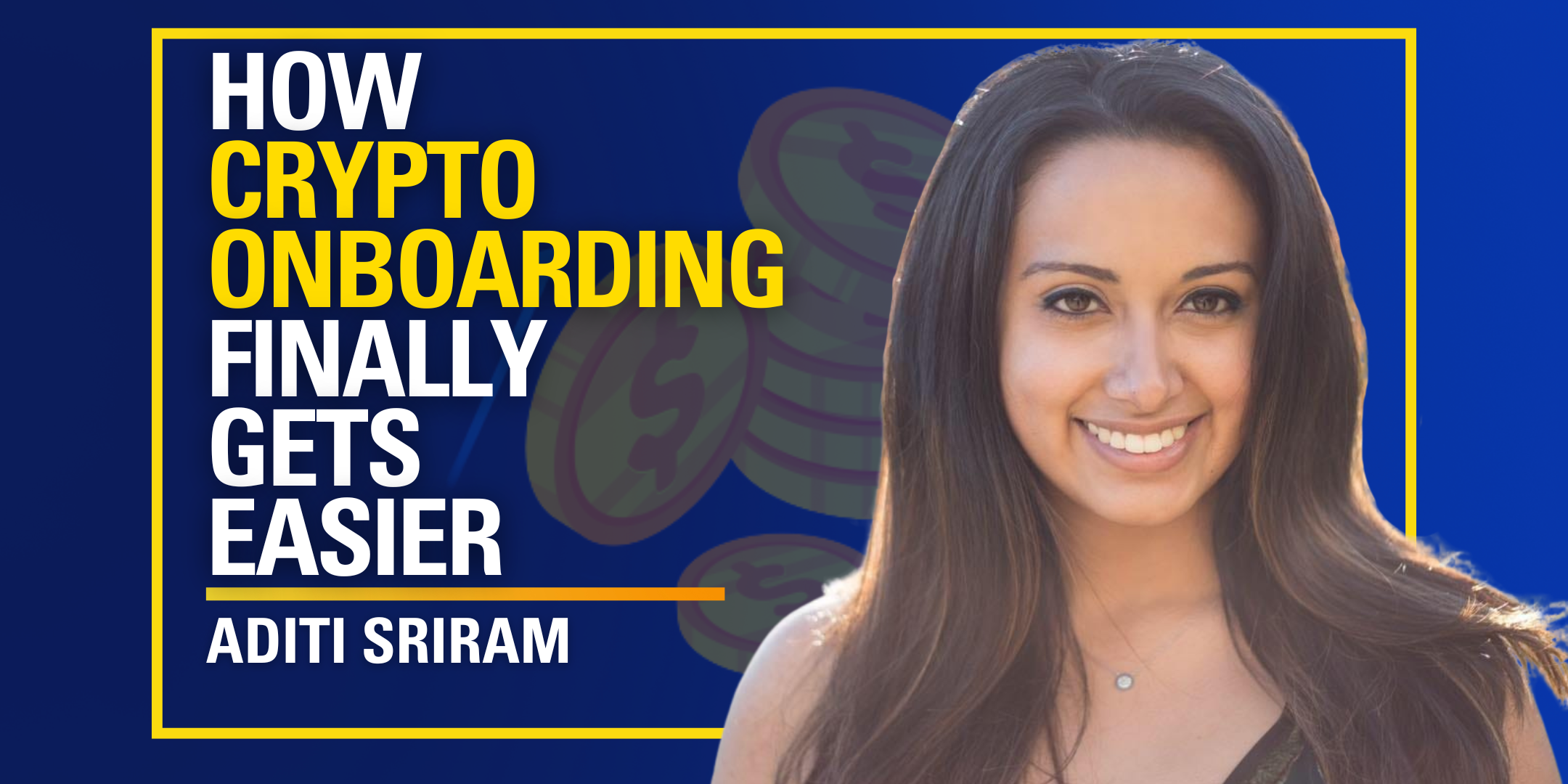
How Crypto Onboarding Finally Gets Easier - Aditi Sriram | ATC #618
On Around The Coin, host Stephen Sargeant welcomes Aditi Sriram, COO of Para, an embedded wallet infrastructure provider powering 15M+ users across 100+ applications. She works at the intersection of fintech, crypto, and consumer platforms, driving platform growth and key partnerships with the likes of MetaMask, Coala Pay and the Ethereum Foundation. Aditi’s role puts her at the frontline of the ongoing shift in financial relationships, driven by wallets, social apps, and internet-native commerce.
Host: Stephen Sargeant
Guest: Aditi Sriram
We are also available via:
Buzzsprout • YouTube • Quora • Medium • X • Facebook • LinkedIn • Soundcloud • Apple Podcast • Spotify • Player FM
Episode Transcript
Stephen: We are in for a treat. We have Aditi from Para, she is the COO. She talks about her previous work at Consensus, being a venture scout at Bain Capital Crypto. She goes all into the modularity of blockchains and wallets. She talks a lot about what Para is revolutionizing when it comes to onboarding the next revolution of crypto users and how to make it easy How to make that embedded onboarding process almost seamless.
We talk a little bit about agentic commerce and we also talk about what it's like to be a COO with some product chops like she is.
This is a fun episode. We love the Para team. We had the founder on, and now we have Aditi. This is gonna be a fun episode. Reach out to me. Let me know how you like it.
Stephen: This is your host, Stephen Sargeant, the Around The Coin podcast. Now, if you've seen the show notes, you probably recognize the company Para. Coming now, we have the COO, Aditi. How are you doing? Tell us a little bit. You had one of the founders on, and we're like, "This is such an interesting project," and we wanted to bring you back and have your company talk a little bit more about what's happened in the last six to seven months.
Maybe give a little background, and then I'm gonna go deep into your, your work experience and all the amazing places you worked at.
Aditi: Amazing. Stephen, thank you so much for having me. Very, very excited to be here, uh, representing Para once again. Um, the context on Para and myself, um, the COO of the company, uh, have been working on this company for four years. Um, started out as a founding team member, uh, so I've been here since the start.
Um, Para is focused on wallet infrastructure, specifically helping companies build on-chain financial products. And so with the onset of Genius, with Clarity hopefully coming soon, um, we have been really working with a lot of Fintechs and payments companies that are bringing money movement on chain. Um, and it's been an exciting kind of last year, um, since then.
So excited to dig into it
Stephen: And you've had some interesting stops, ConsenSys, a little advisory work with TikTok, Edge & Node, and Celestia Labs, and that- that's an interesting one 'cause we had the, uh, the dev, dev re- relationship person on another podcast that we did, Chainalysis. Can you walk us through a little bit about your work journey and how you ended up in crypto?
Aditi: Yeah. Yeah, I ended up in crypto because blockchain was an area of focus in finance and banking in, like, 2015, and it was kind of an adjacent track, uh, in the banking sector, and there was a lot of, like, high-level trends that were coming out of this, like supply chain, like asset management. Of course, nothing was really real and codified.
I ended up seeing Vitalik speak at one of these finance conferences, and I ended up getting just really inspired about what crypto was. That then inspired me to read up, uh, about Ethereum. Uh, I read a yellow paper and, uh, I was in New York, and so ConsenSys was one of the famous companies out in Brooklyn that was actually building things on-chain.
I didn't even know that one could build products on blockchain, or the technology was even really ready for that. And so, um, I ended up getting very lucky and starting my career there, and then, um, since then have worked in a variety of crypto and fintech companies, um, since then.
Stephen: Can you tell me a little bit about, uh, Bain Capital Crypto? You were a venture scout. First of all, for those that don't know, what is a venture scout? 'Cause I think it's one of those words that you think you know. It makes sense, like, hey, scouting is what they do in baseball and sports when they're looking for new talent.
Uh, tell us a little bit, especially you were there 2022 to 2024. I would say that was, like, k- kind of like the, the, the lower end of the last bear market. So what was it like looking for investment opportunities during that time?
Aditi: Yeah, great question. Um, so a lot of my kind of day-to-day work, uh, outside of investing when I did it a little bit was on product and, and GTM. So I tended to see a lot of companies, whether they were adjacent companies that could fit into our existing product stack, um, or companies that were interested in working with Celestia in this case or, or Edge & Node.
Um, I ended up just interfacing with a lot of different projects, and as a function of that, I grew my network a lot. And so, um, coincidentally, before the Celestia opportunity, I was actually getting to know the Bain team as they were starting up their crypto fund. Um, so scouting really is just a way that, um, you kind of have this relationship with a fund where you can kind of find deals that may be interesting, uh, to invest in, and then you're earmarked, uh, some capital from the fund in order to actually invest in those companies.
Um, and so it was, it was a cool experience. I very much love the, the Bain philosophy of, of investing and the sorts of companies that they back. I think even in fi- fintech and, you know, traditional industries, they do a really good job. Um, so I was very familiar with their style and, uh, it just so happened that Bain, uh, led Celestia's Series B.
So, um, was also there at that point, uh, which was a really fun kind of moment of kismet.
Stephen: Before we jump into Para and all the new offerings you have, I wanna talk about wallet infrastructure, wallet-as-a-service as an industry. You know, d-Defense just transitioned from wallet-as-a-service, they're more into, like, digital assets for institutions. They've rebranded. Even see things like 1inch that went from, like, this hardcore DeFi aggregator with, like, dragons and unicorns in their logos, and now it's a very clean monogram logo appealing to this TradFi.
What are your thoughts on this, like, wallet services really trying to appeal and attract TradFi, and why, maybe, are you choosing the other path of really digging deep into, like, crypto-native companies and modularity, et cetera?
Aditi: Yeah. So I think payments have always been the main use case for crypto since the beginning. Um, what happened in 2017, 2018 was that crypto was already being used as a means of exchange, and there was a lot of innovation that happened on top of it in terms of like DeFi and, and NFTs, et cetera. I think the broader trend from those years was composability.
Um, and I think now what we're coming back to is, wait a second, payments are really interesting and can disrupt traditional industries when done in a way that is composable, decentralized, trust minimized, et cetera. So I think the, the properties have come back for why we were so excited about crypto in the beginning.
Um, but I think the applications are now way more serious. Um, and so you, you bring up a good point on, um, some of these wallet companies kind of changing their, their tone in terms of who they're, who they're working towards and, and who they want to work with. And I think that it, it isn't because teams are suddenly getting wiser.
I think it's, it's changing because that's where the money has always been. Um, and I think regulation has just quickened efforts, uh, with, with Genius and, and Clarity. And so the nice thing about Para is we didn't have to reposition too much to notice that change. Um, so we of course still work with crypto native teams, but also do work with Fintechs and institutions.
And, um, I think it comes down to, to two things. Our, uh, security model resonates a lot with that audience. Um, and then you mentioned a little bit on the, the modularity. We're able to kind of position really nicely with a variety of different tools depending on the sort of use case our customers are building.
And so that also helps us flex into use cases like remittances is something that we see a lot. Um, embedded finance is another one. And so, um, it shifts pretty, pretty nicely, uh, given our position in the stack.
Stephen: What are some of those common use cases? You mentioned remittances, you mentioned, you know, embedded wallets, embedded payments. What are some of those use cases, especially since you started till obviously like post Genius, post Clarity discussions?
Aditi: Yeah. Great question. Um, when we started, we still saw payments use cases, like that was still very much our bread and butter. But in terms of the size of company that is-- that we are working with, I think that's dramatically changed given that regulation has doubled down so effectively in the last year.
So, um, remittances is a big, big category for us. So basically being able to move money across borders through stablecoin rails, that's a huge one. Um, we work with a company called... An example of this is we work with a company called KoalaPay. They are managing five billion dollars in humanitarian aid money.
Um, and they move parts of that money to different regions depending on where it's needed. So maybe they're moving ten million of that to, um, Sudan for their hunger program. How do you get that money effectively to those regions where maybe the local banks don't, don't even really talk to each other? Um, so that's a big category for us.
Um, customers will use Para as the wallet infrastructure plus on and off ramps, um, so that money settles in minutes and not days. Um, embedded finance. So this looks like wallets that don't look or feel like crypto, they just look like a balance to a user, and they're dropped into an existing app. So think like Starbucks Rewards.
Um, so being able to display, uh, you know, a, an account, uh, with a balance, but really behind the scenes, it's a stablecoin account, and maybe it's earning yield with Paxos. And the user will never see, um, the wallet. They'll never see, like, what this actually is. They just have an account that happens to run on-chain, and it gives them rewards.
Um, and there's different ways of how, you know, uh, customers will, will use that yield, but that's, uh, that's, uh, a tangent. Um, we also see use cases like payouts and pay-ins, so things like being able to pay contractors and users globally via stablecoin account. Um, treasury and asset management is another one.
And then I think the newest kind of thread that we're seeing, which I, I hesitate to call this like an official use case because it's so nascent, um, agentic commerce. So that's the
Stephen: we're definitely gonna get in-- That's definitely something we're gonna get into, deep into. I'm curious, you know, I felt like you were probably there during this time, it was like, it felt like wallet wars a few years ago. Everyone had a wallet, everyone was, like, vying for customers and users of the wallet.
But now we're seeing, you know, a lot of mergers and acquisitions. We saw Dynamic go under Fireblocks. What do you think, you know, one of the competitive advantages of Pear is when there's so many other wallet-as-an-infrastructure and wallet-as, you know, a service providers?
Aditi: Yeah, great question. There definitely is a lot of bundling happening in this space, which is exciting. Um, our bet has always been on, I think I mentioned this earlier, but security. So the idea that the security model will never compromise is core to how the company was built. So a lot of the team is ex-fintech.
A lot of the team is, has worked building, uh, SOC 2 compliance systems, PCI compliance systems from the grounds up. Um, so that's kind of always been a priority. Um, this also kind of is a through line in our MPC that we use. So we use distributed MPC where private keys are never recombined or shared. Um, this just kind of matches really well with the security posture that fintechs and institutions have.
And so that's kind of one area that we see resonate a lot in the market, and that is different in terms of how we are positioned. Um, the other thing is, you mentioned on the bundling that's happening. Um, one area that we also find resonates a lot in these conversations is our neutrality. So the ability to work with other stacks depending on what our customers need.
So we're not locked into a single on-ramp or a single yield provider. Um, so the example I love to talk about here is, let's say we're working with a customer in Kenya. And, um, yes, we have relationships with MoonPay, but MPesa will always work the best for a customer building a fintech application in Kenya.
And so MoonPay probably works there as well. But having the ability to flex to that is really important and is helping us right now. And so we can work with any of those providers, any provider that our customer deems is necessary for their stack. Um, we can kind of slot in really easily because of this modularity.
And so that's another kind of angle that we've been finding has been working a lot
Stephen: Do you feel like looking at your website, and I probably don't know, I'm probably using your infrastructure at certain places without even knowing, 'cause that's the whole point, I'm assuming, of having, uh, a wallet as a service provider is like you're using it. I feel your UX, your UI, your on- your implementation and onboarding is a lot clea- it feels like what Gen Z-ers...
I'm not a Gen Z-er, but it feels like, hey, it's as easy as us clicking on a transaction and checking out at Amazon. Where I remember five years ago trying to buy, you know, using, no, no offense to MetaMask, but using MetaMask to buy NFTs, and I'm like, "Did the transaction go through? Did it not go through? Did I pay a gas fee?
Did I not pay a gas fee? Why is this transaction stuck? It's just going around in this... It doesn't make sense to me." Do you feel like you've really addressed the problem of cleaning up this UI, UX that crypto's had, the issue that crypto's had for the last, you know, decade and a half?
Aditi: Yeah. I think, honestly, I think we're, we're very much standing on the shoulders of giants in this domain. Um, like the, the advancements that have happened in MPC, the advancements that have happened in, um, just key management in general, I think have led us to be able to innovate and make, make the, the wallet creation be as simple as possible.
And I do think that is a relatively solved problem in the industry today. I think what's not solved is the actual orchestration of like what happens after the wallet is created. Um, the wallet can be created, but one, how easy is it to get funds in that wallet? Depending on where, uh, where, uh, users are and what kind of business this is, I think that's still very tricky.
And you're, you know, you have a compliance lens to this, so I, I'm sure you'll resonate. Um, two, I think there's a question of, you know, how do you enable some of these use cases to be as safe as possible? Um, you know, I think about my, uh, brokerage account. It's actually kind of nice that my brokerage account has auto-deposit from my bank account, and it can, you know, auto-purchase like the ETFs that I like, and it does that every month, and that's it.
Um, that's really great, and that's TradFi, and I don't think we're there yet with crypto, um, and, and on-chain rails. So how do you effectively have the same controls and guardrails that one has in TradFi and bring that to, to on-chain rails? And then three, like how do you make this as easy as possible for the developers?
And I think, I think that's where a lot of this like stackification is happening, um, in this space. But, uh, that's another kind of big priority that I don't think we've, we've solved for. And so, uh, the wallet I feel like is the easiest part, but everything else is, is what needs to come.
Stephen: I'm curious, you know, you wrote this article, I think it was earlier this year, talking about your wallet is your identity in 2026, and you probably don't own it, which is an interesting concept, especially I had Yatzu from Animoca Brands on the t- podcast, and obviously he has Moca Network, talking all about digital identity and digital ownership.
Uh, can you maybe give us your core thesis around, you know, our wallet sharing a lot of information that we're probably not realizing and how important and valuable that information is?
Aditi: Yeah. This ties back to your question on how we're differentiated. So I mentioned security and the MPC that we're using, distributed MPC. Um, one of the benefits of that beyond the, the private key points that I mentioned, is that the same wallet can actually be reused across context. So it can be reused across different applications, it can be reused across different, uh, different like front ends.
Like you can share that wallet in terms of assets and in terms of identity in different places. And so what's nice about that is, you know, we talk to a lot of Fintechs every day, and a lot of them are thinking about consortium models where maybe there's a lot of different merchants and they're all kind of transacting on, uh, uh, a settlement network with s- a certain identity.
Or, you know, there's, there's these models where you do actually have to share an identity in different contexts. Um, and that's really valuable because, one, um, there's... I think this concept of reusable KYC is really interesting, where, you know, you h- I think Cryptoda has done a really good job of talking about anonymity and, and shielded transactions, and I do think privacy has its place in the space.
However, when someone has KYC'd, how can we just allow them to do other things now that they already have been KYC'd and we already have their information and they are, you know, a verified user? I think that's a really important experience to nail. And I think the other kind of, uh, the other kind of angle to this is things like credentials as well come into this, where you should be able to reuse those in different contexts.
And so, um, lucky for us, the, the consortium model use case was built kind of from the beginning in terms of how Apaara was architected, and so we can kind of plug into these really well. But that was always very important to us from the start, because I think we all have this experience of having like, uh, so many credit cards or so many gift cards and like they all don't kind of talk to each other and, and that can get kind of tough.
Um, and so how do you aggregate all of that identity in one place, um, and make it
Stephen: cur- I'm curious with reusable KYC, would it mean just like your KYC is taken in at one place? 'Cause one of the issues in the industry is like, but your KYC is everywhere now. Every time you go to a different exchange, you have to redo the same process. Now your KYC, your identity documentation is in all these different exchanges, all these honeypots, and we all know hackers are really great at getting access to those.
So is the idea of reusable KYC is you do it once in one place, and then you can just confirm to all the other places, all the other exchanges that this person's verified, versus you having to redo that process and submit your ID and KYC to all these different institutions
Aditi: Exactly. You nailed it on the head. Um, so part of our security model is there's also a permissions engine, a policy engine on top of it. So you can just have a policy that grants an application access to that credential where they can see it, know you're valid, know you're verified, and not, you know, have to re-go- re- reintroduce you through that process again.
And so I think you just get into interesting use cases where you have a base identity, and you can just permission off things that are granted to a certain application when it's needed. So I think a lot about, like, in the early days, like, we thought a lot about, like, the, the Google OAuth scope, where it's actually really nice where I can log into Calendly with my Google account and just say like, "Hey, here's my identity.
I am a Google user, but just get read-write access to my calendar." That's it. I'm not giving Google access to my... Or I'm not giving Calendly access to, uh, my Google Photos or any of that information. It's just kind of one-to-one. And so why not bring that same behavior to on-chain accounts? Um, and so that's kind of the future that we're building for, and, and that's also why we're, we're kind of identity maxis at, at Fera as well.
Stephen: And I think that resonates with a lot of people, especially when you don't see that sign in with Google, you're like, "Oh my God, another password that I'm gonna forget. Um, my, my, you know, my passwords app is gonna save it, and then when I go to log in, it's not
Aditi: then my Chrome thing is trying to say...
Stephen: yeah, my Chrome's gonna save it, but it, it doesn't put the username, so now I have a password with no username."
Uh, I'm curious, you talked about, you know, almost like rebuilding the way we look at things like, you know, onboarding and connecting to wallets and making payments. A few weeks ago, you announced Pair 3.0, which was launched where you-- Now you're almost rebuilding the Pair model from the ground up. I wanna talk about that, 'cause obviously it's like you have a really good, solid foundation in your product, and now you're kind of redoing certain elements of it.
Can you walk us through that?
Aditi: Yeah. So a lot of our customer use cases-- Well, now as a function of all the stablecoin, uh, interest from fintechs, our expanding customer base, we're getting customers from different places now, where it's not just US-based. Maybe we're getting customers from Asia, maybe we're getting customers from, um, you know, different, different regions of the world.
And so we're finding that the ways that they are interacting with our technology are really different. So, for example, um, a customer building a fintech in Kenya might actually not like passkeys, which is, which is always crazy for people, you know, in the Western side of the world to hear, 'cause we're like, "What do you mean?
It's so easy. Face ID, whatever, I'm done." No, because a lot of the, the market maybe is using phones that were made in China that don't have passkey support. Um, or they prefer to share wallet information with their families so they can all access an account. And so how do you do that with a passkey? And so we've, we've added a lot of features as a function of our growing customer base, and we wanted to kind of consolidate all of this in a, in a way that makes it really easy for anyone that's now signing up to use Para to go in and get started and have all the information in one place.
And so it was really kind of an effort to, yeah, just, just kind of put everything in one place, given that we are now seeing a lot more volume, and yeah, our... have this really nice kind of product-led growth motion where you can just get started for free without talking to anyone. Um, so that was the impetus of it, and then a lot of the supplementary things that have come from V3 are some of these like orchestration, um, you know, roadmap items that I've mentioned, like our permissions engine and things like that
Stephen: Can you walk me through the day in the life of a CEO during the process of a launch like this? Like, you're op- you're operations officer, you have to make sure that your existing products don't break while you add new ones and rebuild them. Then you have to be rapidly responding to customer feedback or any, you know, any gaps or holes or bugs that happen within the first few weeks.
Walk me through the journey of pre- and post-launch.
Aditi: Yeah, that's a great question.
Stephen: You're like, "I'm still in the journey." I'll let you know when I'm out.
Aditi: prepped for this a little bit. Yeah. Um, hmm. Uh, so I'd say launches are the smallest part of it. As a payments infrastructure company, your launch is now something that other businesses are building on top of. And so we're very, very lucky to have a team of mostly former founders, which is quite interesting.
Um, and everyone is really good at thinking about the really unglamorous problems like migration paths and backwards compatibility and docs and customer comms, and making sure that people that are mid-integration don't have some-- don't wake up to something, like, horribly broken. And my role in that is really just attention allocation to all of these different things.
So launches are great for us, but making sure that we're not destabilizing our entire customer base, which is a net loss every time. Um, and so the, the-- in the early days, a lot of my time was focused on things like customer definition, market definition, early iterations of pricing. Um, now I don't think it's as clean.
Um, the mornings may look like, uh, chatting with a few fintechs about how they're deciding to implement stablecoins. Maybe that looks like looking through, uh, you know, a flow of funds diagram and figuring out what are the fiat rails, what are the crypto rails, where does the wallet sit? Um, so it's a little bit consultative, um, and it looks different per org.
Most, most orgs... Some orgs have a really straightforward idea of what this is. A lot of them don't. Um, and then, you know, the afternoon might look like customer escalations, and the evenings are just pure invoices. Um, so it really depends, and it's all over the place. But I think the, the way that I think about it is just acting as this, like, connective tissue between these different functions in our, in our organization.
But I, I have to say, like, I'm very grateful and lucky to be working with people that already think about a lot of these things, and so it's really just a coordination
Stephen: just thinking about the glamorous things, right? They know the, the nuts and bolts that have to go into it to make it work behind, and that only a founder could know by going through the stresses of building anything
Aditi: Yeah. So a lot of the credit goes to, to the team for being very thorough about that, so that the last kind of Lego blocks are really just the, the end coordination of it all. Um, but yeah, that... I think the, the former founder thing is something that we kind of intentionally looked for when we were initially hiring the team
Stephen: How hard is that? 'Cause then on the flip side, it's like they always have that entrepreneurial energy and spirit, and they're always like one bright idea from just like se- you know, closing up shop and going to start their own thing. How do you balance that like need to build with also like they might just say like, "Oh no, agentic commerce, like I'm gonna jump on this and build my own thing."
How tough is that?
Aditi: We always bake in time. Well, we're-- I think especially with AI, we found that, like, doing the work is very easy and very quick. Like, getting stuff done is, is relatively fast. The, the premium on talent, especially a really talented team like ours, is the space and the bandwidth to generate creative ideas, 'cause that's what AI cannot do.
And so, um, making sure that we have time to do that, where we're actually like, "Actually, we're having a 30-minute meeting, but it's going to be entirely creative, and like we can talk about the to-dos after on Slack." And we trust everybody to execute on the to-dos. And so it's that balance of making sure... And it's been har- I mean, that's, that's a challenge.
But making sure that people have the creative space to, to generate those ideas. Uh, like something that I'm very proud of as part of V3 is, um, Johnny, our head of design, and Taylor, our, our lead product engineer, they, um, in our, in our demo site, you can drop in a website into the, the modal designer, and you'll get a, a bunch of sparkles on the page, and it'll say, "Something paranormal is happening."
And it'll just pull the website's branding and logo and, and website itself, and then just populate it. And it's such a delightful experience to go through with customers, and I don't think, I don't think that kind of stuff happens if you're just always executing on a to-do list
Stephen: And those are the little things, right? Like the little pun, paranormal. Like, there's-- It's just that, those little things that make people like, "Oh, they thought-- They think, they think of all the details that make this an experience," which is really what you're doing, is creating a new experience to take people from Web2 to Web3, but make them feel like they're still experiencing Web2 while getting access to all the benefits of Web3.
And I think that's been the toughest transition for a lot of people, right? That transition usually is met with a lot of fraud, scams, and losing crypto, where you're trying to make it easy. I'm curious, you just talked about f- talking with fintechs and founders and partners. What is the conversation now?
'Cause we went from, you know, stablecoins kinda to, like, stablecoins are here. But now we're already, like, leapfrogging to agentic payments and AI, you know, paying for our vacations and agents doing all these things for us. How are they able to-- How are your partners and customers able to balance, like, we're almost at the point where we can implement stablecoins and the mass adoption's here to people that might wanna jump to the next thing already?
Aditi: Yeah. Um, it breaks down by customer. So some are neobanks that already kind of know their stack. So we work with, uh, there's a company called, um, Decal. Uh, they do, uh, merchant loyalty for, like, brick-and-mortar merchants in San Francisco and New York. And, um, they had a really clear idea of, like, what the stack needed to be.
Like, they were always gonna launch on Solana. They were always going to have embedded wallets. They were always going to work with an on-ramp provider, and they kind of executed on that stack. And I think for neobanks like them, and they've processed, I think something like $5 million already in, in volume, and that's growing.
And so they're, they were very clear at the onset of starting this business of like what the stack needs to look like, and that, that maps really well to other neobanks that we work with. Um, with larger fintechs, this looks a little different. Usually there's, you know, a period of kind of solutioning of like what this can look like.
This is a larger org with more kind of money flowing through the system, who needs to be involved, what, what are the different touch points, are there banking partners that are involved? Um, and then it, it typically kicks off into this like flow of funds style discussion where there is kind of a mapping of like what are the pieces going from fiat into crypto and maybe out, or what is the kind of full end user journey?
And then that's where something like a, like a, like a para will fit in. And so it, it looks really different. There are, of course ... I, I will also say with the, with the, um, bigger companies, there are also people tasked with figuring out agentic commerce, and I think, you know, Visa's done a really good job of launching the Trusted Agent Protocol.
There's X for O2, there's all these different protocols that are being innovated on. Um, but the volume there is, this, I'm sure you're, you know this, but generally smaller. And so, um, more experimental in terms of actual payment volume flowing through those flows.
Stephen: How do you position yourself? Obviously, you have to, you know, make sure you're securing stablecoin transactions and payments for all your existing customers. But how do you position yourself for what eventually is gonna be an AI-driven commerce, you know, phenomenon or world?
Aditi: Yeah. Um, so in terms of, uh, agent protocols, there's a few that have been announced in the past, like nine months. There's Stripe, um, and Tempo's MPP, Coinbase Xfero to Visa Trusted Agent Protocol. Um, I think Google also launched one as well. There's a few others. Um, and I think they do a really good job of addressing how transactions get routed across rails.
Um, what's nice about our system is we're fully modular with any of those protocols, and so we don't currently prescribe to any sort of standard, mainly because we are at a place where these standards are still sort of evolving and growing. And so forcing customers into either one of these standards is, is tough because it might not always meet their needs.
And so currently just kind of modular with all of them, and we find that people use Xfero too a lot, people use MPP a lot, and it kinda just breaks down from there.
Stephen: How do you balance as, you know, someone that's in charge of the operations, you know, shiny ball syndrome, all these new technologies and fables, all the mythos, and we have to get this, and then it's like we put it in and now we have to- they took it out two days later. How do you balance, you know, like your roadmap with still leaving room to experiment and, you know, research and development and explore new ideas or concepts, and then keeping your ear to the street to even know that these things exist?
Uh, how do you balance everything as the COO?
Aditi: Hmm, good question. Um, the balance, I'm very grateful because a lot of my role does involve talking to fintechs and payments companies, and so I get... My ear is on the ground in that way, where I do get signal on what people are using, what their stack is, like, what's resonating and what's not. Um, it's also very important to us as a company to bring in these people that are actually building with these tools into our company process.
And so we've, one interesting thing that we've implemented is, um, we have, like, a customer showcase every Friday in our team meetings where we bring in a customer that's building with Para and maybe has put together their own stack, maybe Aave for yield, maybe Rain for stablecoin cards, and talk about their experience in kind of assembling that.
And that's, that actually brings us closer to reality on, like, what are the, what are the realities of someone that is trying to build a business and maybe has heard of Para and is trying to put this together, um, and, and bring, you know, stablecoins on-chain or, or bring their money movement on-chain. Um, and so that's been an interesting mechanism for us operating.
And then, of course, like, we continue to just hear from the market in terms of what people are using, how they're using it, what use cases they're building in, which is also how agentic commerce even has come up as kind of an area of focus for us because we're just seeing a lot more demand in terms of what people are building in our, in our pipeline.
Stephen: I'm curious, what are some of the risks you see, maybe not even just with the agentic commerce, but overall using stablecoins payments? You know, back in the day, it was always chargebacks with credit cards. What are some of the risk concerns from you, your customers that, you know, for people that are doing this and building and implementing this technology that's, like, top of mind for you?
Aditi: Yeah. One thing that comes to mind is with agentic, with stablecoins in general, um, none of the protocols with agentic finance address who can authorize a transaction in the first place. Um, and that question, in my opinion, lives within the wallet, and I think we don't have the right primitive to answer that question.
Um, and so the hardest thing to answer in crypto right now is to do anything in crypto, you still require a human in the loop, which is tough. So if you think about, um, you're depositing money into a contract, if you're trying to collect yield on that, that might require a human in the loop to actually, like, go and collect the yield, or it might require a human to actually execute a transaction and press a button.
Um, we are not at the point in blockchain today where that those things can happen autonomously in a trusted way. And I think agentic, agentic commerce is, like, even more far off. And so, um, we think of wallets, specifically our role in this world, as w- wallets being about liquidity and provisioning the right access to that liquidity.
And so this is why we've put a lot of emphasis on our permissioning system and making sure that we are able to allow applications to request access to wallets on a very permissioned way. So being able to access even things like, you know, some of my favorite examples are it should be the standard where you have 2FA on a transaction that exceeds a certain limit, or any time you DCA into an asset, maybe require a face ID check on that, or set a spending limit.
Um, and so I think, like, that's kind of where we are building towards, where wallets are great at onboarding and, like, we know we can, like, create a wallet from a Google account now. Like, that's done. But can we get to this, to this point of self-driving finance and, and being able to mirror some of the financial workflows that are happening in Tradfi in a trusted, kind of trusted, safe way?
And I, I... That's kind of how we see Para's role in, in that world, building towards that.
Stephen: I'm curious, like, you know, currently, like I was in Dubai a few years ago, they have this super app, um, Careem, and there's other places around the world, especially Asia, that has a super app. You know, I think a lot of people have been putting it out there that we should have a super wallet that has everything in it because everything is gonna go digital, all of our assets, all of our account balances.
What are your thoughts on this, like, thought about super wallets and, you know, one wallet that rules them all that can do everything from the palm of your hand?
Aditi: I think, I think that's kind of how... Hmm, yeah. I think there is a space for, I think X Money and some of these applications are kind of moving towards that, where, you know, X Money is now, it, it went live in April. There's a metal Visa card that's attached to it. There's something like 6% on, um, balances, and peer-to-peer payments are running on Visa Direct.
Um, and the underlying bank rail, I believe, is Cross River in that context. And so, like that's, that's one version of this, and I think that stands. And, you know, X touches a lot of different users. But I also think there's the other version of it where you do have a need for business workflows that may not always be a one-size-fits-all, where you might actually need to have siphon specific access to something.
Um, one thing that comes to mind here is like our position on KYC, where we actually don't, um, we actually leave it up to the integrating application to decide where to KYC someone. So, um, we have like a, um, like a sports gambling app that, uh, builds with Para, and for them, they set KYC right before you sign up for an account, um, which makes sense.
So right before you enter the app, that's where you're KYC'd. Um, we have Fintechs that we're working with where KYC happens at the point of funding the wallet and not creating the wallet.
Stephen: interesting. You
Aditi: And so
Stephen: you get the user into your ecosystem. They can see some things. They can more importantly, they can see how many other users there are in the, you know, in the marketplace, and then you get KYC when they're actually wanting to do things
Aditi: Right. So I think it looks a little different, and I think, I think that's our posture even in the wallet context where, yes, like there are some use cases where a super app makes a ton of sense. Um, and I think, yeah, you're right in, in terms of like where we see it, we see it a lot in Asia. But I think on the flip, there are still these like business specific use cases where maybe siphoned access or permissioned access is more of what we need for that specific thing that we're trying to do, and I think it's just different per use case.
Stephen: I'm curious, now that people are building with AI and it's so easy to spin up a wallet and to spin up an exchange or a liquidity provider now, even if you don't know how to code, are you seeing any interesting use cases from, like, out of nowhere where you're like, "This could not have happened because the average person couldn't code"?
But now that anyone can code with just words, we're seeing a lot of these random niche areas pop up that might need to use Para services
Aditi: So fun. Great question. Um, one area that we've had to innovate on is we now have a CLI tool. So being able to write from your c-command line, spin up a Para Wallet, interact with our dev portal, sign up for a plan, um, just kind of get started from your CLI. I think since Cloud Code and all the different tools that have come out, we now are finding that, like, people don't necessarily want to interact with a UI and would rather just do everything from their CLI.
And so that's an area that from the tooling perspective, we've seen that we've been really surprised by, where it's just a different kind of primitive that we've seen people build products with. Um, and on the flip, I think from the use case perspective, we see a lot, we see a lot of agentic, um, where it's either, you know, an agent's marketplace, where now agents can autonomously pay for X.402 protected APIs for services, um, or things like issue a stablecoin card for your agent with spending limits and have that agent be, be able to, you know, go interact with these APIs, things like that.
And so again, the, the, the volume on those is still relatively limited, but I think we're seeing that that space is definitely growing in terms of our incoming volume of, of people building with us, and I'm excited to kind of see how that will evolve over time. Um, and yeah, I think I, I have, yeah, a lot of thoughts on X.402, but I, I, yeah, I'm very curious to see how that will evolve.
Stephen: You did write an article about X-402 and some of the things that they had right and some of the things that were still lacking. Do you wanna highlight some of the, the, you know, that spectrum of where X-402 is and some of the things that you think could be improved upon or added to?
Aditi: Yeah. I think with X402, the... I think they got the protocol piece right because they didn't reinvent something new that people had to adopt. I also think the governance that they have on X402 is really interesting because I think there's a foundation in place, there's Google, Cloudflare, a bunch of these different large entities are thinking about the future of X402.
And so I think in terms of how this was created for the industry, they did a fantastic job on it, and I think only Coinbase could have executed something like this. Um, in terms of the act- so I think X402 assumes that a wallet already exists, but in th- I think there's a lot of open questions on how that wallet will be managed and who owns them.
There's been a lot
Stephen: a base wallet exists.
Aditi: Right. Right. And so there's just a lot of different... I think there's a naive assumption that one wallet can just... O- o- one wallet, if you have a wallet that having another wallet in a different place, um, I think there's a naive assumption on how those two wallets are going to interact with each other.
And yeah, whether it's a base wallet or another wallet, there is this, like, growing problem, at least in the crypto native space of, I have so many different wallets I don't even know how to keep track of them. Um, and I have a lot of friends that have spreadsheets for wallets or just, you know, manage all their different wallets on a different computer because that's much easier, and that's not going to be the standard solution for a lot of people.
Um, and so I think that's where my questions come from, is like, how are we dealing with this fragmentation of identities? How are we dealing with the fact that we have $5 here and we have $5 here, and these $5 can never, can never be aggregated unless-
Stephen: for $10
Aditi: Unless I transfer it. Right. It's just, it's ... I think that's tricky.
Um, what I am excited about in, like, the world with Pera permissions is what if I added $100 to a wallet and then permissioned access to different parties for that wallet? So I said, "Okay, let's keep this as a combination for liquidity," and then keep a com- keep a combination of the funds that exist in this wallet for purchasing something, de-seeing something.
Um, and so that way it's a little bit more constrained on what the wallet can actually do. You don't feel like you're giving a, $100 to this wallet in entirety, but you're still kind of provisioning access on a, on a, on a need basis.
Stephen: I'm curious, as a COO, I don't think there's a lot of people I know. I could be wrong, but similar to compliance officers, unless maybe very recently, nobody was like, "I'm gonna grow..." I've never seen a, you know, a movie where they're like, "I'm gonna grow up to be a COO or a compliance officer." How did you get into this role?
Or, uh, and what is, obviously, you talk to probably a lot of COOs, what is some skill sets or skill sets that you might have or characteristics that you might have that make an exceptional entrepreneurial COO for that matter? For anyone that's, like, looking at like, "Hey, I wanna do that. I love product. I love talking to people on the phone and figuring out their problems.
I love, you know, seeing what oppos- operational resilience is like." What are some recommat- recommendations you have for that stuff so that people that are listening to this pod?
Aditi: I think a lot of the-- So I didn't, I didn't expect to fall into this role at all. Um, I think a lot of the skill set has actually come from product roles, where, um, having an understanding for how something is built gives you a lot of empathy in understanding the surrounding operations of how you need to support that thing getting built.
And so being able to, um, th- being able to identify the single most important thing at all times, I think is a product skill set, um, because it comes from when you're building something and you have people using the product, um, you're able to see kind of what is the most broken thing in the system and, like, how do I dedicate my time to fixing that.
And it's very easy to say that's an exercise between priority and frequency. Um, and so I think that's been really helpful, and it's been nice to apply that to a lot of different places in the organization, whether that's like, "Hey, our customers don't understand our pricing," um, or, uh, to something like, "Hey, um, this feature needs to be iterated on because nobody can get it working."
Um, and so it's again, like a lot of unglamorous work that has been sprinkled across the organization, and I think the, the properties of someone that might enjoy this is just being organized and being able to pick that out. Um, the other, I think, experience that helped was, um, anything on the GTM front. I think sharpening skills in terms of speaking to people and networking was a big one.
I think a function of that was, um, you know, New York crypto in 2017 was very small, and a lot of those people are still in crypto today, um, and are, you know, the s- the CEOs of their own companies. And so that was a nice kind of starting point. But, um, that, uh, a lot of that, uh, time in New York was spent going to meetups.
Like, there weren't a lot of people working in blockchain, and so everybody kind of stuck together and was reading papers together and was researching together. And so, um, I think that, like, gave us a really good launching point in terms of network, um, in the crypto native space. So we're very lucky to work with crypto native teams like ENS, like the Ethereum Foundation.
Um, and those relationships have obviously come from that. So a blend of things. I don't know if I directly answered your question, but,
Stephen: No, it's really interesting. Like, move to New York. What, they moved to New York and get in crypto in 2017. Those are, those are the advice we'll give to those that wanna get into SE-...
Aditi: There you go. Yeah
Stephen: for, yeah, like spin back time and rewind time and go to the crypto scene, uh, 10 years ago,
Aditi: But I, but I do feel like, I do feel like a lot of the role, it, it, I... Yeah, you, you don't really, like, kind of study for it. It's really just a culmination of experience, and, and very specific experiences. Like, some lean more legal and compliance, some lean more CEO even. Um, and so I think it looks just a little different per org.
But at our stage, a lot of it is just making sure to know what is the highest priority thing at every point in time. And I, I do think some of that just comes from, like, product chops
Stephen: I love it. B- I know you just launched v- V3. Any other announcements for your roadmap? Like, what are the, what does the next six months look like in 2026 for the Para team?
Aditi: Yeah. We have hardened and productionized our permission system, which is very exciting. Um, we're looking to roll that out with a few payments companies. So teams that are trying to use this permissioning system in these ways we talked about, whether it's like 2FA, um, kind of additional security, or things like automations, enabling that for customers that have real money moving through their systems.
So that's one that I'm very, very excited about. Um, number two is, uh, just generally seeing a, like a, a, a nice set of fintech customers, uh, sign with us that I'm very excited about. So a few of them are going live, which will be cool. Um, and yeah, just continuing to hunker down in San Francisco. We're in the heart of all things AI, um, and so we tend to hear first when there is something about AI payments or AI commerce.
And so, um, keeping an eye on that trend. One thing that I'm really excited about in that space is micro transactions. So, um, just kinda staying tuned and seeing what people are building and staying close to that
Stephen: Just based on some of the pods we had, how does the microtransaction, you know, expense work with stablecoins? 'Cause stablecoins, you pay a premium for stablecoins, which makes sense because of the savings you get when you're doing large value payments, the fact that your funds aren't, you know, h- held for two or three days and you can utilize that capital.
But when you're doing microtransactions or even payments for some of the vendors, how does stablecoins benefit people to the extent that it saves the company money? Or is it just more of an efficiency, removes the friction that they would already receive, and that brings in more customers versus it saving them money from doing it the traditional way?
Aditi: Yeah, it's the efficiency gain, it's the borderlessness, it's the immediate settlement. Um, I-- the, the interesting thing that we've seen with stablecoins is, yeah, like off-ramping a stablecoin, especially like we see this a lot in the remittance use case, where if you're sending money to your grandmother in Mexico, the fee on off-ramping that money into Mexican pesos is so expensive it actually doesn't make sense to, especially sub $1,000, it really doesn't make sense.
And so we, we've seen that supplemented with like additional parts of, of the st-stablecoin stack that's forming. So tack on a stablecoin card to it, where don't make your grandma off-ramp that sub $1,000 amount. Make her just spend from it and just use the stablecoins directly on, on, you know, via a partner like Rain or something.
Um, and so I think it really differs by use case, but from what I've seen in the micro transaction space, yes, it's, it's the efficiency piece.
Stephen: I'm curious, what are some of your nerdy tech friends playing with outside of AI? I know they, they, they
Aditi: Oh, no.
Stephen: You guys can't buy a Mac Mini if your life depended on it there in San Francisco probably. Is there anything else they're pre- Like, I know biohacking is huge, uh, in SF. Is there anything else that people are playing with that are interesting?
Aditi: Yeah. Um, everybody is talking about Midjourney Medical right now. Um, have you heard of this?
Stephen: No, I haven't.
Aditi: Okay. So Midjourney has just announced, um, their new, like, medical line, and they're gonna have scanners that, um, I think detect cancer and a bunch of other, uh, concerns, and they're just gonna be opening up all over the US.
And so, um, it's an interesting change from their original business, but they're a nine-person team, um, and they're, they're bootstrapped. So they can do it, and they can do it well, uh, given their success with, with, um, Midjourney Images. And so, um, that's something that everyone here is talking about. Um, everyone was playing with Fable.
They're no longer playing with Fable now, so that's interesting. Um, yeah, it's, it's a cool time to be building in San Francisco, just given all the attention on AI. I think even, um, I think even some of the money trends are really interesting, where now you can manage your finances out of ChatGPT. They, uh, just announced some, like, money tools, and so it's kind of all coming together.
Robinhood, you can trade stocks from, you know, uh, from these tools, and so it's, it's coming together. It's just a question of how it will kind of piece together
Stephen: I think Coinbase even just released their own AI finance investor. I, I can't remember exactly. I saw the commercial yesterday, but, uh, uh, I'm curious, you have your own website. What are some of the things you're doing? You know, it looks like you do some mashups with music. You have a nice b- you have a nice book club review.
Maybe give us your top book, your favorite song. Like, are you, are you digging Shakira and the new World Cup songs? Like, give us your, your professional DJ opinion as well.
Aditi: Oh gosh, I ... So less DJing, more, um, more Ableton, so more mixing tracks that I like. So I had this habit of when I'd go on trips or when I'd, you know, be with family, and it was, like, a moment that I wanted to remember, I'd record just the, the ambient noise of that scene. Um, and I'd splice it on Ableton, and just make a, make a track for myself.
For no one else. There's no DJing or, or any sort of, like, public playing of this music, but it's just for myself. It's kind of a way to catalog, uh, I guess, fun, fun events in my life. Um, so that's one. Uh, a book I'm enjoying is called The Art of Gathering: How We Meet and Why, um, by Priya Parker. And why I like it is because it's reminded me a lot of company building, where, yes, company building is product vision, um, uh, how we do what we do and why we do it.
But, um, this book kind of goes into the art of contain- of just containers. Like, why do we meet in the way we do? How are we running meetings? Um, are we, are we leaving time to be creative? Are we priming the day with any sort of interaction where we get to know each other on a deeper basis? A- an exercise we, we did recently was think about, like, why, um, why there's pairings on the team that tend to, tend to, like, vibe more on their work.
And we were realizing, like, oh, it's because they, like, catch up every day. And usually, like, they're talking about work, but sometimes, like, they're not, and that's good. And that actually, like, builds, like, social relationships that makes them more efficient because now you're accountable to your friend.
You're not accountable to, like, some random
Stephen: Yeah. And there's that trust issue, and you both want more time to talk about other things than work, so you wanna finish your work faster, more efficiently
Aditi: It's also why we've invested in our, like, HQ here in San Francisco. And, um, yeah, so it's a, it's a book that I have been really enjoying. Um, it's an audiobook. I don't know if I logged it, but it should be in my Goodreads, so maybe it's there.
Stephen: How often do you update that website?
Aditi: It's, that's automatic. So it, it should be automatic, but I think, I think this, uh, the Goodreads is hooked up to my Kindle. So yeah, if the Kindle updated it.
Stephen: I love it. Give me one myth about San Francisco and one fact about San Francisco. For any of the listeners, like, what's one thing you're like, "Eh, that's not really that true," and what's one thing you're like, "Oh, that's really true." Like, people don't really understand how, how true that is.
Aditi: Ooh.
Stephen: you off guard
Aditi: No, no, no. Um, I like it. One myth. Okay. Maybe this was the time that I moved here or the specific set of years that I've lived here, but I think a myth is that San Francisco is, like, always foggy. I don't actually think that's true. Um, I think
Stephen: when I went there. It was
Aditi: I know. Oh.
Stephen: January. That was January, so
Aditi: Yeah, so what I will say is the microcl- the microclimates of each neighborhood really do matter.
So I think one must consider where they are when they're saying, "San Francisco's really foggy." I think it really depends on where you are. Um, two, I think it also depends on the time of day. So there will be days, depending on where you're living in the city, where maybe the morning is really foggy, but then in the afternoon it kind of clears up and there's sun.
So I think that's a myth that San Francisco is always foggy, always rainy all the time. Um, and again, could just be when I moved here, but this is my experience. Um, a... Was it a myth and a, and a
Stephen: truth? Like, what's one thing that people's like, "Say it," and you're like, "Yeah, I heard that and it's real. I didn't realize how true it was until I got here."
Aditi: Yeah. One thing that people say about Silicon Valley is that there's a big, like, giving back culture, and I was, like, kind of unclear on whether that was the case or not. Um, but what I have found living here is that is very true, that you can DM anybody, no matter how senior they are, how important they are, how big they are, um, you can expect a response.
Actually, what I found is, like, the higher you go, the more likely you will get a response. Um, and obviously make sure the ask is clear or make sure whatever your question is is clear, but, um, usually you will get a response, and there is this culture of giving back. And so there's been countless examples of, you know, times like we've been invited to workshops with other companies that are in completely different domains, and, like, we're just trading tips back and forth and, like, doing it over lunch.
Or, um, yeah, there's, there's just... it's... there's just this culture here of if you are serious about building something, that people will, like, go out of their way to help you. Um, and I think that's been really cool to see in the city
Stephen: That is super cool. Where's the best place to find you? X, LinkedIn, where... I've seen some of your LinkedIn articles and blog posts. Really good there. You got your own website, so listen to some tunes there. Where's the best place to find you?
Aditi: Um, these days LinkedIn is actually the best place to find me. Um, Aditi Shriram. Um, Twitter is also good as well. Um, my handle is adeets, A-D-E-E-T-S, underscore 22. Um, I've been struggling with, like, all the algorithm changes that have been happening on X, and so slightly less active there. But, um, those are two good spots.
And then Para, uh, our, our socials are pretty active on LinkedIn and X as well.
Stephen: Awesome. Aditi, thank you so much today for joining the podcast, and we hope to have you guys back again, maybe together in person we'll do something fun. I'm excited
Aditi: that would be amazing. That'd be so fun. Yeah, you gotta let us know next time you're in San Francisco
Stephen: Awesome. Hopefully on a sunny day.
Aditi: Hopefully on a sunny
Stephen: got enough clouds in Canada to last us a lifetime. Thank you so much
Aditi: Sounds good. Thank you.
.png)