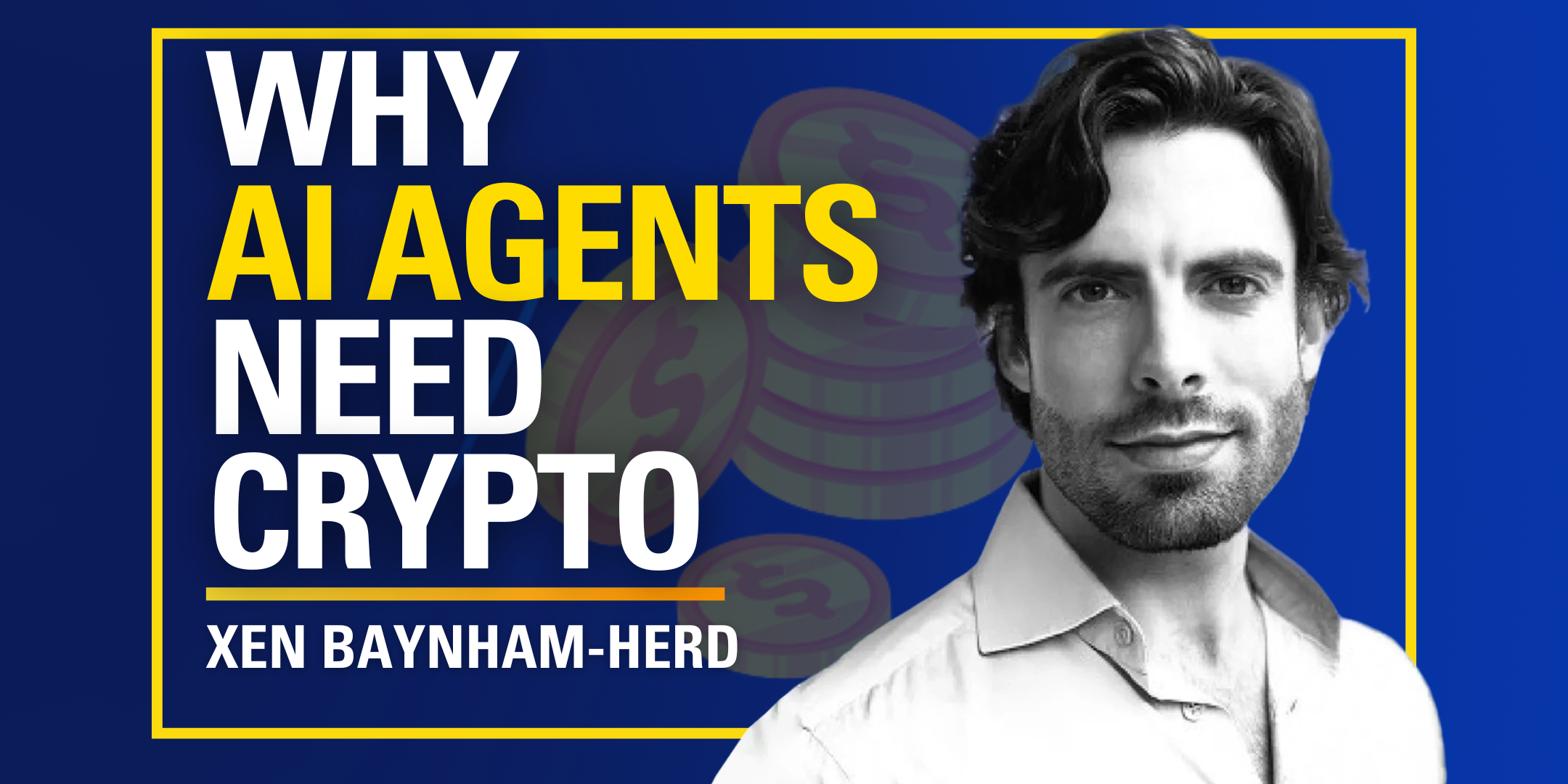
How AI Agents Use Stablecoins - Xen Baynham-Herd | ATC #617
Join our host Stephen Sargeant with Xen Baynham-Herd, Head of Growth and Marketing at Base, where he focuses on growing the chain and supporting a network of builders around the world. Previously, Xen was the co-founder and CEO of Roam, the onchain browser and search engine that was acquired by Coinbase in 2025. Xen has also served as the COO of The Network State, the COO & VP Product at Blockchain.com, and a Director at UBS. He is based in London and holds a Masters Degree in Finance from Durham Business School.
Host: Stephen Sargeant
Guest: Xen Baynham-Herd
We are also available via:
Buzzsprout • YouTube • Quora • Medium • X • Facebook • LinkedIn • Soundcloud • Apple Podcast • Spotify • Player FM
Episode Transcript
Stephen: Let's get Xen At the Around The Coin podcast, or we can just talk to Xen, the head of growth and marketing at Base.Coinbase is Ethereum layer 2 that is building all the best and most progressive apps when it comes to Identic Finance, stablecoins, and everything in between. We talked to Xen about the new products that are just being released by Base, including Base Ledgers and Base MCP
We talk about his previous role working with Balaji at the Network State, and we go on to see what X402 and the rest of the Stablecoin standard ecosystem is gonna mean for agentic payments, and more importantly, agentic finance.
This is gonna be a fun episode talking to Xen, he understands this space better than anybody else when it comes to base, and here you have to listen to this episode.
This is the Around The Coin podcast live with Stephen Sargeant. We have Xen, the head of growth and marketing at Base. Xen, maybe just give us a quick background of how you got to Base, and then we're gonna talk a little bit about some of the projects that you worked on in crypto, as you were very early on, 2017, when you started working at the stable blockchain.com, that we wanna get into as well.
Welcome to the show.
Xen: Thank you for having me. Yeah, really great to be here
Stephen: I'm curious, you started, you know, 2017, the market's hot, everyone's getting into crypto. But you spent five years at blockchain.com, which means that you were there in 2018, which is when I entered the space, and, you know, the momentum kind of died out of the bot- you know, out of the bottom of Bitcoin and blockchain alike.
Can you tell us a little bit, you know, about your time at blockchain.com, what your experience was, and you know, how it evolved from 2017 to 2022, which is when you worked there?
Xen: Yeah, sure. Um, so I actually got into crypto earlier than that, um, around 2015, 2016, whilst I was still a trader at an investment bank. And I was leading a project which was designed to create a, a stablecoin using central bank deposits and, and that project really got me into crypto because it showed me that money could become digital, and if it did, the, the benefits we get from stablecoins and from tokenization.
And so I very much like, um, I guess, came to crypto from an institutional, um, TradFi, uh, um, beginning. And I got into crypto actually, um, through, uh, meeting some people, uh, the likes of like Balaji Srinivasan, uh, who went on to found the Network State, uh, Peter Smith, the CEO of, of Blockchain.com. Uh, I got to know these people, and these people pulled me into crypto, uh, from my, uh, from my investment bank position.
And yeah, so I, I joined Blockchain.com in early 2017, and the, the company at the time was a leading Bitcoin wallet. And what I worked on and what I, uh, felt quite proud of doing with the company was helping to grow the company, uh, over five years to become a full service platform basically for crypto, uh, building up a, a markets and trading desk, uh, launching lots of new products from lending to an exchange, um, to, um, new types of, uh, features in the wallet.
So it was a really exciting time. Volatile as well, of course. Uh, crypto has its ups and downs. There are moments when I thought, "Wow, this could be it. It's all over. It really is over." Like the, the moment when Bitcoin went to sort of 3K, the market completely broke and I was thinking, "Wow, this could, this could be it.
It was fun, um, and that might be it." But-- And so no-nowadays, when we see volatility, as a lot of people who've been around for a while in crypto, it's more of a sort of, "Yeah, we've seen this before." Um, and it's just part of the, part of the journey.
Stephen: As a marketing person, you probably saw, like, how many people tried to buy your domain, buy the domain blockchain.com? I'm assuming you got quite a few requests maybe coming through GoDaddy or other domain brokers.
Xen: Yeah, very much a, a great, a great, uh, domain, uh, very well, uh, established there. That was, uh, a strong move, a very strong move. Similar to bitcoin.com actually, uh, that sort of, uh, um, brilliant, uh, marketing choice of, of name
Stephen: You mentioned Balaji, the network state. That was picking up a lot of traction during the pandemic. Pre-call, pre-recording, you talked about the network state school that's come out in the university. Can you share your experience working there? Especially Balaji's so prolific now in just the entire Twitter sphere and other spaces.
Uh, what did you learn there? Was there any new concepts, you know, of building a company? And what were some of the pitfalls of, you know, maybe the visionary thinking? Was there some things that you can pull from that can help our audience that are also trying to build this huge vision of a network state where we're all connected but live in different jurisdictions?
Xen: Yeah. So the, the Network State was the project I did after Blockchain.com. So, um, I, I joined Balaji when he was writing the, the book, the, The Network State. And I, I joined him because I was frankly interested in the, the social, political, economic aspect of crypto and, and, um, that was really what had interested me initially in, um, in, in, in crypto.
It was what it meant for society, like the different sorts of structures for society you can imagine with, with crypto being the underlying rails, not just for money, but for everything from, um, ownership of property to encryption of defense even, um, public, uh, goods being done through the blockchain governance through the blockchain.
And so, yeah, I joined Balaji. Uh, I, um, spent time in Singapore, uh, working with him, and I focused on helping him look to launch the book, uh, The Network State, um, growing the Network State community around the world. So this was a community which we ran. It was both a online community with, uh, a, a Discord and th-those sorts of things, but it was also very much a physical community, and we had these physical hubs all around the world, and we were doing meetups with people who were interested in building their local version of the, The Network State.
We did the very first Network State conference, which was, uh, for about 100 people in Miami, uh, the very first one. It was just pioneers. It was just the people who were actually building network, uh, societies or, uh, these sorts of new types of, uh, social startup societies we were interested in and, and people who were founding and, and funding these initiatives.
And if you look to where it is now, the, The Network State concept is still very strong. The Network School has been founded, which is a, a place where people go. It's a, it's a real, um, campus, um, just near Sing-Singapore, uh, in, in Malaysia, and it's a incredible place to go. Uh, Base now has a, a builders loft in the, The Network School, and it's basically this, um, almost deserted city in Malaysia.
Um, it was this big city that was planned, has all these like huge, uh, tall buildings like flats and, and skyscrapers, and a lot of it was completely deserted because they, they, they were gonna build the whole thing, and they ended up not building it. And so The Network State project, they basically bought up one of these big buildings and repurposed it to be this campus where founders and creators and builders and developers go to learn about how to build a new society, meet each other, found new companies, grow their companies.
So it's a really fascinating place. It's got a very unique vibe, a very unique a-aesthetic, and it was one of the-- my favorite experiences of, of traveling around Asia last year as part of Base Around The World.
Stephen: I'm curious, was there any companies, concepts, especially now with AI, you know, merging so, uh, a- antiquatedly with blockchain, was there any things that you saw out there you're like, "Oh, this has wheels," or, "This could really make it"?
Xen: Yeah. So, uh, Base actually did a, a demo day at the Network School, um, about a month or two ago. And we did this in partnership with a, a company called Virtuals, a project called Virtuals. And Virtuals is one of Base's leading AI, uh, projects. And Virtuals is, as well as being a AI company, it's also becoming a platform for robots and, uh, and, um, the, the combination of crypto and, and robots.
And we had this robot- robotics demo day where at the Network School in person, we were demoing all of the-- all of these robots. And the, uh, the scenes were incredible, like the videos and the, uh, the shots, just seeing these real robots like compete, uh, for prizes in terms of a hackathon or was, uh, was really amazing.
So I think the, the intersection of crypto, AI, and robotics is really, really interesting. And it does make sense because you can understand why perhaps an agent online might want to use crypto because it needs to go and do something. It might need to borrow money or get funds to go transact or get some data or a skill or access some library.
So it needs to transact, so naturally it would use crypto on crypto rails, internet native money to do that. But also you can imagine a physical robot also does jobs, needs to go buy things, transact. And so again, I would imagine the, the natural place for crypto, um, to, to grow would be AI agents and also robotics as well.
Stephen: That's a huge thing. Uh, I think it's safe to say everyone knows Coinbase as a crypto exchange. Uh, but I think Base might be more familiar with builders in the space and maybe not the average crypto user. Can you share what the core operation of Base is, and why did Coinbase feel they needed to build something in-house with so many L2s to build on top of?
Xen: Sure. So Base is fundamentally a, a blockchain. It's a, a platform for, um, financial markets, uh, for apps, for payments, um, for agents and for builders. And you can think about, uh, Base as being this platform for global finance. The, the reason, um, Base exists is because Coinbase obviously was one of the first crypto companies and now the leading crypto company in the world, but has said very publicly that as finance moves on-chain, we need to move on-chain.
We need to move the, the business on-chain, which basically means moving the activity onto public and open blockchains because those give users better prices, uh, more access, better liquidity, and can enable far, um, far greater global access, um, around the world than, um, companies can. And so I, I think that's really why, why Base was created and, and so it's b- it was done-- it was created a, you know, two years ago, more than two years ago now, and it's grown to be, uh, one of the leading blockchains in the world.
And so I'm very excited to be here to do my part growing Base
Stephen: Can you talk a little bit about maybe what are some of the main use cases you're seeing in Base, or maybe how it's evolved from day one to where we are at maybe day 800?
Xen: Yeah. So really four areas where we're seeing pretty dramatic growth. That is in, in trading, in lending, in payments, and in agents. On the trading side, just generally if you think about the market, we've gone from, say, five years ago or six years ago, 2020, decentralized trading on on-chain venues like Uniswap or Aerodrome didn't really exist.
It was just coming up. It was just becoming, becoming a thing, but the, the volumes were very small, very tiny, and almost all of the activity was done through centralized exchanges. Now fast-forward five years, we're seeing trillions of, of volume being done through these decentralized exchanges. So we've got-- we've gone from zero to one in a matter of years.
And so Base is now one of the leading venues for trading. We have the largest amount of volume for BTC and Ethereum spot trading on on-chain venues, and we're looking to be number one in all assets, uh, both crypto assets and new assets coming onto crypto rails like stocks and commodities and bonds and, and real estate.
So one area is absolutely trading. Another area is lending. Again, five years ago, lending, on-chain lending didn't really exist at all. No one was really, uh, borrowing or lending through open platforms, um, like Morpho or Moonwell or Aave. And it's gone from, again, zero to tens of billions in, in TVL, in total value locked in a matter of years.
And we've seen the same sort of growth with Base. We've gone from, uh, from zero a few years ago, uh, to over three billion in, in total value locked around, uh, just around like lending protocols, like people taking assets like Bitcoin or Ethereum, moving them onto Base, so it's now a token on Base, and then either borrowing against that collateral, so putting up Bitcoin, borrowing USDC, going and doing something with that USDC or depositing USDC into a protocol so that other people can go borrow, um, borrow from that, uh, pool and, and, uh, um, and, and make their assets more productive.
So trading number one, lending number two, uh, number three, payments. I think we've all seen the growth in stablecoins. Um, again, five years ago, stablecoins were pretty minor. Uh, there was Tether, uh, and it was a few billion in market cap. USDC was just being launched. We won- we were wondering, will USDC be a, a big one?
Will it be Paxos? Will it perhaps be, uh... Gemini launched a stablecoin around then as well, sort of 2018 sort of time. Uh, it turned out to be USDC in terms of the leading stablecoin and Base is actually number one in terms of total transfer volume of USDC. We do trillions a, a month in, uh, transfer volume.
That includes trading activity and, and payment activity as well But it's a staggering number. It's a huge number. And it's not just like dollars, it's also, uh, local currency stablecoins. So the pound or the Canadian dollar or the Singapore dollar or, uh, the Nigerian naira, all of these currencies are on Base as well.
And what that means is you can-- it opens up the opportunity to do FX trading on-chain or cross-currency transfers where you can settle into the local currency of choice. And so we're seeing a huge growth in, in payments and demand for stablecoin activity, both from consumers and from enterprise. And we're seeing that growth in the market in general, like just looking at the growth of stablecoins.
We're now at over three hundred billion in, in, uh, stablecoin market cap. But also, uh, on Base specifically, uh, very large growth in, in stablecoins. And then the last one, so we've got trading, lending, payments, and the last one's agents. And agents is a very new area really, in terms of on-chain activity, but growing really fast.
And the reason it's growing so fast and particularly growing so fast on Base is because of the likes of X for Y2, which is the open protocol for internet payments, which was founded by Coinbase. Um, and also because Base has been a home for builders for-- since the beginning of Base. We attract the best builders who go on to build the best products, and obviously the best products at the moment are very much focused around AI and agents, just because that is where, uh, I think every builder has to be an AI builder, uh, as of today.
And we see projects like Venice, which is private AI. We see projects like Banka enabling you to, uh, have an agent that can launch a token and earn from the trading fees. And we see the likes of, um, Virtuals, which, uh, enables all of this, uh, agentic economy to exist. And, and so the reason we're seeing so much growth is, A, I think agents will become a huge force in terms of transaction volume on-chain, and it's already like the case that we see, um, what we've seen over a hundred million in, in transactions on X for Y2.
Uh, but also I think as people want to start using AI interfaces to do stuff on-chain, they'll naturally want to use agents. It makes sense that, uh, in the same way that you might talk now into Claude and say, "Hey, Claude, can you tell me this?" You also want to be able to say, "Hey, Claude, can you go buy me this?"
And the natural way to go do that thing is using an agent that can transact on-chain.
Stephen: Yeah, you mentioned companies like Morpho that might be fairly new to our audience, but you're also, you know, being supported in regards to companies like Visa that has now included Base as part of their settlement program to benefit their partners. Can you talk a little bit when you have like these major, you know, institutions in the financial ecosystem partnering with y- Base?
Xen: Yeah, absolutely. So Base and, and Coinbase are partnering with some of the largest institutions in the world, and the reason is the institutions want to benefit from crypto. They, they now see the benefits in terms of stablecoins. They can see how stablecoins are cheaper and faster and can settle instantly and can clearly unlock a huge amount for their business.
Not only for from internal optimization and internal infrastructure, just being more efficient, faster, cheaper, less capital requirements, but also for their customers who can get, again, cheaper, faster, instantly settled products. And so it's natural that they are looking to adopt crypto, and it's natural that they would come to the leading crypto company, i.e.
Coinbase, uh, and the most trusted crypto blockchain, i.e. Base, to understand what that can be-- what can be unlocked for them, uh, and how their business can, can move on chain. So we're having many conversations with the likes of Visa and many others, helping businesses bring their business on chain and showing them the benefits of doing so
Stephen: I'm curious, you know, nine months ago I saw on your LinkedIn you made like an open call for builders to come build on the Base Network. You're what many will say is a master of networks. You, you were working with Blockchain.com very early. You worked with the Network State. Uh, tell me a little bit about like who and what you want to be built on Base and like who are you encouraging to come into those networks and who consists of the network right now?
Xen: The reason we did that and the reason it's so important is because Base is not only an infrastructure platform, it's not just the, the technology, it's the network of people built upon that as well. And, and that is actually more important ultimately, and that's gonna be the thing that helps Base win ultimately.
It, it's the quality of the, the builders, the quality of the community leaders, the creators, the, um, founders and the, the investors who are working together to, to build startups. And so the reason I made this call, it was simply because we at Base recognized that the, the quality of the builders will define the quality of the chain and the quality of the products and the su- ultimate success of the chain.
And we wanted to attract the very best builders to come build on Base. Um, and we've been doing that. We've been doing a huge amount for builders, and it's amazing to see the, the quality of the apps being built. For example, we hosted our Base Batches 3 demo day in SF, uh, very recently, and this was the cu- culmination of our accelerator Base Batches where we had 12 top builders and top teams, uh, come, uh, to SF to pitch to a room full of investors, including Brian Armstrong, uh, a- and many other, uh, famous crypto figures.
And it was really amazing to see the, the quality of the teams and the sorts of things which they were building. And it was an example of what happens when you allow builders to come to your chain and to build a business. And I, having also, uh, spent time building a business and, and founding a company, um, on Base, uh, before I came to Base, I understood what the, uh, the challenges are for builders and, and what matters in terms of choosing a, a chain and choosing a network.
And we do our very best to make sure that those needs are met at, at Base
Stephen: And I'm curious, you know, we see so many L2 projects, so many side protocols, you know, you know, requesting developers and builders, and they're giving out grants and tokens. How do you keep projects building on Base? Obviously, you have that central prestige of Coinbase and Base as a network, but with so many people seeing incentives and jumping around from project to project, how do you keep developers wanting to continue to build on Base?
Xen: Well, developers and founders and, and, and builders and that whole group of people who are building businesses, they choose Base because it's the best place for their business, right? The-- it's the best place for their business because it's the best technology, it's the best infrastructure in terms of a product.
It's fast, it's performant, it has high throughput, they can trust it. And so when they're building a, a product for users, they need to make sure that the infrastructure's strong and reliable and it's not gonna fail them when it really matters. So that's number one. Number two, they need to go where the users are.
They want to go and get users, and Coinbase has a lot of users and Base has a lot of users. Now, of course, not all of those users are gonna translate directly into the users of the, the builder, but it's a good place to start. It's a good place to go somewhere where there are users, there are successful project-- uh, products, there are people who are bridged to Base, they're already doing stuff.
It's a smaller step to go from there to a, to a new product and, um, and that's another huge reason why, why people come, come to Base is to, uh, benefit from the, uh, the product, i.e. the technology, but benefit also from the users on Base. And then thirdly, benefit from the liquidity on Base. A lot of the product-- uh, projects being built are financial, and so they need liquidity.
They need to have peop- people come in, make markets, uh, provide, um liquidity into pools, and so they go where the money is. The money is on Base, and so that money can move quickly into their protocol or into their product and that's incredibly important when you're bootstrapping a, a new financial market.
And then finally, they also go where other strong builders are. They want to build alongside the very best builders. They want to attract talent. Like being a founder, a huge part of the job is attracting the best people. And so you need to, you need to go where those people are, uh, and find them. Go, go find them in the forums and go into the chat groups and go to the meetups to find these people.
And so coming to a community of builders at Base is a big reason why founders choose Base. And then I guess the last thing is, uh, capital. You need to be able to raise capital as a, as a founder in general. Like some founders obviously can bootstrap, but a lot of them need to go out and raise VC at some point.
And they want to come to Base because there are loads of funding opportunities at Base. There are some of the best crypto investors at Base. There's obviously Coinbase Ventures. There's the Base Ecosystem Fund, which is a VC fund targeting purely Base and Base-aligned projects. And we have Base Backers, which is our, our in-house accelerator for the very best projects.
Plus all of the developer documentation, all of the support, all of that work we do, it's a very compelling package to a builder. And now as we as Base are growing our capability in global markets by growing trading, growing lending, growing payments, it makes it a no-brainer in terms of where would you wanna build.
You need to build where the stuff is happening and where the market is. I consider building a chain to be very similar to building a exchange. If you notice, exchanges tend to grow, uh, around one or two or three like top venues, and they get really, really big. You see this across crypto again and again.
Like the very earliest or the best exchange tends to get most of the liquidity. You saw that with Coinbase. You see that with Binance. You saw that with derivatives and BitMEX. We saw that with FTX, um, for a while. Uh, we're seeing that now with, um, on-chain markets like Aerodrome and Uniswap. We're seeing that with, uh, Hyperliquid on the derivative perp side.
And, and blockchains are very similar because blockchains require liquidity to, uh, enable all of these financial applications to happen, and liquidity tend to gravitate to where there's existing liquidity. So there's economies of scale around liquidity. There's network effects around liquidity. And so a chain needs to attract the users, the liquidity and the, uh, traders and the investors into that one place so they can attract more and more and more.
And so it's a case of bootstrapping that early network effect and then compounding it over time. It's the same for a chain as for an exchange
Stephen: I'm curious, you know, you said you built on Base before you were hired to work within the ecosystem. What's something that you would tell a new builder on Base that you learned maybe either the hard way or that it looks different from the outside, but once you start building, what's, you know, maybe some recommendations or a piece of advice you would give to a new builder on Base from your experience as a startup founder?
Xen: Yeah. We built a on-chain browser. So our thesis was crypto was gonna move from being a desktop web-based activity to being something on mobile. This is a few years ago, uh, before a lot of the new crypto apps came out. And we felt like because crypto naturally was on web at the time due to problems around the App Store and regulatory legal restrictions and what apps could actually do with crypto, there was a need to have a mobile browser to access most of this stuff.
And so we built the best mobile browser for crypto. It was called Rome, and we also built the best wallet. It was a highly performant wallet, uh, linked to the browser, and so you could connect to any app very quickly, seamlessly, uh, do your transaction on mobile as well as you could on, on web. It was a great product.
The problem with the product was that the, the market wasn't big enough at the time. The, the market for browsers needs to be tens of millions or hundreds of millions for that to really make sense as a business. And at the time, I'm talking like twenty twenty-two-ish, around that time, twenty twenty-three, there really wasn't enough people using crypto mobile wallets to do stuff to really justify a venture-backed return for a browser.
We weren't at the-- The, the entire industry wasn't hundreds of millions of people. It wasn't even tens of millions of people. It was, uh, tens of thousands of people who were really using crypto for these consumer activities that require a browser. So for us, the, the actual market wasn't big enough at that time.
So timing matters a lot. I, I think were we doing that same product today, we'd be thinking about it in a very different way. And so making-- You could be right, but you might have the wrong timing. That's my, uh, first piece of advice. And the second one is being a founder is very much, uh... It's almost like a science project.
You, you have a theory about the market, uh, like some sort of thing that you think, uh, people will want or a problem that needs to be solved, but you don't know it's true until you go out and build the thing and test it. And most likely the thing you build won't be the thing that works, and it won't be adopted in the way you think.
You have to keep iterating and finding that truth. And so I find that the best founders are the ones who are desperately trying to find that truth about the market, about the users, and then building upon that foundation of truth. If you're not willing to see the truth, you're not willing-- you're not gonna make it as a founder because you're just gonna see your own vision and the thing you want to be true about the market, but you won't accept what the market really is.
You won't accept what people
Stephen: market doesn't... Oh, I'm too early for this market. The, uh, the market's not there yet. They don't understand, right?
Xen: Yeah, exactly. They're telling you something, which is maybe you're wrong or maybe the market isn't there or, or maybe, uh, you're looking in the wrong place. And so, yeah, think about it like a, a science experiment. You're, you're there to discover truth, and if you're the first to dis- discover that truth and keep growing on it, then you'll probably do really well
Stephen: You know, you sit at a unique spot, probably one, maybe one of the better jobs if you're in marketing in crypto, where you get to head marketing, but also you're in charge of global expansion, uh, for Base, which is like being ch- in charge of global expansion for Coke Cola, where everyone knows it's in every country.
How do you plan, like, what's your in- you know, you're such an internationally recognized brand, what's your, what's your approach to building out more expansion? Are there certain regions you have your eye on where maybe Base isn't as well known as some local players? Like, what are your thoughts about building out Base, and can you borrow some of the things you've learned from people like Balaji in building the network state that you can leverage here in this position?
Xen: Yeah, absolutely. So really important to understand is every market is different. You can't apply the same logic to Latin America as you can to India or Africa or Europe. You have to think about each one as a different market, and you need to have people on the ground in those markets. They need to be doing the work.
You can't assume that you know what that market is like. And so you have to hire great people who have local experience and are physically there and able to really, like, live and breathe the market and understand what's needed and how to localize your message to that market. You also need to operate at a very high level in a very scalable way, uh, from, in terms of, um, the way that you manage your marketing, your brand, your operations.
You have to be extremely organized to enable yourself to scale that across, across the world. And so the-- it, it's really, um The way to think about this is there's an, um, a operating model called decentralized command. Um, it- it's used in, like, military leadership and, uh, it- it's basically a way of how do you enable people on the ground to operate very effectively, but within, uh, the overall strategy of the organization.
And so what this is about is, is about giving people the space and the trust to go execute on a strategy without getting in the way, without having red tape, without, uh, micromanaging them, but also giving them the information, the, the context, and the resourcing needed to go execute and complete that mission.
And a lot of it r- requires, one, a lot of trust between the person on the ground or the person managing or, or leading the overall operation. It requires a lot of sharing of context and information so that the person on the ground to make-- can make the right decision knowing the full context of why they're doing this and the purpose of the, um, of the, of the mission in terms of how it fits into the wider picture.
And so doing that at scale can be challenging because you're trying to get this message across the entire world, across different cultures and different ways, often remotely as well, not physically, but through Slack and through video calls and, and such like. And so it r- requires, like, very clear communication, very good written communication, and, uh, this, um, this, um, way of like giving instructions in a brief and then listening back to seeing did they understand that brief, and they debrief you the other way and say, "Is this the, the, the mission?
Here's how I would change the mission given what I know about what's happening on the ground." You then trust that, let them execute, and then give them a goal which they can achieve, but don't give them the exact recipe of how to go do that. You say, "The goal should be that. You figure out how to achieve that.
Here's the information, here's the context, here's the resourcing. Uh, go do that thing." Now, to make that work, you have to have incredible people, uh, operating on, on the ground, um, doing those missions. And what I found to be the best sort of person is often a founder, someone who's already just got that knack of being able to start a company, being able to start something from nothing, and just going out there and making it work.
Those are the sorts of people who tend to do very well in this decentralized command environment, because essentially they are the founder of that thing in the country, and they need to go make it happen. And so, yeah, that, that's really, um, the, the operating principle of how to... or at least how I think about growing things at scale globally.
And, uh, yeah, a lot of that came from my experience at the, the Network State. A lot of it came from just Experience like, uh, leading quite large companies and large teams, uh, and also reading a lot. There's lots of great books out there, um, about, um, these sorts of things. Like, a lot of the early, uh, history books and, um, and biographies of military leaders have a lot of these concepts in.
Uh, for example, Napoleon was famous for being very clear and, and, and brief in his written commands because the moment it gets across the battlefield and the, the, the fog of war comes on and it's very hard to really understand what's going on, and so being very concise and clear is important. And so yeah, lots of sources, lots of, um, places I've collected information, and I'm very much still learning myself.
And so, um, this is my best shot so far, but I'm sure if you were to ask me this in a few years, I'd have a very different thing to say and perhaps some more learnings about what's worked and where I've, uh, learned lessons myself
Stephen: You know, it's very interesting that you say that. We spoke to the CEO of YAP Global, Otto Jacobson, when we were at ECC this year in Cannes, and he was saying the same thing about media, the regionalization and the local context of media, and how important that is to grow a global media brand, which is what they're doing.
So it's so interesting that you have to go deeper, you know, in different regions in order to get that international leverage and that international approach to grow your brand. I'm curious, you know, Base rolled out two new products, one being BaseLedgers and the other Base M-MCP. I really wanna talk about BaseLedgers.
I'm a compliance professional by nature. It's so important around things like private transactions. This is obviously essential for, like, enterprise transactions. You can't know if, you know, Elon sends 2,000 Bitcoin somewhere, that's gonna shift the market. Every time MicroStrategy, you know, buys up Bitcoin, it shifts the market a little.
How does BaseLedgers support most common enterprise use cases, uh, for privacy, including things like cross-border remittances and maybe even things like B2B payments and settlement that you talked about before?
Xen: Sure. So we announced Base Ledgers at the Coinbase H1 product showcase this week, and Base Ledgers enable private transactions for enterprises on Base. And privacy is obviously incredibly important, uh, for, uh, for crypto in general, and on Base there are already some great projects doing privacy for consumers and what I might call sovereign privacy, i.e.
privacy from everyone. And these projects are the likes of Veil, uh, and, and Horizon and, and others who are doing this in a great way on Base already. The problem that we look to solve as Base and Coinbase was to help enterprises come on chain. And what we heard and we-- what we keep hear- hearing and probably what you hear as well given your background is companies do wanna come on chain.
They do wanna do payments using crypto, but they don't want to show everybody what they're doing the entire time, which makes sense. It's weird to have your payroll, uh, be public. It's bad if your competitors can see everything you're doing. You might have many reasons why you don't want all the payments to be, to be public.
In fact, obviously today most payments are private and there's lots of good reasons for that. And so our goal with Base Ledgers was to meet enterprises and businesses where they are. We said simply, "Okay, if, uh, if the transactions were private, would you come on chain?" And a lot of them said, "Actually, yeah, that's the, the main issue we have."
And so, uh, we designed it in that way. And Base Ledgers essentially is a way that a company can deposit funds into a ledger in a way that is shielded, so you can't see the funds coming in or out. Uh, and once it's in the ledger, they can move money around seamlessly, uh, however they need for whatever internal services or, or payment, uh, requirements they have, uh, completely privately.
Um, but importantly, it's visible to the regulator and it's visible to auditors. And so it's, it's shielded from the general public, uh, and the, the general people looking at block explorers, but it's visible to the people who need to see it. And that-
Stephen: is the balance that we've been looking for over the last decade. I know as a compliance professional it's like, "Hey, we respect the right to be private, but y- we also respect the right that there needs to be compliance as well."
Xen: Absolutely. Yeah. And so we, we see privacy as being this incredibly important missing piece, uh, within crypto, not just for payments, but obviously for, for trading, uh, for financial markets more broadly. And so BaseLedger's is immediately we're focused mainly on payment use cases, but we can also apply it to, uh, financial markets as well.
You can imagine a, uh, you know, professional market making firm or a professional trading firm, a hedge fund not wanting all their transactions to be public. Um, you can imagine a, a brokerage or a bank, uh, needing the same thing. So yeah, that's a very, um, a very exciting, uh, product we've just rolled out and, um, solving a real problem for businesses.
Stephen: Have you seen a real shift in crypto when it comes to privacy? You know, there's so many pr- you know, privacy-focused networks. We have Canton now. We have, you know, FHE with Zama. Privacy coins like Zcash and Monero saw a boost at the end of last year. We're even seeing Aleo's coming out with their own privacy stablecoin.
Maybe can you describe how you're similar or maybe different than some of the other products that you see in the market when it comes to privacy?
Xen: Yeah. Um, so we're very much targeting enterprise and it's an enterprise solution. Uh, we're not, um, we're not the same as Zcash, for example, or, or Monero. And that's important also in terms of our relationship with regulators, um, and, um, and, and needing to be, um, within the, um, yeah, the-- within compliant, um, requirements for, um, for regulators and as part of a public company like Coinbase, it's important that, um, our solution meets those requirements.
So ours is very much targeting enterprises and, and the need for them to have privacy. But yeah, it's not surprising that we're seeing so many solutions pop up because it's so important. And until we solve privacy at scale, we're not gonna see the mass adoption that we want
Stephen: You know, you have that startup founder kinda attitude and charisma. How difficult is it to work for Base that's run by Coinbase, which is a public company, when it comes to things like marketing? I'm always curious. It's so hard to maybe go outside the box when it comes to marketing when you're dealing with, you know, shareholders and boards.
Uh, how have you approached this, you know, being a founder yourself, uh, and maybe how Brian's kind of approached the marketing standpoint when it comes to Base as well?
Xen: Yeah. Well, the good thing about it is, um, a lot of people within Coinbase are founders or former founders or go on to be founders. And so there's very much a, a founder startup mentality within Coinbase. Coinbase obviously, obviously started off as a startup, um, and Brian has that, uh, startup mentality and so does Jesse, uh, the, uh, uh, the leader of Base.
And so the people that I, um, I, I take my orders from and work with, uh, have the same mentality, which makes it a, a lot easier. And many of my colleagues are the same. Um, a lot of the Base team, uh, are founders previously or, uh, or, or might go on to be founders and, and start companies. So that makes it easier.
The other thing is a lot of the marketing we've done has been targeting founders, and so being a founder helps because you know what they need and you know what they, uh, listen to and you know, uh, how to reach them. And so from the, the builder go-to-market, having that background helps. Um, and then I think in a way, I mean, crypto is so early really when-- um, in-- if you look at the scale of things, it's only-- we've, you know, barely scratched the surface in terms of like where crypto can go.
So the whole thing is a startup really. And, and Base very much is a, a startup when you think about it. It's only been around a few years. Uh, we're early in terms of our growth. We're growing very rapidly, but we need to act like a startup. We need to move quickly. We need to be willing to, to change. Uh, we need to be listening to what the market is saying.
We need to be adapting, and we need to be shipping really, really fast to stay ahead. And so all of those things, uh, mean that working within that environment is, is very fu-fulfilling for someone with that sort of attitude and, and mindset
Stephen: I'm curious, you know, obviously Base MCP's huge. It feels like that-- It already seems like a staple in the agentic world. I remember after I talked to Yatsu at Animoca Brands, I set up my own agent at, at Animoca Mind, and it already came with a Base crypto address, I believe. So maybe, you know, what is the big bet that Base is making when it comes to agentic AI and, and payments?
Xen: Sure. So Base MCP, um, is basically your, your gateway to Base and what it does, it enables you to connect any chat interface like ChatGPT, g-uh, GTP-- GPT or, uh, Cursor or Claude to a wallet, to your, uh, Base app. And so what you can do is you can just chat to your agent and say, you know, "Tell me about the crypto market," or, "Tell me what's going on in general."
But then you can start talking about your positions and the things that you have in your wallet and say, "Yep, I've got this, I've got that." And then you can say, "Hey, can you go interact with DeFi and do something for me?" And the, the cool thing about it is Base MCP has all these plug-ins, these skills linked to all of the top protocols and apps on Base so that you can use your agent to go borrow something, to go lend something, to use a, a perp DEX, to go trade on an exchange.
You can do all of these things just from your chat interface. And we've also got security built in and so what happens is you can imagine having certain, uh, guardrails around transactions and spend limits, but at the moment the main thing is you just get a pop-up on your phone saying, "Do you wanna approve this transaction that your agent has just lined up for you?"
You say, "Yep," and the agent goes and does that thing. And so I think just as we gravitate from the web browser being the main way that we interact and the main, main way that we do stuff, now that we are moving on to obviously mobile, but really agents and just talking to, um, to a phone and to a interface, it makes sense that not only do you want your agent to go tell you stuff and give you information, but you also want your agent to transact and actually do stuff.
You want it to go book that ticket, buy that thing, um, trade that asset, and Base MCP enables all of that-
Stephen: Are you surprised that they're-- especially 'cause stablecoins is gonna be at the center and maybe the natural winner when it comes to agentic payments. Are you surprised that with all the marketing chops a lot of the people in the crypto space has, that there just hasn't been a better or well-marketed stablecoin that says, "Hey, we are only for agentic payments," and that there's still kind of this void in the industry where we're using some of the legacy stablecoin providers to facilitate some of these payments?
Xen: Yeah, I mean, I, I think there's a big element of economies of scale here. And so USDC is clearly, uh, the, the winner in terms of a regulated stablecoin. And it makes sense that you want to use the one that most people are using. And so it, it's natural to u- to use USDC. It's simply the biggest, it's got trust, uh, and it's got the, the most adoption from, from regulated entities, and it does what it needs.
So there's no-- I don't think there's a need for another stablecoin to, uh, to fill the void of USDC. I do think there's other types of stablecoins which are needed, and that's everything from more local currency stablecoins and stablecoins which might have different, um, characteristics built in. You can imagine a stablecoin that is actually a bank deposit and it pays you, uh, an interest, uh, just baked into the protocol just for holding it.
Not just like-- Not as in paid into you separately, but just natively into the chain, that could be something. Um, and that rate might be different depending on what bank issues it. So maybe some banks pay higher interest rate, and so you hold that coin versus another one. You can imagine tons of things like that.
Uh, you can imagine stocks also, once they come on chain, having an interest rate built into them and maybe you prefer to transact in a stock because of some reward or some other reason. So I think we'll see a, uh, a whole load of other types of assets come on chain that people will, will start using for, for transactions as well as USDC.
Stephen: Where does, you know, you mentioned X.402, where does that fit into this whole standard and the, you know, and what issues would we have had if this standard wasn't created when it comes to agentic payment scaling?
Xen: Sure. So X for O2 is a protocol built for internet payments, and it was founded by Coinbase. It's now a, a decentralized organization, um, and it's backed by the likes of AWS, uh, Cloudflare, uh, Google, uh, Stripe and, and many others along with Coinbase. And it's important because it enables, uh, transactions to happen natively on the internet.
And without that, there really wouldn't have been a way for agents to go transact autonomously. Um, that, that someone, someone would have to be there like pressing buttons, uh, and approving transactions. Uh, they might have to start figuring out how to use credit cards or, uh, bank transfers. And it's, it, it's very much an enabler of, uh, of agentic commerce, uh, and absolutely fundamental to why agentic commerce has taken off, uh, and why it's happened on Base and why Coinbase has been at the center of, of this activity.
Stephen: And I'm curious, you know, what do you think the biggest hurdle's gonna be f- when it comes to agentic payments? You said, you know, a lot of people use, uh, like, "We're gonna use agentic payments or agentic AI to purchase my next vacation." But where do you think the hurdles and challenges will be? Will it be around government regulations?
We saw a lot of that with, you know, Polymarket, and when it comes to prediction markets, how quickly that exploded and how quickly the regulators reacted. Is it gonna be, you know, things like risks of fraud or agentic account takeover? Uh, or is it the paradigm shift that, you know, people you know, the same th- reason why we didn't wanna just put our credit cards into the internet, they're, you know, do people feel safe, you know, letting agents transact using their own money?
Xen: I think it's m- all of those things most likely will be a factor. I mean, yeah, we didn't wanna put our credit cards in, but then suddenly everyone did, and became very normal to just type in your credit card into a browser, um, without really much thought for where that
Stephen: Now we'd probably do a little too much without much thought. It, it might be the
Xen: Exactly. Uh, but you have all the same problems, um, around, um, abuse and fraud and, and type, uh, like attack vectors around that. And so the, the solutions that win will be the ones that provide the security, the reliability, the trust that consumers, uh, can feel comfortable with when transacting. In the same way that Coinbase earned the trust of consumers to be a, a safe place to leave crypto, a safe place to, to manage your portfolio.
I think consumers are gonna wanna work with agents and interfaces and wallets which they trust, um, and in the same way that they trust a bank, um, and trust a, a card issuer. And yeah, we have to deal with all of the, uh, potential issues that might crop up when you have a new technology and a new payment and financial technology.
But certainly nothing more than we've had to deal with, with crypto in general. And so I'm very, I'm very bullish about the, the future for agentic payments, and I think it solves real problems, and you can see how people would use this in their every-everyday life. You can imagine your family like just talking into a phone saying, "Can you go do this thing?
Can you buy this for me?" Uh, you can imagine being quite useful potentially for maybe elderly people who, um, maybe find it hard to use credit cards. I know my, my grandmother finds it hard to use a cr- a credit card. If she was able to talk into a phone, that might be easier. Obviously, there's security and all that stuff again, but, um, I, I think, I think crypto does enable this, and I think agentic commerce is gonna be a big growth area for, for crypto
Stephen: I'm curious, you know, in September of last year, it seemed like Base was hinting at potentially at least exploring a network token. Where were-- are you standing on that today? Is it part of the roadmap? Is it-- are you focused more maybe on the agentic payments than a network token? Can you talk a little bit about that?
Xen: Yep. Um, so we announced we are exploring a network token, uh, back in September. The only update I can tell you is we are still exploring, uh, a network token. Um, I haven't got anything more for you, uh, than that, um, on the, on the token side. Uh, but we'll definitely keep the community in the loop, uh, and let people know how that's progressing.
Stephen: You know, we had a conversation with Itai Turban and Tal Zaken from Fireblocks discussing their agentic finance and stablecoin report. They highlighted a lot of trends in the agentic space, including things like the agentic AI compliance teams. Uh, now that you're releasing your MCP, what are some of the trends you notice in the industry now that you probably have your ear a little closer to the street than you did previously?
Xen: Sure. So another thing we released is something called Agentic.market. Um, so it's a website, Agentic.market. And you can go there, and it's basically a, a two-sided marketplace where service providers, and so what I, but what, what I mean by that is companies who want to enable their services to be accessed by agents via the X for O2 payment protocol can, can list their services on the website, and agents can then go and, and buy things from these services.
And so what we're seeing is agents and the, the buildup of agents are using services and paying using X for O2 to go do stuff with that, uh, with those services. Uh, a big use case we've seen is coding, and so people have agents which are doing coding. They-- the agents need to access data or inference or other things to complete those tasks.
So that's a, a very natural use case we're seeing. We're also seeing, uh, agents be able to pay per API call, which can be much more efficient than having a, a subscription, uh, to, to a vendor. And so we're seeing lots of these like smaller, uh, use cases emerge, but very much, uh, focused around, uh, coding, uh, and building, um, building apps, uh, through agents.
We're also seeing agents issue tokens, which is quite interesting. Um, so platforms like Banker enable this. You can imagine, um, this becoming quite a big, uh, revenue driver for a, uh, an agent, and it certainly has so far, where an agent can issue a token. That token trades, it earns fees based on the trading volume.
Um, those fees then go back into the agent and can fund operations to go do something. And so the, the token is an interesting revenue model for, for the agent. Um, and I think we'll see many mo- many more use cases pop up as, as this technology matures.
Stephen: Are you seeing any more traditional service providers enter that marketplace? Like, hey, if I'm a flower shop and I know people just kinda like don't really care about which flower shop, I can accept tokens from an agent or even a travel agency, 'cause since we see the agentic AI payment always reference that as one of their, you know, uh, one of their prime examples of agents use cases.
Are you seeing any other service providers pop up on that marketplace that are interesting to you?
Xen: I think the, the majority are, I would say, like tech-forward companies, uh, which is natural, uh, because they tend to be earlier adopters. Um, and also, uh, like payment-related, uh, fintech-type, type companies, data companies, uh, internet native companies. I think we'll see a lot more like consumer companies and like you mentioned, the flower example.
We're not seeing tons of that right now because people aren't buying flowers with agents in general. Uh, but I, I think we're just seeing the very start of this. I, I think this will become very normal. I think most internet shops will have a option which is like enable, enabling agents to buy from them, uh, in the not too distant future, in the same way that they add like Apple Pay or Google Pay, uh, or PayPal.
I think it would just be another way that people can buy stuff
Stephen: What do you think the future of this space lies? Like, we just had recently Anthropic released models. I think it was Fables. They released it. Three days later, people were getting dwarfed from that model if they entered in the wrong prompt, and then they took it off the market due to regulatory concerns or supervisory concerns or how powerful it was.
But people are trying to run their whole business using these AI, you know, agentic, um, agents, and now it's like one of those things where if you run your business, you're almost at the mercy of a lot of these LLMs. What are your thoughts on, you know, this evolving and nascent space?
Xen: I mean, it's moving so quickly. Um, it's, it's something which any opinion becomes quite outdated. Even by the time this podcast goes live, I can imagine, uh, new stuff has happened and whatever. Uh, now Fable's back or it's not back or, or whatever. I think it's just incredibly interesting, uh, to be, uh, around right now building and, and in the game when all of this stuff is happening.
I think it's clear that AI is becoming a national security issue, and it's very important for governments to, uh, feel like they have some control over what's being built. Um, and, and you can see that a-across the world. Um, I think there's obviously intense competition between the models, which is great for us, uh, as users.
We-we've got incredible tools, and it's only getting better. It's, um, never gonna be as bad as it is, as bad as it is right now, and right now it's pretty great. And so I'm just really optimistic in terms of what this means for building, what it means for society. I think it's incredibly interesting to, yeah, be around right now seeing what's happening.
I don't know what's gonna happen with Anthropic specifically. Uh, but yeah, there's some risk if, if that was the main model that you, you were using and now you can't, there's a problem. But I mean, the other, the other models are pretty good too. Um, and, and so, um, I don't think it's been a real problem for many people.
It was only a-available for like a day or so.
Stephen: You're head of marketing. We're having this conversation June 18th, 2027. What does success look like if I'm talking to future Xen and the future of what bases? What would success look like over the next 365 days for you?
Xen: For Base, we want to be the number one chain, um, uh, across all the metrics which matter from trading volume to total value locked, to users, to number of transactions. That's our goal and I hope we've made, uh, steady progress towards that. Hopefully number one for a number of-- in a number of areas. Um, and, and so that's very much on the, on the Base side where we want to be.
We also want to be helping people come on chain and making a difference by making financial services more global, more accessible, cheaper and faster for users and for businesses. And so if we've done that by improving the chain performance and helping builders build incredible apps on top of Base, I feel like we've done a great job and that's what makes me want to come to work every morning.
It's that ability to have some impact on the future of finance, uh, and the way that, uh, money and, and value and, um, and financial technology will work in the future
Stephen: Last question, selfishly. You know, I've seen a lot of friends, peers, coworkers, they started their own business similar to me, entrepreneur, but then I've seen them go back into, you know, large companies, well-known companies like OpenAI, you know, B- you with something like Base. What's that transition like? Is it hard for an entrepreneur?
Is it better because now you're being, you know, exposed to a lot more, you know, how Brian Armstrong thinks, and obviously you come from the experience of working with people like Balaji. So I'm curious, like, what's it like being an entrepreneur working in, you know, Base that's owned by a public company like Coinbase, uh, and how easy or hard is it?
Like, as you said, there's been a lot of founders that also work there. I'm just wondering what your experience has been like, especially, you know, you're head of marketing, you could probably flip on the switch of an entrepreneur and go start your own thing again and have all that, you know, knowledge and power of how to market your services or products.
Xen: I think it depends on the founder, um, the person and the, the company. As I said before, Coinbase is a very founder-forward, startup-y type company, and so it, it fits, um, it, it fits people who have that sort of mentality. There's a lot to learn from being in a large company. There's a lot from-- to learn from working with some incredible people.
Stephen: Xen, thank you so much. I found a lot of great posts from you on, uh, on LinkedIn where you love doing videos, which is awesome. As a content creator, I love seeing people doing really great videos. And I suggest people go check out Base, check out the marketplace, which is very interesting, especially if they're a builder in the space. That's a really cool thing to make sure you're ahead of the curve when it comes to agentic integration, especially with X402 Thank you!
.png)