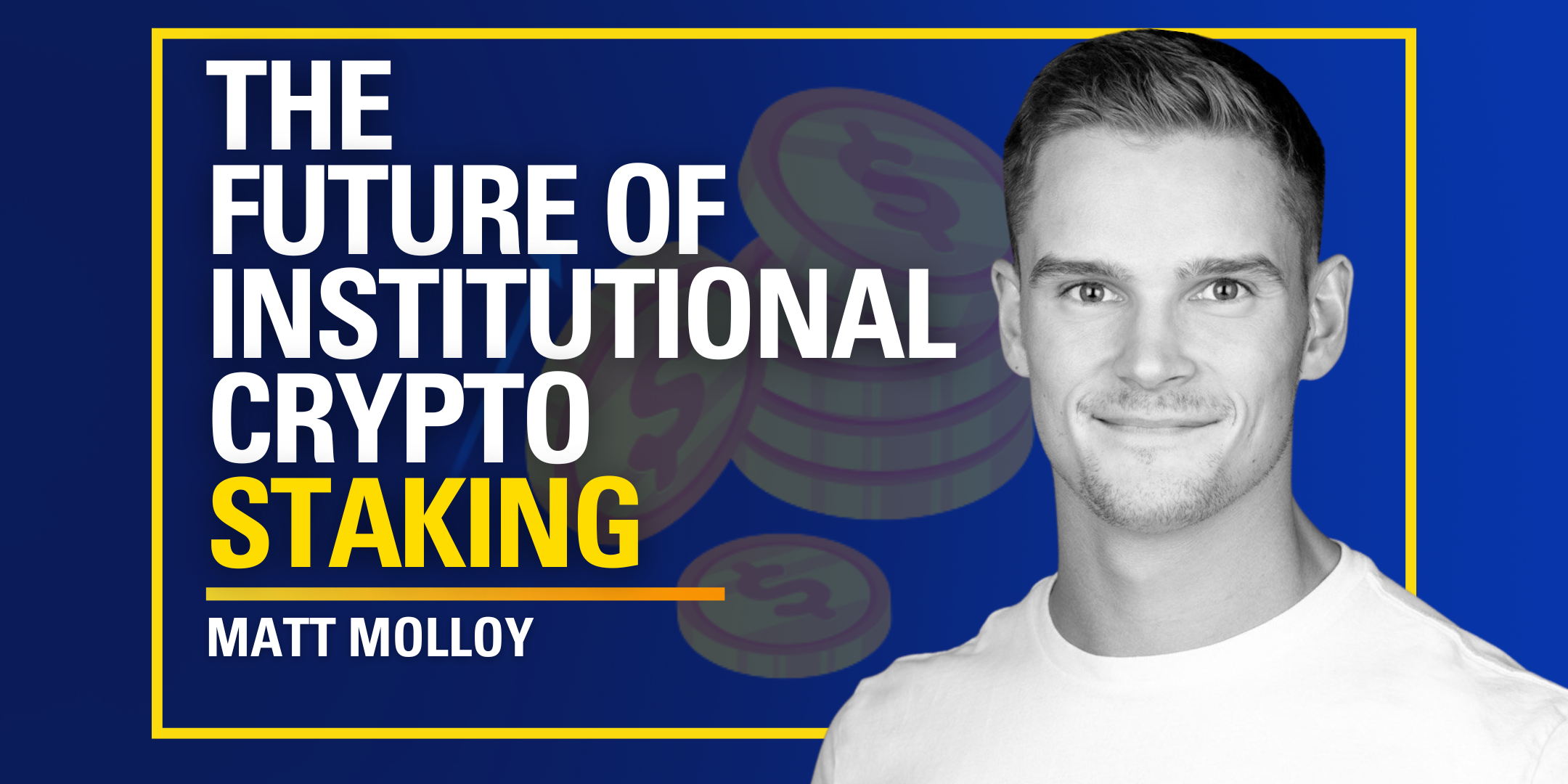
The Future of Institutional Crypto Staking - Matt Molloy | ATC #597
In this episode of Around The Coin podcast, host Stephen Sargeant is joined by Matt Malloy, CEO and co-founder of TruFin Labs, to explore the world of staking, liquid staking, and yield in the digital asset ecosystem. They dive into the differences between traditional and liquid staking, the evolution of blockchain technology and smart contracts, and the current state of the market. Matt also shares insights on regulatory trends in the US, the role of institutional investors, and the future of DeFi finance. This informative discussion provides a comprehensive understanding of staking and its applications for both retail and institutional investors.
Host: Stephen Sargeant
Guests: Matt Molloy
We are also available via:
Buzzsprout • YouTube • Quora • Medium • X • Facebook • LinkedIn • Soundcloud • Apple Podcast • Spotify • Player FM
Episode Transcript
Stephen: This is Stpehen Sargeant, the Around The Coin podcast. Have you ever wondered what staking is versus liquid staking? What yield is? We are finally gonna get to the nuts and bolts of everything to do with liquid staking. We have Matt Malloy, who's a CEO and co-founder of TruFin Labs. He's been 10 years in a digital asset with experience in investing and all the way to infrastructure, and they have over $250.
Worth of assets staked on their platform. We go deep into what is actually happening in the ecosystem, whether this is a bull or bear market for staking, how institutions are getting involved and how they can do so compliantly and making sure that they satisfy regulators. And we definitely talk about the emerging trends in the US regulatory space as it pertains to digital asset.
Matt is no stranger to what's happening in crypto, and we're gonna get all the goods from him in this episode. This is your host, Stephen Sargeant, the Around The Coin podcast. So we have Matt, who's the co-founder and CEO of TruFin Labs. Matt, give us a little bit of your background. We're gonna go deep into liquid staking and we're also gonna level set, you know, the different types of staking what yield and staking actually means, because it seems like in this industry people like to use terms interchangeably and it just confuses a bunch of people for the most part.
So tell us a little bit about your background and we're gonna go in and talk about, you know, back in the day, in your consulting days.
Matt: Of course. Yeah, absolutely. Good. Uh, good to be on Steve. Thanks for, for having me. So, uh, yeah, I started a career back at, at Accenture in terms of consulting. Um, and then moved, I guess away from typical consulting work into what was called their FinTech innovation lab at the time, working with kind of early stage startups, uh, FinTech based for, for the most part, and some of Accenture's largest clients.
And that really kind of pushed me towards. I guess financial technology in general and, and also the blockchain space and kind of been working in that space for the last kind of five to 10 years on and off, um, and founded truth in a couple of years ago, uh, in the kind of liquid staking space.
Stephen: I'm curious, you know, you worked in consulting from 2015 to 2020, which kind of like is the formative years of like Bitcoin mainstream blockchain.
When did you first hear about Bitcoin blockchain? Was it certain companies that were part of the consultancy, you're like, oh, that's interesting, whatcha building, and you're looking at it from like a consulting lens and you're like, oh, this technology's really cool. Can you kind of share that like aha moment?
Matt: Yeah. I think the first time I heard about it was in around 2016. Um, a lot of people were getting pretty excited about, I guess. Blockchain technology at large. A lot of the, I suppose, the larger clients, more traditional in nature that kind of had the, the skew or the kind of point of view of, you know, uh, blockchain, not Bitcoin.
Um, Bitcoin was obviously being spoken about that point in time, come across it for a few years, but, you know, people were pretty hesitant to towards the idea. I think that the volatility in the market at that point in time was something that. People had never really seen before and, and spooked a lot, but people could start to see the power of kind of distributed ledger technology.
Banks are looking at it saying, could this be kind of something that they could use, adopt for, for either their clients or internal processes, things like that. And then you really had the advent of, I'd say Ethereum going live in around 2015. Uh, and people started to get excited about smart contracts and, and that's really where I started to kind of dig in a little bit further, um, and, and take more of an active interest, although.
Personal perspective than than professional. I was kind of still running this kind of FinTech accelerator program at the time, which was on the edges, but there was still quite a lot of hesitation around early stage startups in the blockchain space. Some which, you know, got turned away from the program because they weren't necessarily fit at that stage, but gone to kind of wild success since, since then.
So it's been exciting to see that, you know, they were on the right trend, they on the right trajectory and had the right ideas. Uh, but you know, being slightly more. Conservative from some of the more traditional institutions. They weren't really ready there. And, and yet it's taken quite some time, I think for, for some of those institutions to actually get on board.
And you're only really just seeing what, like almost 10 years later, um, some of those kind of mainstream institutions, whether it's Morgan Stanley. BlackRock and others come to the table, have their own offerings, make it available for clients, and that's been exciting to see. But it takes a, it takes a long time for things to move in the, the financial services space.
For sure.
Stephen: Was there any, was there any concept or ideas you're like, oh, okay, due to regulations, the way governments are pushing back and banks themselves are pushing back, you're like, this is never gonna work, and now you're like, oh, this was obvious. Right? This is so obvious. I'm surprised nobody took the leap of faith back at that time.
Matt: Yeah, I think a lot of it, and to be honest, it's still being played out at the moment, but a lot of the early stage ideas were in and around tokenization of different assets. I mean, tokenization of real estate. I can't remember the first time I heard about that, but it must have been way back when in kind of 2017, where you could, you have some form of enforceable contracts where you could, you'd say.
Divide up percent piece of property and you could have this luxury real estate in Miami and some in LA and you could have an NFT, which represents it and all this kind of sense stuff would live on the blockchain and, and in reality, a lot of that stuff's super difficult. You have all the underlying legal rights, you actually have the physical property itself.
It's not just digitally native assets. So all of that was being spoken at at point time because you know, it was like, what's the art of the possible? What actually kind of came to the fore was obviously somewhat different and really the things that took off were, you know, either trading, lending and credit.
Some of the core functions of financial markets, full stop and you know, the transfer of value. But people really went, you know, and started, especially around the ICO boom, started imagining what, what could be done on chain, not necessarily what should be done on chain, let's say. Um, and got pretty excited about some of those possibilities.
The thing that I think, you know. We're gonna look back on, at least at the moment, and, and say in hindsight it was obvious, is a lot of the kind of existing assets in the world call them real world assets, whether those are funds, commodities, stocks, whatever they are, it. They should live on chain. There's like so many benefits for them to be readily available 24 7 to be transferable, uh, between different counterparties, you know, with certain permissions, but embedded to be able to use for collateral for lending.
All of that in a far more transparent system than their opacity of, let's say present day. I think that'll become obvious, but the biggest kind of hurdle for a lot of that stuff is the regulatory framework, being supportive and enabling it. Otherwise, you. Get these kind of quasi products, which are kind of giving the end investors the, the, the product which they want, but not quite, and not giving them the same level of rights.
And we really need the kind of regulatory framework to, to continue to develop. And it looks like it is, especially with the US at the moment, kind of charging forward with a, a lot of the bills they're passing, but it's not quite there yet. But I think we'll look back and say, oh yeah, it was kind of obvious a lot of that stuff was, was eventually gonna come on chain.
It would just take some time to get there.
Stephen: To be fair, when you're in those hype cycles, like they're like scooters. But on the blockchain, everything is like put on the blockchain, blockchain chain, blockchain. You can't fault the banks and investors to be like, yeah, that's probably not gonna work out because you go to this point where everything's gonna be on the blockchain.
You're like, everything could be on the blockchain. But to your point, not everything should be on the blockchain. What's interesting about Truvin is this is a very narrow, niche technical area of blockchain. Like liquid staking is probably not for the fate of heart. How did you get into such a technical area?
You know, usually the people that do get into these or found these companies are coming with like. Computer science backgrounds, engineering backgrounds, hardcore mathematical, economic, uh, backgrounds. How did you get into such a niche area based on your background?
Matt: Yeah, so I think before I kind of started at Tru and, and started the business, I, I was working over in the private equity world working at a company called Motive Partners.
Specifically looking at and specializing in the financial infrastructure or the technology infrastructure, let's say, that underpins the existing financial economy and thinking about some of the largest. Players there and, and what could be done to those companies to improve them on a forward looking basis.
Um, and we were therefore looking at some of the most kind of novel, interesting technologies that were coming out in and around that point in time of which blockchain technology was one. And it was there that I started to kind of lead the digital assets practice and delve a little bit deeper in terms of, okay, what is this underlying technology?
Actually, what impact could there be on some of these, let's say, legacy businesses? How could they leverage that for, for their advantage and in this growing world, what, what are actually some new products which didn't really, they didn't have analogies, but they don't actually have an existing kind of solution in the market at this point in time because they've only just become a thing like, you know, proof of state networks, blockchain, when Ethereum transition from.
Proof of work to proof of stake, there were like very few liquid staking solutions liable. That's where, you know, they kind of spun out from. And so there was a lot of open space at that point in time or opportunity to build into. And so it was really taking a look at the underlying infrastructure that was going to be developed in this new and emerging world and thinking, okay, what type of products do we need to be building and not just for the retail market.
Tru was spun outta of Bren Howard, or Web Wen, which was the kinda Web3 incubator of Bren Howard. And so there was always a lean and a stance towards institutional focused businesses that essentially aren't being serviced at the moment because it's such a nascent industry. And typically with a lot of these space especially, you'll see you across crypto, whether it's NFTs or perps, whatever.
It's typically those types of products or the the latest development. We'll always kind of lead with a retail offering, something slightly simpler, quick to market, get it out, slightly lower thresholds from the end consumer because they just don't have as high a bar to to cross. And so what that means is there is a gap in the market, especially when you have institutional clients and institutional allocators.
Coming into the market later on, you know, slightly lower risk appetite, but still wanting to leverage and, and utilize that space. And that's really for Tru and where we identified a bit of a gap in the market where there weren't that many institutional providers of liquid staking solutions, especially in areas kind of outside of Ethereum at that point in time when we started.
Stephen: I'm curious. You know, you start in 2023, you see that the, the market's very light, right? There's not a lot of competitors in this space, but rightfully so, 2023, bear Market things aren't going that well for crypto from a regulatory standpoint, especially in the us. Based on your conversations that you're having then and now looking at the space now, is this the most ideal, best case scenario based on everything that's happened in the last two years?
Like was this like, Hey, if this all happens, truing could really succeed? Is, has this been played out as the best case scenario, or did you think more was gonna happen or more evolution or more adoption by institutions by this time?
Matt: Yeah, I think it's a, it's a good question. I think overall there's been, you know, very strong levels of adoption for certain crypto assets, especially with the rise of, of the ETFs in the us You've seen kind of an influx of capital, especially into the Bitcoin etf, somewhat into the ET ETFs and, and subsequently obviously, uh, for Solana and, and a couple of other assets.
So there, there definitely has been kind of institutional allocation in, in the space and money coming in. What I would say though is across. All L ones or smart contract platforms outside of Ethereum, but even Ethereum in general, there's kind been relatively poor price performance for those assets over the last year.
Look at them over the last kind of two to three years. And that's somewhat, I think, dampened the kind of allocation from especially, uh, liquid token funds and others into these types of assets over a long period of time. Kind of chosen to go into different areas or to be Bitcoin only, and then certain other types of assets.
And so for, for those assets, which China Solana and, and a few others, it's been more challenging in terms of the price appreciation. But we are still seeing a growing level of institutional adoption, especially through some of these new vehicles, whether that's the ETFs or digital asset treasury companies and other types of allocators who are, you know, slowly moving to the space, but you know, maybe slightly more cautiously than they, they were in, let's say 20 21, 20 22.
Stephen: Before we go through the, you know, technical rabbit hole, that is TruFin and you know, the niche way that you guys are providing services for institutions and enterprises, we have to really understand like what is staking, what is yield, and then further upon that, like what is liquid staking you kind of level set us.
Give us high level each of these definitions and then get into why liquid staking, what's the difference between liquid staking and maybe traditional staking.
Matt: Yeah, a absolutely. So staking itself is, you know, a core part of, of what makes up a, a proof of state network. So two kind of main, uh, consensus methods for, for blockchains.
Proof of work like Bitcoin, where you know, you, uh, expand energy, you prove the work, uh, and essentially kind of get rewarded with block rewards, uh, Bitcoin and Bitcoin's case. And previously Ethereum was a proof of work, uh, blockchain as well. Now that comes with. A few downsides potentially, you know, depending on your perspective.
One of that being kind of energy expenditure. Uh, and so proof of stake blockchains were kind of drafted up as, as an alternative, uh, form for nodes in the network to come to some form of, of consensus and valid to confirm the states are of the blockchain itself. And rather than kind of expending, uh, work and, and essentially going and, and expending that cost, and then essentially, uh, going out and then, then coming to consensus a across the nodes in the network.
What goes on here is for proof of stake, you put your assets at stake or the validator puts the, the assets that they have at stake in order to validate the network. To agree on, you know, current state of, of what the blocks are and to kind of include new blocks within the overall blockchain. And for that you get, you know, rewarded with block rewards, inflation rewards, uh, from the underlying blockchain itself.
And so staking is essentially just a, a method for you to put, uh, and to demonstrate work, but in a far more kind of capitally efficient. And Ethereum was one, one of the first, but not necessarily, you know, the, the first that, that did this, um, and therefore kind of staking is a very, let's say, safe and, and what's kind of known as almost a risk-free rate of return in the, in the blockchain space for users to essentially put their assets at stake to validate the line blockchain to perform that useful task.
Rewards and essentially then obviously get a, an inherent yield through, uh, the, the blockchain itself. And so that's what, what staking is. And, and we can maybe touch on kind of what yield is and, and liquid staking because it kind of falls into somewhat, you know, similar categories and, and is kind of tangential to that.
Stephen: When you talk about risk, it's because if you're putting up your own assets, you don't really wanna do, do any kind of bad behavior and risk losing those assets. Whereas like, proof of work is like you might be able to try to attempt, you know, bad behavior because you're just rewarded on solving the problem, problem or the, you know, the solution.
Uh, is that kind of the reason why that might be a less riskier version of consensus?
Matt: Yeah, I think, I think from a risk perspective, they're, they're some somewhat similar. Um, there's not, you know, too, too many differences be between them. It's just the amount of capital you could, you can put up or have to put up can be a lot less for a lot of these proof of state networks.
Uh, for, for example, with Bitcoin, if you want to actually run your own node, you know, depends on, or let, let's say you wanna not necessarily just to read the blockchain to actually mine Bitcoin. You know, it, it's can be an incredibly expensive, uh, thing to do, especially in today's day and age. But for proof of stay networks.
You can often have the ability to kind of delegate your stake to a, a validator on the network. And you can therefore do delegate proof of stake. And you could, you know, start with a very, very small amount of capital, but still put that at stake and contribute towards that proof of stake consensus mechanism.
And it's called i, I suppose, all. Known as being relatively risk free because the actual risk of that validator, especially it's it's being run by a professional institutional grade company, the chances of them having any type of double signing or any type of malicious activity is incredibly low, as well as any downtime, which you, you do get penalized.
That's the risk in, in staking networks is the slashing that can occur if you don't follow the consensus rules and if you're not by late in the blockchain. Or the ballot later is not performing the role that is said, whether it's because downtime or because of malicious, malicious double signing, uh, the risk of that is incredibly low.
And you've seen instances like it's the actual statistical odds of, of this happening on, on ballot, especially those that are, you know, well known is very, very low. And so as a user, you can have very, very high confidence that although you are putting your assets. Putting them at stake. Uh, the actions you are taking there are not risk free, but very, very low risk whilst you're still being rewarded with the inflationary rewards of that blockchain, which depending on the blockchain, Ethereum approximately two, 2.5%, but for some newer networks.
Uh, for newer proof of state networks, those rewards can be much, much higher, especially in the early stage because they're trying to attract capital into their ecosystem. Uh, and then obviously secure the network through, uh, the assets that are state. So it can go as high as 10, 20%, sometimes, sometimes even higher.
And so that can be quite attractive for certain investors that, you know, let's say have a, a slightly healthier or or further out risk appetite.
Stephen: We get into yield, there's like two types of yields. People are like yield off of loan products. That's a type of yield. But the yield we're talking about is like, almost like protocol activity.
Your reward for, you know, staking your assets. Can you talk about the two different types of yield and then maybe even go into like what type of yield is allowed and like ETFs and other things, and how does, you know, yield get used interchangeably in, in those aspects?
Matt: Yeah, I'd say like yield in the, in the kind of broader sense is just return on capital.
And that can be in a, in a few different ways. You know, we, we spoke about there for, for staking it's, you know, the return on the capital that you're putting at stake, but it's entirely based on like network, uh, or the network itself. And essentially any inflationary rewards that are coming from the network as opposed to any.
Third party that is external, what you have seen in the crypto space. Kind of outside of that though, um, and especially towards, I forget the year, but let's say in 20 23, 20 24, with the likes of Celsius and Block Fire and others, when you started to see, uh, some of the activity and some of the blowups there, what was really happening is consumers were putting their assets at stake, but they weren't, let's say.
Onto a validator to contribute towards a proof of state network. There wasn't anything like that going on. What they're essentially doing is they were lending out their assets and they were just generally lending their assets to companies like Celsius and Block and others, and those companies would provide almost, you know, an inherent yield or return to invest to, they'd say, Hey, gimme uh, a thousand dollars of Ethereum and I will give you a 10 or 15% yield.
Obviously that would be quite attractive because if you were just staking those assets, maybe you were getting at that point in time, three to 5%. So these individuals were essentially trusting these third parties, Celsius, block Fi, uh, and others. And what those companies were then doing is they were then basically loaning out those assets to risky third parties in a pretty opaque fashion.
And there were a number of counterparties who were hugely over leveraged in terms of their positions and you know, an incredibly risky borrower. But there was a very kind of. Low level of credit and risk scoring and frameworks in place at that point in time. And so you start to see when prices started to go down.
And with crypto, it's, it's a very volatile space and you have to be prepared for that at all times. And, and that's obviously what did happen. You saw a lot of those counterparties who'd been lent to basically blow up and, and not have the funds, which had been l to them. And the people being left held, holding the bag or essentially being left with that debt were those that had lent.
Those assets to those third parties in this kind of black box in a very opaque fashion. So that's what I think people sometimes think when they think, yeah, yield and, and crypto, oh it's, you know, this kind of black box and people don't really know what's happening. But in fact it's staking. And for other products, and we can talk about those as well.
And DeFi, you should be able to have a very transparent look through as to. Where those assets are, assets, where they're being held at any point in time on chain as opposed to anything which is, you know, trusting a third party and then hoping that you get, you know, whichever yield they being promised back to you at a later point in time.
Stephen: I think what was scary back then is that those third parties were lending it to, to your point, risky, you know, risky receivers of this capital and those people were, or entities were then leveraging that lent or borrow crypto. 10 a hundred times. So when the price goes down and they don't really have those funds, they're out of money.
And it kind continues back down to the person that originally lent the money, where it's like nobody has money down the line, so there's nothing coming back to you. And that's usually how those models breaks when you're over leverage. Is that kind of a good summary of what happened?
Matt: Yeah, absolutely. It's just not having a, a very good understanding of the, the risk of some of those borrower profiles and or having an understanding and being okay with the risk and taking undue risk on a, on a client's or customer's behalf, because, you know, they knew that the funds weren't theirs and they were kind of playing with it and playing with fire, and obviously everyone got burnt at the end of the day, and it, it took a while for the space to recover from that.
But I guess from that as well, we've had. Where I think, I think consumers and especially institutional allocators are demanding much higher levels of transparency and on where their assets go if they depositing their assets looking for. Natively on different DeFi applications or whether that's with, uh, third parties looking at different escrow accounts and different situations and controls of where they can have the transparency on where those assets are at any point in time, and also have a greater level of control.
And so a lot of the. Let's say self custodial, uh, sell setups are becoming much, much more popular as opposed to, you know, inherent trust in a third party, which looks more like a, a tradify, uh, setup, let's say, as opposed to anything which is, is crypto native in, in style and fashion.
Stephen: And I think people have to remember this is very similar to what happened in the housing market.
Realistically when prices go up, people don't ask where the money's coming from or going. They're just trying to, to, you know, get their bucket and receive some of the money. It's only when prices start going down and you know, people are looking around like, where is my money? How come I'm not getting it back?
Is when we start to ask a lot of questions. And to your point, this is where you see the consumer, the institutions, the individual investors start to say, Hey, you know, yield sounds great, but maybe I don't want the most amount of yield I want, you know, the less risky yield. So take me from like staging makes sense from a protocol activity, but now what is liquid staking and how does that benefit somebody that's already maybe staking their assets or looking to stake their assets?
Do they usually go through a process where they stake first and then liquid staking? Or do they come in and they're like, Hey, I'm just gonna start by liquid staking.
Matt: It's, it's a, it's a great question. So a lot of users who, who are staking what they're doing and, and we mentioned earlier, is they're essentially delegating those assets onto a particular validator, which is then participating in kind proof of state consensus.
And essentially those assets are delegated to the validator. And depending on the particular blockchain, there are restrictions or rules as to how long those assets have to be held there before they can be unsd. We call this an uns. Un bonding period. And depending on the blockchain, this can vary in length in terms of the staking period.
Um, so you can almost imagine it, it's as if your, your assets are, are held in escrow, a bank, and there's certain parameters around, you know, you're not allowed to withdraw that funds unless you have a seven day cool off period or something like that. So it's relatively illiquid that position. You're obviously capturing the yield from staking, which is great and it's relatively low risk, but for certain clients, they want to be able to have a greater level of liquidity.
Those staked assets or on that staked position. And that's where liquid staking comes in. Liquid staking is there to solve the problem of illiquidity for staked assets, so hence liquid staking. And the way in which that works is a user rather than, uh, directly staking their assets or delegating into the ballot later, they would come through to a protocol like Tru in or others and essentially stake via our smart contracts.
And essentially those assets similarly would get. Staked onto an underlying validator. And then they do participate in that proof of state consensus, uh, that the, the whole methodology underneath. But at the same point in time, that user is then minted a receipt token, which captures their underlying position or is a reference to their underlying staked position.
And it's this receipt token or liquid state receipt token, often known as LSTs, which can then be used by that end user. So they have a tradable asset, which if they want to, they can sell out from that position and they can trade it for, let's say the native asset or for stable coins or for any other asset they're choosing.
Or they can essentially actually go and use those assets elsewhere. Let's say they wanted to go get a loan out or DeFi protocol, or they wanna use it as margin on a trading account. Well, they can now do that. Previously they wouldn't have been able to because the assets which they had states were locked away on that validator where they delegated them to in illiquid, kinda unusable or very low utility environment.
Now you're giving that kind of end user and client the ability to get liquidity on those assets. And also has to have greater levels of utility, either for additional yield or for essentially just being able to, to swap in and out those assets at, at a more frequent basis. And that for certain clients and, and customers is a very kind of appealing, uh, proposition
Stephen: because they're able to do those extra activities without you losing the yield that they would Exactly.
They had to pull those assets from being state.
Matt: Exactly. You can imagine for some of these clients, they're able to capture that staking yield in what's seen as a relatively risk free or very low risk environment. And then they can essentially go out and either borrow against those assets or seek additional yield opportunities, which will basically compound the yield and compound the return that they are seeing on the underlying assets that they had all without actually having to kind of swap out of the, the underlying state assets.
So it's, it's pretty appealing and, and this really actually came out of. Initially Ethereum, uh, when Ethereum first transitioned to proof of Stake, they actually didn't have un staking available. And so there was no method initially anyway, until I think there was a Chappelle upgrade later on where users could untake within a, a certain time period.
But before then, there was no way for anyone, once they'd committed to staking with Ethereum to actually uns stake. And so you had protocols. I think the first was Lido and, and Rocket Pool kind of shortly after. Come in and basically put this liquid staking model in place, which enabled those users to have a a liquid state receipt token or liquid state receipt tokens, which represented their underlying state assets.
And now that they had those assets in their wallet, those users, if they wanted to. Could have sold their e, could have, let's say, sold it for stable coins or could have used those, uh, state assets elsewhere. And that's really where it started. And we then saw a proliferation of those types of companies and liquid staking protocols all over, across several other networks as well.
But all started with, with Ethereum.
Stephen: It's very similar to like if you buy a condo, right? That hasn't been built yet. It is like you've invested in this, you have this thing, you can't really use it 'cause the condo's not built. You can't sell it because the actual unit is not yours. But you can assign it to somebody else that's like, Hey, I want this condo.
You don't really want it. I can now assign you my position that I have in that condo that's being built in the future. Very similar to real estate, I feel in some aspects.
Matt: Yeah, absolutely.
Stephen: I'm curious though, that you said, you know, you talked about Ethereum, but you know, right now Truvin focuses on like Solana, Aptos and other blockchains.
What's the reasoning for maybe those other blockchains versus like, you know, trying to do liquid staking on something like Ethereum?
Matt: Yeah, for, for us it was at a point in time when we were launching towards the end of 2023. Uh, as I mentioned, Ethereum was the first kind of come out in the market with liquid protocols.
There was. This embedded need for liquid staking far beyond other networks staking wasn't possible. And so what you saw is quite early on a relatively saturated market. And what I mean by that is the liquid staking ratio on Ethereum was very high from a very early stage. So of the assets that were staked.
A significant degree of those were already staked via liquid stake protocols. IE you know, it was captured and basically kind of already going through tho those liquid staking providers up to a point of around I think 50% of of total staked assets were going through liquid staking protocols. And to give you kind of a ballpark figure for most other networks, which were pretty high growth at that point in time.
Other kind all L ones or smart contract platforms. Like your polygon, Solana, Aptos, injective near some of the, the networks we end up supporting the, the liquid staking ratio on those networks was anywhere between one to 5%. So you had a much, much lower level of assets, which were currently going through liquid stake protocols.
And therefore we saw that as an opportunity to go in and be kind of the first institutional grade provider in those markets servicing capital allocators, which maybe had. Much higher threshold for where they would and would not deploy capital, but in areas that we felt at that point in time had higher growth potential in terms of, you know, where they would be in the next couple of years.
And we therefore wanted to front run some of that demand and make sure that we were in the best possible position to serve that capital. When it did come online and, and people started.
Stephen: And can you gimme some main use cases? Who are you servicing? Is it like a hedge fund? Is it like private equity firms that you used to work with?
Like who are you servicing? What are the institutions? What are the main use cases? And are there any emerging use cases that you've seen, especially since the tide has turned in the US which has seen ripple effects around the world.
Matt: I think one of the, the major, uh, kind of groups for us is as clients, uh, are ultra high net worth individuals, uh, and family offices.
They tend to be kind of one of the first to, to adopt some of these new, new yield opportunities, but they don't always have the internal capabilities to be doing some of the tech themselves and therefore wanna on offload some of that risk. But they. Don't want to be using permissionless DeFi. They wanna be using something that has a higher threshold with regards to kind aml, k YC compliance, and everything else that is baked into the security of the Procore as well.
So family offices and ultra net worth are one group, which we've, we've done well to, to service so far and continue to do so outside of that. Mainly crypto native businesses that do hold a large portion of their existing treasury in crypto native assets. Whether that is foundation clients or liquid token funds, VCs that may be run a liquid book as well.
Often looking to maximize the yields that they do get. Portfolio and also deploy capital into some of the networks that they may be a part of or that they do support. And so to give kind of one clear example, we'll have a client, uh, who essentially will stake with us. They're relatively large in terms of one of the underlying blockchain communities, and they wanna support the growth of that ecosystem.
And therefore, liquid staking is a great mechanism for them to do that because rather than just staking their, those assets and them being locked and kind of essentially not useless on the ventilator. Securing the network from a proof of state perspective, but not doing too much else for, for DeFi and some of the other opportunities, they essentially can stake with us, get the liquid state receipt token, deploy that as liquidity, for example, across DeFi.
They can use that on other borrowing protocols or lending and borrowing protocols and start to kind of get a, a higher cadence of capital moving around that ecosystem in order to support the growth and development of DeFi. That particular chain. And that's just kind of one such example where, where clients are, are using us and, and SSTs to essentially kind of further some of their aims and objectives in that space.
Stephen: And I'm curious, you know, you've mentioned KYC and a ml, those are all beautiful words. It's basically compliance making sure. Who are you doing this compliance on? Is it the validator? So institutions wanna make sure that the person that is, you know, putting up this stake on their behalf isn't some Russian hackers or, you know, based in a country like Iran or Venezuela.
Can you talk a little bit about that compliance and regulatory aspect that your enterprise clients want to make sure is in place?
Matt: Yeah, absolutely. I think it comes in in two parts. So first of all, we only work with best in class and kind of, uh, very compliant, uh, and kind of leading technology providers all the way through.
So if we partner with, let's say, an underlying ventilator partner, we're working with leading firms like Twin Stake. We're working with those that are institutional grade in the same way in which we are, and they know, you know, where all of the assets, or 99.9% of the assets that sit on their ventilators come from.
They don't have retail offerings. They onboard each of their clients individually and they make sure they go through kind of rigorous KYC and a ML processes to make sure that no one who is on, let's say any sanctions list, uh, or any kind of counterterrorist financing, uh, measures are, are getting through the gaps and making, and kind of giving our clients the same level of comfort that we work with the whole way down.
And, and that comes to a on the provider side, but secondly, whenever we're also talking about regulatory. KYC AML compliance. It's also on the clients that wanna mint and redeem or essentially utilize our products. So rather than having something which is open, permissionless, like a lot of DeFi offerings were and, and the retail focused offerings, uh, still are you, they, they have that their parts in the world and they, they're reasons why they're designed that way for us.
Some of our clients. They can't interact with protocols for which, you know, it's unknown entities behind a wallet address, which isn't known. And so they have to know that anyone interacting with this token or anyone interacting with the smart contract is a known entity and can be tied back from a KYC and a ML perspective.
We have that. So we have, on the way in screening of wallets, we make sure we go through KYC ml, we then screen a client's wallet to giving them access and on a white list. So we know going in. Who each of the individuals or entities are and making sure that their wallet activity and their on chain history is making sure that, you know, it's not being tied back to any illicit activity in the past.
And then we have ongoing monitoring to make sure that that obviously flagged on a, on a daily basis to ensure that anything that does come up, it's dealt with on, on that side as well. So that's what we mean. It's a kind of two separate parts of, uh, K YC or, or Regan compliance as you put it.
Stephen: And yeah, you have to have that in place if enterprise clients are gonna be joining in the fund of DeFi and protocols using liquid staking.
I'm curious, you mentioned twin steak. Funny enough, we're gonna have Tara Anderson that was formally a twins stake. Okay. Yeah. Uh, on the podcast this Friday. Uh, I'm curious for you like twin steak alluvial. Marinade labs, Gito, Lido, there's all these different types of staking and liquid staking protocols.
What makes you different than those and what makes you very similar? Is it just all part of an ecosystem servicing different, you know, customers, whether it's retail or institutions? Mm-hmm. Uh, give us a little lay of the lamb of some of the other companies in the space and where you are similar to them and where you differ wildly from them.
Matt: Yeah, absolutely. I think some of the, the companies where we would be most similar to, uh, would be the likes of Alluvial, which was for, for those that dunno kind of a, a very Ethereum focused, um, institutional grade liquid staking provider. Um, I think they've now just been subsequently, uh, acquired by, by Galaxy, but they've very much focused on the Ethereum side of the market for institutional grade liquid staking.
So that was their core product set, I suppose with, similar to other companies that. I just mentioned, you know, the, the twin stakes of this world kill and other underlying validator providers. So they would sit us below, I would sit below us, sorry. In the stack, we would see them, uh, more as partners as opposed to competitors.
We often service very similar clients, and some of their clients will become ours. And, and, and vice versa. Um, some of their clients that, you know, maybe want greater liquidity and utility on their assets will say, Hey, rather than just. Vanilla staking, I would actually like to go and use liquid staking and, you know, we'll work with them at Tru to onboard that client and, and essentially provide those services to them.
Um, I, I'd say where we're coming at it from a slightly different angle from some of those players is a, we took initially a multi chain approach, so we want to be slightly more holistic in terms of the change that we do and, and don't support, uh, for some of those clients and, and constantly looking to, to kind of expand that coverage and where we're really focusing on this year.
It kind of gets back to the, the kind of core world, uh, or kind of core word of, of yield. Let's say we wanna be a more broad yield protocol. Uh, and therefore we wanna offer institutional grade yield products in both the crypto native assets such as your Solanas, Ethereums, uh, and other crypto native assets.
As well as US dollar denominated assets, real world assets, which I mentioned earlier. So tokenized funds, tokenized commodities, and we're gonna be bringing out products this year which are more focused on that RWA space or real world asset space to provide, you know, a one-stop shop for institutional clients to access yield on chain in a safe and compliant manner, but all through the kind of truth and engine.
Stephen: I'm curious, what are the metrics, you know, you, you're the co-founder, your CEO, so you're driving a lot of this training that truth, and what are your metrics? Is it TVL, which seems to be very popular in this space, like the total value that's, you know, on, or that you're housing? What, uh, AP wise, huge partnerships.
Like what are the metrics that looks like success for you and Dren?
Matt: Yeah, I, I think it comes in a few different ways. TVL is is one metric, and, and obviously for us it's also how do we de derive revenue? So it's, it's important, uh, as opposed to, you know, well, for the business at large. And you'll have seen a bigger trend this year around kind of revenue generation businesses and in the crypto space, it becoming a, a more important topic, which is, is great to see.
So TVL is important up to a, a degree. Uh, not all TVL is created equal. We make. Sometimes more money from certain chains than others, depending on the a PY that, you know, those underlying chains do have. But then you still have to have the price performance of the relative asset to actually have that sustainable long-term revenue, which is something which is also very, very important.
So, TVL to, to a degree, is important. A PY again, secondary is, so for me it's also about new client growth. So we're always wanting to make sure that we're increasing clients, uh, in terms of just the, the pure number. We know that over time our offerings will continue to appeal and we, we should win a larger share of wallet.
Over time with those clients. So new client growth is particularly important in terms of a, a metric that, that we look at. And also the, the final one, which is important is just churn rate. And so you wanna know that those clients that are essentially utilizing your protocol at the start are sticking around and have good reason to keep their assets with you.
And that really comes down to what can they do with those assets that you've created or that you, you've enabled them to, to have those LSTs and other tokenized assets. Do you have the ability for them to be used as collateral on some of the major custody, um, providers for exchanges? Different market makers and other ecosystem providers, and that's where we put a lot of emphasis at proven because we realize that's actually what makes the product appealing.
In the first instance, if you can offer a product in, uh, the same custody setup that they typically have, but with best in class providers that have, you know, really differentiated yield opportunities on top. And that's gonna be very compelling for an institutional allocator, and they're gonna wanna to kind of put some money in, into that bucket and, and essentially allocate to that space.
Staff for us becomes very, very important. The quality of those partners that we have and that we work with at Tru
Stephen: Ist VL one of those things where it's kind of like having a lot of followers on social media. There's hacks where you can try to bring on a lot of people to lock their funds or stake their funds, but you might be offering huge incentives and not actually making revenue.
But you're allowed to tot around this high number of TVL to kind of show that maybe you're more important than you actually are and more profitable. Is that TVL one of those weird metrics that people try to manipulate?
Matt: It, it sometimes can be. I mean, it's, it's harder to, to manipulate as such, but what you do see is, especially within the, the crypto space and, and define and more often on the retail side is where the, the launch of different points, programs and token incentives.
You will have a lot of protocols which will heavily incentivize TVL. So they will say, Hey, if you deposit. X amount of, uh, whatever token into our vault or into our product. We'll give you a certain percentage, a PY in our native token when it launches. And at the moment you'll have points and these will turn into tokens, et cetera, et cetera.
And you see this kind of very fast rush of capital which flows into these protocols. Airdrop farming, I guess, you know, is a technical term. They'll essentially, uh, put, put and deploy capital into that protocol for a period of time, knowing that that is being monitored by the protocol, knowing that they'll get future token incentives.
As soon as that token's released, what you then see is 75, 80, 90%, sometimes more. Of that capital and of that TVL just leave straight away because it was only there for a short period of time in order to farm the token to generate an additional profit. It wasn't using the protocol because the protocol served any real purpose or use to them, which is kind of giving a false vanity metrics.
So that's, yeah, you cannot almost kid yourself to, you've got product market fit. I think sometimes in the crypto space, if you are able to launch that token because you can incentivize people with the promise of a token, which could or should have some value for a period of time. They will then farm that, but you know, it can be very shortlived at the end of the day.
It, it kind of comes back and you'll see the real layer of the land once that token does launch and, and often it's, it's not as pretty as what, you know, people would maybe like to, to think.
Stephen: So I like a lot of these layer two protocols. They heavily incentivize tokens and grants to develop on their protocol.
But the second, you know, to your point, the second that they don't have to stay on the protocol anymore and they can still receive those benefits, they're gone. It's just the nature of crypto in general. I'm curious, you know, you've been around since 2023. How challenging were the conversations or are the conversations today with institutions that are very new to crypto, much less getting into staking and then going one level beyond that, which is liquid staking, uh, has, you know, how have these companies you.
Conversations changed over the years.
Matt: Yeah, I definitely think there's more of a, there's definitely more of an awareness of liquid staking staking. Absolutely. Most institutional allocators, uh, are, are staking uh, you know, it's almost guaranteed at this point in time that if they're holding a certain asset and it can be staked, they most likely will be.
Uh, and so the, the knowledge on that side is pretty high. But liquid staking there is still. Education piece where, you know, we have to bring them up to speed sometimes on the potential benefits that they could see depending on, you know, their use case and their risk appetite. It really does look different for, for every investor.
Uh, and essentially some may be unaware of what they could do with liquid state tokens and how that could actually improve their overall kind of risk. Um, a risk framework in terms of that they do work within, whether that's due to their ability to kind of hedge out price exposure or to use the assets in a slightly different way in terms of having greater liquidity on those if they have a short term horizon for trading, let's say.
Um, so there is still an education piece, but it's definitely been rising and I think with the advent of, um, ETFs and what you've also seen this year in terms of, or last year I should say, with the rise of digital asset treasury companies. There are now a wave of companies which are getting much more sophisticated and hands-on with deploying capital on chain, and that's very exciting for, for us at Truvin in terms of building out yield products for those types of allocators.
'cause there is, I'd say, a wave of capital, which is now seeking higher yields in order to get greater amounts of, let's say, digital asset per share, that they're really pushing for those, uh, types of companies. And so I'd definitely say it's, it's trending up and, and obviously continues to, to be a work in progress.
Stephen: What do you see the future of, like, the way tradies is beating DeFi? Our crypto exchanges seem to be looking more like banks, banks are trying to look more like crypto exchanges. Uh, what do you see the outlook over the next 18 months?
Matt: I think it's, you know, probably a similar opinion to, to a lot of people on this, but you're gonna see those lines.
Blur continually, uh, you've seen a lot of launches of DeFi related products, or let's say the DeFi mullet. So you've got, uh, CFI in the front, DeFi in the back, and products like Morphos lending product or Bitcoin lending product with Coinbase to be one such example. And that's just to hit over kind of a billion dollars worth of of TVL already some, some serious levels of growth across some of these, these products.
And I think you'll continue to see that you're seeing the launch of crypto native neobanks that have very little traditional infrastructure, but are providing. For intents and purposes, the primary bank services to, to clients, but just in a crypto native fashion, without somebody having to be a US resident, they now have access to a US card.
They're able to get, you know, certain payment services, lending points programs, and all of that is being done on crypto rails. And you're seeing players like Visa and others supporting it. So I start, I think you'll continue to see what's already started in terms of the blending of those two worlds together.
Um, it won't be without, uh, its, its hiccups along the way. A lot of friction. I think you're seeing that in the US at the moment with regards to the stable Coin legislation and the arguments around whether yield can be paid out to stable Coin holders, whether it can't, banks have obviously traditionally kept that revenue to themselves and they'll be pushing, I think, for that and.
Others within the, the crypto industry who have a, a slightly different point of view will be pushing for, for something in the other direction. But I'm sure some of these things obviously will, will work out over time. But I, I think you'll continue to see the adoption of crypto related products and rails by traditional financial institutions.
And at the same time, you'll start to see the likes of. Coinbase and other crypto related businesses move very heavily into the traditional world, whether that's offering tokenized equities or bank related services. If they're able to get a charter, you'll see those two worlds kind of converge and, and at the end of the day it'll become finance.
We'll, we'll kind of stop talking about as being kind of crypto native or on chain versus off chain. It'll kind of just be finance, but at the moment you've obviously still got those two worlds coming together.
Stephen: I'm curious, you know, you guys announced True Soul, uh, at the end of last year, 2025. What do you have coming up for 2026?
You're talking about expanding blockchains. I know you're not gonna be able to give us any kind of, you know, sneak peaks part. You know, blockchain announcements and integrations are usually huge PR announcements, but is there any other things that you're looking forward to going as we're in 2026 right now?
Matt: Yeah, I mean, I won't name specific products, but we are putting a, a big push and emphasis on expanding the product set into tokenized RWAs or, or real world assets, making sure that we have a, kind of a holistic offerings across both crypto native assets that we already support on the liquid staking side, and then moving towards these more kind RWA assets, US dollar denominated assets for, for the most part.
For clients that are wanting to diversify their treasury, diversify revenues and yield sources, and we're wanting to bring the same level of infrastructure, compliance and security that we brought for the liquid staking space into the tokenized RWA space as well, and leverage the, the kind of infrastructure, uh, and the, the stuff we've already built.
But bringing that to, to kind of a fresh part of the market, to have a more holistic offering as well. So, uh, I can't name specific, uh, products just yet. I'll probably get told off by some of the team internally, especially our, our marketing lead. Uh, but yeah, we'll be announcing stuff on, on that side very shortly.
Stephen: Satch won't mind. Don't worry. He good friends. Good friends of the podcast. Satch won't mine. I'm curious, you know, you've seen a lot of companies while you're at Accenture, especially those building in the FinTech space, you work for an investment firm. There's a lot of listeners on this podcast that are founders or builders of startups in the FinTech payments in crypto space.
I'm curious, any insights that you see from the companies that you've invested in or has seen that are successful versus ones that you may have took a pass on and for whatever reason they didn't pan out exactly the way you thought they wouldn't. Trends, trends, you know, any thoughts around founders that you can provide this on you?
Matt: Yeah, I think in terms of those businesses that have continued to kind of exceed expectations, they've been going into markets which have, for all intents and purposes, they made the right bets that those markets are, are gonna be sized by continue to grow. Whether that's, you know, tokenized out of uas, whether that's stable coins at the moment, you're seeing a huge proliferation of growth in terms of those areas and they become.
Some of the most popular areas to invest and seen a number of different acquisitions in that space as well. I think the areas for which are gonna be kind of most quickly co-opted or essentially adopted by Tradify, you've seen kind of the, the fastest level of success, uh, across some of those companies.
And also focusing, I think more clearly on. What are the kind of real genuine use cases for blockchain? Uh, and, you know, things focused around transfer of value, uh, around trading and execution around credit or the ability to have credit. Those businesses you'll have and you've kind of seen a number of significant winners or you know, one, one or two per market.
They've done incredibly well.
Are they of this world for, for kind of lending markets on Ethereum or, you know, hyper liquid for perps and others? It's those that are going into markets which will most likely to continue to grow over time. And, and that's why we're excited to kinda be focused on the area which we currently are, as well as going into the tokenized RWA space because we've just seen a huge expansion in terms of the number of assets which are being kind of captured on chain, uh, and put on chain and, and, uh, people wanna get greater utility, uh, and leverage on, on those assets moving forward.
Stephen: Talk to me about the pivot. You know, there's so many companies, especially in crypto that probably pivot to the hype of mean coins or now they're into digital asset treasuries. Like, talk to me about the importance of when to pivot and knowing when not to pivot and just following the plan. I'm sure you have probably had a lot of internal conversations, which, how much progress has happened in the US just within the last, you know, 12 months?
What are your thoughts on pivoting?
Matt: Yeah, I think you've gotta see is the change gonna be durable and sustainable that, that you are reacting to. Uh, and so for example, if there's a, a new meme Coin that's come out and it's got everyone hyped up, I mean, based on the, you know, historical data and how long meme coins kind capture attention for, you can probably bet that unless you're moving within, let's say a week period, sometimes even days, unless you've got a product to market, which is gonna be capturing value for that.
Particular trend, it's not gonna be sustainable and durable. Whereas if you're looking at, let's say, the US regulatory framework and environment and you're building products around what you believe will be kind of growing in large markets over time, which will continue to kind of get regulatory support, that's something which you can obviously look to shape and adjust your business on.
The US went from being an area where. We would never previously touch onboard clients or, or look at because of the regulatory by enforcement actions that were taking place in the area. And then kind of the negativity with which crypto was held to an area where it's very kind of crypto first and there's huge levels of support by the current administration to, to kind of.
Proliferate and have crypto be based in the US and to service US customers. So you can start to say, okay, cool. What does that mean for me and my business? What type of new, uh, kind of products might come online? And then you've seen both the ETFs and digital asset treasury companies become a huge new buyer and capital allocate in that space.
And that's really where you wanna, let's say, pivot or start building towards. You think those markets are more sustainable, durable, over the longer term. So I think it's just really figuring out those that are gonna be. Longstanding in nature for the change as opposed to something which is more short-lived.
Uh, and I guess more, let's say Twitter focused.
Stephen: So, well now they're getting rid of crypto Twitter, so now everyone's doing
Matt: Yeah, everyone's getting shadow. Shadow banned, left, right, and center. Right. So you're, you're gonna see it.
Stephen: Where's the best place to reach you? Now that crypto Twitter's dead, where's the best place to reach you, Matt?
We'll include Tru Finn and all the links to the website, but where's the best place to reach you, uh, where you're actively engaging with people in social media?
Matt: Yeah, more, more often than not, it, it is on Twitter, so it's I Matt Malloy for, so people wanna kind of reach out there. Happy to, to have a conversation.
Uh, and, and likewise, I'm sure the, the truth and handles are getting fluted, but it's at truth in protocol and, and truth as well. Uh, but feel free to, to kinda reach out to me on Twitter and we can take it from there.
Stephen: Matt, thank you for breaking this very technical subject down to layman's terms for all of us to understand exactly what liquid staking in and how institutions and companies can get involved.
This was a really, really interesting episode that really kind of explained to us, you know, what is staking, what is yield, which I think is important if people are gonna be adopting or getting into this field to know the basics. And you really took us down, uh, that path today.
Matt: No worries at all. Thanks so much fa, really appreciate it, team.
.png)