
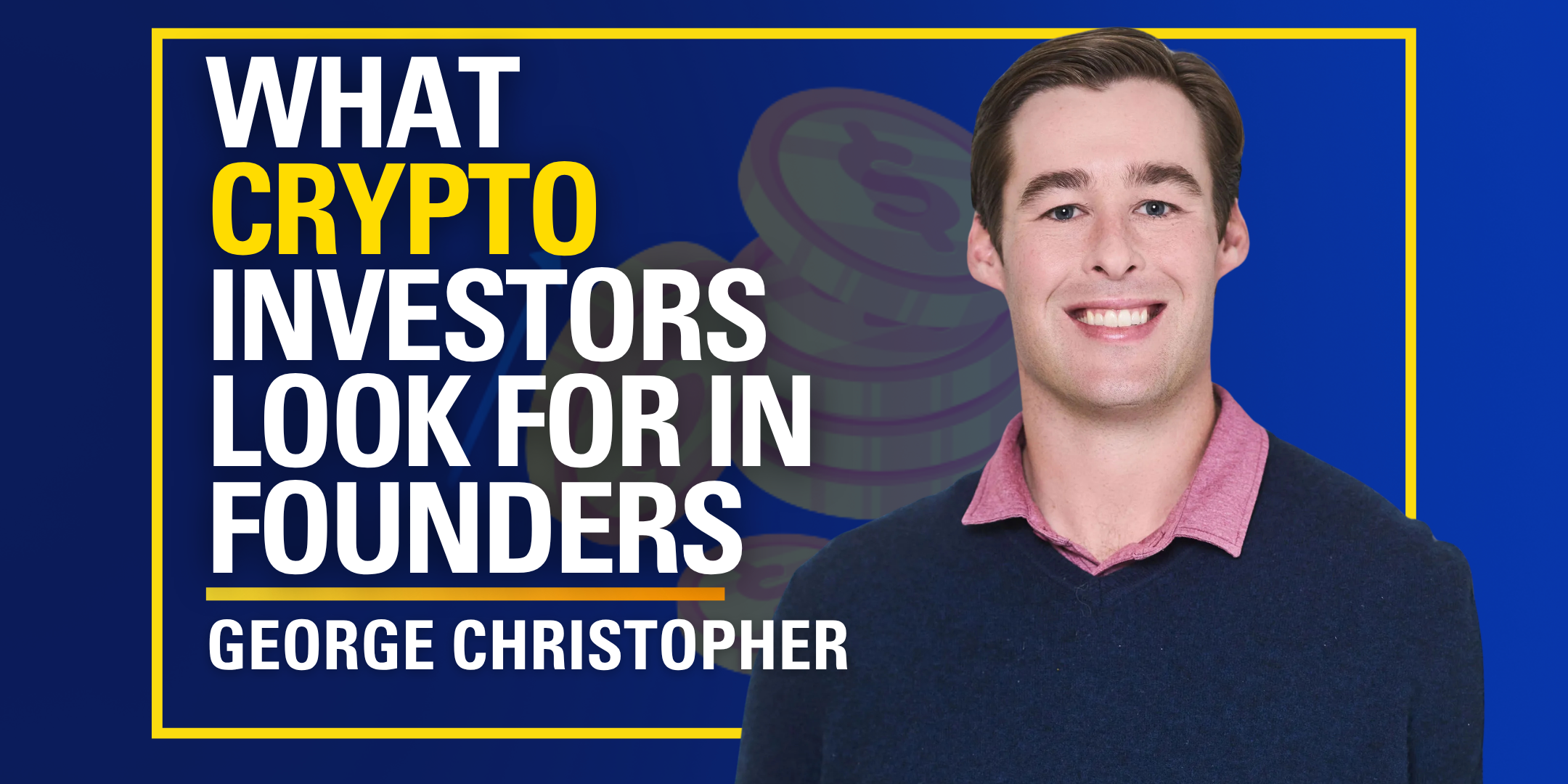
What Crypto Investors Look for in Founders - George Christopher | ATC #628
Host Stephen Sargeant welcomes George Christopher, Principal Investor at CoinFund. He invests in founders building payments, stablecoins, and onchain financial infrastructure. With a background in investment banking and growth-stage venture at AGC Partners and Battery Ventures, he brings both traditional finance and crypto investing experience to his work. His portfolio includes Dakota, Trace Finance, and Edge Markets, and he holds a degree in Economics from Dartmouth College
Host: Stephen Sargeant
Guest: George Christopher
We are also available via:
Buzzsprout • YouTube • Quora • Medium • X • Facebook • LinkedIn • Soundcloud • Apple Podcast • Spotify • Player FM
Episode Transcript
Stephen: This is your host, Stephen Sargeant, the Around The Coin podcast.
We have George Christopher coming up. He's the principal investor at CoinFund. We talk all about stablecoins, AI, blockchain, everything in between, what he looks for in founders and vision and investments. We talk about the state of the SaaSpocalypse and everything that's going on with crypto, with AI in the investment landscape. And we're gonna jump into everything. George is so concise with his answers, and it's great to see somebody that has the values and the ethos of crypto being on the investment side.
So make sure you listen to the podcast. He leaves a bunch of his details at the end, so if you wanna pitch him or CoinFund, you might have an opportunity to do so. Check this podcast out and let me know what you think.
Disclaimer: This episode of Around The Coin is for informational and educational purposes only and should not be considered financial, investment, legal, or tax advice. The views and opinions expressed by the host and guest are their own and do not necessarily represent the views of Around The Coin, CoinFund, or their respective affiliates. Any discussion of companies, funds, digital assets, cryptocurrencies, stablecoins, DeFi, or other investment opportunities is not an offer, solicitation, or recommendation to buy, sell, or invest in any asset or security. Investing involves risk, including the possible loss of principal. Always conduct your own research and consult a qualified professional before making investment decisions.
Stephen: This is your host, Stephen Sargeant, Around The Coin podcast. And we've had a lot of VCs and investors on the podcast recently, as well as our Futurist Blockchain Live conference content. But we're excited to bring George Christopher, who's a principal investor at CoinFund.
George, I think a lot of people have heard CoinFund.
Maybe you could kinda give us the lay of the land of you and what CoinFund specializes in when it comes to investments.
Goerge: Yeah, happy to, and thanks for having me on the podcast. I'm George, as you mentioned. I'm a principal here at CoinFund. CoinFund's one of the oldest crypto-focused investment firms, so it was founded in 2015. We invest out of two funds, so we have a seed fund and a venture fund. Across those two funds, we invest in opportunities all the way from pre-seed through Series C plus so quite a range there.
But we're focused on investing in companies that are, are leveraging or building blockchain technologies. So yeah, that's the quick background and I'm sure we'll get into more detail over the podcast.
Stephen: And you started out with like growth stage software investment before you got into like crypto native stuff. What are your thoughts on the rise of AI, and how do you think that impacts, you know, some of those, you know, original software investments that you made? What do those companies have to do in this kind of age of AI to get past the SaaSpocalypse, as many people are calling it?
Goerge: Yeah, definitely. And a little context there. I started my career in investment banking where I was focused on advising middle market SaaS companies that were either raising a later stage growth round or were looking to be acquired. I then moved over to the investment side, was at Battery Ventures for a little over three years where we looked at much the same sorts of companies whether they were late- raising a later stage growth round or looking to be acquired.
Battery kind of covered the full gamut there. In terms of software and the current state of the software markets, I think like terms like the SaaSpocalypse are a little bit absolute in nature. There's definitely that, that industry has definitely taken a hit. You've seen some multiple compression, but I do think you know, the SaaSpocalypse is a little bit of an absolute.
What is really being affected and will continue to be affected, in my opinion, is things like horizontal workflow tools. They're easy enough to recreate with a pi- a-a AI-powered tooling software. And also part of the reason why those workflow tools are taking a hit is because the people or entities that are, are being productive are not always people anymore.
They can be things such as AI or AI agents. And so with the efficiency gains that AI is bringing it's those things are efficient enough where, you know, it's worth breaking whatever workflow that used to be sticky because there's so much efficiency that is being brought that like the habits and that kind of kept you entrenched in that workflow prior to AI are gone.
Where SaaS is defensible and will continue to do well, in my opinion is where there's moats that can't easily be recreated by AI. So proprietary data is something that tons of people talk about as a moat. Things around like that need security and, and guardrails, like you can go and vibe code a, a tool that could be great and have a lot of the same functionality, but if there's no like cybersecurity around it, then you know, people aren't just gonna like switch off because it's like slightly cheaper if that new tool poses a big security threat or there's no guardrails and that new tool could go off and kind of ruin mission critical systems within an enterprise today.
I also think-
Stephen: reliant on AI and then like you're using Fable and then they, they turn off Fable for three weeks, like companies can't afford for the AI not to be working for any period of time, much less three weeks
Goerge: and then also, you know, I think we'll get into this a little bit later in the podcast, but I spend a lot of my time looking at companies that are using stablecoins to power payments. And I think there's like a few things within that like fintech category that can really serve as moats. So like licenses are a great example.
And then also capital and liquidity can be a moat as well when there's software or workflow tools built on top of said capital or liquidity. So yeah, I, I, I spoke a lot there, so I'll pause. But yeah, I think it's a, it's a mixed answer.
Stephen: No, you have a great, some great insights.
One of the threads I wanted to pull on was around like late stage or, you know, growth stage companies versus like, you know, companies that invest with some, with a founder and that idea. What are the kind of the nuances investing late stage versus very early stage or, you know, pre-seed rounds for some of the-- for you as an investor?
What's the challenges? What are the advantages maybe? And how do you approach, you know, whether it's early stage or late stage, how do you approach some of these companies and the investment into them?
Goerge: Definitely. I think starting at the early stage, the thing that's like most important is just the team. You really wanna be aligned with the founder and you want to have a s- shared or similar vision of how you think the world is going to mature because they might just have an idea with no team or no product, and what they're really building for is a future that's six to 18 months down the line.
So you wanna have like a shared vision because they're gonna be building for a world that may or may not exist in 18 months, and if you don't share your vision of how that world is going to exist, then the product that they build is probably gonna be wrong. We can chat more too around like the qualities that we look for in a founder, but we usually want them to spike in a few areas, whether that's, you know, they just are killer in go-to-market whether that is just they are, you know, a professional in their field, an expert in their field, and you know, they're top 1% in understanding the problem that they're gonna go after.
I think the team is like the foundation for all you know, kind of pre-seed and seed bets. And then the other major attribute is just market as well. You want them to be going after something big something that's, you know, worthy of a, of a venture style outcome. As you start to move into later stage what you really wanna see is signs of product market fit and the capital that you're giving these companies is less about, "Hey, you have a great idea," you know, "We think super highly of you."
You know, "Go off for six to 18 months and build a product in a market that we think is exciting," to, "Hey, you have a product, you have customers, there's something that's really working here and we're just giving you capital more to like, you know, put fuel on the fire. Take this money, build out a sales and marketing team put the money into, you know, the sales and marketing team that already has a motion that's working or go develop like an ancillary product that you can go upsell to your customers."
So that's like the high level vision of how we think about things between the funds. At the Series A plus stage, you really wanna see things working and you know, you're just pouring fuel on the fire at that point.
Stephen: That makes a lot of sense.
I'm curious, how did you get into crypto? 'Cause you transitioned it seemed to CoinFund in 2024. 2024 is kind of the height of the AI revolution. A lot of the crypto VCs turned into AI VCs overnight. What made you attracted to something like CoinFund that's very crypto-focused and obviously AI components and AI elements with a lot of the companies that you're working with, versus like going all in on the kind of AI investment theory that many others probably took around that time?
Goerge: Yeah. There's a lot of pieces to that, that question. But I think, you know Kind of reason number one I got into crypto was, you know, I came into crypto as a, as a hobbyist. You know, prior to joining CoinFund you know, I was someone who was passionate about crypto on the side. So I was fascinated by the technology.
I resonate a lot with the ethos of the crypto community. So, you know, lots of things that people out in the world perceive as normal, I think I question and the crypto community questions, you know, kind of the normal talking points, like being paid BIPS on yield in your checking account while banks are loaning those out at like high single digit interest rates.
You know, the ever-growing money supply here in the US, even though the US has like one of the most, or if not probably the most powerful and, and stable currency in the world. You know, seeing that kind of money supply continue to grow and the effects of inflation, especially kind of early 2020 into COVID.
And then other things such as like large tech companies collecting and owning and, and profiting off of data. These are all things that like don't intuitively make sense to people in the crypto community and, and things that resonated with me as well. So that's what got me into this space originally.
You know, I really enjoyed learning about crypto and blockchains and using the protocols. And then, you know, as I got more and more into that, interacting with people in the space. So all of those things from a personal level were reasons I wanted to make the jump full-time into crypto. From, you know, an investing standpoint I think that's, you know, a super interesting question.
As you mentioned, a lot of folks were getting into like pure play I- AI at that point. I think would start off by saying I don't think that joining CoinFund was like a mutually exclusive decision to like, you know, just invest in crypto and not invest in AI. At the end of the day, blockchains are, are just software and infrastructure, and there's plenty of surface area between, you know, AI and blockchains.
One of our, our founder Jake Brukhman wrote about the intersections of crypto and AI as early as 2022. It was something that was-- he was very passionate about during my interview process at CoinFund and we've made a number of bets in that space. So I do think there's some surface area so it wasn't, you know, kind of mutually exclusive in terms of moving away from AI.
And then lastly, I think we'll make the point that a l- you know, a lot of people in, in venture will say one of the most important things is, is being non-consensus, right? And so, you know, I think crypto and blockchains has gained a lot of, you know, it's become a lot more consensus since I've joined the space.
Maybe not in, in the ways that people would thought it would've worked, but I think like in our mind, in most people minds, like stablecoins are, are here to stay, right? And banks and traditional fintechs are, are moving into the space and starting to adopt this technology in real time. But I do think there's a lot of like use cases for blockchain infrastructure that are still not, not very consensus.
And in venture, you know, you get paid for, for being non-consensus. So Very multifaceted answer but I think a combination of thinking there's exciting opportunity from a tech adoption standpoint and also a personal interest perspective led me to, you know, getting into the space full-time, and I was lucky to land at a place like CoinFund
Stephen: And you mentioned stablecoins. There's like now stablecoin conferences, stablecoin, Stablecoin is coming up in New York, and there's all these stablecoin conferences. If you were to keynote speech of where we are right now in VC investing into crypto, what would be like your key takeaway for everyone to walk away with that are now getting involved in stablecoins?
Is it a, you know, is it an investment market? Is it a builder's market? We just saw, you know, Bitcoin's price spike up quite considerably. Does that change, you know, how the VCs interact with some of these companies and the companies that approach or the AUM, the, the capital that's flowing into your funds?
Does it change with the market conditions? Can you give us the lay of the land of the current VC market in crypto?
Goerge: Yeah, definitely. You know, I think that crypto is, like, very much inherently tied to, like, the market prices, right? It's... You can feel the community, you can feel crypto Twitter kind of come and go with the numbers on your, on your trading terminal. But you know, as a venture investor, you have to take a long-term view.
So, you know, right when I got into the space you know, I think like many others, I, you know, was checking checking the price, you know, probably way too often. And now, like, even in, like, you know, when, when prices are down you know, you just are much less tied to that because you have a long-term belief in the technology and the value that it brings.
So I would say, you know, CoinFund and, you know, plenty of other venture investors in space, we take a five to seven-year view. And so the short-term prices can certainly affect the mood of the industry overall. But I don't think it, you know, it does not, at least in my opinion, like, hurt my conviction in the space long term.
In terms of whether it being an investor's market or a builder's market, I think, you know, the answer is both right now unfortunately. Capital is, like, very abundant at the top. As I mentioned, if you have a founder who comes from a, a great background, has worked at some top companies, and has, like, the perfect experience to build in a space and is building something that is exciting that, you know, in a category that's hot the capital's gonna be there and it's gonna be there's gonna be a lot of interest in that round.
Price is gonna be driven up. But it's very top-heavy. I would say that if you're not kind of fitting that mold capital is less abundant, I would say. So there's a bifurcation there. And so the answer would be both. I think kind of across the board you're still seeing, like, general excitement in a bunch of blockchain infrastructure categories.
I'm sure things that you've talked about on this podcast, or I've heard you talk about on this podcast, are things like payments, prediction markets. Perps have gotten a lot of attention over the last year or so. And so I do think you know, there's some generally exciting niches and categories within blockchain venture that continue to drive attention.
And it's been really fun to look at a bunch of companies across these spaces.
Stephen: You know, looking through your portfolio companies and when you invested them, I feel like CoinFund was very early into things like decentralized AI training networks, AI-native financial institutions, RWA platforms. You know, with AI seemingly reaching peak performance, what part of the investment thesis has to evolve, you know, over time from when you joined to now, especially with the, you know, the rapid rate in ch- of change when it comes to AI?
Goerge: Yeah. Super interesting question. I think as, you know, there's a few ways to answer that. I think one is just how AI has, like, changed the workflows and the job for someone who's in venture. You know, we are very concentrated on using Claude in our everyday workflows or other kind of leading frontier models.
But it really helps with things such as, as research. It helps with things such as company discovery. So there's plenty of ways that AI has not only helped with like kind of scoping out new markets, understanding those markets understanding what companies are in those markets, but also then like helping with diligence of specific opportunities.
The efficiencies there are just massive. In terms of investing and kind of what categories we're looking at as you mentioned, AI is exploding, and I think the surface area of where AI touches has just continued to expand. So having like a core understanding of AI is super important as it begins to leak into other markets, whether that is payments, whether that's financial infrastructure.
Having a baseline and advanced understanding of AI is really important as you look at markets that, you know, you wouldn't think necessarily overlap or haven't traditionally overlapped.
Stephen: You know, what's interesting is you've mentioned prediction markets a couple of times. We had Sina Thomas from Edge Markets on here talking about the need to power these, you know, financial rails that are happening 24/7, in the evenings, on weekends, which is when a lot of the prediction markets and gaming and gambling, you know, type of-- that needs these stablecoin infrastructure, needs the payment infrastructure.
I'm curious, when you think of something like prediction markets and what's happening in the US with bans or the CFTC getting involved, how much does regulation impact your, you know, investment decision-making? And are we starting to see more enforcement bans in prediction markets in the US? Like, does that looming regulation, is that more-- is that exciting for you?
Because, hey, if you bet on the, you know, regulatory clarity eventually, like many people did with stablecoins, then you're on, you know, you're on the right side of history. How much does, I would say, like, regulation impact your investment theory?
Goerge: Yeah, it's definitely something that you know, we want to understand and, and we do understand and we take into consideration around the bets that we make in certain spaces. I would say, you know, within vent- within venture, you know, regulation is very much like a binary risk where it's easy to, you know, because of regulatory uncertainty, it's easy to say like no and write off an investment.
But as you mentioned, when like the regulation does work out in the bull case underwrite it can be a very powerful moat. So we really wanna understand all the regulatory surface areas that a company is, is building under. And also within specifically like, you know, areas like payments, we wanna make sure that the companies and the founders that we're working with are taking like a regulatory first or like a compliance first approach.
But it's definitely an interesting balance. With prediction markets, I do think like regulatory clarity is only gonna help like continue to you know, grow the business. Obviously, you know, there's some... Especially at the state level there are some entities that don't like what's happening with prediction markets.
But I will say I'll use like the Genius Act as like the example here. Like the Genius Act defined you know, kind of what stablecoins had equivalence, which kind of the structural setup for what stablecoins would be allowed in the United States. And once that structure around stablecoins was put into place you saw kind of a rush in towards like acceptance.
So stablecoins had already proved that they were useful, but many people wouldn't even like touch them or start to integrate them into their flows because they were worried about this like pending regulation. So, you know, even if the regulation doesn't like work out perfectly to be like overall bullish for a new technology category, like just having that clarity around like where the market sits, like what is allowed and what is not allowed, allows people to like adopt the technology and start moving into the space.
So I certainly think we need more clarity around regulation with things such as prediction markets, 'cause there are things that are up in the air. But I do think like prediction markets are definitely here to stay. And once there is that clarity in terms of regulation around prediction markets, it will only enable companies that maybe are hesitant to touch the technology now to move into, move into that space more quickly and with more certainty.
Stephen: How much do you have to take in, like, societal sentiment? I'm thinking of things like data centers. Everyone loves AI for the most part. They wanna see it used, especially from a business and VC, but then you have a group of people that are like, "Hey, you know, we're not really getting our share of profit from this.
It's the elite of the elite that are gonna benefit from AI. So let's, you know, let's ban data centers, and let's sue data center developments in our neighborhoods." And it turns into a political thing where many of the political and the politicians are running on that based on the amount of support that they'll get from society.
Does that have any impact with how you approach certain industries?
Goerge: I, I think it's something that we consider. You know, I think that in terms of like the data center pushback it's certainly understandable. But I also think on the flip side, like AI, as I mentioned, has, has already driven great efficiencies within society and I think will in the future continue to.
So it's definitely something that you need to balance and consider as, as a market dynamic. But it's, you know, I think one piece of many pieces when you're trying to make an investment. I also would say that in my experience, the court of public opinion can change quite quickly and is not something that is always steady state.
So I think it's something that is, is certainly taken into consideration both within like the markets that we look at and the companies that we look at. I think one of the things that's like great about investing in, in crypto and blockchain technology is a lot of the, a lot of the technology is focused on decentralization and the democratization of things that people traditionally haven't had access to.
I think stablecoins are a great example. One of the reasons why stablecoin has grown so much is because the US dollar is a great product that people traditionally haven't had the best access to. It's been hard to get access to it. It's been expensive to get access to it. And once stablecoins lowered the barriers to be able to hold a stable currency in an account in a foreign country, you saw people you know, go after that and really kind of adopt it very quickly.
I think you're gonna see similar dynamis- dynamics as tokenized stocks continue to be offered to populations that traditionally haven't been able to get their hands on US investment vehicles. So, you know, I think it's one of those reasons that have, you know, got me into crypto originally.
And so it's always nice when you're able to invest in technologies that are, you know, moving forward you know, society and, and helping people versus the other way around.
Stephen: We had Patrick O'Kane from the pod- on the podcast from Borderless Capital, and Patrick has a huge public sector experience working with, like, intelligence in the US authorities. I'm curious, what t- what does your team have knowledge-wise or earned secrets-wise that you think makes them very cutting edge?
Is it, like, the ability of the research? Is it a background like you have in, like, just the growth mechanisms that happen within SaaS companies or late stage or growing companies? What is-- What do you feel is, like, your competitive advantage going into some of these VC transactions?
Goerge: Yeah, that's a great question. I think it's a few things. So like one of the more obvious ones is just like the firm was founded in 2015, which in crypto years is, is a really long
time ago.
Stephen: lifetime ago. If you've la- if you've lasted this long, you're probably doing something right with the amount of markets that we've had in the last decade
Goerge: Yeah, no, so that's, that's like one of the things is just we have a longer data set, especially within like crypto and blockchains in terms of, you know, what has worked and what hasn't worked. So kind of pre-investment we're able to pattern match against that data set which I think is unique and differentiating.
I also think it really helps our, our portfolio companies after, after the fact, you know, after we've made the investment. We, you know, have backed over 100 crypto companies since being founded in 2015. You know, we've seen what works and what hasn't worked, and we're able to kind of help founders avoid some of the, you know, potholes or maybe steer them towards some of the things that you know, great founders within the portfolio have done.
And to, you know, kind of help kind of streamline their process as founders. So, we like to take a board seat on most of our investments so we can help use, you know, our learnings and share those with our portfolio founders to help them kind of maybe avoid some of the missteps they would have had if we hadn't been there.
In terms of other things that I think are helpful, I think we have a very unique you know, team in terms of team composition. So, there are members of our team that come from like very crypto native technologist background where they were engineers prior to working at CoinFund and they have a deep understanding of like the tech and infrastructure at a level of like they were hands-on with the code for, for many, many years.
We also have folks that come from a background more like myself where, you know, we've been kind of career investors. So David Pakman, who heads up our venture fund, was at Venrock for 15 plus years you know, prior to, to coming on board at, at CoinFund. We also have, David was also a, a previous founder, so it's nice to have that experience on our bench at CoinFund.
So David was the, the co-founder of, of Apple Music and also co-founded a digital music library called MyPlay. So he has that like true experience as a founder, which is great. You know, our other two founders here at CoinFund, Jake Bruchman was a, a technologist, as I mentioned. So he's like very deep into the code but now has also been in, in venture for 10 plus years, so he has great experience there.
And then our other co-founder, Alex Felix, again, traditional finance background, was working in private equity prior to co-founding CoinFund. So I think we have this like very unique team mix that trickles down from, from the top. And that enables us to look at companies both from like a pure like technologist ex-founder perspective, but also from like a, you know, metrics driven more traditional finance perspective as well.
So I think those would be like the main things that I would highlight that help us, you know, both with making investment decisions, but also with helping our portfolio companies post-investment.
Stephen: Love it. Let's get to the nitty-gritty. We have founders, entrepreneurs from payment tech, crypto, AI listening to this podcast. What are you looking across? When you look across your Rolodex of impressive founders, what are some of the key characteristics that you think that you see in the most successful portfolio companies under your umbrella?
Goerge: Yeah, definitely. It's a, it's a great question. I think there's a few things and, you know, no, no two founders are the same. But I think one is that they're, like, very passionate and they're an expert in the industry that they're trying to build in. That's something that we see across a, you know, most of our successful portfolio company founders.
As I mentioned earlier, we also like, like to see them spike in a certain area. So whether that's like go-to-market I think, you know, having those, like, sales skills helps with two things. One, it helps with, you know, bringing on initial customers gaining that initial traction. But two, it also helps them, you know, raise additional capital.
Often you know, the times the check that CoinFund puts in is not gonna be the only check, and it's not gonna be the last money in. And so you need founders who can, you know, not only go and, like, sell to the customer base, but go out and sell to other VCs. So I think, like, the ability to, like, go sell and like, not take no for an answer in terms of like, you know, we're gonna be the best solution for you when you're picking the service provider or like we're gonna be the best investment in, in the current vintage of your fund.
Those are like two very valuable skills that we like to see founders spike around. So those are really the, the kind of the main things that we like to see in a founder, I think is, you know, subject matter expertise and then, like, their ability to, like, go sell. And then also, like, I think the last point that I should have mentioned as well is those sales skills also help attract other top-tier talent.
Once a company begins to scale, you need to be able to bring in people to the org that you can delegate, delegate tasks to. And if you can go sell your vision to a customer, but also go sell it to that next great hire who's gonna bring on a bunch more revenue or build out the next great product those are things that are super important as well but kind of go off the same skill set, I would say.
Stephen: What's the biggest challenge that you see as you sit on board seats or, you know, d- you have an, an elite, insightful view of these companies when it comes to hiring. Where are they struggling the most? Is it finding software engineers because, you know, these, you know, OpenAI is paying all this money for software engineers and they're, they're getting pulled to these bigger, larger LLMs and frontier companies and frontier LLMs?
Or is it, you know, just simply operational? Is it, you know, having a sales and marketing team? Where's the biggest struggle, do you think, in the hiring front?
Goerge: Yeah, definitely. I think it, it, it varies a lot on, like, the stage of the company. I think with-- in the age of AI, like if you can hire a really few good technical members of the team, like you're able to scale that org out so much more now that with just a few people than you were prior to that.
So I would say like early stage, finding those few great technical hires is probably the biggest challenge. I think the later you go finding like great sales reps is something that can be kind of increasingly challenging. Someone who not only like understands the customer and their pain points and has like the kind of softer skills to go sell, but also like has like a deeper technical knowledge of that product as well, and can go talk to like the engineers at the customer, at, at the customer they're trying to sell to, and kind of sit down and have that more like sales engineer role as well can be difficult.
So I would say it like really much depends on the stage the company is at. But again, I think AI has, has really helped kind of, lead to companies be able to have like high- higher revenue per employee. So it's really about like hiring a few great ones versus just kind of mass hiring at this point.
Stephen: I'm curious, you know, you've already talked about, you know, the CLARITY Act and stablecoins that gave us a great high level. Can we talk about maybe where are the picks and shovels in AI? Is it-- and especially in the convergence of blockchain. Is it compute? Is it gonna be tokens, data centers? You know, what do we-- It's hard to identify, it seems like, what the actual picks and shovels are gonna be.
Is it gonna be the, the wafers?
Like, talk to me about what you think the picks and shovels in AI and blockchain are gonna be.
Goerge: Yeah. No, certainly. I think there's a few areas. I think compute is, you know, obviously there's gonna be a massive demand for compute that is, you know, kind of unending at this point, which is why you see all these companies rush to build out the next data center so that they are able to fulfill that demand.
So I think certainly compute is going to be one of those things that people are always gonna rely on long term, short term I think there's sort of a, an unending demand for right now. So that's certainly a, you know, pick and shovel. I think the other thing is kind of like specialized knowledge in data.
So, you know, I think at this point, all the frontier labs have, have scraped all the all the available human written information off the internet that is, is possible. But they need like specialty data around kind of specialized markets where knowledge workers are still kind of outpacing the, the frontier models whether that is within medicine, whether that's within legal fields.
Like data and fine-tune training around those models and those capabilities is certainly something that is in demand. You know, at some point, you know, those models are gonna surpass even like the highest level knowledge workers in those spaces, but they still need like data and training and fine-tuning around those categories.
So, I think like long term, like compute is always gonna be something that is, is in demand. I think also like one thing that's interesting about compute is like for every like right now, at least every like incremental like piece of compute or input, so like the more you increase the input, which is compute, the output gets better which hasn't always been the case with technologies traditionally.
So like that I think will always keep the demand for compute high because the more compute that you have, the better that you can, you know, train a model the better output that you can produce which is something that, that's unique and I think will always, you know, kind of keep pushing the demand for more and more compute moving forward.
Stephen: You know, you mentioned earlier about, you know, agents making payments and agentic finance. What are your thoughts about agentic payments? Are we gonna move further and further towards this? How does that impact some of the companies that you're already working with or seeing coming through your doors?
Do they have to have this kind of agentic workflow or agentic payments or finance connected to whatever they're building? Because soon it's not gonna be, to your point that you made earlier, it's not gonna be humans are using the tools or workflows or making the payments. It's gonna be agents that you almost have to appeal to these days.
Goerge: Yeah, definitely. I, I think that agentic payments are certainly coming. I think taking a step back, I think it's probably gonna take longer than we think. Within the ventures space, we saw like a lot of opportunity around you know, kind of new agentic payments plays coming to market at like a very early stage, like middle of last year, so 2025 through like, you know, Q1 of this year.
We're, we're still seeing it, but like there was kind of the initial rush for like nine months at the end of last year, start of this year. And I think it's gonna take a little bit longer than people think to kind of reach a point where agentic payments is, is really adopted. I think the main, the main blocker is just like trust.
Like moving money, moving funds is something that's pretty permanent and it's hard to, to move back. So people are really gonna wanna know that the right like guardrails are in place. They're gonna wanna have tested these sorts of solutions because, you know, once you kind of take agentic payments out of, out of its box, it's hard to put it back.
So I think that will probably be like one of the core things that keeps agentic payments from kind of hitting adoption you know, in the short term. But I certainly am a long-term believer and think it'll be incredibly useful. I think the other thing that's challenging about agentic payments, like making payments is something that agents can do.
It's just all the payment systems that were designed were designed with the, you know, the silly assumption that a human would be a part of the process, which was not a, not a silly assumption at all. But,
Stephen: And we still haven't even figured that out. Look at the archaic payment systems that we have to use now. If I had to send money to you in the US, I'd have to go through wire transfer, possibly stablecoins. Like, we haven't even figured out traditional ways to send money, much less robot to robot
Goerge: Yeah. So I think, yeah, it's, it's, it's, it's certainly coming. It's an exciting category. I think there's like a number of like different you know, kind of sub-verticals within within like agentic payments, whether that's like the infrastructure that, that value's actually being moved over, whether that is like the, you know, agentic framework or like the SDK that you are selling to an agent that will enable it to pay whether that is like a f- a framework or a solution which is defining compliance or like a KYA, like a know your agent.
So there's a lot of like exciting opportunity that I think will produce a, a lot of winners. And I think, you know, that it, I don't think it will reach adoption maybe in the next six to 12 months, but you know, 18 months plus I think it's, it's a very exciting category and one we're certainly keeping an eye on here at CoinFund.
Stephen: And it's funny that everyone uses the travel, you know, book your travel using an agent example, when I feel like that's the probably the worst example to use 'cause I think humans are even scared to book their travel. Like, I know when me and my wife are looking at places, she wants me to press the, you know, the, the buy button 'cause, y- you know, did we choose the right dates?
Is this the hotel? Like, is this the right flight? So I think that's a probably one of the toughest ones to choose. You know, buying something on Amazon it's a
Goerge: computer purchase, not a phone purchase, you know? You gotta
make sure like
got, you got the, you got the big screen and you can see the price and the right days.
Stephen: yeah. No, never on the phone. It has to yeah. you know, there has to be two people walking through it step by step, whereas my son's already, he's 10 years old, and he's already buying things off of Amazon. I feel much more comfortable letting an agent do that.
What's really interesting, we read your article that you did on, you know, Trace Finance and the Latin American investment that you have in the stablecoin payment ecosystem.
Maybe just explain what is Trace Finance and why was that important to, you know, bet big in LatAm's stablecoin infrastructure?
Goerge: Yeah, definitely. So we're, we're super excited about the Trace team and Trace. So at a high level, Trace is a B2B payment orchestration provider based out of Brazil. They touch a lot of the different pieces of, you know, the stablecoin sandwich as, as people like to discuss. So they do on and off-ramping so Brazilian real into, you know, USD or, or other foreign currencies.
There's also an FX component there as well, and they also do payment orchestration. So that's at a high level what Trace does. You know, ex- super excited about the Trace team the founder Bernardo and Rafa. We think super highly of them and that they spike in some of those categories that we chatted about earlier.
They have a long background in payments. They worked at one of kind of the earliest payment and trading companies based in Brazil called Transfero prior to joining... pri- prior to starting Trace Finance. And they also started and worked at their own kind of Bitcoin trading company.
So they have a, a deep understanding of the proof points around like payments and moving money in and out of Brazil that, you know, made us think and believe and, and we truly believe that, that they're, you know, kind of some of the leading payment experts especially stablecoin payments e- experts within Brazil and, and Latin America.
In terms of the thesis you know, there is a high degree of demand for cross-border payments in and out of Brazil. I think it was 1.8 trillion of FX payment operations in and out of Brazil in 2025. And a lot of the pain points that stablecoins are able to solve or are around this kind of cross-border emerging market payment pain point.
So traditionally you know, how these payments were served was through the corresponding banking network. Banks are slow and expensive. This is nothing new but they're, you know, closed after f- after 5:00 PM on the weekdays. They're closed on the weekends. And to get money to an emerging market usually took multiple hops through kind of the corresponding banking network which, you know, every single one of those participants in that chain was taking a fee, taking a cut.
And stablecoins really enabled you to go kind of from point A to point B. Now you still need, you know, per the stablecoin sandwich, an on and off ramp in both the location that you're sending the money from and that you're receiving the money from. But you know, it drastically cuts down the number of intermediaries in that transaction.
So, we saw a lot of demand for, you know, that Trace is one of those companies where they had a product that was working. They had a very impressive customer base that they were already serving and helping reduce the cost and the speed of, of the payments that they were making in and out of Brazil.
And so I think, you know, a few things that Trace hit on was they're part of that emer- they, you know, they're serving that emerging market pain point. Brazil is a, a massive market and they're already starting to expand outside of that into LATAM. And just like one of the core things that we, we loved about LATAM and, and the thesis there is that you're starting to see, you know, kind of adoption across the board from enterprises to retail.
Stablecoins have really found product market fit. And so we're excited to, to partner with Trace in kind of easing payments within Latin America and within Brazil specifically.
Stephen: And I think, you know, payments is one of those things that, you know, relies heavily on subject matter experts and infrastructure within the actual communities that they serve versus like people from the-- like a company from the US being able to service the Brazilian market. You almost need people on the ground that understand the mechanics of how payments are used and work, and the challenges that I'm assuming go along with those banking relationships.
Goerge: Yeah. It's-- I also
think that's something that I want to hit on as well is that you know, when people think like Latin America, I think people especially if you're not from there or spend a lot of time there, you think of just kind of like one big, you know, almost like, you know, one, one, one big area, almost like it's the US, right?
But there are a ton of like cultural differences and also like technology differences within, you know, kind of their core banking systems within each of those countries, but also from just like a go-to-market perspective, like understanding culturally and like the culture dynamics of the customers that you're serving and selling to.
I think it's really important to have boots on the ground. And you know, that's, you know, part of the reason that we're excited about the Tray's team is just their kind of nativity to Brazil and their understandings of the market there.
Stephen: I'm curious if you think stablecoins can win in these emerging markets first versus like the Canadas and which are struggling with regulation right now. Do you think the next generation of like billion-dollar unicorn Fintechs come out of these areas versus like Silicon Valley or New York?
Goerge: Yeah, it's a good question. I think there's like, there's room for both. I think like one of the things that we thought about and one of the risks, frankly, about like investing in LatAm which we haven't shied away from, is like it's harder to get capital in. Like the amount of venture investment that goes into companies that are building in LatAm is, is certainly lesser.
And then like the amount of outcomes are, you know, again, it's, it's less, it's less like big outcomes that come out of LatAm as well historically. But you know, there is a blueprint there. So like I think like the easiest one to, to point to is like Nubank, right? It's a massive company. And the reason why it has become so massive is because it really serviced a, a large pain point for people in, in Latin America.
And that pain point had a huge underlying addressable market. There's also companies such as Mercado Libre, Dlocal that have had successful outcomes as well. And so one of the things that we were, you know, thinking about prior to investing in Trace is just like Trace fits the mold of like what has worked before in Latin America, which is like fintech.
So, you know, all the big outcomes that have come out of Lat- Latin America historically have been fintech companies and Trace fits that mold. I also think, you know, while there have been, you know, while, while Nubank is a, is a massive outcome, there's plenty of large fintech outcomes over the last decade, 15 years that were, you know, kind of founded in New York or in San Francisco or, you know, even in, in London.
So I don't think necessarily like all the biggest outcomes are, are gonna be, you know, kind of home or, or centered in, in Latin America moving forward just 'cause stablecoins have, have found adoption there. But I certainly think there's room for it and there will be a few.
Stephen: What are some of the challenges? Obviously, like places like the US have these, you know, investment protections, lots of regulations, guardrails. What are some of the challenges when you build in these emerging markets that may not have s- the, you know, the, those financial guardrails in place? Obviously, you know, government relations is a huge thing in places like that.
Not even so much corruption, but like friendships and, you know, government. You, you see even in Asia and China, like governments are backing certain companies versus others and, you know, one winner takes it all. What are some of the challenges with building in emerging markets?
Goerge: Yeah, there's, there's certainly challenges. I would say, you know, some of the regulatory frameworks are, are less permanent and so things can always be changing. I think that goes to the underwrite of the founder. Being able to kind of have a very clear vision of how you think things are going to evolve and emerge from a regulatory standpoint are super important.
And then also I think being able to like have a voice and be like a thought leader in those markets as well. Because I think, you know, t- to the credit of a lot of the, these you know, folks in emerging markets, like the regulators want to have the proper regulation in place. And they look to the leaders in the space for, for guidance of how that regulation and, and framework should work.
And that's been our experience with Trace is, you know, they want to put in place a framework for stablecoin payments, which, which they have, which is coming into effect later this year. And so I think you want to see a founder that has a very clear vision of the future and also has a voice and can help kind of frame or, or shape that market and how it's going to look in the future.
I also think one of the things that gave us comfort about investing in Brazil is, again, Brazil has like traditionally been very friendly to, to fintechs. They want to encourage these, you know, companies like Nubank that have become massive drivers of their economy to, you know, they want them to be successful.
They want to put frameworks in place that allow these technology companies to thrive, but they also wanna do it in like a, a safe way that protects you know, the users of that application or the consumer or customers. And so, you know, I think that was one thing that gave us comfort in Brazil is like certainly like the regulation is a little bit more changing than it is in the US.
But I think they want, you know, it's, it's, we can see through pattern matching that, that regulators want to kind of support economic development and have like the best tech companies that are being founded in their countries thrive.
Stephen: I'm curious, how do you make some-- how do you make venture returns then? You know, everyone knows stablecoins in Latin America. It's not exactly, you know, hi- it's hiding in plain sight now. How do you as a venture capitalist and investor make, you know, make returns when something is now so obvious? Or is it based on the bets that you made when it wasn't as obvious?
Goerge: Yes, certainly. So I think, you know, making the bets when it's not as obvious is you know, we, we have a number of bets across the space which is you know, super helpful and I'm glad that, you know, our fund already has that exposure. It certainly makes it easier to, to have those returns when you're betting in a space that's not obvious.
But I do think like there's going to be kind of years and years of people that are using stablecoins or stablecoin power payments of companies that will like, will have those returns. I think from that perspective, right, like the bets that we were making when it was not obvious, there was also like a much smaller segment of founders that were building in the space.
Now you have like people that are, yeah, yeah, there are a lot of people coming into the space that are, are very smart. So like that almost makes it like less obvious is because ins- instead of choosing like one out of 100 companies, you're now choosing one out of 1,000. And so that makes it like, you know, it's l- let's...
Even though the space might be consensus, the company is, is not consensus. So I still think there's plenty of space for, for new winners that haven't been founded yet as they move into the market.
Stephen: It's funny, we were speaking to Sameez Bayyan from Draper Dragon, and, you know, talking about 1,000 companies. What if I showed you 1,000 AI and crypto companies, startups today? What do you think the characteristics of the top two or three investable ones would be? Or what would be the common threads of the ones that maybe, m- not to say whether they'll be successful or not, are within your risk appetite or within your investment thesis?
Goerge: Yeah, I think, you know, as I keep coming back to it, but like the founder obviously is something that, that separates and then having like a very clear future or very clear vision on where the future is going is something that's super important to us. I also think you know, especially within like taking stablecoin payments as the example there's categories that are, I think, im- you know, going to have large outcomes and may have like less attention at the moment.
So like really focus on building in those categories or maybe, you know, there's, they're building a, a neobank and they have like really some, some unique insight on like, a wedge or initial way to find product market fit in terms of like a unique go-to-market or unique customer base that they feel is underserved, and then they can use that initial wedge to expand from there.
So I think like founder one and then ex- you know, in markets that may be more consensus, like having like a non-consensus you know, more like niche product that they wanna build or having like unique approach from like a distribution or go-to-market standpoint is something that we'd certainly look at, especially in crowded markets like AI and stablecoin payments.
Stephen: How do you balance conviction, you know, shiny object syndrome, long-term thinking? Like we saw recently, you know, several investors got liquidated 'cause they bet all in AI and some of the stocks went upside down. Like how do you manage your conviction long-term thinking, but also not missing the boat on some things that are extremely hyped up right now that may not be...
Like DePIN's a great example. A lot of companies invested in DePIN and VCs invested in DePIN. Right now it's quiet, but we can see in the next two or three years it's probably gonna be, you know, the infrastructure for everything. It's probably gonna be the hype cycle that we go through. How do you balance all these different factors when you think about investing?
Goerge: Yeah, I think it's a, a lot of just like building your own conviction and thinking about things and building thesis in spaces before they get hot. That way, you know, you know what your viewpoint is. When things get hot, when there becomes a lot of noise you can say, "Okay, like I have this approach that I built and this thought process and framework that I built in more measured times."
It makes it easier to not get caught up in the hype. And similarly, when things, you know, go down or, or seemingly go away you know, you still have that framework that you can go back to and kind of, check yourself against. Because if you are coming into a space late if you are trying to build an investment thesis on a category while evaluating a company in that category, it's easy to get things conflated.
It's easy to you know, it's easy to get caught up in the hype. So I think, you know, part of venture is not only like, you know, talking to founders and, you know, looking at new investments, but also building conviction in categories that may not exist yet or that have seemingly taken a hit and kind of building your own framework and building your own convictions separate l- separate of like market category and trends.
And luckily, you know, at CoinFund you have-- we have a lot of like very smart people who are smart across a bunch of different categories that you can help bounce those frameworks against. You-- We're always, you know, surfacing new ideas to each other, giving each other feedback and that like thought partnership is super helpful as well.
Stephen: When you look back, I see a lot of investments that you made back in early 2018, 2019. How much does founders have to adapt or add in AI in order to be competitive in the industry? Like I just had a look at Za- Zapier's website. I'm like, "I remember Zapier API only," you know, infrastruct-- Now it's like AI, agentic workflows, and, and not to say they've changed, but they've had to evolve with the times.
How quickly are some of the companies, like the NFT companies or, you know, the order books that you've been investing in earlier, how much have they had to leverage AI and to evolve with AI in order to be competitive in today's landscape?
Goerge: Yeah, I think it's you know, everyone across the board I think needs to adopt AI in some form or capacity. But I also think like, you know, token maxing is probably not the right approach. Like just dumping a ton of spend and, you know, building it into one of your biggest like OpEx line items is probably not the smartest way to approach it.
So I think it certainly needs to be part of like your development and coding process. It certainly should be helpful in terms of automating outbound or, or go to market. But I also think folks need to be measured in their approach in terms of how they're adopting AI. And you know, as, as, as we've mentioned, you know, crypto comes and goes in cycles.
You know, I think AI will, you know, be up into the right long term, but you know, kind of how it gets to that point is, is still very much up in the air. And so I think people need to, you know, take a measured approach because the, the future is uncertain. So use, use AI for what it's good at today, where it can be helpful, but certainly don't like bank on, you know, AI to completely transform your company all by itself.
So I think that, that would be my, my advice to portfolio companies and, and what I've seen my portfolio companies kind of do.
Stephen: Speaking about the future, what would you think or is there anything that you're looking out on now or the future of CoinFund, maybe a new fund that you might be thinking about? Can you give us anything that we should be looking forward to, whether it's at CoinFund, whether it's like, you know, data centers in space with Elon?
Like, what are some things that are interesting you about the future of blockchain, AI, tokenization and most importantly, investing?
Goerge: Yeah, certainly. You know, I think we are gonna, you know, continue to stick, stick to our core focus here which as I said, you know, we're, we're very excited about companies that are building or using blockchains or decentralized technologies. As you mentioned, like the-- or as I mentioned earlier the surface area of AI is continuing to expand.
And so we're gonna see a lot more intersection between AI and those, you know, kind of traditional focus points for us whether that's payments, whether that is you know, blockchains and, and decentralized technology. So really excited to see kind of how all those industries evolve. I think one area that I'm particularly excited about is just DeFi.
I think like, you know, as you mentioned, the market has been down historically. DeFi has been in a, a definitive lull. But I'm, you know, very bullish on, on DeFi moving forward. I think it democratizes a ton of interesting financial tools and primitives. And I think we're on the way there, starting with stablecoins, with putting really interesting assets on chain that will unlock some of the older primitives.
So, like overcollateralized lending in the past, a lot of that has been, you know, used to just fund more crypto investment. As you start to see tokenized stocks equities, other RWAs, private credit come on chain I think it's gonna unlock... The, the infrastructure that's already gonna be built is gonna unlock a lot of interesting use cases and allow people to do things that traditionally haven't been available to them, like take out loans against their stock portfolio.
And that's been something that historically hasn't been, you know, available to the masses, and I think soon will be. And so I'm, I'm very excited about the long-term kind of perspective and the long-term use cases around DeFi that you know, have sort of been, sort of been a lull, a little bit forgotten at the current moment.
Stephen: And I think now we know there's a-- You know, I just read the Financial Action Task Force, their guidance around DeFi and compliance and regulation. And I think the biggest question always is, is like, is this decentralized or not, right? Is it, is it in, in fact DeFi or is it just, you know, have this DeFi wrapper to avoid regulation and supervision?
I think once we can clarify that, you'll see a lot more growth in the area. As similar to what we saw with stablecoins, once you make a decision of whether crypto is a security or not security, once that decision is made, it's so much easier to move forward. So I think regulation and guardrails is actually gonna be helpful for the growth of DeFi, especially the companies that don't fall under, you know, whether, you know, the centralized approach that many of these DeFi companies still have, whether it's their governance models or their administration.
Goerge: Yeah,
Stephen: I'm curious, you know, as an investor, is there any books, podcasts that you're regularly listening to? Where are you getting your insights from? Crypto Twitter's been very active lately, but it can still be very noisy. Where are you getting your alpha from? Give us some, some alpha 101.
Goerge: Yeah, no, it's g- I think, you know, spend a lot of time on Twitter as an investor, but as you said, there's, like, a ton of noise there. But it's a great way to, like, come across new ideas, come across new companies building in the space especially within crypto. That's, you know... Oftentimes people have a Twitter page or, or an X page before before they have a LinkedIn page.
Which is, is, is starting to change I think, but is certainly something that we've seen in the past. Something that I originally, you know, as I, I mentioned when I was, like, more of a hobbyist and just getting into the space, I think the folks over at Blockworks do a lot of great things in terms of, of writing and podcasts and you know, I think still still tune into them you know, even as I'm now a full-time you know, full-time in the, in the blockchain and crypto space.
But especially for folks kind of looking to get into it, I think that was a, a great source of, like, inspiration and insight. And then in terms of, like, fintech stuff I, you know, Fintech Brainfood newsletter and Tokenized podcast I, I, you know, think super highly of as well. So yeah, those are just a few kind of areas where I, I, you know, check in and get some information.
Stephen: I love that. And where can people find you as we end this podcast? We're you're obviously not... Doesn't sound like you're living on social media on LinkedIn, but where, where, where's the best p- place for people to spend time, you know, quenching their thirst on knowledge on what you're building?
Goerge: Yeah. So CoinFund's website is, is coinfund.io. We have a, like, kind of contact and outreach page there with, you know, all my socials. But on, on X, I'm, I'm g_christopher8. And on, on Telegram, I'm g_christopher. So, feel free to reach out through any and all. And then, yeah, lastly, of course george@coinfund.io is my email.
So any and all of those channels I, I'm checking pretty frequently.
Stephen: I love that. As we end this podcast, is there a pitch that you've received maybe this year that completely stood out? And if so, what did they do? What did they say? You know, how did they approach it? Is there something that kind of stood out that you still remember from January? Like, you know, "This one's still one of the best pitches we've seen recently."
Goerge: Well, I mean, this is biased, right? But like when we invested in, in Edge obviously Sunny and, and team came through in, in a great light. I think one of the best parts of... that actually wasn't part of that pitch, but one of the things that really helped me gain conviction in, in them and that team is the customer reference and checks that we did you know, is one of those things where it's like, wow, like, you know, you're asking like, "How do you rate this team?
How do you rate this product?" And all the scores are coming back like nine and a half out of 10 just across the board. And, you know, people are like, you know, getting passionate. The customers are getting passionate about like the pain point that they're addressing and you know, experience they've had working with the Edge team.
I think that customer feedback is, was really exciting and you know, at least part of the, the recipe that got me excited to partner with the team and, you know, they've continued to, to crush it in my opinion, since we made that investment at the start of the year.
Stephen: I love that. And you're right. You know, you-- normally customers will answer your questions, whatever, but the ones that get passionate about the problem that's being solved, those are definitely, those are definitely the companies that would spark interest. George, thanks so much for joining us today.
This has been an insightful conversation, and we hope to come back maybe at the end of next year or, you know, in 12 months from now and see where we are in the market. Maybe Bitcoin will be at a million by then. We'll see.
Goerge: Well, we'll see. Thanks again for having me on the podcast. Really
enjoyed so much, George.
.png)