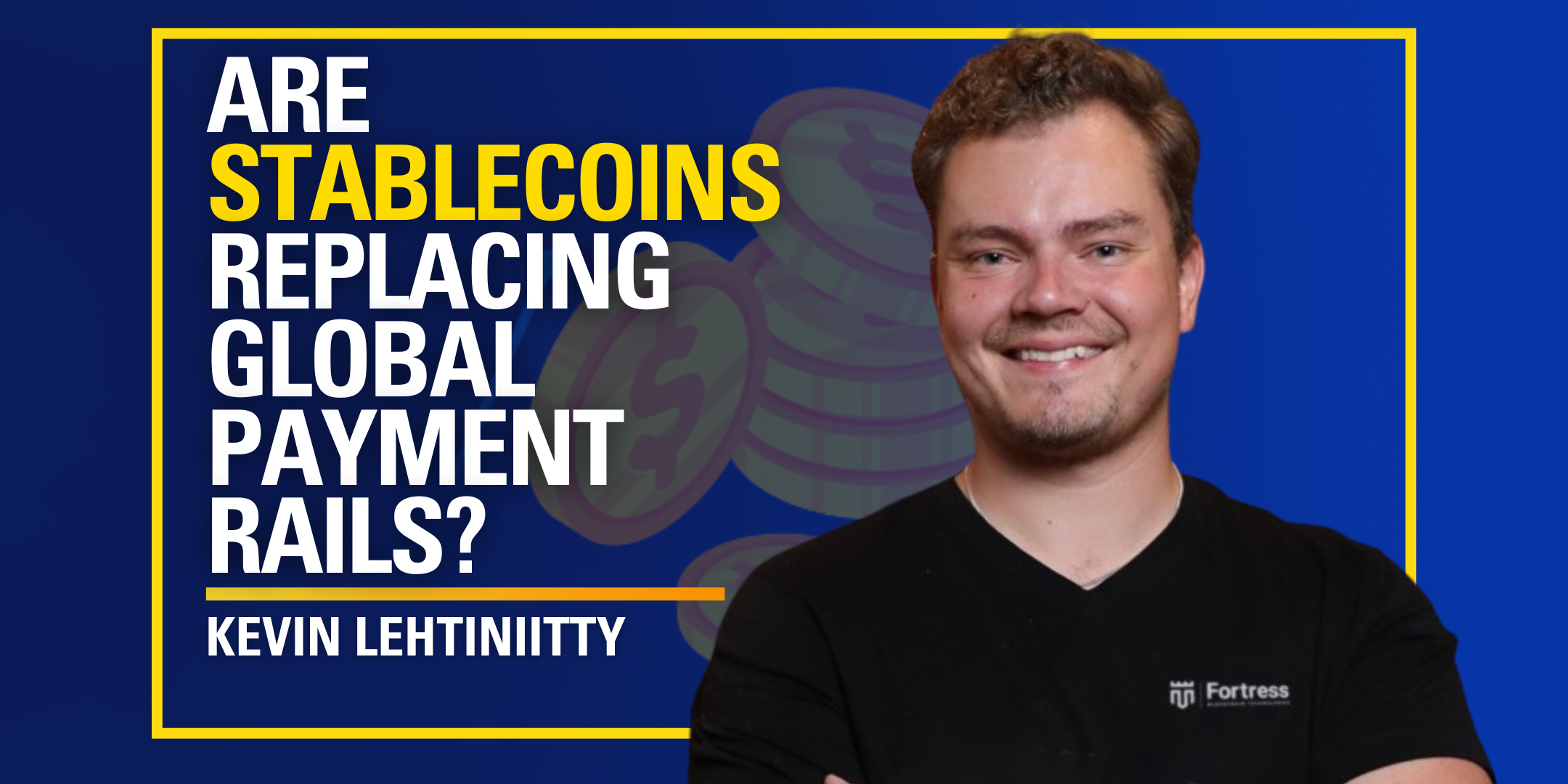
Are Stablecoins Replacing Global Payment Rails? - Kevin Lehtiniitty | ATC #602
Join host Stephen Sargeant as he interviews Kevin Lehtiniitty, CEO and founder of Borderless.xyz, a global best-execution orchestration network for stablecoin on- and off-ramps. Borderless enables PSPs, fintechs, and financial institutions to integrate across a fragmented landscape of ramps and orchestrators through a single API, allowing partners to compare real-time FX rates and intelligently route transactions across a growing network of leading providers.
A long-time veteran of the stablecoin ecosystem since 2016, Kevin helped launch the first U.S.-based fully backed stablecoin, contributed to the Ethereum token standard for real-world assets, and has built regulated digital asset platforms processing over $100B in transaction volume.
Host: Stephen Sargeant
Guests: Kevin Lehtiniitty
We are also available via:
Buzzsprout • YouTube • Quora • Medium • X • Facebook • LinkedIn • Soundcloud • Apple Podcast • Spotify • Player FM
Episode Transcript
Stephen: This is your host, Stephen Sargeant. This is the Around The Coin Podcast, and this is gonna be, I'm calling it my favorite podcast of the year. We're talking all about stablecoins, the nuances of stablecoins with the CEO and founder of borderless xyz. We're talking to the CEO of borderless, Kevin Lehtiniitty, and he's talking all about stablecoin infrastructure.
We talk a lot about the Genius Act, the way that payment flows is going around the world. He even breaks down the different typologies of stablecoins and how his infrastructure and orchestration layer differs to some of the other ones in the industry. It's just a great conversation. Kevin understands the uniqueness of the industry.
What are some of the biggest challenges they're facing, and he even gives us a little alpha about ai. This is gonna be a must listen to podcast. Listen to the whole thing. Let me know what you guys think.
This is your host, Stephen Sargent, the Around The Coin podcast. We have the CEO and founder of Borderless xyz Kevin Lehtiniitty.
Kevin, tell us a little bit about yourself. Do you like borderless or do you like borderless, do xyz. How do you like to pronounce it? Because I feel like you guys go either way. The Pentagon, the podcast podcast
Kevin: we do. That's fair. We're probably a little bit too inconsistent about it. Um, we started the company as just borderless.
Um, and you know, there's a lot of borderless out there in the world. And the kind of official change to borderless XYZ actually came from Token 2049 in Singapore. I was taking the MRT back to my hotel, um, from the Marina Bay Sands and I get off the MRT and this guy comes like at a full sprint down the station, which is already very unusual in Singapore, right?
Like everybody is like. You know, very politely behaved and all those things. And this guy's just sprinting at me and I'm like, am I about to like lose my pinky finger for my private keys or something like, what's about to happen here? And the guy's like, oh my God, I saw your t-shirts at borderless. I'm so glad I got the chance to, to talk to you.
I'm raising my seed round. And I'm like, no, I don't work at Borderless Capital. I work at Borderless the first, you know, stable Coin payments network. And the guy's like, oh. And from that moment on, we kind of realized, wait a minute, all this brand building that we're doing kind of, you know, all the marketing that we're doing, is that value actually accruing to the other borderless in the market?
And we said, okay, well then let's be very, very clear that we are then borderless the stable Coin company. So let's do borderless xyz and let's make that very clearly be the brand. That way it's differentiated from the other borderless in the market. And you know. Now, two years later, like most people know, borderless, the stablecoin company, when we were just starting out, nobody knew borderless the stablecoin company.
So we've become a little bit more relaxed now about borderless XYZ versus borderless because now, you know, we are the borderless when it comes to stablecoins. Um, but that was kind of the origin of, of that. And, uh, I don't remember who it was. I wish I did. Um, but if they're, if they're watching this, um, thank you for chasing me down on the FRT and making me realize that we, um, you know, really needed to land lean into the branding harder.
Stephen: And no, we don't have money for you still, but no, I just talked to Patrick from Borderless Capital the other day just as a friendly conversation. So that's funny.
Kevin: They are the, uh, borderless in the VC world, and we are the borderless in the stablecoin world. Um, and it's, they're not on our cap table. It would be a funny combination of the two.
Um, but you know, they're, they're certainly well respected and, uh, and so are we in payments. So it's, it's nice to have two borderless in, in their own worlds.
Stephen: You were in like crypto custody fairly early, like 2017 to 2023. You were playing around in the custody space. What were some of your first experiences with crypto, um, and, you know, how did you transition to world of digital assets?
Kevin: So I got into, um, crypto 'cause of the peer-to-peer electronic cash concept of Bitcoin. Like I've always been fascinated, um, by payments and by global money movements. I really, really bought into the value proposition of being able to move money with Bitcoin around the world. Um, I liked the permissionless nature of it.
Um, I liked the kind of global instant settling, et cetera aspect of it. And then, you know, I started to realize I think fairly quickly that Bitcoin was probably not going to become the most used asset from a payment standpoint, but it was in fact gonna gain more traction from a store value standpoint.
And that's when I started working on stable Coin specific infrastructure really, really early. Um, and I was lucky enough to be, you know, to help bring, uh, true USD to market, which was the first USD US based fully collateralized USD stable Coin that created the model around, you know, holding reserves in a qualified custodian and doing these independent balance attestations, you know, like all these things that Tether wasn't doing back then at the time.
Um, and then of course, USDC didn't exist yet when this was launched, and that very quickly turned me into a stable Coin maxi, where I think the light bulb went off. And I said, okay, this is the way that we're actually gonna do global payments. Um, and I think still to this day, I still think it's a little, it's maybe not insurmountable.
Um, but the challenge with using Bitcoin from payments construct is that you're teaching the world not just a new technology, but also a new asset class. For the world to adopt both at the same time, um, is incredibly difficult. Versus taking an existing asset, which is the fiat currency that we all use every day and putting it on a new technology, I think that's a much, much more approachable way to change the world.
Stephen: You know, you mentioned Tether, obviously you're an infra layer, so you have, you know, tether USDC and maybe some other stablecoins running through you. You mentioned the attestations and not having it, but I think there's an argument that there wasn't clear regulations in the US to like offer those, you know, there's companies like USDC and Circle that, you know, were compliant before kind of the regulations were really in place.
What your thoughts about that, especially now that, you know, tethers had, you know, were given about three years to come up with their own US compliant, uh, stable Coin. What are your thoughts about how other stablecoin companies or those looking to get into the market should. Look at it. Is it like, hey, compliance first and always, or you don't wanna do compliance too soon if your jurisdiction doesn't require you to it, and you can build it up over time.
Any thoughts around that?
Kevin: I think now is a very different world than 20 16, 20 17. Um, back then, you're completely right. There was no framework, there was no regulation that required, you know, assets to be held by a qualified custodian and managed in a certain way from a reserve standpoint. Um, and I would argue there, there still isn't today, right?
Genius act isn't in effect yet. We know what the framework will be, but it's still not, you know, in effect today. The question was more about how do you build an instrument, um, that can be trusted by institutional and enterprise adopters? And the concept of separating the, you know, reserve custody from the issuing entity, holding those reserves with qualified custodians, doing independent balance attestations, those weren't regulatory features.
Those were trust building features. It was about, you know, how do you do this in the most trustworthy way and how do you do this? Right now, today we have a lot more regulatory guidance, both in effect, in some jurisdictions think Meka compliance in the eu that's in effect. Um, and, you know, guidance that's been issued that is coming into effect like Genius Act.
And I think now when you think about it from a US-centric position, I think it very rarely makes sense to go out as a single issuer and issue a stable Coin. That that world of circle and tether and true USD and others, I think is, is long dead. Now the question is, you have kind of three models. Model one is, do you build on top of an existing tokens ecosystem?
Meaning am I gonna build on top of USDC or USDT or some single issuer? And I think what people are now finding is, hey, that means the value accrues to the token issuer and not to you. Um, and then there's two kind of ways of solving that. The first is the consortium issued stablecoins. So think like Global Dollar Network and USDG with Robinhood and with Worldpay and Paxos and Anchorage and a bunch of other folks that's saying, okay, you know, maybe to build an ecosystem, you don't want to do that as a single party, but we definitely don't want the value to go accrue to somebody else and none to you.
So what if the value accrues to a consortium of which I'm part of? So I'm not gonna get the full value accrual, but I'm gonna get more than zero value accrual. And I also get value accrual from everybody else that participates. And I think that's actually a very, very interesting model. Um, if you can kind of build this ecosystem around it.
And then the third model is of course the white label issuance. And that's what we're seeing kind of the rise of the Genius Act. Where you have a few, you know, leading stablecoin issuers, so like Anchorage comes to mind as kind of currently the only OCC chartered stablecoin issuer. Um, and then you've got folks that are making, you know, really strong headway in enterprise adoption.
Like Bastion who, um, is one of our clients and who's servicing the Sony Stablecoin and some other brands that are gonna be, um, announced I think fairly soon. And then you have kind of the OG issuers, so like Paxos that did Binance USD early on is now doing PayPal, USD. Um, I think those are kind of the three leading players in the issuance space.
And with the white label issuance, you accrue the vast majority of the value. Um, but you don't have the rest of the consortium participants to help build that ecosystem. So maybe it ends up kind of being on some sort of a tiered structure, meaning if you're a small startup and you have no ecosystem of your own.
Then you can't really contribute to the consortium and you certainly can't go at it alone. So you end up building on top of USDC, USDT, you know, somebody else's stable Coin. If you have a medium amount of distribution where you feel like you need some help, but you can contribute, then you end up in a consortium model.
And if you are, you know, a Fortune 100 company, or if you're one of the largest FinTech ecosystems in the world, think Stripe, think adden, think you know some of these sorts of folks. Um, MoneyGram, Western Union, et cetera. Then you say, wait a minute, I don't really need help with distribution. I already own a vast majority of the distribution, so I wanna maximize the amount of value accrual to myself.
And then I go and I do a white label stable point issuance with Anchorage or with Bastion or with Paxos or someone like that. I think that's the way that I think about the issuance landscape today.
Stephen: I've actually never heard that explained before and really break down stable. I think like stablecoins, just like, it's like saying the word wallet or address, it just gets lumped into this, like based on what everyone says it is.
And I think if you really break it down, and that makes a lot of sense, but. So then, you know what's curious, you know, you talk about, you know, February, 2024 is when I believe, um, borderless is you're building borderless, but crypto is still somewhat, you know, in a lull. It's stagnant. Stablecoins in the US seems like a far off dream.
It doesn't seem even possible based on the former regime and the former administration.
Kevin: Yep.
Stephen: Why would you build an ecosystem at that time, especially with all the focus and digital assets being on like Solana and meme coins at the start of 2024 and staking on Bitcoin and DeFi on Bitcoin? Why stablecoins?
Kevin: My thesis around stablecoins has always been in cross-border or global money transfer, right? So I've, I've built a lot of infrastructure, um, that is local to the US powering, you know, on and off ramps and, and fiat payments for like finance US and Citrix. And, you know, a lot of the major exchanges outside of Coinbase that Al always built their own stack and then, you know, powering the on and off ramp providers within, um, meta mask and, and kind of other folks.
Um, it was always very US centric and my thesis was always that it's really about international transfer. That's where things start to get very, very interesting. And what I started to notice was a drastic change in the amount of liquidity that existed, especially in emerging markets between stablecoins and local currencies.
And this kind of rise of stable Coin on and off ramps or like stable Coin enabled financial institutions was certainly not at the velocity that is today. It's continued to accelerate more and more, but we were starting to see these early beginnings. Um, and one of the challenges with getting stablecoins adopted back in 20 16, 20 17, 20 18, was that you didn't have the FinTech ecosystem to actually support it.
So there was this thesis that, you know, dollar access is really hard in emerging markets and you could dollarize people's savings and things like that through stablecoins. But you didn't have the FinTech apps with the non-custodial wallets, with the local on and off ramps. You didn't have the stablecoin backed card issuance that you have today.
Those pieces didn't exist. So what we started to look at was outside of the US regulatory policy, which was incredibly aggressive against stablecoins with operation choke 0.2 0.0 and kind of recent FTX collapses. You know, embarrassment of the Biden administration with all the campaign financing from SBF and like all of that noise was, okay, well if we look outside the US and we look at what's happening around the world, stable Coin adoption is starting to have all the required kindling to really start to take off.
And that's where we made the decision to say, okay, depending on how the political landscape goes in the us maybe we have to completely geofence the US and we'll say, we're just not gonna operate here. Um, and we actually seriously considered moving the company out of the US as well, and Headquartering in London or, or someplace like that instead of New York.
Um, and that kindling, regardless of what happened to the US, was gonna catch fire. So the question wasn't, are stablecoins gonna start to become widely adopted over the next three to five years? The question was, is the US gonna participate in that adoption or is it gonna be in the rest of the world instead?
Um, and then, you know, the landscape has changed the way that it has, and now the US is very much participating, but the rest of the world was gonna catch fire regardless, and that was enough excitement and enough kindling to, to make the jump of borderless.
Stephen: Can you describe, you know, what you're building in the same way you described the different types of stable Coin issuance, like either on top of another stable Coin issuer or white label?
Because I think there's companies like BVNK, there's like, you know, networks and ecosystems like Canton. There's so many different ones and it's hard to do they do everything the same? Is it like a portion? It feels very much like. The industry overlaps. And when you bring up another name of like a potential competitor, they're like, oh yeah, they don't do anything that we do.
They're completely different. Or they're our partner and we, you know, feed into them. So can you kind of distinguish maybe you and some other players that professionals would know and kind of explain like how the ecosystem works? Because I'm assuming partnerships go along with other stablecoin infrastructure as well for interoperability.
Kevin: They do. Um, so maybe, maybe I'll start from square one. Um, and square one is kind of what Borderless is trying to enable. And that is a future where we don't have the digital asset silo and the traditional banking silo living side by side. It's actually a future where off chain money and bank accounts and onchain money and stablecoins can move seamlessly between each other around the world.
That's what we're trying to enable so that we can live in a future. Where blockchain based infrastructure actually powers FinTech at an enterprise and institutional scale. But it does, it invisibly in the background. And if you can't seamlessly move between traditional fiat money and blockchain based money, then you're never gonna have this future where the blockchain powers financial applications in the background and there's a bunch of people that are building, you know, different ways of approaching the issue.
Um, and fundamentally, the issue that exists today is the liquidity and payment rails are incredibly fragmented. So on one hand you have a stable Coin on a blockchain, which is very much a global asset. On the other hand, you have fiat currencies, you have regulatory licenses, and you have traditional banking rails, which are extremely fragmented geographically, right?
You have something like an instant payments network like Pix and Brazil, and you have an instant payments network like spay and Mexico, but you can't settle from picks to spay directly, right? Those networks don't communicate with each other. Um, but now all of a sudden we have a global asset. So there needs to be some sort of a layer that connects this highly fragmented local banking landscape to this global asset of a stable Coin on a blockchain.
And traditionally that's been done a few different ways. Um, one of those ways is by connecting with payments aggregators and payments aggregators are incredibly effective for. A wide variety of, of folks in the industry. They're a great customer segment for us. Um, and basically the way that a, that a payments or an aggregator works is that you face off against one central party IE the aggregator.
And that aggregator then is connected to a bunch of different vendors under the hood that they wrap and they resell. Typically, their business model is to add FX margin, right? So they're gonna store some liquidity at 10 basis points, and then they're gonna sell it back to you at 20 basis points or something like that.
And the advantage of this, especially for companies that are just starting out, is that you get one counterparty. You don't have to manage a whole vendor stack of this PSP in this country, plus this PSP in that country, plus this PSP in that other country, et cetera, et cetera. The downsides of doing that if you're operating at scale, um, are one, you are bound to the increased FX rates because your business model is to wrap, resell and markup.
Um, two, there's very little redundancy that exists in that stack, right? If you have some sort of an issue with that provider, what do you do? Is your whole application down. Um, and then lastly, you are restricted by their roadmap and their coverage expansion, right? So if you want to go into a new geography, but that aggregator doesn't support that geography, you can't go do that.
And kind of, that's the startup. That's the trade off that I think a lot of people are making, where today they're saying, I wanna launch a PO. And I wanna launch a POC as quickly as humanly possible, which means I want to consume a black box service, and I want that black box to be entirely managed by somebody.
That way I can get up the ground and I can get running and I can do things. Um, Stripe sells this very effectively with the combination of privy and bridge. BVNK sells this very effectively, especially with the wallets business as part of layer zero. Now, um, there's a bunch of other payment aggregators that do this quite well.
What we're seeing from the market is that step two of this is, okay, stablecoins are starting to work. Now all of a sudden, I wanna start to own the infrastructure myself. I now care about reliability. I care about redundancy. I care about price optimization, and I care about agency, meaning I want to be able to expand in the countries that I want to go to not have this vendor, lockin and vendor dependency.
And those are a lot of the places where Borderless comes in. And what we've built is the world's first stable Coin payments network. Um, which now circle is in this category with CPN and fire Blocks is in this category of the fire blocks network for payments. And the concept is how do you now effectively connect to a bunch of different counterparties versus your one black box?
And if you imagine kind of the traditional finance parallel, if every bank had to integrate the APIs of every other bank it ever wanted to transact with, that would be insanely unscalable, right? We solved this problem with networks. We solved this with networks like Swift. We solved this with networks like Visa net with MasterCard, right?
Where the issuing banks and the uh, merchant banks don't have to all integrate each other. They all connect to a network. The networks connected to everybody. And this is how things scale. And this is very much the, the easy way to think about borderless. So today the network is 12 of the leading stable Coin providers in the world.
So think bridge, think Bitso, think yellow card. Um, you know, in, I think 70 something countries covering 40 or 50 different fiat currencies. And the investment that psps have to make or that fintechs have to make or that financial institutions have to make now is just one time you integrate into the borderless network, which is a single integration.
And now within the borderless network, you can enable these 12 and growing, leading stable Coin providers all around the world. So now all of a sudden you're getting some very interesting benefits. One is you're getting redundancy in your key markets, so you're no longer bound to just a single counterparty that covers a region.
Now you have two or three if one has downtime, if there's a regulatory change, whatever that looks like, now all of a sudden it's a configuration change that takes you three seconds to go un route the transactions to another provider versus having to spend months ripping and replacing that infrastructure for someone else.
The other thing that it does is it creates a competitive environment around FX rates. So now all of a sudden you can start to do price discovery, and you can say, okay, I need you as DT into BRL. Show me, you know, the five providers in the borderless network that cover BRL, and show me what their rates are.
And now all of a sudden I can get a best execution concept, and if I'm doing enterprise or institutional volume, being able to say that I have a. Some sort of best execution, and there's a competitive environment for that order flow starts to massively improve the margins and makes stablecoins an actually financially viable alternative to traditional swift based reins.
And then lastly, what I think a lot of people are underestimating is the complexity of operating across a bunch of different providers, increases, not linearly, but increases exponentially. They all have different data models, they all have different processes for RFIs, they all have different documentation requirements, they all have different reconciliation processes, et cetera, et cetera, et cetera.
So when you go from three providers to 10 providers, it's not a three x complexity jump. It's a 10 x complexity jump. So then that's where some sort of an orchestration platform comes in, which is what we've built on top of the borderless network that we call our payments hub, where you can say, okay, how am I automating reconciliations?
How am I consolidating RFIs? How am I benchmarking my execution prices compared to, you know, other network rates? And now that's all about making it actually viable to operate across this entire network because you're removing and automating a lot of that complexity.
Stephen: I was listening to a podcast the other day with Brad Jacobs talking about the early oil industry and how, you know, before internet or even like telegram, there was things like, you know, the oil prices wasn't transparent, so that's where they made a lot of their money because they would get the information for the oil prices early.
It seems very similar in this kind of like this supply chain infrastructure that you've created where it's almost like you're vertically integrating these companies versus them having to, you know, patchwork different payment processors and aggregators. And I'm gonna assume when you're only left with one option, that price is gonna be a lot higher.
To your point, the FX rates are a lot more transparent because if you only have one option and you wanna grow in a certain region. Probably like, yeah, we could grow in that region for a price versus now it's like, well, we already have five service providers in that region. Why don't you pick the price and the, you know, the facilitation that works for you.
Kevin: Exactly. And that price transparency example of the oil industry is actually a really, really relevant, um, you know, for a long time when we've been talking to a lot of these enterprise psps, one of the questions they've been struggling to answer is, how does the pricing of stablecoins actually compare to fiat?
Right? On the fiat side, you can look at a bunch of benchmarks, right? Call it xc.com, call it Bloomberg, mid market, et cetera, et cetera. You have very, very transparent price discovery around what is the exchange rate between, I don't know, let's call it USD and South Africans are, right? There's a bunch of different data sources.
There's kind of an accepted exchange rate. You can Google USD Czar and you get a number back. You can't do that historically on stablecoins. Um, you have a bunch of fragments at order books, so you can go to a venue. You can go to Yellow Card and you can get yellow cards price. You can go to, um, crisscross and you can get crisscross price.
You can go to, you know, all these different providers and get their exchange rates. But how do you know if you're getting a wholesale rate versus the airport rate? You know, which is always, uh, not quite competitive. Let's leave it at that.
Stephen: People still have to use it, right? If you're not
Kevin: prepared. But people still use it if you're not prepared.
So part of what we, um, released, uh, Q4 of last year was the first, and, and so far only, um, credibly neutral stable Coin to Fiat FX Benchmark, which we called the borderless Benchmark. And we realized because of the borderless network, we're connected into all of these underlying stablecoin providers all over the world.
And we see all of this transaction data around the quotes that are being returned, the execution prices at which transactions are processing the price feeds, et cetera, et. And we ourselves aren't a provider, right? We're an orchestrator and a payments network. So we can anonymize all this data, aggregate it, and then publish it to the world as a credibly neutral benchmark that just says, Hey, instead of going to venue A and getting venue ace price, here is what borderless sees across 12 plus and growing venues around the world.
This is what we see on the buy side. On the sell side, this is min max, this is standard deviation. And then from that we've computed like what is the borderless true mid of Stablecoin fx? And then how does that compare to like a Bloomberg mid in traditional fiat? And the past couple months, we've started to publish some research around that, which you can find on the borderless blog around Latin America and around Africa, and like what is the price premium of stablecoins versus traditional fiat?
And we can actually start to quantify these things now, and I think that's been a massively missing. Piece of information that the industry needs to continue growing and moving forward.
Stephen: And you know, I took a look at it yesterday and it's very similar to like, hey, if you wanted, like for me, I'm in Canada, I'm getting paid in the us I just wanna say like, what's the exchange rate today?
And I had that same kind of feature and ease of use. And I'm sure when you're dealing with millions, hundreds of millions of dollars, being able to forecast what this rate is in real time is gonna be extremely helpful for a lot of these, uh, these companies. And just that alpha too, right? If you're looking like, hey.
I think that price point, like our stablecoins, the better route based on the exchange rate is gonna be huge. When you're talking about emerging markets, especially, which we see so much stablecoin flow in between Latin America to Europe to Africa before the Genius Act. I'm curious what was the most well-known use case for borderless?
Because I'm assuming the Genius Act probably opens up a lot more use cases and case studies on the borderless network.
Kevin: It's definitely opened up, um, the enterprise and institutional segment. I think prior to Genius, a lot of the conversations that we were having were with kind of stable Coin native companies, which were generally smaller startups, some growing very, very quickly.
Um, but many of which were based in emerging markets, right? So based in latam, based on the continents in Africa, based in Southeast Asia, um, or US companies that were catering to user bases in those countries. Now Post Genius Act, you know, the conversations have shifted from pre-seed and seed startup to the pioneers of the world, to the new VAEs of the world, to, you know, the major banks of the world, et cetera, et cetera.
And I think that has really been the biggest shift, is that it's de-risked the entry for much larger players. There's been curiosity, there's been an interest to play in the stable Coin space, but what's been missing for these major players that have a very different risk appetite than the small C stage startup is the regulatory clarity of how they can and can't engage.
And now that that's in place, I mean. Even think about in this very small amount of time, relatively since Genius Act has been passed, we've seen Zelle announce they're issuing a stable Coin. We've seen MoneyGram double down on stablecoins. We've seen Western Union issue a stable Coin. We've seen. Go very heavily into stablecoins.
We've seen Pioneer announce stablecoin products like these are very, very large global enterprise players who now have the regulatory clarity to go and become part of the space, which is really exciting for us.
Stephen: I'm curious, Kevin, is FX exchange rate, is that still the biggest impact when it comes to stablecoins and the way they're used?
I remember looking at the BVNK decade of digital dollars and talk a lot about about like three of the important things that stablecoins unlocked and the impact that on the industry, and one of them was like releasing capital trapped in payment systems because of the amount of time it took, the jurisdiction.
Is that a huge deal, like this capital that you have there that's not being utilized, that you're not earning interest on or yield from, is that still a huge deal for most of these companies?
Kevin: That today is by far the biggest value. So in most countries, not all, um, but in most countries, if you look at the borderless stable Coin mid versus the traditional like Bloomberg mid, you'll see that stablecoins trade at a slight premium.
And that premium depends on the jurisdiction, but generally that premium is a few basis points. And that creates kinda this interesting question of, wait a minute, if stablecoins are trading at a several basis point price premium, but they're supposed to be better, faster, cheaper, how are they cheaper if they're trading at a premium?
And if there wasn't some cost efficiency somewhere, then there wouldn't be the demand that drives that price premium. So like something's happening there. And what you'll find if you double click there is the larger cost savings is around pre-funding and around locked capital. And what you're able to do is you're able to save.
More money unlocking that capital than the premium that stable coin's straight at. And that becomes the stable Coin FX take rate becomes effectively how much money are you saving by unlocking that trapped capital? And then how much of that can you capture in additional premiums over the traditional market?
And I think the, you know, the, one of the best use cases of this is probably around Remitly, which we all know is like a large consumer, you know, cross-border payments, FinTech. And they used to, um, in their public filings, they announced it's, I think they increased it, it was like 300 million to 400 million.
Don't quote me on the exact number. Um, we can lines of credit facilitated mostly by, by Citizens Bank. And that was to pre-fund the different accounts that they have around the world because they can't do traditional fiat settlements cross border on the weekends. So they need to go pre-fund. And if you have banking, holidays and things like that, you need to go pre-fund several days worth of capital and all these different jurisdictions.
And you can think about what is the cost of capital. Of that multi hundred million dollar line of credit. This is not a small line of credit. Um, that's what you start to unlock from a working capital perspective. And that's just Remitly, let alone every other payments company in the world, let alone every corporate treasury in the world, et cetera, et cetera.
That's the really big unlock that we're seeing today, and that's also the explanation of why there's so much demand for stablecoins at a small price premium compared to traditional fiat is because the speed saves more money than the FX premium.
Stephen: And I think if you're an average listener, like even just looking at mortgage rates over the last couple of years and how much they've gotten up, that those, those basis points add up, and that's only on a small amount of a mortgage.
Imagine that now on, as you said, 300, 400, $500 million at a time, those three days worth of interest and you know, lost opportunities to start to add up.
Kevin: I think historically the biggest challenge to using stablecoins has been the. Liquidity, right? How much liquidity actually exists between these fiat currencies and the stablecoins and how is that liquidity priced?
What we've seen over the past year is a massive acceleration in the amount of liquidity that's becoming available, especially as enterprise players start to enter the space because that also brings enterprise liquidity providers that brings bank FX desks that brings, you know, real wholesale liquidity.
Um, like Zoia markets is probably a great example of this, where they think about corridors from the standpoint of oil tankers, right? How do you do hundred million dollar trades in these various currencies and stablecoins? And that amount of liquidity is now flooding the market. So I think today there's still some challenges around liquidity, especially in very, very long tail markets.
But if we keep solving that challenge at the rate at which we're solving it now, that's gonna be very much a solve problem by the end of the year. The bigger problem now becomes you have enough liquidity across all these different counterparties, but like we talked about earlier, the complexity isn't linear.
So how do I get the operational efficiencies and how do I put in place the right orchestration platform so that I can actually access all of this liquidity across all these different counterparties? And I think that's the next big problem that people still aren't really thinking about. 'cause they're still so focused on solving the liquidity gap, but at the speed it's going, it's gonna be solved by the other year.
Stephen: I'm curious, you know, you talked about a few regions already based on the map that you had on your website, there's some areas it doesn't it fully appear that you've expanded into, including Northern Africa. It looks like the majority of Asia. Is there significant regulatory challenges? I'm assuming Asia might have their own players in this space and that's why it's hard to crack those markets.
Can you describe, you know, how you can scale your efforts in those regions, if at all?
Kevin: Especially for the first half of this year? Um, our focus is on GCC and apac. That's where we feel like the next growth opportunity exists for the network. And that's kind of where we're investing very heavily right now.
Um, we started with a focus on latam, as many US-centric companies do. Um, and then we spent quite a bit of time focusing on the continents and getting the right liquidity partners onto the network There. Um, you mentioned North Africa doesn't have a lot of coverage. I think there's very much a power law distribution in terms of the amount of payments volume that moves into different countries on the continent.
So from a geographic perspective, um, there's quite a lot of countries that aren't covered from a total economic flows perspective. Borderless covers, you know, 95 plus percent of, of the, the payments volume that's moving in and out. Um, so we feel like that coverage is quite good in Africa. Um, and we work with, you know, all the leading companies there.
So now the next natural expansion point is, is apac, um, and is GCC and that's where we're focused on, where we'll then feel like we truly have a global network with, you know, very strong, robust liquidity and orchestration capabilities around US, Europe, latam, Africa, GCC, and apac. And then we'll really become the no-brainer default platform to build stablecoin applications on top of.
Stephen: In Asia specifically, maybe China that tends to pick their own winners when it comes to technology firms, is there any issues there or are they looking for opportunities to now, you know, Canada's kind of opened up the gates to China a little bit more too. Are they looking for opportunities to maybe expand beyond China utilizing your organization?
Kevin: China is one of the largest destinations of remittances, right? The amount of trade that originates in China, um, the amount of payment volume for import export between latam and Africa and everybody else back into China for, you know, container ships upon container ships worth of, of goods that are manufactured there, um, is absolutely insane.
So that's certainly, uh, you know, a region that we spend a lot of time thinking about. Um, it is quite difficult to do local off-ramp there, but interestingly, most major companies still prefer to receive dollarized remittances, even in China. Um, so there's quite a few rails that you can use to do that, and I think that's part of what differentiates, and I think we'll see the split happen more across, um, across the next few years.
But I think this is what will differentiate the FX businesses from the payments businesses. The FX conversion is certainly a part of a cross-border transfer, and it's a very important part of a cross-border transfer, but it's often not the hardest part. The actual first mile or the last mile is what gets much, much more interesting and much, much more complicated around the world.
So right now the market's small. I think kind of everybody plays in this concept of stablecoin liquidity, but as the market continues to mature, you're gonna have companies that become FX companies where they're really focused around the trade lifecycle and they're focused around like market makers and RFQ processes and things like that.
And they're gonna go build phenomenally successful businesses and squeezing another basis point or half a basis point out of an FX conversion. And then you're gonna have payment centric companies, which are companies like ours that are not just about the FX trade, but that are about the entire payments lifecycle from bank accounts to bank accounts bank, including the fiat rails, including the FX conversion, which we may very well use from these FX companies to go and optimize.
Um, including the compliance orchestration, including things like travel rule, including things around like risk signals and chargebacks and fraud and all those different pieces. And I think fundamentally. That market starts to split towards the end of the year. And you have people that are gonna specialize on FX and you have people that are gonna specialize on payments orchestration.
And our, our bet is very much on being a payments business.
Stephen: You know, you mentioned compliance. That's my love language. You know, another, be a, a great partner and client of ours. And you know, others, I see a lot of partnerships with blockchain intelligence companies On your website, what are the regulatory requirements?
Because I feel like companies also come to you, not for just the ecosystem, but it's also that comp, like it feels like they're leveraging your compliance expertise to operate globally. What are the regulatory requirements for you? Because I'm assuming you're being API heavily. Um, and what are some of the financial crime concerns that you see maybe your clients dealing with with cross border payments?
Kevin: I think there's a lot that can be done around, I think the, the first piece is always the compliance orchestration, right? So if you are operating across, um. A network of counterparties around the world. How do you actually orchestrate the appropriate K-Y-C-K-Y-B checks? How do you orchestrate the distinction screening?
How do you run your basic k YC a ML program across all of these different providers? And I think there's an orchestration component there where borderless is actually quite strong. Um, the other component that you have from a compliance standpoint, especially when you're doing cross-border payments, is always the travel rule compliance, right?
So how do you connect into industry leaders like not bene, um, to make sure that you're complying with the right travel rule regulations and how is the information being passed around and flowed from the originators to the beneficiaries of these transactions that they can understand who the ultimate senders are and everything like that.
Um, and then lastly, you have the risk component, which is understanding kind of. Even in things like wire transfers, you still have reversals, you still have, you know, potential account takeover fraud. You have all these sorts of different things, and these risk vectors magnify across all of the different local rails that you're connected to.
So if you're building an FX business, you're completely abstracted from this, right? What you care about is the trade cycle. What you care about is the depth of liquidity. You aren't focused on settlements, you're not focused on first mile or last mile, and that means you're completely abstracted away from the risk problem.
Um, but the risk problem is giant. The amount of money that's lost. So account takeover fraud, that's led to, you know, account impersonation, identity theft, et cetera, et cetera, is absolutely, absolutely massive. So I think if you think about this from a payments business standpoint. You certainly can't build every single component of these things.
And I think that's the beauty of thinking about an orchestration layer, is how do you bring together kind of the best in the world and these different components into a single platform that people are actually able to operate out of? And that's kind of the framework that we're using to think about these problems.
Stephen: When I think about companies like the Bed Aid, that's probably like one of the more expensive solutions in the, in the industry. It's like you're also paying for that ecosystem relationship, right? If you have a problem, do you want someone that's just able to spin up a travel rule solution, or do you want someone that can tap on, you know, their partner network to help solve that problem?
I think sometimes companies don't realize that similar to probably the premium on stablecoins, you might pay a little bit of a premium, but then you realize the benefits in other areas that are gonna save you money. Uh, but that's always a, a tough position for companies utilizing solutions.
Kevin: It is, you know, you can, you can get the cheapest solution or you can get the best solution.
Very rarely are they the same. Um, and you know, I certainly want from a borderless standpoint, you know, we want to be very competitive in the market, but we have no desire to ever be the cheapest solution. We have every desire to solve the most difficult problems with the highest levels of quality and to build, you know, the most robust partner network.
And that often comes at a price premium. Um, but the companies that are very serious about moving enterprise levels of volume around the world using stablecoins, typically understand and prioritize the reliability, prioritize the compliance. And prioritize kind of the functionality that we're building.
Stephen: And I think if you look at it as like from a vacation scenario, right? There's gonna be expensive vacations. But those vacations where you know, you didn't spend the right amount of money, you're still spending money. Yes. And to go and have a bad experience. And what usually happens is you end up spending just the same amount of money.
'cause now you have to offset that bad experience by going to, you know, excursions and other things to try and make up for the maybe substandard, uh, place that you're staying at. You always end up, that's one thing I know about, you know, cheaper. It, it might be cheaper in the, at the start, but in the long run you end up spending more money is from my experiences anyway.
Kevin: I think there's a great, um, colloquialism around like handymen and home improvement. Like the only thing more important than expensive construction is having to hire expensive construction to go fix cheap construction. And I think that's very much, um, you know, the era that we're starting to get into now with, with much more real players.
They, they value, you know, the quality of products, like, not like borderless and like others versus just what is the cheapest solution in the market there and.
That's not acceptable anymore. Right. The bar has been raised,
Stephen: we don't realize about cheap construction. They can't just go build on top of what the cheap laborer did. They have to rip it all out and start over because it's a cheap foundation. I'm curious, you've had pretty strong positions on stablecoin regulations.
I don't think there's a panel that you've been on that you haven't had a classic soundbite that's made me giggle. I, I know definitely at the, at the, uh, we were producing some of the clips for the NO to Benet conference and you had some zingers on stage. What are your thoughts about Canada that seems to have really not dropped the ball, but I think they're misguided when it comes to stable Coin regulations.
Where do you see, you know, regions, jurisdictions that don't, uh, don't have favorable stable Coin regulations? What do you think the governments are missing? Is there, what's the myth that you need to dispel for that?
Kevin: I think for me it's extremely clear. That the world is moving to blockchain-based money movements and the next several years, the vast majority of money will move onchain And countries that aren't there, or money movement rails that don't support onchain transfers are gonna be relegated to being about as useful as a paper check, which granted still useful, still used today, um, but very much not the preferred mechanism for global trade.
Right? Um, and I think the same thing can be said from a, a regulatory standpoint. And what's interesting about technological progress is it doesn't really like to wait. Either you, you're gonna get on board one day or another, and the more time that you spend waiting to pass clear regulation, the more of a disservice you're doing to the businesses.
That are based in your country who are unable to participate in this better and more efficient means of moving money around the world, the more of a disservice you do to the residents of that country who don't have proper consumer protection frameworks in place, um, who are gonna end up being taken advantage of because they don't have access to clear regulation.
And the more of a disservice you do to your economy on the global stage by further and further isolating it from the default way that the world is gonna conduct commerce.
Stephen: We've had a lot of guests here that talk a lot about orchestration, integration, interoperability. Do you think in the next two to three years we're still gonna have this interoperability issue?
I see. Even in like travel rule, there's some solutions that they're closed networks and. Even if you have an, an open network. Yep. They can't tap into that closed network. So it always gonna have this orchestration layer, even for like a, not be, that's an open network solution. You still can't break the, you know, the ceiling to get into these, you know, closed networks that kind of bring the ecosystem together.
You think this is still gonna be an issue with payments and stablecoins in the next two to three years?
Kevin: I'm very bearish, um, closed networks and I always have been. Um, throughout time and we don't even talk about software. Um, closed networks have historically lost. Think about the early days of the railroad in the US as a phenomenal example.
Different railroad companies would use different gauge track, so the trains couldn't run across different places. And that factor alone, if you plot the, like us GDP across the way that the railroad networks expanded was a major limiting factor to US economic. And you would quite literally, you can go like Google these photos.
You would have a train pull into a station, you would have a team of people unload that entire train, take all of that cargo, load it onto a different train, and then this different train would continue along the way because of the fragmentation, because of all these different closed networks. And that was a major limiting factor in the amount of goods and how quickly they could be transported across the country.
Um, then finally there was a standard like US gauge that was set, it became an open network. Everybody was able to, to participate in it. And the, you know, the GDP and the amount of trade just massively took off. Um, closed networks don't win over time and that's also why from a product standpoint, like we compete probably most heavily with, with c pn.
That, um, launched six months after we did. And I think about them in very much the same way where this network can't be a side project. Somebody who has a misaligned interest in the stack. And what I mean by that is that Circle has an active disinterest in promoting any non-issue stablecoins circle issued tokens, and is very much has a vested interest in promoting circle issued assets.
And if we say, look, the stable Coin market is just gonna collapse to USDC and Euro OC and circle issued tokens, then there, there is no place for an open network like a borderless. Um, but we think, especially post Genius Act, we're in an expansionary world, right? And you're gonna have the zeal stable Coin.
You're gonna have the Western Union stable Coin, you're gonna have the MoneyGram stable Coin, you're gonna have the Sony stable Coin, you're gonna have circle stablecoins, you're gonna have the tether stablecoins, you're gonna have the PayPal stable Coin. You may get a stripe stable Coin, et cetera, et cetera, et cetera.
Um, and you need to be able to transact across all these different things and not be stuck in another walled garden, which becomes another fragmented rail with blockchain lipstick on it. Imagine if all of a sudden I couldn't send you a wire because I'm at B of A and you're at JPM, that would be absolutely insane.
That's the way that we're going with these closed loop networks like CPN, and I just don't see a way in which they work long term.
Stephen: Even just from a founder's perspective, listening to you talk, you know, as a stable Coin maxi, but also you're like, just so articulate. Like if I'm, you know, if I'm in the interview with you, I'm like, I wanna join a team like this that has a very, very strong vision.
But from your perspective, you came from like A CTO and CPOA chief product officer in the past, but now you're in the role day-to-day as a CEO. How was that transition for you? How hard is it to keep your hands off of the product and tech side because you like, know this stuff, but like, you also realize like, you can't do all this stuff
Kevin: so much harder than I thought it would be.
Is the, uh, is the short answer. Um, you know, my, my background is, is very much in, in building and scaling products, um, and. While I think there's a lot of very successful technical founders that I, that I look up to, um, I think I certainly underestimated the skillset gap when it comes to things like accounting, things like marketing, things like sales things, you know, all these other kind of different non-product and non-technical components.
Um, and some of that we've been able to hire a phenomenal team, um, that are some of the best people in the world who are, uh, you know, closing those gaps. And they do those things much better than I can. And some other things. I just try to be slightly better at every day than I was the last day. Um, and I think that I am by no means an expert in many of these disciplines, um, but I'm just trying to get a little bit smarter day by day.
Stephen: Is it harder? 'cause I listen to a lot of business podcasts and then you're like, here are new ideas. Steve Jobs did it this way. And you know, Brad Jacobs goes into a meeting and they all have an agenda and they, they pick what the best questions would be and then they go to the agenda and it's their agenda and not mine.
Like, how hard is it not to try to pick up all these different, you know, ways that our people are doing things and not implemented in your business. 'cause you see, well they're so successful, so it has to be this one CEO thing that they're doing that makes them successful. I think we saw that a lot in Silicon Valley, where it's like everyone had the hard nos of Steve Jobs during that era and they realized like, hey, it worked for him, but it may not be the best way, you know, long term for a lot of different reasons or a lot of different companies.
How hard is it not to like ingest stuff and like, you know, go into the office the next day and like, we have a new vision. I'm taking the doors off, I'm taking the doors off to hinges.
Kevin: There's always best practices, but I think generally a lot of that is a fallacy. Meaning if you look at the things that people swear by, at least from my opinion.
Almost every successful person swears by something different, which means that you can't just adopt a thing and then all of a sudden, you know, blow it out of the park. Um, and I think when, when I think about borderless, we have incredibly strong conviction about the direction the world is going and the role that we play in it.
Um, and maybe naive, but our thesis is that as long as we build the things that are needed to enable the seamless kind of movement of money between traditional bank accounts and the blockchain based world, the rest of the pieces won't matter as much. As long as we solve that core problem, then we're bringing enough value in the world that I may not have the world's greatest meeting agendas, but we'll be okay regardless.
Stephen: I'm curious, you know, just one o observation I've had like QCA in Canada, true USD, it never felt like they, they caught the hype cycle. It never felt like they had much traction. Any thoughts on that? Especially true USD was very, very early, as you even said, but it just never seemed to catch the same way that Circle did.
And a lot of these other stablecoins, obviously different regulatory regime now, but even true USD seemed like it was ahead of its time. Same thing with Qcat in Canada. I don't hear anyone talking about it. Outside of the people working within that ecosystem, what are your thoughts on like stablecoins that don't seem to be getting, are they still doing well in the background and nobody's really focusing on it?
Or what do you think the things that they could be missing or the infrastructure that could maybe change, uh, their success?
Kevin: I think it was in the case of true USD, I think it was a focus on the wrong use case too early. And the way that I think about true USD versus USDC is true, USD was very focused on emerging markets and was very focused on dollarization.
USDC was very focused on trading in capital markets. USDC said, okay, how do I give you a way to hold dollars in the exchange while you're moving in and out of crypto positions? True. USD said, we're not interested in the speculative trading business. We don't wanna play a role in that. We think the much larger impact is in bringing dollar access to the millions of people that are living in emerging markets.
Um, and that is a very strong narrative today. That is a massive use case of stablecoins today. But unfortunately, back when true USD launched, you didn't have the FinTech apps that you have today with the non-custodial wallets. You didn't have the stable Coin backed card issuance providers, things of that nature where you could actually get stablecoins into the hands of those people and create utility for it.
And I think it was unfortunately, a case of a wonderful use case. But without the infrastructure being developed enough around it for it to really catch fire. And the right use case at the time was to go give all the, uh, degenerate traders a way to hold, to hold dollars on an exchange.
Stephen: And to your point about like, there might not be another tether or circle that comes out because that infrastructure is built.
You don't really have to go through that methodology. You have a place for any type of stable Coin you wanna release. Now you don't have to start from scratch anymore. Is that kind of your thesis?
Kevin: Exactly. And, and even circle, I don't think is sitting super pretty right now. Um, you know, I think their business model is very much under fire, where historically the business model has been keep the yield, um, well pay half the yield to Coinbase, but keep half the yield.
And, um, you know, I, I think we're an environment where rates are not necessarily gonna continue increasing. They may start to decrease, which is a threat to the p and l. Um, but more importantly, the amount of. Interest sharing stablecoins is massively changing. And what I mean by interest sharing is not necessarily some of the Clarity Act stuff about paying yield to end users.
What I mean about interest sharing is the ability to either join a consortium like USDG where you can earn part of the yield revenue compared to earning almost nothing on on USDC or the availability now of white labeled stable Coin issuance where you retain a majority of the yield. And I don't see a way where circle's business model can continue to gain that.
USDC can continue to gain traction with a business model where all the yield accrues to circle. So more so than than rates changing, I think they need to start giving up a large portion of that yield in order to continue to grow the TVL of that token. And if you're already giving half the yield away to Coinbase.
There's not necessarily a ton of yield left to go give out to everybody else,
Stephen: and there's a lot more options that were before. Like Circle was the really only option if you're an enterprise wanting to do it in a compliant way. To your point now, well there's a lot of options. There's a lot of scenarios now that you're bringing together the industry.
There's a lot of ways you can do that within the margins. Last point, I'm actually curious about your thoughts. We had Joel from Dash on the podcast and his kind of thesis was, you know, stablecoins are backed by the US dollar, or you know, mainly the US dollar. And while the US dollar keeps on deteriorating and devaluing over time, eventually maybe consumers are gonna want something like Dash where the the price of the token is going up versus staying stable with a dollar that's steadily declining over a long period of time.
What are your thoughts on that? When you think about someone that says that, and is that like kind of like AI taking all of our jobs? You're like, Hey, eventually if this works out the way we think it could, this could be a huge issue for the industry.
Kevin: The best asset we have in the world is Bitcoin. That is, that is a fact.
Um, the dollar declining over time is certainly a fact. We can argue about the rate at which the US empire is declining or crumbling versus not crumbling. Um, but I think if we're gonna move off the dollar. The only place to go is the Bitcoin standard.
Stephen: Super interesting. Any last thoughts about, you know, especially where you spending your time outside of borderless or maybe even like, uh, you know, perpendicular, borderless, uh, especially around blockchain.
I
Kevin: like think I have a life outside of borderless that's so optimistic.
Stephen: I feel like, you know, you got engineers working with you, you're still a CTO at heart and someone's gotta be bringing you a different ai, uh, a different AI app or a link every other day. Where are you playing with outside? You're like, Hey, this is interesting.
We might be able to implement it within our business, but for now I'm just gonna create my own AI agent to maybe sit on some of these podcasts for me. 'cause I'm doing too many of them.
Kevin: I am, uh, incredibly interested by how AI changes labor constraints and I think AI is a space that is moving faster than almost anything else.
Um, you know, we live in a world where from an engineering standpoint, we have a much higher penalty for defects than most other people. Meaning if there's some sort of an issue, it's not a photo that gets deleted, right? It's potentially millions of dollars that get lost. And there was, um, I think it was yesterday or two days ago, um, there was this DeFi protocol that was compromised from a poll request that was co-authored by Cloud code.
Um, and I think that's, and I, I don't remember it was like a million or $2 million that was taken. Um, but that's a very good reminder of the risks from money movement companies versus, you know, social media apps or kind of the whole other range of, of non-financial applications, which have a very different kind of risk threshold for some of these things.
But in general, I, I have this thesis that we may be in a labor abundance market for the first time ever in history in the next two to three years where agents become skilled enough, cheap enough that there is actually no more labor shortage across any function. No one will be engineering constrained.
No one will be, you know, constrained by the amount of human bandwidth. Um, and at that point, once you have the kind of thinking type problem solved, then it becomes the physical, which is where I think you're starting to see some very interesting things with some of the robotics and other things of, of, you know, if AI creates this infinite labor force, then how do you put that into a physical body so that you can actually accomplish physical tasks, not just kind of mental tasks.
And I wish I had more like developed thoughts to share around this, but I think it is wildly fascinating that we may no longer have a talent shortage very, very quickly. And we may actually have more labor than we know what to do with.
Stephen: And then productivity doesn't become the challenge. I think it's almost like creativity is kind of gonna be one of the, the next things.
'cause you don't have to worry about the physical or the actual production getting done. Uh, it's gonna be kind of fun to see what people do to create with their time, right? Like what are they gonna do? Uh, now that, you know, everything's like they're making money without having to work as hard. Um, it should be very interesting.
That feels like that's a number one constraint with most people's lives, is like they have to work and they're not able to pursue some of the things they love to do. So to your point, I think it's gonna be interesting time.
Kevin: If you can do anything. The question becomes what do you do? That's gonna become a very fun question to answer.
Stephen: I feel like I get lucky. I get to, I, I love hearing myself talk, so I get to, to talk to other people. Honestly, this has been one of the, I always say this like once I feel like every three or four months where I'm like, oh, this is one of the best conversations I've had and, but this has been one of the best after editing podcasts with you on it, I'm like, oh, wow.
Like it's. It's funny how little I've had to edit podcast with you as to guess, so appreciate. Maybe I'm coming with the bias that you saved. You've already, you're like my personal AI where you saved hours of my time from ending out ums and ahs. Uh, 'cause you speak so flawlessly. Um, what's the best place to people to find you?
Are you gonna attend any conferences? What conferences are you looking forward to maybe, uh, as we get into that type of season?
Kevin: I'm gonna be speaking at the, uh, key Bank, uh, emerging Technologies conference in San Francisco here in a couple weeks. I'm excited for that. Um, I'm gonna talk about stablecoins and maybe hit on AI on the keynote panel.
Um, I'm also speaking at the first Stable Con in Mia. I'm excited to get to Amsterdam and to kind of get a more European, um, middle East Africa kind of type audience versus the, the typical US LA audience. That'll be really fun. And generally I think my wife's number one complaint is that I am everywhere all the time.
So I'm generally not, uh, not hard to hold, but uh, spend a lot of time in in New York as well for anybody that's New York based.
Stephen: I love it. Where's the best place to reach you? Is it gonna be crypto, Twitter? Do you spend a lot, it feels like you're pretty active on LinkedIn in a good way.
Kevin: LinkedIn, Twitter, you know, for on the personal side, I spend a lot more time on Twitter than anywhere else.
Um, but from a BD standpoint, most of our customers spend a lot more time on LinkedIn than they do on on Twitter. So if you wanna get ahold of it's at K-E-V-L-E-H-T, um, on Twitter or on X now, I guess we should be calling it. Um, it's probably the best place to find me.
Stephen: Awesome. Kevin, thank you so much for this conversation.
It was amazing.
Kevin: Thanks Stephen. This was a ton of fun.
.png)