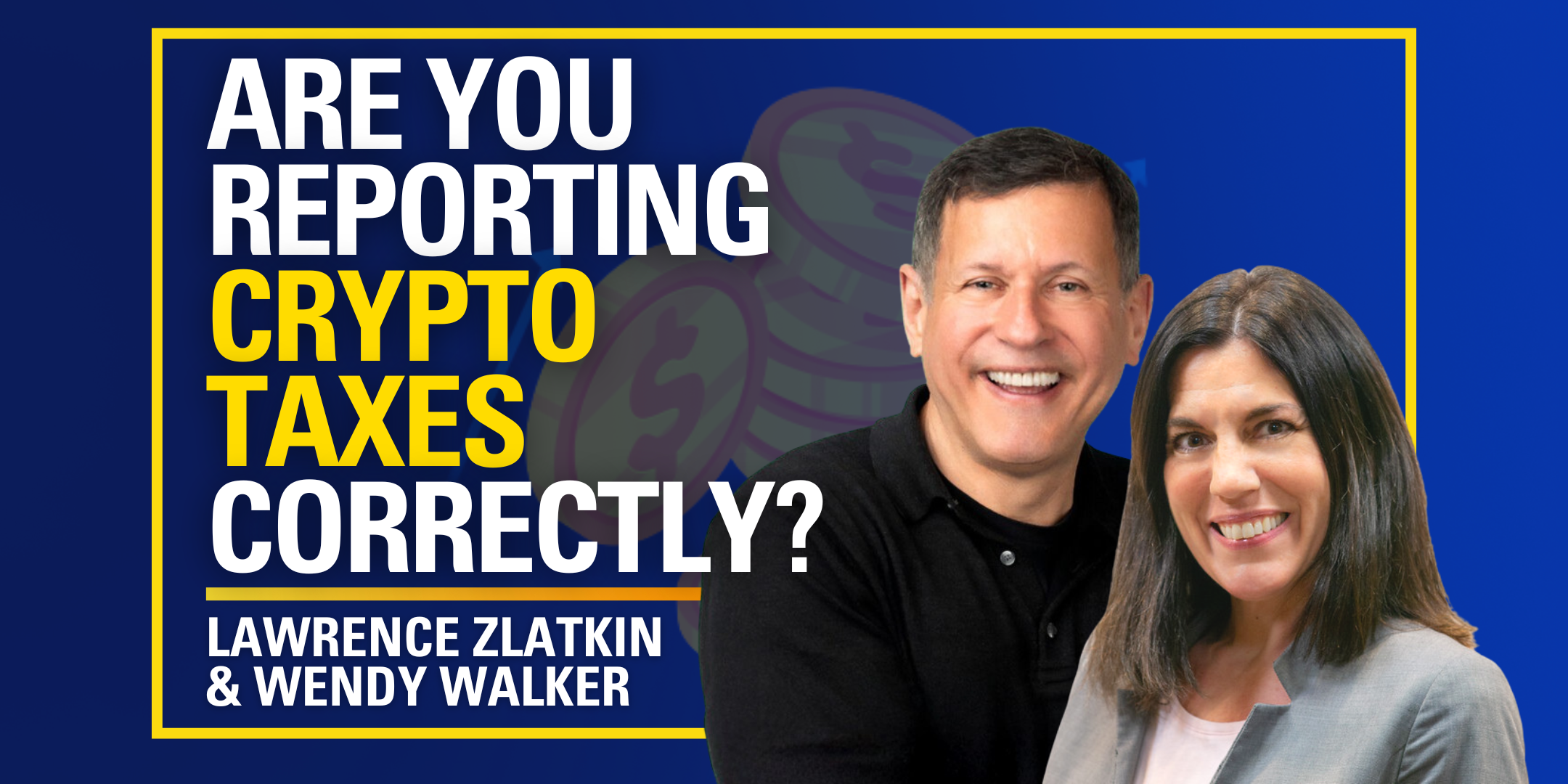
Are You Reporting Crypto Taxes Correctly? - Lawrence Zlatkin & Wendy Walker | ATC #607
Join host Stephen Sargeant as he sits down with two leading experts in crypto tax and regulation. Lawrence Zlatkin, Vice President of Tax at Coinbase, and Wendy Walker, Vice President of Regulatory Affairs at Sovos.
Lawrence Zlatkin is the Vice President of Tax at Coinbase, the leading cryptocurrency exchange in the U.S. and a global market leader. Since joining Coinbase in 2020, he has been a strong advocate for clarity and open dialogue around tax regulation in the digital asset economy. Lawrence actively participates in policy discussions and frequently lectures on crypto taxation.
Before Coinbase, Lawrence built a distinguished career as a senior tax executive at General Electric and as a tax lawyer at several global U.S. law firms. He holds a JD from the University of Chicago Law School and a BA from McGill University.
Wendy Walker is the Vice President of Regulatory Affairs at Sovos, bringing over 20 years of experience in tax compliance, operations, and information reporting. She previously led tax operations at JPMorgan Chase and built FATCA, CRS, and information reporting programs at Zions Bancorporation.
Wendy has worked closely with the IRS and U.S. Treasury through roles with IRSAC, NACTP, and CERCA. She is widely recognized for her practical, real-world perspective on how tax rules function at scale.
Today, her work focuses on emerging reporting regimes—including digital asset tax reporting and IRS modernization—where she applies a traditional financial services lens to new regulatory challenges. She is also a frequent speaker on the future of tax reporting, with a focus on operational feasibility, taxpayer impact, and modernization.
Host: Stephen Sargeant
Guests: Lawrence Zlatkin & Wendy Walker
We are also available via:
Buzzsprout • YouTube • Quora • Medium • X • Facebook • LinkedIn • Soundcloud • Apple Podcast • Spotify • Player FM
Episode Transcript
Stephen: This is your host, Stephen Sargeant, the Around The Coin podcast. We did something really interesting with a topic that not many people talk about, which is taxation, but with the new regulation and requirements going on around the world when it comes to taxes.
We have Lawrence, the Vice President of Tax at Coinbase, and Wendy Walker, who's the VP of Regulatory Affairs at Sovos. They go deep into the nuances of tax and regulatory requirements, why we might be over reporting in the US and abroad, and how the US might not be the most advanced tax regulatory system in the world.
They talk all about the nuance of digital assets and tokenization. We even go deep on AI and how it can be used to filter through the vast amounts of data that we're reporting and the importance of tax.
I loved when Lawrence said that the IRS is a partner when it comes to taxation. Such a great way to look at it. There's so much more involved beyond acronyms like CRS and FATCA and CARF. They go deep in this episode. It's actually one of my favorite episodes in joint conversations. I want you to listen in and let me know what you think.
Before we get started in this episode, it is a little bit of tax heavy, so I gotta read you off that disclaimer. The podcast is for informational purposes only and does not constitute tax, legal or financial advice. The host and guests are not acting as your tax advisors and nothing discussed should be construed or relied upon as guidance for your individual or corporate tax situation.
Please consult your own licensed tax professional before making any decisions now onto the episode.
We have a special episode 'cause we have two guests instead of just one. We have Lawrence from Coinbase, we have Wendy from Sovos, and we are talking about tax. I hear that we're on the tail end of crypto tax season, but there's so much going on in 2026 that we wanna arm everybody with the important details and just some insights on what the exchanges are seeing, what the companies helping some of the digital asset companies are seeing.
So Lawrence, we'll start with you. Why don't you give us a brief introduction about who you are? I think everyone knows Coinbase, but they don't, you know, what are the tax, what are the tax niches of Coinbase that the audience probably doesn't know about?
Lawrence: Uh, lawrence Zlatkin here. So I'm the global head of tags for Coinbase. I joined Coinbase about six and a half years ago. Which. Is a lifetime in the world of crypto. It's been quite a wild ride. We've see lots of lots of activity obviously in the crypto space. Unfortunately, I think every tax professional will tell you is that we don't have a lot of clarity yet on the tax law for, for crypto.
So we know we'll probably talk a little bit about reporting and what that means for our customers and for basically participants in the US industry and globally. But there is actually still not a whole lot of clarity about crypto. So I go to, actually to DC I talk to Congress up to people on On the Hill, and I try to at least advocate for clarity and getting some firm rules.
I think that's just widely understood as both necessary and to some degree non-controversial. There's some aspects we can talk about, which are probably a little bit more sensitive, but by and large, I think just getting clarity and getting the rules of the road is helpful because it sets the, the, you know, the pace allows the industry to grow.
As we say, it allows it to grow within the United States. So who can build you know. A powerhouse infrastructure system here for crypto in the United States. So, you know, Coinbase is the largest exchange in the us. We're the largest in the world, we're quite prominent. We have just launched the everything Exchange to give people more access to crypto, to do more things than just buy and sell Bitcoin.
Um, You can do lots of things on the Coinbase platform, so invite everyone to go to coinbase.com and learn more about us.
Stephen: It is really exciting all the things that you're rolling out. We also have, Wendy, you're the VP of regulatory affairs at Sovos. You've been working with large, some of the largest traditional institutions, helping them in regards to taxation, and you've also dabbled now into digital assets, working with some large exchanges.
Maybe just give a little bit of background of yourself, of how you got here into the crypto niche.
Wendy: Yeah, so I actually come by way of financial services. I have an operations at compliance and a bit of a policy background. So I worked for global financial institutions and tax operations. I worked in tax compliance, building out new regulations like back in CRS, some years back in the.
banks.
But I came over here to Sovos about eight years ago, and I, I really in this role have been working quite a bit more on IRS administration.
So I think where Lawrence is working more on kind of policy side, I dabble in that a little bit with my roles on the IRS advisory council previously. But really I work more in IRS administration. So things in terms of like how we're actually implementing the Form 10 99 DA reporting in practice with the IRS and with the state. SVOs.
s
I guess I could give you an update about Sovos.
Stephen: I'd love to know a little bit about Sova, just so people have a better understanding of who you service and what you do.
Wendy: Sobo actually is the largest private filer of 10 99. Information returns to the IRS, so our solutions span everywhere from the small business all the way up to the global end of the market, and we are producing. North of 700 million information returns out of our systems today. So we are very spanned across different industries and very experienced with the various parts involved with CAF information reporting in the United States.
Stephen: Awesome. Lawrence, I wanna start with you. You've been in the industry for decades. We probably should do a podcast about, you know how you look so young, but you've been in the industry for decades. Some of the biggest tax changes that you've seen over your career and the ones that had the biggest impact to the industry in your opinion.
Lawrence: Um.
So we could go down different rabbit holes on this one because there are lots of different tangents of what's changed. I, I would say so apart from just the US tax system has been overhauled a number of times, even in my lifetime. So, into, you know, just how we tax people and how we particularly, how we tax businesses and, and companies.
And I think largely has been for the better. But what I think is really interesting is when I started tax was. I guess, I wouldn't say niche, but it was more an isolated technical profession. It wasn't front page news. I didn't expect to see tax on the front page of the Wall Street Journal on a regular basis or a senate committee investigating how to tax system impacts companies and how Apple is configured in Ireland in various other places.
So I think just the focus has been. Just elevated quite intensely. And with that has also come a debate over fairness and in income inequality and a whole host of issues that are more value propositions. And again, we can go down rabbit holes on this one and to what degree that's important or valuable or like, and this is an exercise.
So that's been a tremendous change just generally. I've also, I think. For the better. I, I think tax internally within most enterprises, including Coinbase. But I worked previously at a very large, I worked at General Electric actually for, as a tax executive there for, for longer than I care to say. So, and I think so tax Ads, capital, the tax savings, just like the, your tax position we used, I used to always tell people that.
The IRS or the government is your partner, whether you like it or not. And it takes us more, it takes a distribution, if you will, of more or less of your overall capital and in income or p and l on an annual basis. And I think that's better understood. I just think that that drivers for that, both for business people and for CFOs, is just much more apparent.
Getting it wrong is both risky and very costly, so we're not.
just a. Compliance shop that just reports things and is viewed as a cost factor. We actually if we're, we're tooled correctly, we actually help minimize taxes. We help create efficiencies within companies, and I think we create efficiencies for the overall economy.
So I think that's also changed a little bit since I started.
Stephen: I think that's the first time I've ever heard someone refer to as a tax authority as being your partner. But it's probably the best way to look at it if you're gonna have a good tax relationship. I'm curious, especially with you, Wendy, what is the intersection? You're, you're heading the regulatory affairs.
How do you, the intersection of regulatory affairs and taxation? It feels kind of different, but we're now seeing, you know, tax regulation is heavily intertwined with all the other compliance requirements that traditional and digital asset companies have to face.
Wendy: Yeah, I actually think, I mean, I've seen this area of tax information, reporting tax explore. Globes since about 2008. I mean, the government has 30 plus years of data that tells them that more information reporting equals higher taxpayer compliance in terms of paying over their income taxes, reporting and paying over their income taxes.
I think that, you know, in this field that I started out in 20 plus years ago. 30 plus years ago that wasn't it was a once a year kind of activity and we were just part of accounting or we were just part of the tax function. Now all of a sudden, this is a full-time job. Now all of a sudden it's a year round function.
Right. And even more side say in the last 10 years I've seen the, this role in tax kind of shipped over, particularly with track five, it shipped over into. Helping the government understand technology and how it works in financial products, and then what that translates into for tax purposes. And I think that's something we'll talk about a little bit more today in some of my responses.
But I think, you know, that's one of the biggest gaps in taxes. I think taxes moving forward. And coming from a, Lawrence said kind. Thing that you didn't see on the front page anymore. And it is becoming a big deal because it is the, it is the number one revenue driver to our, our, our, you know, our governments. But having said that, I think that there's a lot of pieces to this puzzle that are not in place yet. And I think, if not done correctly, you know, we definitely are gonna be not as innovative as we'd like to be as, as a federal government. I think what we're seeing in tax is a modernization across the spectrum.
And it's great for. The industry, unfortunately, I think it's not happening as fast as everybody else would like, so we need to have.
more about that.
Stephen: I'm curious, Lawrence, you know, you are probably the, have the biggest impact as a crypto exchange. Your requirements have definitely changed, I'm assuming this year versus two years ago. Can you talk about what was the existing tax requirements for digital asset companies like Coinbase? Back in 2024 versus like 2026 with these new requirements, these new forms, et cetera.
cetera?
Lawrence: So the major change really is, and, and Wendy alluded to this, is the introduction of a. Reporting information reporting system for crypto. So previously exchanges like ours, centralized custodial exchanges weren't required to report transactional activity. That's common in tradify and for banks generally.
So people transact in stock securities der whatever they, that's reported on a 10 would call it a ten ninety nine form. Don't ask me why it's a 10 99 versus something else, but it's a 10 99. So that's a traditional form that's reported for tradify that did not apply to crypto. So in 20 21, 22 in the jobs act that Congress just introduced an information reporting system to clarify that crypto is reportable.
And so beginning this year, actually, and Wendy again alluded to numbers of. The number information returns she filed. We also filed hundreds of millions of transactions to the government just for Coinbase alone, and that's new. So we reported, and again, we can go into more detail about what's included and how it's included, how helpful it is.
I'm of the view that it's kind of an antiquated system, unfortunately. So the IRS unfortunately lives in the 20th century for the most part. The information reporting system we have is largely a function of the 20th century. We can do a better job of it, but what's changed is that there is now reporting of tra of transactional activity, of gross proceeds right now to the government for the first time.
So that's, that's what you'll see. There were, there are either adjacent aspects of our industry that, you know, staking income, for example, that is reportable separately and differently. That would've been reported anyhow in a different type of form, different 10 99. There are different types of 10 90 nines, so that would've been reportable previously, but by and large, the biggest change is that if you're transacting on Coinbase and you did something that was taxable from a transaction standpoint, that gets reported to the government for 25 in in the 26 returns that you have.
Stephen: Do you think
This move to especially putting the requirements on you as a crypto exchange was in relation to the fact that, you know, I think widely industry said that, you know, crypto gains, capital gains were widely under reported in the us, much less around the world. I'm sure many of those NFT holders and sellers did not report all of those capital gains that they made in 2021.
What are your thoughts around that? Do you think this is more of a push for regulators to be like, Hey, we, if you're not gonna report it. For a number of different reasons. There's not good enough tax calculators. They're all giving me different information. Then we'll get the information directly from the exchange.
Lawrence: Well, that's certainly what we call the Joint Committee of Taxation, and the government actually reports revenue raised from different legal changes. And so the introduction of the DA was purportedly designed to create $28 billion of additional tax revenue. That's based on the assumption that people have not adequately reported their income, so the income tax system hasn't changed.
Higher tax has not changed. So like people were taxable on gains and losses for crypto transactions, regardless of whether it's reported or not. But I, you know, we do studies all the time of how taxpayers respond to things. And I think it's certainly true that people think that if they don't get the form, there's nothing to report and therefore they don't have to pay tax.
It's not true, but I think that's the underlying assumption that certainly why the form was introduced. And that's the. Underpinning, if you will. That's the reason why the DA form was introduced in the first place.
Stephen: Wendy, I'm curious. You deal with a lot of traditional institutions, some of the largest. Now that you're transitioning into helping digital asset companies, what are the biggest challenges for those companies? They're used, you know, many of the traditional ones are used to taxation, as you and Lawrence pointed out, what are some of the big changes for them transitioning from traditional tax filing, now getting into digital asset tax
Wendy: So I really actually think people misunderstand tradify and how that works today. Tradify reporting is extremely complex and difficult at scale already. So Lawrence mentioned the 10 99. Let's talk all the 10 99 B for stocks and bonds and other types of financial assets. Not pulling, you're not just pulling transactions, you know, into a form.
You're actually dealing with the, the financial services companies have multiple operating systems. They are dealing with external clearing firms for those assets. They have departments within the organization that are calculating the impacts of corporate actions on those transactions. They have massive data sets coming that all have to reconcile together.
So to me I think that. That crypto doesn't, you know, digital assets don't replace complexity for them. I think what it does is adds uncertainty on top of a complexity that already exists. Because in traditional financial reporting, even when things are very complex. You generally know where the data is supposed to come from.
The clearing age of the corporate action group, right? The cost basis solution. You know what the systems of record are, you know who the customer is, you know, who owns the reporting obligation. I think the challenge with Tradify is reconciling at all, not, you know, not knowing whether or not, you know, you have not figuring out whether or not you have the whole picture.
It's reconciling all of that together in crypto. I think it's a different challenge, I think. You right now, especially the exchanges, you know, like Coinbase only see part of the activity for some of their customers. A customer can move assets across wallets, across platforms, across exchanges, and there really is no single party necessarily that has all of the full transaction history or cost basis following that particular asset.
So I think the question isn't just, you know, can I process this data correctly? It's do I actually have. A complete enough view to produce a meaningful report. I was talking to a very large financial institution yesterday. We were discussing kind of a little look back on the season for them. They were talking to me about the digital token identifier code.
That's the the code, A registry that the exchanges supposed to use to identify the asset and use kind of a uniform numerical, I think it's numeric and an alpha coding. Coding to tell the IRS what kind of asset was trade. The problem is that Bitcoin can be has a ticker of, of, of something different on virtually every platform out there.
And so in that registry, I think people trying to figure out which one to use threw their hands up and just said, 9, 9, 9 9 9 9 9. And so we saw a lot of 9, 9, 9, 9 nines, you know, for that code this year. And so I think that's just an example of where, you know, again, I think they don't know where to get the information because by the time it reaches them.
There is that source system or that person that they would go to to get that information is, is not as readily available as it is in the tri fire world today.
Stephen: Lawrence,
do you have those challenges internally at Coinbase? You have, you know, the base blockchain, you have staking, you have crypto ETFs that you're the custodian of. You have the on-ramp, off-ramp of just crypto tokens. Is it challenging managing all the different tax potential implications and that ambiguity through all the different business units that Coinbase operates?
Lawrence: short answer is yes. And I think when, let's unpack what Wendy said, 'cause I think it's actually very important. So the tradify system of trading essentially is a closed. System. So to some degree you can say it's non-democratic. I like to think of crypto as just being much more democratic, which introduces more people with more transactional flow.
Gives you more control. So because crypto allows large scale migrations, on and off platforms, in and out of a centralized, controlled environment, which is what stratify does, you don't see everything. And I think Wendy alluded to that, and that creates a, a tremendous information barrier just in terms of understanding gains and losses.
So, and that's the missing link within our system right now, and I think will be the Achilles heel in many ways for people to understand what their true gains and losses are and why they have to maintain books and records. Don't depend on just exchanges because if you move assets on and off platform, we don't know what you've done.
So we can't report gains and losses to you. So, and that's the missing link. It's, we, I call it missing basis. Like there's a whole I just there's a lot of confusion that arises from this and where we're supposed to get and what we're supposed to report, and it will create a tremendous information barrier for the government as well.
So again, I think we have to go back and sort of redefine. What we should be providing to the government, what they actually need to do risk analysis and to actually evaluate an audit. Taxpayers, I'm not sure the existing tradify system, which was closed is the best way to do that. Be that as it may.
That's the system we have right now, and as that creates complexity and differences. But you're right, we have other products that have, so we have different products and we have different types of customers. That's really why for our world, it's also very complex. So I like to sort of. Divide our customer base into three.
We have our very large, probably the largest and, you know, country of retail customers who basically are just small scale users of crypto. They may huddle, they may trade, but if they're trading small amounts and small numbers, and that's the largest component of our customer base. Then you have like our active trader base.
These are the people who trade constantly. And retail as well. We call 'em Advance Pro, whatever, whatever term you want to use for that. They're just constantly in and out and they have a better understanding of crypto. They do lots of crazy things. They go into DeFi, they lend, they pool, you know, use whatever terminology.
The average, the first customer doesn't typically do that, the second customer does. And then we have, and you alluded to it as well, the. The institutional platform. We are the largest custodian for crypto in the country, if not the world. And so we, we custody for major financial institutions. I don't think we need really need to give them much information.
To some degree we're still required to report their transactions as well, but they, if they have their own accounting systems, I don't think they're depending on us to do, evaluate or determine their gain or loss. So you have three different types of customers. Three different sources of that, consumers, if you will, of our information.
And we have to sort of segment and understand what they're actually doing. And then to your point, we have lots of different transactional activities. So we have what in stratify would be buying, selling, holding, and trading. Fixed, moving your assets and doing things that generate taxable transactions.
But you can do lots of other things. You can stake on Coinbase, you can go and buy. We now offer prediction markets. So there are different aspects of our platform where people do different things and the income they generate will be very, very different and we have to. Constantly makes it up very interesting.
We have to constantly respond to what they're doing and, and whether that's reportable, how it's reportable, and whether we're conveying the right information to them. Because at a minimum, even if we don't give the, and this is very important.
I, Even if we don't, are not required to give the information to the government or to give an incomplete picture, our customers still expect us to provide them with a record of activity.
If you do something on, it's, I think it's a justifiable expectation. If I'm gonna trade or do something on Coinbase. Coinbase, you keep track of what I've done. Right. And so that alone, even that's not reportable, is not all of that is reportable. It's an obligation of ours to provide useful information so customers can then you know, might wanna send it to their accountant or to their financial advisor, but they also might wanna send it to their tax professional in terms of providing.
Information so the tax professional can fill in a tax return. So lots of different consumers of information, and we have to present it in an understandable form and track it appropriately so that customers understand it better.
Wendy: I truly, if you don't mind, Steve and I would jump in and just say, I truly think that's probably one of the hardest parts about crypto reporting, even trippy reporting today that the various sources. Of information and one taxpayer receiving all of that, especially for that advanced Trader Lawrence that you mentioned, because we're talking what could be millions, hundreds of thousands of trades that they need to receive reporting on.
How does the average taxpayer digest hundreds of thousands of documents and translate that correctly onto their income tax return? And I, I truly believe that this is one of the biggest challenges. In, in digital assets today is how to deliver that information, you know, more efficiently and more effective for the taxpayer, but also for the agencies.
I think, you know, delivering right now to state governments, for example, has been can you send me paper, 10 99 das, like mail me paper, 10 99 das, which is, you know, a, a horrible, you know, privacy risk and fraud risk and a variety of other risks that go with that. And so my point being that I think that there is certainly an opportunity in terms of how we're delivering information to that taxpayer and how they are able to use that for preparing your income tax return.
Lawrence: So there's something really important that I think is also adjacent to what Wendy just said. We're talking about hundreds of millions of transactions. So like, and that itself is unusual, like I in Tradify, as big as Tradify is you typically don't see. Hundreds of millions of trans, it's so crypto.
The, the, the trader is a very diff different profile typically than Tradify. At least for advanced traders and for retail like people, it's more democratic. It introduces more and more people are starting to, to do things within crypto. They may not have done in Tradify, but I just think the volume alone.
Is pretty astonishing. And it, it, it causes it, it causes a burden on the government even to digest all that information. How quickly can it really do that? And that, I, like, I talk about this all the time, so, I'll go on a, a rant about over reporting. We as a country, are now requiring that all crypto transactions be reported, and because stablecoins, for example, are treated as digital assets, all stablecoin transactions are reported even though there's no income associated with that.
So you generally. Buy and sell A-B-O-S-D-C or Tether for a dollar. Like you have basis of a dollar. You sell for a dollar. It's really a payment mechanism. So we're reporting payments related to government. That's not really what information reporting is designed, or at least in my view, what it should be designed to do.
So we're reporting hundreds of millions of transactions just for no ga, no reason whatsoever. There's no gain or loss. And we have to sort of ask ourselves why and is that sensible and whether we should exclude those because they don't serve the same purpose. And I go on this rant. Whenever anyone will listen.
I also do this globally because we haven't talked about the global system. There is overreporting and will be overreporting globally, and it's because there's this mindset. It's really a, an interesting mindset people have, and this is a mindset I will say of the government, but I, I don't think this is off for, for most people.
Somehow people believe that more information is better than targeted risk adjusted information. So if I were to provide targeted risk adjusted information for governments to then evaluate whether this taxpayer is filing correctly, that would be, I think, more helpful to the system overall, and we could probably tailor a system that way.
Instead, we throw everything against the wall. So, you know, hundreds of millions. So is the government really be able to digest and use all that information? No, I, I would say that, and you know, I say this globally because people again have this mindset, send everything to me. I'll figure it out. Like if you send everything to me, I sort of feel good because everything is sent to me.
I therefore have you and have all the information I need, but in reality you don't. So most of this information sits unused in boxes in paper if it's paper. 'cause we used to do this on paper and the same problem existed, or it exists in, in the IRS systems never to be used. So the ask question is, why. Why do we do that?
I just would say like, that's not an intelligent way. Of running a tax system, so I would prefer to work on what is more useful and gives more information that governments can actually use. But I'll get off my rant at this point.
Stephen: I think it's important 'cause I come from, you know, I worked at a crypto exchange as well doing crypto investigations and I think there's the same sentiment around suspicious activity reporting where, you know, exchanges are just filing everything that looks kind of suspicious and the government's getting like all of this information, but they're not able to take that intelligence and actually go after the bad guys 'cause they're bogged down with all this information.
Wendy, I want to actually ask you, and maybe Lawrence, you can jump in as well. What is the expectation then, so if we're kind of in this blurry line in the US about what needs to be reported and how is it kind of like best efforts, especially, you know, Coinbase is only receiving a portion of the information.
What's the expectation from the government when it comes to the average user or even the larger institutions if the math can't be exact? Are they just looking for the best practices? They're looking for somebody to show best efforts in calculating what they think their tax burden is.
Wendy: Oh no. I mean, there is no relief right now from, from an infor, not, not from a reporting perspective for the taxpayer, but neither for the payer as well. I mean for, for the exchanges of the world. This is the first year doing information reporting. There is very. Sizable penalties associated with not reporting or with reporting incorrectly.
And so I think there is a lot of angst around ensuring that, you know, the right information is being reported for that, but also for the customer, right? I mean, customers, you know, they don't want the customer to be upset when they're receiving correct. Tax information. I mean, generally I think governments are trying to do what they've always done, which is to Lawrence's point, you know, give me more information, give me more third party reporting because it will improve compliance.
And I think. If you look at the tax gap data, it does deport that meaning that you know when income is subject to reporting, like something like 99%, especially when there's withholding involved 99% compliance rate by taxpayers when income is. Not subject to, you know, substantial withholding or reporting it, it drops down something into the, you know, low eighties percentage.
So compliance and a dropping percentage points from a, from the IRS perspective can mean billions of dollars in revenue. So it is a big deal, right, that they keep track of that compliance rate they. You know, having said all of that, putting out all that data and asking for all that information, as Lawrence said it, it sounds good, except then what are they doing with it?
We all know that the I, I mean, I know from working with the IRS and the administration that, you know, there's a lot of modernization going on in the front. Part of the IRS, meaning the external facing systems that the IRS uses to interact with businesses and software filers like Sovos. But what we're seeing is that we modernize the intake of that information, but then behind the curtain, there's still a whole bunch of manual work going on to get that data into the sum 900 back office operating systems that the IRS has.
So from my perspective. Yes, they're after more information until Lawrence's point. It seems to make them feel good to, if they ever had to do it, they could go back and see that in the information. But I don't know that I necessarily am seeing. Really coordinated enforcement or thoughts about how enforcement, you know, will happen with this data because it isn't fully accurate.
I will say though that this is very similar to what we saw a. With the rollout of 10 99 B cost basis reporting back in 2010 through 2015 timeframe, so in the 2008 financial crisis, that's when cost basis requirements were first. Congress first enacted those requirements for 10 99 b reporting and much like we're seeing in crypto.
It was extremely. Complicated because there are so many financial instruments and so many parties and players in the different processes, and so what we saw was a very phased approach of cost basis reporting. But what that meant was exactly what we're talking about today. The first couple of years, taxpayers are receiving 10 99 Bs.
That.
Check the box to not report basis, for example, because it doesn't make any sense to report that basis because it's not accurate, right. Where they don't have any insight into what the basis is. And so my point being that I think the government, I've seen the government take an approach here that is, that they've taken before to roll out a cost basis.
Regime isn't necessarily a bad thing. They're trying to give payers relief. They're trying to give themselves some. Time to figure out how to process. They're trying to give the taxpayers time to get used to it. But at the end of the day, I think everything that Lawrence said earlier on, which is, and this is fundamental, and this is also proven in tax gap numbers, which is.
When a taxpayer is given a 10 99 form, they'll take the information on that form and directly transfer that to their tax return. Unless they are hiring a tax professional or an experienced CPA to say, actually that number should be this much less, we should deduct and adjust and do these things. They, they will take that number and put it there.
And conversely, if they do not receive an information return, they will not report that income. I early on in crypto tax, 20 18, 20 19, when I'm kind of out there like, you know that as taxpayers you should be reporting this, these are gains that you're receiving. A very good friend of mine that works in financial crime even did not know, and she was.
Horrified to have this conversation with me as a very good civil citizen that she might be, you know, have gone awry with her income taxes because she didn't know that she should have been reporting it. So I really do believe that, you know, the, the government needs to respect the fact that taxpayers really.
Are relying on that piece of paper to be what they use for their tax return or not. And so information reporting right now, the DA reporting and even the CARF reporting that coming that Lawrence alluded to, it is very broad and it's not necessarily reporting taxable amounts. It's doing more information reporting than I would say tax information reporting in that respect.
Lawrence: By the way,
We're, we're unique by the way, in this, in the use of this information. So this system that we have for reporting each transaction and trying to send gain or loss information is unique to the United States. So there aren't very many other countries that do that. Most other countries, including carf, are based on the notion it should be gross proceeds you report.
Sometimes asset classes or just gross large numbers, but you don't report each transaction to the government, and that's, I think, that unique to the US system and makes it incredibly complicated.
Stephen: what's this gap between. CARF around the world and what the US is implementing. Is the US eventually implementing carf? Uh, Is it just gonna take them some time or what's this kind of like tension between Kaf and the, the USA's decision to implement it?
Lawrence: CARF is the global standard for information reporting for crypto. It's applicable outside the United States. 72 countries I think have adopted it. There's, it's in the seventies, it's an OECD initiative. Every member of the European Union, all 27 member states are, have introduced it. It's based on the notion of reporting asset classes and gross proceeds to governments.
So that, again, it's with the same type of collection of taxpayer ID information. It's called self-certification and, and reporting to governments On a macro basis, I'd say it's much more macro than micro. The us has not adopted carf. We also have not adopted, so the US has said it will participate in CARF and introduce it, I think by 2028.
It actually has proposed re rules or regulations to introduce CARF to the United States without going into more detail that has not been finalized yet. And I, I would actually say without. Legislative authority. I just don't think those regs really should be introduced. And we should instead have a uni a system that's supported by the law itself.
So, and so that it's not applicable within the United States. It's a little bit controversial because in the tra fire world, the analog to this is something we call the common reporting standard is global, like CARF and fatca, and so. The reason why CARF was created was because they, we, the United States has not adopted the common reporting standard.
Instead, we have something called fatca. Again, I'm throwing acronyms at you. It sounds like just spaghetti. And that probably is true. We don't have a coordinated system for tradify and crypto, and that's a problem. And I think until, and, and I argue again for parity, I don't think we should be treated any better, but I certainly don't think we should be treated any worse.
So. To have, again, a car system in the US in parallel with a, a US information reporting system is very burdensome. It's very difficult to do, and we're a new industry. We don't have 30 years worth of reporting systems in our, you know, in our, in our bank to be able to rely on, I have to, we are developing the systems from scratch, so it's just incredibly burdensome to do that.
So, but so CARF is not applicable yet in the United States. It is applicable outside the United States.
Stephen: When you're fighting for this in DC and you're lobbying, what are you lobbying? Because I feel like Coinbase is like, speaks for the industry in a lot of things. You've had, you know, tension, not even tension, but you've been kind of the hero of crypto going against SEC trying to. Give them clarity of what you're doing, what is, what would be beneficial do you think, for the crypto industry?
If DC's like, Hey, Lawrence, we're listening to you. You tell us kind of what we should do. Should we adopt carf? Should we, you know, set our own standard? What would kind of be your advice to them?
Lawrence: I argue for parity so principally that we shouldn't be treated any worse and any better than traditional financial services. It should be a level playing field for many of our product lines. I also argue for not over-reporting. I think we have an enormous burdensome system right now of over reporting.
I talked about stablecoins. I didn't talk about gas fees. Gas fees are taxable, so you can have transactions that this, this doesn't exist in drive fi of less than a dollar, and all of that is reportable. So if you use Ethereum on the Ethereum network or on base and you have a small transaction fee or network fee.
That's reportable as well, because there's a gain or loss associated with that transaction. So if you remove the, I call a clutter, if you start removing the clutter from the system, you end up with a clearer system. You have a much more sensible way of looking at what the industry is doing and what people are actually doing.
So those are the, the two, I mean, I can talk about the more technical aspects that. I think also help the industry and help the country in terms of encouraging investment into the United States and building crypto systems, how we treat staking, for example, how we treat trading and asset management. But by and large, the biggest arguments I think are a parody for rules.
And prevention, like trying to stop overreporting stablecoins di mini, we call it the di minimis rule. Gas fees di minims. The small scale transactions that will not pave the roads like we're talking about, like hundreds of millions of transactions that are cluttering our tax systems.
Wendy: I, I, I can so get behind this conversation. One, the parody part of it, and not just because of, just treat us the same, but because of. Competition issues when, when one industry is treated one way and another industry is treated another way from a regulatory perspective, at least in tax ic, you start to see people create products that, you know, compete with one another based on the tax reporting framework.
And that is just it, it completely froze things off and the industry. So I, I'm with you on the parody piece of it. I think though, the other thing is, you know, with carf anyway, this isn't, this is what they're trying to do there is trying to build on top of the CRS to some extent. And I think that's the problem.
Lawrence hit it on the head when he said the reporting requirements for Tradify and for digital assets are not. Not in parity. And so because of that, what they're trying to do is create new regimes to build on top of old regimes and it just doesn't work. Right? And so when you think about carf and people trying to get prepared, which by the way, they're just executing their first US 10 99 DA reporting.
They're trying to do cost basis for this year, reporting. They're trying to do backup withholding starting for next year. And then on top of that we add carve into this. So this is, I think, a very. Difficult time for digital asset exchanges to prioritize and actually. Fully be in compliance with all of these different laws that are just, you know, kind of coming together at once.
But anyway, I, I really feel like with carf, you know, the problem here is that you're building your one exchange, A single exchange could be offering, you know, staking, they could be offering trading, they could be offering custody and, and maybe some kind of stablecoin activity. On paper that looks like one business.
But from a tax reporting perspective, it's not because now you have to answer questions like, which entity in the structure is actually the one that has to do the reporting. Whether a given activity is treated as custody or brokerage or something else, whether staking rewards or income or fees or something entirely different.
And how you determine the customer's tax residency you know, when they've onboarded maybe through one product and. Now they're transacting on multiple products. I, I think that those that di disparity across the products and, you know, is, is instead of finding a way to uniformly do tax information reporting of this information, or instead patchworking together older regulations with newer regulations and trying to make these things work.
And so I do think that CARF reporting is going to be far more. A lot more over-reporting there. Outside of the stablecoin example of Illa is that you gave. I also think the de minimus is an issue. I had a client approach me this past week about. Really is there really no di minimus when my client is, you know, simply using some crypto to buy a cup of coffee?
Do I really have to report this? And this is something I've been arguing for years on the global landscape as well. Like, does the government really care that I use a little bit of crypto to go buy some Starbucks? I mean, do I really need to go and go through a. Gain loss calculation and tracking my basis.
Like I, I do think that there is an argument to be made for a di minimi in this space, particularly because of the fractional share, but because of the use case, right? You don't use a stock to go buy Starbucks today. You don't use bonds to buy Starbucks. Today, digital assets are being used very different than other, you know, instruments.
And so I just think the, the regulations are not quite aligned with the use cases.
Lawrence: Uh,
And that's a really important point because I think that to the extent that crypto is increasingly used for payments, which we think will be exploding in size. Each of those transactions gets reported. And I don't think that's what information reporting was designed to do. So if you're using it to buy the cup, we use the proverbial buy a cup of coffee, pair of jeans, airplane ticket, you, you know, pick your, pick your transaction.
That's not, we don't report that in Tradify. It doesn't exist in tradify. So again, if all digital assets are reportable and USDC is also reportable and it's used for payments and we're reporting that. That's just not what the system is designed to do. I think that's surveillance as opposed to really reporting tax.
Gas fees, we, we alluded to as well, I, I learned this year a new term called dust. Like we have dust transactions. These are fractional pennies that occur within the system that theoretically are also reportable. Creates a lot of confusion for our customers just in terms of what's reportable.
Stephen: You mentioned surveillance. How do we balance, you know, I was at ECC, there was a lot of talk about privacy and to your point, you know, a lot of this reporting is turning what people feel are more of a surveillance methodology than anything else. How do you balance between like regulatory compliance requirements and what some are gonna be deeming as over surveillance?
We'll start with you, Lawrence.
Lawrence.
Lawrence: I think, again, I alluded to it, so I, I payments do not payments or surveillance like I don't think, since there's no gain or loss associated with like, the use of payment tokens and USDC tether and there's no gain or loss associated with that or buying using. Digital assets, Bitcoin to buy a cup of coffee.
It's not gonna change the tax system. We're talking about fractional transactions. That's, that's not really a tax. You're not, you're not promoting tax revenue or tax collection, and you're really not vetting out who are major participants because you're not gonna find like an nefarious actor, if you will, buying, using Bitcoin to buy a cup of coffee.
Right. You're not, that's not good. That to me, is surveillance an invasion of privacy and it's overbearing and doesn't belong in the system. As I pointed out, I think it creates clutter because we're now massively introducing hundreds, and I'm really being serious about this. Hundreds of millions of transactions this year are being reported for gains or losses of let's say, less than a dollar.
Okay? So I just don't, that to me is surveillance. And so I, I think that's, that's that. Doesn't exist. It shouldn't exist within the system. We should focus, I mean, if it were me, I would do a risk-based system, focus on the transactions and the people who do the most activity or might generate the most potential gain or loss and contribute to what we call the tax gap.
That should be reportable and government should have the information at hand to be able to find those people. So, and that should be, if our system is based, you can find them anyhow through, you know, through. To analytical tools, but if you wanna use a more mainstream system where it's reported the way it's reported today, focus on those activities.
And that's where the, that's really where the money is in terms of tax revenue. That is not surveillance. That's, that's more risk adjusting the tax system to find the major participants where the tax gap is located.
Stephen: Wendy,
with more assets being tokenized, what's the impact of that? 'cause everything's turning digital, you know it's gonna be 24 7 of tokenized assets. What is that impact gonna do with the reporting and the taxation considerations?
Wendy: Well, I, I mean, tokenization is absolutely going to increase reporting for financial institutions. But I think as far as the privacy conversation goes, I actually think that from a different angle gear, that what's changed is the volume of data and how many hands is that are, are touching that data. I mean, that I've seen environments where the same customer data is sitting in.
The onboarding system, the transaction system, the tax reporting system, the A-M-L-K-Y-C system, the vendor platform, and then it gets shared off with the regulators and it's sitting in the regulator system. And the more complex the product, the more places that data, you know, kind of ends up. So I think the, the real privacy risk isn't just that we're collecting more data.
I think it's that we're copying it and we're moving it and we're exposing it across multiple systems and multiple counterpart parties in the practice. And I think. A really practical example is like a single transaction today could involve a platform, a bank a compliance vendor, a reporting provider, and then ultimately the tax authorities.
That's a lot five levels of, you know, iteration of that sensitive information being passed. And every one of those. Touch points of data moving is a potential failure point. So for me it's more about how we're managing this data, less about what we're collecting and more about all the different places it lives, which by the way, some of it stems back to what we've been talking about, which is.
You said it early on, Stephen, all of the, in the financial crimes world, all of the SA reporting, Lawrence and I are talking about it in the tax reporting world. The government has a lot of data. What it feels like is we're giving 'em a lot of data, but what it feels like is the data's not necessarily being triangulated together in some way to actually identify the nefarious or the tax cheats or, or whatever it is that they're, you know, focused on.
Stephen: Lawrence,
you get to see a lot of builders. You get to see the exchanges. Investors, you're kind of at the unique, you know, crossroads of a lot of different entities in crypto. What do you, what are your thoughts about what they have to start preparing for when it comes to tax regulation? And it almost seems like, you know, adding in the tax requirements of reporting, you add an A-M-L-C-T-F travel rule, K-Y-C-I-D, it's like, it's almost pricing out, it seems like from a compliance angle, a lot of these small startups in crypto, but maybe you have some different thoughts about how they can manage it.
Lawrence: No, I, I, I, I, I endorse that completely. I, I a thousand percent to what Wendy just said. We don't, we don't use information correctly. We just try to extract as much as possible, and it's a burdensome, overly bureaucratic system and doesn't really serve much, you know, doesn't serve the proper purposes of the ends that we actually need.
I would love to use, if you ask me. What I try, what I would love to work on, instead of building antiquated 20th century systems is to use the blockchain, use tokens to identify potentially a privacy oriented privacy protected identification token that people can use both to transact within crypto transac.
More globally, and also to provide governments with information where they need it. So really to use blockchain affirmatively. So it's not viewed as this, you know, the, the government has still people, some people have this sense that if you're using crypto, you're doing something wrong, right? So instead, let's use it affirmatively to.
Produce information the government actually needs. And potentially even you could use smart contracts to collect tax. Like we could develop a system that was much more 21st century and much more focused on the right thing. Startups could play a much greater role in that because these are new technologies, they could easily adapt to that.
Instead we're just grafting on what we already know and what we think works in, in the 20th century and it. It's not very forward thinking, so I'd much rather work on something that is more, more modern and technologically advanced.
Stephen: This question is for both of you to kind of end the conversation. It seems like we have a lot of raw data. We're sending it over to the government, but we're not getting a lot of intelligence back, or they're not using it for intelligence. It seems like the perfect, you know, breeding ground for AI to kind of help out and support.
How much are, you know, are you using ai? How much do you think regulators and tax authorities to start considering using ai? The data is just sitting there anyway. Why don't we just run it through a couple LLMs and produce actionable data that could be better for the industry. What are your thoughts on that?
We'll start with Wendy and then with Lawrence.
Wendy: I actually am seeing AI being used quite heavily throughout the governments. As a matter of fact, even with the IRS, this is an enforcement especially, this is one of the primary areas we could talk about the 10 99 DA filing this year using the new. Iris system, which is has validation built into it to rere reject files at the time of submission.
This is a huge shift in filing data with our government because our government in the past, with this legacy 1980 system that we've been using, it pretty much accepted everything. And if you were audited as a business, you found out later on. That perhaps you had some incorrect information Eve reporting.
And I think now what's happening is we're seeing that move closer, right? We're seeing it move closer up the, up the stream into the transaction. If you look outside the United States, though, you're already seeing governments move in a whole other direction. Mexico is a really good example with their digital platform.
Reporting rules. They're not waiting until year end to figure out what happened. The platforms are required to collect, validate, and in many cases report or withhold closer to the transaction itself. And so everything, you know, the identity, the tax status, the transaction data is all being handled upfront as opposed to later on, you know, a year later down the road.
And that's a very different model, obviously, than what we have, you know, here in the United States. So when people talk about the future. I think the shift is moving from a system where we report what already happened to a system where we validate and shape the outcome as it's happening. And that's where AI, and that's where APIs, right?
Even many of the governments, instead of us doing these batch file uploads, having API connectivity where we can system to system send it information but also validate. Data reconcile differences, flag issues before they turn into incorrect reporting. So I, I don't think that to Lawrence's point, the goal shouldn't be, let's just keep sending more forms and more information at the end of the year.
I think it should be reducing the number of times we're having to fix things after we've already filed. Right. And get thing, get them what they need and to the targeted, you know, reports that they need to enforce tax compliance. So I think that's really where I'm seeing kind of a more modern.
Real-time tax shift outside the us.
Stephen: Lawrence, any thoughts around ai? I know Coinbase must be using every technology at its hands.
Lawrence: AI is everywhere. Um, AI is your friend. Um, I call my bot Charlie. Um,
So I, AI is very much front and center in everything that Coinbase actually does. We're introducing it both in development of product building our platforms, coding, engineering. But also I think what is very powerful, you will see increasingly within our overall finance function as well.
So my counterparts in accounting, controllership, and tax reporting we're just at the cusp of starting to use AI intelligently using agents to agent assistance to try and help us sift information, extract it, and report it more accurately and, and with better precision and more efficiency. So AI is your friend, is what? what I. Try to think about in this regard. So AI is everywhere. Like I, I don't think there's, that's lost in our industry. That's like front and center and it's front and center with everything Tech. I think Wendy mentioned something that's kind of interesting as well, which is we're not actually the most advanced country in terms of how we apply our tax system.
There are lots of countries. I I did this when I was at GE as well. I've seen other countries that are much more modern and much more adaptable. Are much more willing to introduce new systems that we don't do correctly. So in the us so gonna go in my rant again, but in, in principle, using a 20th century system for reporting is just, it's just inefficient, it's bureaucratic.
It results in overreporting, it doesn't collect, it's doesn't collect the, the the appropriate amount of revenue. If we could use blockchain and AI in the process of trying to sift through where gains and losses really are and where the income really is, it would be both more efficient and it would actually collect more revenue and would also be less burdensome on taxpayers and on companies like ours.
And I think we could do that if we were, and I would encourage everyone to think that way. I would love to be able to develop a system like that. I think it's it's enormous potential.
Stephen: Lawrence, final thoughts? You're. You're a younger version, a graduate, you know, you want to get into tax. You're seeing ai, you're seeing blockchain. What's one place a new graduate could start to, you know, get into a position where they're working at one of the largest exchanges in the world.
Lawrence: I think the tax system is here to stay whether people like it or not, though one of the certainties of life is death and taxes. So if you want a good profession and you wanna know there's certainty about something, then introducing yourself into the tax system is, is. I've, you know, I've found it rewarding and fun and intellectually challenging for longer than I care to say.
So it's just a, a fun place to actually be. And so, and I think what's interesting as well is that when I started, for example, we we're a small, a relatively small company at the end of the day. And so when I build a tax department, I wouldn't typically think of a young graduate as being someone who could really add enormous value to what we do.
But we've had interns in tax for the last two years, and I've been astonished at how again, they use ai. Adeptly and I've seen checklists and information and efficiencies associated with just the use of AI and young people, younger people, people who are just starting out really sort of learning much more quickly and much more adaptively by using tools and entering into the tech system of how, how we operate.
So, lots, lots of future there. It's really exciting to see that actually.
Stephen: Wendy, last thoughts, future, you know, younger you or future, future, Wendy Walkers. What would you suggest in one minute what they could do?
Wendy: Of course, like Lawrence, I've gotta encourage people to get into the tax world, right? I, I don't think this is anything I set out to do for sure, but I, same thing, it's kept me completely engaged and interested for a number of years because it does constantly change. It constantly is challenging you in, in a unique way.
But what I would say is that it is absolutely imperative anymore the tax professionals pair their knowledge with. Technology, ai, of course we've been talking about that, but generally I find one of the biggest gaps that I fill in my role today and I'm watching kind of emerge with this younger generation is you've got to be able to take tax law, which is much more broad and theoretical, and figure out how to apply that.
Into the operation. And I think having that technologist, you know, person that can really kind of interpret and apply that into the operation is a skill that is more up and coming in the tax field than most people are giving it credit for. So, to me, obviously I think tax is great, but using technology with it is definitely going to be the game changer in our industry going forward.
Stephen: Wendy Lawrence, this was fantastic. I love the way you guys played off of each other and you know, the common thread around what you were talking about. We'll tell all of our listeners to find you on LinkedIn. I know you're both active there and we. Appreciate you doing this joint episode on Around The Coin.
Lawrence: Our pleasure.
Wendy: Thank you.
.png)