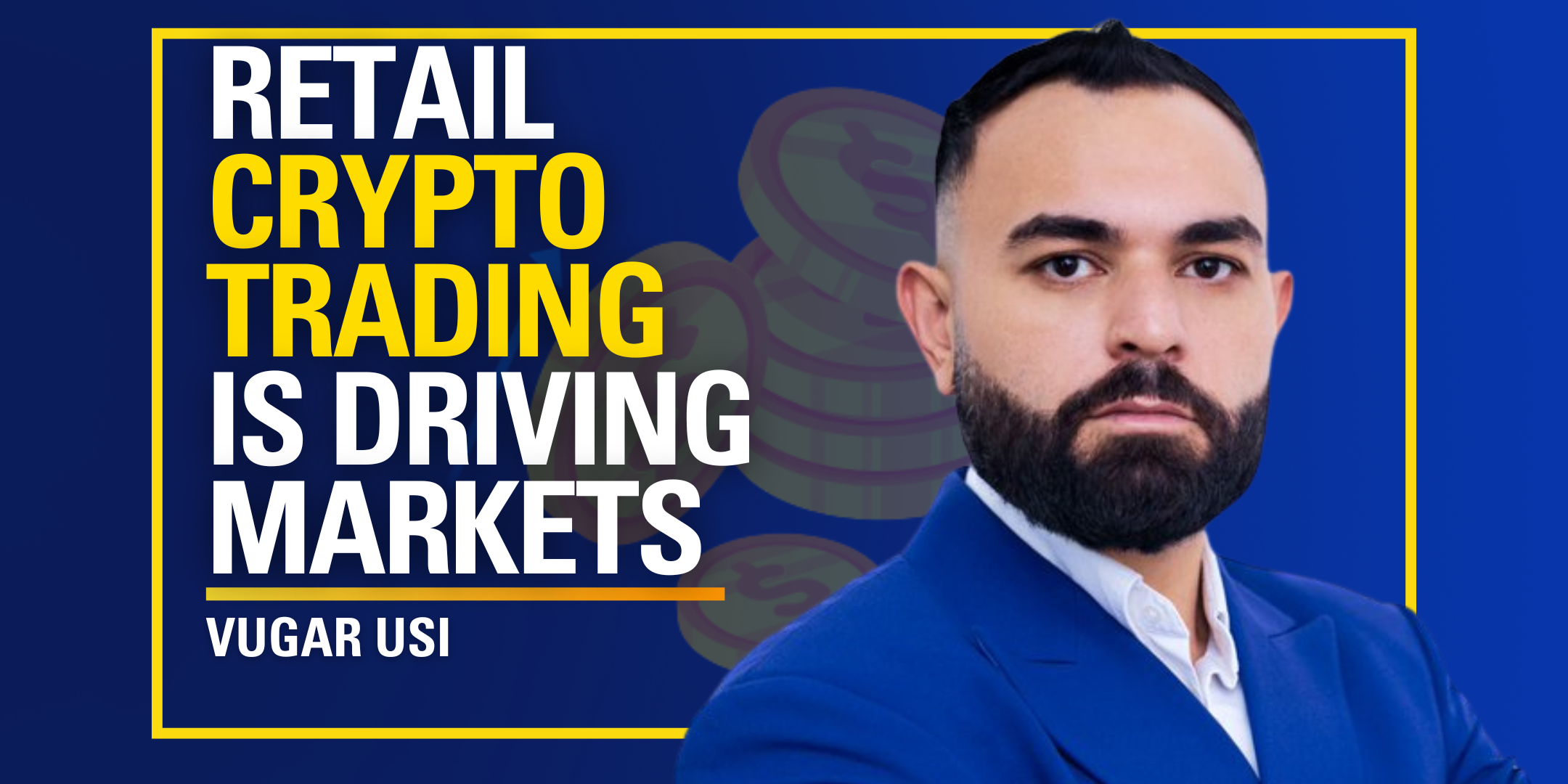
Retail Crypto Trading Is Driving Markets - Vugar Usi | ATC #605
In this episode of the Around The Coin podcast, host Stephen Sargeant sits down with Vugar Usi, CEO of MEXC, where he leads global expansion, compliance strategy, and platform growth. With 15 years of experience across Fortune 500 companies and Web3 ventures, he previously served as COO of Bitget, helping scale the platform to over 120 million users and become one of the world’s largest crypto exchanges. Vugar has held leadership roles at companies like Facebook, Bain & Company, Coca-Cola, and Sony, and is a graduate of Harvard University and University of Oxford.
Host: Stephen Sargeant
Guests: Vugar Usi
We are also available via:
Buzzsprout • YouTube • Quora • Medium • X • Facebook • LinkedIn • Soundcloud • Apple Podcast • Spotify • Player FM
Episode Transcript
Stephen: Wow. That is all I have to say about the conversation I just had with the CEO from MEXC, Vugar. He is amazing. He comes from a marketing background, but has an understanding of policy and regulations and geopolitical hotspots.
We talk about oil, we talk about Iran. We talk about Trump. We talk about stablecoins, meme tokens, prediction markets. We talk about leverage and futures and derivatives.
This conversation literally has everything. About half an hour of the conversation wasn't recorded because I was just catching up and talking to him and learning so much from Vugar. He just came from Poland where he absolutely crushed the stage talking about regulations and crypto exchanges.
I don't normally get this excited talking to crypto exchange folks, but this guy is special. He has a really great understanding And a real practical and logical approach to investing in crypto and stablecoins and what's happening on his platform. Remember, this is just for educational purposes. This is not any sort of investment, legal, or tax advice, but you are gonna enjoy this conversation. Let me know in the comments and we'll talk to you soon.
Stephen: This is your host, Stephen Sargeant, the Around The Coin podcast. We're actually already 20 minutes deep on conversation with our next guest who's the COO of MEXC, Vugar. Tell me a little bit about yourself and then we're gonna go into your background, your marketing chops, which you've already displayed in our pre-recorded, you know, pre-recorded conversation.
It sounds like you have a really good idea of operations, policy, marketing, and the ecosystem in crypto, but I'd love to kind of hear your background, how you got to this point.
Vugar: Hi everyone. Thank you very much for having me here. I'm Vugar Usi, I'm the CEO of MEXC. I am a traditional finance broad, turned into crypto broad kind of a moment. I've been running exchanges for many years now. I can say many, at least like five, six years, and I've been in crypto for almost like a decade now. And it's been a very interesting, tough, rollercoaster journey with a lot of all times highs and also all times lows, I believe.
And I'm excited to be here.
Stephen: when did you get into crypto? 'cause it looked like you were working at a consultancy firm as a Chief Digital officer, which is usually, you know, a nice, you know, transition into crypto. Was that your first interaction with crypto? I see that Crypto Labs with a K was one of your clients at that firm, so maybe that was your first instance of touching blockchain.
Vugar: It Depends, like, what is like a first interaction. Like, my first interaction was actually back in 2019 -20. But like, the whole idea was like, I had a company, I sold it, of course, like, when you're 20 -something with a bunch of money, what you wanna to Buy a home? Buy a car? And I needed to move some money cross -border, like, from Dubai to Turkey, and at that point my friends were like, okay, you know, like, if banks, taxes, it's too complicated.
There is something called, you know, Bitcoin, you'll pay here, you'll take there. I was like, okay, is it worth the risk? But then we did it, you know, like you take that kind of a risk. And I was like, wow, this is cheaper than Western Union. This is cheaper than bank. It's, it's just like a cash in hand. And that's how like I first get, to know, crypto, but at that point for me, it was just another service that you do usually, you know, like you don't think much about it at that point because you're too excited about having the money and doing things.
But then eventually I went on through the consultancy, actually consulting like a traditional financial firms. Worked with JP Morgans and many others and that's how I first time like had this like hands-on experience when it comes to blockchain as a technology or crypto. But this was more of a like, how can I better learn about the product, what it does, like understand the technology rather than use it as a, way to transfer money because the same way when you do a bank transaction or go to western union you don't know how that money moves right and you just love it because of a service but then i got the chance to actually know how technology works and today i always ask myself a question as a ceo of a Mexican. i'm like should the customer even know how this product works or it just solve a problem and a customer is happy and that's it
Stephen: I think anyone that's done a wire transfer, they probably don't love it. They probably wish they knew more about how it was done so they can improve it. But you used to work at Sony as a marketing director for three years. Are you shocked? You know Sony obviously one of the biggest tech companies. Are you shocked that five years later after you left, that Sony comes out with their own stable Coin to the market?
Vugar: I honestly, I'm not shocked. I think like because Soni is very innovative company and even like back in times like the, for example, the way PlayStation came out because they were like competing with Nintendo and they couldn't do. I think that is very like embedded in this Japanese culture Also, like SO'S culture that.
They would partner with someone or they would definitely use the technology, but also if something goes wrong, they will have this energy to put in something better. And I'm not surprised that soon we could see something better. And also, I, I do not have much knowledge about it, but I'm also thinking with this PlayStation ecosystem or Sony's having this...
Sony's one of the largest IP holders in the world. All these things come together. Actually, they could take this stable coin, both earning and payment, do something very huge, something miracles almost because they have very untapped market that they can only access the same way, I believe, like any big production kind of because Sony has music.
So has consoles they take, they're logic, producer of cameras there's
such a whole ecosystem that they can just monetize right
Stephen: They
touch hardware and software and they have probably one of the biggest growing ecosystems in Web3, which is gaming as well, right? So they can tap into a lot of different markets and as your point, it's a very untapped market, but you know, from marketing, leading the operations there by volume.
Let's talk about MEXC. You were at Big Gap before. MEXC is, I think you even put it one of the most. Unfamous famous crypto exchanges, one of the most underrated exchanges, which in the world of crypto exchanges, that might be a good thing that you're not in the news a lot, you're just steadily providing value to customers.
What makes MEXC so unique in the fact that maybe not a lot of people know about it, but definitely a lot of people use it.
Vugar: Today we are one of the 10 largest exchanges in terms of volume when you look at futures we even like there are days that we are third fourth largest we probably serve 40 million customers in 170 or even more markets almost like virtually globally anywhere right and since i joined the company we've been Consistently in top three fastest growing and this growth is coming organically and mainly when we talk about growth in our ecosystem, it is about the user trust because user kind of have worked with their money.
And if the user is moving their money to your ecosystem, it means you're doing something. right.
And Luckily, we've been consistently growing. And what makes MEXC unique Then let's say if you today go to Coin Market Cap Coin Get or any other catalog, and take this like a top 10 largest exchanges. There are two distinct features that makes MEXC stand out.
First and foremost, all large exchanges they kind of cater to the needs of institutions. 80 of their volume come from the institutions. While at MEXC, we are 99 retail. We are actually real people in their kitchen, in their offices during their commute. They open their phones and they conduct these small trades.
That's why we have this great trading ecosystem that is very unique, very humane, very competitive, and very much possible, making it possible for a user to actually trade rather than dominated by the institutions, by the large players. Secondly, what makes Mexico unique or what made me fall in love with MEXC is that MEXC is, no one else is like a first exchange.
I always say this very proudly because usually you don't have someone who comes to Mexico because they have seen our logo on a Formula one car, on a jersey of a football player. People usually... It. that's very important Pa part of a business like there are like all the large players who do that, educate, bring in new customers.
But usually what happens, let's say you one day, Bitcoin is all time high. Italian is doing something or your cousin told you to, you know, to buy some crypto. Naturally you go to finance by bit, bit Gate one of these like a very iconic brands that spend millions and millions dollars to building that brand, that brand recognition.
You come there probably, you try, you mingle around that platform. But fast forward two, three months, you realize that there is a project, there's a cool new token that you wanna acquire. It's not listed there because MEXC has least first approach. We have more than 3000 project in our ecosystem. Or you wake up after two, three months that you've been ripped with the transaction fees.
You've been paying a lot of money in all trades, whether they were successful or you were liquidated. And then you look around, you come across MEXC, this crazy platform that has almost zero fee in all large pairs. We have like 200 pairs in futures. We have Entire sports market including Bitcoin and Ethereum zero fee. and that is your aha moment.
That's you are like, okay You know now I need to move that shift and when we talk about all of this Like this is how we've been able to acquire these 40 million users These 40 million users didn't choose us because they liked our logo they like the football player They liked the formula one car.
They actually chose because the product was solving their problem
Stephen: And that makes a lot of sense because if you're not spending all this money on marketing, you can put it back into saving the customer's money, which is
interesting.
Vugar: Last year we, like with the zero fee, we actually gave back $1.1 billion back to the customer.
It means our customers got $1.1 billion to actually come and do more trades.
Stephen: Does your marketing, uh,
side of you be like, Hey, I wouldn't mind though getting in there on the, you know, a couple FIFA players, maybe Formula One does, does the marketing side of you wish that like, hey, we can now that we can take a little bit of that 1.1 billion and you know, flip up our logo on the stadium somewhere.
Vugar: Of course, I'll take you back to my time at right? We had an iconic partnerships. I, We worked with Leon Messi while he went to the World Cup final and won the World Cup for Argentina. We worked with, motor gp. Laga entire, Like a Spanish Premier League on top. We had like an untold music festival. I have done all these sponsorships.
They're very important. They're cultural moments. They have a different audience that comes in, but I'll give you an like a kind of a flip side of a coin. I definitely wanna do all this like a big shiny things. Marketeer in me loves doing that, but also in parallel I think today largest exchanges in the world like Top two, Top three, They serve 300 million users. We only serve 40 million users. It means there's already 300 million users. We need to go and tell them about
Mexico. tell them that, okay, instead of paying that theft fees, there, come to us instead
of, you know, trading 200, 300, 400 pairs come to 3000 pairs.
And once we do that, definitely we need to go make the pie bigger,
that was kind of our consistent strategy. And I kind of banking on it. where we'd want to become the zero fee gateway to infinite opportunities. We want to bring a lot of products, a lot of opportunities for people to trade and invest in and in parallel, make it closer to zero as close as possible.
Today we are in comparison to all other, like top 10 exchanges. We are 10 times cheaper and more affordable to conduct a trade in our platform. And I hope one day we can become like a true zero trade platform.
Stephen: And that you know, that, you know, encourages more trading, trying new opportunities, trying new projects, which gives you then a lot of trading volume, which then puts you at the top of the charts. But you're saying you're mostly retail? Retail, almost 99%. Where would you say the market is today? What are some of the interesting use cases on the platform?
You know, is there more stable Coin adoption? Is there an uptick? I've seen some gold related tokens that seem like they're getting a lot of activity on your platform. Where are some of the trends that you see in the retail market today? I.
Vugar: When it comes to retail, I think, narrative is still living because I believe couple of years ago, the narrative was like, you'll go to any conference, you'll open any podcast, any YouTube video. It'll be like, Oh, next a hundred X, you know, which project is doing next a hundred X, right? Everyone was trying to find that a hundred X.
Then we went down to 20, 30 Xs, 10 Xs. And that point meme coins boomed, right? Because that was your another a hundred X opportunity. But today, thanks to tokenized real world assets, right? US stocks, gold, silver, petroleum, oil, right? You can actually conduct hundred X leverage trades on these assets. Much better understanding, you could run technical analysis, like the market is much, much fair than finding a random mem coin.
still you are able to do that 10 x, 20 x, even a hundred x. And I think that is kind of a still narrative that embedded in the industry. People wanna get rich, get rich faster and quicker. But now they can do it in a more logical way because previously probably it was very hard to tell your friends and family why they should invest in a frog, but coming and telling people to invest.
Oil Because there is a war or a Tesla stocks or something else is much better. And, therefore, like usually people ask me, like, when will the next alt season will come? And I say, like, I underline it, like, and I tell everyone, like, listen carefully. Like today, whatever we are doing with stocks, whatever we're doing with gold, whatever we're doing with petroleum is actually our alt season.
Speaker 4: Right.
Vugar: it didn't come in a form of the al, we were expecting like a previous run, but the gold trade, the stock trade, the oil trade is our new and we need to bank on this.
Stephen: And like is your thesis. Then instead of putting like a thousand dollars across 40 different random tokens like fart Coin and all these other ones, if you really believe in one token, you're like, okay, it's not gonna 40 x, but I could put all my money in this token with more leverage. And get the same return instead of just spraying and praying it across all these random tokens that I have no idea about.
You can be more logical where you invest and you, you, you might get those outsized returns, but at least you feel a lot better 'cause you trust the company, you trust the project that you're giving money to versus ones that you know you're gonna lose money, but you're really just gambling at the end of the day.
Vugar: Exactly. I think that is one important point. And another important point is that, for example, when we look at this like a kind of a pump fund, even like meme tokens, right? Meme coins, that was like a huge saga. All the thing was run around crypto Twitter and narratives. You should have been there early. If you're not early enough, then you wouldn't make money.
And they were very easy to Rockpool. But today, you kind of still run on the Tesla's narrative. Tesla's just an example,
right?
But still, you know that there's a physical product. There's a huge factory. Probably Elon wouldn't rockpool you. Maybe to that extent, you know. And still you can do much, much better.
And that's why we see today people are making investment that no more around the narrative. Either we saw what happened with privacy projects, right? Or what's happening with DPN project. Either you come with a substance and people invest with a conviction. Or you, if they just wanna invest in a narrative, they would rather go invest in a narrative of.
President Trump or Elon Musk than some random crypto influencer who's telling I'm gonna I dunno, do this do that I'm bullish on this people don't believe in that anymore. And I think they shouldn't
Stephen: I am curious though, derivatives futures leverage that's always had a little, just like yield. It's always had a stigma in crypto because there's been these, you know, schemes that are happening. What would you love to demystify about leverage on your platform? Like I think you've made a really good, logical case there, but is there anything that people get confused about leverage that they should know about jumping on your platform?
Vugar: I think they should understand that like bigger the leverage easier to get liquidated. I think usually people don't understand that Let's say if you are having $1 and you're betting with a hundred eggs It means you only have one person margin of an error And that is a problem. That is a big, big problem, like how you get liquidated and how the market works.
And I think that is one of the biggest problems that people do. And another problem I think people usually don't understand like this, the slippage happening, but like I believe recently there was a case, I don't remember in which program, like they get someone tried to buy $50 million worth of, Some token and, you know, due to slippage, they ended up with like a 36 k. I think this like a two key aspects people should understand. And that's where, like, as a platform today, we talk a lot about liquidity and liquidity and liquidity. It's not only about the opportunity, what you can Leverage on How much you can let's say bet on. I
don't like using the word bet because it's not like necessarily gambling.
Like what kind of a trade you conduct, but at the end of the day it is, it all comes to liquidity. Like as a platform, more money is there more failure it becomes to trade.
Stephen: What are some of the trends you're seeing? Because if you're dealing with 99% retail customers, you probably see some interesting things, especially 'cause we're in a bear market where people, I feel like when we're in bear markets, people are more, you know, prudent about where they're putting their crypto and their trades.
They're not just willy-nilly throwing money around. What are some interesting trends that you see in this market that we're in.
Vugar: Before we go into trends, I think I, one core trend I see that Um, probably moving forward, we won't be having these long cycles anymore. We will be having shorter and sharper cycles, shorter, sharper bulls, shorter, sharper bears. It means we'll be seeing, ev in a, I dunno, a couple of weeks or maximum months or two where a project where, or a topic like privacy tokens, R ws, deep -pins, oil, whatever we talk about, Kind of suddenly peaks and suddenly drops and then people move on to the next big thing. And that's like one thing that we are seeing that people are always kind of in a rush to be first somewhere to kind of
enter first, exit first. That's how you catch the train.
Stephen: Nobody wants to be exit liquidity. Right. So get it and get out before you're the one holding the bag.
Vugar: Exactly. Exactly. Like people learn it in a very, very hard way, like with all this liquidation events and so on. And with AI coming in place now, even like a retail user got an access to. Not the same tool, but like a similar caliber tool. you get news Mm. not even instantly, but at least in a closer speed than all the large players do.
Of course, now we are in an era where people kind of having this like a minus, speed where they. know about the news before even it becomes the news like all these insiders, people are closer to the source, but generally like people are also able to get the news faster when we combine all of this together.
Going back to your question, like what kind of a trends we see, we see two distinct patterns depending where a user comes from. If you come from an advanced economy, probably all you want to do is 10 -15 interest. And we see more and more people from advanced economies. They are kind of trying to go to this like a safe products like yield products rather than conducting a trade.
In stablecoins, even like on like a large Bitcoin and term, there's like a, almost a 15 annual return. That is much, much higher probably from Canadian US banks, even like banks in the Middle East. That is kind of a very interesting for the users. And I've recently heard like there was a data in that US market probably like a stablecoins will take about 35 entire like deposits from the US banking system because there's a higher yield in
there. And when they like as a user that you come from advanced economy, you don't wanna risk much. And instead of Bank giving you 2 you get 15 here.
You're happy, right? Then you just park your money Then you try to do what you wanna do on the opposite end of a spectrum in like a a Developing economies. We have these people whose disposable income or the money that they can invest In a month or two is a couple of hundred maximum a thousand. And for these people, 10, 15 wouldn't change anything in their lives, right?
Maximum give them a dinner or two or a fancy attire that wouldn't change their life much. And then we see more and more people trying to be creative with an investment because they need to multiply their money fast, right? If you only can invest $200, If you can 10 exit, it's 2000. If you can do a hundred exits, 20,000 Only then you can feel a difference. And that's why we see from an developing economies, cannabis, Southeast Asia, South Asia, CIS countries, even Turkey and Eastern Europe, more and more people kind of getting into leverage trade. They try to be fast. They try to be creative. They don't use Bitcoin and stock market to hedge against each other.
They just try to pick and choose the best trade for themself in order to, you know, to make your lives better. And while we have this kind of two audiences, very opposite from each other, kind of a pooling literally market, we have these stablecoins that eventually, kind of embed script into our lives with the card products, all these like spending asset aspects.
Then you have a lot of like a Latin American, Turkish, and European countries, even the Central Asian countries where people use stablecoin. instead of, you know, for an exchange. Especially if they don't have an access or like a valid banking system. And that is how like kind of a, we embed crypto in a day-to-day life without actually.
benefiting or understanding how technology works and we shouldn't but in general if you talk about trade this is like a two distinct pattern we see and we see it in a repetitive pattern that people use crypto either to in a very kind of a traditional way to hedge against assets like dude, this in a very like a book perfect way or they do absolutely crazy stuff like 500 x leverage very risky things bet against the market because if you lose you lose but if you win you really win big
Stephen: So you've covered stablecoins, you've covered meme tokens, and you've talked a lot about like the news being so quick, but a lot of the, I feel activity in crypto is driven by these prediction markets where it's not news, but it's people betting on the news that's making people bet on certain types of crypto assets.
Can you talk to me about prediction markets and how MEXC services the high demand for this product?
Vugar: I think prediction markets are super, super interesting with Polygon, poly market and calci and what's happening in there. We have seen prediction markets kind of becoming your new source of news. And we've seen more and more people using actually prediction market to, as a, like a reliable source of news in order to do certain actions.
First and foremost, we've seen a lot of insiders or people with a firsthand news who could, Um, I wouldn't say even manipulate the market, but like shape the future, shape the outcome. And therefore, at MEXC, we just introduced our own prediction market. You can really go do interesting things, whether you wanna bet on a price action.
Or whether, or you wanna bet on a real life, you know, things that's happening, you literally kind of put a price tag on future. Sometimes to me, it sounds very scary and maybe we can talk about in the like next couple of minutes. But before we dive into that, for me, prediction markets is, I think, the only true source of truth.
at this point because we are able to put a price tag on things and then we kind of force market to act upon it this is like a real -time auction on future and i think with all the things happening in the world right News, media manipulation, today we are able to kind of predict outcome of a US elections because even ballots are open, or no, a world leader if he is dead or not, or if there is like a world war happening or not, all these things, for some reason we are able, because it's kind of a collectively aggregated machine,
and when people kind of put their money in, they become very, very different.
I'm sure like for people who will listen to us today. You've most of you probably conducted a trade in a. a demo account and then you conduct a trade in a live environment. It's two different experience. Like when I do myself and I'm like, wow, like why would I do this? Right. When you do with work with real money.
Like it's different the way you act, the way you Put reality the way you just
justify
Stephen: emotion. There's emotion that's tied when you're actually gonna lose money versus when you don't. It's, it's, there's an emotional, and that's really what a lot of the trading is, is based on emotions. Right.
Vugar: Exactly. Then here's the news, right? Even as a journalist, one thing you're reporting news and your job is just to report it. Another thing is like now there's a money in it, right? Like how many times people put a fake news out there on their Twitter, right? Even if they have a slight doubt, they don't check it.
But now imagine if it's every time you do every action. There's a money price tag on it. you'll be a different person. And that's how we see these truths coming out of the markets in a very, very loud way. Yeah. You don't trust anymore, any president, any media saying anything you
go to poly market, you go to culture and you're like, okay, this is too off, right?
They say, I dunno The world is a beautiful place, but it is not on poly market then it is definitely not.
Stephen: And they're scaling back, you know, poly market, Calci just released statements saying they're really cracking down on insider trading and banning accounts. And that just shows how the regulatory landscape has evolved globally especially since we both probably got into crypto. There's more regions like the USA, the UAE, um, Dubai specifically the EU with the Mika regulations.
How challenging it has it been for MEXC to operate in a global exchange with regulations still kind of fragmented across the board, probably in certain regions.
Vugar: I think when you're as huge as ourselves, like, moving $30 billion every day, serving 40 million clients, you kind of become faster than compliance itself. You, I, I call it compliance readiness. For example, we operate in 170 markets. More than half of them doesn't
even have a regulatory framework. We talk to the regulator.
We go to law enforcement. We tell, oh, this is happening. Maybe you have to do this. We advise them. There are so many markets that we try KYC customers where we know that the, that state or that conent doesn't even have like a unified ID system. We use AI, we partner with SAMSA and other providers to kind of identify these people, make sure they're real, they conduct a real trade.
Why the government itself even didn't crack down in it. Therefore, I believe when you have players as big as ourselves, cultures, poly markets, it definitely adds a huge value because now we, we have to, because we run a business, right? We have an interest. We have to crack down on these malicious, be behaviors and all these players out there.
Then we kind of, able to develop the technology and invest in and then when the regulators come in we can definitely advise them what would be the right way to do but one key problem and it is not me as a ceo talking it's me as an scholar as an educator talking i I recently was thinking a lot about prediction markets and i think it's it could go in a very dangerous direction because sometimes prediction market when the market resolves in yes It kind of reminds me an auction a price tag, you know how they put a bounty on a criminals, right 50 million for someone's head and someone actually goes does it because that's a price tag Today I am thinking like what if tomorrow someone is saying we, I appear in?
You know Stefan's podcast tomorrow or next week and then market resolves at 20 K and then it does make even sense for you to audition that person on your show to market dissolving. Yes. And you take that money and then it can go in a very different direction, right? Imagine are an electrician. I'm not even still talking about doctor, right?
You're an electrician in a hospital where a world leader is being
operated. What does it take you just to turn on and off a device or a cable,
right? If
Stephen: It
starts, we always go to where the incentives go, right? Which is why the government struggles so much in the US. A lot of the incentives are not into producing great products, great solutions. It's about where's the incentive, where's the money? And then the programs are like, how do we get that money?
What's the easiest way to get that money? Then they're like, Hey, we don't even have to service anybody. Let's just say we service them and we can still get that money. But you're right. We get into a situation where. Even now, right? We're looking for where's the fight? We're not trying to help out anybody, but we can record it and we can upload it and we'll get all the views of that fight.
We're, we've kind of moved into a society where, how can we profit the most out of what's happening? Not how can we stop what's happening for the betterment of society? And I think you're right now you add in the more financial incentives. It starts with streakers at the Super Bowl, but it could end very badly if we keep on incentivizing certain activity.
Vugar: Exactly. Also, like, it can be as basic as, you know, you know, we have like human duties, right? As a doctor, if someone is struggling, you, you, you buy if or wanna help. But now, for example, instead of evacuating, would you be opening your prediction market and petting a something because now you have a firsthand information, like, because most of the time it's not even like an insiders.
Yeah. There's a lot of insiders trading happening, but like it is a proximity to the news, Right.
You are in a plane. That got just, you know, in, New York airport, that crushed before even like a help comes even before you evacuate yourself. Do you go to the poly market and open a trade, open a bed or like, I think it's like a million dollar question, right?
Do you go short that company stocks?
Stephen: You're, you're,
and it's so easy. Before you'd have to fill out all this paperwork. Now you're like, Hey, I could just spin up a poly market to say, did more than 12 people get die or get injured? They're like, you're there and you're right. It turns into this game of whether or not, and we already see it with like basketball players like sitting out so that they could, you know, affect the gambling.
But this is why I love AI is like these with so much data now you can kind of pick out these outliers and hopefully that will help.
Vugar: but also we saw with like a first Coinbase quarterly reports. And then during the Oscars, when it's like potato, right, then you
Stephen: You're absolutely right. I'm curious, with so many geopolitics we brought up, you know, things that are happening all over the world, what kinda strain does that put on you from like an operational sense when you have all these compliance issues where they're not necessarily gonna hit the fat of grade list the next day, but there's all these geopolitical hotspots and neighboring countries.
Does that have a dramatic impact on your day-to-day operations?
Vugar: When it comes like operation, I, I, I'll give you a like background information, right? Today Mexico runs by 2000 people in 45 markets. Definitely when something happens, we have Have team members who travel for leisure, right? in the Middle East. Then you have to evacuate these people. First and foremost, like the safety of the team members, their families.
This like first week of the escalation was all about making sure everyone is safe. Second, you need to make sure that you serve. The people fastest way possible because then you see a lot of withdrawals happening in that market, especially when people leave out. Definitely. We've seen a huge demand. Not only us like as an industry.
We saw a huge demand for the stablecoins because people were converting some of their money. Taking, kind of Taking with them because physical cash you can't take more than 10,000. and in a situation of a war, you don't know your bank will be operating or not. And then you just need to make sure that you serve the customers better.
But in parallel, we saw a huge demand by a customer who wanted to trade tokenized oil, petroleum and the tokenized commodities. And that's what we added into the, you know, product choice. Therefore, it becomes. A tremendous kind of a weight lifting or heavy weight lifting both for the team who's sitting in the other corner of the world that has nothing to do with what's happening in a particular region, but still we service that region.
But then there's also people on the ground who we have to evacuate, who we have to make sure they're in a safety. Therefore, it it becomes a very intense place to be at. LI would say luckily, but like. Unfortunately, we had already experience of a pandemic and we know how to, you know, remote operate things.
But today, I believe we are living in a world that, you know, we have this once in a lifetime experiences every two, three weeks. Therefore, I think we all became super agile in how do we operate, what is plan B, what is plan C, what kind of like a worst case scenario we can do. Definitely I would love to operate in a better, smoother world, but that is what makes I think the businesses to kind of survive.
And if you're not as fast as to change and adopt, you are not able.
Stephen: And I think you raise a great point. If you're not all in office in a certain country and something happens around the world, A, you have to think about your users and the banking stability. But B, you have to think about your employee. I didn't even think about that. Your employees are at risk and. You know, when you're remote, you don't know exactly where people are.
'cause we've, you know, coined the digital nomad for crypto. So, although they might live somewhere, they might, you know, spend six months a year in this region that all of a sudden Venezuela is fine until you know their, their president gets ousted. So you're absolutely right that there's so many secondary effects that could affect your operations, not just your customers and your database.
Vugar: I always say like, future should be decentralized. And it's not only about like putting things on a chain, but like when I talk about decentralization, like, Think about if you have employees all over the world, you kind of mitigate that risk, but also it goes to computing power, right? Amazon data centers were attacked in the Middle East, like large banks in Dubai, just they went blank for five days.
Speaker 4: Yeah.
Vugar: You had money, bank didn't have money Prob like problem issuing that money, but you couldn't go to an A-T-M-A-T-M didn't
work.
Stephen: and
that's billions of dollars a day. When you think about from these banks, that's billions of dollars a day just evaporates.
Vugar: but also as a u, like as a person at home, you don't even wanna take millions. You just need $10 to buy a milk and water and apples. Life goes on and now you can't do it because Amazon service doesn't work and your bank can't serve you. And therefore, like, I believe there's a huge, will be the huge need with also AI coming in place.
For decentralized power, right? Decentralized computing power. Because I've been looking into like a lot of deep in projects where people are able to sell electricity back to the grid,
or computing power back to the grid. And I think that will be the way we can survive in future. whether it's attacked by a nation to a nation by another nation or whether it's an attack by big con conglomerates and corporations or whether someone just takes the plug and goes home, we should be able to kind of self -sustain.
Previously like self-sustaining was about having your own generator having yeah i dunno, your own antenna, but i think today the self-sustaining is about having this like a decentralized power where we could just trade energy and computing power and wifi between each other. Once something goes down, the other could support each other.
And I think that is, that's one thing I at least I learned for myself. And that's what we are trying to kind of do within our company to make sure that we have this like a balanced energy, making sure that everyone is safe, but also making sure that we don't have too much in one place.
Stephen: And I think we saw that over the last two years, whether it was CrowdStrike or other companies, the airports go down, the banks go down. Like we've seen a lot happen how reliant we are on these huge organizations. And just because it's in the cloud doesn't mean if somebody attacks the servers that nothing is gonna happen.
I think
we realize how reliant we are in these centralized services and what it means, right? Like it's one thing if it's happening over there. Oh no, this crypto exchange went down. But to your point, when you can't withdraw from an ATM and you can't fly out to go see your granddaughter's graduation, these are huge impacts in people's day to day,
Vugar: also like when we talk about, for example, in technology, right, we always thought about this cyber attacks, cybersecurity, cyber safety, but this was an actual bomb flying to a
data center. This is kind of a one thing I'm sure no one was prepared for, especially in a Middle East, where you live in this like a.
Lala land of safety and security and you like, I, I, I, I've lived like most of my life in Dubai and like, I've never locked my door. Right. That kind of a safety. And one day you wake up, there's a bombs flying and then, yeah, you're like, I don't know for like, I'm sure like people who've been to Dubai, they know, or to Middle East, they know that like, it's so safe.
You can never even think of ATM not working. like.
Stephen: love Dubai. I
went
out there twice over the last couple of years and then. I was, you know, driving back to the airport at 1:30 AM and I was surprised at how many barbershops were open at like one 30 in the morning. I'm like, this is the best you can get a fade at one o'clock in the morning and feel safe.
And how many people, they like small kids out at the mall at like 12:00 AM in the morning. I'm like, I, I felt there was no other place I felt that safe in my life. Um. And you know, one thing I wanted to talk to you about is this. You know, centralized exchanges have always been in the headlines, whether it's, you know, the collapse of FTX or Quadri CX in Canada.
Headline news about certain exchanges and sanctions. Evasions, you were recently on the panel in Poland, actually one of my friends attended as well, where you talked about trust and transparency and accountability. You were joined by like Q Coin and buy bit and other centralized exchanges. What were some of the main takeaways from that discussion?
Especially 'cause I think you guys went on right after a very non regulation focused speaker that was saying, you know, death to regulations and then you guys came on with the regulated panel right after.
Vugar: I think the consensus by all the speakers was that regulation, even with the regulation, there's a huge space to improve and innovate. Second important aspect for us was that We do love working with a regulator and most of the competition doesn't kind of come from other players. It doesn't come from regulators.
Most of the competition comes from other players. Today, our peers challenge us to develop better, innovate better within the existing framework. And still within the existing framework, we all are able to bring a better products to everyone in an industry. What makes kind of my role or my role at MEXC in last I've joined like four months ago to the company and there are like two big changes I made first and foremost, we start consistently publishing our proof of reserve to make sure that.
All customer funds are safe, secure, they're with us, and things like FTX could never happen. Second we have a hundred million dollar Guardian Fund. Me is one of the very few exchanges that never had any security breach or hack incident happening. But we have a Guardian Fund in place that if something goes wrong, we will have enough money to reimburse our customers.
It's around, it stands. sits today at a hundred million. dollars. I am planning to invest also a billion dollar in next year, making us one of the top three largest guardian funds. And that is kind of my two big commitments to the customer. As I mentioned the beginning of my speech, like customer worked with their money. And I think now it's time for MEXC as an exchange to work with its own money to the customer that I have half a billion dollar here.
If something goes wrong, I have enough money to reimburse and now I would make sure that nothing goes wrong. But if something goes wrong, there's enough cash to be there. And for the people listening to me, probably they remember like, last year there was a buy beach hack incident. At that time I was at a, and was one of the first, exchanges actually who jumped in, gave 4000 E Italians to have the buy bit to help the customers to make sure that nothing goes wrong.
And why we did that is... very, very important Because in traditional finance, if Silicon Valley Bank goes down, Credit risk goes down, Central Bank calls another bank, They do some strategies, they buy each other out, But in crypto, we don't have a centralized body. We don't have a central bank, we don't have a government to bail us out, And we understand that, If something goes in wrong in one exchange, everyone gets that impact.
Therefore, we support each other, we save each other, but also, before even regulators come in place, we kind of keep an eye on each other and
make sure that no one does something wrong. When something is too good, and when we can't replicate it in our ecosystem, We understand that something is wrong in there and that is very, very important today.
I think our industry is mature and top 10 top 20 players. We all are kind of interconnected. We meet each other in different panels. We go meet the regulators face-to-face, and we become our best, you know, stress test to see what is realistically achievable. For example, even like a zero fee trading, right?
I think maxi is a, a pioneer in this. We've
Stephen: I am sure your competitors are happy about that. They're like, nah, we're working together. But if you could just bump up those fees a
little
Vugar: We're working together, but also we've seen a lot of exchanges coming up with the xFi festival, xFi campaigns.
They are testing that out because they also want to know like how far zero you can go, right? And then how faster you can go. How much you can have, you know, healthier order books and liquidity and all these places we keep an eye on each other.
And I think that is the beauty of this in industry where yes, regulations are important. We have to be all compliant. We work with authorities where it's necessary and needed. in parallel, we kind of keep an eye on each other because we are the biggest competitors, but also we are the best motivation for each other.
And I think that's what helped us to grow faster in such a speed. I believe in 10 -15 years. Crypto industry achieved much more than the banks achieved in the last hundred years, right? It took banks so long to come up with the neobank idea and offer digital products. And in 15 years in crypto, we not only compete with them, we offer every service they do much, much better. And
Stephen: think about it like when FTX goes down, if, if SVP bank goes down, which it eventually gets bailed out or something happens there. Like HSBC is not gonna feel the effects of that. When FTX goes down. We saw a flood of people leaving centralized exchanges going into DeFi and decentralized exchanges. So it impacts way more of the community than a one-off bank.
What were some, did you have any takeaways from the buy bit hack where you're like, Hey, we should focus a little bit more on this, or, you know, better reassure our customers or bring more awareness? Because a lot of these hacks unfortunately, are human error fo focused
by these hackers.
Vugar: I, I believe it's all three. First, how to build a robust system that is penetrable. Second, I think Ben, my dear friend, CEO of bio, he showed a muscle class on transparency and communication. They were very direct, very transparent. It was, I think, first time that someone had got to do something like that, and I think it's a great lesson to learn.
And third, as I mentioned, It was important how industry came together to save the day and by B is today's, you know, serving their customers stronger than ever. Industry is strong and I think these three lessons come together. But we've been investing all players a lot to communicate how transparency work, how trust work and We still need to earn that trust from the customer.
We need to build the systems that verifies that trust In comparison. When you have your bank, right? You would rarely see a hundred year old bank telling people, Oh, we are trustworthy. They talk about innovation. They talk about being modern
because trust is already implied.
Stephen: Built. It's built in.
Vugar: even judge and sometimes they're too trustworthy that you think they're too slow, too boring, too uninnovative unmotivated to innovate.
And I think in a couple of years we will come to that stage in crypto where with consistent proof of reserves, Merkel tree, all these tools where you can verify your assets, making sure where they are. Push and pull at any time. We will not be coming and asking these questions anymore. We will be thinking, okay, is this place is too trustworthy.
They are too safe and secure. Are they too boring? Are they doing too slow? Are they not innovating on time? And I think that will be very interesting market to operate in, in coming 2, 3, 4 years.
Stephen: Yeah, and centralized exchanges already have the like, oh, this is boring. We need to be on Dexus and Pump fund day, you know, for the younger generation. Speaking of that, like we've seen this convergence of trad Fi and DeFi where, you know, Robin Hood is popped up and. Crypto exchanges are look, getting bank charters and banks are trying to spin out their own exchanges.
What do you think the next future of what do crypto exchanges look like over the next few years? Are they gonna look more like banks? Are they gonna look like more like super apps where you can do everything on the exchanges, which you've gone pretty close to already. What are your thoughts on what the crypto exchange looks like over the next few years?
Vugar: You know Stefan, like, I used to consult, I used to consult banks and when I first came to crypto, I was very, very naive. I was, I once told to a journalist that I believe in a couple of years, centralized exchanges will become bank-like organizations. But today, I am saying the completely opposite. I think today banks are becoming exchange -like organizations and exchanges are becoming This whole universe of a finance super app, super platform, what you gonna name it, but like it is the same way that, you know, today you open your uber app and then you order your food and your commute in some places you can order a helicopter or a boat and many other services a cleaners come in. And whatever you could order and offer comes in one place.
And I think that is where we are becoming. where becoming a finance super app. Today you can go to Maxi, You can literally trade. You can invest. You can do dollar cost averaging. You can do yield. You can stake. In parallel, you can have like our Efy card that you can spend and get 4 cash back.
But if you wanna do prediction market, it's there. If you wanna do future straight there, stocks, commodities, real world assets, oil, petroleum. I dunno who is dying, who's winning which game. Everything is in one place. And I think this is the way we challenge traditional finance where they're still running in these big buildings.
with theft fees and it takes you three four days to send the wire transfer where everything happens instantly here and
we are
Stephen: know, I was in
Dubai, Kareem, the cream app was amazing. Coming from Canada, we have all these different apps and you have to go to all, and you know, some restaurants are on one app, other restaurants are on another app you have to download. The cream app was nice, you know, I get my food, I go to the airport if I need a ride.
It had. I kind of like the Super app and I think a lot of Westerners aren't used to this super app like they are based in, you know, Dubai, UAE Asia. So I think you guys have definitely figured it out.
Vugar: Yeah, definitely Like especially for those who've been to china or southeast asia right in Middleland, we have kareem in there they have grab in china there is Didi, or like even like a whole universe of WeChat and Ali paste, You literally can order everything, right? Even in Dubai, in Southeast Asia, you can order a medical professional to come and conduct blood tests at your home, or you can get your paperwork done.
You can get like almost every or any service. In the middle days, you can get. Even petrol to be delivered and filled your car where it's parked rather than going to a petrol station. Therefore, super apps made people's life easy, in parallel for the user, It's a single platform, single interface. It's faster.
It's convenient. it's safer rather than going to 10 different places, putting your card information in 10 places, putting your ID information in 10 places. Here your KYC wants you put your information. And then you access this whole universe of the products. I think that is what is like users are looking for.
They want to easiness convenience. They wanna be able to, especially in finance, right? One day we talk about gold. Second day, it's all Third day back to Bitcoin and over and over again. You don't want to go to your broker bank app. You don't wanna KY say three times. You just wanna do everything in one place.
And that's what we're bringing to the user, the convenience.
Stephen: Especially
now you're getting into dig, you know, tokens, right? You're getting into real world asset tokenization. So if you wake up one day and you're like, you heard something about Tesla, you don't have to go call a broker. It's, you know, you have this digital asset of Tesla that you can now invest in from the comfort of your own phone which is kind of the way people are moving towards now, right?
Vugar: Yeah, and it's not only like a single Like it's not even like first -time investment. It's usually about the movement, right?
One thing you have to sell and buy again Convert it to something pay commission But here You can do and max you can do everything in zero fee. You can literally sell your stocks Put them into gold and after two hours, change your mind, go back to Bitcoin, do it over and over and over again.
And you can do it much faster because you can literally use AI to tell you what to do and probably Mr. Trump decides to talk about, I dunno, the, her administrate opening then, you know, you have to short the oil, but the other way around if I dunno, the Tomorrow spacex goes public then you will be able to just bank on that without actually going seven rounds of hell Trying to do putting an order and waiting.
I dunno Morning to come in some other place that it's actually processed
Stephen: And I
hear in the US they're opening up some of these, you know, some of these stock exchanges, they're gonna be opening up 24 7. They're building the infrastructure
for that. So.
Vugar: to do that. And I think that's smart thing to do because markets doesn't sleep and I'm not sure I I believe you guys al already pay attention, all these wars and attacks were happening over and over during the weekend because then you get two days to open the market or when the attack in the Middle East happened. UAEs stock market opened, stayed two more days closed before it open but with 24 7 markets, you can just Print money or lose money, but like at at least market will move and people will move with the market rather than waiting two days to do what
Stephen: Last question. You know, the industry right now feels like it's in a downturn for a number of different factors, whether it's wars, whether it's, you know, all this institutional adoption hype ai. If you had to put back on your CMO hat today, what would your advice be for marketers in this space? That I've seen, you know, maybe consumer interest drop a little bit.
If you're a marketing for an exchange or for a blockchain analytics tool, or you know, something that's being impacted by ai, what would be your marketing skill sets? You've been through a lot of these different markets. What, what is the first thing you do? Are you, do you scale back? Do you invest more in education and in awareness?
What do you do as a marketer?
Vugar: First and foremost for all the marketers listening. I have this bold prediction that in an era of AI, we will see more and more CMOs becoming CEOs and more marketeers running companies because humans still buy from humans. Humans still trust humans and More and more we will need creative people actually selling stuff because today you see millions apps hitting the Apple store because everyone is wipe coding.
But then we need an actually users to do that and users consumers will be the biggest power holders because you can. run all these dark factories and produce all the iPhones cheap. But if no one is sending love messages, no one is calling their loved ones. No one is using that phone and making cell. No one needs that phone. Therefore, we have to understand the power of a consumer power of a user and put the user first understand what user wants, and not build something cheaper because we can build that thing cheaper using AI, or we actually need to use AI to cater to the need of a user. And if you are today, a marketeer.
You have to understand the most expensive thing in future will be user attention user retention and that's two things that you need to build everything around how to bring the customer and how to serve the customer better that they don't go anywhere else because
probably
Stephen: companies are really good at, you know, getting that initial attention, whether it's giving away grants and tokens, do you think the retention part is where we have to focus a lot more? How to nurture our customers once we bring them in?
Vugar: I believe both are important. Bringing in important, nurturing is more important, and loyalty will be the most expensive currency. Because moving from one place to another is much cheaper than ever. It is just one, two clicks away. then you need to make sure that your customer chooses you and stays with you.
You can do it in many other ways. As in the beginning of the, this talk, I told you, right? There are brands who bank on a lot brand building and this emotional connection, and then there are brands like MEXC that is coming with the strongest product out there and.
Grab the customer's attention with a strong product, but in both ways, it is all about the customer.
No one actually cares if you wipe code it or automated your entire system. If it is not a human touch, if it doesn't talk to other humans, it'll become a very, very boring business and probably you'll not be there. And I think that is the biggest danger that people don't understand that it is not ai talking to ai, It is still humans talking to humans at the core of a business.
Stephen: This has been a masterclass when it comes to crypto. We, you know, we talk so much about regulations and stablecoins. Where's the best p place for people to find you? You're fresh off the stage in Poland where I heard, I've been hearing that you guys crushed it. They said you with a mic in your hand was dangerous out there.
So where's the best place people can find you?
Vugar: You can find me everywhere from telegram to social media. usithetalk is my handles. It's very consistent everywhere and I am very, very active. And of course mexc.com is where you can also find my face across the website and definitely find me through the max social medias too. Two.
Stephen: We love it. We love it. And, you know, I hope to see you soon on, maybe on an arena, maybe just your face. Put, put your face on the arena. Don't even worry about the Maxxi logo. Just get your face out there. Save some money.
Vugar: Cool. I shall do that. I shall build on a personal brand.
Stephen: Yeah, exactly. Vugar, thank you so much.
Vugar: Thank you for having me.
.png)