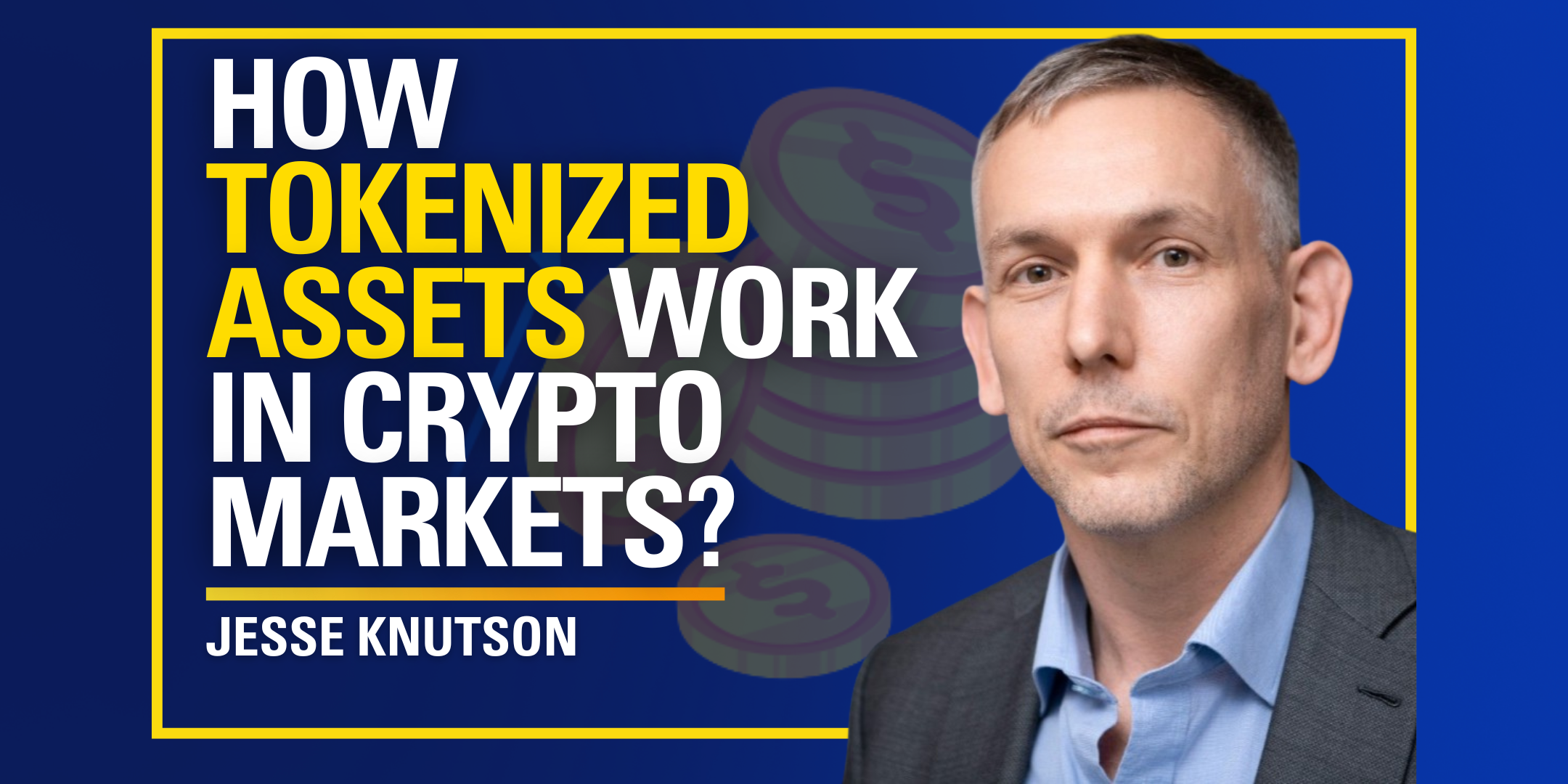
How Tokenized Assets Work in Crypto Markets? - Jesse Knutson | ATC #603
Host Stephen Sargeant interviews Jesse Knutson, Head of Operations at Bitfinex Securities, a regulated security token platform offering issuers and traders access to capital and tokenized securities. Jesse started his career in traditional finance having worked at global investment banks including Barclays and Macquarie. In addition to his role as Taiwan Head of Equity Capital Solutions, Jesse was also a founding member of Macquarie’s digital asset working group, and deal lead on the firm’s first equity investment into the Bitcoin mining space. Prior to joining Bitfinex Securities, Jesse was VP of Financial Products at Blockstream where he worked on developing and distributing financial products built on Bitcoin and backed by Bitcoin and Bitcoin mining.
Host: Stephen Sargeant
Guests: Anders Indset
We are also available via:
Buzzsprout • YouTube • Quora • Medium • X • Facebook • LinkedIn • Soundcloud • Apple Podcast • Spotify • Player FM
Episode Transcript
Stephen: This is your host, Stephen Sargeant, the Around The Coin podcast. You are in for a treat today we have
Jesse Knutson. He's the head of Operations at Bitfinex Securities. We talk a lot about his early days at Blockstream and how that evolved to what he is working on now. But we did go back and discuss
a little bit about the
liquid and the Lightning network. We talked all about security token offerings, STOs, and everything that Bitfinex Securities has to offer with their 24/7 365 platform.
We go deep into the regulatory requirements and disclosures. And talk about the innovations that have been taking place in the
digital asset and tokenization space.
We talked all about real world asset tokenization and what the next phase of the financial ecosystem looks like and why it's not a threat to traditional finance.
Jesse gives us some great advice on heading the operations at Bitfinex Securities, and it's everything you need to know about tokenized assets.
Just remember, we very rarely talk about tokenized assets securities on this podcast. But as a quick disclaimer, the content in this podcast is for informational and educational purposes only, and should not be considered financial, investment, legal, or tax advice.
Me as the host and our guests are not providing personalized investment advice and nothing discussed should be interpreted as any kind of recommendation to buy, sell, or hold any securities or digital assets.
Investing involves risk, including the potential loss of your principal. So listeners, which means you should conduct your own research and consult a licensed financial professional before making any investment decisions.
The views express are those of the speaker, our guest, and me do not necessarily reflect those of the podcast or its affiliates. So make sure you, DYOR, do your own research.
Stephen: We have like maybe like an alumni event here with Jesse Knutson, head of Operations at Bitfinex Securities. You know, as I used to be at Bitfinex way back when, consulting doing a ML investigations. But Jesse, you come from a different background.
You were at Blockstream very early. Why don't you give us a little bit of your background and then we're gonna jump right into Bitfinex Securities and Securities, just in this digital asset, uh, phase that we're going through when it comes to the financial ecosystem.
Jesse: Yeah, I mean, uh, yeah, thanks for having me on. First of all, um, before Blockstream I was in investment banking, so I worked for Barclays, I worked for Macquarie, gone into Bitcoin, and then yeah, ended up at Blockstream and worked as VP of financial products, uh, helping to develop and distribute, um, various financial products backed by Bitcoin and Bitcoin mining.
Stephen: Blockstream was so early. What exactly, I think if you, everyone knows the name Blockstream, but I think if you quizzed a hundred people that are, you know, close to crypto, they wouldn't be able to say exactly what Blockstream done. And I'm sure it's evolved over the last decade. So can you tell me what was, you know, maybe Blockstream when you were working on it, whether they're working on today?
Jesse: Yeah, of course. You know, I've got the white paper behind me and Adam back is one of the, the seven, I think it's seven people that are referenced on the white paper for his work on, on hash cash, which is used in the proof of work algorithm behind Bitcoin. And just like a ton of super smart, you know, interesting people worked at Blockstream and worked at a real variety.
We worked on a, a real variety of products. Everything from satellites to wallets to software to, um, you know, lightning to, um, the, the biggest Bitcoin layer to the liquid network. So all of that stuff. Um, and the product that I was working on mostly, which is, uh, the, the Blockstream Mining note. I, I think that was actually the real first kind of flagship STO product in the market.
It was, you know, they did eight tranches. They raised about $50 million. Um. It was properly, properly tokenized. It had a, it was a security, it had a nice isen issued out of Luxembourg and people could, you know, take it off the platform, trade it peer to peer. Um, the people were trading it on a telegram chat before we even had it on Bitfinex Securities, and it was a proper security.
So it was a, a really cool product and a, and a, I think, a massive proof of concept for the whole tokenized security in RWA industry.
Stephen: You mentioned Lightning Network. I remember when I was working in investigations, lightning was supposed to, you know, be the, the kind of killer app for Bitcoin and crypto. What happened? Did it not reach its full potential? Could we see, you know, similar to how Stable Coins have, you know, come full cycle and is now the talk of the town, could we see that happen with Lightning Network or is there still some missing pieces where Lightning hasn't hit mainstream yet?
Jesse: Yeah, I think so. Of course Bit Bitfinex was super early on, that as well has the biggest lightning node in the whole ecosystem. Um, you know, I, I, I don't know, I think maybe it's part of the shift in narrative that had that happened with Bitcoin, where it front went from, you know, peer-to-peer digital cash, like it says in the white paper, to becoming more store of value.
Um, I think US taxation rules probably are a big reason why Bitcoin payments never really took off. Um, and then I think maybe, maybe, maybe the success of Tether and um, and, and stable coins. Maybe it took a little bit of wind out of, out of Lightning Network sales as well. Like certainly there's still some, you know, really smart people working on that stuff.
David Marcus, um, from, you remember from Facebook, Libra, uh, he's working on Light Spark. You got Jack Dorsey's company. You've got the stuff that the Blockstream guys are doing, so. A lot of people are still working on it. I, I think, you know, I think maybe there's a point when Bitcoin kind of goes past the store of value, um, you know, kind of evolution.
And it goes back to being digital cash when some of the volatility comes out of it. Maybe that will, maybe that'll be a driver who knows when that's gonna happen. Or, or maybe it's a change in, um, you know, taxation rules in the US that could kind of kickstart it.
Stephen: I think taxation has only increased in the US with new, new CARF rules, new, you know, uh, form 10 90 nines and. Bitcoin ex or crypto exchanges needing to, you know, provide their customers with paperwork? I think it's only getting more aggressive. Uh, I think tax in general has been under reported when it comes to crypto gains in the us.
Uh, and they've made that very, very public, uh, on a number of podcasts with a number of people. I think, you know, I
Jesse: like government, it goes in one direction, right? It just gets bigger.
Stephen: Yeah. They never lower the, they never generationally lower taxes.
So, you know, when I was doing b uh, investigations for Bitfinex, I never really heard about Bitfinex Securities or what it was.
Can you kind of give us a backstory about Bitfinex Securities and how it came, like how it's evolved, especially now with securities getting a huge jump in digital asset tokenization.
Jesse: Yeah, I think you probably overlapped with the securities company. Actually. It started in 2021, um, but was maybe a bit quiet, uh, in initially. So over the last couple of years, it's grown quite a bit. We've got about $250 million worth of assets on the platform right now. I think actually we just got another asset approved, so we should be adding close to another.
Um. Maybe we'll get a closer to another a hundred million dollars by the end of the quarter. Depends on what we can get it up on the platform. So, um, yeah, we've done a bunch of different assets. We've done, uh, tokenized, uh, bonds. We've done a string of microfinancing bonds. We've done, uh, tokenized ETFs, we've done tokenized US treasuries.
We've done, uh, alternative assets like litigation, finance and Bitcoin, uh, hatch rate contracts. And that was actually the first product we had on the platform. And that's the overlap with Blockstream. The Blockstream mining note, we were the first, uh, centralized exchange, big exchange to, to list the, the Blockstream mining note.
Stephen: Do you see a lot of transition from people that are using Bitfinex to trade and you know, all the different token pairs to like, Hey, we want to do other things with our crypto or with our finances. Do you see a natural transition to something like Bitfinex Securities where they can raise capital or invest in other securities?
Jesse: I, I think, I think that's definitely the, the trend. I think if you, if you look at what moves the needle in our ecosystem within our industry, like where is the value in the, in the industry, I think there's, there's a lot of, uh, there's a lot of noise, but there's not a lot of signal. I think you could really boil down the accretive parts of the industry to probably, you know, Bitcoin.
stablecoins and then, and then tokenized securities or real world assets broadly. So I think Paulo has been quite vocal about this. He's done a lot of interviews and, and spoken internally in the company about this quite a bit. But that's how he sees Bitfinex evolving, is to kind of focus on those, those verticals is where, um, there's the most, um, kind of value to be given to our clients.
Stephen: You know, one of the things I saw when I was on the website was this ability to raise capital. If they met certain requirements, you could actually raise capital. And this is, you know, not new in the crypto industries. We saw ICOs, we've seen even, you know, exchange tokens. Can you walk us through what type of company would be coming to BI Nex Securities and saying, Hey, I would like to go through your process of raising capital.
Can you walk us through, maybe end to end what that looks like for a company and who would be the companies that would be looking to take advantage of this model?
Jesse: Yeah, for sure. I mean, first of all, the, the ICO thing, I thought that was a super interesting proof of concept. This is, I was working in investment banking on the, on the ECM side, you know, so my day job was trying to help listed companies raise money or to issue, um, products like depository receipts or things like that.
And, uh, that, that's when the ICO boom kind of kicked off in like maybe 2017 ish. And I thought, you know, this is really, really interesting. And I actually had the opportunity for the bank. I was working for at the time, an Australian bank, um, Macquarie to go around and, and uh, I was always pushing Bitcoin products at that time.
And they said, okay, well go to Hong Kong. Go to Singapore. I was based in Asia, still based in Asia. And go talk to our clients and, and see what their impression is of Bitcoin. And so going around talking to everybody, everybody was, you know, what's this ICO thing? You know, how are people raising so much money?
Like people were really interested in this. Um, and, uh, the, and the, the, the whole thing just kind of blew up. And in hindsight, you know, what went wrong I think, was that there was no rules of the road and there was no, no regulatory oversight. So there wasn't clearly defined rights, um, for investors, and there wasn't clearly defined obligations for issuers.
So, um, yeah, that, that's how this difference I see between ICOs and STOs. It's kind of the, you know, a very similar idea, but like with more investor protection and kind of a, a, a more kind of formal and structured framework around it. But I think the original ICO idea was probably a pretty good one. It was taking this technology behind Bitcoin and the digital asset industry and applying that to capital markets.
Um, you know, sorry, I've drifted, I forgot what your original question was.
Stephen: I was wondering
Jesse: me with
Stephen: type of company would come? No, I think that's a great, and I think great and speculation hits crypto just like it does traditionally. You know, you had the ICO boom, then you had NFTs and meme tokens. It always starts off in a very humble way, and then everyone's like, Hey, I can make money with not doing as much work.
And a gray area of regulations. Why not push all of my chips in? We're seeing that now with prediction markets, to be quite honest.
Jesse: Yeah, it's kind of that same energy that this gets repackaged over and over in kind of a slightly different form. Um, yeah. What kind of companies? I think, you know, so one of what we're looking to do, I think one of the value propositions that we have. Is that we wanna be able to kind of bridge the gap, um, between places like Latin America.
We're very heavily focused where people struggle to access capital, especially SMEs. Um, and then, you know, other parts of the world like Europe and Asia, that, that are kind of capital centers. And there's a lot of really interesting investment opportunities in these places. Um, these micro capital bonds, the micro financing company we've been working with.
For example, um, we're restarting those monthly bond issuances. Soon they go to, um, Eastern Europe. They go to Central Asia. Um, and they, they lend out to businesses. So real, real world assets, real world businesses with real world cash flows because the cost of capital is so high there, they can pay, uh, they can issue bonds that have a relatively high coupon and then pass that along to either conventional investors or to tokenized investors with us.
So I think we're open to like a broad kind of range of, of companies, you know, we really want to. Fill that niche of, of helping, um, these kind of places find capital and, and, and, and raise capital. And we've done a, a, a couple of those offerings. Um, a a lot of it has been debt focused. There's a real focus in the industry on fixed income at the moment.
But, um, yeah, we're looking forward to start doing more equity issuances as well, uh, as we move into, you know, further into 2026.
Stephen: And I'm curious, what was the. Existing path for if you're a business in Latin America looking to raise funds, you know, from outside investors. What was the path before Bitfinex Securities kind of created this model for them to get access to capital?
Jesse: Yeah, well I think that's part of the problem is I think that they really, really struggle. I think the banks typically don't lend a lot when they do, the interest rates are very, very high. Um, so it just becomes prohibitive. And then you see capital like really just kind of, um, kind of, uh, focus in the hands of, you know, a smaller group of people.
And I think that's probably a big reason why economies in a lot of these regions have been really stagnant for decades. Um, so yeah, that's kind of what we hope is, I think there's a couple of things that we're trying to do that's maybe a little bit different, um, than what you see with some of the tokenization happening with some of the Tradify players.
I think the improving access I think is a big focus of something we want to do because we're so active in Latin America. Um, another thing too is, um, giving people more control over their assets. So I think a lot of the last. You know, I think you could probably argue in a way that that, that Bitcoin and the infrastructure around Bitcoin has been more influenced by Wall Street.
Then, um, Bitcoin has influenced Wall Street. I think you could probably make a pretty solid argument on that. I mean, you were back at Bitfinex doing investigations and things like that back in the day. You're probably pretty, pretty familiar with that. So I think there's an opportunity here for this kind of like the i the ideas and the, the kind of thinking around Bitcoin and, and, and personal sovereignty and people having more control of their assets with, with this technology, we can bring that back to securities and to capital markets so that people can actually own their tokenized Apple shares, for example.
If you could do that. And take it off the platform, self custody it, move it to another platform for arbitrage, you know, or even trade it peer to peer. So that's, that, that's a kind of one of the, another one of the goals that I think we want to move towards. It's maybe a little bit different than, um, the tokenization philosophy that we see out.
Some of the big tradify tradify players,
Stephen: For many listeners, like even in coming Canada, even to get access to capital in Canada is extremely difficult. So you can. To only imagine what
Jesse: to crypto is difficult in Canada.
Stephen: Yeah, exactly. I still remember in the NFT hype, you know, using my credit card to buy $500 worth of Ethereum, um, and then not being able to use it for some time after realizing only after a few weeks that.
My credit card was blocked because I bought, and then, 'cause I used it to buy crypto. Uh, it's kind of like counterintuitive and it's funny now that, you know, some of the bigger banks are doing TV commercials about cryptocurrency. But yeah, go use one of their credit cards to buy a Bitcoin and you'll see how fast, um, that commercial, uh, gets, gets expired.
I'm curious to you, how long is this process from like the start to finish? You know, you're a small Latin American country or a company, you're looking to get access to capital. When they approach you or even before they approach you, how long would that, you know, cycle last before they can get up and running on Bix
Jesse: Yeah, I, I, I think the whole, the whole process, whether it's uh, you know, a small to mid-size company trying to raise money to do whatever, or if it's, uh, you know, a large fund issuer or, or, or whoever it is that wants to tokenize their asset. I think the whole period, we typically guide 60 to 90 days. Um, so the big steps are, are in that, is that, you know, you need to define exactly what you wanna do.
Sometimes people have an idea, they're not exactly sure. You need to document that. Need to onboard with the platform, we need to go through our listing committee. We have to review it. Um, and then eventually it has to go back to the regulator, and then they give the, the final, um, you know, uh, opinion on it.
And then, you know, you need probably about a month of market facing communications, um, and for, and for the issuer to, to talk to investors and, and things like that. Um, so the whole thing is about 60 to 90 days. So it's, I think it's quite a bit faster than, than traditional markets. And it opens you up to a whole new pool of investors too.
Right. Um, you know, obviously there's, there's a lot of money in USDT. There's a lot of money in Bitcoin and, um, you know, investors are looking to, uh, deploy their capital into different assets. And, um, and then there's an opportunity for investors to kind of connect with a, a, a different group of investors.
I think.
Stephen: You wrote a blog post about finding clarity amongst the crisis finding. Enough, you wrote that in May of 2025 when you know Bitcoin was around a hundred thousand dollars. Now that we see it close to $70,000, uh, I would love to hear your thoughts about like what you believed back then when it came to chaos and to tokenized assets, and has any of those beliefs changed as the market has gone down since then and there's been even more chaos, especially with everything going on with geopolitics and war around the world.
Jesse: yeah, I guess more chaos, right? No, I, I think that the, the point of that was kind of talking about the, the opportunity of, um, the fixed income products within the, the, the tokenized asset industry and that, you know, that's a place to diversify and to park money. Um, so I think that, um, you know, uh, like stable coins have obviously done, done really well for people rotating between Bitcoin and digital assets and, and a and a low volatility currency.
And I think there's an opportunity for various tokenized securities, fixed income products to also play that role as well. So. You know, when, when, when, when, um, when Bitcoin is, uh, moving and, and people wanna take profit, there is, you've got, you know, low volatility products that, that pay a yield, that are in a security wrapper, that are regulated, um, that can give you a little bit of peace of mind and you can park your capital there until you wanna deploy it back into Bitcoin or other assets.
So I think that's kind of the thinking on that, and I think that's probably been pretty accurate. I mean, the, the. The, the tokenized money markets, um, t-bills, um, these kind of fixed income products have, have really kind of dominated the, the tokenized security industry. That's the vertical that's captured the, the, the most capital.
Um, so yeah, just kind of pointing out to people that there's, there's that opportunity. I think that there're obviously, uh, a lot of, a lot of money in those assets already, but, um, I think there's a lot more money out there that could potentially come into the, into the industry.
Stephen: I feel like in crypto words are like tokenized asset are used to describe a lot of different things, um, depending on who you're speaking to. Can you give us your, like definition of what is a tokenized asset and why isn't it important to introduce these to the financial ecosystem?
Jesse: Yeah. What, what is a token? It's a good question. I think that's kind of the fundamental question, and I think you, it's a really good point. I mean, when you, when you look at a lot of the stuff that, uh, especially the big banks are doing, and it's easy to get excited about it because you see, you know, this big bank has done this project and they've raised, um, you know, several hundred million dollars or a billion dollars.
And it looks like it's innovative, but if you dig under the hood, there's really not too much changing. It's often, it's not even accredited only that's often institutional only. It doesn't touch on Bitcoin, it doesn't touch on Tether. It has no connections to, you know, this broader digital asset ecosystem that we're part of.
Um, you can't withdraw the tokens typically, and then there's no effort to streamline capital markets, right? So there's a custodian, there's a broker dealer, there's a depository, there's a transfer agent. There's like all of these people in there that technologically you don't really need anymore in 2026.
So I think, you know, what is a token? I think the definition has to do something with the ability to withdraw it, to self custody and to, and to move it around. Um, and the kind of the way we do that in a, in a compliant way, um, to meet our responsibilities to our, to our regulators and, and, and things like that, is that we do it within a whitelisted ecosystem.
So everything we've done on the platform so far has been done on, um, Bitcoin's biggest layer too, the liquid network. We started with the liquid network because it's got a really robust whitelisting functionality so that, you know, people can go on, on, on, um, Bitfinex Securities, they can buy, um, you know, an asset and once you're on the white list you can withdraw it, you can trade it peer-to-peer.
You can do whatever you want. So we've met our KYC and our regulatory obligations, and then users still get this kinda light touch Bitcoin or tether like user experience that they're kind of used to. So I, I think that's the way that markets will, will evolve.
Stephen: Is there a reason for the liquid network versus maybe on other networks or even using Tether stable Coin? Like is there a reason for the liquid network other than. The
Jesse: Yeah, well.
Stephen: versus others based on what you just said.
Jesse: Well, the, the, the real, I think probably the big reason is that it's a technology that we were familiar with. Our first asset that we listed on the platform was the Blockstream mining note from, from Blockstream, which is on the liquid network. And it had the functionalities that we liked. So we just stuck with the technology 'cause we had familiarity and because our, our first asset was on that, we'll be doing more issuances on more technology going forward.
But. Me personally, and I think a lot of people on our platform, you know, both management and um, and, and, and investors and traders and stuff. I think we've got a lot of, you know, Bitcoin first kind of people, and we want to do stuff on Bitcoin or as close to Bitcoin as possible for the most
Stephen: And I'm actually, I'm actually curious. You know, you, in one of your blogs you talked about like tokenized assets aren't a threat. To the traditional finance. Can you kind of maybe demystify why maybe those are working in finance right now? See this maybe as a threat and why they shouldn't worry as much as they are.
Jesse: Yeah, I, I think it's kind of complimentary actually. So I think it's when you, when you take a step back, basically it's about upgrading the infrastructure between financial markets. Um, and, and, and, and I think this is a product that kind of mainstream, well, I think that really any ins any investor would want, right?
Things like real-time settlement, um, uh, 24/7 365 trading the ability to withdraw assets to move them around. If you ask any fund manager or any mom or pop or any trader, I mean, these are functionalities that people would like to have. Um, in, in Taiwan, you know, where I did most of my, my whole traditional finance career, um, we trade nine till one 30, right?
So you buy TSMC on, on on Friday. Um, and you know, if you, if you sell it, you don't get your cash until the next week. Um, the market doesn't open on on weekends. It doesn't open on Chinese New Year's. So there's, you know, there's just a lot of downtime there. And then you look at a platform like Bitfinex or Bitfinex Securities and BI Bitcoin is trading, you know, 24 7, 365 on Christmas, Chinese, new Year's all the time.
It doesn't matter. So I think, you know, people look at that and they're, they're kind of like, well, why can't traditional markets trade like that? Um, so yeah, I don't think there's. I don't think it's necessarily competitive. I think there's a complimentary feature to it as things kind of evolve over time.
I mean, one of the things that I think that I'm kind of excited about is I think, um, you know, so we used to do depository receipts when I was at the, at the bank. So if you've got like a big Asian com company, like, um, you know, like a foxcon that does assembly for iPhones or TSMC. If they wanna get access to US investors, they issue an A DR, right?
So they take, um, TSMC shares and then they send them over to the US and then people can trade them on US markets, on US hours. And it's just easier for people to do it that way. So I think in the future we'll see people not doing depository receipts. We'll see people doing STOs, so you'll see a big public company like TSMC and they're like, we wanna trade outside of Taiwan.
We have to have like more investors, which they, they obviously do. We wanna be global. And you do a tokenized security offering, and then the whole world can get access to your, to your equity. So I think that's like eventually the way that public markets will evolve. But it's, it's gonna take some time and I think there's gonna be a lot of back and forth between now and then.
Stephen: and they're saying this is gonna be a hundred billion dollars industry by the end of this year. Is that 24 7 365 nature's, is that what's driving this massive adoption? Or are there other elements and factors increasing the, you know, the usage of these real World Tech token uh, uh, assets?
Jesse: Yeah, I think it's all of the above. So I think it's, it's, uh, those functionalities, like it's, it's real, it's real time settlement. It's 24 7, 365 trading. It's like, because of those features, you get better risk management. You don't have to have tokens sitting with counterparties. Are your assets sitting with counterparties, you get better.
Um, uh, cash management. You can churn your capital more because you invest in something, you sell it, you get your cash real time, you can deploy it again, so you can kind of churn it. If you're a hedge fund, um, it's access, you know, it's moving it to other markets. It's moving it to other exchanges. I think it's kind of all of the above.
I think. From a technological perspective, it's just like a, a much better way to do things. And I think as more people realize that, and this is partly a demographic argument too, right? So there, there's always been, like Tom Lee from Fundra had the demographic argument for Bitcoin. It's, you know, that maybe boomers or those kind of people who are the senior people in banks, um, now that they don't.
You know, they're, they're reluctant to adopt new technology. There's kind of like momentum with the traditional system, and that's where they're familiar. But as younger people get into positions of, of power and get AMAs more capital and get more say, then they'll be more comfortable, you know, doing things like Bitcoin and approving Bitcoin ETFs and, um, you know, uh, buying things with the Lightning Network and investing in tokenized TSMC and other assets like that.
Stephen: And I don't think people understand the. 4 7, 365 nature, how important that is. You know, even based on your example, three days of capital, just being stagnant there and not being able to be deployed in other places is extremely costly. When you're talking about tens and hundreds of millions of dollars, you're losing out on so much, you know, yield that could be deployed with that asset.
'cause it has to just stay there and it's almost caught in limbo.
Jesse: Well, I guess that's why Bitcoin is kind of the canary in the coal mine too, as you'll often see it move on times when other markets aren't open. Um, you know, on, on weekends and things like that. So yeah, people would rather trade whatever they own directly, um, but sometimes they can't, so they hedge by buying or selling Bitcoin.
Stephen: Is there, you know, we're both from, I think the time when, you know, scooters, but on the blockchain where everything was gonna be put on the blockchain and, and we're like, that might not be a great idea. Is there anything like asset wise that you're like, I don't think this should be a huge priority of putting it on chain or tokenizing.
And we can take our time and it might evolve to that, but we don't need to do it tomorrow. And we should be weary of people saying that we're gonna put this on chain tomorrow.
Jesse: Yeah, there's, there's some things that people have talked about for a long time that just haven't seemed to develop. So I wonder about like providence, you know, um, when I was at the bank, one of the first things, applications we had for blockchain was to look at. You know, what about things like iron ore?
Right? So apparently there was piles of iron ore in places like China. We weren't quite sure who owned it, like three or four or five or 10 people claimed ownership, you know, and it wasn't clear. So we thought, well, Canadian blockchain could, that could be an application for, but then you kind of get this situation of like garbage in, garbage out.
You know, somebody still has to kind of. Link what's happening on the blockchain to what's happening in the world and things can break down kind of there. So I think that's maybe part of the reason why we haven't seen as much action in like some of the commodity space. So that might be an example. And also, you know, housing is maybe something that go on the blockchain, but I don't think we'll go on Bitfinex Securities.
Right. So Dubai is working on, I think doing their whole registry. Um, for houses and apartments and things like that. And I think that's, that's definitely interesting. But I'm not, you know, that doesn't really translate well to Bitfinex Securities. We can't have an order book with like a house on each side that's like two or $5 million right.
On the bid and the ask. So I think things like REITs make sense for us, right? So it's like, um, you know, a bunch of assets or one big asset into, into a fund kind of structure and fund units are, are trading back and forth. That makes sense. But, um, like, you know, a whole country's household registry is probably something that wouldn't fit very neatly in an order book.
Stephen: I'm curious. You know, B Securities Tether has this huge focus on the Latin region. You've, you know, propped up. I think a lot of your thesis is there, right there in El Salvador. Can you talk to me about this? You know, I think this will be reviewed at some point as maybe a case study in Harvard Business Review of what you've done with this one region and how much buy-in you have from, you know, the, the leaders of that region.
Can you share some insights on how you've evolved tokenization in this region? And are there other countries, whether in Latin or around the world where you think that they are equally as, you know, progressive? We've seen some things, I think it was Bermuda, uh, with Circle and Coinbase, uh, or do you think like will be as forward thinking as El Salva?
Jesse: I think Sal El Salvador is a very unique com country, and I think its success is like, you know, in part due to Bitcoin and, and the efforts of Bitfinex and Tether. But I, I certainly don't think it's totally, they've got a lot. Um, you know, they, they, the, the, the president is um, a very unique individual and I think he has a vision and, um.
And, and he's doing a lot of things right over there. Even in the short time that I've been aware of El Salvador, you know, since the 2021 Bitcoin law, um, have been traveling back and forth there. I think I've been there, um, I don't know, maybe five, six, maybe seven times, I'm not sure.
Um, but it has changed a lot.
It's changed a lot and it's, um, you know, last time I was there, we were there for, um, plan B and El Salvador, um, Bitfinex and, uh, and, and, and Tether and kind of our ecosystem does two big flagship events every year. One is in Lugano, Switzerland, and the other is in El Salvador. Um, and El Salvador was, was booming.
Like there's a lot of construction there. It's very safe. Um, it's, it's, it's changed a lot and everybody is really, really positive. Um, the, the, the, the Bitcoin regulation and, and the, the tokenized security regulation, I think is just part of, um, what's happening, what's happening there. Um, and, and they do, um, they're, they're reaching out to a lot of people across the region.
They're people around the world really are going to El Salvador to kind of talk about what they're doing with, uh, with tokenized assets. Assets. Um, and it's an interesting question.
I often, I think I. I wanted to ask this to Paulo in, um, in Plan B and Laguna, but I didn't get a chance he was gonna do a panel and we didn't get him on the panel, but I wanted to ask him, you know, which region could be like Asia, you know, so like Asia maybe 30, 40 years ago has had, you know, it's just changed a lot.
It's had a massive amount of growth. Right. And if you were able to capture that, like fortunately I think I've been able to capture a bit of that, you know, by being here. Um, you know, if you were a young person, where would you go now? Where are these regions that can really outperform? And I think you'd probably have to guess like Latin America could definitely be one of those, one of those regions, you know, they're very, um, resource rich.
There's a lot of opportunities there. Um, and uh, I think, I think, um, tokenized securities and helping to kind of update their capital market infrastructure could be a big part of them being able to achieve that. Um, I think, I think there's probably a lot of exciting opportunities there.
Stephen: I think, you know, and I'm not an expert on geopolitics, but when you listen to a lot of the podcasts and you're talking about China and where they were 40 to 50 years ago, it was like a vision that they had and the government bought into that vision and they also supported the companies that were focused on main things like energy, raw earth materials.
We've seen that in other places. We saw, I think Saudi Arabia has like a 20, 30 vision and many places in the Middle East. So I think that buy-in of government is huge.
Do you think El Salvador could be that hub with the government listening? They want to hear about innovation and ideas and tokenization Could, do you think that could be the next hub for like FinTech and crypto talent and more companies?
'cause they have that digital asset license as well.
Jesse: yeah, I think they definitely could be, you know, like China's kind of a different thing, right? China's a beast of its own, it's, it's much bigger, but maybe like a Singapore. Right. Singapore, I think is a good, good comparison. It's, um, you know, it's a small city state, um, and, and El Salvador is a small country.
I think it's, uh, there's definitely a lot of similarities there, and I think that's kind of, or maybe like a uua e in Abu Dhabi or a Dubai, I think, I think there's a legitimate opportunity there for sure. Yeah.
Stephen: Securities has always been an area that's so hard for decentralized players. You know, you even talked about, I think we've moved more towards what a bank looked like than we are towards, you know, being your own bank when it comes to crypto in general. Right. Even Bitcoin now to ETF versus like peer-to-peer.
How do you navigate the regulatory requirements when you're trying to, like you wanna do securities, but you still want to keep that innovation and that ability to trade 24 7, 365. How do you balance your regulatory requirements for securities for bifida?
Jesse: Yeah, I think, I think, I think that's a good question. I mean, maybe on. You know, again, I guess the optimistic thing on, uh, the look on, uh, you know, that Wall Street has influenced Bitcoin so much, is that maybe things like the ETF or a Trojan horse, right? Like that, I think this happens with a lot of people.
You get into Bitcoin, the number starts to get up, and then you start to dig into it and you start to uncover more features. And also that demographic argument again, I think people will over time will come to realize that like, okay, the ETF is a good kind of, um. You know, gateway drug, but like, you know, but taking a step beyond that, maybe it's better to self custody it or, you know, maybe there's other things that I can do with my Bitcoin and there's a kind of a whole ideology and, and, um, way of thinking around it that people are, have yet to discover.
Um, in terms of, uh, managing, yeah, I mean, we're, I'm not sure that securities can really, uh, be decentralized, right? You need to know who the owners are. You need to have that white list. You need to have a regulator. Um, companies need to know, um, you know, where they're paying dividends to. So I think, I think a lot of this stuff probably can't be decentralized for securities, maybe for some other kinds of, um, tokenized real world assets.
But for securities it probably has to, it's hard to get away from like a pretty significant degree of, of, of centralization. And the heavy lifting on our end is all the traditional capital market stuff. It's like getting contracts in place. It's listing agreements, sales agreements, regulatory approval. Um, disclosures.
The tokenization stuff is the, the easy part, to be honest. But once you're in the token, you unlock all those benefits. So it's just kind of getting there. Yeah.
Stephen: I think people don't realize like, Hey, I'm in Canada. I'm like, Hey, I wanna, the, you know, price of Bitcoin is going down. I'm not gonna be able to invest directly in Bitcoin from my retirement savings plan, but I can invest in, you know, certain. You know, funds that hold Bitcoin, like there's ways that you wanna get invested.
You don't wanna be your own bank, but you wanna get more into Bitcoin, but there's still some restrictions where some of your retirement funds can go. Uh, so I think there is, it's nice to have like a ability to still get close to the asset as possible.
But let's talk about the disclosures. Nobody's reading them.
They're, they're onerous. They're burdensome. Have we been able to find an exciting or innovative way to provide investors with the close disclosure documents? Like, it's funny, I was on LinkedIn the other day and Yaya was rapping about the, the decentralized financial ecosystem. Like, is that the panacea where we have, you know, knowledgeable policy people?
Maybe able to wrap the disclosures to you or, you know, sing it in a fun way. Uh, but like it's one of those things where they're the most onerous hurdle, but nobody's even reading. Like, I don't, I've been invested in mutual funds, like I've never gone into the disclosures. It's kind of just a waiver for taking your kid to the trampoline, uh, park.
You're just accepting and keeping it moving. You're not reading any one of those clauses.
Jesse: there's some degree of buyer beware there where you can't get away with it. You gotta gotta be responsible for whatever you're buying. But no, I feel you. Like the terms of service are everywhere and, um, you know, they're inserted on everything. So on your iPhone, on every app that you download, all of this stuff, there's like, um, pages of legal discourse that.
Definitely most people don't look at, um, you know, may, maybe one thing I can cite is like the, the approach in El Salvador is that they've kind of got, uh, they've got a, the relevant information document is what they call their offering documents. And it's, um, you know, they've got specific things like a template that they want you to fill out.
Um, those documents can be relatively short. I mean, they can be, I've seen them as short as like 20 pages, and I think that's the idea is to make them relatively light touch and approachable to people. Um, but what I've noticed over time too is that you, you know, the more lawyers you get involved and people just kind of bring their, um, you know, their traditional, the way of doing things to it, and it, it gets more and more complex and gets, the documents seem to be getting longer and longer and looking more like prospectus.
But, um, I think that was probably part of the attention, uh, intention with El Salvador structure was to have like a relatively simplified and straightforward, um, uh, offering document to show investors. So, yeah, it's tough to get away from it and people really need to know what they're buying and I think maybe that's, um, you know, and to, to kind of define what the rights and the obligations are between the investors and the issuers.
Like I said, I think that's where ICOs really went wrong, is people just, you know, over overpromised and underdelivered.
Stephen: You mean they just went on Fiverr, got someone to write them a white paper,
Jesse: There is a lot of
Stephen: millions of dollars? Was probably was probably where we went wrong, I think.
Jesse: Or billions. Yeah. Some of the big
Stephen: Yeah.
what are your thoughts? I, I know Cbdc have kind of been, you know, put to the back burner now with stable coins and everything happening and the dominance of like tether and other stable coins.
What are your thoughts on like the bank of the BIS, the Bank of International Settlements? They've run a lot of pro, I went on their project page yesterday and they have a lot of projects in innovation. Uh, what are your thoughts on how they're trying to introduce like blockchain and tokenization? Is this something that you think the central banks and more of the larger banks are gonna get into?
Jesse: Um, yeah, I think, I think the banks are very interested in stable coins. I think that they're interested in stable coins because the Bitcoin, ETF was such a massive success, right? So I think a, a lot of people were massively surprised by the success of the Bitcoin ETFs and they're kind of looking for the follow-up product.
Um, they tried with an Ethereum product, it wasn't that successful. They've tried with a bunch of index funds that I don't think were nearly as successful. Um, and then they moved on to stable coins, right? To try and add yield to stable coins. And I think that's been kind of a mixed bag. Um, but people are still trying on it, and I think maybe that's why they're looking at secur tokenized securities as well, is because they think that that could be the next, um, uh, big things in terms of cbdc, I mean, I remember a few years ago the Central Bank of Canada had a, um, had a, uh, kind of a questionnaire or a survey out to see what people's interest or desire.
And people had no interest, right? Like, people are not interested in A-C-B-D-C, we don't want that. Thanks. Um, so I think that's it. I think people don't, don't really want it. I think central banks want it for obvious reasons, right? It gives them a lot more leverage. Right now they basically have, you know, increased interest rates or decreased interest rates.
Um, and, and, uh, uh, a central bank digital currency would, would, would give them a, a, a lot more control. Actually, on the IMF blog, there's a classic article about that, I think it's called. Uh, going negative and it talks about how, what you would have to do to force people out of cash, because cash is kind of like this, um, you know, system that keeps the banks honest.
Because if, if you go deeply negative for interest rates, then people can withdraw. You can have a bank run and people take all of their money out into cash. I think this article was from like 2016 or 2017, and they kind of talked about, you know, what would we have to do to get people to not use cash? And over time they didn't have to do anything.
People just stepped away from it. Right. In Canada, you know, there's, there's not a lot of cash in Canada. There's not a lot of cash in Australia. It's just a convenience, so people have completely stepped away from that. And for the convenience, I think they've just inched themselves closer to CBDC. So it's a bit of a slippery slope.
Stephen: I, I think, you know, Canadians don't wanna talk about CBDC when it costs $16 for a bag of grapes. I think that's the thing in Canada, when you have such high, high, high taxation and you're feeling at the grocery store and at the gas pump, you're less likely Doc, you could care less. And I think. Even Pierre was pushing crypto a lot, but at the end of his campaign he barely even talked about it.
And I think it's just for that reason. Cbdc is, crypto sounds great when everyone's involved in the wealth, but when you're struggling, I think, which many Canadians are, especially with the high prices of everything, I think it gets put to the back
Jesse: Well, I don't think CB GCs sound great kind of at any point. I mean, right. Like one of the things we learned from COID was. You know, there's a real danger that the government is gonna, you know, censor your, you know, you censor your money, you're gonna confiscate your money, they're gonna block your payments, they're gonna surveil you.
And it's high probability, I would say it's a hundred percent right. So we kind of, we kind see that we've run that experiment. We know it's gonna happen. So, I, I, you know, I don't, I'm not a big fan of giving the government any more authority over me than I absolutely have to.
Stephen: And I think we specific, and like the reason why I'm laughing is 'cause we specifically saw that in Canada when people were donating to the freedom the truck convoys. They went after every crypto exchange. They wanted information, they stopped the GoFundMe. And if the government was distributing money to those people, I'm pretty sure they would've turned the tap off at any given time to kind of coerce them and, you know, under what they believed were, were within their powers, which we find out later.
Was it within their powers?
Uh, I'm curious, what is the next phase? What phase maybe are we at when it comes to tokenized capital markets and what's the next phase and how do we get there?
Jesse: Yeah. One, one thing I wanted to add onto your comment though, is I think the other side of that is, that's part of the reason I think, you know, for the success of USDT that's often underestimated is the opposite side of that is the freedom side. So people often talk about, you know, if we can add yield to USDT, we can, you know, we can take market cap and we can come become bigger.
But they forget that USDT became big in a period of historically low interest rates. So it was never about the interest rates, it was about the, the, the freedom of the product. Be able to like, kind of control your own assets and to move them around and yeah, we want to take that and apply that to, to securities for sure.
And, you know, is how this evolves. Yeah.
I think one of the things that excites me is the ability for big publicly listed companies to do STO issuances directly, um, and to get out to like a global market. So just completely eating up the, the depository receipt model that we talked about before. Um, I think that's super exciting and I'd like to see more companies from within our ecosystem.
So in the 2021 cycle, all the big miners went to the Nasdaq and they listed in the US Coinbase listed. You know, I wanna see some of the big companies from our space and some of the, you know, the big successful private companies. I want them to, um, to, to do tokenized issuances. So I'm, I'm looking forward to that.
I think that'll be really exciting as well.
Stephen: I think you know, bifid X has always been pretty innovative. I think you know, even CZ on the recent All in podcast, I'm almost positive he said that. You know, they basically copied the Bitfinex order books when they're coming up with concepts. And you know what
Jesse: he say that? I didn't hear that.
Stephen: I, I, I heard that definitely.
Maybe not copy. You said you like, maybe like, took the model of, he mentioned the Bitfinex order books. I'll find that part and maybe we can clip it in, uh, in the early days before even Binance. Where are you innovating at Bitfinex Securities and how much are you utilizing things like AI.
Jesse: Ah, that's a good question. Yeah, I think, ah. Ai, I think, uh, on the platform, I think not, not a lot. I mean, like personally and, you know, synthesizing and, and doing market analysis and things like that. Yeah. Do a lot, um, on, on the platform. You know, I'm not, I'm not aware of anything that's being done at, at, at the moment.
Um, I think in terms of innovation for, I mean, none of this is super innovation. It's kind of, it's kind of obvious, but it's stuff that we need to do. Like, you know, I hope that we can be able to offer securities as collateral, right? So that people can buy, uh, and this is what people want, right? They wanna be able to buy securities, they wanna be able to tokenize, t buy, tokenized T-bills, or whatever.
Then to use that to, um, trade their crypto strategies to basically, um, you know, increase their net equity and trade on the platform. So, yeah, I hope we can bring out functionalities like that. I hope we can have more interaction with other platforms. I wanna be able to see people to really, to have. Dual listings where there's, right now I don't think there's many examples of, um, two or three different, there's really not that many tokenized security platforms.
With a secondary market. I'd like to see more interaction between the two so people can withdraw assets from one platform, move them to others. Um, I'd like to see dual listings between tokenized and conventional securities with a conversion mechanism so that if you've got, um, you know, pick a, you know, uh, maybe not a US stock, maybe another one, TSMC, for example, say TSMC.
So if someone has TSMC, they can send it to a broker, convert it to tokens, and then it would go on Bitfinex. You know, we trade 24 7, 365, the TWSC and Taiwan trades nine to one 30. We've got different kinds of investors. There's gonna be arbitrage opportunities and people can pull them off and, you know, go and try and close the arbitrage by converting to the conventional and vice versa.
This is the kind of stuff that I hope we'll see in the, in the next couple of next couple of years. I think this stuff is super exciting. Basically, uh, more of a merger like the Venn diagram closing over a traditional, um. And, uh, and, and the, and the new finance and, and, and hopefully that we can have a little bit more success in, in, in influencing them over the, over the coming decade.
Stephen: What are your thoughts? You know, AI agents, you know, I heard on all in podcasts today, the C-F-T-C-S-E-C chairs or the people working within those institutions were talking about, you know, AI agents, you go on crypto, Twitter and AI agents, uh, have their own hedge funds all of a sudden now and investing.
Uh, and we've seen yesterday, I apparently AI agents were killing my marketing agencies or outta business now 'cause the AI agents. What are your thoughts on AI agents that now have the capacity? To invest in things. They have their own accounts or digital wallets using Tyler and other things. I think Tyler just came up with something to do with AI agent payments.
What are your thoughts about AI agents and where they are in your market? Or is it too difficult in your market because of the requirements and the regulatory approvals that are needed?
Jesse: Yeah, I, I mean, it, it's all happening very, very quickly, right? It's really accelerated. Like, I mean, chat GPT wasn't really that long ago, and it's just everything has exploded from then. So it's kind of, it's kind of difficult to keep on top of. I do feel like there's a natural fit for our industry and that industry, right?
So I think if we're talking about, uh, payments between AI agents and, and different platforms and things like that, I think that that naturally probably favors Bitcoin and, and Tether. So I think that that's, uh, bound. Bound to happen, and there's bound to be more integration there. And it's, it's evolving so quickly.
It's, it's hard to say. I think, you know, everybody kind of has to try their best to understand the technology and to use the tools as, as best they can because things are just really changing very quickly. It's, it's also an like an amazing way to consume big amounts of information. It's, uh, and to try and make sense of information.
It's, it's, it's, it's a pretty wild time.
Stephen: Pretty great to like just throw in your disclosure, prospectus and disclosure, throw it into AI and say, tell me the parts that actually I should be aware of, and
Jesse: There you go. There's your solution for your disclosure issue. You don't need to give it to a wrapper. You can give it to AI and they can wrap it to
Stephen: Ai, I'm, I'm copywriting. I'm gonna copyright that. Now, disclosures, ai, I should be able to raise at least at a hundred million valuation just based on that idea.
Jesse: But one thing, one thing I've, you know, I've
Stephen: help me raise capital.
Jesse: So capital from, yeah. AI investors. Um, you know, I mean, one, one example is, um, you know, people are often regularly using AI to kind of go through their own offering documents and their material, and they use that to prep themselves so they're better prepared when they go and talk to a lawyer.
And then the lawyer helps 'em sort through stuff. So that's something that I see on like a, a daily basis.
Stephen: I would love to know what is the biggest challenge? Your head of operations and a huge ecosystem, Bitfinex Tether, some of the biggest ecosystem, your head of operations at Bitfinex Securities. What are the biggest challenges or the biggest success? Says you fell in that jump.
Jesse: Yeah, I think, yeah. Um, our, our head of Marketing Shield, he sent me a report last week from a, uh, a company called Bricken. They're a, a security token business in Europe, and they had kind of a report and they cited one of the biggest challenges is, uh, is regulatory. And I, I think we've made a little bit of, I think we've made quite a bit of progress on that.
I think even, you know, our, our regulators that are very front foot. They can get swamped at times, um, because there's a lot of interest and, uh, and, and, and can start to move a little bit slowly. I think there's maybe, maybe that's part of it. And then there's other regulators that, you know, still struggle to under understand the, the, the technology.
So I think you know it from that report, it looks like the market thinks to, um, you know, regulations are still, still part of it. I think it's kind of closing the loop with traditional finance. You know, the investor base on Bitfinex and Bitfinex Securities is. Is mostly, you know, high Bitcoin net worth individuals and high crypto net worth individuals.
And then kind of fast money kind of quasi institutional like prop desks and hedge funds and market makers and, and people like that. I think, you know, for our business, for securities, we need to make more connections with traditional investors, like private wealth people that wanna buy fixed income products.
I think that's kind of our challenge is to build out more and to connect that. And I think we've got something to offer. Um, those tho those people, those the broker dealers, um, private wealth, those kind of people. And, um, and I think they certainly have something to offer us. So I think it's, again, it goes back to that same theme about these two industries that have been kind of mostly like apart for the last 10 years and, and, and coming more together.
And, and who's gonna monetize that more? Will it be the big banks or will it be kind of innovative companies like, uh, Bitfinex, Bitfinex Securities and Tether.
Stephen: Have you seen a difference working out in Asia versus you were in Canada for a little bit and like obviously the US has such a broad reach when it comes to influence. Have you seen a difference in Asia versus. As other parts of the world and how they, you know, apply things to securities and tokenization.
Jesse: Well, I've been in Taiwan longer than I was in Canada. I've been in Taiwan 26 years. So I, I came here as a young man and I'm now well into middle age. So, you know, most of my, my whole work career was here. One thing I would say that's different about here, and part of the reason why Asia has been such a big part of crypto is that, uh, retail money is a much bigger part of the, uh, the traditional equity markets here, right?
So, Korea, Taiwan, India, it's like 70 or 80%. Is is just moms and pops churning their own portfolios. Um, whereas in the US it's, it's, or, and Canada, it's all institutional, right? People take their money, they give it to fund managers, and then they manage it for them. So that's part of the reason I think over the last decade why, uh, the Asia market has been such a big part of crypto is because people are used to trading their own money.
They're, they understand more sophisticated products like derivatives and warrants and futures. They're better at, um, you know, managing, managing risk and things like that. So I think that's one of the big difference between the, the, the two markets and that people in Asia, they love to have a punt. They love to gamble, so they're willing to take on a little bit more risk, I think.
Stephen: I love that. Do they have sophisticated investor? I know for traditional, do they have like tests that you have to take to be a sophisticated investor in certain parts of Asia? I think Singapore has that, and we're even talking about that in the US is like, okay, like get rid of this accredited investor thing and just.
Have a test of sophistication when it comes to
Jesse: A hundred percent. Yeah. No, they have different rules across different jurisdictions. They're, they're mostly kind of like roughly line up. Um, but, uh, yeah, no, I a hundred percent agree. I think that's one thing that needs to change, especially in this era where like all the growth is coming from technology and, you know, who understands technology.
It's like. The younger people have the best understanding of technology, and the money is just a paper cut. If you look at the history of accredited investors, where this came from, it was just they needed a really easy way to kind of, as a proxy of knowledge. And we can't test everybody's knowledge, so we'll just say like, do you have money?
Yes or no? And if it's a yes and you can invest, if you can't, then it's too risky. So it's basically just to make sure that you know you, number one, you have the ability to understand what you're investing in. And number two, you're not gonna like. Get wiped out and, and, and cause a problem. You know, if you, if you get hurt, right, that you can take a little bit of pain.
I think that's the idea. But you know, out of, out of, I think what you kind of create sometimes is a, is a situation where you get the people that understand and want to invest, who tend to be younger and they haven't had experience to build capital. Um, so they don't meet those thresholds, they can't invest.
And then the people that can invest older people with more assets they don't understand and they don't want to. So there's just kind of like. Things get left in limbo. So yeah, I think it would be way better if we could have some kind of, rather than just a simple money cut, there should be an opportunity for people to, you know, prove that they have some knowledge and the way they, they kind of do that when some jurisdictions where they look at your work experience and your educational experience and stuff like that.
I feel even that is a little bit unfair, you know? Uh, you should be able to, there should be another way to do that. I'm not exactly sure what the answer is, but yeah, I would definitely. You know, be in favor of opening up access to more people if they can demonstrate that they can take a little bit of pain and that they can, um, you know, understand what they're getting into.
Stephen: And then you see that where it's like they have maybe the sophistication, but they can invest because they don't have enough money. But then they end up in prediction markets and fantasy sports and they, they end up. Meme coins and NFTs. Exactly. That's where they end up going. And then everyone's looking around like, why are they putting their money?
Well, they have nowhere else to put it 'cause they don't meet certain requirements. Jesse, this has been an amazing conversation.
Jesse: you know, I was just gonna say one last thing is, uh, another, another, another thing that came up in that All in podcast that you mentioned is, you know, um, prediction markets and insider trading. I think that's another, you know, really interesting conversation is, um. How do you, how do you manage that and kind of the history of all of that.
So I think, you know, things are definitely changing. Um, markets are changing. The whole world is changing. Um, and, and I think this is, you know, I, I look at Bitcoin and kind of what we're doing with, uh, tokenized securities and, and trying to give people more control over their assets and return some power to people.
That's kind of been eroded over the last couple of decades. I see these as like positive things. Um, you know, the kind of reasons for hope within this kind of like, greater morass of kind of like chaos that's going on. So, yeah, no, I, I, I'm, I'm still reasonably optimistic on the future.
Stephen: I love. That's a great optimism, is a great way to finish the
Jesse: Gotta be.
Stephen: Where, where's the best place for people to find you? Are you on more on Twitter? Do you, do you frequent link, LinkedIn? Where's the best place
Jesse: I, I, no, I'm on, I'm, you know, I've got a LinkedIn account. I'm there. I don't really, I'm not very active. Uh, I'm an active reader on TWI Twitter. I'm not much of a, a a, a, uh, a contributor to the conversation, though. So, yeah, go to Bitfinex Securities. We're on, we're on LinkedIn, we're on Twitter. Um, uh, check us out.
We've got podcasts and articles out there, and take a look at the platform and have a fiddle with tokenized securities. The best way to like, you know, learn is to have a little try with it, so.
Stephen: And that's what we talk, even from an investigation point, like the best way to investigate, you know, blockchain illicit activity is to touch the actual thing, like use the tools, spin up a wallet, and to your point, like get into a lot of the things that the criminals may be using and regular people are using to understand what's proper activity and what's not.
Jesse, thank you so much for this conversation today.
Jesse: You bet, Steven. Thanks a lot. It's been fun.
.png)