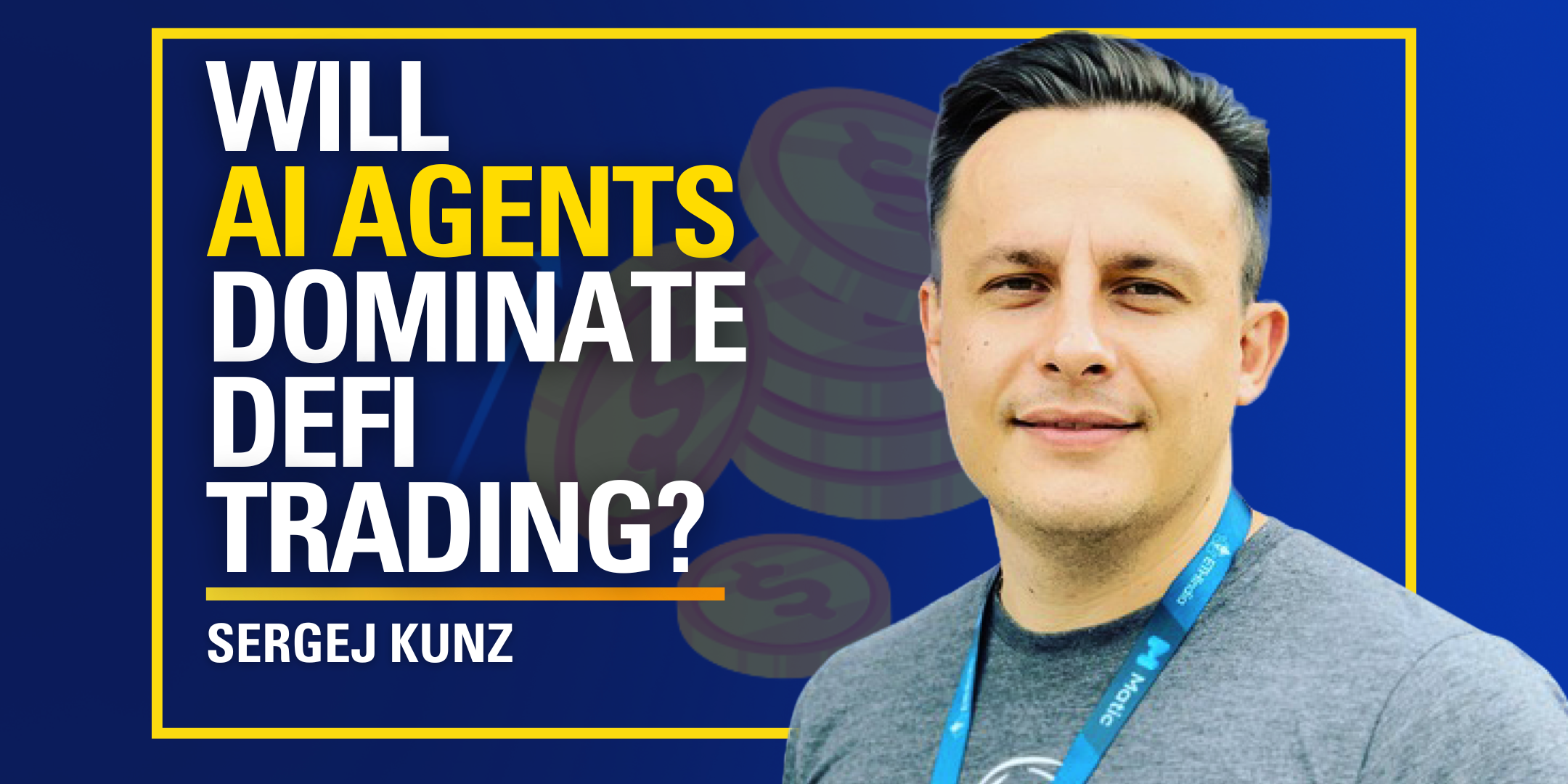
Will AI Agents Dominate DeFi Trading? - Sergej Kunz | ATC #612
Join host Stephen Sargeant reports live from ECC, where discussions center on wallets, tokenization, real-world assets, regulation, and compliance, and introduces alive Around The Coin episode featuring 1inch co-founder and CEO Sergej Kunz, a distributed network of decentralized protocols that enable the fastest, most lucrative and protected operations in major blockchain ecosystems. Numbers-wise, they have 2.7M+ wallets, $194B+ in trading volume, and $55B+ in available liquidity.
They also recently raised $175M in Series B funding at a $2.25Bvaluation. Sergej has been in the crypto space for 10+ years. He and his Co-Founder Anton Bukov created the 1inch Network MVP in 18 hours at the ETHNewYork hackathon in 2019.
Before founding his company, Sergej worked as a software engineer. His resume includes Mimacom consultancy and Porsche. He also co-hosted the YouTube show Crypto Maniacs.
Host: Stephen Sargeant
Guest: Sergej Kunz
We are also available via:
Buzzsprout • YouTube • Quora • Medium • X • Facebook • LinkedIn • Soundcloud • Apple Podcast • Spotify • Player FM
Episode Transcript
Stephen: This is Stephen Sargeant live at ECC. This has been such an exciting conference. A lot of talk about wallets, tokenization, real-world assets, regulations, and compliance is such a hot topic. As you can see, we've been blessed with this beautiful background, this backdrop of amazing scenery. We're having the best conversations on this couch right here, talking to the movers, the shakers, the builders of crypto compliance, talking to all those that touch the unique aspects of blockchain analytics and compliance risk, and some of the best risk and transaction monitoring you can find in France.
Around The Coin podcast is gonna be live at ECC. We have the 1inch co-founder, Sergej Kunz. He's gonna talk all about his early-stage projects, demoing in front of Vitalik Buterin. We go into what integrated DeFi actually means, and how 1inch is positioning themselves as one of the foremost aggregators for the traditional financial institutions getting into digital assets.
We talk about regulation, compliance, and the emergence of the DeFi ecosystem, meeting the traditional financial real-world asset tokenization. This is gonna be a blockbuster episode with the CEO of 1inch. 1inch is one of the most well-known brands, but- Give us a little bit of an intro.
Sergej: Yeah, my name is Sergej Kunz.
I'm co-founder of 1inch. Um, my background is software engineer, software architect. So yeah, w- working right now as, uh, CEO of the, um, Labs Group and Holding. So w- building on everything what's is 1inch related. I, I go to bed with 1inch, I, I wake up with 1inch, uh, topics, uh, and, and, and projects.
Stephen: Tell us a little bit about 1inch, 'cause I think people know them, but you have evolved over, you know, since its inception.
Can you tell us a little bit how you started and where you are today?
Sergej: So we started, uh, 2019 on, uh, New York, uh, Ethereum Global Hackathon. Uh, we had just an idea after some discussions with, um, Vitalik Buterin. I catched Hayden Adams, um, shared the idea, and, um, uh, yeah, everyone like said, "Oh, makes sense," yeah, kind of.
Uh, try, and, uh, we tried. Uh, my personal sleepless records I made in, uh, New York City with, uh, 56 sleepless hours to deliver, uh, 1inch together with Anton, my co-founder. And I was, like, pitching at, at the end of the hackathon to everyone, really to, to everyone, and only one guy said, "This is the next big thing," and I didn't believe them.
So, and nowadays, you see, um, big projects pivoting to being a DEX aggregator nowadays. And, um, we have, uh, a lot of good, uh, kind of, uh, projects who also try to compete with us.
Stephen: What is a DEX aggregator, and how is it different than maybe some of the other swapping services that you're seeing out there?
Sergej: Uh, yeah, nowadays, I think, uh, almost everyone, uh, swap on an aggregator, yeah.
Uh, it can be CoSwap or what use more centralized approach for intent-based swaps, where they decide who settle, yeah. In our case, um, we offer multiple s- solutions. For example, user, uh, take all the risks, um, of failed transactions, of being, uh, a, a victim of a math bot, and the user can create a transaction by themself and send the transaction to the mempool.
For swap across different liquidity sources, since we offer information how to exchange any asset to any asset, even if there's no liquidity for the specific pair. So, and there are other solutions like intent-based swap, uh, protocol, um, we are just... I, I pitch it like eBay marketplace. You know, you as a user, you say, "I have one Ethereum, would like to sell it on Ethereum to USDC."
And it's like on the eBay marketplace, I p- I put my order, and there are a lot of people who want to take full or part of it. Same here, um, we introduced more than one and a half years ago a cross-chain, uh, atomic swap, um, protocol, where people in the same manner put it, uh, on intent on a marketplace, and there are a lot of different participants who pass KYB and compliance check on, uh, on our side.
Uh, most of them are market makers, arbitrage traders, uh, try to, uh, settle the trade. So for cross-chain swap, it's like user publish the intent and someone take full or part of it, and, uh, it works through as cross. We use hash time lock contracts approach together with intents, and so it's fully atomic swap cross-chain.
Um, and you don't need actually liquidity like in the bridges. It's, uh, the liquidity is given by market makers who wants any way to trade and rebalance between block- uh, blockchains and networks. So, mm, and of course, we have also limit order protocols, uh, what are also intents actually since 2021, I think we released them.
So, um, yeah, these kind of products we offer, uh, from, um, 1inch side and users are going to m- mostly to the DAC, uh, DEX aggregators to, um, e- exchange assets because it makes no sense to go directly to the DEX, for example, Curve, where you can only swap stablecoins and only in this liquidity source. But very often there are market makers like Mint or Mute who offer same or better rates, but with less gas execution costs.
So that's why actually it's, it's a good thing that now we have very well, um, uh, uh, aggregator adopted in, in, in our space.
Stephen: I'm curious, you know, you mentioned Vitalik very early on, you were pitching NewTube, and you were doing, uh, hackathons, and Vitalik was in the first row. I'm not sure if he was a judge or just watching.
What were those early days like, you know, pitching in front of some of these people that have built some of the biggest blockchains, and now you're, you know, founding one of the biggest DEX aggregators in the world? Our
Sergej: story is that we were just two simple guys who were traveling around the globe. Uh, we participated in 13 months in like 16 hackathons or 17 hackathons around the globe.
We were almost everywhere. And you mentioned Nutube. It's kind of... I wouldn't say this is the best name for, for a, for a project. Uh, it was built in South Africa, and, uh, Vitalik, uh, also was in, uh, as, as a judge participating. So, um, we were lucky that we won the main prize. Yeah. So we got some funds. We could pay our airplane tickets, and, uh, most of the time we just were able to pay our tickets, uh, uh, maybe a hotel room.
Um, uh, and it was fun kind of, um, col-collecting a lot of, um, uh, friends. You know, we, we had at the end huge network. I actually used very well this network to spread around, uh, what did we release with, uh, at 1inch, uh, every week, maybe twice a week. The, the project what you mentioned, the Nutube project, was, um, decentralized video streaming platform where people paid for each kilobyte they consumed via crypto.
It was RaiNetwork used, I think, under the hood for, um, these payment, payments, uh, channels. It was kind of fun idea. Uh, on every hackathon, we just had fun, fun idea, just built it. Only one thing worked, so from 16 hackathons, only one project worked, and this is, um... And we got kind of lucky as well, you know.
Sometimes I see very gr- good projects, but they don't face any adoption. They don't get enough funding, and they need to close or to sell it to someone else. And I feel very lucky to, to be here in this position that we raised three times and happy to continue to build for 1inch Network.
Stephen: I'm curious, we're seeing a lot more conversation about tokenization, traditional institutions getting into crypto.
It seems that using your services is a natural progression for a lot of these large institutions. Talk to me about appealing to enterprise and institutions, especially around things like regulations and compliance.
Sergej: So y- you have maybe recognized our rebranding, and, um, it was done, uh, to improve our institutional adoption and enterprise adoption as well.
I think e- every business will use Web3 in, in the future. Mm, that's why we are, um, updating our rebranding, like our brand and how we act and, uh, how we communicate and how we, uh, on whom we onboard. So, m- right now we have like clean, simple design with black and white or white and black. Address also the institutionals.
I was here on a coin, uh, coin s- stablecoins summit. It was S- S- Saturday, I think. Um, there was a guy from Deutsche Bank, um, uh, who was telling on the stage that no one have built, um, atomic swaps for, for, uh, institutionals. After the, uh, panel, s- couple of questions, uh, at-- but at the end, you know, we, we have built atomic swaps for, for in- institutionals.
They can already use it And we are infrastructure project. We are like AWS services. We offer a platform. We offer infrastructure. So any business can do anything they want in Web3, exchanging any assets to any assets. For the best execution, we have support also for R2Blaze. So all our partners can consume it and integrate in own products by having own license.
This is kind of the way what we choose and we go to offer to everyone what we have built actually in the last six years as infrastructure.
Stephen: What's keeping some of these institutions on the sidelines? Because you've built the infrastructure. Is the word DeFi still have a stigma to it where they feel they can't participate because it doesn't meet certain compliance requirements that they're used to in their traditional world?
Sergej: Yeah, we have lack of education, especially like if I look on this person from Deutsche Bank, he wasn't very aware what we are and how it works. He was familiar with TWAP swaps and some protocols. But at the end, I had the feeling they protected his own product, own baby what he right now building at Deutsche Bank in own silo before just partnering with us, getting our smart contracts what are already well battle tested and audited and just also could use our infrastructure to just offer institutional grade product.
It's already possible right now to select the participants in, for example, for a swap. At 1inch protocols, you can say, okay, I am okay only with these specific market makers. Even the new product what we are launching, the 1inch Hawk Farm, this is a shuttle liquidity protocol what will also change the DEXs at the end, has support of NFC token.
So or specific conditions what, uh, the settler
Stephen: meets, uh, to, to execute, to settle. Where are you seeing the most trends right now when it comes to tokens and swaps? Is it around stablecoins mostly the institutions wanna get involved in? Where do you see some of the most, uh, frequency in the use of your tool?
Sergej: I, I would say AWS. So they, they tokenize now a lot, and they bring tokenized assets. So we see, uh, xStocks, we see Ondo Finance, we see, uh, um, also Securitize, so BlackRock moving and pushing this direction, and it's, it's great. Um, I heard that in DC they are speaking about to introduce, uh, 24/7 trading, so, and we are the infrastructure.
We are the internet they had to adapt, uh, when they used all the papers for settlements. And then we, we are the internet what they adapt now, uh, for what will be, uh, the, um, the next, uh, evolution step for, um... Not revolution, evolution step for finance.
Stephen: I think they're building a huge place out in Texas, a huge 24-hour NASDAQ or something huge there.
What are your thoughts on regulatory requirements? Obviously, DeFi is not 100% regulated, uh, especially because you're not touching user funds. What are your thoughts about where the regulations impact your business model? Obviously, you're focusing on compliance to bring in those institutions, but what are you required to do by regulations as of today?
Sergej: So our business model is, uh, B2B right now. Yeah. So we, we are integrated almost everywhere, I would say. Um, unfortunately, we were not integrated in Aave, so they faced a huge incident, uh, where someone exchanged fifty million and got forty-four thousand at the end. Could be different if, if they would use us, I would say.
Our business model, we, we get sub- we have subscription model for the packages. Uh, we, we offer API as a service, where they pay also for per, per request, and also some, some of the projects, um, do rev- rev share with us. This is our business model. B2B, so I can bill someone who I know, yeah, and, um, and also market makers, yeah, of course.
They pay for, for, for specific integration and volume, yeah, from these integrations what, what we do. So it's kind of both sides. So in terms of regulation, um, I think they will... What I al- also have heard, uh, in DC that, uh, especially-- I'm speaking more about US because- Yeah ... the, the, the music plays in US, I would say.
Yeah. So they speak about to regulate how that is with specific conditions, um, where teams need to meet these conditions. For example, proper, um, scanning of the wallets, verifying that it's not a hacker, not a bad actor, and so on and so on. And on demand also to do some KYC, but not that strict, what I understood.
I wish that they come with something, so we can work with that. I think it would help if they come very soon with, with something what, what works, uh, for everyone.
Stephen: What's it like building in a space like crypto as you as a founder working in this space for as many years as you have? What have you learned about building a team, you know, hiring people that aren't gonna maybe jump on the next wave?
A lot of the blockchain people are now in AI or robotics or, uh, bio health or bio hacking. How do you keep such a core team and build on it, uh, especially during a bear market like we're in?
Sergej: Yeah. We, we are since, uh, two thousand and nineteen on the market, um, so we don't really care about bear market. Um, in any case, we get volumes.
Yeah. So right now it's a little less than we had. Um, we have, like, between one hundred to one hundred fifty mil every day of volume. We had five hundred mil. On huge volatile days, we had eight billion per day. Yeah. So we, we just continue to build. We try to do it more in healthy manner. Um, we didn't, we don't have any profits, so in terms of, like, of what we are doing, it's not about the money at all.
We are adopting new technologies, new big thing, and I'm very, very happy to be in, in my place to be able to work on that. So, and all the revenue what we got from the business integrations, we just reduce our burn rate. Yeah, so we had-- we, we raised three t- three t- three times now fulfilling all the, uh, um, promises what, what we had to these professional, uh, backers, uh, whom we got.
Um, and yeah, try to give our best. Yeah.
Stephen: What are your thoughts around this idea, especially in the last five years of TradFi coming into this space? You know, to hear someone from a bank talk about atomic swaps, wouldn't... You wouldn't hear that in twenty nineteen. What do you-- what are the conversations and how have those changed since twenty nineteen, especially when you're talking to regulators, you're in the-- your company's probably keeping its ear on what's happening in DC.
How have those conversations evolved, as you like to word-- to use the word evolved, over the last six years? I had
Sergej: no, n-no kind of relation to any institutionals back in twenty twenty, twenty twenty-one, twenty twenty-two. We started to try to push our 1inch Pro, what is actually pivoted a little bit into just 1inch, what allows you to use 1inch in all the protocols in the manner that you meet all the compliance requirements, compliance requirements.
So nowadays it's much different, I would say. I already said the Ger-German guy from Deutsche Bank, uh, they are already working on a product. They're building something inside of Deutsche Bank to offer any other, um, banks, uh, option to settle in atomic manner, uh, any cryptocurrency trades.
Stephen: How can you support for like banks are like, that sounds great.
We're not building anything in-house. How can you-- like what's the-- a nice linear way you can support banks that are trying to get into the space instead of them having to build their own and make their own mistakes? You've seen the industry, especially with market makers, liquidity, et cetera. They can already use us,
Sergej: so they need just our business account, uh, um, they need create one account and then passing KYB and some compliance checks, and then, um, they can already start to build, uh, experiment, and if they need a white label solution, they can get it if they want.
Stephen: What are your thoughts of ECC? I've heard a lot more conversations about regulation, tokenization than I have in the past. What are your thoughts about the conversations that are taking over ECC this year?
Sergej: I've seen s- uh, only a few, uh, speeches on the stage. Um, I spoke with some people here. Um, I get the feeling that everyone is like want to verify if, if the other people are more advanced than themself in AI and, uh, and AI agents like, uh, like I spoke with a guy, he, he asked me if I'm using OpenClaw, and I said no, um, because I used OpenClaw and decided to build my own, uh, agent based on my own architecture, what is more secure, and I understand what is behind that.
And he showed me also same, same, uh, Telegram group chat with all the topics that he also speaks with the, with the agent, get all the, um, reports. It's, it's very f- very nice kind of to see that people, mm, kind of, um, develop themself and try new things out, and it's really helpful. So I feel by using AI, like I have a 30-man m- people, uh, team behind me who, um, with whom I even don't need to speak, you know.
Uh, they understand everything what I need, and they execute. So I'm able to do researches, uh, instead of months, I can do it in, in two days on weekends, you know. I've built multiple prototypes of, uh, different protocols, um, uh, also new things, uh, in really a short, short amount of time, and it's a kind of new age.
Yeah, it's new approach, and it's new way of thinking even.
Stephen: Yeah. How do you balance using AI for your organization when institutions are already a little bit, you know, scared of DeFi, and now you're introducing AI and, you know, they're hearing the same things you are, right? It's not, you know, it's not closed loop, so they're worried about, you know, faulty code, et cetera.
Sergej: You, you know how they use AI. They sign a contract with Microsoft and get, uh, Copilot, um, and get also a, a custom solution with own documents, uh, to teach with own documents, and they, uh, like hide from their real power. Yeah. Anthropic- ... uh, Claude Opus, uh, four, 4.6, for example, uh, what gives you a lot of power.
Yeah. So you can build a lot of things in very short amount of time. Um- Yeah, I don't think so that is a problem that we are using AI and, and we are using a lot of AI. Uh, so all the tests are written in AI. Um, uh, all CI/CD pipelines are written in AI because one person would just take... Normal senior software engineer at 1inch would take like two, two days to write a pipeline, what I do like in one minute with, uh, with, uh, a Claude, uh, model, yeah, for example.
So I think they will be much slower. All the, all the enterprise who try to just be super, super compliant with their own compliance in the company and just have a Microsoft, uh, Copilot, what is also limited to outside, they will, will be not that fast as, uh, all the startups who-- one-man startups who are now building the next generation of applications.
Stephen: I love it. What do you think the future and where is the future of DEX aggregators, 1inch? What's the future like for both the industry and your organization as a-
Sergej: Yeah, the future is already, um, working today. AI will be a main user of Web3. You, you see all the projects building skills, publishing the skills, MCP servers.
We launched, uh, yesterday MCP server at 1inch, so any AI agent can use it. Um, we publish also some skills, so to teach AI how to use our APIs. Uh, I personally, uh, built my agent with Web3 support. I can have my, uh, internal, uh, wallet, what is on my Mac Studio in secure place. It's here again, it's something what, what is very Web3 related.
People started to install OpenCloud on all machines, on all Mac Minis, and this is n- nothing else than self-custody. Yeah? So, um, yeah, I connect my, my agent to, um, my 1inch wallet through WalletConnect and can actually, um, provide liquidity to Uniswap. Um, and I get the suggestion from the, from, from my agent, because they have access to Dune Analytics, they can look into data, understand, uh, in what price ranges the, the token pair was in the last three months, and I put for the next three month, uh, liquidity position based on data, not based on gut feeling and, and, and guess, you know.
Um, and this is the next thing. So everyone will have an agent and an AI agent, and this agent will use crypto for payments, for, um, managing portfolio and for swaps.
Stephen: I love it. If I was to talk to you next year at ECC, what would success have looked like for you? What would have had to have happened in the last, in the next year for you to feel that 1inch has b- has been successful over the last 12 months?
Sergej: That we got integration in all the AI agents And then I get integration f- of all people who are using AI engines.
Stephen: That's
Sergej: awesome.
Stephen: Thank you so much, Sergey. Appreciate it. Thank you.