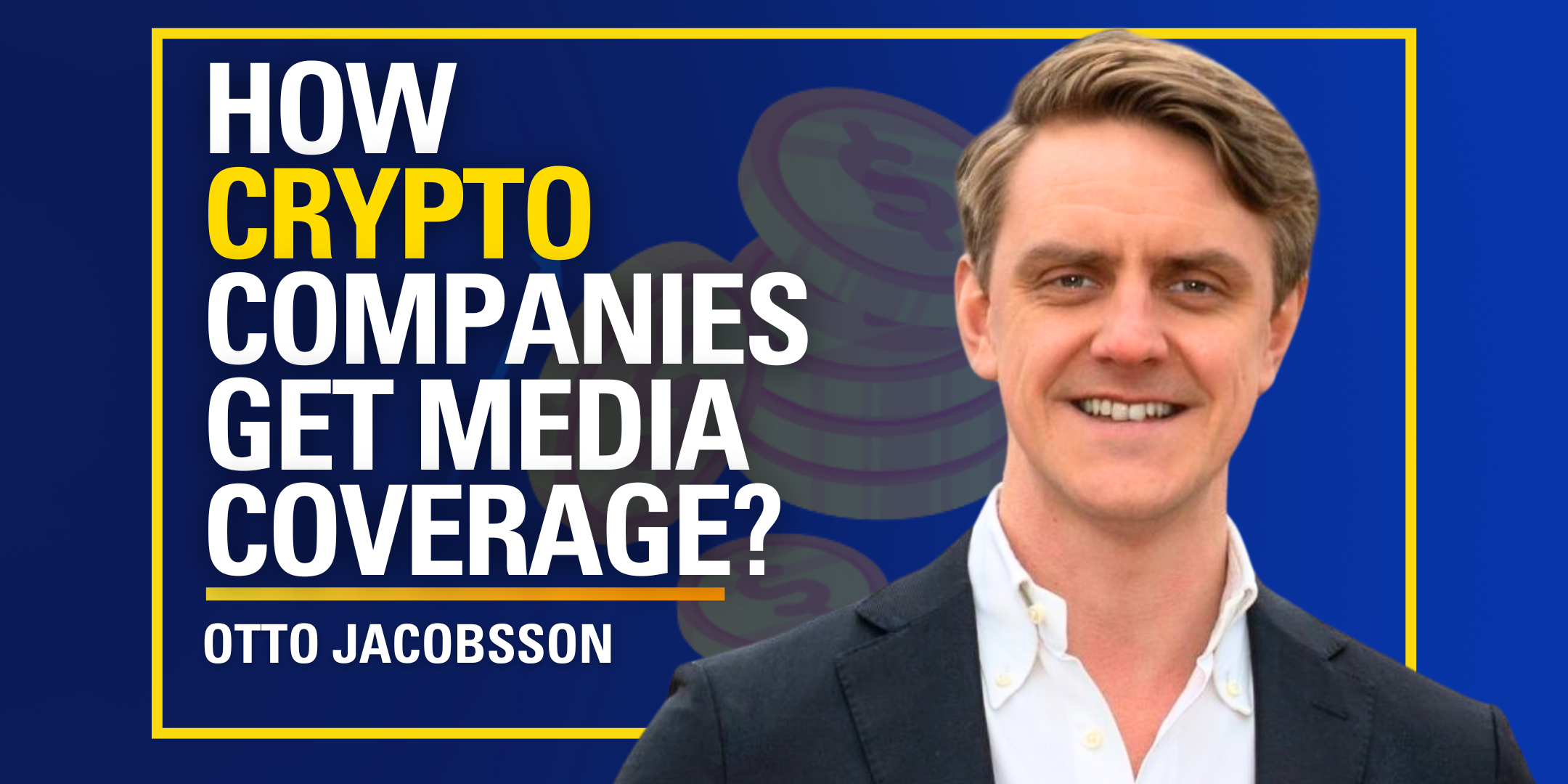
How Crypto Companies Get Media Coverage? - Otto Jacobsson | ATC #611
Join host Stephen Sargeant live from EthCC in Cannes for a special episode of the Around The Coin podcast featuring Otto Jacobson, CEO of YAP Global. Otto shares his journey from investment banking and CFO to leading one of the top PR firms in crypto, blockchain, fintech, and AI. Together, they discuss the evolving media landscape in Web3, the rise of niche content creators, and how crypto companies can effectively communicate their stories in an increasingly crowded market.
The conversation also explores major industry trends including stablecoins, tokenization, FX trading on-chain, institutional adoption, and why traditional finance giants are moving deeper into blockchain infrastructure. Recorded live at EthCC, this episode is packed with insights for founders, investors, marketers, and anyone interested in the future of crypto and fintech.
Host: Stephen Sargeant
Guest: Otto Jacobson
We are also available via:
Buzzsprout • YouTube • Quora • Medium • X • Facebook • LinkedIn • Soundcloud • Apple Podcast • Spotify • Player FM
Episode Transcript
Stephen: And you guessed it, that means that the Around The Coin podcast is live at ECC. For our first episode, we're gonna be talking to the CEO of YAP Global, who's handling all the media here behind the scenes at ECC. We have Otto Jacobson, who's transitioned from CFO to CEO of YAP Global. We talk all about the current state of media, podcasting, what it's like to be at an event like ECC, and how
Otto: companies can get their message across in the day and age of so many different outlets to communicate to your audience.
This is gonna be a special episode. Stay tuned.
Stephen: I'd just love for you to tell us about you and YAP Global, 'cause I think it's one of the interesting PR companies that have come out of the crypto fintech space.
Otto: Cool. Yeah. Thanks so much for having me. Um, so YAP Global, we're a leading PR consultancy in the crypto, blockchain, and digital asset space, including, uh, fintech and AI.
Um, we do a lot of work in the stablecoin space. And yeah, we started in, uh, 2017, 2018. Uh, Samantha Yap, the founder of the company, she was freelancing at the time, having worked as a journalist and producer, and a bit in PR, and she just, yeah, basically fell down the Bitcoin kind of rabbit hole, and started from there.
And now we're global. We have, uh, offices in London, where I sit, and Singapore and New York. So, yeah.
Stephen: It's crazy talking to founders now. 2017 used to be like, oh, you got in... You know, 2017's like the OG space. Now you look at 2017, that was like nine years ago, and you're like, "Wow, we've survived in crypto for that long."
Otto: Yeah.
Stephen: Tell me about the PR space, where it sits today, 'cause I think traditional media's changing. Uh, even, like, paid media's changing versus earned media. Give me the lay of the landscape from the way you see it, especially as a new CEO of a global PR company.
Otto: Yeah. No, absolutely. Uh, it, it, there's a lot of to unpack there.
I think one thing that is clear to me, like, and because we do some work in the AI space as well, like, good quality media assets and good consultancies, good PR firms, they will be able to survive, like- the age of abundance, the age of AI, and everything like that, because media relations is just super important.
So what does that mean for us? It means that, you know, any time that we can save for our team through AI, uh, they're gonna be spending on building better media relationship and, of course, relationship with our clients. Now, with the media, I think crypto media is, is still around. It's doing well in a lot of ways.
Obviously, some people have kind of fallen away. As unfortunate as that is, the- there's still a, I think, a thriving crypto media scene out there with a lot of kind of alternative content producers and so on. What's really changed for us is regional media. Uh, so not just the mainstream financial press, your Bloomberg, FT, Wall Street Journal.
They've been covering crypto for a while, right? But the regional media in, in Europe, in Asia, and indeed in the US is, is picking up, uh, coverage, which means more opportunities for our clients to get coverage out there. So I think it's a, it's a boom, basically.
Stephen: If you're a fintech stablecoin company, you're watching this interview, you're like, "I need to...
a PR company." Where are some things, what would you advise an- a company that's very new to the digital asset space, but also extremely new to the PR space? Because I think there's a lot of myths in PR. You just pay, and then they put you on Forbes, and you ride off into the sunset with all these new customers.
Right. And I think it's a little bit different than
Otto: that. Yeah, yeah, yeah. I mean, so we don't do any paid media, so, uh, we work with editors and, and content creators and so on, and there's never any money involved from our side. Now, obviously, a lot of our clients have significant paid media budgets, advertising, and there's obviously a huge role for that.
It's just not what we do, right? Um, a couple of things you wanna think about, like, what is the story that you wanna tell? What are the narrative points that you wanna hit? And obviously, I mean, narrative points, that's a PR kind of term, right? Um, but basically, what do you want to communicate about yourself?
And that goes kind of into common sense and business, you know, business, um, uh, you know, just general business. What are the unique selling points of your stablecoin versus someone else? I, at the moment, I think it's quite interesting, right, 'cause the USD s- uh, stablecoin's obviously dominant. They're the biggest one.
They're gonna continue to be the biggest one, for sure. But non-USD stablecoins, I think that's really interesting. Are you launching a Brazilian real stablecoin? Are you launching a, um, you know, an African stablecoin, for example? Uh, or a, e- even another Euro one is still a pretty underexplored market. Mm.
And then FX trading on-chain I think is a big, new narrative because that is going, I believe, it's gonna move on-chain 'cause it's just obvious that it needs to. Uh, and I think everyone's looking into it. So can you go- You know, I guess the saying is can you skate to where the puck is going- Right ... rather than trying to, you know, be in front of the goal and score from there.
Stephen: I'm curious to you, especially when you're seeing a lot of these cr- you know, we're at ECC, there's a lot of newfound, there's a lot of creative energy, but it's a very tech-focused crowd, and those are the companies that are coming to you to get PR. But they're talking about primitives, and you're like, "Yeah, that's not exactly the way the media's gonna, you know, capture this story."
How much of your work is taking what the founders are saying and the things that they're exciting about and translating it to stuff that people actually wanna read and get excited about?
Otto: Yeah, I think as weird as it might sound, it used to be kind of worse. It used to be a lot more technical and really, like, developer- Yeah
almost, uh, worship. Yeah. Um, which i- is fine if you're a developer and you're a technical audience, like you can, you can consume that kind of information, right? Yeah. But if you're not, then you need someone to translate it. You need someone- Yeah ... to explain it to you. And it's still a big piece of our business.
I think what has changed now is that you have a lot of commercially minded people, like, you know, people that have worked at big banks like both of us- Yeah ... basically, and, and we're coming into the space, and we're saying, you know, "We're not technical. We need to basically sell this kind of product- Yeah
to sell this service." So, uh, yeah, I think it's changed a bit. It used to be a lot more.
Stephen: What did you wanna do coming out of school? 'Cause I think you went to school for economics. We, we see a lot of the blockchain- Yeah, yeah, yeah ... FX companies. We're here with Scorechain, Chainalysis. A lot of their founders, economics background.
Is that something- Yep ... you're looking to get in on more on the investment trader side? Uh, and then how does that compare to where you are today and-
Otto: Yeah, yeah, yeah. Um, yeah. So I kind of, you know, I'm a European. I'm Swedish originally. I wanted to move to London and work in investment banking, and that's eventually what, what I did, uh, kind of out of university.
Yeah. Uh, so I did debt capital markets, which is a very, very traditional- ... part of investment banking and TradFi. Um, yeah, it was... I liked it. I enjoyed it, but, um, after a couple of years, I realized I was probably a bit m- more entrepreneurial and- Yeah ... and broke out of that. Tried some different things and then eventually ended up at Diap Global and now kind of running the shop,
Stephen: so yeah.
First day at the conference, I heard tokenization, regulation, and compliance used in three different of the keynote speeches on the main stage. That's the first time I've heard about it at any conference, much less ECC.
Otto: Okay.
Stephen: What are the narratives that you're seeing today? Is that tokenization still one of the big narratives?
Otto: Yeah, I mean, it is because, uh, tokenization, if you think about it, basically means, you know, everything, right? Like, everything that is a non-crypto asset, non-digital asset and bringing it on-chain, which I think will be a major topic to continue because there's obviously, you know, you think about housing.
Yeah. You think about stocks, which is now, they're getting tokenized, right? It, it will, but I think it will go beyond that, and it will be a bit more niche. Like, for example, FX trading, like I mentioned, um, I think people re- realize that even the leading fintechs in, you know, FX remittance kind of business, going on chain is inevitable.
Like, if you're dealing with retail clients, having, um, you know, a 10 to one kind of cost savings is fine. Like, you might not move on-chain for that reason with the friction that unfortunately we do see still with, with, uh, on-ramping. Yeah. Um, but if you're an institution moving, you know, 10 million, 100 million, a one to 10 cost saving is, you can't ignore that anymore.
And therefore, I think the leading fintechs will also move into, um, on-chain business as well. So we see Stripe with Temple. Yeah. You know, that will just continue, all of them. Revolut is getting into crypto in a big way.
Stephen: I'm curious, you know, PR is a very competitive field. Obviously you're, you know, the PR company that's handling the media, so you're dealing with a lot of other PR companies at this conference.
Sure, yep. How do you stay competitive or what do you think your competitive advantage? Why are people coming to YAP Global? I think organization, you guys organize a perfect media back here. And I've been a beneficiary of that. Yep. So I think that's all hard to do when you have so many competing interests on, you know, a span of three
Otto: days.
Yeah, yeah. No, I, I, I do think about this as well because, um, we obviously wanna contain or retain our competitive edge, right? Um, business understanding I think is, is underrated. I think because crypto and digital assets is a relatively technical space, I think non-technical people think that they shouldn't look into it, that they kind of need to only have like a surface level understanding.
Stephen: Yeah.
Otto: I wholeheartedly disagree. Like, we don't need to be technical as- uh, experts.
Stephen: Yeah.
Otto: But we should understand the business, how it makes money, what kind of customers, what kind of clients it goes after, and so on. And then we will do better PR because we will better be able to sell it into the media in a better way.
Stephen: Yeah. You're speaking to the choir here because that's how I got into this industry doing media, is that a lot of people knew blockchain, some people knew blockchain links and compliance, but nobody knew the nuances between. I was like, "Hey, I can help you guys. This is all I used to do." Yeah, yeah, yeah. Yeah.
And it's hard because if you don't have the context, it's really hard to get that narrative across- Yeah ... if you don't understand what's happening in the background or who these companies
Otto: are. Yeah. And I mean, sorry to interrupt- Yeah, go ahead ... but I think you, you have to understand what, you know, what a bank faces in terms of compliance con- Yeah
uh, constraints, right? Why is blockchain able to b- offer a better solution? Because they are basically having, you know, the banks are having people that are sitting and monitoring transactions. But if you can automate that, it's just- a better solution, full stop.
Stephen: Your CFO background, you were the CFO at- Yep
Yacht Global before- Yep ... jumping in the CRO role. It looks like a lot of companies, especially in the blockchain space and the market that we're in now, have to focus about revenue, you know, uh, you know, reducing expenses. How's your CFO background benefited you talking to some of these companies that are obviously looking for PR, but they're also looking to save dollars- Yeah
in getting their message out there?
Otto: I mean, you mentioned it, right? Like, we've been through what, three or four major cycles since- Yeah ... since we started.
Stephen: All, all the major, all the ones that count.
Otto: Yeah. And it, it, they get kind of, you know, the upside is bigger now. Um, uh, but also, you know, you feel a little bit, not more depressed, but, you know, the downside is also bigger in some ways.
If you can just survive in this space, you will be a leading company, leading business. Um, so protect the downside. Um, you know, just yesterday I was having a conversation with, um, with a client basically who need to, yeah, save some runway. A- and, and w- we're very willing to work with our clients in that regard.
And I think, uh, you don't have to go for broke all the time. Now, as a VC-backed company, you should. You should have a bold idea, try it out. If it doesn't work within two to three years, then move on, right? But be a little bit more protective on the downside, and maybe don't spend so much on useless stuff like-
Stephen: Yeah, no arena-
parties ... no arena naming, uh, none, none of that good stuff during the good times.
Otto: I mean, if you're a centralized exchange- ... leading, you know, leading the US market, maybe you can afford it. Uh, but
Stephen: yeah. I'm curious for you, where do you see the, as you say, about the puck going, where do you see that for media?
We're seeing podcasts, obviously I host podcasts, but we're seeing podcasts get a lot more attentional. Um, people are using that for their media sources versus now, uh, the traditional media that we've seen. So how do you position yourself by utilizing maybe a small content creator versus maybe the Bloomberg News?
Like, how do you navigate that as a PR
Otto: company? Yeah, I, I, I mean, I can't stress this enough. The, it's amazing the time that we're in, right? Because you can have a super niche subject, and we see this with some of our clients where, you know, they, they, they kind of, you know, very niche. They, they have a very specific focus.
But we have a global audience now. Um, and we've had some- For a while with internet, but literally you can have a sub-Substack with a super niche topic, and they still have 10,000 super dedicated subscribers. Yeah. And that's a pretty good outlet to get coverage in, uh, for our clients or, or, you know, if you're, you're hitting that, uh, niche compared to a general interest story in crypto media and so on.
Now, those things still matter, and you should do that, and you should work with us obviously- Yeah. ... to do that. But, but the niche is really good. You can have a global audience for something that's super niche.
Stephen: You talk about regionalization and being in certain regions. Yeah. Even some of your clients aren't in those specific regions- Yeah
but you have feet on the ground. What did you think that the gap that was, you know, m- that, what were you missing by not being on the ground in those regions, and how much has your business improved because you have people there talking to local outlets and, you know, being a part of the community, which is also hugely important when you're in PR and you have to make relationships?
Otto: Yeah, yeah. I mentioned, right, we have a office in London, Singapore, New York, and then we have someone in Dubai as well. So maybe Africa and South America, Latin America is an area where we have, you know, less, less coverage. So I do think we miss out on some of those stories and what's coming out of there, and I, I, I wish we could do more.
Uh, at the moment, you know, this is where we are. Um, but I think the, the point is, um, what kind of business do we wanna build? If you really want a global business, then you kind of need to think globally and hire globally.
Stephen: Yeah.
Otto: Um, and that should affect your PR strategy, right? Like, how do we translate material into Spanish?
How do we translate material into Chinese? And, you know, this, this is pretty simple these days, but are you willing to take those extra steps into, in order to get your content into the right hands, basically.
Stephen: And there's translation, but there's also, like, certain euphemisms that are used in those regions, right?
Yeah. Like, you can translate using AI, but if you're not using certain terms or certain words that isn't translated by the AI, it's hard to attract those markets obviously. Yeah.
Otto: Yeah, and I think this is not that expensive, you know, anymore. You're talking about, if you're talking about a targeted media campaign, you should be spending some, some money on that, and you can easily find localization translation that can get you into the right press, even in places like, you know, South America, Korea, et cetera, where local language markets really matter.
Stephen: Now, you talked about your clients. I don't want you to pick favorites, but are there interesting projects that you're working, or even just narratives, if you don't wanna mention the clients specifically. Are there narratives that you're either personally excited about, uh, from a CEO position, or just industry-wide, you're like, "Hey, this is a really hot topic"?
Otto: Yeah. Um, so personal interest, I mean, I think I, I've mentioned a couple times even during this conversation, like FX trading, because it is the, um, it is- the largest financial market, uh, in TradFi, right? Um, so that moving on-chain will be a huge boon to the world economy overall, et cetera, cost savings, whatnot.
We won't see that directly, but indirectly. Uh, and it also enables a lot of financial markets on-chain that we don't have currently, like interest rate swaps, cross-currency swaps, and so on, which is what I used to do back, back at the bank. It's pretty complicated stuff- Yeah ... and we don't have that on-chain.
I mean, some of the lending markets are now announcing, you know, fixed to, uh, sorry, floating to fixed, uh, interest rate swaps, which is, is good 'cause most people- Yeah ... wanna know how much they're getting paid. But I think that is super interesting, but it starts with having FX trading on-chain.
Stephen: Yeah. And we had the founder of, uh, s- uh, and the CEO of, um, 1inch here that was talking about atomic swaps, and even Deutsche Bank mentioning atomic swap, which is a lot of different conversations.
Where do you see companies like, you know, the traditional financial institutions, how can they merge with some of these fintechs, crypto native companies, and where are the conversations being had? Are there conferences like this? Are they side conversations when they're building an infrastructure?
Otto: Yeah.
Yeah. I think they do go to these crypto conferences. There's for sure maybe more institutional-focused ones, like EthCC is still a developer conference, right? Yeah. But the institutionally focused ones. Now, in terms of what they want to do, they want to either make more money, increase revenue, or save costs.
Stephen: Yeah.
Otto: Uh, and at the moment, I don't think they're necessarily saving costs by engaging too much with, you know, a public blockchain like Ethereum. Potentially down the line. Um, but there are significant revenue opportunities, and that's why you've seen Deutsche Bank and, and other major investment banks launch crypto custody for the majors, right?
Like, for BTC and, and Eth. Um, but they wanna do more and, you know, some of them are even building L2s, and they wanna move trading onto those Platforms, right? Can
Stephen: you talk to me about your transition from CFO, where you're probably the bad guy reducing budgets, to now CEO and you have to, you know, lead a team and have a different vision than you did from a CFO position?
Otto: Yeah. Yeah, I think it was, it was relatively seamless. I mean, at least I would say so. You know, having a financial background is never a bad thing. Uh, of course, with leadership and, you know, thinking about, uh, expanding opportunities rather than saving costs, uh, I think that's been a shift. You know, you wanna spend money in the right kind of ways.
And a- actually one of our kind of, you know, venture-backed clients said this, that we basically, we want to hire the best people, and we want them to feel frictionless in doing their work.
Stephen: Yeah.
Otto: That means spending a lot of money on them. Right. And, you know, we're a professional services provider. We don't necessarily have the same opportunities as that- Yeah
but I want all the people that work at YAP Global to be able to do the best kind of work that they, that they possibly can do.
Stephen: We're at ECC. Tell me about what your thoughts are. If someone's never been to ECC, this is my first time here. Obviously, that background here at Cannes is a- Yeah ... is a nice backdrop- Pretty nice
to technical conversations. I feel like there's a well-rounded audience here, a lot of people from a lot of different countries, where you don't see maybe in North America. You see very focused on North America. But here you're meeting people from Germany and all over the world. Uh, talk to me about ECC and Cannes.
Otto: Yeah, I mean, I can't stress enough what a good job the organizers do. Yeah. And technically it's, you know, the f- French-speaking, um, uh, the Ethereum kind of advocacy group for the French-speaking part of the world that is organizing this, right? But they put on a great show for, for us who don't speak French- Right.
as well, right? Um, and, and the content is great. I think this year, you know, the market is, is down. Um, no one is having a monster year, so to say, but it's constructive, right? Yeah. It's very, very constructive, and I think the signal, if you come to ECC this year, is, is very, very high. So I think it should be on the roster for every serious project who touches the Ethereum or EVM space.
Stephen: And the builders are here, and I think during down markets- Yeah ... this is the best time to have conversations with builders. There's not the hype around it. You can have real conversations. What are your thoughts on that?
Otto: Yeah, I mean, I agree- Yeah ... wholeheartedly. Um, I think especially if you wanna hire builders- Yeah
uh, hire developers during this, this time, yeah.
Stephen: What would be a game plan for a company that doesn't have a huge budget for PR, and they, they're looking to get into this space? What would be, you know, a game plan? What- Yeah, dude ... how do you take them through? I'm a new company. I'm like, "Hey, I wanna get into this market.
I love the backdrop here, um, but I don't have the connections that a YAP Global
Otto: has." Just do it yourself. I mean, if you can- Yeah ... identify three to five journalists, uh, editors, content creators- Yeah ... that really hear- you know, the kind of narratives or the, the market that you wanna hit, just contact them. I mean, most of these people are looking to speak to more sources that, as you know, right, uh, all the time.
They just wanna expand their networks. Even the journalists at, uh, mainstream and crypto publications wanna build their roster of contacts to get specific insights all the time. So do it yourself. The reason why you work with an agency is because either you wanna really focus on a region or, or a narrative, or you wanna take things globally, and you might not be able to do that in-house, right?
But our competition is, I hope I don't sound too, um, too, uh, you know, arrogant, but it's not the other agency. It's the fact that people do it in-house, which I can completely understand why they do.
Stephen: That's interesting. Uh, last question. You're an entrepreneur. You say you have entrepreneurial background and tendencies.
I'd love to know, is there books, podcasts that you listen to to make sure that you're staying abreast of what's happening in the industry? Uh, as well as just, like, is there anyone that you look to as a mentor in the, in other industries you're like, "I love the way they've run this." 'Cause I feel like YAP Global, some of the companies like CAA, a lot of people look at some of the founders of CAA as, uh, inspiration.
Otto: Yeah, no. So, um, in terms of content, I, I was just talking to someone about this. I think Blockworks, despite them shutting down their news division, as, you know, unfortunate as that was, I, I, I guess I can understand that from a business perspective. I think the newsletters are really good. Yeah. Especially the, the one that b- is written by Byron, um, is a bit broader.
Yeah. Uh, I, I read that almost on a daily basis. I think it's interesting. Um, then i- in terms of outside of crypto specifically, um, yeah, for PR, there's, there's, there's a few things. Um, one is, uh, written by Jennifer Prosek, who st- founded Prosek Partners- Yeah ... basically, which is a huge, you know, mainstream PR agency.
Yeah. She's written a book called, uh, Army of Entrepreneurs, uh, which I found re- You know, it, it was good. It was good for me- Yeah ... as I'm not a PR guy by background. Right. So it was good reading for me.
Stephen: Any career advice for anyone that's looking to get into PR? We see now that investigative journalists have an outlet.
We see Nick Shirley and people going on YouTube. They're not maybe absorbed into PR companies. They're, they're trying their own hand. Obviously, it's hard to make it as an investigative journalist.
Otto: Yeah, yeah. Um, be passionate about whatever industry you wanna get into. I mean, it's the k- key thing that I try and look for when we hire is, why do they care about digital asset or crypto, right?
If they don't care about it, they're not gonna like it, they're not gonna do a good job. But on the other hand, if they, they love it, and they're just fascinated by it... And that does not mean being, you know, a hype boy or girl, right? It means just being super glued in. Um, they're gonna do a good job because they just want to learn more about it.
So yeah.
Stephen: The advice I got into crypto is like, "I hope you like doing crypto compliance. I hope you like doing compliance," 'cause eventually, the crypto novelty wears off, and you're just doing investigations. Yeah. No, yeah, yeah. And you have to really love it- All right ... and wanna learn more about it. Otto, thank you so much today.
That was great.
Otto: Hey, thanks for having me.
Stephen: That was great. Thanks.