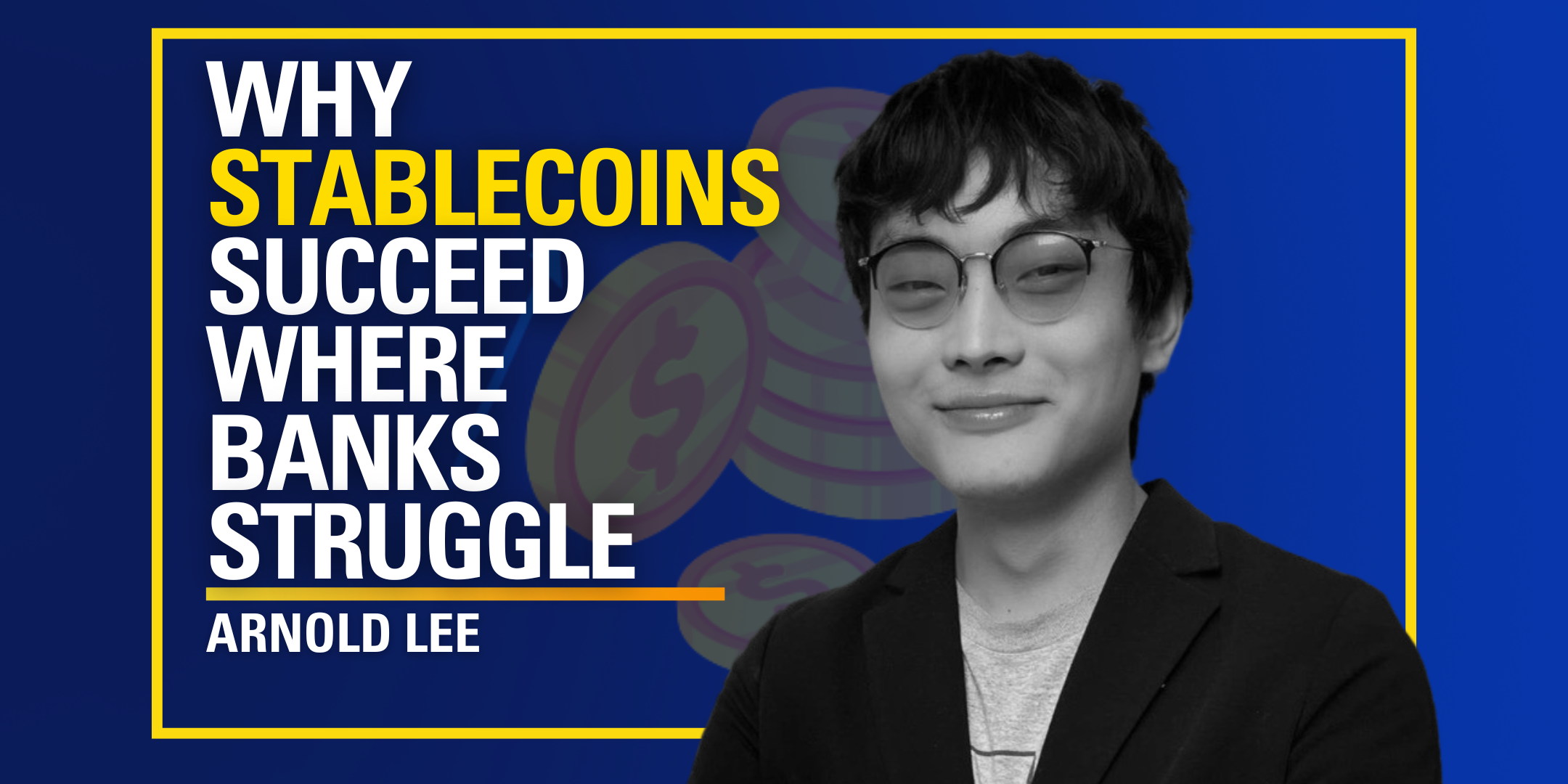
Why Stablecoins Succeed Where Banks Struggle - Arnold Lee | ATC #608
Host Stephen Sargeant interviews Arnold Lee, CEO and co-founder of Sphere Labs,, a financial infrastructure company building the settlement layer for cross-border finance. Under his leadership, Sphere Labs has developed two complementary products: SpherePay, a cross-border payments platform processing $2.5B+ in annualized volume with 200+ businesses and institutions across LATAM, Africa, and APAC; and SphereNet, a compliance-native shared account ledger on testnet with 27 licensed regulated institutions across 18 jurisdictions, ahead of mainnet launch.
Arnold is a recognized thought leader on stablecoin infrastructure, emerging market economics, and regulation as a competitive advantage. He regularly engages with regulators, central banks, and institutional financial leaders on the role of stablecoin infrastructure in the future of cross-border settlement.
Host: Stephen Sargeant
Guest: Seth Rosenberg
We are also available via:
Buzzsprout • YouTube • Quora • Medium • X • Facebook • LinkedIn • Soundcloud • Apple Podcast • Spotify • Player FM
Episode Transcript
Stephen: This is your host, Stephen Sargeant the Around The Coin podcast. This is a fun episode with our friend
Arnold Lee. He is the CEO and co-founder of Sphere Labs. He talks all about what's happening actually at the ground level of some of these stablecoin payment service providers.
You know, whether it's a farmer in Brazil or that needs to send payments all around the world. He has a unique vantage point.
He actually read the BSA and the other compliance regulatory acts, and he has a
unique standpoint of where stablecoins are plugging in the entire ecosystem
and how countries are evolving the evolution of stablecoins and of sphere labs. And he has such humble understanding of what's happening at the ground level and where Stablecoin is having the most impact. Without mentioning stablecoins all the time, he's just more about how he's facilitating payments for people all around the world. This is a really great podcast.
Listen out, reach out to Arnold. Reach out to him 'cause he is very focused on compliance now too. They've had some compliance professionals recently. So make sure you stay tuned. Talk soon.
This is actually a fun episode 'cause we get to speak to Arnold Lee, who's the CEO and co-founder of Sphere Labs. But I actually produced a podcast with TE Analysis with Arnold, I think it was a couple years ago. And one thing I just told Arnold was like, just had really good energy, really good vibes for someone that's in crypto, not taking themselves too seriously and just loves the technology.
Arnold, why don't you just introduce yourself a little bit about Sphere Labs and then we're gonna go into deep into your background.
Arnold: Yes, sir. Thank you. Um, really excited to be here. Uh, an excellent episode. I was telling Stephen very rare for me to be in the same exact room, uh, between podcasts. Uh, and so, uh, I'm Arnold, CEO co-founder of Sphere. Uh, we help businesses move their money from country aid to country B, faster, cheaper, fewer headaches.
Uh, mostly been working, uh, with, uh, FinTech software companies as well as. Uh, more brick and mortar companies, uh, you know, food type products, uh, fabric, metals, uh, so on and so forth with stablecoins in the middle. Uh, so was telling Stephen, and I'm sure we'll get into it. It's been a fun years, uh, uh, a rather last few years down the rabbit hole.
Uh, but yeah, use sphere if you want to move money faster, cheaper, as a business. API dashboard, uh, we got the whole stack.
Stephen: I love it. What made you 2022 is when you founded it, and I'm assuming like you were ruminating out about it for a few. But that was like DeFi summer, stablecoins weren't hot. Like, sounds like a perfect time to create any kind of NFT imagery, uh, and sell it for millions of dollars. What made you decide to build infrastructure at that time?
Uh, especially when, you know, 2022 is when like, Hmm. It feels like every year you could say like, oh, it wasn't a good year to start a crypto business. Doesn't matter what year it was. Uh, but what made you decide though, like, Hey, this is a perfect time. The market just came out of the bottom of crypto.
Nobody's interested. The metaverse no longer exists. What makes you decide like, hey, let's get stable infrastructure and use stablecoins to help facilitate merchants all around the world to move money.
Arnold: Yeah. Um, so my best friend from college and I had been building for a while, uh, we're both simple people. Uh, we both studied math, computer science in New York, um, and we are engineers by trade. Uh, and so we are, uh, uh, maybe adamant about things that make sense to us at least. So we, we won't be able to hit everything, uh, but we try to really think through things from first principles.
Um, and so at the time, uh, that had led us to trying to extract data on chain, you know, observe what people are doing. Uh, tried our hand at trading data analytics, um, and we're both finance e uh, he worked at Vanguard. Uh, and I had grown up, uh, perhaps in like quant adjacent circles. Uh, and so we were always trying to think like, what is the edge?
Uh, what is the structural reason for us to do something? Um, 22, uh, we had been tinkering around on chain, going quite deep into the plumbing. How, how do these blockchains actually work? How are the blocks constructed? How do you get this canonical log? Um, and if you like, dive into the details, like what are the nuances of how transactions are prioritized between each other?
Um, you know, when two people from the same place are trying to submit the same transaction, how do you like, figure out which one goes first? Um, one thing led to another and we had a couple of, uh, big events that year. Uh, there was the Luna Terra thing. Eventually FDX happens. And so at the time we were like, wow, we have terrible timing.
Um, we're trying to build something now. Uh, and it seems like everything's blowing up. Um, and in the spirit of true, uh, where is, you know, their opportunity, it's usually where other people aren't looking. Uh, we had the blessing slash curse of starting when everything was, uh, not going so well, um, where things were on the decline.
Uh, and it, I think cut a lot of the fat, uh, that might make it seem like one has product market fit. Uh, during that whole NFT craze, a lot of people raised a lot of money to create, uh, NFT related. Uh, companies. Whereas for us it was like, well, nothing seems to be working on chain. Whereas the, where are people actually hungry and desperate for this technology?
Um, so we're very simple people. We realized that, well, if you have this unified ledger from first principles, payments probably makes the most sense. It started as a Venmo idea, became a Shopify, eventually became a stripe. And then at this point, uh, we're at the end of the year and we're like, wow. Um, what are our customers actually asking for?
Who are the customers no one is talking to? Um, and the amount of reach out that we kept consistently getting overseas from the Caribbean, Latin America, on occasion, Asia, uh, Pacific, um, it was just consistently, hey, like we don't really care what you guys call it. It could be called, I don't know, X Coin. Um, all that we care is that we're able to send dollar denominated assets.
Through bank rails or whatever, uh, faster, cheaper, and with fewer headaches. Um, and at the time that led to more discovery, more investment into stablecoins. Uh, but probably the best decision that we made was, well, it doesn't really seem like there are many other companies left on blockchain natively. Um, people are pivoting into ai.
They're, you know, shutting down, uh, you know, it's peak bear market about to start. And so that gave us the time, I suppose, and quiet to go and live, uh, in these, uh, places where, you know, they spoke different languages, uh, culturally we were so different, and yet it was just the clearest smoke signals for like actually needing the technology.
Not caring about what it's called, uh, not caring about the narrative, not caring about really any of the other baggage. Um, and that, you know, one thing leads to another. You know, you spend some time in Brazil, you spend some time in Central America, you spend some time in Central Asia and you realize that the, the, the, the need is universal.
Um, everyone wants to, or is used to sending a wire, but for some reason it just takes forever for it to show up. And you have to talk to your bank. You have to submit documentation that might just not exist in your country. Um, and stablecoins ends up being a really convenient, uh, uh, like circuit or short circuit to a lot of that.
Um, obviously there's a lot of, uh, uh, nuance in the details of the entrances and the exits, but I remember in like the, that June or that summer, uh, post all the, the craziness we, you just had weeks to, as an engineer to like read through the Bank Secrecy Act. Um, and that gave us the compliance foundation as an example, uh, to like understand, hey, like this is why it's so difficult when, uh, say someone from, I don't know, central Asia is trying to onboard to an American bank.
There's just a disconnect in what they have versus what the expectations are and how the correspondent networks have been formed over time. Um, so at the time it really didn't seem like a, well, you know, sort of like two year planned out trajectory. It really felt like we were, uh, uh, rubbed, so to speak, uh, in deciding to invest in our time and energy, et cetera, and building into space.
Uh, but years later it was really important set of lessons including look where other people aren't. Um, if there's any opportunity there at all, then it usually is because there's some structural reason why no one else is looking.
Stephen: Right. I'm curious what, what gap wasn't being filled back then? 'cause it, you know, you're talking about between 2022 and now there was the FinTech Neo Challenger Bank era and it's still like, where, where was like the slippage? Where was like, we had solutions but not for the people that needed it the most.
'cause I know a lot of people got into crypto because if you were to move from the UK to Canada, both under English common law, uh, you couldn't open up, you couldn't even rent an apartment because you didn't have any credit because you couldn't get a bank account because you had no address to, you know, to get the KYC for the bank.
So it was, you know, people were moving money in crypto because, you know, two first world countries struggled to send money. Um, can only assume when you're talking about Brazil or in central or rural parts of Asia. Where was the disconnect that some of these larger fintechs weren't solving for?
Arnold: Yeah, it's, it's so fascinating because, um, uh, you know. The history of the 20th century hasn't had that much time to play out. Uh, like World War II was in like the forties. Uh, it's not that long ago. Uh, maybe a couple of generations. Um, and from the, like 1950 to call it 2000, uh, a lot of the world has gone through various cycles of like inner country development.
And then once the, the country gets stabilized, uh, then perhaps you start to see, uh, uh, the creation of like a banking sector. Uh, and you know, that banking sector starts to interact with other parts of the world. Uh, you start to see the formation of like stable population growth, um, you know, uh, then. Call it national identification.
Um, like there are all these like, uh, like common processes for like country development. Like the craziest part is that for many places in the world, um, it's not like, uh, we're at the, the, the, uh, very beginning of that. It's, we've had decades. But for the part where a FinTech ecosystem starts to form, uh, call it a venture ecosystem, an entrepreneurial ecosystem starts to form.
Uh, the, the place becomes, um, called, uh, uh, at the right time, I suppose, for like foreign investment, uh, outside of like country level or call it, uh, uh, private equity or asset manager, uh, level FDI. Um, we're, we're, we're starting to see that. Turn on in so many different countries. I remember, you know, growing up in the two thousands, no one from Nigeria was on the internet.
Like I, at least I never met anyone. Uh, whereas in the 2020s there were a lot of people from Nigeria or Indonesia, uh, all on Discord, uh, uh, having the same conversations. Um, and so, uh, I think the need basically comes down to there just hasn't been that much time, it's the right moment, uh, uh, of nascent for these markets to start to do more global or like cross border trade.
Um, and therefore the correspondent networks between the banks, uh, say in the developed world and in the emerging world, uh, are either still forming in progress just formed or haven't been well dug out. Uh, the average, you know, correspondent relationship takes like two to four years. The total number of correspondent relationships since, uh, 2008 have gone down as a way, uh, to de-risk, uh, uh, you know, call it the, the global interdependence that created that, uh, crisis.
Um, and so it turns out that if you are from most of the world, it's really difficult to send money, uh, uh, by design, uh, uh, structurally. Um, and so, uh, the need basically came down to that, call it macro like bubble. Uh, plus, uh, the events of 2022, uh, 2023 led to a lot of blowups, uh, from the traditional, uh, set of providers.
Uh, some of them were able to survive and now have become winners, uh, zero hash thinking discussions to raise or get acquired. Uh, BV and KI think, is now getting acquired by MasterCard. Uh, those I describe as the old guard starting in like 20 16, 20 17. Um, but, uh, some of the newer entrants, uh, are, uh, you know, like Prime Trust, uh, fortress, uh, even some of the older guard like Wire, um, they, uh, also didn't survive in that last cycle.
And so there was, there was a big gap from traditional call it service providers. Um, and it's, I think here where companies like Bridge, uh, conduit really, uh, uh, stepped up to fill some of that need. Um, and we were lucky to have a front row seat as some of like earliest users, uh, uh, of those companies, uh, to see where the distribution had the most product market fit.
Um, remember early conversations with both leadership teams about the, the, the presence and the adoption rate in places like Latin America and like, you know, Hey, can we get this, uh, dashboard? Can you guys like build an API? Um, and it, it's, uh, fascinating 'cause that was only just a couple of years ago. Um, but the, I suppose, uh, market reset, uh, led to an openness, uh, to being able to fill in this gap.
And I think we were just at right place, right time compared to like 2019 where, uh, perhaps the, uh, latent appetite, uh, with Pix not out, uh, in, uh, uh, in Brazil, uh, like fully deployed to the entire population. Um, and the, uh, you know, like external to, uh, stablecoin orchestration industry, uh, macro components weren't quite there yet.
Uh, but in 22, 23, they were starting to get there. 24, 25, I think they really started to kick in. And now we're, uh, seeing, uh, both the broader development of the USD side and the emerging market side as these, uh, markets become more sophisticated. Um, even in just LA last two years, there's been so many developments and regulatory called specificity where, uh, uh, end user, uh, sophistication, end user desire.
Um, that has, uh, continuously kept the market updating. Um, but, you know, going back to 22 and 23, I think, uh, it, it, it, low key makes sense. Now, connecting the dots backwards, why my co-founder and I who like aren't from Stripe, like we never worked at Adyen. Um, we're not like, you know, deep. We, we, we weren't there in 2014 when Tether was a thing, uh, first came out.
Um, but it makes sense why we had the open-mindedness perhaps, and, uh, uh, bad timing, uh, of starting to look at wherever, uh, product market fit might come from on the order flow. Um, and, uh, the, uh, the space became reset enough for the service providers to also, uh, be willing to, to, to meet this need. Um, if we didn't have that market reset, I think it's possible, uh, that, uh, some of these markets would've not gotten, uh, the services that they needed to trigger, uh, uh, this next, uh, uh, cycle.
Um, yes.
Stephen: You bring up regulatory, you know, obviously the Genius Act feels like it's opened up much of the stablecoin market. Where do you fit? You talk about product market fit, you talked about a little bit about regulation. We've seen this. What's the current state of stablecoin adoption? You know what's interesting is you started off the conversation and you didn't mention stablecoin until the last sentence, versus everyone had no mentioning stablecoin as the first word that comes outta their mouth, but you're like, no, we are the bridge that helps, you know, someone pay, you know, someone else all around the world.
Merchants like, it seems like you're really about the connection between the actual users versus trying to shine the light on the stablecoin neon sign, which we see a lot of people doing now, that stable con, there's all these conferences, there's this like wave of stable con stablecoin adoption, especially with a lot of just like regular payment service providers that are not like, Hey, we do stablecoins, you know, send us money, send us capital, send us VC dollars.
Like give me the what, how you view that, you know, the new regulations, the kind of like uptick in stablecoin attention. And where do you sit in this, 'cause you mentioned like BV and K and bridge, like are those competitors, are those, you know, rails that you ride on? Like give us a lay of the land, uh, from your perspective.
Arnold: Yeah, it's, um, it's one of those things where when a tech, uh, thing, uh, migrates away from this like cult-like niche audience and becomes more mainstream. Uh, by necessity it has to, uh, get diluted. Um, and yet, uh, the objective function that we always optimize around is, uh, presumably we're building technology for it to be useful to other human beings.
Um, presumably, you know, uh, we should be thoughtful about who those human beings are, why they have those problems, um, and the technology, uh, should be invisible. Um, it's, it's convenient, uh, to, uh, foster regulatory, call it, uh, specificity or change clarity, um, by, uh, this moniker of stablecoins. Um, it's a way, a great way to simplify to a very busy politician, to very busy policymaker, very busy business executive.
Um, this is the, the thing, the new thing that's happening, um, and this is why you should support it. Um, but it's often easy on the, on the flip side to get lost in the sauce, uh, of over biasing towards, uh, the technology itself and the fact that it's new, the fact that it could be disruptive, uh, versus like thinking deeply about what is it actually and how does it ultimately end up helping, uh, call it some max function of human beings.
Uh, uh, you know, and if you like, dig into the roots of those two sub components. Um, you know, at its core, stablecoins are a pointer, uh, for the, the computer science, uh, folks in the audience like, and see you have pointers, like all this techno, like the way that we're communicating right now, uh, it's, it's pointers to bits, uh, zeros and ones.
Uh, and it like recomposes a file structure, a file hierarchy where you like point to different addresses in, uh, your machine. Um, and to us, uh, as engineers, we were like, oh, well stablecoins are just the same thing. It might be issued through Circle, it might be issued through Tether, it might be issued through someone else.
But fundamentally what's being uh, issued is a pointer to a bank deposit. Um, and so functionally stablecoins are a proxy currency accounts. Um, but you know, it's much easier to call them stablecoins than to call them a proxy currency account. No one will know what that means. Um, and yet, uh, like from first principles, like why is this useful to people?
Um, well, I can now have a proxy currency account, a very like, specific slice of the services that a bank can, uh, otherwise offer me. Um, and that's useful to me if I need to pay in dollars or need to save in dollars or need to borrow or land in dollars. Um, and, uh, therefore it is that. Call it statement that is the most useful, uh, leading into sub-component.
Two, how does this actually help people? Um, if you are a, I don't know, farmer, uh, from some other country, or you're a multinational corporation, uh, in the United States, uh, and you need to be able to pay a lot of people, uh, throughout the world in different currencies, uh, it is much easier to do so through these pointers rather than getting an entity, a local team, local bank relationship set up in every place where you wanna operate, that would cut out most commerce globally.
Um, and therefore, uh, you know, as, uh, uh, as tempting as it is, uh, to kind of lean into the stablecoin identity, the realization is that, uh, that's a fight maybe that, uh, others, uh, can go and spearhead and we can be helpful participants. But as builders, what we want to do is, uh, maximize the, uh, call it, uh, connectivity that we have to that end user.
Or their direct service providers. Um, because presumably, uh, even if we had like genius in its, uh, full maturity, uh, where every specific guidance has been made, uh, the exact implementation details have been well-formed and battle tested. Um, none of this like really matters unless you get to the end user who is ultimately gonna use it, that, uh, uh, piece of software.
Um, and so it's always been interesting to me, uh, because in 2022 and 2023, if you advertise yourself and, you know, and we did, uh, it was on a lot of decks, uh, as a stablecoin company, people were like, oh, well who cares? Um, you know, uh, that's like calling yourself a money company. Like everyone uses money.
Um, and fast forward a few years later, it's become quite, uh, useful in certain contexts to call yourself a money company, apparently. Um, but I, I suspect increasingly that distinction will become, uh, invisible. 'cause the truth is that for, you know, that multinational corporation or for. Uh, that farmer for that, uh, FinTech, uh, uh, domestic or abroad, uh, that distinction really doesn't matter.
Um, ultimately it's still, uh, uh, an API or like a rest interface or dashboard with buttons that you click through. Ultimately, how the things work underneath the hood really don't matter. It, does it show up faster? Does it cost them less money? Uh, you know, do they have to call people less? Uh, submit fewer documentations in this, like very extended back and forth.
Really, that's what, uh, matters. Um, and so, uh, re like the competitive landscape and how we fit in. Um, you know, uh, it's, it's fascinating because like, I guess normal FinTech, everyone does something slightly different, but everyone kind of also does the same thing. Even if you have the exact same license, you might do something different with that license and how you communicate that to your regulators.
Um, you know, uh, I think where we sit weirdly, paradoxically, is both beneath the stack and above the stack. That is to say if, uh, there is a money transmitter, uh, moving, you know, uh, uh, call it like a bridge or BVNK between stablecoins and fiat, um, we sit beneath them in the sense that, uh, we are optimizing the plumbing as it touches, uh, the banking space.
Um, we are not, you know, going to use a, uh, a default, uh, like Jack Henry Fiserv, FIS uh, integration in order to communicate with the bank's core ledger. Um, because we are focused on, uh, uh, again, greenfield markets where the end user might sit in a a, a not well dugout correspondent network, it's really important that we can pack as much compliance, uh, as an example, data into the wire, uh, uh, message or equivalent as possible.
That way this reduces the amount of like time zone, uh, uh, uh, you know, difference bounce back between country A and country B. So we're optimizing, uh, the, the part of the banking block box that most stablecoin orchestrators don't really want to dig into 'cause they kind of don't really need to. Um, and then we also sit above those stablecoin orchestrators in the sense that, uh, we want to get very close, uh, to the order flow, um, and really understand, uh, what that order flow needs, uh, as, uh, part of like the initial call, like distribution arm, uh, for this last cycle of winners.
Um, and what that means is, you know, their front ends, their API interfaces. Um, but uh. It, it, there's, there's usually localization, uh, nuance that's hard to capture unless you are spending time there. Um, uh, you know, A CPF as an example, it's kind of like a passport. Not really, it's very d like, it's actually very different, but as like a national identifier, it's like, kind of like a passport.
Um, and that nuance, uh, uh, localized, can get lost, uh, unless, you know, you're spending, uh, a lot of time, uh, with the end, uh, user, their service provider. And so, uh, it's weird because we sit both below and above them, um, for certain markets, uh, we will sit in the same, uh, uh, level, uh, of the stack, uh, because the overall nuisance of the market, uh, doesn't allow for that three layer, uh, three level distinction.
Um, but, uh, yeah, it, it's, it's been an interesting, uh, call development of the industry because you start to realize that, you know. All of the, the, the, the, the licensed providers will still work together, uh, because what specifically they do with their license, uh, might touch on a different layer of the stack or their team composition might imply like a different, uh, uh, uh, type of specialization.
Um, and in 2024 or 2025, if you asked like bridge BVNK conduit who their biggest competitors are, they would all say each other, but they all talk to each other and they all use each other for specific corridors. Um, and I think the, the overall interaction complexity has, uh, gone up quite a lot, uh, with net new markets turning on.
Um, and, uh, uh, you know, you can't be everywhere all at once. Um, is, is, uh, uh, uh, the fundamental, I guess, like paradox within the industry, um, I feel like I'm saying a lot of words, so I'll pause there. Hopefully that
Stephen: No, I, I think it makes a lot of sense. And I remember from the last conversation that you had with Ian Andrews when he was at Chain Lysis was like. There's very niche areas where if you don't put that information into a, the transaction, like there's a good chance that transaction's not gonna go through.
And I think in certain regions that's your specialty of making the transaction go through where other stablecoin providers are like, Hey, we're not really focused on that. But if they need to send from, you know, the US to Canada, like, we got you there, there's not that much complexity for that. But you are like, really feels like you're going on the ground in some of these regions and making sure that there's a, you know, some kind of access to the, a financial channel where they can make the transaction easier and affordable, but they're not gonna spend all their time focused on there.
Whereas you will probably, you know, over index in those regions. Is that somewhat accurate?
Arnold: Yeah, I think, um, it, it, it's funny, I joke about being like a, a translator or like a diplomat or a therapist. Um, because, um, one area, uh, uh, probably the biggest, uh, uh, opportunity for this is on the compliance side. Um, very fortunate to have read the Bank Secrecy Act as an engineer, uh, because then you can start to understand like what the gaps are.
Um, in, in travel rule implementation, which I would, I would personally consider, uh, uh, one of the like more relatively, uh, simpler, uh, things to enforce. Um, but if the, uh, you know, country B, uh, country A is the United States, country B is like capital controls or like, uh, uh, a very, uh, opinionated, opinionated set of, uh, bank requirements.
Um, or they have like a unique, uh, national identity system. Um, you know, they already have real-time payments. Maybe it is picks, maybe it is UPI. Um, these all act as alternative signals, um, uh, into forming an overall compliance picture, uh, of the counterparty. Um, and it's, it's a lot of like, it's not a deep tree, so to speak.
It's just a very wide tree, uh, uh, uh, of like if then, uh, uh, uh, conditional digging. Um, and so the realization is, um, it makes sense. Why, uh, a relatively nascent market, um, where a call, even a company headquartered in the United States is setting up shop there. Um, they're like hard goods. Um, uh, as part of their ma manufac, uh, manufacturing process, uh, that has to go through that country.
It like makes sense why there's a disconnect between what the expectations are locally versus what the expectations are in, say, the United States. Um, and there's a lot of opportunity to be able to act as that transcription layer, um, and, uh, uh, map, uh, the different requirements from, you know, uh, uh, that country A to country B uh, uh, uh, simpler.
'cause over time it'll get sorted out. Usually that is that like multi-week email bounce back between, uh, the, the originating bank in the America, uh, and say the receiving bank in a different country, even if it's an intercompany transfer and it's the exact same entity just moving their own money. Um, but uh, unless, uh, uh, structurally there's a cult language or cultural shift where everyone at the company, uh, for some reason now can like, read a different language and speak that different language, um, software is a great accelerant in, uh, uh, uh, providing a overall picture to both sides and, and making both central banks underlying both fis underlying, uh, really comfortable, uh, with the nature of the transaction and, and, you know, the fact that it is compliant, uh, uh, localized.
Stephen: I am super curious how much geopolitics, sanctions. Even things like supply chains. We see what's happening in Iran with supply chain. There has to have been over the last, you know, tariffs over the last year, year and a half, even during the pandemic, this movement of funds in places that they didn't normally go, that has to be done quickly or, you know, you could go outta business if you, you know, if you supply it to China, but now China has a tariff, you have to supply somewhere else and there's sanctions and Trump makes a tweet and all of a sudden now, you know, all your payments have to go to another country.
How much does that impact? Because now you're in a lot of those places where, you know, a small change could be demeaning of what, you know, whether a whole, you know, city or a village eats. Um, based on that money transfer, how do you look at that geopolitics, everything that's going on around the world supply chain and how important it's of what you do and how that impacts your business model altogether.
Arnold: Yeah, it, it, it's so fascinating because, um, and I, I'm biased here. Uh, if you were to ask me, uh, it is the root of the industry's PMF. Um, and it's hard to see by the time it, uh, it gets to, uh, uh, the layer that we're all used to. It's typically like pretty diluted down. Um, but like the, you know, the root of, uh, cross-border, uh, uh, commercial interaction is in, you know, electricity.
It's in food, it's in water. Uh, it's in, you know, crude that like forms plastic. Uh, you know, it, it, it is in the, the, the like, uh, uh, I think Elon has like the idiot index, right? For rockets. Like there is an idiot index for like a lot like everything. Um, and usually that idiot index is of raw materials that get produced in, uh, uh, the emerging world.
Um, and, uh, to your point, uh, supply chains have been disrupted quite heavily, uh, the last few years, um, which I think helps explain a lot of the growing stablecoin adoption. Um, I think these markets, uh, uh, and the overall picture gets very cloudy, um, because information flow isn't all that great. Uh, and correspondent flow isn't all that great.
Uh, so like the, the nervous system or the blood system respectively of the bits of information and of the money, uh, moving between these places there, uh, there's a lack of visibility. Um, and stablecoins are a great way, uh, to short circuit, uh, uh, those relationships being formed and to get, you know, a blockchain level visibility into, to what those, uh, uh, uh, call it fundamental movements are.
Um, I, I suspect though it's kind of like the Fed, where it's not just what they say today, it's what they've historically said, and it's forward guidance on what you would expect. Um, and I, I think that in, you know, maybe another why now for stablecoins over the last five years has been, uh, there has been, uh, there have been significant upheavals in global interaction.
Uh, you could point to COVID, you could point to, uh, different political changes. Um, you know, you, you could point to a lot of things, um, these countries getting sufficiently, uh, uh, uh, developed as an example. Um, but I, I suspect that even if, you know, we waved a magic wand, uh, and things started to calm down, uh, so to speak.
Um, they, uh, uh. The, the expectation, the historical existence of supply chain volatility will mean that redundancy, and call it like backup routes, are now just an endemic part of the game in a way that they weren't before. Um, and so, uh, we are heavily, uh, you know, thinking about, um, you know, uh, seasonal changes, uh, like there are latent, uh, uh, tensions between different supply routes where like, this might be your top choice, but if X were to happen, y might be your top choice.
Um, that have profound impacts, uh, on the underlying, uh, uh, sources of those raw materials. Um, and obviously, uh, we can't like predict, uh, what will happen, uh, when, you know, who's gonna win the election, uh, or who's going to like, uh, uh, institute X policy. Uh, when does the like bubble, uh, get big enough for there to be a pop?
None of that we can predict. Uh, but the good news is that if you reverse engineer. The sources of order flow and like, what are the most important trades? Um, just to throw out a random example, uh, a lot of food gets produced in Latin America and shipped out. Um, where else would that happen? Uh, what would it take for that to change?
Um, you can start to compose like a, uh, not to go too crazy on you, like a multidimensional matrix, uh, that's weighted based on, uh, the empirical order flow that you see. Um, and start to take more educated, uh, bets on, on, uh, where to get set up, um, where to focus. Um, so, uh, uh, yes, there, there, uh, I, I suspect more of that will come, um, the, uh, the, the mandate that countries have now of, uh, energy verticalization.
Uh, to preserve or preserve their self sovereignty, uh, has just become apparent, I think. Um, and another like heuristic way to look at that is the amount of capital being allocated to all the AI companies. Um, that capital has to go somewhere. Uh, some of it gets allocated to, you know, uh, uh, the front facing things, the, uh, I don't know, uh, uh, cloud credits, uh, or acquisitions.
Uh, but a lot of that capital that, you know, you look at the chart and it's like flowing to Nvidia or it's like flowing to Oracle, um, ultimately flows to the hard inputs, uh, that enable those industries. And that's when things start to touch our world a little bit more. Um, where weirdly, over the last few years, um, we'll see those names more often than most of our, uh, cohort, um, more often than, you know, a a a crypto or, or FinTech, excuse me. We'll see, uh, companies like that allocating capital to the hard inputs. And as a a, you know, facilitators of money movement, um, will engage but suspect that, that that type of activity, that flavor of activity will be increasing in the years to come. Just 'cause, just because now there's an expectation that there will probably be volatility on the supply chain side.
Uh, and, uh, it's very tricky, uh, because if it had to go through Country X now it has to go through country y. That's just the next best choice. If there isn't a strong correspondent network between country Y and the buyer, uh, of those goods, it's a great opportunity for stablecoins, again to short circuit, uh, the establishment of that relationship.
Stephen: And you can't just spin up that, you can't just spin up that correspondent relationship overnight. But Stablecoin can kind of facilitate that, especially if you were already on the ground trying to, you know, create those pathways. For a local farmer, you're like, Hey, we already have the pathway here. Just kind of plug into us.
I'm curious, what are some emerging trends that you see, whether it's jurisdictions now getting more involved in using your platform, or if it's just like, just, hey, like we're seeing more farmers or more plumbers because now they're, they're having to relocate to places in the US to stand up some of these data centers.
Are there any interesting trends that you're seeing based on some of the data?
Arnold: Uh, yeah, I feel like, um, it, it, it's, it's, it reminds me of like a new type of industrial revolution, uh, where most countries it appears, uh, like some of them might be more locked up than others, um, where it'll take more time for them to fully verticalize. Um. But, uh, it, it feels like most countries at the governmental level are trying both explicitly and also encouraging implicitly through their private sectors, uh, to retain as much of their independence on energy as much as they can.
Um, and that takes the form of, uh, not just energy related stuff, um, but you might see, uh, uh, like higher tariffs as the easiest example, mean that there are now more manufacturing companies relocating to the United States. Uh, more activity in like the Midwest. Uh, more investments into like concrete, uh, because you gotta build the buildings for people that work in the Midwest.
Uh, you know, more, uh, like chemical products because you need to use like fertilizer to grow things. Um, and so, uh. Yeah, I, I think this trend is pretty global. Um, some countries like aren't positioned to do full verticalization. They might just not have enough landmass to like host data centers or for like, there to be an active farming, uh, uh, call it cohort, uh, compared to, uh, the Brazils or the Americas, uh, of the world.
Um, but in general, I think, uh, what we see is that countries are being thoughtful about how do we protect our ability to conduct monetary and fiscal policy, uh, to retain our self, uh, sovereignty. Uh, and given the general trend of spend, uh, towards things that are adjacent to ai, um, how can we ensure that we are not getting, uh, uh, out leveraged, uh, by other countries, uh, who might own our sovereign debt or who we might do bilateral, uh, trade agreements with.
Um. Usually the, the clearest silver bullet is, is own as much of the, uh, inputs as you can. So that way, you know, it might be more efficient to distribute the labor, uh, between like six countries, uh, to ensure that your citizenry gets delivered electricity that year. But just in case something goes wrong, uh, this, the backup supply chain sets, so to speak, are like still there and available.
Um, so, uh, uh, that's a weird type of race, I guess. Um, we we're lucky to have a front row, uh, uh, uh, viewpoint or VantagePoint of, of, you know, what were the different timelines. Um, the United States as an example, has a ton of cash, uh, has a ton of like, uh, uh, geopolitical leverage, um, that has a lot of open real estate, uh, in places like the Midwest, um, and, uh, and certain border, uh, uh, states, um, to, to get all this set up, uh, but their counterparties, uh, uh, in other places of the world.
Uh, it's fascinating to see like how they're, uh, thinking about that timeline. Um, with, uh, uh, the different, call it like hand that they've been dealt, um, they might lean into, uh, chips as an example, uh, and therefore metals and chemicals. Um, and that's where they'll hang their hat on a, a, a setting shop and like really investing in as, as a concentrated bet on where they can sit within the, the energy stack.
Um, but
Stephen: and I think China's done a great job of this, right? Like they were focusing on, you know, raw materials, energy. It's one thing to have data centers in the us we also have to power them. It's like China's already thinking about that with nuclear. Like China's spinning up a nuclear reactor anywhere in the US in the next seven years, it's gonna be pretty tricky to get the kind of energy that you need to power some of these things, which gives, you know, these unfair advantage to countries that have been like thinking about this while we were still worrying about maybe other matters.
Arnold: absolutely. Um. It's been, uh, a blessing, um, quite surprising, uh, to see the extent to which some of this has been set up. And I don't think any, you know, most of it or any of it was set up, uh, uh, predicting how good the, the LLMs would get, um, but as like a directional bet, uh, in some places, yeah, it's like multi, multi decades, uh, uh, uh, of, of set up time.
Um, the multinational court perspective, I think is quite, uh, uh, uh, interesting too because like the global HQ will bias us towards, uh, uh, uh, uh, like wherever it is. Um, typically that is like a large state like America. Um, but now they have to navigate, um, not just optimizing for, uh, uh, you know, their HQ's POV, but all their different branches throughout the world.
And then, uh, creating like, uh, uh, a aggregate like score. Uh, how do we keep this machine optimized on average, uh, uh, throughout all these different countries, understanding that like the, the heart of it is in the United States. Um, and so, uh, you know, this might lead to certain, uh, uh, parts of their internal supply chain, so to speak.
Uh, being rearranged, uh, where, you know, like a Toyota, uh, as an example, might migrate some of its, uh, uh, components, uh, uh, over to the United States more aggressively, uh, because the, the tariff rate is, uh, much higher, uh, for that part. And it, like, as a global optimization function doesn't make sense, uh, for them to warehouse it ev uh, uh, in, in other places.
Uh, but it means that like, uh, uh, the, the, the, the natural call it like free market state, uh, is being artificially, uh, uh, moved around, uh, because of these macro, uh, uh, dynamics between countries. Um, and, uh, uh, these guys are pretty smart typically. So like, they'll, they'll, they'll have backups in case things were to like go, uh, uh, uh, volatile the other way around and they have to, uh, uh, you know, go back to option number one in a couple of years.
Um, so rising tensions there, it's all very good for stablecoins. Uh, um.
Stephen: All, all good use cases. I'm curious, you know, you mentioned compliance, you mentioned reading the BSA, which probably gave you a little bit of an advantage dealing with some of the headaches in other regions. I'm curious, it looks like you've had a, you know, you've always been focused on compliance, but it looks like Sphere is hiring some, you know, compliance officers or you know, legal counsel.
Like what is, you know, the focus on compliance this year, it feels like more than in the past.
Arnold: Yeah. Um, we were very lucky, uh, where we started off as like a core group of engineers, uh, designer, um, very crypto native. And then one of our first, uh, hires, uh, was this old school like Wells Fargo, wire room operator, who eventually, like three decade career in banking, uh, became, uh, uh, like a risk, uh, uh, risk director, risk officer.
Um, and so, uh, relative to like what I would describe as most like startup technology startup companies, um, the fact that we weren't able to get a bank account. Because we were crypto adjacent 2022 and 2023, uh, really encouraged us to dive in deep. And so, uh, to understand like first principle is like the why, like why can't we get the bank account?
Like why are there all these requirements? Like what, what is the root of why all this is being asked of us? Um, and, you know, uh, uh, not every law makes sense, but then you start to understand a lot of this does make sense. Like if, if you know an entity is responsible for moving other people's money, you probably want to regulate them to make sure that they can't just take the money and run like that does make sense.
Um, the, the information that is, uh, asked for them, uh, to, uh, uh, ensure that like they have a consistent, robust set of, uh, process, uh, to guarantee that they won't just take the money and run. Like, oh, okay. That does make sense. You probably wanna ensure that the counterparty, uh, is not just leaking, you know, uh, sensitive data.
Um, uh, uh, so like a principle is based, uh, uh, a categorization of what the requirements were, at least from the United States, which has a pretty, uh, uh, mature, uh, uh, call it a set of requirements, um, was super helpful in, uh, going, uh, to other markets and assessing, Hey, like they call it something else.
There might be a different license category, um, or the banks might, uh, have a, a different set of expectations for this, uh, uh, activity. But like, at its root, it is the same rationale. It is the same rationale that they want to avoid fraud. They want to avoid like egregious obvious instances of. Control being assumed and it potentially harming the end user, the end consumer, uh, which, and, you know, liberal democracies usually percolates up, uh, to political change.
Um, so like, it makes sense why these like broad inner, uh, uh, principles of compliance, uh, like generalize across states. Um, and, uh, uh, with Genius coming out, it's been fascinating because like, you start, you, you do have the Brussels effect, uh, for this law where a lot of the, the finer details, uh, are, are still being implemented.
Uh, but in other states, they're looking at genius as a framework for, uh, you know, digital assets specific, uh, uh, activity. And you start to understand, hey, like there's an opportunity to help give perspective. Um, this is the digital assets, uh, some of the unique set of behaviors that you can get on crypto rails.
Uh, but the, uh, uh, as you know, uh, call it, uh, uh, contributors to understanding, uh, these are the same broad principles and how, how they map. Uh, to digital assets activity, uh, that would probably be helpful to you, uh, uh, as a policymaker on ensuring that, you know, things don't go terribly wrong in your locale.
Um, and, uh, uh, it's been a, a, a very nice blessing and curse, I suppose, to see this play out in real time in places in Latin America. Um, because I think consumer, the, the, the, the latent product market fit there these last few years was so high. Um, and so you can see in real time what happens if, uh, uh, uh, the canary in the coal mine, uh, uh, uh, you know, is trying to like escape.
Um, what, what is the, uh, probable like set of guidances, minimum capital reserves, uh, you know, uh, the, the initial reaction, uh, from the traditional fis, uh, if a lot of private sector activity migrates towards stablecoins, um, and you know, that's getting replicated throughout the world, sometimes preemptively.
And culturally you'll have like a unique flavor, perhaps, like East Asia, uh, is a little bit more preemptive. Um, and, uh, uh, I'm originally Korean, like Korea has very high capital controls. Um, uh, they're very protective about their local economy, uh, for understandable reasons. Um, uh, the FSC discussions, therefore like bias, uh, in a way that leans conservative.
Um, but it's, it's the still, it's the same fundamental debate that's happening, uh, everywhere just with like a local flavor. Um, and so, uh, you know, it from our perspective has been a, a very, uh, you know, a, a, a blessing, um, to have had that time to understand like the root why and to look at some of the, the bigger like case precedent, uh, for, you know. There, there used to, uh, be less or fewer requirements, uh, uh, for ensuring that people who have the right to transmit money, uh, can't just take it and run. So then something bad happened and that escalated it, uh, uh, into stricter requirements. Um, I'm sure in the years to come, uh, slash with Genius today, uh, you know, uh, what happened with FTX or with the regional bank crisis, uh, will act as similar types of case precedent, I suppose.
Uh, our, our luck is that we, we were, uh, birthed in one. Um, uh, and, and therefore, uh, it's very, uh, useful I suppose to predict what will happen in these places and to come in having already done the homework that hasn't been assigned, uh, because, you know, it makes sense, uh, why these types of protections or, uh, you know, certain policies, procedures, certain like, uh, attitudes towards risk, um, will eventually be formed.
Uh, to, to, uh, make sure that things don't go crazy. Um, but, uh, uh, you know, it, I think helps us as a credible actor, uh, when entering, uh, uh, certain markets or, or, or the markets that we're, uh, excited about, um, to be able to provide that, uh, perspective of, you know, if maybe some of these data points would be useful for you all to consider.
Um, because if the private sector gets the green light to go, um, and, uh, uh, the nature of the underlying technology is to be able to move money, uh, into assets like dollar denominate stables, like this is probably what will happen. Um, and you know, you're gonna see it anyways whether we tell you or, or not.
It, it'd be probably we're gonna build our system around it. Whether we tell you or not, because we, we don't want to go back and do, you know, work differently. Uh, there's, uh, uh, we don't want to like correct if in six to 12, 18 months you're going to change, uh, the expectations, just like we've seen in other countries before.
Um, and so, uh, we found it very useful for, for our own efficiency, uh, to be able to guide towards those data points because, um, the, the, the, you know, multi-decade, uh, uh, foundation that's been set on, uh, these international compliance and risk, uh, uh, standards or expectations, um, it, uh, uh, you know, you can kind of slice to the root of like why they have them.
Uh, and, uh, I, I, I'm grateful to the engineering trading, uh, because you, you would think that some of them, uh, uh, uh, I, I could get why like an outsider looking in is like, oh, but this is different. Or like, this doesn't matter. But like, if you get to like the root of the case precedent, you're like, ah, yes, Dodd-Frank has weird random like, number like boundaries.
Be because something really bad happened and.
Stephen: Exactly. And we can see that with FTX. You see that with nine 11. I think there's a couple interesting points that you made there that I'd like to dive in on a little bit is one, I think people don't realize the banks are the defacto regulator. You probably saw that like, Hey, the regulations only say this, but the banks are asking me for, uh, way more.
And you're like, oh yeah. 'cause it doesn't matter whether regulations say if I wanna transact around the world, I have to abide by the bank's compliance requirements. So I think that's an interesting point that people tend to forget that the banks technically make the rules if you need that banking relationship, which most of us need if we're gonna have a viable business.
I think the second thing is, is that, you know, I was at ECC in CAIRs last week or the week before, and a lot of DeFi protocols are starting to talk about regulations and compliance that I've never heard of them. This is my first time at ECC, but I can tell you, even outside of the conference, people are reaching out to me about getting in touch with blockchain analytics companies.
They're fully DeFi, they're not regulated, but they know it's coming in some form or fashion. And they want to attract that institutional capital and attention. So they wanna make sure they're kind of almost leading with compliance, which you saw the advantage of. And I think you had the like monopoly, like there's certain things in Monopoly that we aren't doing right when regarding the charge rent, but nobody's ever really read the rules.
We just go by what the last person kind of did. And that's kind of where you probably see in payments is like, why are we doing this? What's the reasoning for it? Oh we just do it. 'cause like where I worked at, the last company did that. But if we dive deep, we don't have to do exactly this. Or if we dive deeper, this code is the exact same thing of this code.
They may have different names, but it's the same re this is the reasoning why they want that information. And I think that's probably what's given you your advantage at Sphere. I could be wrong, but I'm assuming reading the rules has given you an unfair advantage in a lot of areas.
Arnold: Yeah, I think, uh, reading the docs, uh, is what we were trained to do as engineers. Um, reading the docs is pretty useful. Um, and, uh, the, the core why I think, uh, uh, root cause analysis, right, um, the core why, uh, uh, is probably the most helpful 'cause it's robust to cycles. Um, so, uh, uh, uh, to your point, I'm seeing a lot more of our, uh, original cohort, uh, the people that, you know, started at the same time as us, um, leaning into compliance, leaning into, uh, what's required to interact with, uh, the real world, so to speak.
Um, and, uh, it can seem fuzzy, uh, uh, because each, you know, counterparty will have bespoke levels of comfort and what they want, uh, what they expect. Um, but we've, uh, uh, we at least we've found that if, if you're coming in with like, hey, like, we understand the why, uh, we, you know, have folks on the team who have, uh, uh, a decades long, uh, call of like, uh, a war scars of like the why and seeing it all play out.
Um, then there's uh, uh, an opportunity to build, uh, uh, enough trust in a relationship to help find a better solution as a lot of this regulatory implementation is being built out in real time.
Stephen: And I think what you see is like a lot of people that have building payments companies end up build building rec tech companies. 'cause they spend 90% of the time on regulations and they're like, yo, I have better ways of using this technology than just doing transactions and you know, minimal margins and payments.
I'm curious, we had Kevin from Borderless on this episode, uh, on this podcast saying, you know, like, I don't think Tether and Circle could be built today they way where, you know, it wouldn't make sense to be built. What your thoughts could sphere be built the way this, you know, today, you know, four years ago, like you mentioned your cohorts and how much you've had to go through in the last four or five years could, do you think it could build sphere the same way in 2026 that you built it in 2022 Or would you know, has the landscape definitely changed and evolved?
Arnold: Um, so, uh, from a tech point, I think generally things are built faster. Um, so there is some delta, but I don't think like all that much has changed. Um, I think the rails, the virtual machines, the bites, uh, all that's still the same. Um, maybe it could be done slightly faster. Um, I think relationships are typically within a unique window in time.
I don't know if that could be replicated. Uh, especially when it's like a once in a country's history. Uh, opportunity to come in. Uh, some of the folks that we took a bet on, you know, in 23 and they took a bet on us, they're like the first ever within their country to raise a certain amount of capital or to hit a certain amount of user, uh, uh, usage within country.
So I don't know if that can be replicated. Um, I, I'm almost most grateful though, for perspective because if I were to restart sphere in 2026, my fear is that I would be, uh, call it intaking, uh, uh, already digested alpha. I'd be like biased towards what I see on the internet, uh, what's being announced, um, and.
Stephen: raises of companies starting at the same, like when everyone's starting in the struggle, nobody's really jealous, but like now you're seeing, hey, if I add AI to stablecoin payments, and that will be my next question, is around a agent ai. It's hard not to be like, can I do it that way? Am I doing it the wrong way?
Whereas like everyone's like, we don't know what we're doing and we're all not getting paid out, so we just keep on building.
Arnold: Yeah, I, I feel like, um, we, uh, were so, so heavily encouraged, uh, to do like a stripe for crypto back in the day by really smart, really well established people, some of them even at Stripe. Um, and uh, it turned out that none of them had tried to build a stripe for crypto before, and they were like, we hope someone will.
Explore it, and it turns out it's not that great of a business. And so I think that's given us a healthy, uh, skepticism for what we see in popular narrative. Uh, and to give us like a, uh, uh, you know, a particular, uh, flavor of opinion. Uh, we we're more comfortable standing on, uh, call contrarian ideas relative to rest of industry.
Uh, because when we, when we started, uh, starting at all was a contrarian idea as the industry was like six companies. Um, uh, and, you know, uh. That's probably the, the bit I'm the most grateful for. Um, I don't know if I could recreate that. I think like the literal code basis sphere, we could probably recreate, um, you know, uh, a lot of the, the workflows we could probably recreate, but I think like the direction of where we wanna focus, uh, call it on the type of order flow or the type of counterparty or, uh, the product roadmap there, we can have a much more opinionated, uh, uh, uh, call it like flavor.
Um, because, uh, uh, yes, when something gets announced, my instinct is not like, oh, I'm just gonna believe it in its entirety. I, I, I'm thinking like, oh, well, you know, a couple of years ago everyone was saying that all these blockchains that we're thinking, uh, uh, to build on are dead. So like, um, you know, what is like the, uh, root cause, uh, uh, uh, of the reason why this news is coming out, um, does it fundamentally change, uh, the assumptions that we're making for, for our, uh, our product bets or market entry bets?
Um, yes.
Stephen: What are your thoughts on stablecoins? Agentic AI payments, they're creating tokenization standards, uh, through t Revix and Ledger. Uh, there's all these things going on where it's like agentic AI is gonna pay for everything and fire plane tickets for the next conference. Uh, final thoughts on stablecoins?
The future of stablecoins and where AG Agentic AI plays into that.
Arnold: Um, Ooh, this is a juicy one. Let me, let me make the, uh, uh, it's, it's one of those things where a AG agentic payments ai, call it x stablecoins, is directionally correct. Is it the why is the why now here less sure. Is this form factor the way it will be? I'm more skeptical, um, because the noise is so large.
And I don't doubt that Claude will buy our airplane tickets. I just don't know if that's the 10,000 x. Um, so, uh, I wanna be cautious because I am bullish on agentic payments. I am bullish on AI dash stablecoins. Uh, I think it will be a great new thing, uh, innovation. Um, and, uh, uh, really excited to see the, the builders there kind of dig into the, the branches, um, as are we.
Um, but the things that get the most noise now, uh, the depth or the demand, the desperation, the hunger that you, I, our cousins, you know, our friends have, for our LLMs to be able to go and buy things on blockchain rails. I personally don't experience it that much. Maybe I, I don't have enough money, uh, to buy things.
Uh, my fa my family and friends aren't like. You know, describing this as a 10,000 x and so that that delta relative to the noise that's being produced does make me skeptical. Um, it, it, it's one of those things that eventually we know some, uh, uh, form of this will be a big hit. Um, so it's true, it's correct, but is it the, the form that exists today?
I, I'm not sure. I, I tend to suspect that, um, again, like stablecoins as pointers, uh, to, to bank deposits, um, you know, the, uh, the, the, the most interesting opportunities to me, uh, for, for, for this confluence, of course, on the compliance side, there's a ton of like, manual stuff that needs to be automated, reconciled, uh, that's a little bit, uh, more straightforward.
I can like measure that in manaus like today. Um, but the a, a a a migration between, uh, uh, discreet price discovery to continuous price discovery on the most desperate industries, that is probably like where my spidey sense jumps to. Um, for, for where this interplay will become a 10,000 x, um, you know, uh, uh, like market structure that can't currently exist because it would not make sense for humans to quote or for, you know, trading firms to build the infrastructure around.
To quote, a good example would be on, uh, uh, like, I don't think it'll be a, a compute credit token. Like, I don't know if that makes really sense, but like, uh, uh, it is true that today, uh, downstream for end users, these, these credits are discreetly priced and I think continuous price discovery. Um, is probably what's gonna happen at some point because it just makes so much more sense for agents to be able to handle.
But, uh, if you built a startup around it today, I just don't know if it would have that much product market fit because there are all these other dependencies that have to play out first, uh, before it, uh, uh, uh, it physically be, can become a 10,000 x.
Stephen: And I think, yeah, I agree. It seems very theoretical too. Like a lot of theory based, a lot of content based. Like it's great for content creators to say, Hey, look at what, you know, perplexity computer does, it can do all these things. Like I see a lot of like content creators like, Hey, you can use Luma for video editing this, but like you didn't make this video using the AI tool.
So it's like, if you could do all those things, why didn't you just do it on this video? Why are you showing me how to do it? Just show me the video that you created with it. And that's where I think the disconnect is. It has a very metaverse approach. Will it eventually change things? Yes. Will it have to evolve?
Yes. But everyone could make $10,000 using ai. Well, but you're not doing it consistently. And much of these max studios are probably collecting that. People have them, they ran one program, but like, okay, now that you're not a developer or programmer and you have to make one fix and you know the, you see those memes with the blinds?
You fix the blinds, the other one falls. And it's like, that's what it feels a lot of great for content creators. 'cause now you're getting a bunch of followers telling people what they could do. But I haven't seen a lot of execution of that. Especially within enterprises.
Arnold: Yeah. Um, it's like NFTs were massive and we still haven't seen them achieve their dream. But tokenization itself, so the fun fts, I guess, fungible tokens, uh, eg stablecoins, eg. With the flavor of regulated entities acting as the guarantor, um, that's gotten product market fit. So the, the thing wasn't directionally that far off, but it just wasn't with the right form factor suspect until, to your point, uh, it's being dog footed, uh, by its largest proponents, probably by then the alpha is dried.
Um, but until that happens, where we're using it, where the clear, you know, use is there for us. Um, uh, I, I am skeptical,
Stephen: I love it.
Arnold: you know, like GPT 10 or GPT 20 can probably, like in real time create its own runtime like execution environment, like in real time and like each second be developing a new blockchain or a new payments protocol that is infinitely better than whatever existed before.
Um, so, uh, uh, given that future is probably coming at some point, it does make one, one wonder like how much of like, uh, protocol development, standard development or what have you, like how much of that is real or will like, will like remain real?
Stephen: And it's funny, I'm talking to ya from NCA Brands tomorrow on the podcast and like you just see the evolution of NCA is like, hey gaming, uh, NFTs. But now NFTs is kind of like real world asset tokenization and it's more about digital ownership. Like he sees the through line in transition. But I don't think a lot of these influencers on crypto Twitter are gonna see the same thing.
Arnold, where's the best place to reach you? I, you said you don't spend as much time on crypto Twitter. Uh, I see you on LinkedIn posting. Where's the best place for people to reach you?
Arnold: Yeah. Uh, I am now on LinkedIn, Arnold, H three seven, uh, and also active on Twitter, uh, zero X-D-I-R-I-C-H-L-E-T, Dirichlet German mathematician. Apologies in advance. And Sphere is active on x uh, sphere Labs, sphere labs at Sphere, and also on LinkedIn Sphere Laboratories. Um, and yeah,
Stephen: I love that you told the story of like where Sphere is because I think that's a much more helpful than saying, Hey, we're a stablecoin provider and payments. Uh, I think everyone's trying to flip on that. So just like everyone flipped on the switch of we accept Bitcoin just to get the, you know, like short term press, but they're not actually like, Hey, you can pay your, your invoices or your taxes in Bitcoin, but like nobody ever did.
Like it sounds great, but how much taxes have you received in it? In Bitcoin? Probably not a lot because those people are trying to find out ways not to pay their taxes. So Arnold, it's always fabulous to have you, it's always fabulous to have you on the pod. Uh, I appreciate you joining the Around The Coin podcast today.
Arnold: Appreciate you so much for hosting me, brother. Um, and looking forward to the next one.
.png)