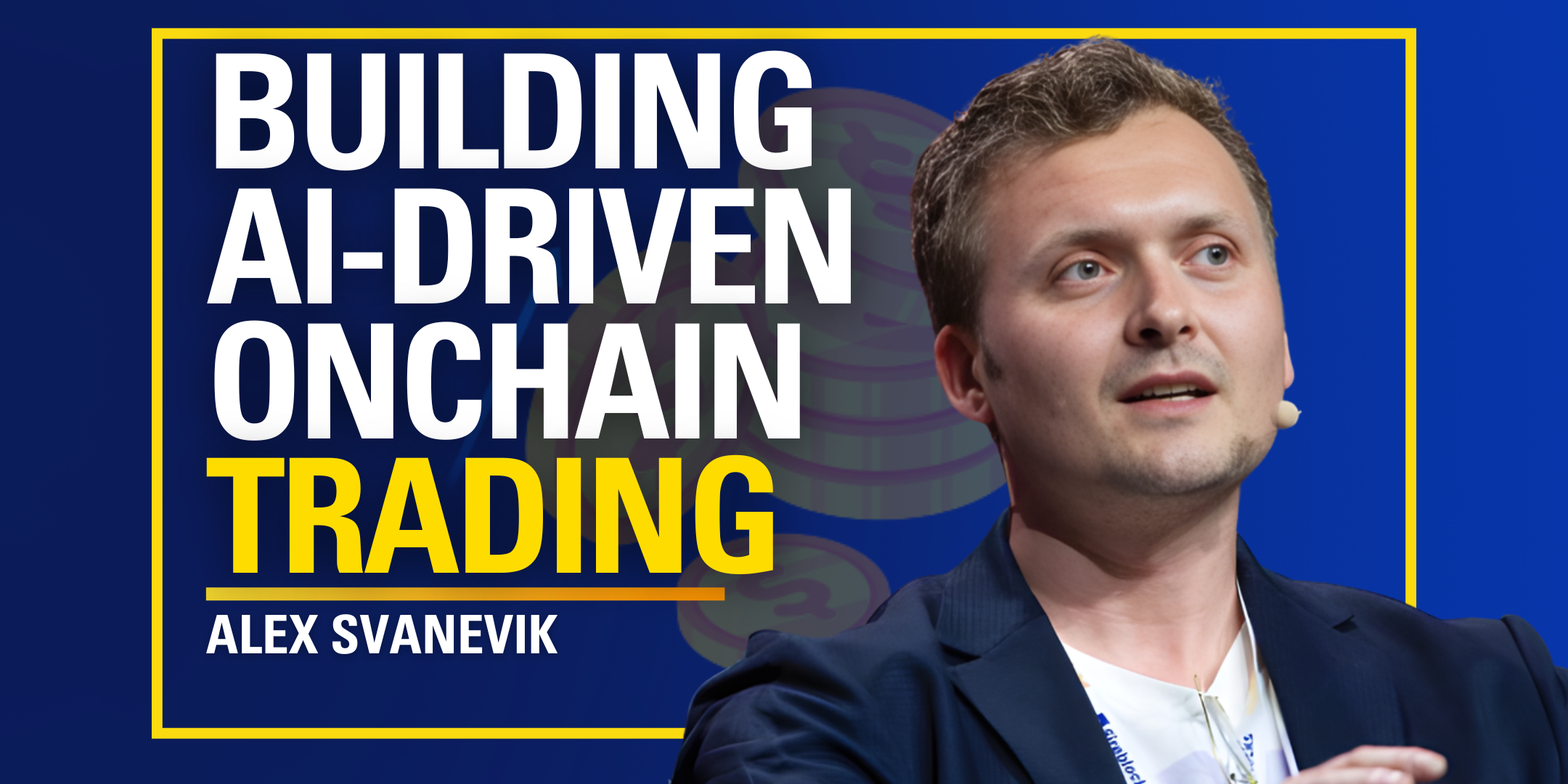
Building AI-Driven Onchain Trading - Alex Svanevik | ATC #600
Stephen Sargeant interviews Alex Svanevik, CEO and co-founder of Nansen, an AI-driven onchain analytics company headquartered in Singapore. He held more than a decade of experience in artificial intelligence, data science, and management consulting, before co-founding Nansen in 2019. Over his tenure as CEO, he has helped Nansen secure more than $88 million in funding and establish itself as a leading source of onchain data and insights. Beyond Nansen, Alex is an early DAO member of Lido Finance and PleasrDAO, and serves on the board of WalletConnect. He's also an advisor to Pudgy Penguins.
Host: Stephen Sargeant
Guests: Alex Svanevik
We are also available via:
Buzzsprout • YouTube • Quora • Medium • X • Facebook • LinkedIn • Soundcloud • Apple Podcast • Spotify • Player FM
Episode Transcript
Stephen: This is Stephen Sargeant, the host of the Around The Coin podcast. Do you guys remember Alex? He broke the internet a couple years ago talking about his PR application to Singapore getting rejected. He was on Bloomberg. He was in every article and every LinkedIn post for like, I felt like six months.
He is the CEO and co-founder of Nansen who started off helping retail customers get all the alpha and signal when it came to NFTs, and he expanded his business into an onchain intelligence juggernaut, helping people take the intelligence that they need to make some of the best trades in the world.
This is not an investment podcast, but he talks deeply about the intersections between intelligence and onchain and ai. He is built in his whole business as an AI native business, and he is going all in on, onchain and ai, and he describes exactly how he is doing that. This has been one of the best episodes when it comes to understanding a lot about trading in this industry and how the blockchain transparency is helping those people get information that they need the MOST.
Alex is such a fun conversation. He knows so much about what's happening right now in the industry and he shares all of it with us. So stay tuned for one of the best episodes you're going to hear when it comes to Onchain and ai.
Stephen: Do you guys remember the NFT marketplace and Nansen, how they controlled it? And now we've evolved. Five years from now we have Alex Svanevik, CEO, and co-founder of Nansen. Alex, tell us a little bit about yourself, then we're gonna go way into your background and figure out how you went from all the way from there to where we are today.
Alex: Yeah. Hey Stephen. Good to be here with you. Um, yeah.
A lot of people know our products from the NFT days. But we actually started building the product in 2019. And so my background was in data science and actually in ai. I like to say I was in AI before. It was cool. Not everyone was in ai. Um, I worked as a management consultant for a few years, uh, and got my first job in crypto in 2018.
Uh, I, I was, uh, was, um, let go. Along with all of the product team. From that ICO backed the startup in Hong Kong back in 2018, and then I took some of the best people with me and started building Ton in 2019. And so the focus with Ton has always been to surface the signal and create winners. So that's the mission of the company.
We try to make it easy for people to navigate what's happening onchain in real time. The very first wave that we hit was DeFi Summer. I don't know if you, uh, were around, uh, uh, jumping into, you know, yield farms and all these different things in, in the summer of 2020, and then NFTs was the year after.
And then we've done meme coins, uh, generally people trading anything onchain. And uh, I'm sure we get into that a little bit later. But now we've basically evolved to become a full stack onchain trading product. So not only can you get data and analytics, but you can also execute your trades through Nelson, which is very exciting.
Stephen: Which seems like it makes a lot of sense now, but I'm curious, you know, you have a master's, uh, in artificial intelligence from like 2009. What were your plans there in school? What were you planning on doing and. Then are you surprised by how it's evolved over the last 15 years, or could you not even imagine what's happening today back then?
Alex: yeah. That's how old I am. Um, there's been like two big revolutions since I graduated, uh, with a degree in ai. Uh, the first one was deep learning. Which is around 2013. Uh, and then the second one was gpt, which has kind of led to the modern AI era. And uh, back then when I studied ai, my family was like, wait, that's a degree.
That sounds like science fiction. Like surely you can't study that at the university. Uh, but to me there was always something really fascinating about ai, both from a philosophical perspective. If you think about movies like Blade Runner or Alien, or one of the crew turns out to be a robot, then. So on.
That's always been really fascinating to me from a philosophical perspective. And I think also because I was playing video games as a child, I always wondered like if you play against the, the computer, like how do they program the machine to have something that resembles intelligence? So I was always fascinated with, fascinated with ai and uh, in some ways I feel like it was inevitable that we've gotten to where we are now.
I have to say, like in the last, even in the last few months, it's really started to take off in a way that feels really special and a little bit scary. So I've really, I've really dug deep into the AI rabbit hole. Uh, again, uh, over the last three years, I've gotten the whole team to become super AI native.
So we run the company now in a pretty unique way, uh, where a lot of the stuff we do is agentic, uh, and of course. We've also, uh, transformed the product to become agentic. So this is what we refer to as a new way to trade. So instead of just, you know, using order book type user interfaces and the, the exchange interfaces you might be familiar with, we're trying to create a new way to trade that's agentic onchain and fully integrated in one product.
So, yeah, but it's a, it's a fun time. Like I have to say, it's a crazy time to be alive right now with ai.
Stephen: It probably doesn't hurt to flash that master's, you know, if you're looking to raise funds now to, to VCs, it doesn't hurt to have a master's in AI over the last 14 years. Uh, can you share your thesis? 'cause I think what you said, like your company's, you know, two important shifts in your pillows are AI and onchain.
Can you talk about, you know, how you guys are in, in like, into. Interpreting that within the organization? 'cause you're saying you're, you're relying heavily on ai. What does that mean for your actual staff?
Alex: So we are, just for context, we're about 80 people in the company. So to some people that's a lot to other people that's very small and lean. Um, but uh, I have this kind of overall vision for that I call New Way 2030. And it has three pillars. One is a new way to trade. The second one is a new way to build, and the third is a new way to work.
And so lately we've been focusing a lot on a new way to work. And so, for example, uh, when people in the company started dabbling with, with clo bots or open clauses as they're, uh, known as now, um, we discovered pretty quickly that we needed to find a way to equip all our team members with, with Clause as we, uh, refer to them as now.
So that's an example where, of course many companies kind of just shy away from it because of the security, uh, aspects, and you have to take those things very seriously. So at our company, you know, one of our principal engineers and our head of security are the two people who drive this. But for those who aren't as familiar with, with Open Claw, basically what it is, is it's kind of a way to let an AI run an operating system on a computer, which means it can do anything.
That, uh, you can do on a computer pretty much. And because the models we have now, like Opus, uh, 4.5 or even 4.6 for Anthropic, um, and some other models are so good now, uh, they can basically just take control of the computer and they can code, they can write, they can do tasks, they can help with scheduling, they can help you write strategy documents.
They can, you know, do a bunch of different things and it's kind of amazing. So. We had our management team gathered a few weeks ago in Bangkok, and the whole theme was a new way to work. Like, how can we transform the way we work? For example, I don't think engineers should be coding anymore. They should be creating agent systems that are producing the code and they should be creating quality gates to ensure that a pull request doesn't make it through.
If it, if it shouldn't, if it's insecure, if it produces poor quality code, if it has bugs, if it doesn't pass all the test tweets. Some of this stuff is kind of not novel. It's the same principles as before with like continuous integration and continuous deployment, but it sort of takes it to the new level, a new level now that you have, um, agentic ways to work.
So that's kind of on engineering, but even on product management, on design, all of these roles now are basically just full stack builders to some extent. And you might have kind of a specialization. For example, in design, but now you can amplify your skills horizontally into engineering or into product management or other things, or marketing.
And so to me that's really exciting and it means that people, I think it'll be empowered in a big way to build things really fast and to end. But it does mean that you have to almost like forget a lot of the things that you know from the past and just, you know, figure out what is a new way to work. For people who have maybe 10, 15 years of experience or more.
It basically means that you have to kind of rewire your brain, which is a big challenge I think right now.
Stephen: Do you find with like people applying and new hires, that they're really like almost AI first, like kind of like how the younger generation is like iPhone first, or like they can, you know, fill out a full application just using their thumbs. Do you feel that, you know, push from. Uh, the, the people coming into your company that they're very AI native.
Alex: Yeah, we, we have, uh, for example, one engineer who is an intern who is now, uh, a junior software engineer with us, and he's one of the most AI netted people in the company, really leaning into it. Um, but I think, you know, there are pros and cons. If you are a bit more experienced, you probably have a higher quality bar.
And so that's really helpful in an agent, uh, age or AI age. If you're younger, you might be a bit more malleable or plastic in the way you think, which is good. So you can not bring with you all your habits from the past, but you might not know what great looks like or what amazing looks like. So I think it's good to have a bit of a mix.
You know, you have some more senior people who are still really eager to learn new ways to work. And then some more junior folks who, uh, are definitely very hungry and have a high. Will and, and eagerness to learn, um, but they might not yet know what great looks like. So yeah, I think it's healthy to have a bit of a mix.
Stephen: I love that.
I wanna talk to you about, you know, 2021, everyone's buying NFTs. You know, Nancy is the talk of the. Town and now you evolve for a full stack. So you're taking intelligence and you're actually, instead of going now off platform, get your intelligence, go off platform and go to an exchange or train platform.
You can do everything within your, your four walls, let's say. Uh, how were you able to pivot during that time, especially 'cause the NFT, you know, hype seemed to go away quite quickly.
Alex: So it's funny, like I said, we started the company around DeFi Summer and the first thing that people wanted to do with Ston was to figure out which yield farms PE the smart money was putting their capital into. So I think that's always been a theme of our product, that you want to figure out what the smart money is doing.
With NFTs. Similarly, you wanted to find out which NFTs people were minting in real time. And I, I remember discovering Bored Ape, yacht club BAYC when people were minting that through, through Nansen And I minted 40 of them, and I sold all of them way too early. So I, I missed out on, I think, uh, I guess seven or maybe even eight figures, uh, just from selling them too, you early.
Um, but. I kind of thought of NFTs as the next evolution of, of tokens, uh, in the sense that the, the playbook was a little bit similar. You wanna figure out what the smart money's doing onchain. You're not exactly copy trading, but you're seeing what other addresses that have a good track record are doing.
And I think this is a good point to, um.
Sort of explain wh why, you know SEN is unique and why blockchains are unique. It's because you can see everything that's happening on a blockchain, right? So maybe that's obvious to some people, but you can see everything that's happening on, you know, Ethereum, on Solana, on the L twos and so on.
But you don't get out of the box who the addresses are. And so very early on we sort of decided that that was gonna be that. The technological challenge we wanted to solve. And so at like today, we have more than half a billion addresses labeled. And if you kind of count up all the multiple labels an address might have, we get into the, into the billions of how many labels we have, uh, in total.
And so this was very helpful during the NFTs because you know, you might have a public figure, an influencer who buys a specific NFP collection. And that can be alpha, right? If you can discover that quickly. So that's kind of a, an evergreen, uh, point where smart money tracking has kind of become the thing that's evergreen and lasting across all the different narratives.
But, um, we take the approach that we try to build a product that is universal and is not necessarily built only for specific narratives.
You can use the same tools to discover a bunch of different things, and I think this is especially relevant now in the AI age because now the way you interact with Dun is mostly to just talk to it. So you can go to the web app or you can go to our mobile app, which is uh, just a few months old and you can just ask it questions. You can sort of think of it as, imagine you have like Opus 4.5 or you know, Claude or, or chat GPT for that matter, but you've given it access to everything that's happening onchain in real time, plus half a billion labeled addresses.
And you've basically fine tuned it to be very useful for onchain related prompts. That's basically what our product is today. And so the, the way I think about it is that the. Interface is kind of an infinitely scalable user interface because you can incorporate new things, whether it's perps, whether it's prediction markets, whether it's new chains, and the agent can sort of be the iceberg where you ask it a very simple question, but you can keep going as deep as you want with us, without us having to create a very complex and convoluted user interface.
So that's kind of how it's evolved, um, over the years.
Stephen: And what are the main use cases? Obviously, you know, and the investors and the founders that do investment on listening to this podcast are like, oh, that's perfect. I need that kind of alpha, I need that kind of signal to make trades or to see where the market's going. I can also see business units within organizations looking to forecast.
They can get sentiment from your intelligence. Are there any other use cases that you, or even surprisingly in the last 18 months with stable coins and other things, there aren't any other use cases where you're seeing NSS being utilized.
Alex: We've chosen to really double down on the investing and trading use case. Uh, and when we started the company, we didn't have as clear of a focus on that. It was a bit more of a universal tool, but we discovered that the users who get the most value out of the product are investors and traders. So today, I would estimate that 98% of our users are basically traders or investors.
They could be funds as well. So you can sort of think of this flywheel where you discover something onchain through our product. You can then due diligence, it, you can basically figure out, Hey, is this worth my, uh, my capital? Should I invest in this? Should I avoid it? Then you can actually execute the trade, and then you can also track your holdings, uh, onchain, and then it goes in the loop, right?
So the cool thing is that I think historically when you think of crypto. You've had to make a choice. Either you have a great user experience on a centralized exchange, but you're off chain. You're trading in someone's database, right? And that means you have to wait for them to list the tokens, and you can't use smart contracts, a bunch of different, uh, limitations.
Or you go onchain where you have the Wild West, you could buy like a hundred million different tokens. You have to hop between all these different products, right? You have to go to one product to find the alpha. You have to go to another product to execute the trade, and you have to use a third product, the wallet to sign the transaction.
So it's just a very clunky and fragmented user experience. So what we've tried to do is we've taken the best building blocks and components, and we put them into one integrated product where everything happens onchain. You have your own. Self custodial embedded wallet, but it feels like an Apple grade user experience.
Right. And that to me is kind of unique because the infrastructure to build it really hasn't been good enough until quite recently. And of course now with ai, you can, you can transform the whole user experience. So it's fully agent, you don't have to figure out, Hey, which dashboard do I go to? Which thing in the nav bar should I click on?
You just literally talk to it and you ask, Hey. Tell me what smart money's buying right now. I'm interested in, you know, micro caps on Solana, or, Hey, I wanna buy tokenized stocks. You know, what can I buy or I want, or I wanna buy commodities, you know, can I buy gold on Solana? Is there a way to do that? And the agents helps you figure it out.
And ultimately if you say, Hey, okay, cool, put, you know, a hundred dollars into this token. It goes out, it runs meta aggregation. On other deck aggregators, wifi, OKX, Dex API, and Jupyter at the moment, well, we might add more, but it checks all three and it gets you the best price among those, and it just allows you to one tap execute the transaction onchain through those.
So it's a, it's a pretty magical user experience. I think, um, when people see it, the, the experience, the, the reaction I get typically is kinda like, wow, that's, that's a very smooth user experience. So I would just encourage people to download the app, first of all, and, uh, you know, we can top it up through, through Solana or base, uh, and then you just try it out, you know, and if you don't want to put any funds into it, you can just ask it some questions, get a feel for how the agent is working.
Stephen: And I think what's interesting about that is it feels like you've transitioned. From like, you know, retail users to more institutional, larger teams, crypto teams, but also this is kind of how people get their outfit. They're asking questions, but usually it's on Google or YouTube. And usually the answers they're getting are very biased, right?
Because it's based on who's selling the most ads on those platforms. And you see the younger investors, they're going on TikTok. So you can see how this is actually transitioning where how people get their information and their intelligence. And actually how they trade, which is I, to your point, it's kind of revolutionary when you think of it.
Alex: Yeah. And, and there are no ads in SSON by the way. Right. It's a pure experience and very clean. So, so yeah. It is funny because we kind of boomerang back to the retail segment. The retail segment was the first, um, segment that we really had product market fit with. Then we grew extremely fast and scaled up the company and we started spending more time on sort of enterprise and institutional use cases.
But we're actually now back again to the onchain retail investors because I think that's kind of our DNA, that's where we started, and we in the company are also in that segment ourselves. So we really empathize with all our users and we, we dog through the product relentlessly. All of us have our own onchain portfolios and so. Yeah, it's kinda interesting how we've, we've had that boomerang journey and uh, and now we're back to the onchain retail investors.
Stephen: And I think, you know, you talked about clicking all these buttons. I think historically you probably know this better than me. You know, crypto's better when you're not clicking or connecting more than you need to. Right? That's where the biggest attack vectors are in the industry.
Alex: Oh yeah. Also.
Stephen: too much.
Alex: That's actually an excellent point, right? Because you, you might say, okay, I saw I saw this token on, on X, uh, let me find it. And you, you sort of go look for it and there's a huge chance you're gonna pick the wrong token and like, okay, that's why everyone asked for the ca right? The contract address.
So make sure you, you're actually getting the right one. And so built into our product, we take care of that, right? So our agent figures out. on liquidity, based on who owns it, based on market cap and signals like that. It figures out this is the address. You mean when you say, you know XAUT, it knows that.
You mean the tokenized gold token that has enough liquidity, not some kind of scan token that someone is filling on like deck screener or whatever. Right. It finds the right token and so it sounds kind of mundane, but to your point, this is like an attack vector where you might actually. Either pick the wrong token or go to the wrong website and get scanned and phished.
So in a way it, it feels safer to just have everything in one integrated user experience.
Stephen: You probably felt that with NFTs, right? There was such a rush and hype and so, so, you know, minuscule time limits that you had to connect your wallet by is that, that's where a lot of the fraud and the scams happened, is people were just throwing caution to the wind because it was, it was easier to lose a little bit money because you know, if you got in at the right project.
Before anyone else, you would make so much more.
I'm curious, you kind of coined this term like, and even just the way you describe it feels like, you know, we know about vibe coding, but now you've kind of coined this vibe of like vibe trading where you just, you know, you can talk to, you can talk to the agent ai, it's giving you feedback, but like it doesn't just stop there.
Kind of walk me through how you guys came up with this concept of like five trading.
Alex: So I do think there's a real parallel to coding and engineering. And so historically engineering has been kind of reserved for the upper class of software engineers, right? You have to, um, you have to have the skills to code and then with. AI now, it sort of makes it accessible to anyone who is technically adjacent and maybe not even that, like if you're a product manager, designer, something like that.
Suddenly now you can express something and get like a React web app built out in like three minutes, which is amazing. And so I think with trading it's a little bit similar. If you think of trading and investing. Most people don't do it right. It's pretty inaccessible. And if you look at the average exchange ui, it's pretty daunting and confusing for people.
And so I think what Vibe Coding has done is to basically make coding accessible to a thousand x more people. And I think Vibe trading similarly will make trading accessible to a thousand X more people. And so. If you just get someone to express what they want, like the intent, Hey, I want to get some exposure to crypto, but I don't want to buy something crazy.
Like maybe like let's put together a portfolio of like two to three assets and like how much to put into, uh, each one. Like, what do you think? And it's like. The way someone would ask you, and I'm sure you got this question from friends and family all the time. Typically they ask you when Bitcoin is at the top.
Of course. Like, should I buy Bitcoin?
Stephen: No, they're asking if I bought a lot of Bitcoin so they could see if they could borrow money and borrow some money.
Alex: exactly. And so, and so you could sort of think of the vibe trading user experience as kind of a proxy for that. You know, the family member who knows more than you about crypto, right? Then like who happens to be plugged into everything. So that's why I think it is potentially much more accessible to people.
But I think it is also really interesting because it gives retail investors kind of an Ironman suit. You know, in the, I think in the, um, in the days before, the level of AI we have now, you would need to have like PhDs and like research analysts and everything to kind of stay on top of everything that's happening. Now you can sort of equip the same capabilities. You can equip a retail investor with more or less the same capabilities or even better. So in a way, it sort of levels the playing field on the information side in a way that's interesting. And one thing I always found really cool with crypto is that crypto is a very inefficient market.
It's not yet professionalized in the way that like the stock market is professionalized. That means there are lots of opportunities in different corners of the crypto market. You know, you and I might be looking at totally different segments of, we might be on different chains. First of all, we might be looking at different categories.
We might be looking at different pockets of, you know, assets and tokens that you can trade. And that means you can sort of develop a bit of an edge in your little corner of crypto. And I can develop an edge in my corner of crypto. And so to me, this is. A really exciting idea where you can give every retail investor an Ironman suit and then have them go crazy in their own little, you know, pocket.
So I think that's, that's cool.
And then the last thing I'll say on this is I do think vibe trading is gonna follow a bit of a trust ladder, where again, you can draw an analogy to, to coding, but you could also draw an analogy to, to driving and self-driving. Cars full self-driving. So most people are not comfortable going straight to full self-driving.
Like most people wanna sit in the driver's seat and like maybe have a hand like near the wheel at least you don't go straight into the backseat most of the time. And this is kind of representative, the trust ladder. You want to, you start where you're like, okay. The car as a copilot. Maybe if you go back to just Google Maps on a device, that's kind of a copilot experience, right?
It's telling you take a left, you know, take a right.
That's kind of the first, uh, step towards full self-driving where it's actually telling you where should go, but you're steering the wheel. Then next level is like, okay, I'm gonna let the car drive, um, and I'm gonna take my hands off the wheel, but I'll still sit in the driver's seat.
Then, you know, the next stage, eventually you get to full self-driving where in, you're in the backseat maybe, and
Stephen: are not even asking questions. You're just getting into Waymo and you're going, you're not asking no, you don't have time for questions.
Alex: I, by the way, last weekend I was in Shenzhen in China, and I did, I, I took my first self-driving, uh, taxi and, you know, uh, I live in Singapore, so we don't have full self-driving, uh, self-driving taxis here, but it was like.
Pretty, pretty interesting experience and pretty amazing. Um, maybe you've taken way most and like it's common in the US but uh, but I think like it's gonna follow a similar trust ladder. You're not gonna be comfortable just going like, close your eyes, take all my money and like, invest it autopilot. I don't think that makes Nansense for most people.
I think you want to be like, you wanna have a copilot, especially if you're an active investor and trader. Where you're working with the agent to find out what to invest in, and it helps you do research really quickly, almost like a Google Maps or something. And then over time you're like, Hey, why don't I just tell it what I generally want to do or even have it infer for my training style strategy?
And then you can go and execute the strategy. But like, let me know when you make trades right? And maybe even let me sign off on the trades before you execute them. Then from there, eventually I think you get to some kind of autopilot, full stop driving. But it's a trust ladder. And I think both, um, on the technical side where you need to make sure that this stuff actually works and you're not just systematically losing money for people and on the user behavior or human behavior side, you need to warm people up to that user experience.
So yeah, so that's, I think the trust ladder is like my mental model for this.
Stephen: And I think a side note is that if I'm making certain trades and certain activity, I'm going, as you said, I'm going off of human behavior, human emotion. It's probably being able to tell me like what type of trades I'm making, how I'm reacting to certain signals without me even knowing that information.
Right? I'm just clicking buttons because I heard this report that came out of Trump. You know, he signed an executive order, but it can tell me based on how I'm trading, like maybe the style or what I'm planning to do, which I think is, is usually lost,
Alex: Man, we, we, we have like a, if you download Ton ai, the mobile app, we have like pre-created prompts and like, either you can set up your own ton wallet or you can just track an existing wallet you have, right? So if you just paste in, you know, a Solana address or an Ethereum address, you can then ask it to roast your portfolio and so and so.
It'll just give you like a funny. You know, roast of like your trading style. But you could do like a more serious version of that too and say, Hey, look at all my own chain history. What are my, you know, my biggest wins, my biggest losses? Like where do you see errors I've made and what, what are the, do you see any patterns in the mistakes I've made?
Do you see any patterns in the wins I've made? And like, let, let's now, uh, refine my trading and, and maybe develop, uh, a bit of a trading journal or like a, um. To basically level up your own trade, right? So I think this, this idea is kind of a cool idea because you get very emotional when you trade. Most people get affected by the market's tanking or mooning, and you're screen shutting your portfolio instead of taking profits, right?
Um, and so I think the idea of having like a cool headed copilot next to you is, is quite compelling. And I think overall I'd be surprised, um, if people don't do a little bit better if they have a copilot like that.
Stephen: You've probably seen some of the top traders, even back, you know, early on the NFTs, you know, the top people buying and selling. Uh, I was just listening to a podcast where we were talking about Roger Federer and Tennis. Basically saying the number 400 person in tennis is closer to the number 10 than the number 10 is to the number one, because like those top people are so far ahead.
Uh, what are your thoughts on that as it relates to maybe training on the blockchain?
Alex: I mean, there's definitely some of that going on. It depends a little bit on which, uh, vertical you look at. You know, like pers trading, we check hyper liquid perpetrators very closely. And if you go into, uh, our product on web on the homepage, you see the top hyper liquid, uh, perpetrators. Um, and yeah, some of them make a lot of money and also some of them lose a lot of money.
And there are some like infamous examples of that. I think in the NFT market and also meme point market, it tends to, especially in the meme point market, it tends to be quite concentrated. And so, um, that means the people who, who make money make a lot of money. And frankly, a lot of people lose money. So I think this, that's the other side of this, right?
Where, um, at the very least you wanna make sure that people aren't making dumb decisions and making obvious mistakes.
And so the North Star, like I, I'm not sure, you know, to what extent I should communicate this from a like regulatory point of view. And I wanna be very clear that, you know, we can't promise that people are gonna make money with Nelson, but the North star of the product team is that our users outperform the market.
Like that is the single North Star, right? And so, uh, that's how we build the product. I think some other trading. Um, platforms because they don't focus so much on surfacing the signal, they'll probably just look at volume. You know, if you have a lot of volume, you're obviously making a lot of money as an exchange.
Um, and then you that can lead to kind of casino-like um, user experiences with flashing lights and getting people to trade when maybe they shouldn't trade. And because it drives volume. So like our perspective is that become we, because we come from. Onchain analytics world where we wanna surface the signal has always been really important to us to make sure that the North Star that we follow is to make sure that our users' portfolios are growing and outperforming the market.
That's overall the North star of the product team.
Stephen: I love that, but I also know, you know, human behavior and usually I've been in crypto long enough. Usually when people lose money, they don't. Themselves, they blame the platforms where they lost the money. Right. What, how, what are your regulatory responsibilities? 'cause especially now with the trading aspect and you know, how do you handle when the market goes down and, you know, there's a bloodbath?
How do you handle users usually turning on the platform? Or do you experience that, uh, in your opinion?
Alex: So first of all, we're a technology service provider, right? So just to be very clear, we're not an exchange. We don't custody funds. We don't even have an order booked. So the way to think about our product is more like a self-hosted wallet or a self custodial wallet. Where you have information elements, right, that help you.
So I think that's important for people to understand. This by the way, means that we don't hold your funds. We don't control your funds. Like we infamously covered FTX, uh, with our product when FTX was imploding and we actually, uh, somehow managed to get a lot of press around that coverage because we could see in real time that like SPF was sending funds out to Bahamas users when he had said that they.
Uh, you know, had, uh, uh, closed all withdrawals, but I was like, I could see onchain they're sending funds out to users. Like, what are you talking about? So, so I'm, I'm like deeply committed to self custody and I think FDX is like the best example of how bad it can go, uh, if you have, if you trust custodial players who shouldn't be trusted.
Right. So the way to think about our product is that it's self custodial, like. Any wallet where you basically have the private key, it's, it's more convenient because it's an embedded wallet, and that means that, um, you don't, you can export the private key, but a lot of that is abstracted away from you because we use Privy, uh, which is the, the leading, uh, embedded wallet provider, uh, under the hood.
They're owned by Stripe, uh, which you might know. And so. So it is, it should be thought of as an onchain product and an interface to the blockchain, right? We're not a custodial exchange and so on. And so, um, when it comes to the bloodbath, I mean, frankly, we launched our trading products quite recently and the markets have been really bad, right?
And so let, let's see how it goes when, like, markets come back up again and they're gonna go down again, and maybe we can, I can come back in a year and then we might have more of a rollercoaster to, to build on. But this is. We actually launched the trading features literally like a month ago, um, for, for most users.
So it's quite new actually, but, uh,
Stephen: when your intelligence is needed the most. When everyone's losing money. This is when you need the intelligence the most. Not when everyone's making money. When everyone's making money, they don't need any alpha. They just need more money to invest.
Alex: You just click by. Yeah. If you that. That's true actually. Like I actually, personally, I've always found that like, the sideways market is the most interesting because you, it's harder in some ways.
You can also make, um, make decent returns in those times. Um, I'm not sure how I would describe the current market. It's a strange one because you have all these positive underlying, uh, regulatory currents and institutional currents, but you have this really bad retail sentiment, right? So.
It's a strange market right now, but, um, my, my bet is that I think agents are gonna revive crypto in a really big way, both at the, the UI level, like how you, how you trade and how you interface with the blockchain.
But I think agents are also gonna autonomously be very active onchain and they're probably gonna be creating their own protocols and they're gonna be speculating on each other. They're gonna have their own little parallel economy. I'm sure you've seen Malt book and, and so on, right? Um, so that's actually one of the things I'm, I'm really curious to see how it plays out.
I think we're gonna be surprised actually by how big of an impact agents are gonna have on the blockchain space.
Stephen: And are you gonna be able to label, maybe you're already starting to label like, Hey, this is a, an agent just based on their behavior or how they conduct transactions. Do you think you're gonna be able to label some addresses that are owned by agentic?
Alex: There are some standards already. Uh, I'm not gonna say the number of the. Standards that Ethereum put together. 'cause then when I get the numbers wrong, something with eight, uh, I think 8, 6 0 4 or something. Um, I'll have to look that up separately. But yeah, we can, we can label to some extent, you can't label a hundred percent accurately because in theory I could be running a claw bot that looks just like a human and it's running like with an externally owned account, like a normal EOA wallet.
And it's really hard to know for sure. But I think, um. It might become more common to like self disclose as an agent and even have like agent identities for various reasons. So we do have some labeling for it, uh, but we can never claim to have a hundred percent coverage because it's actually pretty difficult now that AI is so, uh, indistinguishable from humans in many arenas.
Stephen: that's true. Uh, probably more reliable in some senses.
Uh, Alex, you just mentioned Singapore, and that's where you're based. You broke the internet a couple years. I know you broke LinkedIn a couple years. When you mentioned that your PR application in the country was denied, you were on all the news outlets talking about this.
Can you kind of take me back to that time? What was the frustration? What was the feedback that you got? 'cause it looked like a lot of people were a chiming in and saying, yeah, I went through the same process. A lot of people were also saying like, Hey, go move somewhere else then if you're not happy with the application process.
Tell me about that entire experience. 'cause I think that probably caught you off guard. It looked like you were just like, Hey, this is really the process. Like, does anyone else see this? And it seemed like the internet saw it and responded.
Alex: Yeah. So, so first of all, uh, so I get this question a lot. Every, every event I go to, people ask me about this. Um, so first of all, I'm still in Singapore. Uh, that's like the first thing people wanna, where did you move? Singapore is genuinely an amazing place, and of course, that's why I, I, I initially, uh, sought, get the pr, um.
It was a little bit random to be honest. You know, I had applied for it, I got it rejected, a bit of frustration in the moment, and I just tweeted it while I was at the gym. Um, and then like it blew up really quickly. I think maybe because people aren't that used to, um, foreigners in Singapore speaking up in that way.
Uh, and I would say. Overall, it was a mixed experience. Um, and I think, first of all, let me just say I think it's totally fair that I got rejected. I'm like, I don't feel entitled to get the pr. Just to be super clear, um, the frustration I had was mostly around the lack of transparency. Transparency is like one of our values at, it's something I care about a lot, and I would've liked just to have more transparency, like what do I have to do to get it?
At the same time, I don't feel like they owe me it. So, but yeah, it was, it was kind of surprising that it ended up on Bloomberg, um, on I think the front page. And a lot of people, uh, contacted me, a lot of people saying That was a dumb idea. That was a really dumb idea to do
Stephen: Oh for you because like you're kind of like, you know, alienating the people that are in the future. You know, you need to kind of.
Alex: Like, I, I genuinely mean this. Like Singapore is the best place that I've lived. I love this place. It's incredible. And uh, so there was no like resentment in that sense. And I don't feel differently about Singapore, what they've created here. And for everyone who is interested or curious about Singapore, you should read from Third World to First, uh, Lee Yu's, uh, book, the sort of founder.
More or less of, of Singapore. It's like one of the most amazing books ever written. And uh, it's a, it's a really special place. Um, but, um, yeah, so I'm, I'm based here now. I'm happy here. And you know, I think there's a really, there's a great tech scene both for crypto, increasingly for ai, and generally just, uh, happy to contribute to the, the ecosystem here in whatever way I can.
Stephen: So did you get the pr, everyone wants to know. Did you get the pr?
Alex: No, no. I didn't get the vr. No, no, no. I didn't get the, I got, I got
Stephen: is it something that you can reapply for or is it like, what and done? Like if you don't get,
Alex: can, it's a little bit complicated, but, uh, to make a long story short, I'm happy with the work pass that I have now, which is a, like a five year work pass and I'm totally fine with that. And so,
Stephen: and there's a little note on your file that says, please
Alex: and yeah, maybe, maybe
Stephen: end up back in the.
Alex: I suspect if I reapply, they might not, uh, give it to me anyway. So I, I'm happy with my work pass and that works for me.
Stephen: As like a founder entrepreneur, did that help boost Nansen or your, you know, your founder profile? You have to ask 'cause like, hey, you got a lot of coverage at the time. And then people are probably like, who's this guy and what's Sen like? Especially 'cause your crypto bro gets rejected kind of vibe that I thought a lot of people took that angle as well.
Alex: I was chatting with a, a good friend of mine who's also, uh, a CEO here in Singapore, and about this today, and we sort of concluded that in 2026, if you're CEO, you're, you're a chief entertainment officer, that's kind of part of your job. And so if you look at, you know, obviously Elon is like the master of this, um, but if you look at even, I think Dario from.
Philanthropic is really great at creating engagement about all this, like scary thoughts around AI in, interestingly enough, because this company is obviously ai, um, Palmer Lucky, who's like one of the most entertaining people I know. I saw him live, uh, at an A 16 C summit last year, and it was the funniest fireside I've ever seen.
He was, he was just, he was just amazing, like so, so smart, so funny. So I do think there's a bit of that where like as a CEO in 2026 maybe, maybe six, especially maybe in in tech, you have to be entertaining. And I do, you know, get, uh, people who come up to me and say they follow me on X and they like my shit posting.
And so I think it's just part of the role at this point.
Stephen: You do it in such a fun way, like you and you really own that story back then.
Uh, I don't wanna leave this conversation without talking about the tokenized L one in the. X, uh, NX eight. Can you tell me what is it? Why now? What were people doing before using this type of index? Uh, and is there a reason to launch this part, you know, project in partnership with another organization versus just kind of doing it on your own?
Alex: yeah. So for context, um, this is a tokenized index product. It's called NX eight. It's issued by one of our partners called Open Delta. And so Open Delta announcement went together and we basically said, Hey, we should create a high quality curated index product that is solely focused on Layer once there are index products for crypto out there.
But in my experience, they have a pretty broad basket. Maybe 30, maybe 50 assets. And we said, Hey, we wanna just focus on the highest quality category that's been proven in crypto for tokens, which is layer one. And so to be specific, it's uh, an in export that has eight uh, constituents or eight underlying assets, Bitcoin E, so B-B-T-R-X, hype, sui, and avac. And the methodology is such that it's market cap weighted. It has a cap of 20% of each constituent. That means you get pretty wide, um, diversification in the basket. So it's like roughly 20% Bitcoin, 20% E, 20% sold 20% B and B. And then the remaining, uh, four sort of share the, the last 20%, uh, in a market cap weighted, uh, manner.
And so if you are, I think it actually potentially caters to sort of three different user segments. Um, firstly you have kind of normies who again might ask you like, Hey, what should I buy Soul or E or Sui, right? It's like, just buy NXA. It's like buy the index, right? The of these L ones. You don't have to think so much about whether soul is gonna flip E and all that stuff.
So that's like one thought. And then I think for the institutional segment, it's kind of a similar thought. They might not be that deep into crypto, and so again. You can buy an index product that just has a weighted, uh, composition of the layer wants. And then I think also to the sort of degens, like maybe you and, and, and myself, it's a product that is fully onchain.
It's tokenized, it's on Solana for now. We might, uh, deploy it on some of the, the other chains as well. But you can, you know, you can lend it out on Camino, right? It's integrated with DeFi from day one. You can provide liquidity on it. You can even stake your, your, um, your liquidity tokens, uh, and get boosted yield on Camino.
So I think it's an interesting product. Um, and, and to take a step back for us at sson, we're gonna do more joint ventures going forward, where we basically co-create what we call joint venture protocols with partners. This is the first one where we're partnering with Open Delta to create the. Protocol that underlies NX eight.
So NX eight is the first tokenized product. There's gonna be more tokenized products on that protocol. And so the exciting thing that we're gonna do later this year as well is to esNansentially give nonsense points holders ownership in that protocol. But, uh, I'll share more details on that later.
Stephen: I love that with the last two minutes we have, if you're in the elevator with somebody and they say like, what is your thoughts on the future of. Finance as it relates to AI and onchain, which is the two things that you're betting on. What do you think the future holds? And I know it's hard to predict, but let, let's just say the next 24 months, what do you think has to be done to what is the future and what has to be, what hurdles have to be, you know, jumped over in order to get to that future?
Alex: Well, let's look a little bit further in 24 months. And I would say that firstly, every asset is going to be tokenized. That's really important. Every asset, everything that you would want to own and trade and transact is going to live on a blockchain. That's really important. The second part is, I think because of that, you'll probably have billions of people on earth who are owners of some kind of assets, whether it's owning a little piece of your home, or you're owning a little bit of tokenized gold, or you're owning a little bit of Bitcoin.
You're going to have, uh, a more inclusive financial system where more people will own things. And I think it's a really healthy thing for the world that people are owners. I think you take better care of things when you own them. And so as a result of every asset being on-chain and tokenized, I think you'll see billions of people be owners.
And in that future, I think blockchains are going to be the financial fabric of the world. So these are kind of. You have to kind of stick with some pillars that you just deeply believe in, and you are very confident that they will be true 10, 15, 20, 25 years from now. And to me, those are like the three pillars that, uh, that keep me, uh, excited about everything we're doing.
And then I think if you maybe go a little bit more near term, because it's gonna take a while for every asset to be tokenized, I do think that probably. Agents and agent user experiences are gonna transform software in a really big way, not just crypto and not just blockchains, but I think from what I've seen in the last few months, I think we're gonna see some massive changes to how we deal with software, how we interact with software and. On the one hand, it's kind of amazing that like you and I could create a pretty good, I actually created like a, a pretty amazing web app in a meeting with someone today. I was like, Hey, let me just like tell my call about to build a first version of this. And then in, I'm not joking, in three minutes it came back to me and it was like, here it is.
And I was like, that is basically what I wanted. I'm gonna polish the UI a little bit, but it does like the core thing. So it's amazing that we can do that at the same time. I think it's just gonna, like, it's a new paradigm where we're gonna work through agents more for everything. Whether it's like going shopping or you know, it's to buy stuff, it's to invest in things.
It's to build things. It's to basically get anything done. And so that's the world that I'm really excited about. I think that's gonna happen faster than I imagined. Like if I go back, you know, five years, I didn't expect that it would happen so intensely. You know, as it's happening now. So I, I think that's gonna have a massive impact on software in general.
But like, I think for crypto as well, we've always said that like crypto is the worst user experience out there and it's one of the reasons why we haven't reached, reached mass adoption. And maybe like agents are gonna abstract all of the stuff away from us and you just talk to like an OTC desk or a broker.
So maybe we're going back to like 1980s, pick up the phone, Hey, buy Microsoft stocks and like that's the user experience.
Stephen: And I think the audio's there.
I think you raise a huge point on ownership too. I think the younger generation doesn't feel like they have that ownership, which leads to a lot of investments in things like poly market and prediction markets because they're like, Hey, we don't own anything anyway, so we might as well just spend.
Alex, this has been a fascinating conversation. Uh, we'll definitely have you back at the end of the year 'cause we, you know, everyone's making the price predictions on Bitcoin for the end of the year, so we'll definitely have you back and talk a little bit more about some added protocols or added uh, applications to your new protocol.
Alex: Awesome. Thanks for having me, Stephen. Great chatting
Stephen: Thank you.
.png)