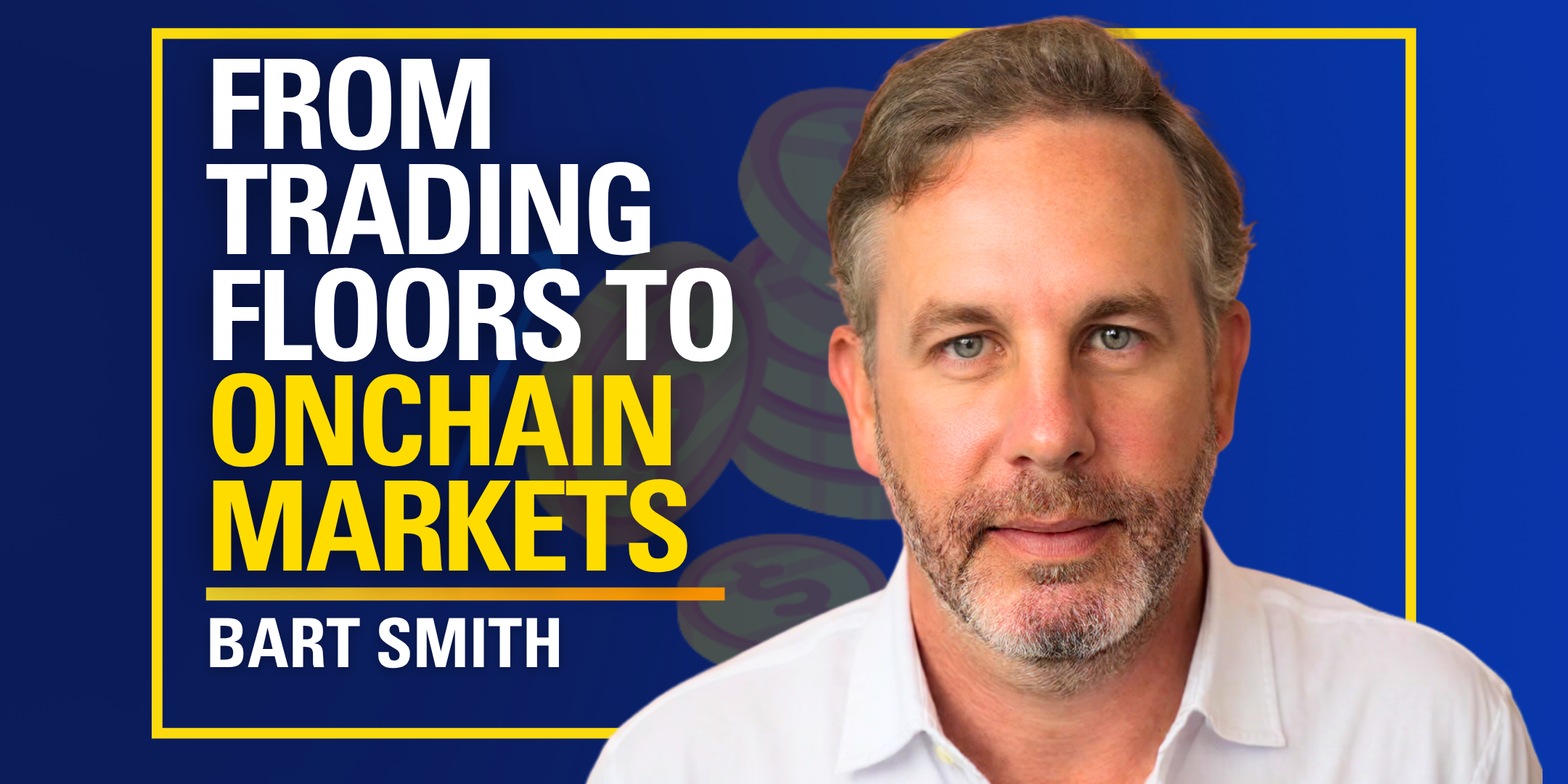
From Trading Floors to Onchain Markets - Bart Smith | ATC #629
In this episode of Around The Coin, Stephen Sargeant speaks with Bart Smith, CEO of Avalanche Treasury Co. He spent over a decade a Susquehanna, first leading its ETF business and then building what became the largest institutional digital asset desk on Wall Street, which was among the earliest adopters of Bitcoin in traditional finance. Bart has spent his career bridging old Wall Street and new crypto infrastructure, and he is now using that experience to build a new kind of digital asset treasury for the Avalanche ecosystem. He is a leading voice on how digital assets are reshaping markets.
Host: Stephen Sargeant
Guest: Bart Smith
We are also available via:
Buzzsprout • YouTube • Quora • Medium • X • Facebook • LinkedIn • Soundcloud • Apple Podcast • Spotify • Player FM
Episode Transcript
Stephen: This is your host, Stephen Sargeant, the Around The Coin podcast.
We had the CEO, Bart Smith, of Avalanche Treasury Company. Such an interesting conversation around digital asset treasuries, what's happening with regulations in the US with Clarity and Genius Act. We go deep into discussions of the Avalanche blockchain, what is happening, what people are building, how they're investing in the community, and what will be sustainable.
We talk about stablecoins and payments and real-world asset tokenization and everything that's happening on the front lines from Wall Street to San Francisco.
This is a really great podcast. Hope you enjoy it, and reach out to Bart on LinkedIn or Twitter if you enjoyed this podcast.
Disclaimer: This episode of Around The Coin is for informational and educational purposes only and should not be considered financial, investment, legal, or tax advice. The views and opinions expressed in this episode are their own and do not necessarily represent the views of Around The Coin, Avalanche Treasury Company, or their respective affiliates. Any discussion of companies, digital asset treasuries, digital assets, cryptocurrencies, stablecoins, DeFi, or other investment opportunities is not an offer, solicitation, or recommendation to buy, sell, or invest in any asset or security. Investing involves risk, including the possible loss of principal. Always conduct your own research and consult a qualified professional before making investment decisions. Now, let’s get into the episode.
Stephen: This is your host, Stephen Sargeant, the Around The Coin podcast. We're lucky enough to have the CEO of Avalanche Treasury Co. Bart, tell us, A, what is Avalanche Treasury? Tell us a little bit about the blockchain, and then we're gonna go deep into your background and growing up and getting into the crypto space.
Bart: So, Avalanche Treasury Company is a digital asset treasury listed on the Nasdaq. We started live trading about 90 days ago, so we're about three months in. It's a digital asset treasury that's focused on the Avalanche ecosystem. So we own Avalanche, we stake Avalanche, and then we're actively looking to partner and to invest in different parts of businesses, and organizations that are building within and on top of the Avalanche ecosystem
Stephen: And why is it like a treasury co? I think of a lot of blockchains and they invest in, you know, some of the projects and apps that are being built, but they don't have a digital asset treasury doing that. Why do you think it's important to have a separate entity investing directly into some of the builders in the space?
Bart: I just think that in one of the gaps, that existed for investors, particularly kind of larger individual investors or smaller institutional investors, was having a regulated way to get exposure in a way that they trust in their brokerage accounts. So we solve for that in the sense that people can go into their brokerage account right along with their other stocks and bonds and options and everything that they hold as part of a, a broader investment process, and they can own Avalanche right in there.
And they know that it's regulated by the SEC and that there's auditors and that the organization is you know, transparent. So I think that is the benefit. And then on top of that, you know, being so embedded in the ecosystem, we work very closely, alongside the foundation and Ava Labs, which is the for-profit, you know, marketing and business development company within the ecosystem.
We have a very good purview into different opportunities that are coming in the space. And we have the ability to hopefully and successfully, capture some of the growth that's building on top of the Avalanche ecosystem, along with just kind of the beta of owning the AVAX token as the ecosystem hopefully grows
Stephen: And, you know, getting into investments and trading, this is what you did, quant trading for about 10 years. How has that industry changed from, you know, when you started maybe a, a decade ago working with Susquehanna to, like, now, right? We hear about quant trading and quantum computing and AI. How has that industry changed, and do you still keep a close eye on it?
Bart: it's interesting, it has evolved a lot. Like in 10, 15 years ago, there was like a sales trader, and then there's a trader, and there was a software developer, and there was like a quantitative analyst, and they were very, very different roles, right? And over the course of the last 15 years, particularly the last five years. What's a trader versus what is a software developer versus what is a quantitative researcher have like kind of morphed into more of one, that you have, in many cases, you have, an individual who is doing all three or four of those things in some form or capacity, which previously five, 10 years ago for sure would've been very segmented.
I guess the other thing that I would say that I would find surprising if you asked is that the role of the human trader is still incredibly valuable. In many cases in today at these quant firms, they're not really trading in the context of like how we would think about it 10 years ago.
They're really just playing a video game, right? Like there's a bunch of software that has a bunch of rules that is buying and selling things based on a software model that is very much in control by a human trader, but they're just kind of getting put to trades. Like they're watching a screen, and trades are happening that they are doing, and then they're managing the risk.
And I would've thought, if you told me how advanced, automated trading would've been and just technology broadly defined five, six, seven years ago where we are today, I would've thought that we would've needed half the traders. And all of these firms they can't hire traders fast enough because there's so much human value.
So I think that's the most interesting thing to me, in the last couple of years, is like the role of the human trader is still super important, even though so much of the trading decisions are done through automated trading systems that are designed by software developers and quantitative analysts.
Stephen: Yeah, so it's a lot of math and science where the human element that you wouldn't think would be as involved as it is, 'cause there's no real art or finessing to it. But to your point, you're saying that the humans are an important part of that loop now more than ever, which is, I think, a little interesting. I believe like when you think of quant trading and crypto, it feels like, you know, kissing cousins almost, especially with everything that happened with SBF and Alameda and the connection there. How did you first get into crypto? And was that quant trading crowd really interested in like cryptocurrencies and digital assets when you were working there?
Bart: I just think at most of the people who work at Citadel or Susquehanna or Jane Street, they went in many cases, they went to probably, a high percentage of them went to 20 very technical or computer-heavy or math-heavy schools, right? And so there is like natural curiosities.
The type of person who ends up being really good at being a quantitative trader, outside of their personal life, there's just other things that they tend to be interested in. It's not uncommon to have projects, things that people do in their kind of personal life that is a commonality across those types of firms. In 2013, I think the Cato Institute was starting to write a lot about Bitcoin. Shout out to Jerry Brito, who was one of the earlier writers there talking about kind of Bitcoin and how it was peer-to-peer and decentralized and had all of these kind of benefits to it. And so I think that was when we started talking about it, and I think as a firm we had the technical expertise to be able to purchase Bitcoin. Obviously, at that point, there was like Mt. Gox and Coinbase was like just kind of coming on, I think. So like there were centralized places that you could do it, but I think we had just kind of decided to kind of do it ourselves at the time.
Stephen: Like in, in the pharmacies using the red phone trying to, trying to buy Bitcoin? Those olden day stories of trying to buy crypto overseas
Bart: it was an interesting process to go through. I would say that. Obviously, there aren't a lot of firms that have the kind of the technological and capabilities to be able to do that on their own. So yeah, that was like 2014. And then Cameron and Tyler Winklevoss had filed for the first Bitcoin ETF. And so they kinda came down to Philadelphia and met with us and was interested in us helping to support them with the regulators in trying to get a Bitcoin ETF listed. I thought we could do it in a couple years. I was obviously wrong by a long time. But yeah, just basically being able to kind of advocate with regulators and saying, "Listen, like, we'll be able to keep this thing in line."
There was a lot of concern about, like, all the kind of the dark underworld. They would talk about money laundering and all these other use cases that people use fiat for, you know, all around the world. But really it was like our perspective was really on like the arbitrage factor.
Like, can we keep an ETF in line and, you know, in periods of like major stress, would you be able to hold it in line? And so that was kind of the beginning of it, and I would say, firms are in the business of making money, but I think philosophically, there were a lot of people at Susquehanna all the way to the very top of the organization that were very supportive of the philosophy around Bitcoin.
And I think it's safe to say that we were all kind of rooting for it, if that makes any sense. And then, you know, 2016, 2017 happened. You had all these ICOs, you had Ethereum, and then you had a kind of that first ICO boom that went bust in 2018, and it just kind of went from there.
Stephen: And are you surprised about the conversations that you're having with regulators then versus now? Are the same concerns coming up based on some of the things you see in Congress and the conversations? Are you like, "Oh my God, they're still talking about illicit activity?" When it's, like, so much different than it was a decade ago?
Bart: You know, there was different iterations, right? Because everyone just kind of wails on Gary Gensler, and that's probably well-deserved. But even like Jay Clayton, who was a Trump appointee, was fairly critical and had a sharp eye around Bitcoin back then.
And but that period, there was a genuine intellectual curiosity. They were trying to get to the truth, and they were dubious, and they were, they felt that there was a lot of risk, but they were trying to get there. And then the Gary Gensler era came in where, I just stopped having the conversations because it was really evident that you were wasting your time.
There was nothing that you were gonna say or do. They would ask these questions, and you could answer them to the absolute best of your ability and try to eradicate any doubt, and they would just still say no. So, and that was just kind of that period of time, up until, you know, obviously Trump 2.0 and they put in a much more friendly.
And then just as quickly you realize that they were open for business. They were willing to do whatever it take, to try to get to a stable structure and then onshore all of these businesses that left the US because it was just impossible to function in the US in any meaningful way without taking on tons of legal or regulatory risk
Stephen: And businesses that were making hundreds of millions of dollars profits overseas, you know, and helping and servicing the rest of the global ecosystem when it came financially, it makes sense to have them in a highly regulated region like the US where it can be somewhat monitored, somewhat supervised.
I'm curious, talk to me, 'cause obviously you're working at this quant trading, you have this unique aspect, you're in digital assets extremely early. What made you decide to go all in on one blockchain ecosystem, and for a public company nonetheless?
Bart: So obviously going back a year ago, there was obviously MicroStrategy's and Renown Strategy and the success that had over a long period of time. And then the discussions talking about could we mimic this for other chains? I was working at Susquehanna Crypto at the time, and we had looked at a lot of these digital asset treasuries.
We did not invest in very many of them at all. And in fact, in many cases, we were fairly critical of them. In the ecosystem, we had many people that we worked with, we would share ideas with other types of firms. One of those firms was Dragonfly.
Rob Haddock is one of the GPs there. And he had reached out to me in particular about he was interested in doing an Avalanche digital asset treasury. He kind of reached out to us to see if we would be interested in being kind of like an anchor investor in that. And my first statement to him was like, do this the right way. 'Cause Avalanche in my experience, has as good of a chance, if not the best chance, of any of the L1s to succeed in a lot of verticals. It just checks a lot of boxes from my experience, that like TradFi and just broad finance needs. And so I had said to him, we knew Avalanche really well and I just said, "If you're gonna do this, you need to do it right." We didn't want to go the pipe route into an existing company. We wanted to do a SPAC, because it would have a clean balance sheet. And the more I started talking with him about it, the more I was thinking to myself, I do believe that this next phase of institutional adoption is going to hit in the next 24 to 36 months.
And if I was gonna make a bet on any chain that would ultimately succeed in that vertical, it would absolutely be Avalanche, particularly given from a price perspective, it was just so much the total value of the ecosystem, which is just like the token versus how many tokens are outstanding, which is kind of like an arcane way of doing it, but it's the way people do it.
But the value of the ecosystem versus a Solana or an Ethereum was just so massively undervalued. And so the more I kind of thought about it, I was like, you know what? If I was gonna make a bet that infrastructure happens and that infrastructure matters, I would do it on Avalanche.
And so that was kind of the decision that, I would kind of work with the ecosystem, the foundation, labs to help, promote and draw capital to the ecosystem. 'Cause I feel like it just naturally is going to check a lot of the boxes that institutions and businesses need to be successful.
Stephen: And what are those boxes? 'Cause when I think of institutions, Avalanche does make a lot of sense, but you also have these shiny new blockchains in Solana, and you see, you know, Trump and other administrations are betting on projects on Solana. What makes Avalanche so attractive to institutions? And because it is focused on institutions, is that why financial institutions like working on it versus Solana that has, like, the meme coins, but they also do service technically businesses as well?
Bart: So ultimately when you go to... And this is a conversation I've had for two or three years, you know. So even as a successful in crypto, obviously I've been in the broader finance industry for a long time. I have a lot of friends that, who had success at other firms, and they would call me and be like, "I'm just trying to figure this out," right?
Like, " we're trying to figure out how to implement blockchain technology. Could you talk to me about it?" And most of the time, the conversation kind of starts with like, I have my own private information and my customer's private information, and I can't put that on a fully explorable blockchain, right?
Like, I can't take someone's Social Security number and put it on a blockchain, or else they're not gonna be my customer for very long. And so the privacy part of it, and the permission part of it was super important, right? And so, like, that's what, like, Canton has focused on, right? Like it's permissioned.
You have, total control and that is kind of the point that they have. But the other part of it is what, like Solana and Ethereum, well, Solana had, which is like a fast, a high throughput, fully decentralized chain, right? And then Ethereum wasn't really fast.
They had to build an L2 on top of that, right? And there was this whole Vitalik versus consensus war going on. And if you just look at it, it's just like Avalanche has everything. Like you can set up your own L1 in like 30 minutes with one software developer. You can build a walled garden where you can customize the software.
Totally composable. You can do whatever you want with it. And when someone starts an L1, like the community, like, the foundation and labs and the ecosystem, like they don't know who that person is unless they avail themselves. They see the chain is there, but they're totally anonymous, and they can permission people however they want.
They can code in their regulatory requirements. So know your customer, any money laundering stuff, you can literally code that in. But then you're connected to this fully decentralized, high throughput, EVM-compatible chain, and it just checks all the boxes. And so when I have the conversations with people at exchanges and brokerages and banks, they're like, "Yes, that's what I want."
And you're like, "I don't wanna build an L2 on top of an L1. I don't wanna have this kind of permissioned closed circuit, Canton-like blockchain. I wanna have it all." And like in my very biased opinion, I think the only thing that has it all out of the box is Avalanche.
Stephen: And what are some use cases? Like, what if I, if you were to give a case study, if you're going, like people are coming to you like, "Give me... Who, who are you selling? What's the company like?" As a media agency, we partnered with Chainalysis very early on, so Chainalysis is the company we mentioned. People know it, I don't have to explain very much.
Maybe give us some of the use cases that you use to make sure that people and your, you know, your target audience understands how capable Avalanche is for their needs.
Bart: Right. So the easiest one is the World Cup, right? FIFA just had the World Cup. It was very successful in the United States. You know, we've all, like over the years, these big events, the Taylor Swift concerts, you know, going back three years ago, where the ticket secondary market for the ticket sales was like through the roof, right?
So they issue the tickets, some bot buys them all up off of, you know, tick- and then resells them on Ticketmaster or Live Nation or whatever it is. And there's this massive delta that doesn't go to the promoters or the talent or the athletes, you know, the people taking risks. There's just like this massive inefficiency.
So for the World Cup, FIFA built their own L1 on Avalanche, and they issued... And, and this was like kind of a beta test. So it was like big enough that it was like that they know that it could scale, but it was like, wasn't so big that if it didn't work out, that it wouldn't have been like catastrophic.
And so they sold, I believe, 100,000 of these like right to buy tickets. So these are tokens on Avalanche that gave you the right to purchase the tickets from FIFA, and then you could also resell it. But the best part about it was the people who were buying it had no idea they were using Avalanche, right?
Like this is the reality is that crypto will really make it when people don't know they're using it, right? And so the, this was a classic example of that. The vast majority of the people had no idea that they were using a blockchain, let alone the Avalanche blockchain. And then there was resale data that FIFA had total access to.
So you can like follow the full life cycle of the ticket sale. And so imagine now if you could do, if you could scale that to all of the tickets, right? And you just have a digital wallet, you know, just like you have an Apple Wallet now, or even like Ticketmaster now will sell your ticket for an NFL football game, and you put it in your wallet, right?
Like that's the world that we're going to. And so they, they built their own L1. They built the rules around how they wanted to use it, and they used it on a fully decentralized blockchain. And it was perfect. It had no mistakes, and not at least that I'm aware of. And, you know, ultimately, that is a use case that will scale, right?
So that's one of, you know, I could do 10 more, but
Stephen: And I think a lot of questions are people are gonna ask, "Well, why do they need a blockchain to do that? Why couldn't they build their own ticketing platform, and they could still, you know, manage the sales?" Like, what was the advantage for them of doing that? Is that to avoid resellers? Is that to avoid, you know, certain price ceilings?
What was their attempt at using blockchain there?
Bart: It's potentially all of that, right? It's just you have like, you ultimately have more control about like once you sell that ticket to someone, it's out of your environment, right? And if there is this huge gap of value that goes to somebody else other than you, then that is bad for consumers, right?
If they have to charge 150 bucks in order to make a good enough profit for the business endeavor that they're going into to put this all together for the World Cup and everything that has to do with that, and then $200 goes to somebody else and the ultimate consumer is paying $350, right?
That's bad for everybody except for the person who sits in the middle. And so I just think there's tons of efficiencies, the state of Wyoming has a stablecoin that they built on top of Avalanche in partnership with Rain, which is one of like the fastest card platforms in the world.
And so your tax returns in Wyoming will be sent to you like on a debit card that's managed by Rain, and it'll be a stablecoin that is the Wyoming stablecoin and they can also do that for like any kind of like nutrition assistance. So like this is the stuff in the future.
It's like you basically just get this card, it's on a blockchain. Like you won't know it's on a blockchain, but if we've learned anything in the last 24 months is that payments cross-border remittances, like all of that stuff is gonna be on stablecoins going forward. And so these are just examples of like the infrastructure moving to a more efficient, better platform.
Stephen: That's programmable. I think the programmability of that is huge, right? The transparency, the audibility, the accountability, the, the programmability makes that so much better than just giving people cards that have money on it.
Bart: Yeah, I agree
Stephen: I, I'm curious that, you know, we've seen the evolution of balance sheets now, including Bitcoin, and why wouldn't, you know, these companies, the TradFi companies are super interested in the Avalanche ecosystem, why not just hold Avalanche directly?
Why is it beneficial for them to go through ABAC?
Bart: Well, I mean, think like owning crypto in like your own personal wallet like does take a certain level of capability and like knowledge and experience. One of the difficulties for Bitcoin, Ethereum, all of the cryptos that have been around for a long time, and Avalanche included, and frankly if I went back to 2014, 2015, and I would be disappointed to know that the user experience is still very scary.
Like anyone who's ever... Like I ran one of the largest crypto trading firms in the world, and moving money around is terrifying. Like moving crypto around is terrifying.
Stephen: Buying crypto, buying an NFT is still terrifying.
Bart: I like, I'm literally a professional I'm literally a professional at this. So yeah, I think first and foremost is like most of the people who wanna speculate on the future growth of crypto and, you know, any one specific L1 like Avalanche, uh, kind of broadly, it's just easier to do it in a regulated format that, you know, you don't have to worry about your keys or any of that stuff.
So I just think, User accessibility is super important, and that's one of the areas where I think crypto has done a really poor job at the spot level. And so this is kind of what Avalanche Treasury Company kind of fills that gap. So you just, like, go into your brokerage account, your Schwab account.
Like even Schwab and, you know, today that you can buy Avalanche at Schwab, right? They will do it for you, right? And so, that's an amazing kind of g-growth for the tens of millions of US investors who use the Schwab platform to be able to buy AVAX there. So you can buy AVAX there, you could buy an ETF, or you could buy Avalanche Treasury Company.
And all I think all three of those activities are, you know, reasonable depending, you know, as long as you understand kind of the differences, nuances between each of them. I grew up in the ETF world. It was where I spent most of my career, prior to running this, Avalanche Treasury Company.
So I think ETFs are great. I think owning spot is great if you have the capability to do it and you really wanna deal with the taxes and you wanna use the token in DeFi and do all the things that you can do in crypto other than just hold it. Or if in our case,
we own the underlying asset. We stake it over 90% of our AVAX is staked. And we're actively looking in the ecosystem for other opportunities to invest in things that are building on top of Avalanche. And we believe that a lot of the value accrual for these ecosystems will not just be the token themselves, but it'll be the businesses and applications that are built on top of that layer.
And so our goal over the course of two, three, four years is to be able to provide a more holistic exposure to the growth by owning other things or investing in other things that are building on top of Avalanche.
Stephen: What are the biggest opportunities that you see that are gonna help, you know, bolster the chain that you can reinvest in over those next three to five years, you think?
Bart: I mean, obviously the big one right now is payments, right? And so, that you can't go to a fintech conference, right? Where it's just they're not talking about stablecoins. And then you think about, the interchange market for credit cards, when you like swipe your card, at grocery store and you pay money, like how many people are in that chain. Like the Fiservs of the world and the Capital Ones of the world, and there's the point-of-sale, operators, Toast is one and Square. And so that area to me is massive. Where just stablecoins are just better. And you know how I know that they're better?
Is because when CLARITY Act was being debated on the floor, all the American Banking Association, all the big banks were basically trying to re-adjudicate Genius with CLARITY, because I think the administration came in with like a lot of momentum, and they just kind of like rolled Genius over the line.
And I think that once the banks realized like how powerful stablecoin was for payments and cross-border remittances, like there was probably a lot of remorse there. But other areas, the securitization of like everything. So like stocks, real-world assets broadly defined, private credit, all of that stuff being issued on blockchains, I think it is a huge vertical.
I think the entertainment, gaming, sports, like the example we gave with FIFA, I think that's a humongous vertical. And there's countless more, but I would say those are probably like the biggest areas, like the Ticketmasters of the world is a big one.
I think exchange fees, cross-border remittances, the Western Unions, debit card providers, and then like Wall Street's infrastructure is just built on 100-year-old technology, and like that needs to be upgraded.
Stephen: And, you know, how do you obtain and retain the top talent building on top of Avalanche? 'Cause we see huge amount of chains that throw tokens and grants and money at developers to come build on their chain. How do you keep up with the, you know, keep builders on your platform building in these ways that you wanna invest in?
And does the fact that there is a digital asset treasury attract a lot of people that wanna build long-term because you're there to kind of almost, you know, fill capital into the ecosystem for the long run?
Bart: Yeah, I mean, hopefully that's true. What I would say is that historically, these ecosystems were competing for mostly crypto-native opportunities, right? And so there's some TAM, that someone wants to go after, and they have a crypto way to disintermediate the establishment of these like traditional TAM, you know, total addressable market opportunity in something.
And they were crypto-native. And by crypto-native, they had no money, right? And so in order for them to reach their goals, they had to raise money. They had to raise money from venture capitalists, the Panteras and the Dragonflies of the world, or they had to raise money from, other people within the community, or oftentimes they would go to a foundation of the Solana or Ethereum or Avalanche and say like, "Hey, if you give me money, I'll build here, and I'm really talented.
Here's my credentials, here's my idea, but I need money." Like the next wave of a lot of this adoption that's happening, like FIFA doesn't need our money, right? Like the New York Stock Exchange and NASDAQ and CME like doesn't need, you know, a foundation's money. Like banks and brokerages don't need it. So like you're seeing these massive global firms that are implementing blockchain technology because it is better, it's more efficient, and frankly, the market is just going to force them there.
And so I think it's a long-winded way of saying like, I think the, like the day of these like massive deals that are going to very risky early-stage cr-crypto-native are like probably less common, and you're just gonna see more adoption from kind of larger institutions that are well-capitalized and are just trying to win the race of efficiency and scale using blockchain technology.
Stephen: Have you seen this shift? Obviously, like 1 inch has rebranded. Think like hyper-native, very crypto-native service providers have now transitioned their branding. Defense is another one to really attract this institutional adoption. I was in, you know, Cannes for ECC, and the amount of talk about regulation and compliance and tokenization, like really overflowed a very developer-focused conference.
What are your thoughts about this whole transition to just trying to attract additional or institutional capital?
Bart: Yeah, I mean, I think it's kind of inevitable. I was out in Wyoming at a SALT conference about a month ago. They do a really good job. It's a great conference that has a lot of, you know, it's not very big and has a lot of, like, very high impact people there. And we were kind of, you know, those types of conferences are, like, good litmus tests of, like, where people are at and what they're thinking. And one, one of the, kind of the hot takes there was that, like, in five years there won't be crypto conferences. Right? You'll go to a financial services conference, and it'll be like real world asset on chain would be redundant, right?
Like, real world assets are of course gonna be on chain because the uptake is, you know, the alternative of doing it the old way is so antiquated. So, yeah, I definitely think that you are getting to a point where, like, crypto is trying to apply the rules of Wall Street, like regulations and laws, and Wall Street is trying to implement the infrastructure of crypto, right? Does one of them win both, or do they just kind of, like, merge into one thing? It's like, I don't know. But that's definitely what's happening. The institutionalization of crypto is the horse is out of the barn.
We're way further along than the price action would suggest. You know, prices are generally lagging indicators, you know, in innovative kind of uptake. And so that's gonna be the interesting thing is, do the crypto like, who wins? Does, like, NYSE and NASDAQ and CME, like, implement blockchain technology?
And do they, like, do they use their competitive advantage to beat Kraken and Coinbase and Robinhood or vice versa? So, like, you know, I have mild opinions on that, but that's definitely what you're seeing at bay right now.
Stephen: Well, Kraken's pay just got $100 million to play with, so they're gonna be competing pretty hard. I think one question my audience is gonna have, and even I had, is like aren't digital asset treasuries dead? Like isn't this like NFTs talking about in 2026? Like w- why are you why do you feel that the DOTs fell off, and how have you been able to be successful with the Avalanche DOT?
Bart: So I think, you know, there's like a history of this, right? Where like there's boom and bust cycles, and it well-documented, I'm not gonna get in an argument of whether the four-year cycle is real or if it's psychological because, it has the same result either way, right?
And so you have periods of exuberance where the market is super excited, prices are high, and then there you have obviously periods of fear and doubt where people are kind of selling indiscriminately. The landscape in the last 12 months has been obviously pretty poor.
In 2025, right, we thought we were getting the CLARITY Act and Kevin Hassett in the Treasury Department, and then we, you know, we got Kevin Warsh and Warren Moran, right? So it was like not exactly the macro environment that I think a lot of people envisioned.
And obviously a lot of the things that have happened in the macro landscape in the last 12 months have been real strong headwinds for just crypto broadly. The AI infrastructure build-out, data centers and all these companies going public, there's not an infinite amount of capital in the world, particularly growth capital.
And so those businesses just soaked up everything. And so that money's gotta come from somewhere. So there's a lot of people who were cycling out of crypto into kind of AI and at some level, even though we're gonna have a couple more IPOs, like, that feels like that is normalized, and you're starting to see people coming kind of back to crypto. You've seen kind of better market prices in the last 12 months. So I think, like, those are things that have led to the price depression. You know, this is not investment advice. I wanna clarify that. And I'm not specifically talking about having a treasury company, but just broadly, there's a lot of these digital asset treasuries that are trading very well below their intrinsic value, right?
And so if you are a long-term believer in blockchain technology being implemented and therefore these assets being greater, there is a value opportunity to buy these things at an intrinsic discount to their net asset value. In end of 2020, all of the Grayscale trusts, which are different than digital asset treasuries, but they were publicly traded.
They were trading at huge premiums, and within 3 or 4 months, they'd gone from huge premiums to huge discounts. And then into the malaise of 2022, they were trading at massive discounts, and there were a lot of people who went in and bought up not just GBTC and ETHE, but they bought up Litecoin, which was, like, LTCN, I believe, and, like, Bitcoin Cash, which is BCHG.
Like, they were going out and buying these things at massive discounts, and when the market came back, those discounts Increased, right? And, you know, and ultimately those became, many of them became ETFs, which got them back to one in the case of a treasury that they wouldn't become an ETF. But there is a history of people buying these things at their, at a discount to their intrinsic value, particularly when those entities can buy back their shares in the market at a discount.
You know, a month ago, our board approved a very large buyback of our shares, which we've been participating in, so we're able to buy back our shares in the market 'cause we believe that's the best value accrual for our shareholders at this time. So the fact that these things trade at premiums and discounts is a feature, not a bug.
Like, it allows you to do things where you can buy back the assets below the value of the asset you're holding on your balance sheet and provide value to value investors, you know? And then there'll be times when the market is ripping and everyone wants to own crypto and, you know, the Michael Saylor sells at a premium and he buys the underlying spot to lever up his balance sheet at that time.
So, like, I think all of these things right now are just great opportunities broadly, not speaking specifically about my company. But just, I think, you know, people can look back at that playbook from 2023 to 2024 to 2025 and see that, like, there is a precedent for investing in assets that are trading below the intrinsic value of their crypto holdings.
Stephen: And you're the CEO, what do you measure success by? What is your bonus tied to? Is it per share? What Avex is per share? Is it staking yield? Is it ecosystem investments, operating income, market cap, partnerships? Like what do you value the most as you wake up in the morning? What are the KPIs that you're checking on every day?
Bart: Well, I mean, ultimately, as the CEO and chairman of a, a publicly traded company, like the share price is kind of the North Star, right? Like you're trying to think every day about how can I manage the assets I have? How can I execute a strategy? You know, what is my capital market strategy? What is my financing strategy?
All of that is kind of meant to like I need to have the best return for my shareholders possible. There is how do I use this entity to help further the growth of the Avalanche ecosystem, which is obviously a positive loop.
So like that's kind of day-to-day how I think about it. It's like what, you know, ultimately we need to get the best return for shareholders possible, staying true to kind of our ideals of being centric to the Avalanche ecosystem.
Stephen: How much, you mentioned Clarity Act, Genius Act, how much does regulation impact Ava personally, like as a company? Or is it more like it impacts the payments and the stablecoins and all the infrastructure and applications being built on top of Avalanche, so it has a significant impact on what you would invest in?
Bart: Yeah, I mean, obviously, Ava Treasure Company is a publicly listed company, so the biggest thing is SEC rules. And so the Clarity Act is more about like the spot market in my opinion, and the ability for institutions to implement blockchain technology on their platform and understand what the rules of the road are.
There's just like things about like that, like just even like accounting rules of like how do you account for this asset on your balance sheet is always been like massive headwinds. So Clarity would've been I think in my mind, like it would've definitely had a bump. I think that the rulemaking that you've seen with the SEC and the CFTC and obviously the implementation of Genius being done by the Treasury Department already, you have, you know, two years of this White House administration to implement rules in the CFTC and SEC before possibly you know, maybe you have a situation where you bring in, you know, an administration that's maybe less friendly. It's hard for me to imagine that if you, with all the rulemaking that's been done, you have two years of implementation, that some- something could come in and undo all of that and just basically say like, "All these rules we made, we were just
joking, and now you gotta just reverse course and do the opposite." Like, I just don't think that's gonna happen. I don't think the courts would let that happen
Stephen: And I'm curious, do you look at AVA as like one of those like bridges between regulation and institutions and DeFi? 'Cause it's so hard for a lot of these institutions to get into decentralized environments. Do you look at your guys as the bridge just because you're following so many of these rules and implementing some of these regulations?
Bart: Yeah, ultimately, the DeFi growth in Avalanche has been fairly, you know, tremendous over the last 12 months. And so I think just by owning the AVAX token, if that continues to grow you should benefit from that growth in DeFi by owning the token itself.
Those are gonna be areas that hopefully over the course of the next two or three years, we'll find some opportunities to get different exposure for our shareholders. But yeah, I think the big surprise for me has been the way the SEC and the CFTC has actually embraced decentralized finance and has tried to, like, bring it into the regulatory fold rather than, like, castigate it and, like, try to, like, keep it out.
And so, like, that has been a very big surprise for me from this administration. So yes, I think the opportunity to invest in businesses and organizations that are central to that part of the ecosystem is gonna be important over the next 36 months.
Stephen: You know, I think I read on the website that you believe that, or the thesis is that Avalanche is the infrastructure layer of the next 50 years. What does that mean to you, especially since you mentioned that these cycles can feel like four years, sometimes even two years, depending on what side you're playing on?
How can you make such a long-term bet, and how do you sustain that?
Bart: Well, I mean, I think the average person would be fairly surprised at like how clunky and bad like equity infrastructure is. Like having worked in one of the largest equity trading firms in the world, like there's a lot of human error and mistakes about delivery and like trading, like all sorts of things that happen every day that are just fixed by human. You know, caused by human error and fixed by humans. And so the need to go to a better infrastructure and particularly as we go to 25 or 24, 24/5 on our way to 24/7, which I think is just the market's gonna demand for everything. The current infrastructure is just not built for that, right?
You cannot re jigger this thing to try to get to that place. So for all of those reasons, you're gonna have to build a new infrastructure for 24/7 trading, and that's gonna be on blockchains. Like I, I don't think there's really much of a, a debate there. And so the difficulty with that is it's hard to change a tire of a car while the car's moving.
And so that's the difficulty that you're having is that if because you have this like existing businesses where the equity trading is part and parcel to their bond trading, which is part and parcel to their future trading, like all of these things are interconnected.
It's hard to just take one piece of it and then turn that into something that's like outside of the ecosystem. So that's where you're gonna see like things like real-world assets areas where there's new issuance. So IPOs of stocks being on-chain, I think is gonna be a lot easier than like taking the entirety of McDonald's stock and putting it on-chain, right?
So yeah, I think that's the stuff honestly that I'm the most excited about. But it's gonna take a while. I don't know if it's gonna take 50 years. I hope it doesn't take 50 years. But for everything that's interconnected to be on blockchains is going to take multiple years.
I think as people integrate with AI and AI is very clearly going to, you know, AI agents are gonna use blockchains for all of the reasons that we've talked about. So like the, the conversion of those two things, crypto, finance and AI, particularly AI agents, I think that will accelerate it.
But yeah, that's what we're seeing going out multiple decades.
Stephen: Yeah, it may not take 50 years, but it almost felt like the Bitcoin ETF was gonna take that long at some points during that cycle. I'm curious, where are people using AI on the platform? Do you see a lot more developers now because they can use AI? Do you see a lot more what you said, like AI agentic payments?
Do you have like an X402 or X402 for like Avalanche? Where are you guys with the agentic payment scene?
Bart: I'm not as close to that. I've never had like a real good pulse on the stuff coming out of San Fran in that vein. What I would say is like part of the reason, one of the greatest criticisms of all of these L1s, Avalanche and Solana, it's block space is infinite.
We don't need 20 blockchains because the blockchain scale so much and they already have so much throughput and Let say it's 1999 where people were just like laying fiber cables across oceans because the internet was going to expand so quickly and then it kind of crashed.
But then even those cables being laid and people scooping up that infrastructure at pennies on the dollar, when ultimately the pickup in internet activity was there, like that infrastructure was laid. I think that's very similar to what's going on right now. You have all of this block space that's out there, but if every household is gonna have like 20 different bots that are running for them all day, they don't get tired, they work 24 hours a day, and they're gonna be doing those on blockchains because it's more efficient, then like it's not hard to imagine a world where blockchain's space is not infinite, right?
That like agentic transactions are going to require, specifically if you can differentiate the utilization of your blockchain as being better than another one. So I think owning infrastructure as AI gets more to consumer, and owning the kind of the rails that those bots are gonna be running on, I think that's part of the investment thesis for Avalanche
Stephen: And I'm curious, what does that look like for you guys as you start to, you know, evolve as the industry's starting to pick up more institutions? What does the future look like for AVET?
Bart: Well, you know, hopefully I'm right about the institutional adoption and the infrastructure that these applications are gonna be built on is gonna be valuable. I feel really good about that thesis, and so that's kind of part one. And then, as you see in the payment space and you see in kind of ticketing and you see in particularly Wall Street broadly defined, so securities on chain, like all of those verticals I feel like are very prime for Avalanche to be important in or if not win.
So that's kind of what we're betting on. We're betting on that, that we're gonna hit in different segments of those verticals and that the infrastructure is going to be valuable and therefore the ecosystem will grow in value
Stephen: I'm curious, you personally as a CEO, you're probably talking to some other CEOs of the builders and developers of these other application and businesses on the chain. How is it being a serial CEO of a DOT versus maybe like a crypto startup in your opinion?
Bart: I mean, it's kind of the same, right? Like it's your day-to-day activities are different. The 24/7 nature of running a crypto trading desk is a unique facet to that job. So like, if there's, you know, my weekends are probably a little less stressful, now than they used to be because, like, all the bad things in crypto tend to happen on the weekends.
But I think ultimately, you're right. It's strategy and execution and communication. Those are the core tenets of the things that you do and the things that you need to do over the intermediate and long period to be successful are not that different from one role to the other.
So I've actually enjoyed the last year. I'm really excited about the, the next couple of years here at Avalanche Treasury Company.
Stephen: Where's the best place for people to find you? Are you deep in crypto Twitter again since it got hot? Are you reading the Wall Street Journal by your desk on LinkedIn? Where's the best place for people to get in touch with you, Bart?
Bart: be, like you can't be in crypto without being on crypto Twitter. I'm @GBartSmith on crypto Twitter and I am... Even though I've been in crypto for whatever, over a dozen years, like I am from TradFi, so like I am on LinkedIn, and I know that kind of like dates me and the DGen community, you know, would despise that.
But we Lane Lippmann and I, who's our COO, who was the president of Hidden Road before coming to Avalanche Treasury Company, we're both active on LinkedIn. She puts out kind of a biweekly post that talks about the intersection of running an organization and crypto that's really good.
So I encourage anyone who's on LinkedIn to read Lane's posts. They're actually great.
Stephen: Well, we're a little bit of a LinkedIn influencer group over here, so I think our listeners definitely know that LinkedIn's still a great place to learn about crypto, digital assets especially those on the cutting end of technology and, you know, Wall Street. I'm curious, everyone leaving this conversation is like, "Okay, I understand a little bit about Avalanche."
What's one thing that you wanna leave with them with? What's the one, two sentences that they should walk away from this conversation and remember about Avalanche and Ava?
Bart: well before I do that, I wanna put a plug in for the Avalanche Summit, which is in New York next week. It's the 16th and 17th. So I believe CoinDesk will be streaming parts of that, if not all of it. So you can get access to it directly in the city, or if you're not in New York City, you can watch it online.
So what would I leave you? The inevitability of the blockchain adoption and that I had a good purview of all the different chains, and I personally chose to make a bet on Avalanche because it has the embedded in it, like it was built for businesses, and it has the embedded privacy and customization that businesses need.
And it has a one of the fastest and highest throughput EVM-compatible decentralized chains. Like I just believe that the combination of those two things is unique and will bear out success as the next phase of institutional adoption. It's been a bear market in crypto prices, but it's been a bull market in adoption and in many cases like that adoption is the price is a lagging indicator, as I said earlier.
So When I get out of bed in the morning, like that's what I think about
Stephen: Which is kind of strange, right? We were begging for institutional adoption. Now that it's here, the price is not rewarding us right now. So we'll have to see what happens
Bart: Yeah
Stephen: Bart, thank you so much for this conversation Around The Coin. I will definitely leave all your social media links and Twitters and make sure people get in touch with you, especially about this episode.
Thank you so much for joining the Around The Coin podcast.
Bart: I appreciate it. It was great