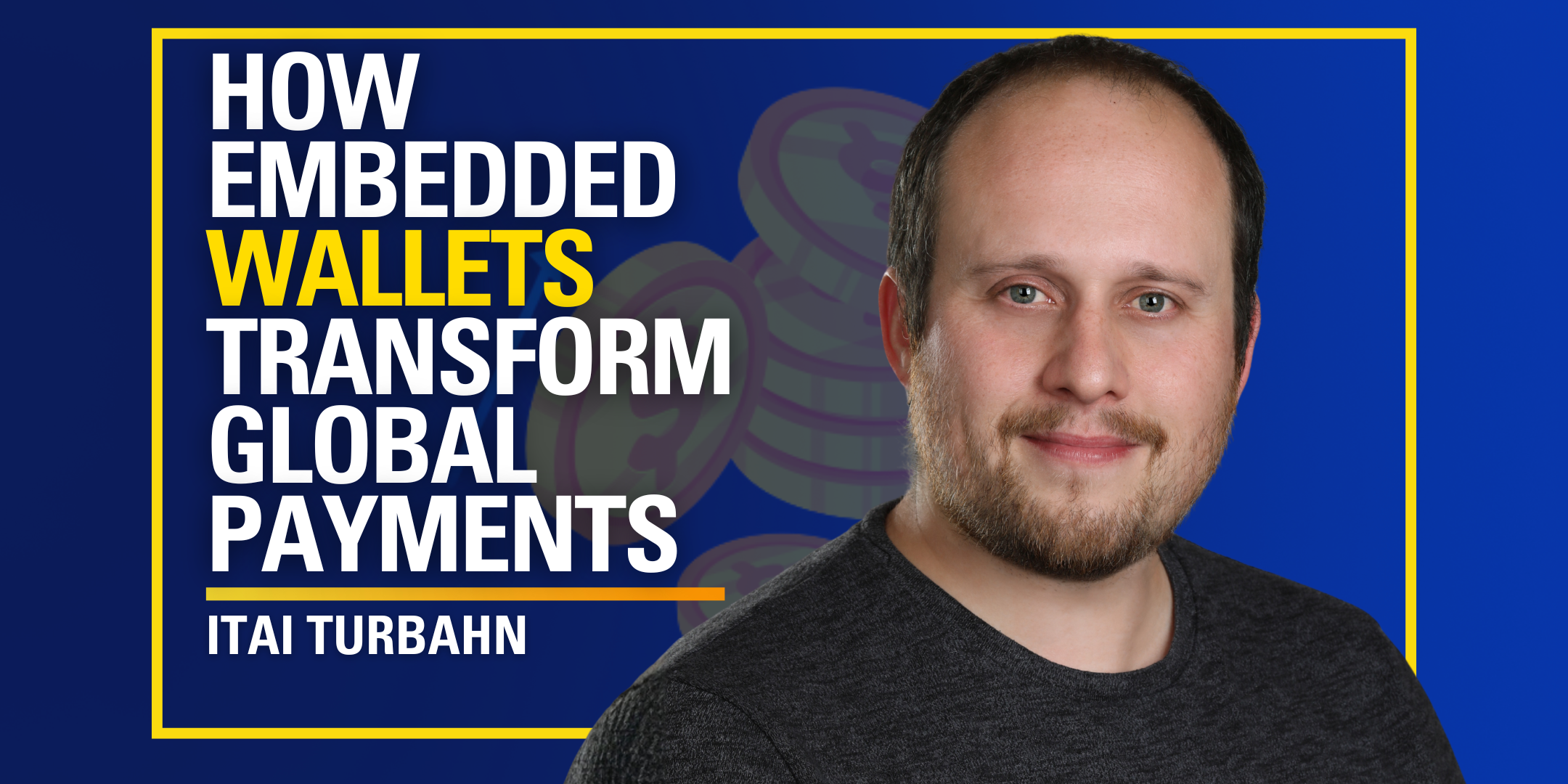
How Embedded Wallets Transform Global Payments - Itai Turbahn | ATC #588
In this episode of the Around The Coin podcast, host Stephen Sargeant sits down with Itai Turbahn, co-founder and CEO of Dynamic, he believes that crypto rails will soon be the invisible infrastructure behind every global transaction, just like the payment systems we use today. And he's building that future through Dynamic, the $21M startup he co-founded with Yoni Goldberg. Meet Itai Turbahn, the MIT-Harvard grad behind the platform already powering millions of wallets, from Kraken to Magic Eden to Stripe integrations, and making it as easy to use on-chain products as it is to log into Netflix.
Host: Stephen Sargeant
Guests: Itai Turbahn
We are also available via:
Buzzsprout • YouTube • Quora • Medium • X • Facebook • LinkedIn • Soundcloud • Apple Podcast • Spotify • Player FM
Episode Transcript
Stephen: This is your host Stephen Sargeant, Around The Coin podcast. We have Itai co-founder and CEO of Dynamic. They were just acquired by fire blocks the one of the hugest acquisitions when it comes to wallet as a service wallet infrastructure. Itai provides us all the details of the different types of wallets, how fire blocks compares to dynamic, the intricacies of wallet infrastructure and the industry including being used for payroll remittances.
Cross-border payments, anything that you can think of where Fiat is involved. Blockchain is coming in digital assets, and he talks about this, the acquisition and his approach from an entrepreneur lens and from a co-founder. And he even gives advice for others. Going through the process of building a company, looking to get acquired or just handling the day-to-day.
This is one of the best episodes. Fun fact Itai was on the Chain Analysis Public key podcast where he's still after three years, one of the most downloaded podcasts, and you're about to find out why in this podcast. Enjoy the show. Reach out to Itai. Look at what dynamic's doing and seeing where you can get involved.
If you're interested in payments, whether you're from the traditional or the crypto side, this is gonna be the most important infrastructure that we see for the next decade at least. Talk soon.
Stephen: This is a special episode of Around The Coin. We have almost like a transitory. We have the biggest episode that we had on the Chain Analysis Public key podcast, which we produced. We have ite co-founder, and CEO of dynamic. You, you hit the headline. You had the top 10 episode after three years of the Chain Analysis podcast. So I'm, I'm glad that we have you here so you can share that energy. Tell us a little bit about yourself, and then we're gonna go into your background and where you started and how you got here.
Itai: Yeah, absolutely. So I, I, I appreciate that. Now I can't, I don't know if I can live up to those, uh, expectations. I might, I might need to add, uh, top 10, uh, China, uh, podcast to my LinkedIn. Uh. LinkedIn profile. Uh, but yeah, I can share, uh, maybe I can share a little bit about to, to your point, uh, you know, uh, my background and then we can dive from there.
Uh, but yeah. Uh, so very quickly, I am originally, uh, born and raised in Israel. Uh, grew up there. Uh, uh, my co-founder and I met at MIT. Uh, we both did our undergrads there. So my co-founder and I have known each other for about. Uh, 19 years at this point, 18 years, uh, so have been, uh, pretty much trying to start companies for a very long time.
And then, uh, you know, have been mostly in product across, uh, IBM and across benefits. Um, went to business school, started a startup, uh, in travel tech. That was a terrible idea. Uh, didn't really work. Uh, don't, don't go into travel. Uh, and then, um, pretty much spent time, mostly product across, across multiple organizations.
Uh, started dynamic at, in late 2021. Uh, and we'll get to it, but really the premise was, um, that uh, when you wake up in the morning and open your phone, every app on your phone will have a wall wallet component to it. So you kind of need a wallet infrastructure, uh, company, uh, to be there.
Stephen: I am curious about is Israel, like there's so much talent, especially outta the cybersecurity tech crypto. I know many people on the podcast come from the unit 80, 80, 200. And as far as Israeli army or military, is there like this ecosystem that just has all, you know, tech peoples are like a huge WhatsApp group.
Is there meetups and conferences?
Itai: Yeah.
Stephen: know, like, what is it, do you feel that you have a little bit of, you know, breadth.
Itai: Yeah.
Stephen: because like there's so many people succeeding out of this camp that you can be like, I can pick up the phone. Is it like the Silicon Valley kind of ecosystem out there in Israel?
Itai: Yeah, very, very much so. Like imagine it. Uh, and I, by the way, just as a good example now, a dynamic joined, uh, firebox entire three weeks ago, and very much, very quickly, I realized I know about 40 people or know, uh, you know, uh, I have friends who are friends of at least 40, 50 people at Firebox. Uh, that I just, you know, didn't even realize.
Right? And so it's a very small community. The reason, by the way, if you think about it, uh, the analogy and you gave the 8,200 unit, uh, which is an army intelligence unit, is an like, as an example. But the analogy is, is pretty much imagine you are to take, um, all the kids that go to Stanford, right? All the kids that go to, uh, MIT or Caltech or whatever.
And instead of sending them there, you do the same trials. You check, you know, you have them go through tests, you have them go through interviews. Instead of sending them to learn for four years, what you do is you put them in a room and give them a bunch of tech and tell them to like run. Right? And so you get like the geekiest folks just sit there for 3, 4, 5 years, uh, with really top of the line tech.
And, uh, and very kind of mission driven, uh, tasks. And so you get a couple things. First, you get. On the job training at very high scale. And second is you get this like really great impact of, uh, kind of, you know, training in, in, uh, growth that they have. And you get to build these like very cohesive type units that work really well.
And so all of that is really what you get, uh, as part of, as part of this entire experience.
Stephen: I'm curious, you know, like switching your LinkedIn profile to add to analysis. think a cool headline would be from Coffee to Crypto. Tell me about how you trans transitioned from come tier, which was disrupting the global market using
Itai: Yeah.
Stephen: and coffee.
I'd love to know about that, especially since I'm assuming every single one of our entrepreneur, professionals, consultants, listeners, uh, probably consume a high amount of coffee on a daily basis.
Itai: Yeah, absolutely. So, uh, my, my, you know, my background is software engineering. I, you know, pretty much spent my, my. Entire life, you know, coding or doing product stuff. But the thing that gets me really excited is it's pretty much not being industry specific, but rather, you know, I, I think there's innovation across everything, right?
And, um. Commenter, which I highly recommend. By the way, I'm a shareholder, so you know, the more people buy the happier I am. Uh, but, um, I highly recommend chatting, uh, folks. Check, uh, checking it out was really this company, it, it still exists and, and is growing, uh, that kind of try to take this. Innovative approach to, to coffee, uh, which was really cool for me because I was like, okay, this is, this is just, just, you know, I, I, you know, everyone kind of loves coffee.
It's, it's, uh, it's a fun, um, place to learn and see how consumers interact. And so I, you know, um, uh, spend some time there mostly on building their digital business and building the global business. And, but for me, it wasn't around coffee. It was around, Hey, can you take this idea? Um, that, and, and, and make it into a, a thing that people consume and people buy and kind of you grow it.
That, that was the thing that was interesting for me. In the same way, the transition to, um, to, uh, crypto was, uh, was more of a kind of coming back home to my roots of software development, uh, versus kind of more experimentational, uh, going, going for coffee. Uh, and so that, that was, it was very much a coming back to where I felt more comfortable with developer tools than, um, you know, trying to sell, uh, coffee online.
Again, highly recommended. If folks don't know what it is, it's pretty much kind of a frozen puck that you get sent into your house on dry ice and you get this phenomenal level coffee.
Stephen: That's cool. I'm gonna, I have to try it out now. At least my wife will try it. For sure. Were you able to leverage the experience? 'cause like I'm assuming the coffee industry is gonna be either highly saturated or highly monopolized by maybe a couple of huge companies. Uh, were you able to leverage some of that experience going into building in the wallet infrastructure space, which at the
Itai: Yeah.
Stephen: Dynamic entered was also, you know, there it was a huge competitive market at that point.
Itai: Yeah, it, it's, uh, the short answer is yes. What you realize, uh, very, very quickly that, that, um, when you get into an industry like coffee is that product doesn't win on its own. You gotta build a brand. And you gotta tell a story as to the impact of that brand and why, uh, someone should purchase from that, right?
Like, it's very hard, right? You have an espresso and you have, um, you know, other, other players. And it's not just the fact that you have a better product doesn't necessarily help you in a lot of ways. Very similar to crypto, right? Like, okay, crypto as a, a way to move money internationally is far superior to traditional rails.
There's no debate, I think on the speed and efficiency and the fact that it kind of just works. Uh, but that's not enough, right? And so you gotta tell a story as to how it impacts or why someone should switch to that. And so in the same way, you realize that very quickly on coffee, which is to your point, an extremely competitive industry, uh, as you can tell, by just leaving your house and going to like, you know.
Down the street and you get like five options. Uh, you gotta tell a similar, you gotta start thinking about it in the same way in crypto, which is brand building and not just a product.
Stephen: I'm curious, you know, like 2023 I think was kind of heralded as like the, the war of the wallets in crypto. Huge players like meta mass, you know, trust wallet. Coinbase wallet was coming in. Can you give us the lay of the land of right now, what is the current state of wallets infrastructure
Itai: Yeah.
Stephen: and maybe how far it's come since the last three years you've been building in it?
Itai: Yeah, so I, I think what we've seen over the last couple years is, is that you really get this like split in the market as to branded wallets and places where crypto is front and center versus wallets in the background where crypto is very much behind the scenes, right? And so historically that split didn't exist three years ago.
And now it's really kind of two industries. And what I mean by that is, on the one hand, you have more and more company, uh, individuals using Coinbase and Meta Mask and Phantom and OKX and Binance, et cetera. And that's how they manage their crypto, right? And what you see there is this rise of pay with crypto, right?
So, uh, Stripe is a good example. If you click, uh, pay with Crypto on Stripe, that runs on dynamic. Uh, you'll see this on, on a bunch of, uh, apps and sites, uh, as well rolling out, and that's about, Hey, I have a branded application that is where I hold my crypto, and now can I use it? So that's one side of the market.
On the other side of the market, what you've seen is this abstraction of crypto, right? So is the concept of why do we need to talk about this at all? It should just be in the background. That's where companies like dynamic and embedded wallets come in, which are to say, look, if I'm building a global remittance app, if I'm moving money globally, if I'm paying payroll to someone in Argentina.
I just want it to work faster, but they don't need to know it's crypto. They don't need to know, uh, that they're using stable coins. But to make that happen, I need a wallet. And they need a wallet. And that's where embedded wallets come in. It's, it's kind of wallets in the background that abstract away complexity.
So really to your question, what happened is you very much still have the wallet wars, but they're kind of, you know, bifurcated into, into a. Front and center, and while it's very much behind the scenes as infrastructure companies fighting versus brand building companies fighting.
Stephen: How did you decide or did that, you know, what you have now with embedded wallets? Did that evolve over time? Like how did you decide what niche you were gonna attack? Did you see a gap in this space with some of the wallet infrastructure? You're like, Hey, I think this feature is the best part of having a wallet as a service provider.
Let's go all in on this feature,
Itai: Yeah.
Stephen: maybe some of the other companies are focused on other features.
Itai: Yeah, so it was very much a, a green space type decision versus, or blue ocean. There's an analogy there somewhere. Uh, uh, blue ocean, green space, you know, whatever it is, uh, decision versus kind of competitive edge decision. The hypothesis for us was pretty much that. Uh, again, if you open your phone and look at every app on your phone, it's gonna need a crypto component.
And that inherently means every crypto transaction starts with a wallet and ends with a wallet, which means that every app on your phone will need a wallet embedded into it. Uh, and so it was very clear to us that that's gonna be a giant market. Right. Similar to how every app on your phone has a login component, so, which is why an auth zero or an Okta or gigantic corporations, or why every app on your phone's gonna have an AI component, which is why you see, uh, you know, uh, chat PT or, or, or API tools, kind of, uh, or cloud API tools blowing up the same way.
The hypothesis was pretty much that you're gonna have those crypto components built in, which made it very clear to us. That you need infrastructure companies to focus on the, on those, and they're going to do very well. Um, so it's much more of an analysis from that lens versus like a, what's our edge type analysis, much more of a what do we think and what do we know the future to be?
Therefore, what tools are missing to build that future?
Stephen: I am curious, when you're talking with investors at the time and you're looking at the tam, the total addressable market of the industry, I remember Michael Groener saying from chain analysis to co-founder, like every company's gonna become a blockchain company. Is
Itai: That's.
Stephen: same kind of methodology or a thought process or ideology you had?
Like, hey. This might only dismount of wallets exist today. But if something like that is true that every company becomes a blockchain company, then you know the space is unlimited. The OSHA gets even bigger.
Itai: That's exactly right. The analogy is very much, you know, uh, if you were there, you know, 150 years ago when, uh, the electricity was starting to make it to homes, really all you needed to think about is, well, is this gonna be in every home? If so, I should be in the business selling outlets, right? Uh, and, and or selling things that you can set up with electricity in your house, right?
The same analogy holds true here, which is if. I fundamentally believe that the way in which money gets moved globally in the next 5, 10, 20 years is based on these far better rails for money movement, uh, that are global first and, and kind of are available 24 7, and everyone can innovate and build it on top of.
Then you have to believe that you should be in the business. Of selling things on top of those financial rails, which is, which is what embedded wallets are and where dynamic plays. Right. And, and we're seeing that. The thing that that was surprising to us is we kept saying it's five years away. It's five years away.
And all of a sudden this year, I think we're probably talking to the vast majority of top. 100, top 1000 FinTech companies were actively implementing wallets into their products, right? So the change here is that now every remittance company, uh, every payroll company, every accounts payable company, accounts receivable company are at not just, you know, thinking about this in the future, but saying, Hey, this can impact my business today.
Let's implement something like dynamic for this today.
Stephen: Your ICP, your avatar went from anyone that touches fiat funds is a possible customer at this stage. You talked a little bit about the fintechs. What was one of the biggest challenges you faced building, especially working with crypto and fintechs that you knew would be difficult, but were still a little surprised about how shockingly hard it would be once you started building.
Itai: Yeah, so we, we, um, it's this really interesting, you know. Part of crypto land because we're moving from being a crypto vertical to being a part of FinTech. And over the last three years, uh, and over the last 10 years or 15 years, but mostly between the last winter and this winter, the focus of all in this kind of crypto summer, the focus was very much on building four crypto companies.
Um, and when you build for crypto companies, when my customers are crypto customers. Uh, then I can explain about gas fees and I can explain about, you know, uh, which chain to choose and zero knowledge proofs. And I can talk about MPC and I can talk about a lot of these concepts, uh, of signing messages versus transactions and, and broadcasting that are very crypto native concepts.
Right? One of the things you realize very quickly is that when you have a developer from a remittance company. They do not care, right? They do not. If you now sit there and have to explain what gas fees are, you have lost the plot, right? And so the big shift and that's happening now is to abstract away all these concepts that I talked about and move them behind, you know, backstage instead of friends and center.
Right. A developer who has never touched crypto should be able to visit dynamic, create an account, and move money globally in five minutes, right? That is what we're going for, and that is the focus is to abstract away that complexity that is currently still a little bit front and center. And completely remove that from the consideration.
The same way that you don't go to Plaid and say, okay, well how do they connect? What technology do they connect to Citi with? And then do they use the same technology for Morgan Stanley and for other, you literally just have it work. And same way you don't go to Twilio and say, well. Do they use a different technology to send WhatsApp versus SMS?
You just say, no, no, no, no. I just wanna send a message to my customer and they take care of that complexity. This is the stage dynamics ad, which is abstracting away more of that complexity, moving in behind the scenes.
Stephen: Are there any elephants in the room when it comes to crypto wallets as it stands here today? Like things that everyone knows in the industry but nobody kind of talks about it. 'cause they're, they're impacted in some way so they don't wanna highlight it to the broader industry. 'cause they might be all running off of like maybe web two infrastructure somewhere.
Is there anything that, you know, people deep down know that there's still an issue with crypto wallets that you're trying to solve?
Itai: I would argue, you know, there are a couple things that, um. I think are getting solved that, that, uh, historically, you know, folks, folks have pushed out a little bit, which are everything around, uh, KYC compliance and money movement, right? At the end of the day, crypto doesn't live in la, la, la. Right. It lives under the same regulations, same compliance of regular FinTech, et cetera, which inherently means that when you are doing custodial solutions, you need to K yc someone.
Even if you're doing non-custodial at times, you want a KYC, uh, and they not does non-custodial solutions because you might wanna create more sophisticated features. Um, I think everything that has to do with compliance has moved from, um, you know, um. Important to now, hey, critical, you're not gonna be able to work with a bank and you're not gonna be able to work with global financial powerhouses unless you start the conversation with how your com, how compliance works, and how money movement works, and how you do a ML and how you do OFAC type controls, et cetera.
And so it's, I wouldn't call it an elephant because I, I think the co uh, the crypto industry is actually. Addressing it in a very fast, very effective way. And I think regulation really helps here on defining the rules of the road. But that is a place where, um, it shifts very quickly to front and center.
Um, you know, in, in, in, in the way in which we do our bus, uh, we conduct our business.
Stephen: I think, you know, the industry for years have been talking about institutional adoption. Well, institutes can only adopt if you're gonna meet certain regulatory requirements. It, so you either can have a libertarian company or a company that's actually a good business model and that can survive. So, I'm curious though, 'cause it seems like compliance. anti-fraud. That's at like the core of your wallet infrastructure. Tell us a little bit about like, you know, why that's so important,
Itai: Yeah.
Stephen: of the emerging threats that you're mitigating for your clients.
Itai: And, and you're right. And by, by the way, uh, one of the reasons we were excited about the firebox uh, acquisition was they are pretty much the top player globally to do this. Right? They secure, you know, um, the vast majority of, of crypto money movement, you know, touches firebox systems in one way or another.
And they have to think about the security at, at global scale, right? They have to think about state actors. Right and securing state actors and that, that was, that was really important for us. Um, because, because you realize very quickly that when you're, um, starting to touch global money movement, then you have to think about a state actor protection.
You have to think about. Extremely sophisticated, uh, actors trying to, trying to kind of, uh, attack you. Uh, and so for us it was very clear that we gotta team up with a company that does this for a living. I mean, the firebox security team was actually bigger than the entire dynamic team, so that made us feel pretty great about.
Kind of this partnership. That's where we spend a lot of our time. A lot of our time is spent on, uh, kind of global infrastructure, efficiency, uh, security, uh, trustless type deployments. That's pretty much where dynamic spends, I would argue, 70, 80% of our time. It's pretty much just getting things right.
Right. You have to, as a dev, if you're a developer and you wanna build your global neobank. My goal is to abstract away that complexity, but also to make sure you sleep at night well at night, knowing that, you know, we're, we're thinking about this every day.
Stephen: And I'm curious, you know, with, you know, talking about
Itai: Okay.
Stephen: but on your website you talk a little bit about. You know, blocking fraud before it starts and deterring bots. Can you maybe give us a high level, a less technical explanation of like, how do you do this? Um, how are, how is this possible and do you think this is like the real thing that needs to be solved when we think about crypto and crypto wallet?
Itai: Yeah, absolutely. So, um, let's say, uh, you are, uh, opening a website. And you want to, uh, move money internationally, right? Uh, the first thing that will happen when you do that is you're gonna get a bunch of, uh, bots to try to attack your website and, and, and move money on, you know, uh, with your systems, right?
And so you're gonna want to detect whether all of a sudden, if your website had a thousand people visiting it, and now it has a hundred thousand or a million. What just happened, right? I give you the tools to do that. I give you the tools to do, um, kind of automatic blocking, right? I give you the tools to check, wait, if someone's moving money, are they sending that money to someone's who's on a sanction list?
Right, uh, which are with the chain now citizen integration that we have. So I give you those tools and I try to give you those tools in a way where you just toggle them on, right? Uh, if you think again about anything finance, you have to think about. Uh, you know, where does that money end up? And I give you some tools, some tools you have to build on your own to, to do that and run that process, uh, as needed.
And that's, that's, we spend a lot of our time there as well. Again, because FinTech is very much tied to, uh, compliance and regulation. And again, we, we provide technology and we provide non-custodial tools, but we also wanna enable you to very quickly kind of build on top of it with your own kind of, uh, regulatory experiences.
Stephen: You mentioned a little bit about how you work underneath Stripe and their kind of like connect the wallet infrastructure. Can you tell me some other use cases? I see Ondo Finance, which is huge. Uh, Kraken. I'm curious like where Kraken, who I am assuming, had their own wallet product. W where do they work with you on that?
Magic Eden, some
Itai: Yeah.
Stephen: that you've been working with. Can you give us a couple of examples of your customers and the use cases where you provide the infrastructure?
Itai: Absolutely. So let's talk about Kraken as a good example. Really there we're seeing is this really cool trend, uh, which is. Uh, the trade, everything trend, right? If I go to Kraken, uh, for my, uh, trading, then I should be able to buy, uh, crypto and I should also be able to buy stocks, and I should also be able to buy prediction markets, and I should also be able to buy mean coins.
And for some of those, you need a custodial solution that Kraken has. But for others, you need a non-custodial wallet to enable you to do stuff that you can't necessarily do in on the custodial side. Right? Uh, it enables you to move faster as a technology company and offer assets, uh, that are directly on chain and the user can interact with directly.
And so in the Kraken use case, what they've done is they've created this really cool inky app, which is, uh, mean Coin trading app, uh, that you download. And when you download that, that actually. Has a dynamic wallet in the backend, you're not gonna see it. You're, you're just gonna log in with your email or your phone or your Apple id and it's just gonna work.
And you're, you can access assets and trade things that you couldn't trade before. Uh, but dynamic would sit there in the background, uh, and kind of power the wallet so that, that is a use case that we're seeing more and more, which are exchanges saying, this is awesome. We would like to, um. We would like to inherently, uh, just offer more assets to our customer.
Base it, it comes into this thesis. I know, apologies for the log monologue on that example, but it comes into this thesis and I think Magic Eden sits there as well, which is, I am your hub for trading. I should be your hub for trading anything. Right. Whether I'm Robinhood, I'm bringing in crypto, or I'm bringing in, uh, you know, stocks, digital stocks internationally or whether I'm cracking, I'm bringing in, uh, kind of, you know, meme coins or prediction markets.
Those are all ways for me, the big player to say, Hey, you're already coming here to trade. Just trade other stuff with me too. Right? So that is one, uh, big use case that we have. Um.
Stephen: And they've already done the hard work of the KYC and the AM L, so they've got the hard part out of the way. So plugging into dynamic to do the transactions is actually probably the easiest part of that
Itai: They, they have to, it. It's this really interesting, I, I think you're exactly right, right? They already have, uh, I, I would argue it's less about the k, uh, uh, KYC and a ML, it's more about the brand building, right? Uh, Kraken is a giant company. They have the brands and they have the employees, uh, sorry, they have the customers.
And now it's about, well, if, if someone's already coming to me and they already know me for, uh, you know, trading. Then I should be able to offer them more tools that let them get access assets that they, they couldn't access before. And for that, you need these non-custodial admitted wallets. Uh, so that is a very, very, very common use case, uh, that we see.
And we see it across, uh, social training, uh, with companies. And we see it across, uh, uh, buying, um, uh, younger companies like Legion is a dynamic customer and they let you. Buy into early stager companies, right? So these are all the investment use case and trading use case. Um, on the other side of this, there's the pay with crypto use case, which is, Hey, I have money in my wallet.
I have Ethereum, or I have Bitcoin, or I have. USTC, can I go anywhere and pay right? And, uh, or can I go anywhere and, and, and trade? Uh, and that's the Onfinance use case, or that's the, uh, Stripe use case or the zero hash use case, which is, Hey, I wanna be able, as a good example, zero Hash has this phenomenal flow with Calci, the prediction market, where if you want to deposit money into Calci, you can click deposit from USDC.
That will pop up zero hash, uh, to do that, right? And so they're building this incredible experience, uh, that allows anyone who has crypto to move it to a prediction market like Calci, right? And those types of companies can leverage dynamic, uh, to build, uh, really cool experiences. So you get this, and again, apologies to listeners for an extremely long monologue.
Of dynamic customers, but you get anywhere from the trading apps to the, um, kind of the pay with crypto all the way to gaming or to kind of experiences, uh, around NFTs and, and around, uh, uh, RWA. So it's a good, uh, maybe just one last example for the longest monologue of all time, uh, we work with, uh, a company called Frank Shaw, which is a steel, uh, manufacturer, and you can go in and buy steel.
You can, you get tokens for steel and you can exchange them for physical steel or you can invest in steel. So, uh, it's about exposing to more asset classes that you couldn't get before. Yeah.
Stephen: I don't think it's a long monologue. I think I, I appreciate, 'cause I think wallets, crypto addresses, they get bucketed all into like one thing, like all encompassing, especially it depends on where you're getting your information, whether it's TikTok, whether it's a round table at in Basel, like. Everything gets lumped together.
So that's why I really wanted to ask you like, what's the separation? What are the specific use cases? How does the infrastructure work? Because I think that's important for people trying to get into the, you know, into the industry and just understand exactly what's happening with wallets. I'm curious, we talked about every company being a blockchain company, but there's this notion of like, we have one wallet for everything.
Whether we wanna buy a meme Coin, sell an NFT, make a purchase at a grocery store, trade in fiat. Do you see this like one wallet that rules 'em all scenario? And how would dynamic be like the leader or at the forefront of that evolution in society?
Itai: I very much don't see a one wallet rule them all. I, I, I kind of think that, um, there's too much at, at stake for folks to lose this fight. Meaning in the same way that you don't just see login with Google, but you see login with Google and log in with Apple and login with Facebook and uh, log in with email and GitHub, et cetera, right?
You're gonna see the same thing with wallets. Every company is gonna wanna own your identity. Right. Uh, and wallets are a key part of that. So you're gonna see login with Coinbase and login with Kraken, log in with others, right? They all will want to own this identity, um, for you to create an experience.
So I don't think there's a winner take all, but I do think that there's a difference between owning the technology and owning the brand. Right. These are brand competing companies. Uh, I am an infrastructure provider, so I'm very much hoping that whatever brand you choose, it actually leverages dynamic in the background.
Um, there's a second use case by the way, which is, is the, I don't care about crypto use case, right? While it's in the background, right? So when I'm doing international remittance, uh, those will all have wallets, right? If I'm sending money from the US to someone in Argentina. I will have a wallet. The person in Argentina will have a wallet, but we're not gonna even know the brand.
It's just gonna be, um, you know, the, the western unions of the world and money grabs of the world in which you leverage, uh, these, uh, money movements without really knowing it's crypto, right? So there's the crypto front and center where you need a brand. And again, crypto in the background where you don't.
Stephen: I'm curious, we can't have a conversation today or any day without talking about stable coins. You wrote the playbook on stable coins or at least how to build stable Coin apps in 2025. Can you share some high levels points from this playbook? It was well received by the industry, especially 'cause everyone wanted to build anything that had to do with stable coins.
Um, you taught even how to build the tech stack and the rise of stable Coin chains. I would love to hear your insights from that playbook.
Itai: Yeah, absolutely. So there, there, there are a couple key ones. First, by the way, I, I, while why, while I posted about the playbook, our great marketing team actually, uh, and our product team actually wrote a bunch of the playbook. So the, the credit can, uh, can't really go to me, uh, you know, on that front I am nothing but humble.
You know, a distributor of, of, uh, some, uh, phenomenal team, team, uh, members work. Uh, but in, in short, really what we write is, is the following, which is when. Today we have companies like Revolut and Newbank and SoFi and others, and they are all these massive global, uh, consumer neobanks and consumer money movement apps and Cash app, et cetera.
And they all started Region first, right? Because the rails existed Region first, right? Cash App is a US based company. Venmo us, right? Rev Revolution. Europe, right? Newbank, Brazil. They all started, uh, region first. The hypothesis is that the next set of new banks, the next set of cash movement apps, uh, are all gonna start global First.
Right, because they are gonna leverage these crypto rails to build these global first experiences. Global First Neobanks. Uh, we have a company like Endo that does this, right? Um, global first experiences for payment like Suku, which is a dynamic customer that does this. And so they're gonna, they're gonna move or offer.
Which does this, they're all gonna start, you're gonna get the next set of multi-billion dollar companies that are gonna build the next revolut and the next new banks and the next SoFi that are gonna build, build them on top of, uh, kind of stablecoin rails, right? And so what our report does is it says, okay, let me give you the playbook for how you do that.
You need to choose a chain. You need to choose a better wallets. You need to choose whether you offer yield like cards, uh, like, uh, a rain card or yx or anything like that. You can offer, um, savings on, uh, the, the accounts, et cetera. We give you the full stack. For how to get to a point where you can build your own next Neobank, or you can build your own next Cash app or Venmo and instead of it taking years and being region first, you can do it in weeks and months.
That's what this, uh, report's about. That's, that's really what we're trying to do. We're giving you the guide to do that.
Stephen: You've talked about so many use cases on how you're integrating the Dynamic Wallet. Is there any use cases that you're surprised haven't caught on, or any industries where you're like, oh, they should be using this technology more? Like, I know supply chain was one of the early industries. Now you're talking about payroll and payments.
Is there any industries that you're like, oh, I, not catching on as quickly as I thought it would.
Itai: Yeah, I think the, the one that. I think was a little bit too early and I'm willing to bet it is gonna come back is everything real world assets. So, um, you know, there's this really cool set of. Companies that tokenize things that are off chain, right? That are offline. So again, steel as an example, or silver or anything like that.
Or housing and putting them online, right? Making a a, um, um, making an asset that is illiquid more liquid for trading. Right. Uh, these are a set of really cool companies because really they let you gain, gain access to assets that you couldn't trade before. The reason they were early is because it's really hard to create a full kind of brand around those, right.
So you, it's really hard to go and be like, okay, let me find a company that Tokenizes Steel. Right. But now with these Trade Everything apps, when you have the Robin Hoods and the Coin Bases and the Krakens, et cetera, uh, be in a place where you log in, you can buy everything, then all of a sudden. Exposing real world assets and letting you buy those makes a lot of sense because you're in the same trading platform that you use for prediction markets and for others.
And so what I'm hoping is that a lot of these things that, you know, couldn't exist. Not because they're not good ideas, but because distributions are, can now exist in this world of embedded wallets and trade everything type apps. Uh, so that's, that's both my, uh, thing that surprised me and, and one kind of bet.
That I have, uh, you know, with a caveat that I'm, I'm, I'm usually wrong when bits
Stephen: And real world assets is that it was hyped at the start, right before stable coins. That was the, the biggest hype.
Itai: yeah.
Stephen: hype, like when we talk about NFTs and meme coins, how do you, I'm sure there's a lot of companies that want you to, that build something very customized or build in, you know, their arena of what they're trying to do. How does you and the team decide on like, Hey, this is, you know, this is sustainable. Let's build an infrastructure here for fintechs or NFTs. Like how do you decide what project that you wanna focus on and not just about the hype at, at the minute that people are coming to you? You know, see that meme with the, the handout with money, people coming to you and saying,
Itai: Yeah.
Stephen: can you build this for me right now?
'cause it's hot.
Itai: Yeah. We, we very much do it based on what we believe is true about the future. Right? Do we believe that? Um, you know, in, really the question we ask ourselves is, do we believe that in three years. It's gonna take you five days or three days, or, or you're gonna wait the weekend because the banks don't work, uh, to move money internationally.
Right? And, and the answer is no, you're not. There's no scenario in which in three or five years we're gonna be there and be like, oh, I want, I need to pay you. But, uh, the banks close. You know, there's no, that doesn't it, it doesn't, it wouldn't exist, right? And it wouldn't exist where I say, Hey, you're, you're in, you know, uh, uh, you're in Brazil, then it's gonna take me two days to send you money.
Those scenarios are gonna go away, right? And if I am in, uh, the Philippines, uh, the scenario in which I can get 1% yield on my money and there's inflation, but in the US they can get 5% yield on my money and there's no inflation, those are all gonna go away, right? They, there issue, there issues that, um, are not gonna exist in five to 10 years, right?
And so really we think about, okay, what are the tools to solve those? What do we need to build? To enable companies to solve these problems and is. Are the tools, are the products we're building helping solve these problems, right? That's really how we structure the roadmap. It's more about, okay, what do we believe about the future and what tool sets and infrastructure and financial infrastructure would company need companies need in order to build that future?
Uh, that is the dynamic roadmap. That's what you're gonna see me build over next year or two is really abstraction of that complexity more and more.
Stephen: Can you tell me a little bit about the acquisition with Fire Blocks? Not just from like, Hey, we got acquired. That's amazing. We have so many founders, entrepreneurs, and startups that listen to these episodes. What was your approach as a co-founder? What was your decision tree or your de decision modeling of like, Hey, we could partner with them, like what was the benefit of an acquihire or acquisition versus just partnering with them and having them as part of your ecosystem?
Because I think there's a lot of builders in this space. Their dream outcome is to be acquired by a juggernaut, like fire blocks. But I'm assuming there's, you know, a lot of thought process that goes in it. I'd love for you to walk us through anything that you're carrying to share.
Itai: Yeah, it's, it's, uh. It's definitely a non, non straightforward kind of decision tree, right? Because there's a lot of trade-offs and, and when, when you build something, it's very much your baby, right? Um, the key question we, uh, had, uh, you know, dynamic is doing extremely well as a company and I think we're, uh, have, have grown, uh, you know, uh, multiple xs uh, over the last, uh, year.
And so the decision for us was, um, very much. Do we think there's a bigger pie if we partner? Do we think, for lack of an apologies, you know, for this analogy, because I hate it and yet I'm gonna say it, which is, do we think there's a one plus one equals 5,000 here? Right? And it was very clear to us, and we've known the firebox team for about four years.
So we've known the firebox team pretty much a month after we started Dynamics is the first time I talked to the CEO of Firebox to Mike. Um, it was very clear to us that this is the thing that accelerates dynamic and gets us in front of everyone, right? Uh, and both we can contribute to firebox in that sense.
And firebox contributed to dynamic growth in that sense. And once that was clear and once it was very clear to us, given that we've known the firebox team for so long, that this is a very good culture fit to do that. It made the decision pretty straightforward. And we see it, you know, we see it on a, on a, on a day-to-day basis.
The types of customers that we, uh, get to interact with now and help now are these incredible companies, uh, that were in better, better positioned to, to help and empower now than we were before. Five bucks, right? So it made the decision very straightforward in that sense.
Stephen: From the outside looking in fire blocks and dynamic would be seen as competitors in the wallet space. Is that accurate or is there just, there was some overlap but their core business wasn't impacting your core
Itai: Yeah.
Stephen: Or with like, 'cause I know they do MPC, you kind of like divide out exactly where the overlap was and what their focus was compared to your focus and how friendly you were at the start.
Itai: Absolutely. So, uh, this, I think the firebox dynamic deal is one of those rare deals that is extremely complimentary to each other, right? Think about firebox and dynamic as two sides of the same Coin. So let's take a remittance example. Um, right. A remittance company is an example. I am, uh, a remittance company.
I wanna be able to send money from the US to the Philippines, right? Uh, for that you need a following. You need, uh, an omnibus wallet in the US where you as the company, you as the remittance company, can manage funds for your users and can send funds out. That is fireball bread and butter. That's what they do for a living, right?
Uh, but where do you send that money out? You need to create these non-custodial embedded wallets on the other side for every customer in the Philippines that they receive money. That is dynamic. That's what we do for a living. Together you can give a remittance company this full end-to-end flow from treasury management and omnibus accounts all the way to, uh, these noncustodial wallet.
This is a second example. We talked about the Trade Everything app. If you go to any exchange, they have five blocks based omnibus accounts where the exchange is managed, their custodial accounts, but then all of a sudden they wanna be able to trade other assets. So they need non-custodial wallets by dynamic.
So that combination is this killer combination because it lets you as a exchange, as a remittance company, as a payroll company to have a single place where you get the full experience, whether it's custodial or non-custodial. So it worked extremely well as this like full end-to-end solution that we can provide customers, uh, who are already happy firebox customers or happy dynamic customers to, to solve their issue of like.
Five vendors or different technologies, it just kind of works together.
Stephen: I love that. 'cause fire block customers get, you know, broader access using your infrastructure and your customers get to be part of the ecosystem of fire block's customers,
Itai: That's right.
Stephen: of the biggest in the industry. I, I think the last count they had like 1600 of the top companies, you know, working with fire blocks and that's probably the last time I looked a couple years ago.
I, I think with stable coins blowing up, I can only imagine how, how outdated that number is.
Itai: Yeah, yeah, yeah. Uh, that, that's, that, that was the thing that we got very excited about is, is, um, the fire blocks team, again, both on the cultural side, is, is a phenomenally good fit for. For, for us at Dynamic, uh, and we are extremely aligned. We get to talk to, uh, ox as co-founders on a day-to-day basis. And, and we, we have a fun time daily when we do so, but it was also, uh, extremely aligned on the types of customers who were, we're servicing and trying to kind of, uh, reduce complexity for it.
So it was, it, it, it worked extremely well.
Stephen: Any advice for founders? You've built a business, you know, you're raising money, you're getting acquired, any, was there any common thread through all that that you needed as a characteristic as a founder? And then obviously, you know, you have other shareholders and you have other parties that are involved, including your co-founders, and you're
Itai: Yeah.
Stephen: first couple hires of the company.
Uh, what's it like going through that whole process and any advice for anyone at any stage of that process today?
Itai: Yeah. So in, in general, I would say, and, you know, take it as the one data point, uh, because, uh, what I've learned is that, uh, uh, founder advice is, is is relevant for that founder, right? And, and everyone runs their business in a different way. Um, I think the thing that worked, um, for me is pretty much a combination of, of two key things, which is focus on customers.
Focus on customers. If, if your customers are happy and they are growing with you and they tell you and listen to them and they tell you what they want, uh, that is, that is a huge plus. We are in an extremely fortunate position where we wake up in the morning every morning to dozens, if not more slack messages from customers with feature requests, with questions.
And that is a huge positive, uh, for how to build a business. And so I would argue that is my one advice, is focus on customers. Talk to your customers. I talk to our customers. 20, 30 times a day. Right? That is, that is the killer way to build kind of a good product is to just, um, um, see what people need, what their pain points are and try to solve them.
The second thing on advice that I would say is, is startups are this roller coaster of daily emotion. Okay. Uh, you wake up in the morning and you see a customer that, you know, uh, might be shutting down their business, right? And they need to, um, kind of, uh, close, close their account, and then you sign a, a giant, uh, deal, 10 minutes later.
Then you see a press release, uh, from someone. And these are rollercoasters of emotion. And the best way to handle those is not to get too excited when something good happens, and not to get too sad when something bad happens, and just run the course on the fundamental belief of what you think the world should look like and run the hypothesis of what you need to build to get to that.
Um, as long as you do those, uh, and, uh, have a very long time horizon, then uh, you're in a good spot. So that's the combination of, of, of my humble advice, you know, with one data point, uh, that might be wrong, but, but hopefully, uh, the minimum it's helpful for, for folks.
Stephen: I listened to a podcast called Founders that talks about the great, you know, world's greatest entrepreneurs in the past, and that that customer thing seems to make a lot of sense of where the success comes from most of them, uh, as we end the podcast. I'm curious, is there any feature requests that you can share that customers are asking for now, or any recent ones that you've implemented?
Because the demand for it was so high.
Itai: Yeah, we, we, um, have spent a lot of time on a new feature called delegated access. And what that is, is really a feature around automations. So let's say you're building a trading bot, right? You wanna trade on behalf of the user, right? Uh, the user is there, they sign transactions all great, but what if they wanna sell something in a day, uh, when it hits a thousand?
Can you automate that in a non-custodial? So we built this feature called delegated access or automations, which lets you, uh, as an end user approve, uh, a developer doing, taking certain actions on your behalf, uh, that you can revoke access to, but you can kind of control, uh, more nuanced settings and more nuanced policies around.
That is a feature we're extremely excited about because it gives you the ability. Uh, to, to kind of, you know, help users with actions they wanna take. That, that are asynchronous incentive of synchronous, that is a feature that was just rolled out. Uh, it's in beta, so if anyone wants access to it and wants to play around with this concept of delegated access or automations, that's, that's a place where we're spending our time.
Besides that, um, you know, we have spent our time over the last couple months in just getting the basics right, so abstracting away. Any complexity. So if now you're a, a non crypto company, if you are again, payroll or, um, you know, accounts payable or anything like that, um, you know, we're building some features for you.
So just, you know, reach out to us. Uh, you'll probably there some of our secret, but, uh, uh, you'll probably see some stuff that you like and abstract away complexity.
Stephen: I love that. And that's, you know, to your point about focusing on the customers, especially those new to crypto, I'm, I'm assuming that's highly beneficial. You talked a little bit about automation. How much are you using ai, um, whether it's workflow daily, operationally, whether it's part of your, your tech or dev stack.
How much are you using AI within dynamic?
Itai: AI is a, is obviously a big part of how I think companies should be built today. Uh, we use them across, um, we, we use them as tools across, uh, multiple parts of our stack, right? Anywhere from helping developers move faster to helping marketing, to helping sales, uh, you know. It is, it is a tool just like any other tool in your or, or in your kind of inbox of tools.
Uh, meaning you have to learn how to use it. But on a day-to-day basis, I, I probably touch five to 10 AI tools, and I would argue, you know, our team does the same. Uh, you know, I, I very much have this hypothesis where the next set of companies are gonna be one person billion dollar businesses. Uh, and we're getting closer and closer to that dynamic is a, you know, uh, is a small company, uh, in terms of people, but mighty in terms of kind of, uh, the output.
And that's a result of, of phenomenal, you know, uh, 10 x engineers, but also, uh, great use of tools across ai.
Stephen: Is there a particular tool that you think that nobody really talks about? Maybe it doesn't do anything crazy for the everyday retail consumer, but you're like, oh man, I, I live by this. It's fun. Whether it's like a, a tool to use your own personal financial accounting. Like is there any tool that you're using that like, this is pretty cool stuff.
Itai: Yeah, I, I, I actually, that's a good question. I don't know that I, um, have anything there. I am pretty basic in my usage of, uh, you know, uh, two primary tools. That I'm a big fan of, and I think actually work, which are, uh, cursor for coding, uh, Devon for coding as well. So three tools. Sorry, when I lied, when I said two.
It's really three, uh, cursor for coding, Devon for co, for coding and agents. And I, I honestly, I'm just like a, you know, a a a Chachi PT fanboy. I, I try, uh, Gemini, uh, you know, once a week to see whether I'm wrong. And I try Claude once every two weeks. To see whether I'm wrong, try perplexity once every couple weeks, but I come back to it and I specifically very much enjoy.
Maybe this is a sub tool. I very much enjoy voice mode in chat. Gt I take my dog for walks and when I do, I just chat strategy for 30 minutes, uh, with the chat agent, I just talk about, uh, talk about it just like I would, uh, an expert and, uh, that, that, that usually helps me think. Uh, about kind of a new set of ideas every week.
Stephen: I love that this has been such a great episode. One of my favorite. Now we can see the people that listening to this epi could see why you topped the charts on the chain analysis public key episode. Great energy, so much knowledge, concise answers about everything. This is probably the, you know, per second value.
This is the highest we've reached on Around The Coin 'cause it's been one of our shorter episodes, but with so much value, I have to think of more questions to ask 'cause I'm like, I don't want this to end. Thank you so much. Where's the best place people can find you?
Itai: Yeah, so easiest place first. I appreciate that. Uh, I, I, uh, you have raised my, uh, morale for, for the day, so I'm gonna walk around and tell people. Uh, I'm podcast famous. Much appreciated. But, uh, in short, uh, you can find dynamic on dynamic.xyz. Uh, you can obviously go to firebox.com and, and, and look at dynamic there as well.
Uh, we're at Twitter @dynamic_xyz. My Twitter handle is just my last name, turban, T-U-R-B-A-H-N. Um, check out our blogs. We have a couple more cool PDF reports coming out. Uh, so all that is coming out in November and December. Uh, highly recommended, uh, and we're in all the conferences, so if you're in a conference we're, uh, in crypto or FinTech, we're probably there.
So just come find us.
Stephen: And that's stablecoin playbook. Like I'm not big on stable coins in tech, but that was a really cool read. So
Itai: I appreciate it.
Stephen: I implore those that are listening to this episode. Go check it out. Couple pictures in there too to help out. Couple a couple images.
Itai: I appreciate it. Yeah, yeah. It's a, it's a long read, but it's worth it.
Stephen: Thanks so much.
Itai: Thanks. Bye.
.png)