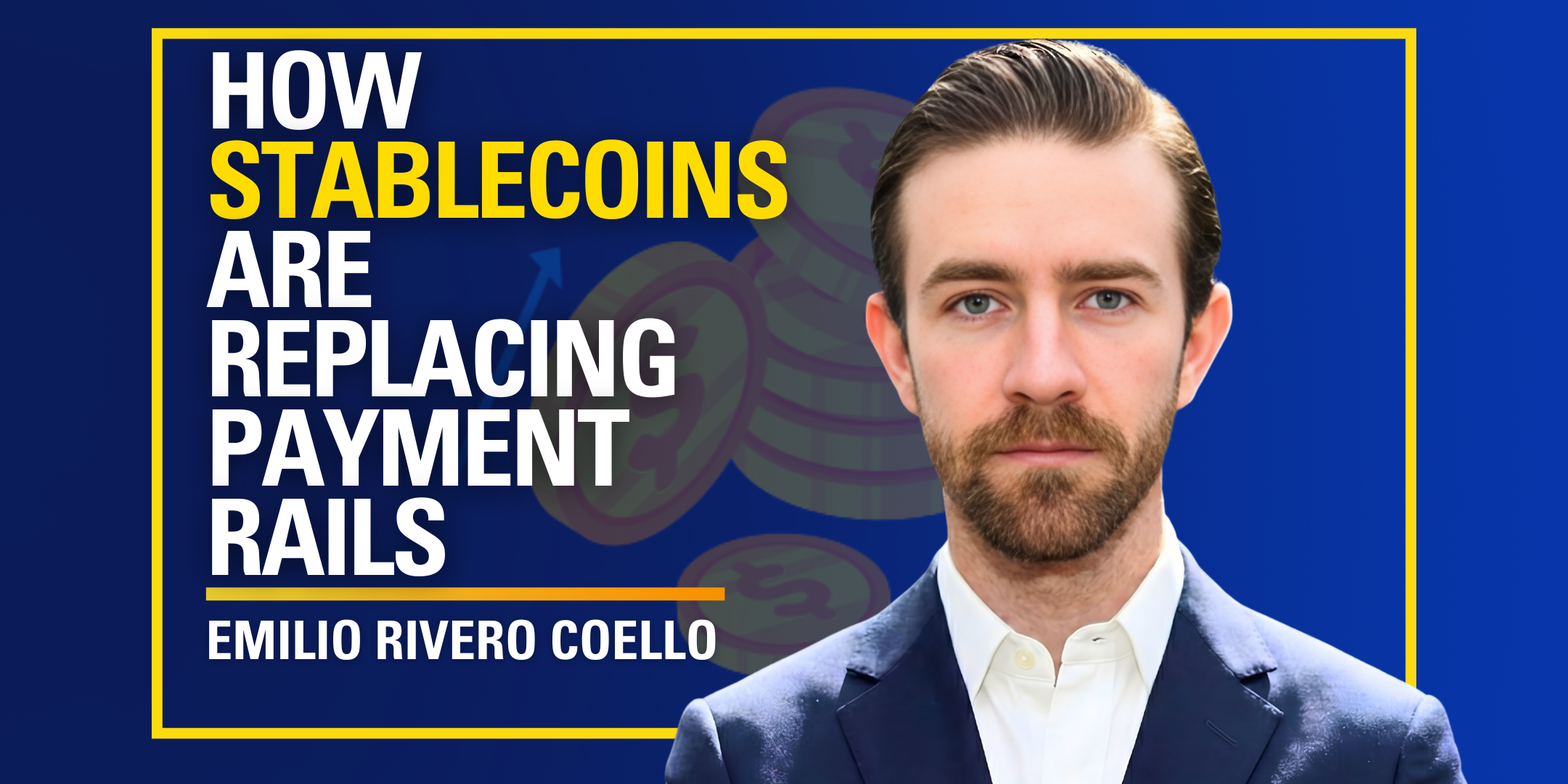
How Stablecoins Are Replacing Payment Rails - Emilio Rivero Coello | ATC #591
Join host Stephen Sargeant as he sits down with Emilio Rivero Coello a leading product manager at Aptos Labs. Emilio is a seasoned product manager currently leading payments at Aptos Labs since December 2024. Previously, Emilio served as Head of Product for Stablecoins and Head of Business Execution at Bitso from June 2023 until December 2024. Additionally, Emilio's experience includes a summer internship at QED Investors and various roles at Bitso focusing on public policy and regulation. Emilio co-founded and hosted the Tripeando Podcast from December 2018 to June 2021, and provided advisory support to prominent political figures in Mexico. Emilio earned an MBA from Harvard Business School, an MS in Finance from the Instituto Tecnológico Autónomo de México, and a BA in Economics from the same institution, complemented by summer school programs at notable universities.
Host: Stephen Sargeant
Guests: Emilio Rivero Coello
We are also available via:
Buzzsprout • YouTube • Quora • Medium • X • Facebook • LinkedIn • Soundcloud • Apple Podcast • Spotify • Player FM
Episode Transcript
Stephen: This is your host, Stephen Sargeant. We were lucky enough to pull one of the best people for product management at Aptos Blockchain. That's handling everything payments, stable Coin. We have Emilio Coello. He takes years of experience working for one of the largest latam crypto exchanges at Bitso, where he was doing regulatory and policy work, and he is now building the features that we're seeing at one of the fastest blockchains out there, the Aptos blockchain.
He's talking all about payments. What makes Optos such a competitive advantage over some of the other L one blockchains? Some of the interesting things that they're building, especially around financial institutions and tradify getting into the digital asset space. We touch a little bit on DeFi, a little bit on RWA.
We spend a lot of time talking about on chain compliance, regulatory requirements. This is such an amazing episode. You very rarely get to talk to product people about what's driving the stable Coin adoption and crypto payments around the world. And we are lucky enough to bring 'em on their Around The Coin.
And I know you're gonna enjoy this podcast. Stay tuned, love it, like it, and let me know what you think or if you have any questions on who our next guest should be. Talk soon.
Stephen: This is your host, Stephen Sargeant. They're Around The Coin Podcast. We have Emilio Coello, he's a product manager handling everything payments at Aptos Labs. Emilio, welcome to the pod.
Emilio: Thank you so much, Stephen. It's, it's exciting to be here. Thank you for having me.
Stephen: Can you share a little bit about your background? I wanna talk actually, 'cause you've been in crypto very early since 2017. You've been working on some interesting positions. But one of those was like before Crypto was the advisor to the Minister of Finance and Public Credit, and that was, I believe, in Mexico City.
Can you share a little bit about what you were working on? Was there any discussions around FinTech or open banking or digital assets technology back at that time?
Emilio: I, I love that question. I was not expecting it, but actually the response, the very quick answer is yes. Uh, back when I was working in the minister's team, there was a FinTech law being enacted. Uh, it was being drafted by Congress, the Senate, and the Ministry of Finance. So I had an opportunity of, of reviewing what the FinTech framework, basically regulating two structures, which were e e-money institutions and crowdfunding and digital assets was gonna fall under that regular storage structure.
That that's the first time I got to see from a first lens what regulation was gonna look like for Mexico. And this was all being, uh, drafted, negotiated between the private sector, public sector, and. When I joined my, my first crypto company in 2018, the framework came into, into existence. It was enacted, approved by Congress, by Senate.
So it gave me a very good opportunity of understanding what was gonna happen and how we were gonna have to deal with, uh, trying to become one of the first licensed crypto companies in in the country.
Stephen: We hear a lot about Argentina, Brazil, especially with some of their emerging regulations. Where do you think Mexico has landed over the last almost decade since enacting some of those rules and, you know, guidelines and guardrails that they were back then to where they land now? You know, when it comes to digital assets in the Latin region.
Emilio: So Mexico was very forward thinking in 2018 when they were thinking about creating this regulatory structure for digital assets. Um, there was some complexities with the secondary regulation that the Central Bank sort of implemented that sort of restricted the overall, um, applicability of the framework for digital asset companies.
And at the same time, you had the Financial Action Task force releasing some of their recommendations for how to regulate and treat, uh, virtual asset service providers. Um, so this was all happening in 20 18, 20 19, and most of the countries in in Latin America and, and, and the region were very behind thinking like, how are we actually gonna implement this?
And I think what quickly happened is that. They realized there was a competitive advantage on having virtual asset service provider friendly frameworks. So a lot of countries started to implement, um, the vast framework for registering the operations of entities that were dealing with digital assets. Um, so a lot of countries very quickly caught up to speed.
Mexico was, uh, forward thinking at its time, but then I think as you mentioned, Argentina, Colombia, Brazil, they all did a huge effort in making sure they had either sandboxes, regulatory environments, uh, frameworks that were gonna allow for entrepreneurs to start, um, creating companies that we're gonna deal with that.
And we're talking 20 19, 20 20, 20 21. Um, I mean, it's still not as friendly as the UA, uh, USA has become, or Europe, with the clarity that some of the newer frameworks have given, but it's getting there.
Stephen: Well, it took USAA long time too, so Mexico shouldn't, shouldn't really worry. Uh, considering, you know, SEN was already considering pretty much crypto companies, uh, needing to do a ML from like, you know, 2015 and onward. Uh, you spend a fair time at Bitso, which is one of the largest exchanges in Latin America.
Uh, what were some of the right, you were working on the regulatory side, the policy side. What were some of the challenges, especially 'cause you saw the emergence of these regulations from the public sector side. What were some of the challenges and hurdles that you dealt with, uh, while you were focused on stable coins over the last three years before you moved to opt those?
Emilio: So when I first joined Bitso, it was very unclear what the difference was gonna be for operating the local Thea operations of an entity and the crypto operations of an entity. Um, and that very nuanced relationship between. Crypto assets and fiat assets, which are very common now, right? Exchanges e everywhere in the world have like this fiat pairs against crypto and like how you treat crypto.
And that was very, very unclear. So we had to have hundreds of conversations with regulators, uh, the central bank, the local securities regulator, the Ministry of Finance on how we were planning on, on structuring that, how we were planning on making sure that we were gonna be able to comply with, um, the requirements that financial regulation had, even though.
There was not necessarily a sui generalities regulation for crypto assets. It, it was kind of complicated. So navigating that was extremely complicated, tiring, and there was a lot of back and forth and we were not even dealing with stable coins back then. Uh, like if you remember when stable coins really started taking off was around 2020.
2021 when the market cap of Tether and USDC started to increase. But before that, we were dealing with, um. Assets like Bitcoin, uh, XRP, Ethereum. And then once stable coins, uh, started to start to play a more important role, it started to become a little bit clearer for regulators, uh, how to start treating some of those assets.
Um, so the job became a little bit easier, uh, because regulators understood better what type of things mattered. For example, the reserve backing of the assets, how you were, were gonna be managing those reserves, publishing at the station reports. And it was easier for them to understand the type of operations you were doing, um, when it meant you were dealing with a stable Coin directly.
So.
Stephen: And I think stable coins have kind of evolved, right? There was such a bad reputation around stable coins and what was backed by Tether. And then you had the Terra Luna debacle. So stable coins, you know, just like any other digital asset went through its ups and downs. And I think once you start looking at from the other side and seeing that, you know, a lot of this, you know, investment in stable coins into things like digital treasury bills, et cetera.
If I had to, before we get into Aptos, I'd love to ask our guests, gimme the lay of the land, like you're on stage right now at the biggest crypto and regulatory conference in the world. What is your state of crypto payments and stable coins that you see as of today before we go into 2026?
Emilio: Well, what I've, I'm seeing right now, 2025, is that we're crossing trillions in volume, um, on stable coins only, which is very, very impressive, right? Like stable growing volume is competing against the volumes that we see in card networks that we see in local payment systems. The market cap has exploded to 250 billion plus, um, in supply.
So what I think is gonna continue happening is one, those volumes are just gonna continue to grow exponentially as more and more institutions start to adopt stable coins. Two is market cap is gonna continue increasing. And I have a very strong thesis that non USD stable coins, uh, backed by other fi currencies, are gonna become the connectivity tissue between the local payment systems and the on chain economy.
So I see a lot of potential growth in, in those areas. They have different use cases as USD steel coins, but I do see that that is going to very quickly become the standard for, for institutions operating, uh, on chain.
Stephen: Can you share your thoughts about, you guys have a stable Coin as well on the Aptos blockchain. I wanna jump in, let's just maybe jump into what is Aptos first, and then we'll dive into USD one and the stable Coin that you're bringing to the ecosystem. But if you can share, like, you know, it's a layer one blockchain.
It seems like you guys are always focused on things like performance and consumer grade applications, which seems perfect in the kind of situation that we're in the digital asset industry. You feel, I think you're well positioned right now, but explain what Aptos is and what makes it desirable to users.
There's a lot of L one blockchains out there. Why are people coming to Aptos versus others or along with maybe some other blockchains in the ecosystem?
Emilio: Absolutely. Um, as you mentioned, Aptos is a layer one blockchain and the infrastructure and technology is optimized and constantly being improved with all. Objective of making sure it's institutional grade and ready for institutional grade applications. We're always trying to optimize how can we reduce the cost of operating, uh, on, on transactions.
Meaning how can we make sure that the gas fees and the transaction costs are as low as possible? How can we make sure that the finality and, and the latency of the network is as low as possible? And how can we make sure that the capacity and throughput of the network is as high as possible? So if you think about Aptos, Aptos is always number one in all of those metrics.
And, and we are very proud of that because it means that we can start having conversations with institutions that are thinking about mass adoption and scaling this to billions of consumers, right? And when you think about how can you actually make. That happened. It has to be in a high throughput, low cost, um, and instant settlement, uh, blockchain.
So we're very proud of the technology and the infrastructure that we've built. And obviously one of the biggest applications that we're seeing is stable Coin and, and money movement on chain.
Stephen: I am actually curious, you know, when I think about blockchains, when you mentioned a couple of their metrics there, you as a product person, is there a certain metric that, you know, like keeps you up at night maybe versus the rest of your product team? Like what's the one thing that like, looks like success for you?
Obviously, you know, with so many features, you're leading in many of those features. Uh, but what's the one dearest to your heart where you're like, Hey, I know we have to do great and all, but this is the one that like we really need to spend our time focused on.
Emilio: That's a great question. If you ask our infrastructure team or our cryptography team, they're always thinking about how can we reduce block time settlement times like they're optimizing for very specific technical metrics. Um, me as a product manager, I'm constantly thinking, how can we increase transaction count?
How can we increase market cap supply of stable coins on aptos? How can we increase assets under management or, or token, uh, stablecoin supply on chain, and how can we increase the number of use cases and applications using steel coins, uh, on our network? So those are the main metrics I'm following every day.
Um, every single, uh, week. I'm constantly monitoring, uh, to see what type of partnerships do, do we want to close, what type of products can we build that can have an positive impact on those metrics. And we're all. Working towards, like increasing those metrics, at least on the payments and the financial institution side of things?
Stephen: You know what's interesting about Aptos is I believe they were founded by former engineers of Facebook, Libra. Now Meta, it used to be called DM Novi, whatever you wanna name the project, which you know, got canceled. But technically it's basically the same, you know, concept that we're working with today in stable coins.
How do you know, you think the founders approach building Aptos with kind of that in the back of their mind? Was it like build, you know, towards eventually that being the use case, even though it didn't work out for Facebook?
Emilio: Yes. I, I mean, I think it's in her DNA, right? Um, when Libra was being built, it was being built with billions of users in, in their mind. Uh, I think the team was thinking about. If we're gonna roll out a technology that is gonna be used by the billions of users that meta has, how can we actually make sure that it works, that it has, uh, all the capabilities and scalability and security that it needs to be able to serve?
Uh, not hundreds of millions, but billions of users, right? So when we talk to the team, that motto and that, um, vision is still there, we're still thinking about having the capacity to process hundreds of millions of payments, um, per day, uh, for billions of users without having to, to limit ourselves to the capacity of the network.
So I think it's been since inception and it continues to drive how we see adoption and partnering with institutions, uh, slowly and now very rapidly coming on chain.
Stephen: We're gonna get into some of your specific products, but can you gimme like the main use case you're seeing on Aptos today and maybe 'cause of stable coins and the surgeons of stable coins, some of the emerging stable, uh, Coin applications or just even a applications that you're seeing, or you know, the opportunities that you've seen since the boost in stable Coin infrastructure.
Emilio: absolutely. Um, we, we see a lot of use cases on Aptos. I, I think like we could separate in different buckets, right? Uh, one of the buckets being the DeFi ecosystem, which is more managed by our ecosystem team. There's a lot of applications happening there. Um, then we have, uh, two of the newer products that we're launching, Shelby and Decibel, we can talk about them, uh, but they don't really fall under the stablecoin specific track, right.
Or the payment specific track. On the payment specific track, we're constantly having conversations with, uh, stablecoin issuers, stablecoin orchestration platforms, uh, on and off ramps exchanges that are leveraging this technology to bypass, uh, traditional banking, uh, or corresponding banking, meaning that it's being used for money, movement and settlement across borders.
And, and there's different uses, uh, for different companies, right? Like some institutions are doing it to do settlement between their entities and different countries. Some other institutions are using them for cross border payments on, uh, B2B side, and some institutions are even leveraging stablecoin movement for.
Uh, remittances, right? So a B2C approach. So we're seeing all of these use cases, um, on Aptos. A lot of our partners give us an insight into how they're using that and, and how blockchain aptos and running stable goings on Aptos is able to contribute to a better margin toward reducing cost to an increase in settlement speed.
Um, so yeah, I would say those are right now one of the biggest use cases that we're seeing is intra institution settlement and cross-border payments.
Stephen: I'm curious, you know, anyone learn knowing about blockchains can already see that building a L one blockchain is not the easiest thing to do, but now you roll out your own stable Coin. What was the reasoning, the thought, the decision process around utilizing your own stable Coin? And are the, are they the same use cases where it's more like, you know, building out your ecosystem and then you know, those members of the ecosystem can use USD one to kind of transact, make payments and settle?
Emilio: Well, we have relationship with multiple issuers, right? Um, we have a relationship with Tether. We have a relationship with Circle, uh, USD one, of course, uh, is a more recent deployment on the Aptos blockchain. Um, were also just announced a few weeks ago pay YUSD from PayPal and, and USDG from Paxos via layer zero.
So, uh, the way I see it is that stable coins are meant to serve a specific purpose, right? And different stable coins will have different use cases, and depending on. What use cases, distribution regions, you see different types of behavior for the usage of those table coins. So I can tell you that institutions, for example, are very used to using USDC, um, and billing on top of USDC.
Uh, but at the same time, I can tell you that adoption in emerging markets is very heavy on USDT, right? So you see different patterns for different, uh, stable coins. And I, I think that's gonna continue being the, the, the case going forward. The stable coins specifically are gonna serve a specific purpose for a specific use case.
And I think institutions have started to realize that. And banks, uh, big financial institutions are increasingly announcing that they're gonna launch their own stablecoin for a specific purpose, right?
Stephen: And you know what's interesting is that I didn't know this before. Researching Aptos is probably, you know, one the third largest chain for tokenized RWAs, which is real world assets. Now I know that's not your area of, uh, expertise, but you know, the payments infrastructure is what's driving a lot of these RWAs and you know, everything on chain.
Is that something that you think about, especially working at Aptos is like literally all assets might be digitalized and might be brought on chain.
Emilio: Yes, that's my dream. Uh, I think that seeing every financial asset tokenized in some form will just increase capital efficiency, capital movement, reduce costs. And I, I think that future is not too far away. Right? And my mental framework for thinking about how capital assets, real world assets and steel grains interact is very similar to how they interact in, in the traditional financial system.
So if you think about the money supply M zero, you have the most narrow form of money, which is like bank deposits and circulating cash, and then you have like back deposits or treasuries and you start going to more broader forms of money, right? And tho they're all different representations of value. Um, and you could think of a world where even equity and debt are some form of.
Cash, right? Like they're, they're a representation of economic value. So I see it as exactly the same thing on chain. We see stable coins as being the connectivity tissue and the most narrow form of on chain money. And then we might see other types of financial instruments like tokenized deposits, tokenized money market funds that will start increasing that scope and that size of the asset classes.
And, and the market size just starts to become bigger. But, and the way you onboard into that on chain economy and you offboard and they're trading into, and trading out to, is always gonna be done on stablecoin. So you need that liquidity layer of stable coins for r wa assets to actually have the utility that we think we're gonna have on chain,
Stephen: And if you could put your regulatory, your old school policy hat on for me, what are your regulatory obligations and has it become easier now that places like the USA Singapore, UAE are really drawing out the blueprint for, you know, regulation in those regions when it comes to stable coins, almost DeFi and definitely around digital asset tokenization.
Emilio: Yeah, absolutely. Um, I think Genius Act, uh, clarity Act, the Steel Gun Act have taken a huge step, uh, step forward. Also, uh, the ME a framework and the European Union have given in different ways, very clear instructions on how institutions can engage with stable Coin issuers, with stable coins. And that sort of gives you, uh, line of sight into what applications you can actually do and how you can engage with that.
It tells you what sort of. Compliance you need to do around it. A-M-L-K-Y-C-C-F-T, uh, information sharing. It's very clear that when you're dealing with, um, digital asset or stable Coin transfer, you have to comply with transaction monitoring rules. You have to share travel rule data. And I think those frameworks are extremely useful for institutions, uh, not because it's, um, easy to do, right?
It's still very, uh, the technologies are still very new. Like we're still understanding how that interacts with the traditional financial system frameworks. Um, but what it gives you is a lot of clarity on how you can engage and how you can do things. And I think that's very quickly migrating into other asset classes.
So RWAs are starting to have more clarity on who can actually, uh, sell or distribute or, uh, trade, uh, digital assets that have been tokenized on chain. Or real world assets that have been tokenized. And I think that clarity is just gonna continue to increase as time, uh, moves forward. So
Stephen: I am curious, from like a product perspective, taking off your regulatory hat and putting back on your product hat, what are some internal maybe constraints or trade-offs? You know, you're building one of the best payments focused L ones. What are some of the trade-offs of like focusing on that? Could it be like maybe the price of Aptos or you know, the way you know security functions?
Are there internal trade offs that you wanna demystify or that nobody ever sees when you're building? Like almost like a payment first? Blockchain.
Emilio: I think, um, there's, on the infrastructure side, I don't think there's a lot of trade-offs, right? Like the infrastructure serves for. It's capable enough to serve a lot of purposes and a lot of volume and a high, very high throughput. So like you can do payments, you can do, uh, trading, you can do so many things on the technology that the trade offs are not really on, on that front.
Um, I see many of the trade offs of there's so much to build, so many applications, so many controls, so many messaging standards, uh, compliance features that we need to build to get up to speed at, at par with the traditional financial system because we have a better technology for settlement and moving money.
But it doesn't mean that we have better technology for, um, routing those payments. It doesn't mean that we have a better technology on communicating who the, uh, parties on a transaction are. We don't have better technology on increasing the privacy. So I think the trade offs are like. What do we actually build that is most useful for institutions, um, so that their willingness to transition to this new technology is higher?
Right? And I see those trade offs as being the things I'm constantly thinking about. And when we're speaking to partners, like they're the ones telling us like, oh, this is amazing. Like, I, I would love to start doing stablecoin payments, but I'm very used to sending my information and routing my payments through Swift.
Then how can I do that in, in Aptos? How can I do that with a stablecoin? And the reality is we still have to mature and make sure that those routing mechanisms, that information, um, is standardized in a way that is at par with the traditional financial system. So I think some of those trade-offs are I what I look at and what I'm thinking about as product manager and in the space.
Stephen: How do you decide, you know, there's been so much hype to your point about digital assets back in 2021, there's been so much hype. We went from NFTs to the Metaverse to, you know, I remember soul bound tokens and security token offerings. Now RWA staking meme coins. How do you decide on where to allocate your research and resources and efforts and how do you decide like, Hey, we still have to meet our customers where there are, even if this is hype, but we also have to focus long term and sustainability of.
Some of these projects and applications, how do you bounce that from a product side?
Emilio: Uh, that's a great question and it's a dilemma we have all the time, right? Like one you have to make sure you're meeting your customer's needs on, on what they need today. And the other one is sort of understanding what they're gonna need in the future and working with them to map out what is gonna come next.
So it takes a lot of work, a lot of conversations, a lot of back and forth. We're involved in a lot of working groups. Um, for example, we're part of the far faster payment council that's constantly thinking about like, how can we make sure that, uh, we can achieve faster payments at a lower cost? And this is where we are seeing the industry go towards.
So you have to see some of those. Long-term vision from different people that have a lot of experience in the space and that understand what's where the industry is currently at and how it's maturing. Um, in order to be able to select all the pieces of the puzzle and make sure you make the right trade-offs.
But it comes from a lot of it iteration, a lot of conversations with potential customers and a lot of shipping and building and, and testing with partners to see if it meets their needs, right? Like sometimes we build things that are not necessarily what they need today, but hopefully, uh, it's a product that they're gonna be using in the future.
So,
Stephen: Have you thought of a product and feature that you might've launched in the past that customers weren't going raving about, but they, you know, realized how important structurally it was? You know, now that we have it, like basically stable Coin, uh, hype and usage and infrastructure.
Emilio: yeah. So. I've always been a huge proponent of on chain compliance. Um, I think there's so much to build that as a layer one we can bake into the protocol, into the network that facilitates compliance for the parties interacting with it. And we still haven't shipped anything specifically. Uh, we have a couple of PRDs internally that we wanna build, uh, to facilitate on chain compliance and make it easier for institutions to interact on chain.
So I'm hoping that's one of the things we're able to build in the future where I've been spending the most time for the past, uh, eight months is building. Um. A protocol for improving in-person payments. So it's one of the things that we haven't really seen take off. Um, we haven't seen a massive adoption of stable coins, um, for in-person payments or e-commerce.
And I think that there's a massive opportunity to build something that facilitates that. Um, if you try to go to pay, uh, with stablecoins at your local coffee shop or at your local grocery store, it's most likely that it's not gonna be possible. Uh, even if you go to a very crypto friendly me merchant, it still takes you nine tabs, 10 tabs, uh, in your screen to, or clicks to be able to find the right, uh, QR code to send it all assets.
And when you compare that to traditional payments in person there, there's a. Drastic difference in the user experience. So I think there's a very big opportunity to reducing that difference and making sure that in-person payments, using new rails and new technologies is as seamless as it can be, uh, with a credit card, for example.
Stephen: And that's why I think we're seeing an influx of crypto payment cards because of that. You know, maybe that UX issue, if you can't pay as easy as you can at Starbucks, people don't seem to, or Apple pay people don't seem to want it as much these days. You know, you talked, you talked a little bit about the nuances of, you know, product side versus like even things like on chain compliance, but you've been based both in Mexico and in the us.
Are there any unique differences building an al Latin market like you were at Bitso, uh, or even places like Africa as an engineer, you know, based versus like someone that is an engineer in the us they may not understand some of those nuances of those regions. Have you noticed some nuances even from like an engineering and product side, not even just like a regulatory side.
Emilio: I think, um, the reality is it's, I think those nuances come more on, on the use case side. For example, in the US a lot of the use cases and institutions are thinking about payments outside the us, right? Um, so like paying from the US to other countries, stable coins facilitates that process to basically a single transfer, um, in other countries, um, for example, in Mexico and Argentina, uc, the, the reverse operation, right?
Like receiving stable coins, converting them to the local fee at currency, and the use case is different, and the mindset of building towards that is a little bit different. And also, for example, in emerging markets, stable coins are being used as basically digital. Um, dollar bank accounts, right? So there's a different mindset of the type of use cases and how you build around the technology, but the reality is the core of it all is, is basically the same.
Um, so I, I wouldn't see a lot of difference between how people are seeing the technology in one place or the other. It's more about the application of it.
Stephen: You know, even blockchains need to have a, you know, you mentioned the ecosystem, a tight partnership ecosystem of industry players. It seems like you guys have obtained that with like Google Cloud and Microsoft and MasterCard. Can you share some insights on what makes a good partnership, especially from like a product side for you and you know, are there certain types of companies that you're looking to partner with?
You know, going into 2026 and with the emergence of crypto payments and stable coins.
Emilio: Yes, absolutely. So 2025 has been a lot of partnerships, uh, that. We think we're essential to start building connectivity around different regions. We started partnering with companies in Africa and Southeast Asia and Latin America, uh, to make sure that Aptos is present in a lot of countries. And we start building that fiat connectivity that is needed, uh, for cross-border payments, for remittances, for building that liquidity.
Um, and 2026 is a year that we want to continue doubling down on that and where we wanna start partnering with, um, more, uh, brand name, uh, institutions. Right. So you, you asked me what makes a good partnership and from a product perspective. For me, a good partnership means we're both gonna be investing resources, time and money into.
Into a partnership, eh, I wanna make sure that I'm building something for you that is useful for you, but I wanna make sure that you're spending the proper time on giving me feedback on making sure you're talking to your own customers and telling me whether the technology is serving their needs. So I think, uh, partnership with a institution has the, the objective of creating synergies between the two of them, right?
And the only way you can create those synergies is by communicating the benefits of what they're bringing to the table, what you're bringing to the table, and how can you add, uh, one plus one so that it equals three and not two, right?
Stephen: I'm curious, I looked on your website. You guys got a lot going on. You have Aptos Connect, ascend, you have something called omi. You have the, you have Petra Wallet. Can you maybe give us some high level, maybe some of your, the features that you and the products that you've had your hand in, and what are the main users doing with those products?
Emilio: Yeah, absolutely. I think all of those products that you're mentioning are, uh, key primitives and essential components of the ecosystem. Those are things that have specifically built in-house, uh, to serve the ecosystem. So, for example, you mentioned, um, uh, keyless, right? Keyless is infrastructure that allows you to abstract the way the need of creating a or storing seed phrases for creating wallets and simplifying the process of being able to create an apto account to a single click or a single login.
Um, for example. Uh, GMI has a lot of, uh, technology and infrastructure aimed towards developers so that they can interact, uh, create smart contracts, create processes, index data in a better, faster, simpler way, specifically built for the Aptos blockchain. So a lot of the things and products you mentioned are aimed towards developers and institutions so that they can leverage as much of the, uh, infrastructure that we'll we're building so that they can build their own custom products in a very easy and seamless way on top of our blockchain.
Stephen: You know, Aptos talks a lot about this concept, like the next financial internet in blogs mentioning on chain finance and TAP to TAPT, the Aptos authentication protocol. Can you describe what does the next financial internet look like to you from a product side and maybe where some of these protocols fit into this?
Emilio: Yeah, I think, um. Our CEO Avery is constantly talking about the global trading engine and how that global trading engine means that every asset is gonna be able to be traded on chain and it's gonna have a digital or on chain representation. And we are hard believers that that's gonna happen. Um, and we're, that's what we're seeing in those other, the patterns that we're seeing, um, from my perspective and my lens, that means, for example, uh, tapped, which is the product that we've been working on, that a lot of the payments are gonna be replaced by new rails.
So we're making sure that, um, we're thinking about like, how does loyalty and rewards, uh, systems that have been very siloed between their own companies, like, think about like, uh. Airlines. They have their own loyalty programs, but they don't interact with the loyalty programs of coffee shops. Right. Um, but they share.
Same vertical, which is they all require, they're all a payment backed, uh, system. So what we're trying to build is a payment system that allows for the interoperability of all these things in a single interaction. So making sure that, uh, when you grab your phone and you pay, um, at a POS system, you're able to use your rewards from one place.
You're able to cash back at the same time and pay in whatever asset you want to be paying in, um, without the merchant having to deal with all the complexities of understanding if it's a stable Coin, if it's a reward, if it's a, so we're trying to simplify that to a single interaction, um, the same way you do with a credit card payment, but doing it fully unchained with new rails, with the speed and efficiency that you get from, from using stable coins.
I.
Stephen: You know, you have billions of dollars. You talk a lot about the institutions and the enterprises using Aptos, you have billions of dollars on chain. What are some of the lessons learned from like these institutions, especially around building tokenized products, and what does that mean for the future of digital assets?
Like there must be some lessons learned when you're trying to onboard billions of fiat dollars into a digitalized, tokenized world. Uh, what are some lessons that you've learned from our product side?
Emilio: I think yeah, that, that, that's a great question. Um, one of the learnings I've seen is that the industry has still a lot to do to simplify, uh, onboarding institutions and people onto this new digital economy. Um, we've done great progress if. If you remember, like 10 years ago, uh, you wanted to start, uh, using crypto and stable coins didn't even exist.
It was very complicated, right? Like it was almost impossible. It felt like you were hacking a computer, uh, just getting an address, uh, so you could do a transfer. And the industry has been improving the user experience. It has been improving the product and simplifying and abstracting away many of those complexities.
But I think there's still a lot of work to do in order for financial institutions to actually adopt it at a mass scale, right? Right now, as you mentioned, we're seeing billions in volume. We're seeing, um, every month we're seeing billions in market gap and stable coins and aptos. Um, but I think there's the capacity of that turning into trillions in volume and hundreds of billions in in market supply. in order for that to happen, institutions have to feel that it's so easy to integrate that it's so easy and interoperable with their systems, that you abstract away all the complexities of having to deal with, uh, key signatures, with key rotation, with security. Like they need to feel like this is almost as easy as their existing systems, but better.
Right? Um, and I think that's one of the learnings I have. The more we build towards simplifying and improving the user experience for end users, customers, and institutions, the faster we're gonna start seeing adoption.
Stephen: Speaking of speed, you know you're working on the product side. You're always about shipping product and shipping features. But there's a whole ecosystem of L one blockchains, especially now with stable coins being the focal point and a lot of capital being poured into stablecoin infrastructure. How do you, you know, maintain like, Hey, we have to deal with this a certain way.
We're onboarding billions of dollars for financial institutions from around the world. We can't go too fast and break things. We can't use the, you know, the Facebook or you know, some of the Apple mantras in order to help onboard those next million or billion of people that you're talking about. So how do you balance seeing competitors in the space, companies that move fast but die out?
Like how do you keep that noise out and focus, but also still meeting a certain speed level that you can, you know, better support and service your customers?
Emilio: Uh, it's a great question. Um, I, I love the idea of moving fast break things and then figuring out how you can fix those things. Um, but the reality is when we're talking about money, when we're talking about a financial infrastructure, that is not the case. Finance, um. Financial institutions are one of the most regulated institutions, and it, they're regulated for a reason, right?
They're regulated so heavily because they are, the regulation is trying to protect consumers. Um, institutions are dealing with the livelihoods and the money of, of millions of individuals across the globe. And when you're building with that in mind, you have to be very mindful that everything you ship is very tightly audited.
That everything you ship is very, uh, in compliance. That has certain standards in terms of, uh, security, in terms of, uh, protecting the consumer. Um, so I think it's, it's definitely different. It's a different nature. It's not the same building a tech product that you can launch and you can let people test, um, without actually making sure that everything is tightly then if you're gonna deploy a stablecoin contract, right, that is gonna have millions or billions in market cap that a hacker or someone cannot exploit that contract to, to remove funds from people.
So I think, uh, I'm very pro-regulation in that sense, making sure that regulation, um, keeps a certain standard and make sure that consumers remain protected. Uh, but obviously it, it's also very important to, to ship fast, to make sure that you're keeping up with competitors because it's a very competed space.
So.
Stephen: I guess there's a little difference, like if Facebook's, you know, shipping Farmville or you know, Ima image tagging, that's different than other people's money. That's when the regulators really care when you start losing other people's money versus maybe your own market share or your own big company's money or tech stacks money.
Uh, I'm curious, we talked a little bit about, you know, what the current state of stable coins is. We had somebody on the podcast that was saying like, yeah, stable coins are great, but eventually, you know, consumers are gonna want more, especially when a lot of these stable coins are pegged to a fiat dollar that might go down in value and it, you know, essentially has gone down in value over the last decade or 20 years.
Would your thoughts on that, like people getting away from stable, like you don't, you're not gonna see too many Argentinian backed, peso stable coins just because that value will go down and people are looking at the US in the same way. What are your thoughts about that? Do you think about that or, you know, you're pretty safe in like, we still need to move money based on the value of the US dollar and other countries dollar, as you stated before.
Emilio: That's a great question. I think. Uh, while the US dollar continues being the reserve currency of the world, um, I think US dollar stable coins will continue being, uh, the predominant, uh, share of the pie, right? Like, I don't see that changing anytime soon. But what I do see is a lot of use cases and will depend on non USD stable coins or, or like Mexican peso backed Brazilian rail, uh, backed or Turkish li backed stable coins.
And one of the use cases that I am a firm believer is gonna come on chain. And there's a lot of complexities in solving that and making that happen, but is on chain effects. I'm a huge proponent that the FX markets will, will come on chain, and for that to be a reality, it requires. Non USD stable coins.
Um, now as you mentioned, are the use cases for an Argentinian peso backed stablecoin gonna be the same for the, uh, than a US dollar stablecoin? Of course not. I think, um, they're gonna have different use cases. Um, I think local fiat stablecoins are gonna be the connectivity tissue to the financial system.
At the end of the day, governments will always want their currency to be used in their jurisdiction, right? Like if you go to Mexico, there's a law that makes it obligatory for you to pay in Mexican pesos, um, because governments want their currency to be used. So I, I think that's not gonna change in the long term.
I think that non USD stable coins will have. Use in, in the economy and there's always gonna be space for that. But I think if you look at the total monetary mass of the world, like the US dollar has a very big composition of the total money supply, um, and maybe the Euro or the maybe have different, uh, market gaps, uh, in the fiat world, I think we're gonna see something very similar in going on, uh, into the on chain economy.
I don't know how much time it's gonna take, but.
Stephen: You know, just even talking about, you know, when we went back to like shipping fast, like how much are you utilizing AI. There's been tons of reports and concerns around using AI in smart contracts, and the vulnerabilities and exploits has happened. Because of that, you're dealing with traditional financial institutions and you even said like, Hey, we can leverage a lot from what the traditional financial ecosystem is doing.
Right, which is usually based around security. So what are your thoughts about utilizing AI or using it more so to expedite things internally, like whether it's redundant tasks versus using it on some of the code that might be visible externally.
Emilio: So I think we're very careful with what we actually put on the smart contracts and make sure that that has been audited, that has been reviewed by the people that actually know what's, uh, going on there. Uh, but in order to ship, iterate, ideate, uh, we're using AI very much, right? Like you're, we're constantly thinking about like mock uh, creating mock-ups, creating, uh, APIs like, and for that, AI is an incredible tool.
You can actually build demos in hours instead of days or, or show a partner how to potentially use their product or how it would interact with their product and. A couple lines of code and a couple of prompts, and you have something that you can show your customer, uh, without actually having to build the full, uh, product demo for it.
Right? So in that ca in that sense, uh, AI is incredibly useful. Uh, when you're shipping institutional grade things and, and you're testing everything, I think that's when we're we being more careful And I think it, we still have a very strong engineering team that's doing that. Um, so, um, yeah, I think that answers a little bit your question.
Stephen: What's the talent pool like? Like you're managing, you're hiring people. You obviously, when big projects come up, you have to bring in talent. It seems like talent is scarce, a lot of talent's Going over to AI tech companies versus staying in blockchain. What do you think the talent pool's like? What makes a good person that's building product in crypto?
What are some of the characteristics of somebody that wants to get into product management in the blockchain space?
Emilio: Great question. Um, I think to, to be able, at least where I'm building and where I'm focusing my time, which is payments, money, movement, financial infrastructure. Some of those skills you need is to understand like, what are the needs of financial institutions. So a lot of the product managers come from either traditional financial institutions or from fintechs, because that gives you also some level of experience of understanding like what are their regulatory constraints of building, uh, and technology, like what are the com um, the compliance features that you have to, uh, build in, or.
The compliance integrations that you have to build in. Even just thinking about like, are you in the flow of funds? Are you not in the flow of funds? Are you building custodial, non-custodial? Like some of those have very big implications when you're building a product and you're shipping something. So I think having a, a little bit of experience of how the traditional financial system, uh, gives you a tremendous edge in, in being able to be a product manager, not only in crypto, but specifically in in the payment space in crypto, right.
Stephen: How much are you able to pull data and intelligence? I'm thinking like, hey, you're seeing the rails, you're seeing the inflows, you're seeing the outflows, and this is, companies are playing on, you know, very slight margins when it comes into, especially financial ecosystems and the, you know, tradify especially.
Are you able to gather data like, Hey, we are seeing a rise of inflows into Mexico and outflows to Europe, and these are some of the insights we can provide to our clients, and maybe even spin it off into a separate product altogether where companies are looking for these edges, they're looking for the competitive advantage in order to get into the, not just the stable Coin market, but in order to be com compete in the payments market.
Emilio: Yeah, that, that's a great question. And I'm constantly syncing and working with our head of data, data science in our company, uh, trying to come up with those insights and understanding where the flows are coming from, what type of institutions, where the money is going from. But as you can imagine, like even though the data on blockchain is completely transparent and everyone can see it actually.
Being able to get actionable insights is still complicated. And we work with a lot of data providers who help us do tag in, who help us do transaction analysis. Um, because you need to build that labeling, you need to build that. So it requires a lot of effort in order to be able to gain some of those insights.
Um, it's not like web two, it's, it's much more complicated in, in the Web3 space to be able to get some, some of those insights and it requires more work. And I think data providers, compliance companies are doing a massive effort and, and making sure that some of those things become as easy as web two.
Stephen: Are there blockchain analytics companies that you work with that have kind of like traced your the Aptos blockchain and able to, you know, spot illicit activity or abnormal activity? Suspicious activity or more importantly, attributes certain players on your ecosystem. So as companies come in and use your utilize or build on top of your L one blockchain, they can see some of the transparency of the Aptos blockchain.
Emilio: Yeah, absolutely. Like we're, we're supported by some of the biggest, uh, blockchain data providers. We're supported by some of the major compliance companies, uh, doing anal analytics monitoring, sanction screening. So all of that becomes transparent as institutions come with their own tools and say like, Hey, I'm using XY provider for some of my, uh, stable going and crypto transactions.
Um, can I do it with Aptos blockchain? And we're like, yeah, absolutely. We've been collaborating with XY Company, uh, on tagging certain addresses on making sure that we have visibility on this front. So yeah, I mean that's one of the benefits of, of having a technology that's as open as and as transparent.
Um, I don't know if you would agree with that.
Stephen: No, I, I, I think as a, I'm a compliance and blockchain former blockchain investigator, so even if there's not AIC activity, I, I'm visual, so I'd love to see the way the ecosystem is not just, you know, crypto addresses and obscurity. I'm curious, you know, you mentioned a lot about Paxos and building within certain, you know, organizations.
The Global Global Dollar Network seems to be getting a lot of traction, especially around stable coins. What is the Global Dollar Network and what is the driver behind Aptos contributor getting involved in those type of initiatives?
Emilio: So I'm probably not the best person to talk about the Global Dollar Network, but what I see from the outside, uh, and one of the reasons we're very excited about having USDG, uh, the issued by Paxos and in collaboration with Layer Zero on Aptos, is that they have a different value proposition and they have a different use case to other stable coins.
And one of the main advantages of USDG and the Global Dollar Network is that there is, uh, more equitable, uh, distribution of the earnings of the reserves, uh, that are backing that stable Coin. So a lot of the partners, um, get shares and redistribution of the underlying interests of those reserves. We ma, which makes it very, very attractive for a couple of institutions and I think that's why you've seen a Global Dollar Network grow for, from a couple of companies to, I think they've crossed a threshold of over a hundred companies over the past year or so.
Um, so as I was mentioning in the beginning, I think stable coins are gonna be use case specific, and I think USDG is a stablecoin that is very well positioned for institutional adoption and has the right incentives for play, uh, players who wanna build on stable coins to wanna participate by using that.
Stephen: You know, any huge announcements from your side coming. I know you can't tell much. You're on the product side, so you have to be very tight-lipped. Anything you're excited about, you know, aptos, whether it's, you know, the emergence of real world asset tokenization, anything, others, things that you're seeing interesting.
Maybe staking getting more limelight than it did a couple of years ago. Anything interesting within Optos or what people are building on Optos or anything in the industry overall going into 2026.
Emilio: So in October we had two big announcements. Um, well, three big announcements. We announced Shelby, which is our decentralized storage solution. Uh, I'm extremely, extremely excited to see that go into testnet and main net in 2026. Eh, same with Decibel, eh, which is currently on Testnet. I am very excited and I know the product manager for that product really well.
I'm very excited for Decibel to come into main net. I think that's gonna bring a huge amount of activity. Uh, but on the other hand, I also. Work very closely with our business development team, with our Chief Business Officer and our head of capital markets. And the type of relationships, conversations, and potential partnerships that they're driving is extremely exciting for me in institutions that 10 years ago I would have never dreamed of seeing on chain.
And now we're actually having very real conversations with 'em about how do we tokenize X, Y, and Z assets and bring it on chain. And I think that's gonna be an influx of billions and billions of assets into, into Aptos. And that, without mentioning any specific names, uh, gets me very, very excited.
Stephen: Is there anything you think shouldn't be on chain just by like, you know, the sheer of, you know, the complexities and the nuances, whether it's on chain compliance, as you said, whether it's just a technology stack behind it. Is there anything you're like, Hey, that should definitely be left off chain. It isn't worth it.
Trying to bring it onto,
Emilio: Well, one thing that I'm very convinced, and I've always been convinced that should be left on chain is a publicly identifiable information. Even if it's encrypted, eh, I don't think that should ever be on chain. Why? Because like if for some reason there's some. Encryption improvement or quantum computer improvement that can decrypt, uh, those encoded messages, then you have a massive leakage of data.
Right. Uh, so I think PII needs to transform into digital identity, into other forms of KYC and information sharing. So I've always been a proponent of trying to leave that off chain so that we're not open to massive data breaches. Um, even though I, I don't think web two standards or, or FinTech standards are, are the way to go.
Right. Uh, but I think that personal information should continue to staying off chain for the time being.
Stephen: From a person that works in product in crypto Web3, you're looking at a DeFi RWAs payments, stable coins. Is there any books or podcasts that you, you know, help keep you up to date with what's going on in the industry, or you just learn by fire, you're in the fire every day so you know exactly what the heat is.
Uh, gimme some ideas of anything you consume outside of Aptos or even maybe within Aptos, but not necessarily with what you're building.
Emilio: I, I read, I, I'm constantly reading industry reports. Um, and that's, um, I mean, in the beginning when I first joined Crypto, I remember reading every single book about crypto, uh, that there was. One of my favorite one continues to be, um, the, the book by Andrea Stanus. Uh, let me do a quick search, uh, Andrea's book.
Okay, so one of my favorite books when I joined, um, the crypto industry was a book called Mastering Bitcoin. And when I read that book, it blew my mind. I was like, wow, like I can actually understand how the technology, uh, uh, works. I think there's a similar book for mastering Ethereum mastering smart contracts.
So like those books are absolutely amazing for understanding that technology. Um, what I read most of the time and, and whenever there's a new report being issued either by consulting firms, uh, by big payments companies, by data providers, I'm reading those reports every single time that I have an opportunity, uh, with a 2025 volumes with a perspective for 2026 because a lot of companies do a lot of research and a lot of work in speaking with potential customers and asking this same question like, Hey, what do you see is gonna happen in 2026?
And when you aggregate all that information, I think you get a very good outline and outlook of what's gonna happen. So I spend a lot of time reading some of those industry reports, um, and it gives me a good insight of, and validation of what are we working on and what's coming next?
Stephen: It is funny that that book brought you more insight. That book made me realize that maybe the technical side of crypto is definitely not for me. And then I went back to his like Internet of Money books. I'm like, okay, tell me about traditional finance and why crypto's a little bit better. I don't understand the code that you're writing in.
Bob and Alice do not make sense at this stage for me. Uh.
Emilio: There's an another book that I was recently recommended and started reading that I'm loving, uh, called The Anatomy of a Swipe. Um, that is a book that is helping me understand what are some of the hurdles and problems in the payment space and, and with traditional cards, and how can we make sure that we improve that with new technology.
So that's one that's currently on my nightstand.
Stephen: Emilio, the podcast doesn't always get the opportunity to sit down with product focused people that have a regulatory background. So this was definitely a treat. You covered all the bases, uh, and you gave us a really great look into like what it's like building some of these products and features.
Where's the best place for people to find you? Are you spending more time on LinkedIn, Twitter? Do you have a medium that you're still, you know, writing even though maybe not that many people are, are on that platform? Where's can people find you?
Emilio: Uh, people can find me both on LinkedIn and on Twitter. @EmilioRivCoello is my, uh, username for most of my platforms. Um, and I'm always happy and open, uh, to chat with people in the industry wanting to learn. And I want to thank you Stephen. Like this has been super interesting. Uh, thank you for having me and hosting me.
And I, I hope I get a chance to get invited for another topic, maybe.
Stephen: I am excited. I wanna say maybe at the end of 2026 we'll be able to do a recap of what we talked about today, which I can only imagine how much will change and evolve until then. But I'm excited to talk to you again, Emilio.
Emilio: Likewise. Thank you so much, Stephen.
Stephen: Appreciate it.
.png)