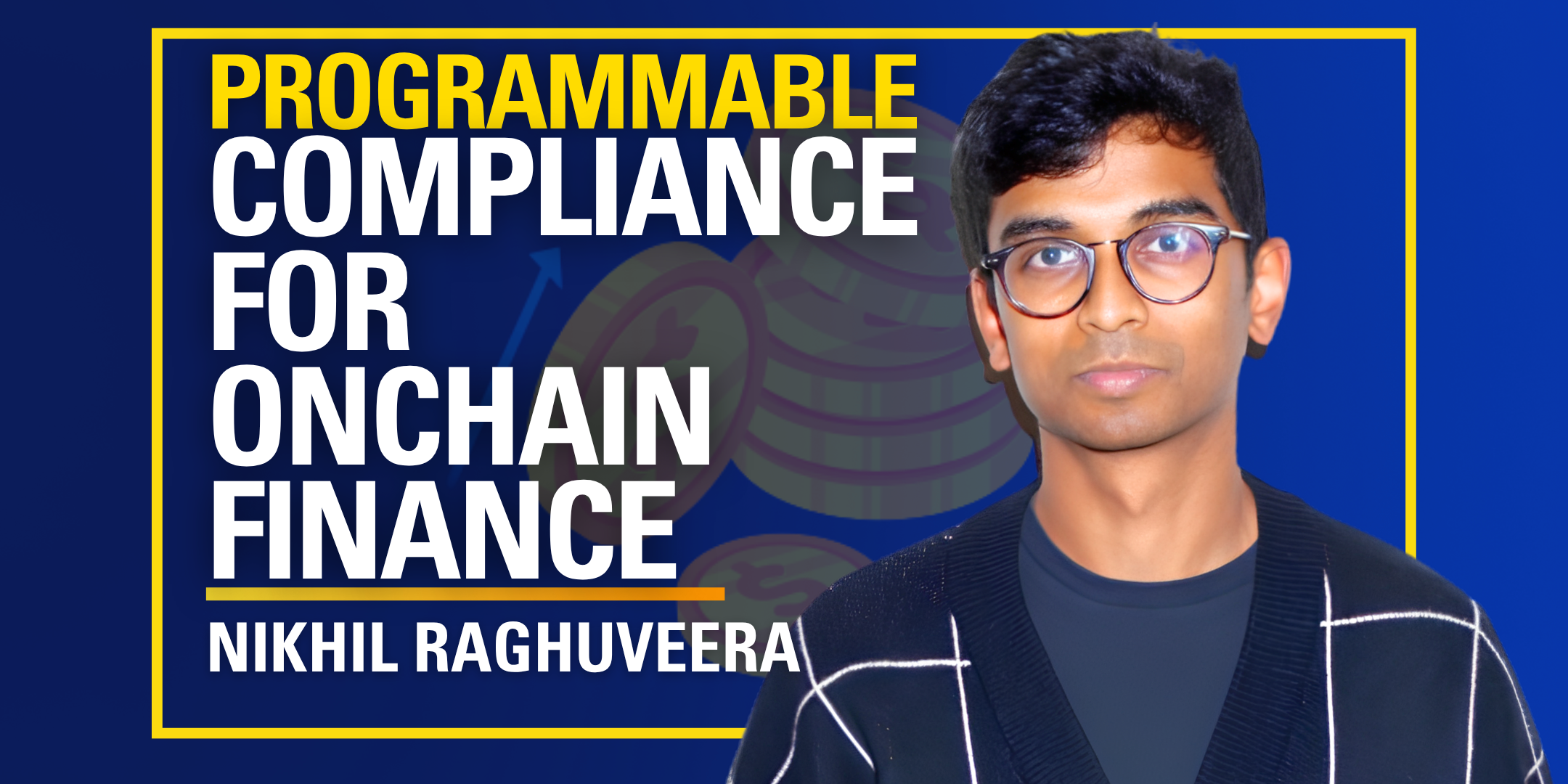
Programmable Compliance for Onchain Finance - Nikhil Raghuveera | ATC #622
Host Stephen Sargeant interviews Nikhil Raghuveera, CEO and co-founder of Predicate, the platform for real-time onchain compliance controls. Before that, he was Head of Strategy & Innovation at Celo, served as a fellow at the Atlantic Council, and worked in consulting.
Host: Stephen Sargeant
Guest: Nikhil Raghuveera
We are also available via:
Buzzsprout • YouTube • Quora • Medium • X • Facebook • LinkedIn • Soundcloud • Apple Podcast • Spotify • Player FM
Episode Transcript
Stephen: We've heard of Chainalysis, TRM, maybe even Blockade and Hypernative, CipherOwl, have you heard of Predicate? This is a new onchain finance risk management, and
we talked to Nikhil, the CEO and co-founder of Predicate. We were connected through Henry that used to work at Chainalysis, and this is an amazing episode going through the full workflow of programmable compliance onchain with so many institutions and tokenized assets coming onchain.
How do you protect them? How do you make sure there's security? And more importantly, how do you create opportunities for privacy tokens like Aleo or for MoneyGram stablecoin using Mzero?
There's so much in this podcast. If you're in crypto compliance, payments, tech, AI, we even talk about agentic commerce.
This is the one for you. I guarantee you'll like this episode. And if you're looking to get into this industry, he provides some good career opportunities that might be coming to Predicate. Talk soon.
This is your host, Stephen Sargeant, the Around The Coin podcast. When I hear about something that's crypto compliance, blockchain investigation, on-chain compliance, and I haven't heard about it before, I get a little bit, you know, uneasy about my profession as your crypto compliance guru. So we have Nikhil from Predicate He's gonna all explain exactly what him and his co-founder and that CEO, what they've built there. It's actually Henry that was at Chainalysis that made the introduction. So Nikhil, let us know what you are and what you built that's so underground that, like, only the who's who of crypto compliance and on-chain finance know about what you guys are doing.
Nikhil: Yeah. So thanks so much for having me, Stephen. Um, so yeah, I'm Nikhil Raghuveera, co-founder and CEO of Predicate Quick intro of myself. Yeah, so before starting Predicate I started my career, uh, some time ago in economic consulting in the litigation space on securities and antitrust. Also spent time in management consulting, uh, where I did public sector, private equity, and pricing strategy, and then came into, to crypto.
Uh, my big interest in crypto was particularly around payments, actually. So spent time at Celo, where I was, uh, head of strategy and innovation at the Celo Foundation. And, you know, as we were working on a lot of different use cases for Celo, we were looking at microfinance payments in emerging markets, uh, like real world lending, like humanitarian aid, all of these different things.
One of the questions that would come up quite a bit is: how do you manage compliance for all of this, right? And I also have a background in digital asset policy, I forgot to mention that. And of course, every regulator is also thinking about the AML considerations. And so, you know, we've always had, and for some time we've had the blockchain analytics providers such as Chainalysis, TRM, Elliptic, uh, and we've had other groups as well.
But they supply data. And what we realized was actually how do you enforce whether a transaction should actually happen or not at a blockchain level, right, within a smart contract? And that was something that no one had built. But it was actually really possible. It was possible to be able to say, "Here are the rules for what transactions I actually wanna execute it from a smart contract perspective, and how can I actually enforce that in real time?"
And so that was what caused my co-founder and I to leave Celo and start Predicate So we started Predicate in 2023. We service a number of companies that you probably know of in the digital asset space. And, uh, yeah, we basically power on-chain, uh, policy enforcement.
Stephen: I'm curious, especially when you're working at payments, emerging markets seem to be Celo's like niche, you know, blockchains with purpose and payment movement. What were you seeing was the biggest bottleneck there? Was it KYC? 'Cause we've heard that crypto's supposed to, you know, bank the unbanked or underbanked since I've been in it for almost a decade.
Doesn't seem like we've really solved that problem, even though we're getting closer and closer with stablecoins. What's the real bottleneck from a compliance perspective?
Nikhil: Yeah. When you're operating in many of these different markets, and I'll actually say pretty good today, we probably focus a little bit more on your, uh, traditional regulated markets. But the challenge from a Celo perspective is you're operating in, you know, a lot of different, uh, markets that may not have as much, uh, kind of how we think of, of, you know, the normal compliance processes that we have in place in traditional financial sector.
And so whenever you get to a point of transactions happening on chain, but then it has to interact with a centralized organization like a, a Grameen or a Mercy Corps or a Care International, or, uh, when you have a market maker who's facilitating liquidity to be able to do like real world lending, all of those guys are like, "We can't-- We have to ensure that, you know, this fu- these funds aren't coming from, you know, um, a, like a malicious actor or going to a malicious actor."
And all of those things really do matter, and it's, it's the same challenge that we see today. Like, I think, uh, this is something that Tether has to navigate given their use of stable USDT around the world. And if you'd ask anyone at US Treasury, like what is their biggest AML concern right now, they would probably flag Tether as like very high up on the list because of the use of USDT across the world.
And so it's all of those questions kind of coming to bear, right? And that was something that I saw regularly with some of our different, uh, partners. And then the other one would be the different organizations that we're building on Celo. So take, you know, Uniswap, uh, which was on Celo, or, uh, we were doing work with Axelar at the time.
There was a number of different organizations that are building, you know, financial products on Celo. Their focus is how do we really hit the real world market, right? You're not just servicing a crypto market, you're operating and existing in regulated markets. Your users are coming in from regulated markets.
Uh, you're interact-- you're, you're thinking about how can I better connect with fintechs and financial institutions. The moment that you're saying that we're building a financial product that has to intersect and interact in a regulated market, compliance comes up. And so that was a question then is how do we solve all of this?
And we were like, "Someone is gonna have to solve this at some point in time."
Stephen: And it's funny, we've worked with Michelle Latsor from Corsa Finance, and they, they, her and her partner Julie were building Tweed, which I think was a payments infrastructure. And once again, pay, you know, payments, fintech, crypto, compliance is the one thing that came up all the time, and they built out a full case management system.
But it always came back with the biggest hurdle in payments is always around compliance, and that usually turns people into trying to find solutions there, which is what you're doing. You're a fellow at the Atlantic Council, which is one of the most notable, I guess, fellowships when it comes with working in geoeconomic centers.
And but there's some interesting trackers I saw on that website, including tariffs and sanctions and even a CBDC tracker. What-- You know, maybe talk about some time there. What are some interesting, you know, things that you've picked up from the policy side that allows you to do some of the work that you're doing with Predicate I'm assuming especially around sanctions?
Nikhil: Yeah. So, I mean, this would be when I first joined the Atlantic Council, this was in 2020. So this was just as the Atlantic Council was really thinking about digital assets itself. Um, at the time, early on, a lot of my work was actually focused on central bank digital currency, CBDCs, and what are the opportunities there?
Just taking a step back, why are they valuable, right? What is the inherent value? How should they be structured? Um, then it shifted into what are the geopolitical implications of CBDCs? How does that relate to the, you know, the political, uh, questions as it, uh, as it amounts to money? Like money is a national security issue for the United States, and a CBDC can also be tied to national security.
And so some of the research was on that. And then of course, you get into a world of, uh, cryptocurrency, right? So digital assets that are not central bank digital currency. And, uh, a lot of the research there was just understanding how digital assets work, and then you get into the policy question. So I remember when Treasury released their, like really their first report on AML, uh, the US Treasury released their first re- report on AML.
I believe this was in 2020, like January 2024. January or February 2024. And where they-- The first place they like came and spoke about it was actually at the Atlantic Council. Um, and it was quite valuable, right? Because it's that type of engagement where you have this question around technology, uh, geopolitics, national security, and, uh, that coalescing of all those, that was really a lot of my, a lot of my work there.
Stephen: It's funny because FATH have just dropped a, another virtual asset guidance they did about an hour ago, so you're gonna probably be busy. Uh, you better c-carve out some time for, for that, for you and the team, especially with the World Cup coming up on this weekend. I'm curious, what are your thoughts on CBDCs now?
It looks like obviously you're building on kinda like programmable on-chain compliance. It seems that we're moving further and further away from CBDCs, at least in the US according to Trump, and many other places you haven't seen the pilot projects go very far. Uh, do you think that they're... You know, governments have realized, like, maybe we should leave this in the hands of the private sector?
I remember speaking or hearing, you know, from Dante Disparte where he said, you know, "Governments don't build planes. You wanna leave that to the private sector, otherwise the planes will be too expensive for anyone to catch a flight anywhere." What are your thoughts on that?
Nikhil: Yeah, I think, I think looks like the United States has probably closed off any subs-- like further work on CBDCs. I think the idea really is that private sector advances the dollar. Um, I don't think that's gonna hold in every other market, though. Uh, I think Europe still does care a lot about a CBDC. I think, uh, I think China, China does as well.
Uh, I think some of your other Asian markets. So it really comes down to what you're trying to solve for and who do you want to give really power to, uh, is how I see it. Um, so United States circle would say that there's no need for a CBDC, just use USDC, right? Like that solves the same problem. Um, and the United States has a history of saying, "Okay, great, we will kind of leave it up to private sector to go and do XYZ things."
But then in other parts of the world, I don't think that necessarily holds. And, you know, it's, uh, that same challenge of what is the role of private sector versus public sector has, has manifested itself in another way. Like if you take India, India has probably created the most comprehensive identity system that is really, really valuable as it relates to also payments.
The United States has not come anywhere close to building an identity system like what India has done with Aadhaar. And so again, it's a question of like, what is the role of a public sector versus a private sector? So we will still-- I still believe we will see CBDCs, maybe just not in the United States, or we might come back in the future and say, "Wait, there's actually still core problems that we need a CBDC for as it relates to the operations of our Fed Reserve," right?
Um, I still think there might be something that we come back to in the future, but right now we say, "Look, we don't actually need it. We have stablecoins. They kind of solve the purpose that we really need at the moment."
Stephen: Speaking of, you know, your question of what problem are you solving for, when you and your co-founder created Predicate what was the problem you were solving for? You know, Chainalysis has a wide scope when it comes to compliance, so does Elliptic, TRM Labs. There's several other players, especially now with AI, there's several players in the crypto compliance or AML space.
What was the one thing that you're like, "Nobody does this quite well," or, "They're not just focused on it. It's like a, a patch onto something that they're more focused on, like blockchain analytics. They're not really focused on this specific thing, and we think we can fill that void."
Nikhil: Yeah, it's a, it's a focus question. Um, so an organization is building a financial product that operates on a blockchain, right? That's take a vault, take, take any type of product. We're saying that historically, organizations that build financial products that operate in traditional fiat rails, like that's how all fintechs operate today.
Then the hypothesis there was, okay, if we believe that blockchains have become a global financial settlement system, you're going to have financial products that are built on permissionless blockchains, like Ethereum or on Solana. If that's the case, in the same way that you have traditional fintechs who build financial products, they have to enforce different rules for what transactions actually get executed.
You have to be able to do that on a blockchain-based system. And while you use data from different places, you have to then determine how do you actually create the enforcement mechanisms? How do you create the rules that are baked into your technology stack? And the thing about a blockchain is that transactions settle in real time, and so there is no going back, right?
So when you have a, when you have a fraud, when you have an instance of fraud and your money is moved and it goes into another bank account, you can actually, you know, reach out to the bank and there's law enforcement mechanisms to say like, "Block this payment or return the funds back." That doesn't happen in crypto.
When funds come in from North Korea, there is not a case where you're like, "Oh, but we want to now go and deal with it." Funds leave from your system and that's from North Korea. There's not anything you can really do. And so for us, it was really the ana- the, the, the TRM labs, the Chainalysis of the world build really, really sophisticated data systems.
And then they tell the organization, "Hey, yeah, you guys go figure it out. We're gonna give you a bunch of data. You're gonna pay us for data. You have to go figure out how you're gonna ingest and use all of this." And many of the large organizations are like, "We're using multiple different data pieces," right?
"We're using AML data. We have to have geolocation data. We have KYC, KYB." KYC, KYB is not done by a Chainalysis or a TRM. They have to configure that, and they have to be able to do all of that in real time. That is-- And then, you know, and then you have the security groups like a Blockade and a Hypernative.
Now suddenly you're thinking about all these disparate systems, and I have to create a rule system that is all enforced in real time, and no one is doing that. And so that was really what we said was we can actually build something that operates in sub-second latency, cannot be bypassed, and allows for you to enforce every rule that interacts with your smart contract.
That was, that was kind of the, the difference of what we were doing, and no one was focusing on it because it just is a very different problem that one has to solve. Like you need a completely different engineering team. You need to have a different architecture because you're not a data company, you're building infrastructure at the end of the day.
And it's hard too, you know. So s- uh, I used to consult for a lot of companies where they had this exact issue. They would bring me in to help them, like, "Hey, we have the tool. Now what thresholds do we set? Where, you know, where's our risk appetite, and how can we reflect that using the tool?" And the tools are really good, as you say, but they can't kind of play both.
Stephen: They can't show you that there's a tool that can provide this data and then tell you how to assess the risk at the same time. It's kind of a competing interest by a lot of these companies.
Nikhil: And then how do I put it so that it's actually baked into my technology, right? So how do I directly link that into my technology itself so that way whatever I've set, only those things actually go through, um, the gating system, if you will
Stephen: And, you know, I think you brought up some of these companies like Blockade and Hypernative. We've seen Hypernative, Defense, even One Inch kind of rebrand towards this institutional market. They're kind of going after these traditional institutions that are now getting into digital assets. Have you noticed this shift, you know, maybe away from crypto-native monitoring?
Um, and how can you-- Like, it seems like you're going in from, like, "Hey, traditional companies, we can help you use some of these crypto-native tools and, you know, create programmability around your risk exposure and guardrails." Was that something that you came out the gate with, or did you notice that there was more demand from traditional institutions than some more crypto-native companies?
Nikhil: We started with the more crypto-native companies, and we still work with a lot of crypto-native companies, uh, usually because most of the crypto-native companies are still trying to build a financial product, right? And so, like, an example I can give, uh, is take someone like Plume. Plume builds, uh, a product that allows users to deposit and earn, uh, yield.
And the yield is coming in from tokenized treasuries, public credit, private credit. It's a product that they've built, right? It's fully on-chain. It happens, settles real-time, all those things. Um, there's a crypto-native team, but they said, "We're building a product that can be used." And so that's, like, that's a great example for us because they needed to enforce AML requirements for every transaction that enters into their system in real-time.
Basically, they can't have North Korea come in and earn yield in their system. And so that was one that it's a crypto-native team that uses Predicate But I think over time, we start shifting into a world where it's like starts going a little bit more on the traditional side. So examples of this are, um, we work with a lot of stablecoin issuers on stablecoins.
So take someone like M0. M0 works with a number of different organizations on stablecoin infrastructure. And so all transactions, every stablecoin that, uh, is powered by M0 uses Predicate We ensure automated sanctions freezing. So any time a, uh, regulator makes a sanctions update, in real-time, we update that acro-- update that stablecoin across all blockchain networks.
So that way it freezes in real-time for any sanction addresses. And then some of our customers who are using M0 add additional configurability. So someone like Consensys, they have a stablecoin, and so for them, they have additional requirements. They're like, "Hey, we don't want our stablecoin to interact with, you know, other malicious addresses."
And so Consensys uses Predicate to set both automated and manual restrictions that they can enforce when they need to, and they have a full platform to do that. Uh, or you probably saw MoneyGram is using M0 as well, and we power the compliance infrastructure for MoneyGram. So again, you kinda see this movement, uh, towards more and more of the institutional side.
We spend a lot of time working with Paxos Labs, who's working heavily with fintechs on different structured financial products. So I think it's this world of crypto becomes more and more like fintech. And if that's the case, we-- that's great for us because that's really the world that we really envision at the end of the day.
Stephen: You talked about this freezing and, you know, FATF kind of even put it in their last report around stablecoins and even, you know, self-hosted wallets around this concept that emer-- like countries that are members of FATF should start considering whether or not stablecoin issuers should be monitoring the secondary market, which is a huge lift.
It seems like you're kind of building out that programmability for Mzero in a way where you're able to freeze based on sanctions violations or sanctions updates by OFAC or the UK, I'm assuming. What are your thoughts on stablecoin issuers being mandated to kinda govern their secondary market and what happens with those tokens once they're kind of out of their control?
Nikhil: Yeah. We've submitted a few comment letters to Treasury on this, and we've engaged heavily with US Treasury on the topic. Our take has been that, uh, you should not have a widespread monitoring requirement in secondary markets. For example, a stablecoin issuer should not be KYC, KYBing every single user in secondary markets.
It doesn't work. It's very difficult. It adds a massive overhead. It also doesn't make sense because we're talking really about digital dollar. Now, a stablecoin issuer should, however, have the-- Our take, and I think this would align with many of the stablecoin issuers, is that stablecoin issuers should have discretion over what to do in secondary markets.
Now, there should be baseline requirements, right? That, that has been articulated in Genius, that sanctions enforcement is strict liability. You have to have to do sanctions enforcement, and if you have to be able to service lawful orders. If there's a lawful order to freeze, like you should be able to execute that if you wanna be a registered stablecoin in the United States.
Now, a mass monitoring system, uh, like we don't think makes sense. But the stablecoin issuers should be able to go and say, "Hey, we have additional things that we need to freeze or we need to take action on." For example, um, there's a major exploit. Stablecoin issuers should have the opportunity or the ability to say, "You know what?
We haven't heard from law enforcement yet, but we need to go and do this from a market integrity purpose." Like we care about the market. There's certain things we have to do or we care about this from a reputational perspective. That's a position we've taken is mass surveillance and KYC, KYB does not, should not happen.
But ha- we already have really good blockchain analytics tools to be able to monitor transaction history and be able to take action. And so stablecoin issuers should have the discretion to be able to go and take action in secondary markets based off of their own, uh, risk requirements and Bank Secrecy Act requirements
Stephen: That has to be written into regulation or to law because, you know, Circle seems like they're very hesitant to do that, whereas Tether in some cases isn't as hesitant based on how, you know, how headline-worthy the conversation was. We saw with the Drift protocol, there's a now class action lawsuit against a stablecoin issuer because they didn't take action quick enough or without a court order, which they're like, "Hey, well, we're not gonna set the precedence of doing things without a court order and then be liable if something goes wrong."
Um, where do you think it has to be baked in? Is it like, are we trying to self-govern or is it more that it has to be in regulation that they can use the discretion if they choose to? And then does that hold up in the case of a class action lawsuit, in your opinion?
Nikhil: Yeah. So right now, I would say that stablecoin issuers have the authority to be able to go and do secondary market freezes if they wish to. They can do that, and they technically have discretion to be able to do it. What they don't have is legal coverage if they were to freeze an address that they shouldn't have frozen, right?
So Circle can get sued by a, uh... Circle can get sued if they incorrectly freeze an address. And so they are very, very hesitant to do so because they would-- it's akin to a property seizure. As a result, Circle would just say, "Look, like we'll only freeze if there's a lawful order, uh, because otherwise we face the risk of being sued by the person if they believe they've, if, if we've incorrectly frozen."
Now, the way you overcome that is you basically need, and I think this has been proposed in the Clar- in Clarity Act, is safe harbor, giving the, uh, stable-- giving the asset issuer the ability to say, "We are gonna be able to... We have the right to execute freezes as needed per our compliance requirements, and so you can't get directly sued."
That starts looking a lot more than like how, you know, I've had my Venmo account once like paused because I went to a Cuban restaurant with a friend and Venmo'd him like with money that when the, the, I put the Cuba flag and then it was Venmo, Venmo had paused me, right? Saying like, "Oh, you're high risk.
We need to like review this transaction." And I think it moves more in that world of you have discretion, and so now the issuer can say, "Yeah, yeah, we are going to be able to pause an address to be able to review for a period of time, and then we can unpause." Uh, but right now, US-based stablecoin issuers would just say, "We're not comfortable with that potential risk."
But again, if Circle freezes an address and they freeze correctly with their own discretion, it was a North Korean address, it's not like North Korea's gonna come over and sue them, right? Like, that's not something that happens. The risk is that Circle thinks it's North Korea, freezes it, and it's actually one of our addresses.
And then you're like, "Wait, but I shouldn't be frozen here. I'm not North Korean. I'm gonna go and sue you, Circle."
Stephen: Yeah, and the amount of legal back and forth even before the seizure that has to go through that. I'm curious, where do you plug in? Create a tech stack for maybe one of your customers where you can tell me where you fit in, because we know you, you integrate with companies like Elliptic. You mentioned other companies like Blockade and Hypernative.
There's companies like CipherOwl. There's so many blockchain analytics and data companies. Where do you fit into a company's tech stack, and what other tools or vendors might they use in that same tech stack to give the l-listener and the viewer maybe a sense of where you are in this whole puzzle?
Nikhil: Yeah. So there's two scenarios, uh, two types of kind of instances of how we fit into the tech stack. One of them is-- And both are smart contract-based. One of them is a smart contract that allows for someone to submit a transaction into the system. So think like a vault, a Uniswap V4 hook, um, a, uh, let's say like a...
an... the entry point into a privacy system, a bridge, any of those things where you're saying, "I'm gonna submit a transaction to go into this smart contract, to enter into whatever service that it provides." Um, we fit there. So every transaction that's being submitted to that smart contract, if they use Predicate, it requires us to essentially approve that transaction.
We issue a signature attesting to that, to every transaction. We issue a signature in sub-second latency. If some user tries to bypass our signature and directly submit a transaction to a smart contract, they won't be able to. The transaction would get rejected. Uh, think of us almost like a notary, right? A real-time notary that's notarizing every single transaction and says, "Okay, great.
This is good." That's one type of integration pattern. The other one is on like an asset, so take like a stablecoin. Uh, stablecoins have a freeze manager role. Uh, the freeze manager role is a role that allows the execution of freezes of addresses. And so ours, for Predicate, we have a system where we take a freeze manager role, allowing for us to have automated and manual freeze, uh, executions for that asset, um, across all blockchain networks.
Those are the two ways we really plug in, and then going to your question of, so where does, you know, where all these other groups sit in, right? So a TRM or a Chainalysis or, you know, a CypherL or a Blockade, they supply data, so their data all sits off-chain. Uh, and so in the first example, you know, when a user is about to interact with a smart contract, they need a signature from Predicate.
So they request a signature. The signature, there's different ways of requesting a signature. The user doesn't realize that a signature request is happening. That's all on the back end. They don't see it. But an API call is made to Predicate. Predicate goes and references data from various blockchain analytics providers and data providers for that specific policy requirement.
And then we say, "Yep, we've checked all the different data. This transaction is clean. Here's..." And then we spit out a signature that's sp- uh, issued on-chain. That's how it works. You have all these different datas that sits off-chain, and then we reference all of that data off-chain, and we spit out a signature on-chain.
Stephen: I'm curious, like what is the biggest, you know, illicit activity that you're worried about? 'Cause, um, based on that diagram in my head, it's not gonna be like wallet drainers. Is it gonna be like approval phishing scams? Like, what's the biggest thing that you're worried about or that, you know, your customers are like, "Yes, we need you 'cause we wanna make sure everything coming to us has been properly vetted."
What's their main concern?
Nikhil: The biggest ones are usually we're on the AML/CFT side, so funds associated with, you know, terrorist financing, sanctions, human trafficking, CSAM, major exploits. They don't want those funds to come in because that taints everything else within their system. Uh, an example of this, like, so one of our, um, one of our customers is Aleo, the privacy blockchain.
And so when they were about to go live, they actually had to wait for us to go live because their concern was we're building a privacy blockchain, and there are many AML risks as it relates to a privacy blockchain. And so they passed a, they passed a full-on governance proposal saying that all bridges to Aleo from Ethereum and any other, uh, any other chain has to have AML requirements that are, uh, kind of built in.
It was a whole thing around just a whole-- It w- basically, they passed a full governance proposal around an entire, like, risk requirements configuration. And so as a result, Predicate is used for a lot of those because we need to, they need to, uh, their ecosystem needs to enforce compliance requirements for who can enter into the Aleo blockchain
Stephen: Who do you think is the biggest benefit? Is it something like Aleo that's like, "Hey, we wanna make sure that we're vetting everything coming in for AML purposes so we can show the regulators"? Or is it the user like, "Hey, I wanna go through this method so I know that I'm not, you know, connecting to a smart contract that's gonna steal my life savings worth of Ethereum"?
Nikhil: Yeah. I think it's usually, for us, the bigger value proposition is probably to the, the company at the end of the day, because for them, they have to be able to operate in various markets. Uh, I think users do care to s- I think especially in the case of exploits, users do care about not having their funds be associated with other kind of malicious actors.
But I think for us, where we've seen is like usually the company is like, the company organization is like, "We wanna make sure that we're able to enforce, like we're able to enforce certain rules." Uh, because that way they can go and acquire users, they can operate in the markets they need to operate in, all of those things.
Stephen: I'm curious, Predicate has an identity feature on the platform that does the KYC, KYB for on-chain finance. How do you balance the need for, like, the compliance requirements like KYC, and the need to, like, move large institutions millions of dollars, as you're saying in almost every sentence, in absolute real time and seamlessly?
And then maybe even the conversation around privacy, where does that integrate, and how do you have to balance all three of those things, privacy, compliance, but, like, frictionless transaction?
Nikhil: KYC/KYB definitely imposes some frictions. That's undoubted, right? Like you have to KYC/KYB. If it's pure AML verification, it doesn't hinder the user experience because all that is done in sub-second latency using data from a lot of different places. But if the user has to KYC/KYB, it of course does change the user experience because they have to go through that full flow.
Um, so it really just comes down to the use case. Uh, for KYC/KYB, an example of that where we've-- where it's been quite helpful is we work with Uniswap Labs on their-- They have a platform called CCA. It's a, it's au- it's an auctions platform that allows organizations who are about to launch a token, uh, to be able to use the auction platform to have a more efficient pricing mechanism and pricing discovery, uh, to be able to sell their token.
Now, take, uh, like Aztec last year did their token sale, and they used Uniswap. But what Aztec needed to do is they had to actually require every user to KYC/KYB because it is a token sale, right? And you're cl- you're receiving funds for a token sale. And so every user had to go through a KYC/KYB before they could participate, before they could submit that transaction on chain to say, "I wanna buy, I'm gonna bid X amount for this token," right, in this auction platform.
And so, yeah, we have to be able to service all manual reviews for KYC/KYB, customer support if a customer is having a problem. We have to reject users if they're not submitting appropriate documentation and reas- and details. Uh, and so the best way you do that is either you pre-- like you verify people before this thing starts, or once it does, you say you have to go through the flow
Stephen: And I'm curious, you mentioned that, you know, you had comments around the Genius Act. Obviously, one of them was about what you said earlier was on the stablecoin and monitoring the secondary market. Was there any other big factors or anything else important in your comment letter that you didn't really like or wanted to see changed in whether it's the Genius Act or the Clarity Act?
Nikhil: Yeah. Um, so the main i-items we focused on in our comment letters to g- uh, for Genius were, were a few things. One is, from a stablecoin perspective, the c- the capability to have automated freezes, especially for sanctions, and the capability of actually incorporating with, if there's discretion, real-time responses in the case of major exploits.
So you can automatically freeze addresses if those addresses are involved in an exploit. You can also freeze, preventatively freeze addresses that are malicious contracts. So imagine a world where I have my stablecoin, and because the issuer has used something like Predicate to freeze a drainer contract, so the drainer contract cannot drain my stablecoin out of my wallet.
It's quite power... It'd be quite powerful, uh, actually. And so we talked about that, the capability of both real-time freezes and preventative actions that can be done in, in, uh, in a very, like, programmatic fashion. The other thing we talked about is the use of APIs and, uh, on-chain enforcement, so that you can actually enforce compliance requirements at a smart contract level.
When we first started Predicate, uh, many organizations were just like, "Oh, we can enforce the compliance requirements on the, the, the interface level." But the interface is easily bypassable, right? I just can interact and submit a transaction directly to the smart contract, or I can build out my own interface.
And now, especially with Claude, it's really easy to just spin up my own interface, and then I avoid all AML requirements then. And so what we talked about in our comment letter was actually, no, no, you can enforce compliance requirements at a smart contract level that are not bypassable. And so we just encourage Treasury to think about, um, and encourage organizations to think about API-based tools that allow for on-chain enforcement.
Stephen: When you make something like a comment letter, I think this is quite regular in our industry, is it something that you're speaking to others in this space that might have similar interests, and you're kind of making sure that you're hitting the same points as you submit the comment letter? Is it more of like, do you think anyone's listening?
Like, what is your feeling about the comment letter? Have you seen anyone come back to you and say, "Hey, you know, they brought up this great point," or maybe once the legislation has been kind of enabled, you see some of what you wrote in there in some way or another?
Nikhil: Yeah. Uh, so we do coordinate with other organizations regarding our response. Uh, we're also a member of the Blockchain Association, so we share there. But then depending on the specific topic of our comment letter, we will coordinate and get feedback from some of other organizations, particularly some of our cu- customers and partners.
Now, on whether Treasury sees it, I can't comment on if Treasury sees everyone's comment letter, but they 100% have seen ours, and the reason why I know that is because they reached out to us. So in April, I actually went and met with a number of folks from Treasury where we actually showed our platform to Treasury, FinCEN, and OFAC because they reached out and they were like, "Actually, it'd be really helpful to understand how Predicate does some of the things you guys are talking about in your comment letter."
So again, I don't know if they read everyone's. There's a lot of people who submit comment letters, but, uh, 100% they read ours because we met with them about it after they reached out.
Stephen: That's pretty exciting. That was actually gonna be one of my questions. Do you think they're technologically evolved enough to even understand what you're trying to explain about AML at the contract layer? But that makes sense that they bring you in and kind of like show them the process and how your tool does that.
Nikhil: Yeah. I would say, you know, when we first started Predicate there were a lot of questions around, "Wait, but how is government even gonna understand all this stuff? Are they even thinking-- Do they even understand what smart contracts are?" All those things. And that was a
pushback how Chainalysis works, I think, still at this point, right?
I don't actually disagree. Uh, our conversations and meetings with Treasury, FinCEN, OFAC, also with the S-- like I spoke at the SEC last year, year in December, um, they understand the technology really well. Uh, we're not seeing a gap around, they're like, "Oh, what is a smart contract? What is possible here for a stablecoin?
What isn't? Uh, what is a vault?" Like, I actually think they understand the technology quite well. Now, there's still some stuff that they'll have to ramp up on over time, but I would say, like, you're starting to get into the really, really technical weeds of, let's say, zero-knowledge proofs and privacy-based systems.
Like, that can get quite complex because you get into a world of cryptography. Um, but I actually-- our experience has been that, uh, US government, especially amongst the regulators, is quite up-to-date on their, um, understanding of the technology.
Stephen: And are you only servicing US customers? Like, how far can you branch out with the technology you have?
Nikhil: We service customers globally, so we have customers in Europe and Asia as well. I would say like a lot of our customers are US-based, but that's more just a virtue of us being located in the United States and m- a lot of our network being here. But yeah, I mentioned Aztec, for example. Aztec, uh, is based out of Europe.
Um, so we do have customers, uh, globally
Stephen: And does the use cases change? Like, I'm thinking with so much sanctions, it's heavily around Iran, Russia, you mentioned North Korea already. W- Are- do the use cases changes with some of these customers that obviously they know they have to do the sanctions stuff, but now they're also concerned about, like, hey, what about neighboring countries and everything that's happening in the Middle East with Israel and Russia and Ukraine?
Are there things that you still have to adjust for, uh, beyond sanctions that are being requested from your customers?
Nikhil: We never do only sanctions. Sanctions is never enough, right? So you have to, the same way you have to account for a lot of other, uh, information as well. So again, terrorist financing, human trafficking, CSAM, exploits, uh, dark net. Um, there's a whole host of categories. It's not just sanctions. So yeah, we have to kind of navigate all of them now.
Though what that means is when you have a case like, uh, US government spending a lot more time around, like, law enforcement in South America or with the Iran war, you have a lot more addresses that are now tied to violent extremism, terrorist financing, drug, like, uh, black market trade, all of those things.
So yeah, we have to account for that. And then I will say on purely sanctions enforcement, especially for stablecoins, that is one where it's not just US. It depends on where that stablecoin's issuer is located. So if they're located in other markets, they have to account for EU or UN sanctions as well, Japan sanctions.
And so we allow for them to be able to, uh, enforce those rules as well if needed.
Stephen: Nikhil, you went almost 35 minutes and haven't mentioned AI. That might be a record, uh, on this pod- on this podcast. My next one, I wanna ask you how you're using AI, but first, like, when you see things like Fable 5 and Mythos and they have to pull it off the shelf because it's a super cybersecurity national security issue, and, but, you know, a lot of these companies are coming after, you know, you know, AI for KYC, AI for marketing.
Uh, what are your thoughts about, you know, having these powerful tools enter the space? And how does Predicate create a moat, uh, based on what you're doing? Is it gonna be just, like, you're focused on a single type of use case and you're able to go much deeper than these general purpose, uh, LLMs?
Nikhil: Yeah, I mean, again, like I think the AI, like AI is used to be able to build software. So I-- the real question we ask internally is, "Can someone else go and be able to build Predicate really quickly using AI?" And that, I think, is a question that every organizat- every technology company now faces, and not only technology company.
Service industries face it too, right? Management consulting faces it right now. There's questions in, uh, for, for, for lawyers as well around can AI replace what they do. Um, and we've asked that question, of course, and we also use AI quite a bit internally as well to build, uh, various pieces. I think here what it still comes down to in these kind of questions is who is still responsible, right?
So if I, as an organization, go and use AI to automate everything, what we really pay for when we pay for software, we pay for technology, why do we pay? We pay because we actually need to offload the responsibility to someone else to take care of it, right? And we also inherently, as part of that, have someone that we can go and yell at when something goes wrong.
And we actually need that. That is a really, really fundamental part of how, uh, of, of really how business works, and that won't go away. And I think the reason why that won't go away is because there's also legal liability. You still want to have liability for someone else to be able to do different things, because if not, you take on all of that cost and risk internally.
That doesn't go away. And I think even with AI, someone still has to be responsible for being able to do things at production grade. Um, and if I'm an organization or if I'm an individual and I'm like, "I have all these different AI services running," and something goes wrong, I have to now manage that. But then if something else goes wrong, I have to manage that as well.
Now suddenly I'm dealing with multiple different items that I don't have enough context on. And at the same time, your customers are like, "What's going on? You now-- You br- this is broken. You, you've lost me money. You've caused X amount of harm." I think that's really where AI still will never be able to solve, is that question around liability and who's responsible.
So while AI can make technology be really, really powerful as to be able to build things, um, someone has to be responsible. And then to the other point, right? From an attack perspective, AI, AI also makes it more and more likely that... Or like just the vulnerabilities only increase, right? We've seen that especially now in crypto with the number of exploits.
There's basically an exploit at least once a week. I don't think that goes away either. I think exploits will continue being there. I think incidents, like major incidents continue to happen, and so someone still has to be responsible. Imagine if there's an exploit and the person is like, one, AI was probably used for that exploit.
And then two, if the organization is exploited, it says, "It's not really on us, it's on our AI." Like I don't think that really works, right? Like if, uh, if Kelp or, um, which one was it? Uh, Drift was just like, "Yeah, you know, like it was our AI system. Didn't really work. Sorry about that." That's it. Like that doesn't work, right?
And I think that only becomes more and more apparent and more and more relevant over time.
Stephen: When you think about, let's say you're using Fable 5 and Anthropic takes it off the market for two and a half weeks, your customers can't afford to be offline and not do compliance or KYC or KYB checks for the better part of a month, uh, and still you're-- they're paying you. That's just not something that can happen, unfortunately
Nikhil: Yeah. I think the other thing we'll have to reckon with too is I'm curious on how pricing for the a- different AI tools kind of continues, um, because many of them are not profitable today. And so the question would be, while they generate significant amounts of revenue, but they're, they're not, they're not operating with, in a-- They're not profitable.
And so how does pricing change over time will also be really important because that will affect how we can use the technology and who has access to it. Um, that's something we will have to... My hunch, at least my hypothesis, we'll have to reckon with that in the next five-ish years or so.
Stephen: You know, it's been three years since you launched Predicate What are some things-- How has the platform evolved from day one to where you're seeing now? Especially, it seems like a huge focus around tokenized assets, 24/7 markets, prediction markets, uh, and more widespread adoption, thanks to Trump, the Trump administration.
Nikhil: Yeah. I think when we first started Predicate our hypothesis was that we will build generalizable infrastructure that anyone can go and use to build and enforce their compliance requirements, right? So we were like, you know, "We'll give you the platform, the infrastructure. You, organization, go and figure out what all you wanna do and what all you need to do, and we'll just give you all the tools."
What we've realized over time is that is not a very easy world to operate in, because the immediate next question from the organization is just like, "Wait, but which analyt- which blockchain analytics tools should I use? Uh, how should I configure them? Wait, but I need to do KYC, KYB, but now I have to manage all the manual reviews for all of this.
How do I deal with the PII for it? What should I do about the PII? Wait, now I got a law enforcement request. I have to navigate that." It's just a lot. And so where we've shifted over time is much more of a product-centric design where we're like, "Okay, no, we're gonna take opinionated positions on really how the architecture should be, and we will take on more and more of the responsibility from you so that you don't have to make all these decisions and maintain all of them."
And so I think that's probably been the biggest shift for us. And then from a go-to-market perspective, I think it's then just the evolution of the customers, right? So 2023, when we first fundraised, it was complete bear market. People were like, "Is crypto even gonna exist in a year or two?"
Stephen: That's what they're saying right now, Nikhil.
Nikhil: I know, we got that every few years, right? Um, but at the time, it was mostly still, like, very crypto native. That was really the world we were operating. It's coming out of DeFi summer. I think now the, the, the-- and this was our hypothesis then, was that crypto will have to go mainstream. And by what that, what it means to go mainstream is to operate in regulated markets and interact with users in regulated markets.
You're a fintech, right? That's, that's really what crypto companies are becoming is, is fintechs. Uh, and so then that informs how, like, who we service and how we approach them, and what are the problems that they're trying to solve for. They're not building generalizable permissionless infrastructure where they just say, "We have no opinions.
Anyone can come in. We're not really building a product." It's not that. Most of the crypto companies now use generalizable permissionless infrastructure, like in Ethereum, but then they go and build products on that, operate on that, that they need various forms of control. And so that is the evolution, is our customers look more and more like fintechs.
They are not crypto foundations. They are n- uh, they are not kind of fully permissionless protocols. They are organizations that are building, they are fintech organizations building financial products.
Stephen: Can you take me back to that time? Like, how do you make a decision? Like, let's look at the landscape in 2023. The SEC is still suing, like, the most compliant crypto companies probably in the industry. We're no closer to stablecoin adoption in the US than we were three, four years. For 10 years we were hearing, you know, institutional capital is what we need, but they still seem to be killing the pilot projects that they had started, as you said, in DeFi summer.
How do you look at your co-founder and say, "We're placing a big bet that everything's gonna do a complete 180 at some point in the next few years"?
Nikhil: I don't know if we thought that there was gonna be a 180, but we thought that regula- at the time, the enforcement was perhaps too harsh, and that will have to change at some point in time. And it's really just because we're like, "Is the technology good enough?" Uh, in that can it really be able to offer a better financial system?
And that's the base question, right? Are we actually building technology that's valuable from the perspective of technology? Or have we always been building something that has no inherent value? And we're like, if there is fundamental value from a technology stack of blockchains, then this will have to get further adoption over time.
It's just inevitable, uh, because technology will, in the long arc, technology will win if it is truly better technology. And that was a bet that regulation would change, regulation would evolve. It was also that, you know, regulators will get more familiar with the technology. At the time, I would say a lot of folks didn't entirely understand the technology, but we were like, "You know, in the next year or so, people will start probably ramping up on that."
Uh, the bet, yeah, our bet was that this would become more relevant. In 2023, we were like, "This will be more relevant in about two years. Until then, it's not gonna be relevant because no one's gonna be really looking at blockchains in the first case."
Stephen: That's a huge bet. Kudos to you and your co-founder, 'cause it seemed like the regulatory system actually got-- was the worst in 2023, even though it was always the Wild Wild West. It seemed like we had reached the epitome of companies trying to be compliant, and there was no guardrails put in place in order for clear guidance on what they were or weren't able to do.
So that's a huge bet, and congratulations on that. I think I saw on your LinkedIn post that you were at a recent event, uh, with the SEC commissioner Hester Peirce, where she made statements around privacy and compliance not being competing interests. How do you thread the needle of, like, risk management, verification, without creating honeypots of personal information all over the internet and all around or all on chain?
Nikhil: Yeah. Well, I think one is the honeypot question I think will be one that we'll have to continue dealing with, whether it's, you know, PII that's stored in off-chain systems. It can't be fully stored on-chain because of, like, permissionless blockchains that are fully transparent. Now you get into a question around the use of zero-knowledge proofs, and I think there is real opportunity there and user ownership of that.
And so I think this is what Commissioner Peirce has been really talking about, is just the capability of u- us not having to disclose all of our information at all points in time for these different cases, but rather having user ownership of that data and then only providing certain things. Uh, and so that is, I think, where we want to get to.
Now, I-- my take is still that's gonna take time because the world has not fully caught up with that. Like, zero-knowledge identity systems still are... It is very difficult to use that and then meet the requirements of an SEC or even Bank Secrecy Act for regulated assets, right? Like, and I think we have to kind of build out this thing around the zero-- like, privacy preserving identities and privacy preserving systems.
Where all can that be used? And you have to get adoption there first. You don't go after fully regulated markets that actually require a ton of, like, requirements solely for, for reasons that I've... You know, there's a whole host of different reasons, but you start with the other cases, right? Like, do I really need to show my, uh, complete driver's license?
And everyone talks about this example. Do I need to show my entire driver's license with all of my, like, personal details, with my, like, address if I wanna get a drink at a bar? You really just need to know that I'm over 21, right? And I think it's that kind of stuff. I think same on financial transaction history.
Like, I sh- my personal transaction history should not be fully available to everyone in the world. Now, it should be available to certain organizations when they need it, and I think there still is a question around... That doesn't mean that, you know... I think we still give up some amount of personal liberty in the common form of, like, security, and you have to decide where do we wanna sit on that.
But I would wager that most people would not give a complete, would not have complete, uh, privacy at the extents, at the, to the point of where, "Oh, I have no idea if the people around me are actually, you know, terrorists," right? There is now a security question. So we have to navigate that world. Uh, from a technical perspective, there's lots of different ways of thinking about it, right?
And I think from a blockchain way, there's privacy preserving identity systems. There is, uh, view key-based systems for specific types of settings of, like, where transaction history can be possible and viewable. But I think it, then it really gets in the weeds of different implementations, and we have to be good about going into the weeds of those different things.
Stephen: We've seen both sides of that spectrum. I remember, like, I'm handing over my medical records for, to a 15-year-old girl just so my son can play in arena for soccer during COVID. And so I feel like we've been on some serious spectrums, and I think that kind of goes into your point. There has been debates all over every conference of whether, you know, w- uh, can institutional finance operate on a purely open per- or a permissionless blockchain?
What are your thoughts about that? Specially working with a company like Plume that has, like, this real world, real world asset tokenization play.
Nikhil: Yeah. Um, privacy will be important and is critical for institutions as it relates to their business activity or even, you know, for things like payroll, and that's where privacy will really matter. Um, I think right now it hasn't truly happened yet because most institutions are not really doing things at scale.
I, I think-- I would say that they're starting to do things, but it's not like they're like, "Oh, we've shifted our entire set of core operations over to a blockchain." That hasn't happened, right? Uh, but as that starts happening, then you'll say, "Look, there's certain things we're comfortable being public, and there's other things that we're not comfortable with actually being public."
And so I think that's the world that we move to. Uh so institutional adoption will require privacy, 100%. Now, it won't mean that everything that they do is private, but there will be core functions that they will need that has to be private
Stephen: Tell me where you sit on agentic commerce. So in the example you gave of somebody wants to participate in a smart contract, what if that somebody's a agent of mine, but you know, it's not gonna be able to surpass or meet the requirements of KYC, KYB? Is that still far down the line because it's gonna take a while for institutions even to start using agents?
Or is this one of those problems that you're looking for solutions today?
Nikhil: We're not looking for solutions to it today because it's not happening at scale. Uh, we were-- I think my co-founder was just taking a look at it yesterday or the day before, and he was like: "Let me look at the volume around some of this." And the volume is still, was pretty low. Um, so we're not seeing it at scale yet, but it will come up.
And in the meantime, it's just, you know, who is the original owner of that agent is what you have to, to verify. But in production level scale, we're not seeing it quite yet
Stephen: Nobody's using it to buy vacations. That's, that's the one use case I hear all the time. I'm like, "I'm not trusting an agent to find the best vacation, putting me on two, two connecting flights just to get four hours away
Nikhil: And I think, I think you are-- there is some of those opportunities, but then it's still, the payment is still being done where it's executed by, you know, the original bank details of the owner of that agent. It's not like the agent is spinning up their own thing and then doing all these different things.
And I think that's the important part, right? That, that payment that's being originated is still from the owner, the original owner
Stephen: Right, and that can be traced on-chain if they're using their base wallet or whatever wallet. I'm curious, what is the future of on-chain finance? Like, what are some things that maybe even your customers are bringing up similar to agentic AI and agentic commerce that are, like, still a little far down the line, but you have to start thinking about it with your co-founder?
'Cause the same way you made, you know, an educated guess, uh, in 2023 and bet on regulations changing, uh, what are some things that you're, like, thinking where the, where the puck could be going in the next couple of years?
Nikhil: Yeah, I think privacy is one that we just talked about. Uh, another one is KYC/KYB. Uh, better systems around KYC/KYB. How does that become more real time? How do we deal with it at scale? How do we deal with it in a more global system, uh, real time? I think, uh, those are two that, like, immediately have come up quite a bit.
I think the other one is even on some of these payment flows, where how... It, it goes into a world of agents as well, but, um, agentic finance also incorporates a concept of, in blockchains, intents. And intents are where the user isn't executing the transaction and someone else is executing the transaction on behalf of the user, for example, an agent.
And so what are the responsibilities for those intent-based systems? What are the responsibilities for the agent? How do you set guardrails? How do you set requirements? And so that's the other part that we are thinking about that will happen in the future at some point.
Stephen: I'm curious 'cause you mentioned, you know, privacy stablecoins and a- what they're building at Aleo. We haven't been able to get Ya Ya on the show, but I'm curious, could Aleo exist without what you've built for Privacy Cake? 'Cause that was the one concept I didn't understand, is how are we gonna have a privacy, you know, stablecoin without it getting into the area of, like, Iron Fish back in the day, or even, you know, on the privacy side, like Monero, especially when privacy is so big of a deal now than it w- ever was the last two years, I feel.
Nikhil: Yeah, you should definitely want to have Yahya on the, the podcast. Uh, he's great. Um, if Predicate didn't exist, Aleo would have to build some of the, some of these things themselves, and that was our early conversation with Aleo was initially I think Aleo was planning to build it themselves, and then they found out that, hey, there's an organization called Predicate, and they're like: "We don't have to do some of these things."
So it's either use us or they have to do it themselves. That's really what they would have to do
Stephen: I'm curious, as you know, we end the episode, we like to, you know, get- figure out what's going on in the industry, especially, especially in SF and New York. You're at the kind of like boiling pot of trends and cool nerdy type ele- gadgets and electronics and probably run clubs. Like, what's trending that you're seeing that are like, "Oh, like I've never seen this before, but it's picking up.
It'll, it'll take a while to get to me in Toronto, but it's picking up a lot right now." Whether it's pickleball or paddle or what do you see, what do you see happening, uh, where you don't think that's picked up across mainstream yet?
Nikhil: That's a good question. Um, let me think about this
Stephen: Is everyone just buying out Mac Minis and running their own, like, Kimi and all running their own LLMs?
Nikhil: There is a lot of that, I will say. Like, at least like, you know, um, like I'm in our office here and it's-- there's other offices here as well, like other companies. And yeah, the sheer volume of people experimenting and trying out new things that they can do with AI, like from a personal perspective, uh, that's a lot.
Like, I don't think like-- But I, like, I grew up in Central Florida and, like in a small town. Like, I don't think, uh, like when I was last there, like people weren't doing that kind of stuff. And, but I see here, like people just tinkering and playing around with what other stuff can I build, like personally to like manage my like day-to-day life, right?
And I've s- like, and I think you do see some of those things. Like how do I manage my schedule? Like I have kids, like how do I think about all of those things? I think-- I don't have kids, but like other-- if someone has kids, like thinking about that entire schedule of how do they plan their life and how can they at least have these like different systems of coordination.
So that is something that I've seen quite a bit of.
Stephen: That drives the most stress is with the with the kid. That
Nikhil: Yeah.
Stephen: stress. Uh, I'm, I'm curious, y- you know, now that you've transitioned into more of a compliance space and risk management, what are some other companies that you're seeing or even within your building that you're seeing that you're like, "Oh, this is kind of interesting."
Like, even the idea of a privacy stablecoin two years ago would be like, "What? What are they building?" Is there any companies or any pr- projects that you've heard about that you're like, "Oh, that's kind of interesting. Never heard of that before"?
Nikhil: Yeah. Um, within our office there is, uh, there's a company called Unlink. Uh, they're actually building... They're-- It's a privacy team, but they're thinking about how to just make, like, privacy possible on existing chains in, like, a really, really seamless way. So I think that's really cool. Um, I was talking to some folks at, you know, Stellar the other day, and we also saw recently, like DTCC, like what is DTCC doing with the blockchain, like the tokenization of assets.
I think there's really, really cool opportunities there because now, you know, when I think of collateral posting, I can actually post collateral in stablecoins or in digital assets that can then be used from a DTCC perspective from an institution. So that, in, to my mind, is fascinating. Um, another one that I think is really cool is, like, what MoneyGram is doing with stablecoins.
It's a legacy, you know, payment system, right? And when I was at Celo, we thought we, we looked a lot at MoneyGram and the Western Unions of the world, and we're like, "All right,
Stephen: they have the infrastructure built out in real life. Imagine if they could just put things on the blockchain rail.
Nikhil: Yeah, and exactly. And so now you can actually do real-time payments, right? You'd be able to do real-time payments with MoneyGram with a stablecoin globally. And the great part is, is, you know, one of the challenges of stablecoins is always how do I on and off-ramp in an ex- in a market, whereas MoneyGram actually has that component already.
They have that really, really hard problem solved already. And before it was that the stablecoin part is a difficult one, but it's not anymore. The stablecoin part, building a stablecoin is easy. It's then all these other pieces which MoneyGram has, and I think that, I think can, can, uh... The opportunities there are really cool when you take existing companies and say, "Wait, they actually have distribution, they have the licensing."
Um, how can you actually make the technology be more seamless that actually drives value to users? So those are some, some of the things that I've been kind of seeing here in New York recently. Um, I'm trying to think if it's-- Yeah, those are the ones that come top of mind right now.
Stephen: And you think eventually it'll start staying in stablecoins versus, like, the backend operational being in stablecoins, and then you go pick up, you know, your local currency. It's g- eventually it's gonna make sense. Like, hey, if, if they just send me USDT, it's cheaper, it's faster, but now I can use USDT at my local merchants.
We just had somebody from Morph, uh, Network on the podcast, and they were saying the exact same thing about servicing merchants. Do you think eventually it'll just stay in stablecoins and won't there be this need for FX everywhere you go?
Nikhil: Yeah, that's right. I think it's also the unlock for, uh, tokenized securities. Because if I hold money in stablecoins, I don't need to off-ramp, I don't need to off-ramp to go and, you know, invest my money. I just go directly. Like right now I have a Charles Schwab account bank account, and then I have a brokerage account as part of that, right?
So when I have a certain amount of money, I will move that over into my brokerage account and then invest to basically just manage my holdings. If a lot of my money is, if all of my money's coming in on stablecoins, then I shouldn't be off-ramping to go and manage my wealth. I would instead just buy tokenized, uh, assets.
And so I think that's also the unlock. I think all this gets unlocked through stablecoins
Stephen: As we're evolving this podcast from Around The Coin to more of like a trust layer, like identifying where do we have trust in technology and AI and government, where do you think we are at the spectrum? At the zero to 100, where do you think the trust level is a- around the world? Where would you put that index, in your opinion?
Nikhil: Trust of what?
Stephen: Just trust of like where people's trust are, especially around when it comes to blockchain technology and the regulated entities that you're working with
Nikhil: I think the trust of blockchain technology is between like, you know, like a 0 to 100 is, I would say like lately probably more like a, like a 40 or a 50 from a trust perspective. And I think the reason for that right now is the exploits. Um, I think that's-- My hunch is I think that's actually going to slow things down because exploits tied with AI, because there's not a great response that one can give and say, "Oh yeah, we won't have another exploit."
I think AI just makes that more and more challenging. Now, your legacy protocols are in a good-- are in a better position, right? They're like, "Look, like we've been battle tested for so long," like something like an Aave, but, uh, an Aave or a Uniswap. But I think it's tough when you think about just the world moves really quickly, and so how do I kind of navigate this question around like just things happen really quickly?
Stephen: Does Predicate help with that? Does, like, Predicate eliminate or reduce the risk of some of these exploits just by nature of how the transitions are-- the transfers are being conducted?
Nikhil: We do have, uh, solutions that can mitigate, uh, the, like the impact of an exploit and in some cases prevent them. But again, it's, it's still a difficult problem to solve, so we can't guarantee that it's always going to work, right? And that's the real challenge is we can't guarantee that, "Oh yeah, you're, you use this and you definitely won't get exploited."
Um, I think it's, I think it's tough to s- I think it's, it's really tough to say and I don't think, like we work closely with Blockade. They're like one of our, one of our close partners and it's something that I don't think they can say like, "Oh yeah, guaranteed you will not ever be exploited." Like, I think that's tough.
Now maybe we move into a world, I was talking to, uh, someone at PIMCO and they were like, "Maybe we start having like more sophisticated insurance markets as well for this," and maybe that's the answer. Uh, maybe we need a financial layer that hasn't happened yet.
Stephen: We also need a societal leader like, hey, if you're putting your crypto into something, make sure they have some audits. Don't just go there 'cause it's giving you an extra 2% yield. I think we also have to, as a society, get a little bit more careful where we're putting our crypto as well. Not to take all the responsibility on society, but I feel there's a lot of speculation which leads, you know, to a lot of cutting corners, which, you know, we saw in the NFT market leads to a lot of losses, unfortunately
Nikhil: Yeah, that's right. And I think it's also your, uh, your crypto organizations have to also be better about saying that they won't accept stolen funds, right? If that happens, you cut off the market quite a bit
Stephen: Right. Nikhil, this has been an amazing conversation. We covered, uh, as m- more than enough ground, I think, for anyone listening. They got a healthy dose, especially our, our crypto compliance community, which love these type of episodes. Where's the best place for people to find you? Are you more on LinkedIn, on Twitter?
Where's the best place to find you?
Nikhil: I'm on both. I'm on both Twitter and LinkedIn, and, uh, our website is also predicate.io, so they can reach me through any of those, uh, platforms
Stephen: And are you looking like career-wise, are you looking at like filling positions within the organization? Like how is Predicate growing? What are you focused on now? Is it more technology hires? Is it more like risk pr- uh, policy professionals?
Nikhil: Uh, we are hiring for engineers. We might be hiring someone for business on BD, uh, but we haven't posted that job post. We haven't put up that job.
Stephen: We'll keep it u- we'll keep it under wraps. I'll have to make it all the way to the end of the podcast to get that, that cool insight. Nikhil, thank you so much for this podcast
Nikhil: Yeah, appreciate it. Thank you so much for having me.