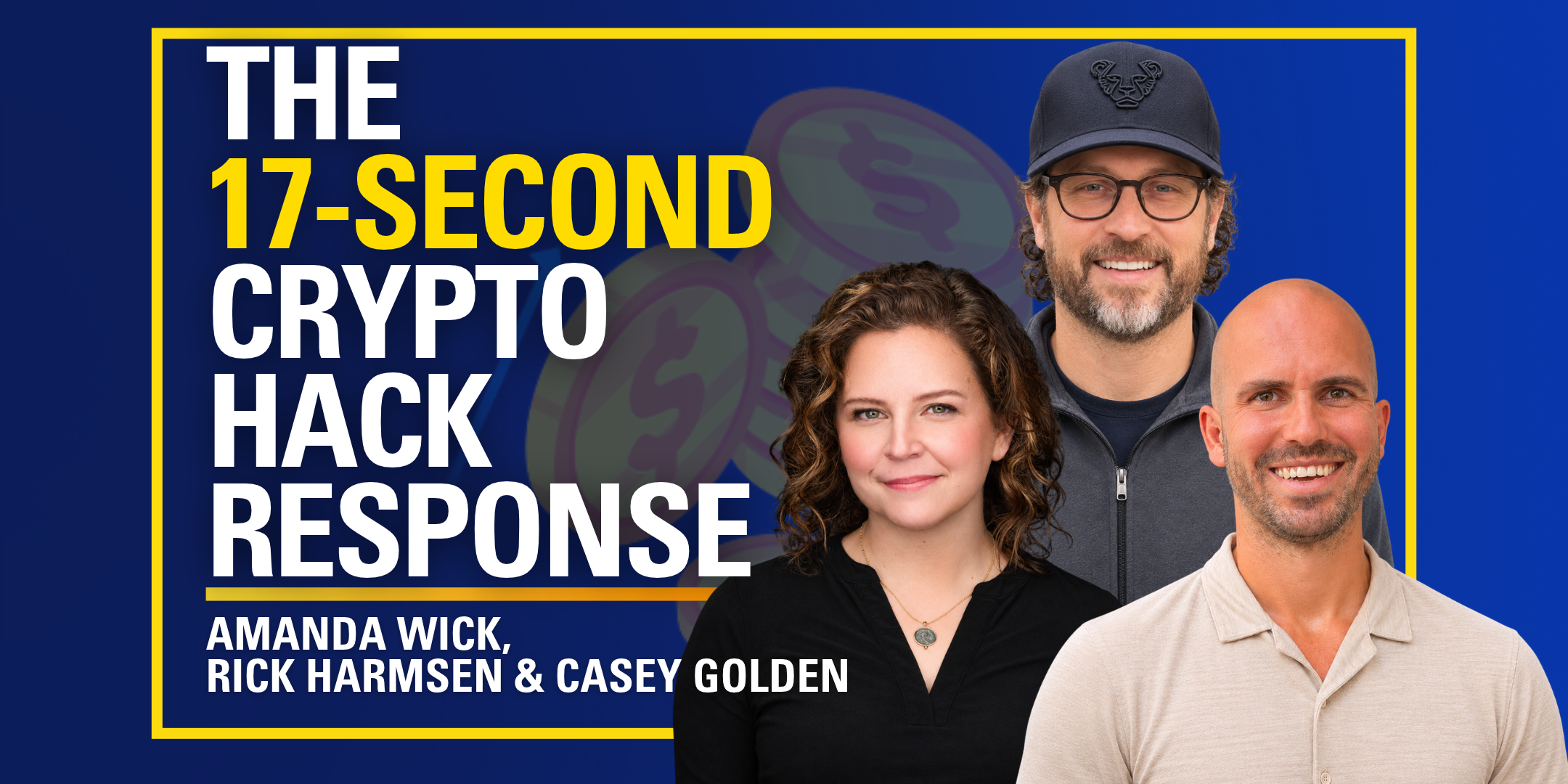
The 17-second Crypto Hack Response - Amanda Wick, Rick Harmsen, and Casey Golden | ATC #637
The Binance hack raised serious questions about crypto security, accountability, and how the industry responds when billions of dollars are at risk. In this special Around The Coin discussion, Stephen Sargeant is joined by Amanda Wick, Head of Americas at VerifyVASP; Rick Harmsen, CTO of Data Expert; and Casey Golden, CEO of ZeroShadow, to examine what happened behind the scenes and what the incident means for the wider crypto industry.
From ZeroShadow detecting suspicious activity just 17 seconds after the exploit to the controversial decisions surrounding stablecoin freezes, the conversation explores the challenges of crypto investigations, the role of law enforcement, gaps in compliance standards, and why individual victims often struggle to recover stolen funds. The guests also discuss AI-driven cyber threats, weaknesses in existing security practices, and whether exchanges are doing enough to protect their users.
Beyond the Binance hack, this discussion challenges the industry to move beyond minimum regulatory requirements and take greater responsibility for consumer protection. Because if billions can be frozen in under an hour, why can't the same urgency be extended to everyone?
Host: Stephen Sargeant
Guests: Amanda Wick, Rick Harmsen, and Casey Golden
We are also available via:
Buzzsprout • YouTube • Quora • Medium • X • Facebook • LinkedIn • Soundcloud • Apple Podcast • Spotify • Player FM
Episode Transcript
Stephen: What are your thoughts about Binance? Are they too big to fail? The question is, what's more important, Binance losing all these funds or, like, all those people losing all their funds?
Amanda: Woman loses life savings. People lose life savings. People commit suicide over this.
Casey: We're in for a really, really difficult time from a security point of view.
W- we didn't even talk to Binance at that point, right? We already knew what was happening. Uh, 17 seconds after the exploit happened, we notified sort of Seal, says, "Hey, like, something is not right with the situation going on."
Stephen: I can't imagine that one laptop could cause $6 billion to leave an organization as big as Binance.
Casey: There's another exploit, another one just two days ago or so, and it was a couple million dollars.
Rick: Think about what happens if Binance fails. Like, what would it mean to the industry.
Sarah: Disclaimer: This episode of Around The Coin is for informational and educational purposes only and should not be considered financial, investment, legal, or tax advice. The views and opinions expressed by the host and guests are their own and do not necessarily represent the views of Around The Coin or its affiliates.
Any discussion of companies, individuals, cybersecurity incidents, investigations, digital assets, cryptocurrencies, stablecoins, or regulatory matters reflects the perspectives of the speakers and should not be interpreted as verified findings or an endorsement of any company, individual, or course of action. Nothing discussed constitutes an offer, solicitation, or recommendation to buy, sell, or invest in any asset or security. Always conduct your own research and consult a qualified professional before making investment decisions.
Stephen: This is the first time we've ever done this on the Around The Coin podcast, where we just speak to industry experts, no BS, no filters, and just have them talking about what everyone's talking about.
I've seen a million TikTok videos on the Binance hack, a lot of them heavily inaccurate , I believe. So I figured why not get the experts from legal, from investigations, people that literally are in charge of tracing some of the biggest hacks in the world, all on one session, and then break it up into two parts.
So we're gonna have multiple speakers. Today we have Amanda Wick, Rick Harmsen, and Casey Gordon. We're gonna talk all about the hack. Everything that we wanna know, what's really going on behind the scenes, and remove all the fluff and the promotion of products and solutions, and talk about, hey, what does this mean for the industry?
Talk about the nuances, like why is so much action being taken because it's Binance? So we're gonna go around the table. I'm gonna start with Amanda. Tell us who you are, why you're here, and why you love AirDrop.
Amanda: Yeah. So, uh, Amanda Wick, a former federal prosecutor, former FinCEN, former Chainalysis, uh, former Hill- I- Hill adjacent, um, and most proud of founder and former CEO of the Association for Women in Crypto, which Steven is probably one of our biggest allies, which is probably why I'm the world's biggest fan of AirDrop, because when he's your biggest fan, you tend to be his biggest fan.
Stephen: That's awesome. Rick Harmsen, we work with Data Expert, but you do investigations. You don't promote any time you're doing it. You put out so much community knowledge. Just give us a little bit of intro of who you are, what Data Expert is, because I think you guys don't promote yourself enough to the industry.
Rick: Yeah. So Rick Harmsen, CTO of Data Expert for Crypto Deficit Branch, basically supporting worldwide law enforcement, defense agencies, uh, financial institutions in regards to learning how to trace everything in regards to funds that move on the blockchain, doing our own investigations, providing support, consultancy on everything that has to do with basically, um, supplying teams with the knowledge in how to keep yourself safe in the blockchain environment or to trace when something has, uh, has taken place.
Stephen: I'm excited to talk to you, especially from the law enforcement perspective and what you see behind the scenes when you're supporting them working these investigations. Casey, you know, your whole team, I believe, spun out of Chainalysis doing these type of investigations, and now you're one of those agencies that the biggest exchanges call when these hacks happen.
So maybe you can give us a little bit of intro of who you are and what you do.
Casey: Yeah, of course. Yeah, thanks, Stephen. Um, uh, yeah, so we, we focus on f- uh, four primary areas, and again, we get to, um, uh, interact with Amanda, and, and Rick's amazing. Um, his, his, his work, and it's, it's... We-- Our general approach before getting even what we do is w- it's, it's a community, right?
I think maybe that's maybe part of my, my point, especially in this Binance case, um, is that we have to do this together, and it's, like, a, a really important thing. Uh, and we can talk about the good things and the bad, right? Currently in that sort of, like, coordination. But for us, we, we focus on incident response.
Uh, we moved into risk management. We do quite a bit of that, preventing things from happening. Um, triage, which is our twenty-four-seven VSOC, and then we do our threat intel package, and I think that's actually one of the important things for us anyway to sort of stop this crime and, and to support law enforcement actually, um, in doing that, to actually action these, the hard work of everybody in the, in the, um, industry.
So yeah, super excited to be here and, and, um, anything we can do to support, uh, you, uh, Stephen, and, um, it's a, it's a pleasure.
Stephen: Casey, I wanna start with you. What happens when you get a call like this, when s- you know, the Slack is going off, "Binance hacked. Binance hacked." Talk us through, uh, as a company, what that means.
How do you guys get into action? Is... You know, does the Seal team get involved? Does... At all, like, h- what happens, like, a minute after this hack is noticed fr- from your perspective?
Casey: Yeah, great question. Um, yeah, and, and again, in this particular case, um, it's, it's been a re- it was a really wild circumstance. We...
So generally we, we try to sort of watch for pitfalls and things that are happening in general for, for risk, right, of, of different things happening. So, uh, seventeen seconds, actually, we sort of, like, did this. Now, seventeen seconds after the exploit happened, we notified sort of Seal, says, "Hey, like, something is not right with this, this situation going on."
So it was fast. Like, it was, it was super fast. Um, we immediately then notified through them, um, actually Seal and, and Tae and a whole bunch of amazing people on Seal, like, we, we get to work with all the time. It's like, "Uh-oh." And it's like something we know right away is wrong, and so immediately, we just straight went to the stablecoin providers immediately to sort of, like, get that action.
Before-- We didn't even talk to Binance at that point, right? We already knew what was happening. Um, so it's like all these things happen in parallels. Everything happens, um, because everything is moving so quickly. So we did that and, and kind of moved, uh, through that process. So I think a normal circumstance, we'll notice something completely abnormal, um, weird, somebody may notify us, but n- the first part is to, um, basically minimize damage.
Right? So there, there's an initial sort of rush. Everything is happening. They can't do everything at once. They're doing a lot at once, but not everything at once, and the, the important part is to get as much done as quick as possible to, uh, sort of like, uh, put a ring around the sort of damage, right, that they could possibly do.
So, uh, that was the first maybe hour, two hours, right, um, that I
Stephen: would say happened. I want, I want to interrupt you there c- 'cause you mentioned stablecoin providers. Amanda, you know- Mm-hmm ... this is one of those things where stablecoin providers, there's no law enforcement request. You, you know, you're talking s- seconds and hours.
The first thing you're doing is not even notifying law enforcement. You're getting on the horn with the stablecoin providers who have the ability to freeze these funds and redeem them or do whatever they have to do afterwards, but they have the ability to kind of, you know, soften the blow and definitely put a ring around transactions that are involving their tokens.
But what are your thoughts about, A, law enforcement is not even involved in this process, and we've seen issues where this happens to, you know, an elderly woman in Nebraska that's lost her life savings- Mm-hmm ... and it's almost impossible to get a freeze. What are your thoughts around the stablecoin providers?
Is this a good thing? Are they setting a bad, from your legal stance, are they setting a bad precedence in stopping these funds immediately without a court order, but not doing those for maybe lesser or not well-known cases?
Amanda: So, uh, it's funny you say this, and, uh, I recently got some advice, uh, that I should be a little bit more calm and not so shamey, and I try not to be shamey, but it is very frustrating, um, only because I remember, I think it was, like, two days after the Drift hack, me and Michael Lewellen were talking with Laura Shin about what had happened for six hours.
There were a couple of things that I think pissed people off, right? Which is for a very long time, Circle in s- in particular told law enforcement that it was technologically impossible for them to freeze. Now, let's, uh, let, let me give them the benefit of the doubt and say maybe that was true at one point.
I don't know. But I think we could definitively say now that it is clear that that's not the case, right? And I think part of the frustration, particularly from law enforcement folks I talked to, was exactly what you said, was that they work these cases. They put up good packages. And Casey talks about this a lot, which I really appreciate, is that I do understand the, the quality of investigative packages issue, right?
But even where there have been quality investigative packages, the response has been zero, and my frustration was because, yes, I get reach-outs from victims, but I also sometimes get reach-outs from companies who maybe d- like, are early stage startups, maybe don't have legal on board, right? They're just reaching out to former feds, trying to find a contact.
They are like, "How do I get this money back?" And they are just a company that frankly is too small to care, and that's the thing that I think enraged people, is- W- woman loses life savings, right? People lose life savings. People commit suicide over this. You just have to watch Aaron West and Operation Shamrock to see that the real impact that this has.
Companies lose money that could be, like, terminating, right? And Binance loses what? Like, two weeks of profit, and they're an investor in Circle, and they get a freeze in less than an hour of $800 million. And it can't be the DPRK issue because people were screaming for six hours that Drift was DPRK linked.
So I'm just trying to figure out, like, how does Jeremy write this op-ed this time to spin? And this is, like, the thing that all of us are kind of like, how do you explain this? Because I think what was interesting, and, and, and don't get me wrong, I, I really try to be fair. Circle, I think the issue was people were upset with the hypocrisy.
With Tether, like, somebody said to me, "I didn't expect any..." Like, "I don't expect anything better from them," right? Like, but I will say most law enforcement you will talk to will say, "Actually, Tether's pretty good about freezing, and we even get reminting from them." It just depends on what country you come from.
So my, like, really big takeaway for this, and I think this is something that Casey and I are both really passionate about Is we need better standards in all of this, right? Like, there needs to be clarity in when are the issuers going to freeze? What's the pro- It can't possibly be that you have to wait until legal process.
I think Circle's position there is going to be untenable, not necessarily from a legal perspective, although I am dead curious how the Drift hack law- class action lawsuit goes after this. Side note on that. But I do think, like, it's not just a legal issue, it's an ethical issue, right? It's like, can you as an issuer stand by and just watch as funds move off your platform if you have the ability to do something about it?
And I feel like in Tradfi the culture was different. Like, I used to get freeze orders from... Everyone's got a freeze order from a bank over the phone when the guy was in the lobby trying to get his fu- money out while we were executing a search warrant on his house. They did it on a call, and they did it for three days until I could get a seizure warrant.
So I feel like it's like the ethical issue blending with the legal issue, where we're moving beyond what do you have to do to what should you do because the world is about to have multiple choices for genius compliant stablecoins. And what, like, what do customers want? Because if the answer is, "I want somebody who's gonna freeze and help me," I think they're really starting to see who's gonna help, who's not helping, and this incident just made really clear who can help and chooses not to, and I think that's a very big deal that we have to talk about more.
Stephen: Rick, I wanna go to you. You're working with law enforcement. You've seen probably the quality of reports from all sorts of places, because law enforcement relies a lot on your investigative expertise at Da Expert in order to complete their cases. I don't think that the law enforcement you support would be able to do a lot of the work without you.
What are your thoughts about the freezes? Is it one of those things like, "Hey, we were able to take away $3 billion from DPRK. A win's a win. We'll worry about, you know, the elderly grandma in Nebraska a little bit later"? Uh, what are your thoughts on this, about the Binance hack in general, and do you think there should be k- kind of a standard?
And then I'm gonna go to Casey, who's trying to effectively push some of these standards across the industry as, like, more of a self-regulated thing.
Rick: No, I, I totally agree with, with Amanda and, um- You know, standards are lacking in this space. I think you see it all around the board. Um, I think it's really something that, um, that's really apparent in cases where it's almost like do you know someone somewhere and how easy can you get in if you want?
Like, being on a call, being able to make a freeze somewhere, um, even for seven days, which we experienced, like, without any issue. And the other ones are like, "No, no, no, you know, you need your, you need your law enforcement request," and so on. Even if you're, like, supporting a law enforcement, for example, at the moment, just because, like, connections are everything in this space at this moment.
And I think that's a really big problem. The, the, the question is, I think at, at, at this moment, like, what's more important, Binance losing all these funds or, like, all those people losing all their funds? Like, those sole victims, they're losing 100K, a million, 1.5 million, which effectively if you, if you- That equal, that
Stephen: equal 3 billion if you collectively put them together, right?
Rick: Exactly. A- a- and let's be honest, like, if you look at, like, where all these cases are originating from, they're also, like, mostly centralized criminal entities. So, like, supporting all those cases on a larger scale and making sure that those get processed and that law enforcement actually gets through, like, that also tackles, like, a big part of the whole crypto scamming, Roman scamming, investment scamming.
That whole industry will get tackled if everybody, like, does a little bit more effort in making sure that those cases get through. But I think it's all ab- it's all across the board eventually. I think law enforcement has a lot of ground to win. Like, if you look at, like, the teams working crypto cases, you know, they handle 1% cases because just smaller teams are not equipped well enough.
It has to do, of course, with, you know, with licenses, costs, and training and, you know, can you get everybody up to speed? It's always a budget versus training versus capability issue, like, inside the teams itself. But also goes to the exchanges because, you know, the bigger exchanges, of course, they got their standards to a certain point in order, which you can doubt if you look at what happened with Binance right now.
But all the smaller exchanges, you know, what, how they are running their teams, you know, a lot of them are already happy being ready with, like, the, the CRC, for example, at this moment. You know, your standard training, you know, having your basic fundamentals things in order. And, and I think there's just a lot of ground to win in general where, you know, the industry is young, yes, but, like, the amount of money that's being made on those entities, you need to do a little bit more.
Stephen: Casey, I wanna ask you, because Zero Shadow had this initiative and still has this initiative, is like, how can we remove law enforcement from this entire equation and do the bulk of the work with the industry, which we saw actually play out well in this Binance issue, is like, hey, we were able to grab a half of the funds without the FBI or the Department of the, you know, Treasury labeling this as DPRK.
Uh, how can we push this forward? How can we create standards from this? And what are we learning from this process? Where are the holes? And like, hey, this is great, we're self-regulating, but there's still some gaps where we need law enforcement to come fill in for us.
Casey: Yeah, I think, I mean, I, I definitely agree with everything Amanda and Rick had said.
Like, there's The first point I'll just say is like there's a constant sort of work and, and certainly frustration from our team of trying to get the cooperation and coordination with sort of the stablecoin issuers. Um, the interesting thing is we're seeing certainly at least some of the newer stablecoin providers in the market actually action a lot faster.
There's another exploit, another one just two days ago or so, and USDC zero, like they made the call, right? And they sort of froze the money, and it was a couple million dollars, and we had something sitting for Circle as well and no response, and it's really frustrating, right? So I think we... It, it's inconsistent.
I think one of the challenges for, um, at least us, and I, I'm curious if, if Amanda and Rick are seeing the same thing is, is there's no defined standard of what evidence you have to produce to get the call, right? Like if there was, then we could like build around it and coordinate even with the agencies globally, right?
There's a lot of amazing work that Amanda's team and, and, uh, certainly Alex Kim from UpBit is like doing to coordinate global resources, right? Like trying to get global law enforcement to support the action like of the private industry who qualifies to do that, right? So we're, we're working. We just don't know what the standard is, and it's really frustrating because it breaks your heart when, when we do things like, uh, Rick and Amanda were saying.
Like we certainly work big cases, but we have a, a huge number, hundreds of cases each month where we're helping mom and dad and your f- their friends and, um, it's their life savings, right? And they're brokenhearted, brokenhearted, and that's sort of like one of the reasons why we do this and, and support.
To-- for me and the team, it seems a, a really big struggle to not know how to Give the right evidence to those companies to meet their standard of, like, uh, making a freeze. Rick said it's a lot of relationships. He's absolutely right. Um, it's unfortunate in that sense because it's a limited sort of non-scalable path, but it is how it is right now.
Uh, and I think what I- I'm hoping, again, like, and it- to the point I'm hoping, hoping, is that the companies who are really responsible meet the standards of the traditional finance sort of example, right? Like Amanda was saying as well. Um, meaning their primary goal through regulation and legislation is to protect the consumers and to protect the companies, right?
They're there to he- to help establish the risk management standards, and if something happens, how to mitigate those. It's not to protect assets in the sense of, like, liability. It's, it's to sort of pause, create friction, hold on, we're gonna investigate. Give us a few minutes, give us a few hours, give us a few days if we have to, to take a look.
Even if you freeze something, right? Like in a stablecoin sense, you can release it. It's not a one and done. You can always sort of take time to investigate. And I think an- another thing that was noted, and again, just talking to ask- Kim is working with a lot of things for Amanda obviously. Uh, some recent conversations were exchanges have the right to freeze on suspicion, right?
They do, right? They have the right to do that, and the same thing with stablecoin providers. Take your time. It's not where anything is gonna go wrong, um, in terms of the long term, but it's a, it's a social responsibility, an economic responsibility. And ultimately, if you're gonna be a player economically, like as a stablecoin provider globally, you're gonna have to show how you take care of the people as long-- as well as the businesses.
But both. It can't be one or the other. It's gotta be both.
Stephen: Amanda, is this a legal issue? Because, you know, regulation doesn't say that, you know, these stablecoin issues have to do anything. FATF has mentioned it, like, "Hey, member countries should start considering whether stablecoins should monitor the secondary market actively or proactively."
But w- we know if FATF is mentioning it today, we're not gonna see anything enforced in the next four to five to six years. So is this a legal issue? Because Circle's getting sued either way. Circle's getting sued if they don't do anything. They're getting sued when they do things. Same with Tether, right?
What? Tether makes money
Amanda: I, I think
Stephen: it's- Casey, not, not just like stablecoin issuers in general. Um, and-
Amanda: No, no.
Stephen: Yeah ... based on
Amanda: Casey's- I, I totally get what you mean ...
Stephen: based on Casey's point of saying, "Hey, we need this standard," is that kind of like, well, if we create the standard, then that opens up the floodgates of people meeting the standard, and that has to take action on something that isn't our core business model.
So that's why they kind of leave it in this gray area, and they can kind of have lawyers kind of push back when they're like, "Hey, this is not worth our time."
Amanda: So I think it's an interesting thing, and, and I think the question is, is your question what do they legally have to do? Like, what are they legally required to do?
Or to Casey's point, like compliance, which is not really a legal thing, right? I mean, it is. There's, there's obviously like... There's obviously laws and regulations that set out like a compliance framework, but the actual practice of compliance, right? Like, we all know tons of people in compliance who are not lawyers, right?
And so there's this, there's this question of the risk-based approach and who do you want to be as a financial institution. And if you're legally required to do this floor, right, do you step above that floor because it's the right thing to do? And I think that's where it, it, there's a very interesting dynamic right now o- of what's happening, particularly with the major stablecoin issuers and with exchanges, is that some of them are in jurisdictions where the, where the laws and regulations are very clear, and some of them are offshore VAS where it's not even clear who their regulator is or what laws they're following or, right, or what standards they're even subject- Or where they're headquartered.
Or where they're headquartered, right? And so like that's a massive problem. So I think, you know, one of the interesting thing about Ca- Casey's point is that standards are different than what you're required and regulated and obligated to do, right? So if you take Binance, for example, I'm, I'm not even sure where they're regulated now.
I think it was ADGM. I'm not sure. I can't remember where they are now. But like wherever they are, if their regulator doesn't require it, if you put standards and say, "Hey, the industry is gonna set this floor for standards, and everyone should adopt it." And let's say the Coinbases of the world, the Geminis of the world, the Bitco- like everybody jumps on board, and Binance doesn't.
Then it's an issue of, well, now you're just telling consumers who you really are. You're telling institutional who you really are, and you're being really honest about who you are. And that's a different thing, right? So that's why I say the question isn't so much legally what they're required to do because, to a certain extent, I think crypto more so than TradFi still lives in a world of we're gonna try to find the bare minimum of what we legally have to do, right?
To Rick's point earlier, I used to get so frustrated when people would say this, this industry is so nascent, and I'm like, "I think it's 16 years old, and in some countries that's people getting married and having babies. Stop saying it's young," right? But it actually kind of is when you think about how long TradFi took and how long the evolution of a lot of these things took in other industries.
So I've kind of checked myself on like my triggering there. But I do think there's a really important question when if you go back and read, it was a while ago, but if you go back and read the op-ed that Jeremy wrote, um, about like Circle's decision after Drift, he did like he pointed out several things that, that he thought like made the decision difficult, right?
The, the legal question, the moral quandary, the are we becoming like the arbitrary kind of like when do we decide to hit the button? And a lot of us who were in TradFi were like, "Did you not know what running a financial institution would be before you started a financial institution?" Like was this a surprise?
Did nobody warn you that this was life as a financial institution? Like it, it felt like somebody like surprised him with the la- with, with, with like life the day after that hack and was like, "These are all the questions you'll have to face." And I think the problem is, is that, a- and I know we've talked about this, Steven and I, you and I, like so many times, they are living in glass houses.
That's just the nature of crypto. We can see everything they're doing. If you wanted the pl- the, the pleasure and the privilege and all the benefits that come with living in a brick house, go back to a bank where nobody can see from the outside, where people can't... where a Casey can't find you in 17 seconds and know that your accounts have been hacked.
You chose to enter the world of living in a glass house. You wanted to get into the future of digital finance. You wanted to adopt the technology that has different risks, different speeds, and an insane level of visibility. You made life choices. Now you're a grown-ass adult and you have to deal with them.
Like, I don't understand, like, how that's such like a, a big debate. And so, like I, I want standards only because I think people aren't paying attention to what's gonna happen with Genius and the implementation. Because somebody was messaging me the other day about like, "Well, what Genius compliant stablecoin should we use, if not USDC?"
And I'm like, first off, nothing's Genius compliant yet, 'cause they haven't, they haven't, like, officially said that. But look at how are people going to handle freezes. Look at how they're going to help. Do they have a freeze mechanism? Do they have a, we participate with law enforcement, or do we cooperate with private sector, like Casey and Rick, who are doing what some law enforcement can only do in weeks or months, right?
So I think it's just, we have to move behind, like, what's the legally obligated thing to do, because I just think businesses that live on the floor of what they have to do aren't gonna be able to compete in a super competitive, visible glass house of, but what are you choosing to do to actually help customers?
'Cause crypto customers are a lot more a- attentive. Like, if you're in crypto, you are DYOR'ing your ass off compared to people in TradFi, right? Like, you've already decided to enter an advanced industry. You're looking at different coins. You're looking at different exchanges. You're looking at different issuers.
You are a much more kind of, I don't wanna say savvy, but like, guys, jump in if you know a better word, but you know what I'm getting at. Like, they're just- Yeah ... more, like, attuned to this stuff. Like, they're doing research in a way that I, sitting in my bank, I've been at the same horrible bank for 30 years.
I cannot escape that bank, right? They- But I change coins ... can
Stephen: move from dozens of glass houses. They can actually do a lot of that research. They can-
Amanda: Yeah ...
Stephen: change things like exposure. Rick, I wanna go to you about, like, Binance as a whole. Because let's not f- you know, I don't wanna play devil's advocate here, but four years ago when FTX was going under, nobody was mentioning Binance's DPRK action or their activity.
Everyone was like, "Please, Binance, bail out FTX so we don't lose all of our money." Nobody was going after Bi- I didn't hear one post about how bad Binance was when FTX was going under. But you're also doing a lot of the investigative work. We do a lot of trainings together where we see a lot of activity somehow hitting Binance.
What are your thoughts about Binance? Are they too big to fail? Do we just have to accept some of this illicit exposure in order to, like, keep the industry moving forward? Or what happens if we would take Binance offline? Could the industry even survive the way it is, or that just opens it up for other illicit actors or, you know, actors that do participate or receive funds from illicit actors to just thrive in this, like, underground crypto hawala market?
Rick: I think it's an interesting take to, to think about what happens if If Binance fails, like, what would it mean to the industry? And maybe it also, maybe it's, like, similar to what would it mean if, like, uh, Microsoft and, and, and, like, Apple, for example, you know, dies off, like, what would happen with developments in general, for example?
I don't know if it's the exact right comparison, but I do think that they're as big as they are, that they do have, like, a big part of the ch- of, of, of the pie basically in what is happening and, and, and how, how much users are getting onboarded. And, but, but one, but one thing that just keeps going through my mind is, like, like, seven- I'm just thinking about 17 seconds, like, how quickly everything basically got...
And I'm like, "What the fuck are we even talking about in regards to setting standards?" If someone from the outside basically is able to detect what the hell is going on in 17 seconds, is able to go to stablecoin providers already notifying, and then we're talking about should we set... You know, this is the exact reason for me at least, like, why I think that if people are, like, looking at FUD off standards and, and all the other things in regulation that is going on, it, it's, it's nice to have.
It's nice to wake up the industry. You've got to comply to certain kind of, you know, parts that are really needed if you want to protect your consumers, and you know, everything, and how you are setting up your teams and your, at least your bare minimum of know what is happening with the transactions. But, like, 17 seconds, yeah, like, look at what is possible and how shitty everything is going on if someone gets scammed on the outside right now.
Because I'm quite sure that you could apply at least some of those heuristics and inner workings and monitoring functions to get a big percentage off the charts and people that are getting scammed. And for example, as, as I think it was Casey who, who s- who said it, like, freeze the damn funds for a moment, investigate it, and don't take, like, two or three weeks, as we all know happens with the most bullshit questions that there are so now and then.
But, like, with really legitimate direct questions that makes you process, like, the whole process basically much quicker. Like, 17 seconds, like, it standards are applicable. You, you can do it if we just want to, and invest in it, and make sure that it is running correctly.
Stephen: I feel like I have just so many content ideas.
Like, you remember the show The First 48? The First 48 hours after- Yeah ... a murder? Now it's 17 seconds. I just want, I just wanna chop up this whole podcast into, like, The First 17. Yeah . And it's, like, a little clock. You just see the second mark. Casey, tell me something that we don't know. or that, you know, demystify something to us about this Binance hack.
I'm seeing so many rep- I'm seeing people mention nonces and all this sorts on TikTok, and I'm seeing everyone try to reframe it. This isn't a, you know, uh, this isn't an investigative pro- this is a privacy th- Like, everyone's trying to, like, gear this conversation to whatever product solution or consultancy that they provide.
Give us something real where it's like, you know what? Like, is it the, the laptop, the Hunter Biden laptop type investigation? We're hearing a lot about this one laptop, and I can't imagine that one laptop could cause six billion dollars to leave an organization as big as Binance. Give us something. Give us some juice about what you're seeing, and maybe even if the question's still out there, like, "Hey, I don't know exactly what this is, but I know it's something here that we need to investigate further."
Casey: Um, for sure. I think generally speaking, I think, um, because of the glass house, I love that analogy, Amanda. Um, because of the glass house, we can start working backwards, right? So what we know is that there was some type of authority compromise, right? So, so then you start working backwards about how did that authority get sort of taken because essentially, and the, and I'm not gonna be technical 'cause there's a lot more on blogs and things that can do that, but basically they got permission, um, and tricked the system to sort of do what they wanted it to do instead of what Binance wanted it to do, right?
The different mechanisms and VIPs and, and, and ways they did that. That being said, like that all points to something in the system was compromised, and one thing that is consistent with this particular threat actor, Trader Trader, um, and it's a unfortunately a rise generally, is that the source of, um, hacks for people also actually like the citizens that we, we deal with and Rick deals with, Amanda, um, helps through as well.
Um, most of them are not necessarily smart contract exploits. There are some certainly, but, but the number of exploits that, that happen, the vast majority start off chain through some type of compromise, right? Some device, some key that's given, right? Because you wear me down and I'm so emotionally drained that I just trust you, Stephen, that you're the, uh, consumer support of this company.
And I'm like, "Okay, here you go. Help me save my money." So that's really the source of a lot of these issues. And it's, what's interesting is, is that the Um, general causality of it, of where there is some type of infrastructure breach, it's propagated to where it needs to get to to cause damage, and then it's executed.
So it's not that far from Bybit. It's not that far from a lo- large number of other ones where they'll take time. I think that's one of the things that some folks were asking about today is how fast did it happen? And we don't know exactly how it happened, but looking at the patterns, generally they'll take weeks, months, maybe six months or so, 'cause they're very, very patient.
They wait until it's the right opportunity to strike. They wait for distraction. They wait for a lot of stuff going on. Um, and even the time of day helps them, right? Because, for example, they'll often do it at Friday night, um, at, like, ten PM Eastern Time when the rest of the world is asleep. All these things where it's
When you have that seventeen seconds part, nobody can respond- Mm ... 'cause we're all sleeping, right? Like, th- this is a sort of reality world. And so we've, we try to fight against that and work with, um, folks around. But I think to get to your, your question that you were asking about, the one thing that is maybe unique is that it's not unique.
Maybe I'll sort of throw it back that way, where it's like we've seen this sort of typology over and over and over again. Um, but it's so subtle, and I think that's what is happening, where things that you didn't think were problematic when you do your sort of risk and sort of security around our systems, those little tiny gaps in the window now cause big problems, right?
Where they used to just stay little problems. But AI is helping discover the connections between things that weren't really thought of connecting before, and then you get to where you wanna go. So I think that's one of the t- transitions, especially with the emergence of the AI sort of enablement, perhaps, right, of these, these crimes is even when you have something small, you can make it a, a large sort of role, a large authority.
And, and I think that's one of the things that's problematic and actually quite scary for citizens as well as, as companies. But I think, like, just going back, that's why we have to agree and, um, move faster than regulations. And one example I would say, like, there was a case four, three, four weeks ago now, um, UK, it's public, um, where a person was held, uh, at knife point, right?
Um, a knife point they posted on X, right? Yeah. Um, wrench attacks are, are on the rise. In a matter of an hour, right? Like, they posted it. Seal picked it up. Um, we sort of helped action it in our threat intelligence network, and within one hour the money was actually frozen. And who froze it? It was a decentralized sort of entity.
They don't have any regulations. They're not like ... There, there is nothing there. But they took the action, and I think Amanda's point is really spot on, is, is there is a general standard of, um, ethics that it's almost odd where we see those who don't have to comply actually at all, 'cause they're not even registered in a jurisdiction.
They're the ones taking action, helping the victims oftentimes more than those who are registered in a certain place, um, and would have the standards of traditional finance to, to use as a reference point. So I think that's, that's one of the interesting things, is that there, there's a consistency, but I think it's, uh, we're in for a really, really difficult time from a security point of view, um, because of the AI assisting these things to happen more frequently, um, at larger scale.
Stephen: Amanda, I'm curious I was going to go to you and see if you saw anything other than the, you know, the whole stablecoin fiasco. Is there anything interesting? But feel free to, uh, uh, piggyback on what, uh, Casey said, and then add in your own thoughts about was there anything interesting that you saw as part of this, maybe outside of what we've already mentioned around the stablecoin issue?
Amanda: You know, so, and it's so funny, because I was literally just about to respond, and then I completely lost... Casey, what was the last thing that you were saying? Like, what was the very last thing you were saying? Do you remember?
Casey: It was about-
Amanda: We're definitely going to have to edit this part.
Stephen: It's around decentralized, the decentralized- Yeah Oh,
Amanda: yeah, yeah.
The revenge attacks. The ethics thing, right? Like, right, and revenge attacks. And, and, like, do, people doing, like, what they don't have to 'cause they're not even regulated, right? That, it's a really interesting thing because I, I, I think... I, I was, I was talking with, uh, I was in a call with Joanne Barefoot the other day, and she said this really cool thing about AIR and, like, the Alliance for Innovation and Regulation, and how, like, we're evolving into this, like, w- jurisdictions moving away from we put out a rule, and then, like, life ha- Like, the idea that we're basically gonna need, like, reactive regulation or, like, iterative regulation.
Just this idea that regulators are gonna have to adapt, like, a lot faster. And I think there's this really interesting question about, I think it's very hard for regulators to kind of m- m- set standards and then, like, monitor and police them, like, regularly, right? Like, that is very, very hard to do. I think my frustration is that I think that's where the industry could be really good, and you see some of the, some folks in the industry saying that, and saying, like, "Hey, we wanna be good."
And, and I fi- I, I just realized at the beginning I forgot to mention my day job, where I, I work at, at the head of Americas at Verify.bas, and all of my views are my own and not necessarily those of my employer or anyone that I'm associated with. But we spend so much time, I feel like all of us spend so much time talking with folks, right, particularly in the compliance phase.
And you rapidly realize during the course of a conversation, d- oh, you just want checkbox compliance, or you actually want to know who's on the other side, right? And I, and my fear with regulators is that the actual success that they're having in kind of monitoring and patrolling that seems really questionable, right?
I mean, like, every other day, I'm reading Charlene Cis- Cislyk, Kislyk, like, right? Like, the, the queen of, of monitoring, like, the horrible AML in Canada, right? Like, when I wanna know, like, how garbage Canada is, I go to Charlene, right? 'Cause I think America's the worst, and then she's like, "I double down on Canada being the worst," right?
But it's really interesting because this culture that we have, I don't know that it translates into crypto, right? Because we have this massive offshore VASP problem. And going back to Rick's point about Binance, one of the problems that I have is that right now, like, the cost-benefit analysis in compliance of doing this is just so heavy in favor of take the dirty money, don't help the victims, right?
Like, I mean, I remember, I will never forget, and he said this publicly in front of the press, but Noah Perlman, who was the CCO of Binance at DACOM a couple years ago in New York, he used to be at Gemini, and he literally said something to the effect of, "If I could go back and ask the Gemini twins," like the Winklevi, like, given where they're at in market share versus where Binance ended up, would they still choose to register and be regulated in the United States?
And he said the quiet part out loud. If you could become an offshore VASP and get number one market share, you pay a $4 billion fine, you know, you buy a pardon, and then all of a sudden you're running around living the good life. You're still number one in market share, unclear what your regulator's doing.
You know, trying to petition and negotiate your way out of one or both monitorships and just Doing your thing. Where is the incentive for anyone else to do compliance if you're just watching yourself lose market share and everybody else is gaining market share, right? I think I wanna give them some grace, but I think this was Circle's problem with Tether, right?
Was that you see global inflows going to a company located everywhere and nowhere, and then in El Salvador with a questionable regulator, and you go, like, all in on trying to get regulation and saying, like, "We're the clean ones, we're the best," and nobody cared, so then all of a sudden you're like, "Well, I guess if you can't beat them, join them, and now we're not gonna do anything in re- without legal process."
And so you see people lean into the friction, which is actually the problem. And so you have this system where it's like we need, we need regulators to do something because realistically, I mean, we're all seeing in real time that none of these companies will do anything without being required to. But to Casey's point, I do think there are a handful of what I call good crypto who if they would just be a little bit louder and a little bit out, and I think we're working on initiatives geared towards that, could say, "There are those of us that want standards."
And I think I said this, like, a year ago, and Stephen, I know we've joked about it, the Harry Potter sorting moment for crypto is so here, and we need Gryffindor crypto and Slytherin crypto to really just make clear which houses they're in, and then just make... Like, because going back to the visibility point, you can see who gives a crap and who's doing good in crypto.
You can literally see illicit flows. You can see whose glass house is filthy inside, right? And we can have the argument about, oh, you know, like, illicit flows versus volume, and I've had that debate years ago, and I get it, but at the same time, some of these houses are really freaking dirty, and we just have to be able to have that conversation.
I don't think it can be standards alone. I do think, and I've said this publicly, we need more regulators to start going after offshore VAS that are illegally doing business in their jurisdictions. Because if all you do is police the quality of the programs that bother to register, all the unregistered ones are just gobbling up market share illegally.
So, like, you have all these pieces that have to happen, and, like, we're all kind of pushing in our own ways at those pieces happening. But I'm looking at regulators in some of the major markets and saying, "If you do not take care, if you do not regulate against offshore VAS, if they don't have any regulations to follow, if there's no supervision, if there's no examination, if there's no monitoring of what they're doing, how are they allowed to sell to people in your jurisdiction?"
Right?
Stephen: Rick, I wanna go to you. And- Amanda, I think you great- Yeah ... you have a great point. I didn't wanna cut you off, but, like- No, no ... hey, if you're going with the glass house analogy, well, that glass house that a lot of these legit platforms based in the US- Like, it's on the foundation of some of these exchanges that are offshore.
So if you remove this exchange, Coinbase at any time can cut off any transaction they want from Binance, but they're not gonna do so because then there goes 50, 60% of their transaction volume as well. I'm assuming, I'm not using exact stats. But I'd have to say that you can stop interacting with Binance if you want because of this glass house nature, but they're, they're not doing it, and they're not going to because then obvi- their house won't be sitting on a proper foundation, and now they have a whole other problem to deal with.
So why not wait until the regulators say, "Hey, Binance is a sanctioned entity," like they did with Huobi or HDX or whatever they called themselves. The regulators stepped in, and then you stop transactions with that. But you can do it before the regulators step in. You could do that before OFAC or OFSI sets in But why do you think, Amanda, they're not doing so?
Like, w- you're saying that they can separate themselves. They can do that right now without regulators, but is it worth them risking their entire business model over it? I'm curious what your thoughts are there, and then we're gonna go to Rick.
Amanda: Oh, wait, you were asking me. I thought you were asking Rick.
Stephen: Yeah. No, no, no. I was so gonna ask Rick. We're gonna go to ask Rick, but you- I, uh- ... signed off at the point of the, you had the analogy of the glass house, so I wanted to let you answer before we jump into Rick.
Amanda: I think it's really tough because some jurisdictions... Look, America has a culture of prosecution, and i- if, if somebody touches America, hell, if somebody does a transaction through a correspondent bank in America, right, like, N- New York prosecution is, like, next level, right?
Like, if somebody s- if somebody does a transaction through a correspondent bank, New York prosecutors, whether it's state or federal, will often aggressively find a way to prosecute sometimes foreign conduct in the United States. That is culturally very different than other jurisdictions, right? And it's very difficult.
Like, we see some penalties, but I've read so many of Charlene's posts, right, about how weak the Canadian penalties are, and I've heard so many Brits complain about the UK and their penalties, right? And we've seen some in Australia, and, like, bits and pieces here. But this is where I will say, like, I think the world is seeing how problematic it is to rely on one country to be the police of the world, particularly when somebody wakes up and says, "We're no longer gonna be the police of our country, let alone the police of the world," right?
Like, "We're going to literally draw everything in, redo priorities." Like, and don't get me wrong. Every administration has its own prosecutorial priorities, right? There's always, like, a change there. But if you are counting on, like, the US for extraterritorial impact, and an administration comes in that changes that, then the, then the question is, when are other jurisdictions going to step up?
And the idea was, oh, well, this is what the FATF is for, right? Like, we want all of these countries. But we have a real problem with the FATF, who is, I think, at, the most at risk of its credibility that it has ever been. Because you wanna graylist a UAE, you wanna graylist some of these countries that are like, like, a storm in a teacup, but you're gonna let the United States, the UK, and Canada launder their asses off.
I mean, the Amer- America's about to get spanked in its mutual evaluation because we just blatantly ignore some of the FATF recommendations. This administration even rolled back some of the Biden administration's improvements to become more compliant with FATF, and they just finished, I think, the onsite evaluation, and they're moving towards the plenary.
And everybody's waiting for the inevitable whitewashing of what this report is gonna say because everybody knows how horrible America is, particularly in crypto, where we can see all the glass houses and what they're not doing. And when FATF says, "Nothing to see here, folks You wanna be taken seriously?
And, and then if you're a middle power, if you're UAE and you just spent how many billions getting off the gray list for your little storm in a teacup while you watch the US and the UK and Canada do whatever the hell they want. Like, there's a huge, there's just a huge geopolitical issue to, like, the whole AML CFT concept right now where...
And I, and I forget who said, like, the rules are for thee for not, but not for me. You know? Like, I'm, I'm kinda butchering that phrase, but, like, we are living in that, and I think that's super problematic because essentially everybody's watching and it's like, at what point is enough, uh, is enough, right?
Like- Yeah ... what crypto has done with the visibility is basically show how okay we were. And we've, y- Stephen, you and I have had this conversation, how okay we actually are with money laundering- Right ... and how little actually gets done about it. And we are watching in real time where I'm like, some of these jurisdictions absolutely know that they have unregistered, unlicensed exchanges gobbling up market share and they don't do anything.
So what do they think is gonna happen?
Stephen: That final comment, that final one is a, is a hole in the conversation. Yeah. I, and especially around race and who these countries are that are on the gray list and what they can do. It's like, you know, penalizing the poor and, like, sending them to the electric chair.
A rich person has never gone to the electric chair, in my assumption, in the US, uh, based on that. Rick, I wanted to go to you because you, you know, you're the investigator. You've seen some of this activity on chain. Is there anything that shocks you? Maybe, you know, Binance is used to incoming of DPRK funds, but not used to it, DPRK removing the funds from their exchange a- as much.
Allegedly, right? Allegedly.
Amanda: Allegedly. Allegedly.
Stephen: Allegedly. Rick, what are you seeing on chain? Is there anything shocking there? And is it as complex as some of our, you know, LinkedIn, Twitter, TikTokers are making it seem?
Rick: Well, first thing is exchanges are gonna love us after this chat. Uh, but, you know, let's be...
Like, if you look at most exchanges and their exposure, like, it, it is worrisome. At, at, at, at the least it's really worrisome in, like, what is flowing in it. And people always say, "Yeah, but you never know if the attribution was there before everything was, or, or, like, at the moment everything was flowing into the exchange and so on."
Like, bullshit, because it's also flowing out to all these entities. And, you know, the speed at which things get attributed nowadays is really quick. And if it's not quick, then just look at, like, what Chiyomira and so on is doing, you know? 70, we can just use the phrase 70 seconds for things, like, nowadays.
Like, that's just gonna stick in my head. And, and e- and everything is, like, raising so many thoughts at the moment, like listening to, to, to Amanda, which is already great if you see all the soundbites and so on on LinkedIn, but this is even better. So, um, because like o- one of your questions was would an exchange take their own action in doing something that's really good, like blocking some kind of entity out of themselves, even if it's not, like, on any list or whatsoever?
They won't. They will never do it because they're already struggling with, like, five or 10 ops backs in certain occasions. They're already struggling getting the narrative down, and sometimes blocking for nonsense, which we have clients for, where like, oh, it's a scam. No, it's not a scam. Just learn what happened in 2018.
You know, train your investigators. And then letting through everything else that makes no sense at all, you know, even within, like, four or five days and it's already cashed out to, uh, to other entities. And so they won't take that action because it means a whole lot of responsibility. Like, how are you going to handle it if it goes...
Let's say, for example, you block exchange A and it flows into exchange B, and you, you block exchange A from that moment and a client just cashes out Through just a random wallet of their own, and then inside, are you going to block them as well? Are you going to block them if it's five hops, if it's 10 hops away, you know?
It raises so many questions that's also needs so much accountability for what you are doing, explaining to your clients- Yeah ... explaining standards. And, you know, let's be honest, at this moment, people who are setting the standards, who are sitting at those round tables are the big exchanges who are saying, "We'll help you figure it out," because what do regulators really know-
Amanda: Yeah
Rick: about what is happening on chain? How many regulators do you know who can read a chart? Just looking at it and telling you what has happened on the chart if you, I don't know, map out 20, 30 hops or something, you know? Let's stand alone even bigger cases and bigger examples and so on. So whatever you present them with a really good narrative around it, it will be taken as something trustworthy because they have been running the space for 10 years plus, for example.
So, so I think that it, it, it brings a lot of interesting angles in how to really handle it, but we're already so far in the process of getting regulation settled, you know, with, with, with all the drafts and everything going well in whatever country or however it works in getting to, uh, getting into effective.
So that, that you could almost also say, you know, is it something that is still some... Is it still something that we can contain, that we can, that we can handle, that we can change for the good? Or is it something that's already so settled in stone, all the drafts being out, their guidelines, you know, FATF doing their thing.
No matter how trustworthy we think it is, how trustworthy just the public think it is, you know, that that's the thing that matters in the end and, and, and, and how good their, their chats are overall. So is it something that we can still prevent and, and make better from the start go, or are, or, or are we already, like, too far gone and just gotta accept that we gotta change it bit by- Bybit, Bybit, you know, it's
Stephen: Speaking, speaking of Bybit, that'll be a nice...
I know that entered a little segue there. Uh, Casey, uh, I'm curious, you know, after you saw a lot of what happened with Bybit, but afterwards we saw some main players get taken out for good reason. EXCH, I think, was one of them. OKX had, like, a dex aggregator that was laundering a little too much North Korean funds.
Who are the players that you think are gonna get exploited, potentially shut down, or at least a lot of scrutiny on them after something like this when DPRK is involved? No, I think that- Have you seen any, you know, whether it's a coin swapper, dex, have you seen a little too much action go through one entity that might get a lot more, you know, conversations with, to Amanda's point, with the US government over the next, you know, several months?
Casey: Yeah. It, it's a great question, and I, I honestly, I don't know the details of it because it's, it's moving so fast like a fire hose. I have to stand, like, a few blocks away to sort of, like, not get drenched myself 'cause it's, it's, it's moving at such a rapid pace. And so, um, it's, it's a great question. I think in the next week or so we'll probably have sort of analytics to sort of, like, see where things are going because I think currently they're just using, um, paths that have, um, significant enough liquidity, right?
To kind of get it into position to sort of do more interesting and intricate things and plan things. So I think, uh, it's a re- really good question, and it, and it probably will happen as well. But again, I do- I don't know exactly who it's gonna be, but one of the things that was interesting just hearing Amanda and, and Rick talk, where I think...
I think it's right where I, I don't know if regulation will happen fast enough. But- But in terms of the standards, I think what is, what is place of progress? I'll just put it that way, right? It's not there right now, but I think as a place of progress is there does seem to be a, an enhancement of the cooperation and collaboration between private industry and public, especially in the law enforcement side.
So what I mean by that is there's always that question of, like, if, um, Stephen says, "Hey, like, please freeze this," it's like, okay, like, he has his mind view. Like, what is the standard if, if Casey says it, he's maybe a little bit more expert, but then Rick comes along, he's really expert, right? Like, like, he really knows, and, like, his evidence package is gonna be greater.
And then, so, like, that's all nice, but all that can do is get, uh, is law enforcement supporting you, right? So, like, no matter how good we are, there is always gonna be that. So what I would say is, is progress is there's law enforcement who is, um, instead of coming in their own car a couple hours, a couple sort of days later, right, to sort of verify what the experts have submitted for freeze requests.
They're now actually in the cop car. So basically what that means is with the intelligence packages, again, like, the, that we can have, they can actually submit directly to the stablecoin providers. They can submit directly to the services, whether they're sort of centralized or decentralized, doesn't matter.
So what's happening is there's this timeline is converging, right, and sort of collapsing into sort of a unified one. So all of these questions of, of permission and authority and, and sort of what you have, all that's getting c- collapsed into sort of the same timeframe. So I know there's international stuff, like I mentioned, that Alex and Amanda are working on and, and Interpol and, like, globally speaking, right?
Really some really interesting things that can actually bring down that timeline. So I think to your point, getting back to sort of who will sort of be those who are sort of, I guess, the area of focus of, of kind of shutting them down or sort of getting them out of the, the ecosystem, I think that will h- be clearer when they don't o- oblige the law enforcement requests, right, that are there.
So private industry, um, law enforcement, we're gonna sort of, uh, be at the same timeline. And so once that happens, it's not... A- and again, I'm curious, Amanda, if, with your experience, like, there's regulatory, but then there's law enforcement, right? So if, if law enforcement says, "Please freeze," even if the regulation doesn't necessarily say do it, they have a certain amount of authority to request certain sort of actions to be taken, and I think that may be what moves faster than the regulatory bodies, right, is aligning the sort of like law enforcement side, the, I guess, judiciary side of the, the sort of pendulum.
But I'm curious, like, on that, but I think that's maybe one of the areas, both industry but also with the sort of private industry, but on the law enforcement or the public industry and law enforcement.
Stephen: Amanda, why did you do that shoulder shrug? It was kind of like, "No, they can, but it's not really gonna..."
Like, it-
Amanda: No, no, no, no ... indicates that that's right. Because I'm a recovering lawyer that doesn't technically practice law now, and I, and I felt like the lawyer coming out of me because he's like, he's like not wrong, but not like, it's not, it's, it's super jurisdiction specific, right? Like, and this, this is part of the problem is that everybody treats law enforcement like this singular entity as if, right, like, as if US law enforcement rules are the same as like a Singaporean police officer or a Canadian police officer, right?
And you're sitting at an exchange and you're getting like all these different requests, and the question is, is, is, okay, like, do I have to answer this request based on where I'm from? Could I ask them for an MLAT if I wanted to slow things down? Do I have the legal authority to ask them for an MLAT and just, you know, use that as an excuse to slow them down?
Legally, they could ask for an MLAT, right? Which some companies do, and- Legally they can, but we all know that an MLAT is basically death, right? Like, in the timeline of freezing. And so you see some of these companies, like, basically deciding what they wanna do above and beyond the floor, right? So I w- I was kinda making that motion only because in the United States, the difference between a state and a federal freeze order, right?
And even when we say what is a freeze order, that nomenclature is actually kinda terrible because, like, is it a freeze letter? I once did a freeze call with a bank where I basically said, "I'm, I'm telling you I have exigent circumstances. I don't have a warrant, but I want ... But can you just freeze it?" It was really almost like a courtesy freeze that they decided to do, right?
So, like, in each situation, like, the, the basis on which you're relying, is it a legal request? Is it legal process? Is it a request from law enforcement that you're using as a, um, justification for doing your own very fast AML review and saying, "We're gonna freeze based on our policy"? So, like, like, the, what goes into the recipe of the decision to freeze, we, we sometimes kind of make a lot more simple, and I wanna give credit because, like, when you're sitting in an exchange or at an issuer, like, you're having to think about all of those things.
Like, what is the hodgepodge of things that are coming in that give me the right to freeze? And we always forget, like, about terms and s- uh, terms and conditions, right? Which is basically at most exchanges, uh, we can freeze whatever we want, whenever we want, on whatever grounds, because they want the authority to be able to freeze when they want, but then they turn around and say, "Well, we didn't freeze 'cause we were so afraid the customer would sue us."
I'm like, and yet when you want to freeze for your benefit, you are not so concerned 'cause your Ts and Cs say, we can freeze for damn near any reason we want. So, like, it- Section
Stephen: 14A, A to E. Yeah. AML clause. Yeah, they'll- So- They'll lead you to the terms and conditions quickly.
Amanda: So two quick things, one that I have been wanting to say since Rick said something, like, 20 minutes ago and I forgot, because he made this really, really important point about law enforcement capability.
And one of the things, Casey's kind of alluded to it, but, um, Alex Kim, uh, uh, at Uphold is one of the most passionate people I know at an exchange who's trying to, like, fight illicit finance. And at my company, Verify Vault, we have a non-commercial tool that is only available to law enforcement. So if you are law enforcement and your budget for a tool is zero, reach out to me on LinkedIn.
It is, it is a, it is a tracing tool. It is not meant to replace commercial tools, but if your budget is literally zero, we don't want anyone to not have any tools. So just mes- it is law enforcement only. You have to have active law enforcement address. We do due diligence on that. Just message me on LinkedIn.
I wanna put that out there if you're law enforcement and you're in that bucket of nobody should be out there not able to trace because of affordability. Like, that, that is, that we have to get rid of, and we're working on that. But I think something that, that Rick and Casey kind of allude to that's really fascinating to me, and we've kind of, like, touched on it, and it's, it's probably, like, a larger discussion.
I think one of the biggest existential threats to the crypto industry as we think of it is the silent stalking that TradFi and tech is doing to use this technology and build it in. Like, I don't know if anybody knew this, but the day before the Binance hack, Google actually announced its custody platform that's currently only available for banks and financial institutions.
Like, it's an institutional product right now, but most people... I think it's called Multi-Party Compute, MPC or something. I always confuse it with MPC, but, um, it's MPC, I believe, and it's their crypto custody platform. And, like, it was the day before the hack, so, right, like, timing terrible, like, news got consumed.
But I think what crypto is really not thinking about is that with every day that they kind of refuse to mature, refuse to adopt standards, that they think that they have all this time. A bank, a tech platform, and everybody who has already achieved trust in customers is gobbling up this technology and is going to incorporate it, find a way to build it in.
And my fear is that this beautiful idea of, like, decentralization and the democratization of finance and all the things that a lot of us were passionate about if crypto for good was winning this battle, is sadly... Like, the longer that crypto for bad dominates the conversation and is the majority of the, of the viewpoint, banks and, and tech platforms will just swallow all of this.
Like, like, we won't be talking about Binance someday because essentially they'll just eventually become, like, the criminal liquidity platform or something, right? And, like, it'll just be them dealing, like, with Russia, Iran, and all, and, and Tether, and like, and like, and all of the stuff that we were like, look, everybody knew about.
Like, and I'm, I'm just kind of hyperbolically saying... Somebody said to me, "Everybody knew who Binance, Tron, and Tether were. Circle was the only surprising disappointment," right? And, and that's because, like, for all that they say, like, we're watching what they do, we're watching how they live in their glass house, and S-L-O-K-I, right?
Like, it is what it is. But I, I, I worry about if that's who's the loudest, if that's who's the biggest. If Binance is too big to fail, can you just imagine if a JPMorgan or an HSBC said, "We're registered everywhere and nowhere, we have no regulator, and we're trying to, uh, we're trying to negotiate our way out of a monitorship, and we've made it really clear that we are not intending to turn our compliance boat around."
That, that, that is just so... It's an honesty And a, and a visibility that the world isn't ready for. Like, we're just, we're just not ready for it, and I think most people, like, don't realize how fast a lot of folks will just go to PayPal, Stablecoin, or, like, whatever company they know that starts building this stuff.
They will just stay with the safer players because the longer that crypto stays this giant industry that refuses to delineate good crypto from bad crypto, bad crypto absolutely gets the press. Like, the media bias has been evident. There's no... Like, it is what it is. But I, I, I just... If good crypto doesn't separate and bad crypto is it, the banks and the tech platforms are the ones who are gonna laugh their way to the bank swallowing all this up, and good crypto won't have a chance.
Like, they just won't be able to, like, secure enough trust in the market to overcome all of the ill will that bad crypto is earning them all day, every day
Stephen: Rick, I wanna go to you. I think Amanda's brought up some really
Casey: good points Well, just one, one thing I was just- Yeah ... sorry, sorry, I just, it was on my mind since then.
So I'm, I'm here, right, in, in, uh, Hong Kong Tech Week. Your point is, I think, spot on, Amanda, because there is two issuers, right, of stablecoins that have been allowed right here in Hong Kong, um, HSBC and Anchor Point, right? So the interesting part is as soon as HSBC was approved, they introduced it into their wallet.
3 million people had stablecoin. They could use it anywhere they wanted to, and like McDonald's here will now take your stablecoin, your redcoin. And it's like, wow, like these people have no idea the technology behind it, but when, when I hear, like, and there was an amazing sort of, uh, Jean Chung, she was speaking about what Standard Charter is doing for compliance and regulation and how they're protecting the consumers.
I was like, wow, like, that's their approach, and your point is so good because if crypto s- thinks it's invincible, right, it, it's gonna be clearly sort of like dwarfed very, very quickly. The tides are gonna turn because traditional finance has, like, the customer base far greater than any crypto wallet has, right?
And it's, it's gonna sort of be a, a huge shift of, of tides because of that infrastructure. But they're approaching it in a way that protects consumers, so it's gonna be defensible. It's gonna be strong. It's gonna be within regulation. It's... And so I think that's, again, an urge for those, right, certainly in the US, right, to sort of...
There was a really good point also. Metacompose, uh, had a great analogy, so, um, Desmond from that. They're, it's not just compliance. I think the US is currently defensive compliance, right? Only doing what you have to do because, right? What they're saying is you have to do offensive compliance, right? Step forward.
Do it because it's the right thing to do. It's where regulation will go, right? Right. Like, it's, it's, it's moving that forward instead of sort of waiting on the heels of what's already been passed, right? So I think that's really w- how things need to shift for the crypto industry, um, so they don't get dwarfed like Amanda was saying.
I think it's a spot on point, and I think it is already happening. And so it's, it's here for sure.
Stephen: I think offensive compliance is also hard though 'cause you need the money to do that. And then when you're doing offensive compliance, that's where a lot of your revenue dries up 'cause it's going to these other international players that are barely doing defensive compliance I think.
And then it's, like, hard. There w- like, revenue to do the offensive compliance, and now we're barely breaking even. Where these other companies that can recover from a $6 billion exploit, they'd be like, "Guys, don't worry. Your funds are fine." And you know, I'm sure if that happened to some of those decentralized exchanges or any exchange out there, they'd kind of be like, "Oh, man, like, I don't know if all our customers are getting their money back.
Sorry, guys." Rick, I wanna go to you because w- why is there a bad crypto? You see some of the, like, cutting edge, whether it's device, forensic, like, you're seeing all of this investigative power, all of these tools that have real life use cases But maybe not absorbed by these crypto exchanges 'cause they're like, "Hey, we're barely keeping up with the Chainalysis tool that we have, or the TRM or the Elliptic, and we barely even know how to use it to its full potential."
Why do you think there's still bad crypto when there's so much technology that should be able to pinpoint the device that the Bi- Binance hack had, you know, that can, you know, see off chain that of something that happened at the BuyBika hack. Like, why are we still in bad crypto land?
Rick: Like, in one phrase I would...
Like, they don't give a damn. I think that... I, I think that's just one of the biggest... And I, I'm not, like, talking about every exchange or any kind of, like, provider using crypto that they don't all care. But I think a lot of them, in general, just don't care enough. Because of everything that Amanda and, and Casey said, you've got regulation, but, you know, how good is the thought of regulation in general?
How good are all the drafts that are being made right now? Do some of those drafts even matter? Like, like, no. No. Somebody's out there like, "Why the hell are you writing that up if you don't even know how to handle DeFi yet," for example. You know? You, you have no idea on what you're going to do on certain aspects of the space, and still writing all those drafts into oblivion, where, like, nobody's gonna read that shit.
Like, nobody is going to implement that. Like, if it's a checkbox, yeah, they will check it somewhere along the line, but nobody's going to read that. So, so I think that's an interesting part. And, and then looking at all the options out there, like, there's no excuse for not at least doing, like, 80% better, I would say, you know?
But, but one of the issues, of course, is, you know, they're already happy with one license and, you know, yeah, but we do our transaction monitoring and we use, like, we, we do tracing and transaction monitoring all in one. You know, when you buy something for your house, you most likely won't buy an all in one package for everything.
You know, you will probably split it up because one thing is much better than the other in, like, certain aspects. Like, maybe treat that multi-billion dollar business that you're running exactly the same. And, and it's not that you can't prevent... You know, you, you can't stop everything. Yes, there's attribution.
Yes, attribution will be slow in certain cases. But if you're using one attribution provider, you know, who's buying, like, select data sets from also other providers but not everything, and then they got their own magic sauce on top of it. No, you're getting, like, a fraction of what is out there. So I was like, what...
I don't even know, like, why it's allowed to run a business with, like, one crypto tooling, like, monitoring everything that is going on, or maybe even two. You know? Just get a damn package. You know, it's, it's, it's, it's, it's It's j- exactly the same if you're in law enforcement and you're, like, tracing and you're like, "Oh, let's do, let's only buy, like, the tracing tooling and trace what is going on."
And then you got all these devices laying around, and you think that, yeah, your normal out-of-the-box solution will find all those crypto addresses. No, they won't, because it's an out-of-the-box solution. We said like, "And now we also do crypto," you know? So, and it's exactly the same with some of these monitoring solutions that people are using.
So, in fa- investigate the space. What do you need? Oh, see, that's how, that's how involved I am now. So, in , like, in- investigate the space that you're actually working in. See, like, what, what you are supplying to your customers, and make sure that everything that you are doing is tailored to it. Instead of just, like, believing in a mock-up that you are seeing from, from any provider and thinking, uh, "That's it.
That's what we gotta do." Uh, and I think the biggest, one of the biggest examples that I can give, like, there are people out there trying to kick things off in crypto, no matter what they are doing. Like, if it's, like, uh, making solutions or, you know, whether it's like in exchange variant or, or, or anything else.
They're, like, trying to kick things off in crypto, and it all starts with what kind of solution do I need? And they're, they're looking at all those options out there in the space. And then so now and then, like, we're talking with, with, with some of those parties. It's like, "So what do you already know about crypto?"
And they're like, "No, we'll follow the training once we've got the solution." Like, yeah, you know, maybe learn, like, at least what a blockchain transaction is And then dive into it because like, and it, and it's not even about, you know, that you're not buying the correct solution, but you're like, you're believing slight.
Just start with that own knowledge bit. Slow down your startup. Just slow it down for two months, for three months. Get some of, like, expert training, dive into the space, install a wallet. Like, the least you could do is go to Google Chrome, you know, and, and just go to the store and download a MetaMask. You know, take those actions and then start, like, in the space.
And I think that's where a lot of the issues lies, like trying to move quick, trying to... And I think with the best intents so now and then, you know, yeah, we know we need a solution. We want that solution, but then, like, being so, like, mind fucked all around, whereas, like, we need that, and then forgetting everything, like, that's in front of it before you start with.
So-
Amanda: Rick, I'm so glad I was not drinking anything for Rick's answer because I felt so seen. And, like, when you said the thing about, like, tools that are like jacks of all trades, we see this all the time in travel rule, where it's basically, "We do all of these things, KYC, KYB, and we bolt it on a travel rule solution."
And I'm like, have you ever used a Swiss Army knife to actually try to open a wine bottle? It technically does have a wine bottle opener, but I wanna see you actually open a real bottle of wine with the- Yeah ... janky piece of shit bottle opener that comes with a Swiss Army knife. Because it turns out you could do lots of things kind of badly, or you can get things that do well because they're built to do the thing well.
And we see that all, you see that all the time. Everybody wants this one-stop solution that does all the things, right? One ring to rule them all. Doesn't do anything well. And it never does that. It doesn't do- Doesn't do anything well ... maybe does one thing well. That's the joke. It doesn't, doesn't do one Maybe, maybe one thing well that they originally set out to do, and they were like, "What if after we make a knife, and I...
Oh," and I'm like, "We just add, like, a bottle opener, a spoon, a scissors." And you're like Eat off that shit. I want to see you cut something, eat something, and open a fricking wine bottle with that in my face. Like, I just want... It's just ridiculous. So Rick, I felt very seen by everything that you were saying, but I will say this, to your point, and I know Steve and I have talked about this, one of the biggest problems though is, is that so much of this industry is run by marketing, right?
Like, it, it, it, it's, it's spending money to get in front of eyeballs. And if you look at some of the best investigative tracing tools, reg tech tools, threat intelligence, right? Like, l- look at some of the best tools that companies should have. Generally, they're small, and generally, particularly if they're compliance tech or reg tech, they are trying to stay as lean as possible, right?
'Cause, like, having worked at a giant blockchain analytics company that charged an arm and a leg, if you make something insanely expensive, people are gonna buy the Toyota if they can get away with it. They're not gonna invest in a Mercedes if they just need to get from point A to point B, right? And so you see, like, you see this inverse relationship sometimes between the best quality products that are built to solve real problems and how much marketing budget they're spending.
Because if they don't have all this VCPE money to just, like, blow and do stupid shit and sponsor F1 and do all the things, they're just building really good tools and trying to get in front of the people who matter. They aren't, you know, buying booths and doing all these things. They're, they're... Like, I can't tell you how many of us, we try to co-sponsor events, we try to get creative, we try to, like, guerrilla market because it's all about how to get in front of those eyeballs.
But the people who are churning out all this content and getting in front of the eyeballs aren't necessarily, like, the best product, but they know if they can just spend a bunch of money on marketing and get in front of people and get in, it's really hard to get out of a product, even if it's garbage.
Once they get people trying and once they get them in, they'll stay. And I say that as somebody who's been in the same shit bank for 30 years, right? Like, inertia It's very real. So, like, it's, it's a huge problem, and we see this with the trade associations too, 'cause I'm involved in a couple trade associations, and every time we go to make comments, and we wanna talk about AML, CFT, and all these things, and the importance of counterparty verification, and oh my gosh, crypto could do so much better, but we're not the biggest paying members of the trade association.
So a higher paying trade asso- member, like, say, an exchange who doesn't want AML, CFT, gets a lot of say on what gets put into those comment papers. So you look at trade associations around the world, and what ends up getting submitted i- tends to be who's paying the most to those trade associations for their memberships.
So you have, like, across the board, you have money being volume. You have money dictating, right? And if you get big enough, you can just buy your way into every room, whatever you wanna say, whoever you want to say it, right? And it's, it's really hard to find the places where an initiative is just, "This is the best thing to do.
We're just doing this for non-commercial reasons because the industry needs it." And I will tell you, I think, like, present company excluded, the list of who is on that, of who is, like, in good crypto and is really doing things because they really care to make the industry better, I think 25% are on this call now.
Stephen: I was gonna say, I was gonna say, we rounded up the majority of them. So that, that's why. Yeah, we definitely put our Around The Coin sponsorship opportunities. Yeah. And Amanda just sunk my media agency sponsor- sponsorship opportunities. I wanna give everyone the last word. One minute, we have three minutes left.
Wanna give everyone the last... What's a key takeaway if somebody's listened all the way to the end? What's either one thing you wanna remind them about, whether it's the Binance hack, I think we covered so much ground here, by the way, that the Binance hack is just, like, part of more of a industry culture that we have to start looking under the hood, and not just why Binance lost $6 billion, and how these stablecoin companies were able to freeze 3 billion of it Casey, I want to go to you.
Give us a key takeaway for anyone listening. Doesn't even have to be a, a, an existing thought. What's something that came to mind as we went through the gauntlet of cool ideas on this podcast?
Casey: I think one thing that just sticks out to me is, uh, there- there's really two, but one of them is kind of piggybacking on what Amanda had said, is that the folks making these decisions, right, to freeze or not to freeze or to do certain actions, remember it is in a glass house, right?
It is not like it has been before where you can make the decision and hide behind, "Because I said so," right? You- you'll be very clear what you do and don't do. And I think the, the other point that, uh, she emphasized, which is that house you're in, that glass house may be collapsed by the glass monster coming in from the traditional finance space, right?
You might not know it right now. You feel really big, but you're still a very small house, right, compared to the traditional. And if you don't grow and, and become part of the solution, you will just no longer exist, right? Like, you will be eclipsed. You will be taken over. And I think that's part of, like, just something that stood out to me that was amazing, that I think was a good way to put it.
The other part, I think, on the more sort of like what can we do right now, um, it really is about coordination and not doing what you have to do, but what you can do and should do of where things are gonna be in the industry in two years. So take a look at your decisions. Think fast-forward two years.
What will my decision be then? 'Cause that should help inform your decision today.
Stephen: I love that. Rick, last thought.
Rick: I think my thought really goes to, it's also the protecting s- uh, basically like the investigation side of things. Like, what I would Love to see all those crypto data providers basically do, like, make more proof of how good the data actually is.
Instead of how fancy your platform looks, like, how good is your data really? Provide more openness all across the board. Like, e- each and every data provider out there in regards to, like, crypto information and, and attribution and, and what else everybody would like to use and would like to see. Like, how good is it really?
How does it compare against industry standards? 'Cause I don't get what, what any provider is saying right now. Nobody really is, like, using industry standards. They're trying to build it themselves, but it's not like a real collective. And, 'cause I think it should be a situation somewhere in a few years, like, you, you can't say next year, that's impossible, but somewhere in the next few years where you pick what kind of data you want.
You know, we got big companies, we've got smaller companies with all their own strength, and then, like, build... Like, AI is there. You can build your own solution on top of it that makes sense and it works correctly. You can hire another company for it. Like, you can leverage, like, all the amazing kinda, for example, that Zero Shadow has, like, in how quickly they work, how do...
You know, if, if everybody just pitches in with all their knowledge on it, then it's not like an out of the box solution anymore where you can basically say, "Oh, I want a little bit of this, a little bit of this," and, like, the rest is, like, all configured standard. Then it's like a solution that's tailored to what you are doing.
And I truly believe that if you use those outputs, that aggregated output eventually, that it will also help industry players, like exchanges and so on, like, make better decisions on what's flowing in, you know, what's flowing out bec- because you know what your users are. You know? If you know your users, you can tailor the data sets and everything what is happening on your exchange.
You can tweak it, like, in the, in the split of a second where like, oh, we, we, you know, we, we got mo- we need more data on, on, on these levels and so on. So I think if we move in that direction, it will also, like, help that whole, like, glass house situation that, that Casey was explaining and, and basically make it stronger on the investigation side, on the compliance side, on everything that entails.
Amanda, final word.
Amanda: First off, thank you, because we had so many amazing points that it literally took me all of that time to amalgamate my thoughts. So I, I feel like I had an unfair advantage. But I think the, the two things for me, I, I... You know, when the Binance hack happened, it just consumed everything, and a lot of people didn't see that, I think, like, the day after, two days after, there was actually a cyber incident at Chainalysis where data was taken from them.
And I think, like, you know- I joke sometimes because at VerifyVASP and UpBit, we have a level of security that's actually higher than when I was at DOJ. Like, I, I, I complain sometimes because I get locked out of things. I can't access, like, 80% of webpages. Like, when I tell you the security is so high, and I, and I used to curse our IT person, and then I realized he was the greatest gift.
Because I think what most people don't realize is that cybersecurity is now, like, a national security issue. Like, if I was Codex, no offense, I would be literally making sure that the honeypot of data that is the next after Chainalysis, or if you're TRM, if you're Elliptic, if you're sitting on emails of law enforcement, if you're sitting...
If, if you, if you're sitting on anyone's funds. Like, I just don't think people realize it's not just North Korea, right? North Korea wa- is the one that gets the airtime, but we are all sitting with probably insufficient cybersecurity. Because if you have good cybersecurity, you know it. It's difficult. It adds friction.
To your point earlier, right, I think of Aiden Larkin always saying, "Fast in, slow out." And everybody wants atomic settlement and atomic this, and I'm like, no offense, but atomic goes nuclear very quickly. Like, the damage when something goes wrong. And I think Casey, Rick, and I all, we all live in this world of worst case scenario planning, where too many people live in best case, right?
Like, "No, no. Yeah, there's a hole in that window. We'll fix it later." And I'm like, but all of us are thinking that hole in a window, like, lets in somebody who comes in, robs your home, rapes your kid. Like, we're just thinking of all the horrible things at every single moment, and I really wish more people were like that.
Because the number of companies who come at me after they've been hacked, or people after they've been hacked, and I'm like, "But this is why we told you to do cybersecurity." And I really wish that more companies would just stop whatever they're doing and get a huge assessment cybersecurity-wise. The other thing that I would say, and I think we all kind of covered it and touched on it, is that I do think that we are moving, like, like, Casey and I are working on initiatives.
There are amazing things that are growing, and I think that we need to find good crypto. And so what I would say is that if you are a small or a medium company, I don't care what you're building, I don't care the size of your company, I don't care if you're a guy or a woman in your mom's basement building something on a laptop.
But if you care about this industry and you don't want to see it get swallowed by Tradfi, and you think that we need better standards, and that you want to see asset recovery, and you want to help victims, and you're interested in getting involved in whatever way, and you don't have the money for a trade association, but you have passion, please reach out to Casey and I on LinkedIn and just connect.
Because I do think, you know, I try to stay positive. I do think this Binance hack was terrible, but it also showed something that we all know, which is the potential for how things could be if we got programmable finance right, right? Like, if the Caseys of the world could do their thing in 17 seconds, if we could get valid counterparty identification, so you actually know who's on the other side and law enforcement doesn't find Mickey Mouse listed as a counterparty in a transaction, right?
Like, if we can fix the things that we know are broken, it turns out You can get billions of dollars frozen in under an hour when everything works. And I think what a lot of us looked at was the public-private co- partnership conversation needs to happen and needs to get better. It just cannot be that it only works for the largest exchange of the world when billions are stolen.
So I think the optimist in us is like, let's take this example of what programmable finance can look like, rapid identification, rapid response, rapid recovery, and actually do it. And then I think what you're gonna see unfortunately is what a lot of people learned, and I think this goes to something that Rick said earlier, what crypto was showing everyone is that there was way more dirty money in the world than people wanted to acknowledge.
Like, people were just so naive about how much money in the world is actually dirty. And crypto didn't create criminals. It's just that when everybody started moving from brick houses to glass houses, suddenly we all realized how filthy everyone was, and we started to, like, really, "Holy crap, there's lots of crime, and a lot of the world runs on crime, and a lot of the money is dirty."
And it just turned out we couldn't see it 'cause it was in brick houses shoved in closets under sofas, but now it's in glass houses and we're seeing it. And I think people are just gonna have to really kind of get over the cognitive dissonance of that, and let's just start talking about how to fix it.
And we just saw how it can be fixed in an hour. So if you want to scale that, you wanna get involved in those standards conversations, reach out to me and Casey and, like, let, let's get moving on those discussions of how to make it happen.
Stephen: And, like, also finance. I think what happens is, is, is a lot of nonprofits, you guys are doing your own volunteering, your own man-hours while you have full-time jobs, and that's not where the capital's flowing to.
The capital's flowing to, "Hey, can we get a strip club in Miami if we're gonna throw this conference?" Yeah, I got a million dollars for that. Yeah, I can, like... Somebody had to go and say, "Hey, I can get $40,000 of $1 bills to put in that." I- But you say, "Hey, do you wanna help this, you know, woman-driven diversity?
Do you wanna help, you know, furthering the self-regulatory?" "Uh, you know, that's not really on our marketing plan this year."
Amanda: I literally joke, we just need one billionaire who gives a shit. One. Just if you're a billionaire out there who gives a shit, please reach out to me. My DMs are open. I promise you. I promise you we will do so much so effectively.
And I said this to somebody who was a wealth manager, and he literally said to me, "You haven't met any billionaires, have you?"
Stephen: Well, Elon is hailed by a new platform that says, "Hey, put your bills and expenses out, and we'll have boring billionaires go peel them off." So maybe, maybe the first thing he can do is, guys, like once that platform opens up, submit it.
Guys, this has been such an amazing... This is how I learn. These are the conversations I wanna have all day, every single day. Real people talking about real stuff, not worrying about like, "Ah, what's our marketing and PR com-..." Like, these are the real conversations that we're gonna have. But to your point, and hey, I work as a media p- company, we're getting PR pitches for guests every day on this podcast.
And to a lot of your points, it's like this is not what they want to talk about. They wanna talk about the feature, the slide deck, the, the solution that may or may never come to life. And I'm glad you guys are willing just to have these real conversations, and I think people are gonna, like, start rethinking, like the Binance hack is a bigger opportunity for further discussion of what we want this industry to look like In the three to five years, but I think, Amanda, to your point, is that if we don't correct something soon, these bigger players are just gonna make it what they want, and we're already starting to see it.
Half of these crypto-native companies have now rebranded to institutions. And, well, what happens if all of our crypto-native companies do that? We're not gonna see very many left servicing the players that we want to see kind of push this industry forward. It's just everything's gonna look like Google or Microsoft or Facebook.
Amanda: That's not a knock on Google. Don't get me wrong. Yeah. I'm a huge Chrome fan. It's just a question of, like, if we want the democratization, a- and we see this in the, in the United States and all democracies, we have to be a lot more active in it. We can't, like, passively assume that it's gonna get constructed the way we want.
And I think, you know, I love these conversations, and I'm really grateful for you, Stephen, and how many folks that you highlight and you give a platform to that may not have the budget, right, to, like, be out there and be saying the things. But I think the thing I love about you and the community that you've created is it's a lot of passionate people who are very active, who are at least trying to make things better.
And whatever direction that goes, at least we'll have fought the good fight.
Stephen: And we just have to hold up signs that say, "We want billion- We want billionaire..." That's gonna be our mission. This podcast might be named Looking For Billionaires. Uh, guys, thank you so much. Amanda, Casey, Rick, if you have an extra minute, I want you to pitch your company, 'cause you guys never talk about your companies.
You guys never shill how great your services are, and I'm gonna co-sign every one of you and all the projects you do anyway. So Casey, tell me, 'cause a, a lot of this preemptive stuff is kind of what you're working on with companies, is helping them with their, like, kind of security before the... You want the call before the hack, not after it.
So tell us a little bit about what your solutions are towards exactly what Amanda just talked about. We'll give you 60 seconds each.
Casey: Uh, thanks, Stephen. W- I think what we're known best for is the incident response. That's where we started. But I think the majority of impact we can have in a positive way is through our three other areas, which is, um, our risk and security management, which is, like, prevent things from happening.
And just like we've said on this podcast, tighten up your cybersecurity, tighten up those, those exploits, tighten up those things that create a little bit more friction but an immense amount of more security for you. So we do that both for your own infrastructure, but also on the assets that you manage, right?
I think that's one thing. So any type of risk manager or security manager, that's a big part of what we can help do. Then we also have our, uh, VSOC program. So that's the 24/7 around the clock, right? So that's 17 seconds that, um, Rick famously likes, um, and, and quoted. That's really where it happens. Right?
You, you... Unless you have somebody on the clock all the time, there's gonna be gaps. Um, and so you need a exceptionally fast response, and that's our VSOC program. And then our threat intelligence program is relatively new, but that's getting speed out to the edge. So when Rick has an attribution or law enforcement or somebody on our team or SEAL, the fastest way to get it out, to get it blocked or frozen, um, or actioned, is through our intelligence network, and it takes literally two seconds.
So if Rick has something, he publishes it. Two seconds later, it's on the edge. Right? We have to beat block speed. We have to beat the sort of bad actors, and I think that's, those are the areas that we can help companies, and those solutions already exist for us, and we're happy to help. We're super supportive And we're looking forward to sort of helping things become safer and, and as a collaborative team.
So, so thank you, Stephen.
Stephen: Love that. And Rick, what you guys do best is like, hey, you see all these solutions, you give law enforcement and now the private sector, "Hey, this is the best package for you." Not just the coolest tool, not just, like, h- the slide that gets the most attention. Talk to us a little bit about what Data Expert does.
Rick: The easiest way to describe what we do is we've been around for 35 years Um, on different levels from, from forensics to OSINT to crypto, basically everything in the cyber domain. And we differentiate ourselves in not like tying ourself to one product or one solution, but really looking at the whole ecosystem.
So for example, in my job, it's my job to make sure looking at what, what, what fits in a workflow correctly, what are truly like the ecosystem players that work to protect the ecosystem within crypto and blockchain tech, especially for public and private sector investigators, compliance teams, consultancy teams.
How do we build that stack, but then also how do you truly train on those kind of products? How do you truly incorporate it within your team? What do you leverage? What should you leave out? What should be developed maybe even in certain scenarios? And making sure that whatever you do, if you're fighting crime, like trying to tackle inflows into your exchange, if we te- uh, if you are tying to this subject, and making sure that, that you're doing it effectively.
And that's also what we're doing constantly in scouting the market. I think one of the... If you look at crypto, wh- which what everybody is watching this for, you know, it's one of the reasons why we got like Chainalysis and TRM, but also a whole lot of other products like Addressable, you know, on different levels, on different sides of verification of what is happening on-chain but also off-chain.
Stephen: I love it. And Amanda, you're, you know, trying to combat some of these, what I call FATF chasers, that just update their website every time FATF has a new report or guidance about what's coming into the next three to five years. Uh, tell us a little bit about what you and VerifyVast are doing, and the Association for Women in Crypto.
Amanda: I s- I s- well, the Association for Women in Crypto is the easiest thing. We are a global association, I think over 30 chapters in 25 countries now with more than 800 members. And if you think that the w- the industry should be more inclusive to women, male, female, non-binary, we don't care. If that's your, if that aligns with your advocacy or advocacy mission, check us out at womenincrypto.org.
The new CEO is incredible and she's building amazing things, so can't shout that out enough.
Stephen: Active chapters too. These are not
Amanda: quiet chapters. Active chapters. Active. No passivity. No passivity. Yeah, active. That's right. I
Stephen: love
Amanda: that. And no mean girls. Very, very strict rules. VerifyVast is actually the most fascinating, wonderful, nerdy niche thing because we are like the least sexy part of compliance, and yet somehow the most essential.
And people are like, "What's the travel rule?" And it's just the idea that who is doing the transaction, the counterparty information, travels with the transaction. Which seems like something we all just kind of like acknowledged in Tradfi, but was a hard thing to bolt on to crypto. Because when you think of the transactional visibility that Rick and Casey were talking about, we could do this, we could do this, we could like see all these transactions.
Imagine if you actually had valid identity information layered on that. We are like the missing piece to truly getting programmable finance right. And right now, it's just we have a lot of smattering of enforcement around the world. But like our concept is basically a verified network where we do due diligence at the legal entity level.
So you're not looking at Kraken the service, a blob on a graph. It's is it Kraken US, is it Kraken BVI? Like, what's the actual legal entity doing the transaction, so that if it blows up and law enforce- needs to issue a subpoena, they're actually going to the right place and not losing 30, 60, 90 days because they accidentally sent it to the wrong counterparty.
So it is this insanely essential, crazy niche thing, but if you're a compliance officer or if you're somebody who's looking at how do we do travel rule compliance, I proudly say this, we are 100% the best product in the market, because we are verification at the time and not after, and with actual counterparty due diligence, not using, like, a blockchain analytics tool and guessing.
And we have cr- encrypted messaging so that you are not getting a blasted email, a PII, to ceo@exchange.com, "Here's some travel rule information that you might want," which is actually happening in some of these tools. So, like, I do get very, like, I'm strangely passionate about travel rule and something that I, like, I didn't know existed like five years ago.
But, yes, if you want to nerd out on travel rule, and you want a really good product, like the best bottle opener, not the one that's, like, in the Swiss Army knife that you could make work and check off that you have a bottle opener, please reach out to me. We'd love to have the conversation.
Stephen: And we're gonna include all the in- all your information, contact information, company information in the show notes.
We only went 8, 17 minutes over, which for an hour and a half I thought we would, you know, maybe we might run up into the hour and a half. This is probably one of the best conversations I've had this year. This is probably one of the most enjoyable for the people that listen to this podcast, that are founders, techs, payments, crypto, you know, fintech, regtech.
This was an absolute blast. I hope you didn't have a call that you had to get to, but I think all of you probably blocked off the extra half an hour knowing f- knowing full well even an hour and a half is not enough to tame us, and it was just such a fun conversation. This is amazing. This is Around The Coin first, but probably not an Around The Coin last, plus we might do it again tomorrow.
Who knows? We're putting it all out there. We love h- hearing different voices, and I appreciate all three of you for joining us today.
Amanda: Thank you so much for having us, and you guys were amazing.
Casey: Thanks for hosting. Thank you. Thanks, Mitten. Thanks, Ricky.