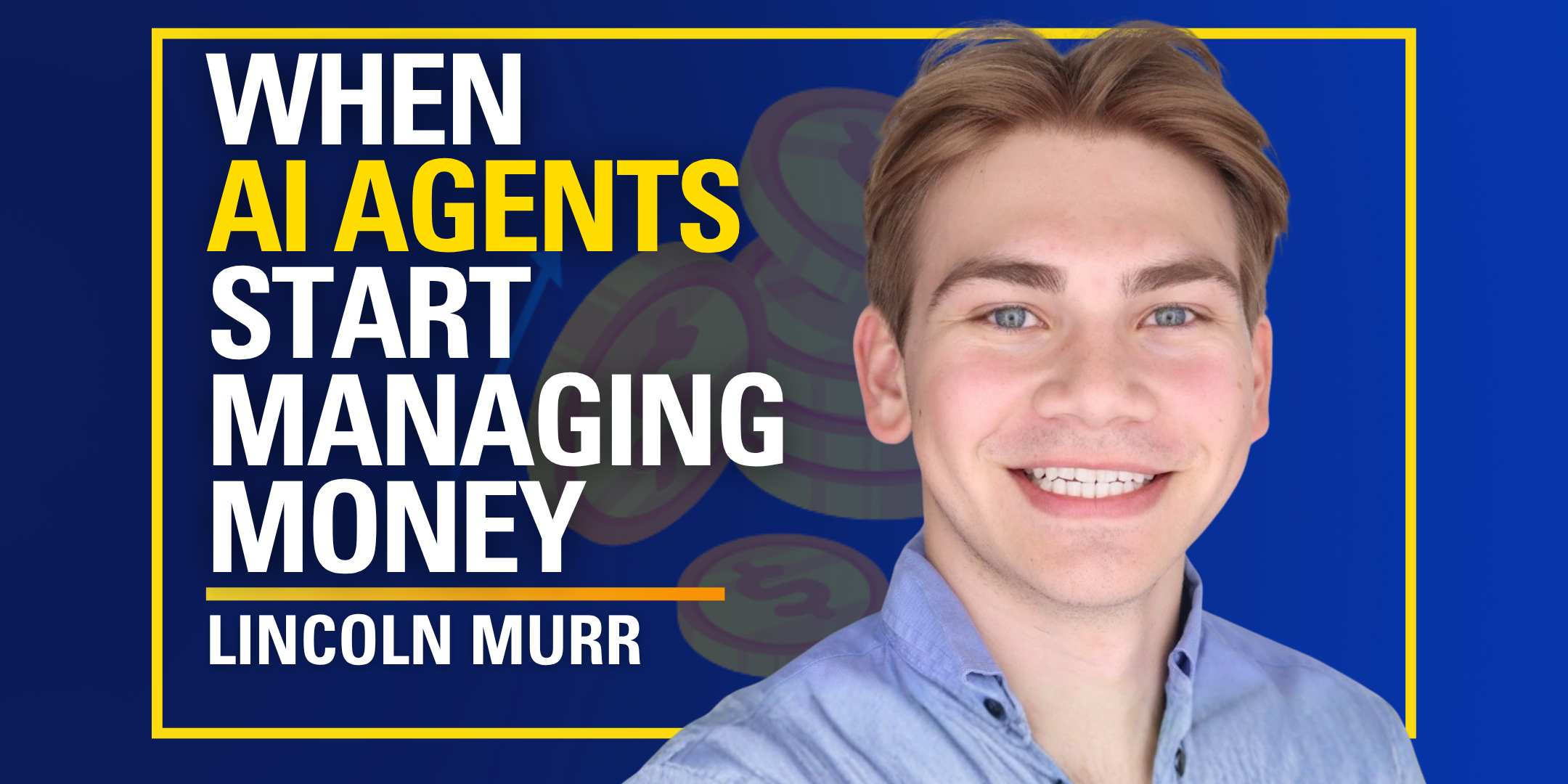
When AI Agents Start Managing Money - Lincoln Murr | ATC #634
Host Stephen Sargeant interviews Lincoln Murr, Head of AI Product at Coinbase, where he leads the products powering the agentic economy. He is responsible for Coinbase for Agents (which lets any AI agent trade, pay, and execute financial workflows with user-defined guardrails) and Coinbase Advisor (the first AI-powered SEC-registered financial advisor embedded in the Coinbase app, giving every user access to professional-grade portfolio guidance), among other onchain agentic experiments. Lincoln's work is grounded in a core belief: AI agents are becoming first-class participants in the economy, and Coinbase is building the financial infrastructure they'll run on. Lincoln was previously a fellow with the Ethereum Foundation and currently sits on the board of the x402 Foundation.
Host: Stephen Sargeant
Guest: Lincoln Murr
We are also available via:
Buzzsprout • YouTube • Quora • Medium • X • Facebook • LinkedIn • Soundcloud • Apple Podcast • Spotify • Player FM
Episode Transcript
Stephen: This is your host, Stephen Sargeant. This is the Around The Coin podcast, and this I'm going to call probably one of the best episodes we've had on the podcast.
We have Lincoln Murr, who's a product manager at Coinbase, but he's in charge of everything that's happening on Coinbase when it comes to agents, agentic finance, agentic payments.
We go deep down the rabbit hole of what's going on at Coinbase, how they are powering the backbone of a post-AGI economy. He's talking about how payments are actually being used, some of the use cases when it comes to virtual assistants and AI.
He talks deep in regards to the regulatory aspect and some of the concerns, and the highlights that using agentic payments is going to have, and how creating friction and removing it is actually going to be great for the younger generation.
This is such a powerful episode, not just because he's extremely young and extremely insightful, but it's just a great episode to listen to. If you're hearing all about Instinct and Muse and agentic payments, this is one you can come to and get a really great understanding of what's happening behind the scenes and how you can get involved if you're a payments tech entrepreneur or founder, or just a person that's wanting to use agentic payments to pay for some of the easiest things in the world.
And we talk about payments for toilet paper to investing and everything in between.
This will be one of the best episodes, trust me on that. And he leaves out a bunch of information on how to reach out to him or use the Coinbase stack when it comes to AI at the end of the episode.
Grace: Disclaimer: This episode of Around The Coin is for informational and educational purposes only and should not be considered financial, investment, legal, or tax advice. The views and opinions expressed by the host and guest are their own and do not necessarily represent the views of Around The Coin, Coinbase, or their respective affiliates.
Any discussion of AI agents, agentic payments, automated trading, cryptocurrencies, stablecoins, blockchain technology, financial products, or platforms such as Coinbase is not an endorsement, offer, solicitation, or recommendation to use any service or buy, sell, or invest in any asset or security.
AI-powered financial tools and digital asset transactions involve risks, including potential errors, unauthorized transactions, market volatility, and financial loss. Always conduct your own research, understand the risks, and consult a qualified professional before making financial or investment decisions.
Stephen: This is your host, Stephen Sargeant, the Around The Coin podcast, and we're always lucky to have somebody from Coinbase. But with the emergence of agents and agentic finance and agents booking your hotel and vacations and, you know, all the podcasts are talking about, you know, agents and, you know, Muse just released something.
So I'm really interested to speak to Lincoln Mer, who's the product manager at Coinbase. Maybe just give a brief introduction, then we're going to go into everything agentic, and you're going to shed some light about what's happening, how come ag-agents are taking over the world, but also helping us with the day-to-day administrative stuff that we can't wait to unload onto AI.
Lincoln: Yeah. Thank you so much for having me. Great to be here. I've been at Coinbase now for about two or so years, currently leading product on all of our agentic trading and payments initiatives and agentic finance or AI Fi as we like to call it overall. Prior to that, I was doing research with the Ethereum Foundation and been poking around in the crypto space for a handful of years before that as well.
Stephen: I think, you know, I was listening to the Roll Up podcast where you, you know, you gloss over a story of getting into crypto at 11 years old. You know, you could-- so you could buy a VPN to pirate video games. As an elder millennial, I remember those days of LimeWire and Napster and, you know, we actually had the physical burner machines.
They weren't baked into the computers like they are now. Can you talk-- walk us through that time using a P2P exchange, I think it was LocalBitcoins at the time. How easy was it? How much were people around you or online you were connected to familiar with this technology?
Lincoln: Yeah, so, so growing up on the internet, I'd sort of had heard of Bitcoin, was, was familiar with the concept or at least the idea that there was this digital currency, but I didn't know anything else about it. And at the time there... Well, actually there, there was two parts to it. One was that all of the exchanges that existed, there was no need for KYC whatsoever.
So you could go into them and you could use a debit card if you wanted to and just start onboarding with, with crypto. But I didn't even have a debit card. So I actually had to go pay cash at my local grocery store for an Amazon gift card, and then I had to go on LocalBitcoins and then use that and trade it and submit the receipt.
It was such a pain, and there was a massive conversion fee associated with it. I think I spent, you know, $25 on this gift card and got back maybe like 15, 20, something along those lines. So the whole process was a complete nightmare. And I remember doing math on like, I would get fuel points at this g- at this grocery store 'cause I was getting gift cards and, and did that help like offset the fees and whatnot.
So, it was fun to turn 18 and finally be able to open a crypto account and not have to go through that whole hassle for a, for a handful of years.
Stephen: That's hilarious. You know, at the start of the pandemic, you talked on the-- You had a TED Talk, and you were talking about the importance of, like, blockchain technology, decentralization of payments. Seeing how centralized crowdfunding like GoFundMe has, you know, had, you know, the ability to censor contributions.
I'm in Canada, so I remember the Freedom Convoy. They, you know, I think they raised almost $10 million that GoFundMe ended up shutting down. You know, there's also, you couldn't, you know, send funds to Ukraine to help them with military-grade equipment. You know, how important or how important or has your conviction strengthened when it comes to the need for decentralized payments and crowdsourcing?
Lincoln: Absolutely. I think there's such a clear opportunity for money to flow across the internet as permissionlessly and as freely as information and speech do. And I think that's what blockchain technology at its core enables. Instead of us being reliant on banks and traditional legacy finance for the ability to use our money and leverage our money to either send it to other people and, and transfer value or to just create more value and wealth through DeFi and these other protocols that allow for free lending and borrowing and all of these different financial primitives that were previously only available to, to big banks.
I think that being made available to anyone, anywhere in the world is such a critical component of a strong, robust economic system, and I think that's primarily what makes me excited about blockchain being further adopted.
Stephen: You know, I'm sure everyone comments about your age and how young you are to be, you know, this- have this much depth of experience in cryptocurrency. But do you think there's actually been a shift when it comes to, you know, AI and crypto amongst the younger generation? Is it, you know-- Are they never going to go into a bank?
Like, what are your thoughts about this shift, you know, with Robinhood and Wealthsimple and all these easy ways to get the younger generations involved in stock markets and crypto and, you know, meme coins without ever going through tra- a traditional financial ecosystem?
Lincoln: It, it's been weird for me particularly because I've spent over a third of my life pretty deep in the crypto space at this point, which is just strange to say out loud. And, and, you know, I do see a lot of people who are, who are my age who never even think about touching a bank account. They're primarily using these sort of brokerages or, or the everything exchange, whatever it might be.
I, I think we're still going to see a use case for banks because of the sort of trust and legitimacy and the, and the established nature of them, FDIC security, all of these things that make p- make people much more comfortable placing their money in them. But at the same time, there, there's a very interesting opportunity around this convergence of, of super apps in the US and the way that with blockchain, you no longer need to have banking licenses and go through this whole regulatory regime to start storing money and, and helping people with their finances.
I could absolutely see a world where there's a TikTok bank account. You know, we already have TikTok Shop. The next logical step for them to control the next part of that payment processing step is to have a wallet there too, and maybe the creators get paid inside that wallet. You can see the same thing happening on YouTube and whatnot.
I think the creator economy and the fintech space are, are very ripe for disruption and, and innovation.
Stephen: I'm curious, how do you think, you know, creators, content creators, you know, there was a-- Jake Paul was on the All In podcast th-this last week, I believe talking about the creator economy, how everyone wants to become a creator and have their own brand and launch their own products. How important do you think crypto or agentic payments will play in that field?
Lincoln: So crypto specifically, I think it's relevant because it allows these creators to monetize their audience in a new and novel way. And I'm not totally convinced on this point, but I've heard a handful of arguments related to, say, you're Jake Paul, for example. What's the best way for you to monetize your audience in a non-destructive, non-dilutive way?
Give them the ability to store money in a Jake Paul wallet or a Jake Paul account that has the same sort of guarantees backed behind it as a sort of traditional institution would, but it uses crypto rails to provide you with a high interest rate via stablecoins. I know this is something that, that MrBeast has actually talked about a lot and, and I know they just recently acquired some sort of fintech, and I imagine that they're starting to trend in this direction where he's got this massive audience, hundreds of millions of Gen Z people who he could start to upsell financial products and, and wealth preservation and growth to in a way that feels a little bit more positive sum than selling, you know, drinks or whatever they might be doing, consumables.
Stephen: Right. And the distribution layer, if they're, you know, if they're making the payment arrangements directly with MrBeast's, you know, bank versus going through intermediaries, he can actually reduce a lot of the cost involved with the transactions are really they're buying a por- portion of MrBeast.
Whatever the product is, they're really just trying to find ways to support MrBeast. So by removing maybe, you know, intermediary banks and, you know, payment service providers, this might be a way that they can, you know, give away really cool things to their audience at a fraction of the cost that other creators would be able to. You know, it's c- it's funny, I, I just saw a tweet that said, you know, "My instinct," which is the, you know, I, I don't have to tell you, but for our audience, is the agentic virtual assistant "is just randomly ordering bikinis." "I'm not ready for AGI." As funny as that sounds, it feels like agentic payments are here.
But give me the state of the union from your side about the agentic payments and the payment layer that sits within this ecosystem.
Lincoln: Yeah. So what we're primarily seeing is this new class of participant that's been enabled by AI. These agents are now for the first time having more autonomy than ever and more access to the internet. And in the same way that humans with, with a card or with some ability to pay have the ability to do infinitely more things online than they otherwise would, we're seeing the same things with agents.
Agents need to transact, they need to hold assets, they need to move money at the ma- at machine speed and a velocity and scale at which we've never really seen before. And part of that today, I think we're seeing with the initial encroachment of e-commerce traditional activities coming over to agents and the ability for me to go into my Instinct and order whatever I want or, or use DoorDash's new product that allows you to order agentically whatever food you might want delivered.
All of these are, are pointing to a world where the agent is the primary UX that we're seeing people interact with. And it's just a, it's a natural shift from first it was web to mobile, and now we're going mobile to agents. And as a part of that, we need a clean way for agents to act as us and, and be an extension of us on the internet.
And that very naturally requires money whether that be for micropayments and accessing goods and services that, that are available specifically for agents or if it's for this larger e-commerce use case, if I still wanna order things on the internet. Both of those I think are very valid use cases that we're starting to see crop up more and more.
Stephen: You know, you mentioned on LinkedIn that you wanna make Coinbase like the backbone of the post-AGI economy. What does that mean? And maybe like construct a transaction, agentic transaction, and show me where Coinbase integrates with every point of that transaction or, you know, even the con- conversation or communication between a user and their agent
Lincoln: Yeah, gladly. So the, the, the best way I would describe it is, is AI Fi breaks down into two main categories. One is agentic payments and the other is agentic trading. Coinbase's core competencies are payments and trading, so there's a very natural intersection between the two of those two things. And to talk specifically about where Coinbase fits into this whole stack and why I think we have this AI Fi moment going on right now, and why it's going to run on these open programmable rails, I'll take the example of your Claude agent that is going off and paying for something like generating an image on the internet.
A fairly simple use case. So today, if I wanted to use my Claude to go pay for that, I would tell my Claude, "Hey, I wanna go generate an image." Claude would respond, "Oh, that's great. Here's, you know, five or six different providers. Why don't you click on one of these links? You're going to have to sign up for an account.
You're going to have to fund that account with money. You're going to have to give me this API key, some sort of unique identifier to link the two of us, and only then I can actually generate that image." That's a huge pain. It doesn't make any sense. It's, it's built for humans. We're moving into this era where we need to start building for agents specifically.
So what X402 and what the agentic payments infrastructure we're building enables is for AI agents, but also merchants to buy and sell goods as, as efficiently as possible in a completely global manner. So in this new version of the world, I tell my agent, "Hey, let's go generate an image." My agent is going to have a wallet.
That wallet could be powered by Coinbase, it could be built on the Base L2, and it could be having USDC as its settlement currency. One of the things that we're building is this discovery layer, this, this marketplace of all the goods and services that are acceptable and open to agents. And right now there's tens of thousands of these services that are available.
My agent can search across this whole list and say, "Hey, who's accepting payments for an image right now?" It'll get a bunch of responses back, and it might see one that says, "Okay, if you wanna send me an image, that'll cost 10 cents." My agent can then use its wallet to pay on chain using infrastructure that Coinbase has built to allow that payment to be received by the merchant.
It gets accepted into a Coinbiz account, Coinbase for Business. That allows the merchant to, if they want to never even see or think about or touch crypto, immediately offer it back into their fiat balance such that the whole thing feels very, very natural, intuitive, and all the hard crypto stuff is abstracted away.
And once that payment has been settled, the server, the merchant responds with that image generated for my agent. So in isolation, it just, it allows these agents to feel much more autonomous because they're more economically independent. And I think the goal of allowing agents to interact with, with, you know, long-running 24/7 types of interaction patterns is how we see the next leg up in agent productivity overall.
Stephen: And they don't have to really leave the Coinbase ecosystem, whether they're the merchant or the user. They're kind of all intertwined in Coinbase, so it feels a lot more comfortable knowing that there's a number that you can pick up and call if, you know, if you, you're confused about something or you can just log into your dashboard at that stage 'cause you're seeing that transaction flow through the Coinbase ecosystem
Lincoln: Yeah, exactly. And we think payments is just the beginning, but agents are ultimately going to want to hold more assets. They're going to manage that money, trade, run financial workflows. All of this we're, we're uniquely positioned to do because Coinbase already has such a robust set of financial infrastructure that's built for this next era of finance that we're finally seeing come online and on chain.
And, and that to me is why there's such a clear compelling opportunity for Coinbase and, and, and these programmable money rails for agents to, to work so seamlessly together.
Stephen: And do you think with these more user-friendly, including Coinbase, but more user-friendly like virtual assistants like Instinct, Muse, GrokBot, do you think that now you're going to see multiple agentic payments from your average consumer a lot more than you would've, let's say, three or four months ago, where people had to like kind of build their own agent to make these payments versus now they can just text message, you know, a Facebook interface or a, a user board that can allow them to make these agentic payments?
Lincoln: Definitely. So for this whole microtransactions use case, I imagine that it'll ultimately be completely abstracted away from the end user. In the same way that when you interact with Claude Code or any of these other platforms, you ha- you're, you're churning through tokens and, and you're, you're basically being charged by these AI companies on, on a, on a per transaction basis.
You don't necessarily think about that, but it's happening behind the scenes. And when we're talking about microtransactions that can be as low as one, one-millionth of a cent, there's no world in which the user actually even needs to know that that's happening behind the scenes. I just wanna top up a balance or even get it as part of my existing subscription and have my agent go off and be able to interact and engage with the things that it wants to engage with without me thinking about it.
And then, of course, for this larger e-commerce use case, I think humans are still going to be in the loop for that. They wanna be involved in the shopping process, but everything becomes so much simpler. And when we're disintermediating these individual stores, I don't have to go to, you know, eight different websites to figure out what coffee machine I want.
I can just tell my agent to go find me the best one. It's just a, such more e-efficient process that ultimately leads to greater velocity of money and better outcomes for everyone.
Stephen: From a user perspective, you, you know, you talked about how difficult it was to pay on LocalBitcoins. What's outside of Coinbase, what's been one of the best user experiences when it comes to payments? Is it the Starbucks? Is it you know, Uber Eats? Like, what has been your best experience, and how can you mirror that with some of the products that you guys are building so people have, you know, a more common, you know, n- intuitive way of transacting with Ajax?
Lincoln: It's a great question. I, I think Starbucks is honestly one of my least favorite because they, in some s-- at the airport specifically, they force you to put put money into these Starbucks, Starbucks accounts, and it just sits there in between my airport trips. And, and, and that process to me just feels very predatory, where you know behind the scenes they're taking that money and earning a bunch of interest on it, and the whole idea of the Starbucks bank is a very, very common concept at this point.
So to me, that's actually one of the worst ones because it's this... You're, you're being forced into a closed ecosystem that you are, are ultimately required to just put money into, never able to get it out, and, and it's just turned into coffee money. I think the exact opposite is what we wanna do with X402 and, and agentic payments more broadly, which is it's always your money.
It's never not been your money. When you give it to your agent, it's, it's safe, it's secure. There's there's a common misconception that agents are, are going to go rogue with this money. We have defined budgets and guardrails that you can trade and pay for services, and your agent can be completely safe and secure when it's doing that.
And if you wanna pull it out at any given time, you're more than welcome to. And, and that to me, and this idea of an open permissionless ecosystem is, is one of the benefits of, of crypto generally. And I think it's one that we should start to persist and, and should pervade the public's mind such that Starbucks' solution is, is, is unacceptable ultimately.
And it, it should be, it's your money just in your agent now
Stephen: That's a great point. I never looked at it like that other than I, I always hope that I have a balance to, you know, to purchase coffee. I always put in $25 at a time, which doesn't get me very far, so maybe that's not a great example. W- what is a great example? What is a great use case? 'Cause I'm hearing everyone talk about an agent, you know, paying or booking a vacation.
I think that's the worst u- that's the last place I want someone other than me... Even my wife doesn't wanna book the vacation 'cause she doesn't wanna press the confirm button and have the wrong dates or times or hotel location. So what is a g- is this a good example, like booking vacations, or what's a better use case that you think that, you know, Coinbase and X-402 will be a part of?
Lincoln: So the, the ones that are most interesting to me on the, on the consumer side, I think it breaks down into two categories if you're talking about larger purchases. On one hand, you have these, I think travel is a great example of like more boutique, you, you wanna be in the process, it might be enjoyable, and there's a sense of like sort of taste or aesthetic that, that goes along with that.
I think clothing is another example of something that falls into that category. The other side though is just like pure consumable goods, things that you need, necessities where maybe it'd be great to optimize for that, but if you're doing it like doing it today or, or optimizing for it without an agent, it feels a little sick.
Like an example would be toilet paper. Like maybe I'll spend 10 minutes trying to find a good like the right toilet paper brand, but if
Stephen: reason why I'm laughing is 'cause that's the one that came to mind. I'm like, "Just give me three-ply. I don't care what brand it is or the... If it's three-ply, I know we've reached a certain standard of excellence."
Lincoln: exactly. Like a-anything more than a couple of hours of searching, and even at a couple of hours, you're like something-- There, there's a lot of questions. But if my agent can do it for me, then great. Yeah, let's just set up a weekly order. Let's just make it happen. It can figure out the right timing and scheduling and whatnot.
And those consumable goods groceries, I, I think all of that is, is a particularly interesting use case. And then for, for microtransactions specifically, the, the clearest one that we see today are these machine-to-machine datas, compute, AI services. One very coherent example is around this agentic trading use case, where we're seeing people give their agents a, a high-level strategy that they want to execute, that they don't necessarily want to sit in front of their computer 24/7 and trade these charts.
Some, some things that these people are doing include event-based trades. You know, if Nvidia has a great earnings report, let's buy more. Let's watch the, the news about the Strait of Hormuz and see what's going on with that and how that's affecting oil prices and making trades entirely on their own.
But, but part of this process is needing to get access to proprietary or premium data. The model can only go so far by searching the internet. So we're seeing people use X.402 payments such that their agent can go off and pull valuable, you know, alpha, alpha indicative information from the internet somewhere, pay a microtransaction for that, make a better, more optimized trade as a result, and then for increased demand for them to get access to more data and more trades that could ultimately occur.
I, I think the, the person who said it best was Vitalik a handful of years ago. He has an article about information finance where he hypothesizes that AI agents will be the primary traders on low liquidity prediction markets because their cost of reasoning and analysis over massive sets of data is so much lower than it is for me or you or any human, that they can go off and make a couple dollars on what would take a human multiple hours of work to, to find as an opportunity.
And I think that's where we're starting to see these agents being used is for these human agent sort of arbitrage opportunities.
Stephen: Do you think trading is a really great example? Because like usually when you're making a trade, you're like, "If this happens, I want to do this." But-- And if you can have an agent, like use that oracle and use those price or, you know, market changes. Because I think in the moment though, when you see it actually happen, you know, you might emotionally, you might go back on your decision 'cause it's happening in real time.
Versus like the decision's been made previously, the agent like kind of clicks in at a certain time, and it removes a lot of that emotion that would happen during the time of like the price did go down. Now it's like, "Oh my God, the price went down. I don't think we should buy this now," even though, you know, I decided before, once the price hits this limit, I'm going to make sure I purchase more stock.
Lincoln: I, I-- the, the one where I think it's particularly relevant, yeah, taking the emotion out of the user, but then also to things like Nansen's Smart Money API or, or Arkham's on-chain intelligence. Both of those are available via X402, and it allows me and my agent to take a much more well-informed decision about what we're doing with agentic trading.
So I can see how money is flowing on-chain that otherwise would not be visible to me. I can see maybe if there's some sort of whale that's accumulating, and that might inform this investment decision. So all of this information that is, that is, you know, in pockets across the internet and that requires so much manual effort on behalf of humans to go gather and identify, now being accessible to agents in a more frictionless frictionless manner is, to me, where we're going to see this initial use case for agent payments start to come up.
Another one, a little bit more practical, is around data on websites. So Cloudflare and AWS both announced that they're going to start gating websites behind microtransactions using X402. And to me, that's a very clear and compelling opportunity to change the way that the economics of the internet work.
So we've seen an increase of something like, I think it's 15 to 15x of bots scraping websites. At the same time, human traffic has gone down 40 something percent. And as a result, anyone who's reliant on ads revenue and, and attention from humans to, to earn money is seeing a, a, a decrease in their, in their earnings.
At the same time, they're seeing more traffic than ever. And the way to remedy that is to take these agents which don't have a concept of attention or, or viewing ads and charge them, whether that be one one-hundredth of a cent or one one-millionth of a cent for the privilege of accessing that information.
I think that's where we're going to see another very early interesting use case start to pop up for these microtransactions.
Stephen: From a consumer perspective, where are we on that trust scale? I know you talked about, you know, didn't have a debit card to, you know, to put in or, you know, buy certain things on on l- Local Bitcoins. But, you know, my-- I'm 45, you know. I remember when we were scared to put in our credit card information to buy something off of eBay.
So where are we with the trust scale of people giving access to their agents, their credit cards or debit cards or bank accounts? Where do you see it? 100 being like how we are now using Uber and all these other apps, Amazon, where we have no problem putting our credit card and storing it there online, to like, "Hey, I'm not going to give my a- agent free reign to, to go crazy to buy, you know, you know, 100 bikinis just 'cause I liked one or two of them."
Lincoln: Where we are today, I think is in this early sort of hacker experimental phase, where within tech communities we've seen a lot of excitement and adoption and, and generally more risk risk appetite. But I think the average consumer still sees the opportunity with agents interacting with their card as only a bad idea.
And there's a lot that we've done to help mitigate that concern. We have guardrails, risk controls, limits, all within the Coinbase surface. We have the ability such that if you want to be in the loop for every single interaction, you can do so. And in my mind, it's about creating a progressive spectrum of trust such as you can build it up with the user over time.
And I think the clearest analogy is how self-driving cars have evolved. Five, 10 years ago, maybe it was parallel parking for you, maybe it was just doing lane assist, but nobody in their right mind would give those systems access to full self-driving. Now, you go to San Francisco, you hop in a Waymo, and it almost feels normal in some sense.
That to me, I think, is how we're going to see the general progression of agents accessing money progress over time. And, and though these systems are capable of it today, it's really about making the user feel like they have control and trust and autonomy, and giving them the tools such that when they do wanna take off those training wheels, it's entirely up to them to do so, and they can do so in a way that still doesn't result in them losing all of their money, which anecdotally we haven't seen happen at all thus far.
But it's always a concern in the back of people's minds.
Stephen: Yeah, I agree. And I think you are exactly right at the stage we are. Very tech-focused people, people that will try anything, GLP-1s or any new AI ecosystem, they're, they're in it. But, you know, my mom's probably not going to get onto Muse anytime soon or, you know, make an agentic payment. She'd rather call or go into the bank and get her, her book signed or stamped versus trusting an agent to buy her toilet paper at this stage.
Can you give me-- You working on several different projects at Coinbase, can you give me a high level about, you know, X402, what Coinbase for Agents is, and then maybe a lot about what Coinbase Advisor is? 'Cause that feels like, you know, really stepping forward into AI, generating that data in- information intelligence to allow you to make intelligent investments.
Lincoln: Sure. So I'll, I'll start with Coinbase for Agents as kind of like the, the... It, it, and it's a connector that allows you to give your AI agent access to a primary financial account. We wanna become the primary financial account for AI. And part of that is both having an in-app portion of how you can use agents and AI inside Coinbase, but also if you're already inside ChatGPT or Grok or any one of these other platforms, we wanna have a safe, secure way for you to connect your Coinbase account to those platforms.
And in the same place that you do everything else, you can start to manage your money and, and make trades as well. So the whole idea is to take all of the features and capabilities that exist on Coinbase today and are primarily oriented toward humans and expose those to agents. It's, it's Coinbase but, but for agents.
It's, it's, it's, it's very literal in the naming and that's intentional. And I think we'll look back on this name in the same way that you would think about having something like a, you know, XYZ but for the iPhone. It just feels like the inevitable shift of how we're thinking about the world, and I view it in some sense as the next iteration of the, of the mobile app is really what we're building.
So yeah, that, that's kind of the, the main way that I would view Coinbase for Agents. It's this tool for agentic traders today, but ultimately will become the way that you can give your AI agent a primary financial account. X402 is an open standard that we've been developing to allow payments to occur across the internet.
So if your agent wants to pay for something today, it's, it's, it's very difficult. As we've discussed, you have to give your agent a card, which most pe- most people aren't comfortable with. You have to find websites that accept payments from agents. This doesn't really happen at scale. So we wanted to come up with some sort of standard or some sort of way for these agents to all agree about how money should be moved across the internet and around the internet.
That has been since pushed to the Linux Foundation. It's in the X402 sub-foundation now. It's being co-governed by ourselves, Stripe, Amex, Mastercard, Visa, Cloudflare, everyone who has an incentivization around driving agentic payments and, and, and building out this infrastructure for the future version of the internet.
And
Stephen: was built for decades, right? Like the XRO2, like the payment required was there. What was it doing before, and why did we need AI to kind of like re- like revitalize this kind of project?
Lincoln: So the idea of 402, which is an HTTP status code, has been around for decades. And, and you might be familiar with some of the other ones. 404 is error not found, 200 means success. You see these. Yeah. So 402 has been defined in the internet spec since the early '90s as, as payment required, but the description of it was purely reserved for future use.
And there was never a, a clean implementation of it. We've seen numerous attempts over the decades to come up with some sort of way to do internet payments, PayPal being one early example, Stripe as another. There was a handful of attempts to directly create an X402 there are 402 implementation prior to X402 that never really got legs.
And it was only when agents started to become this, this new economic actor on the internet that we started to see this trend really start to start to, start to shift toward X402 and, and the need for this standard again. The inflection point was AI agents are now interacting at machine-to-machine scale, and they need a machine-to-machine standard to do that, and stablecoins are the cleanest, fastest rail on which we can send payments globally, permissionlessly.
No need to have this KYC process involved to, to do these transactions. And those two things inspired us to stand on the shoulders of the giants that came before us and finally make this 402 reserved for future use description a reality.
Stephen: And I'm curious, you know, we had Yatsu from Animoca Brands on the podcast. You know, I set up my mind after, you know, researching for the podcast, and it, it gave me a base address right off the bat. He-- And, but he talked i-instinctively about digital property rights and why ownership matters in the digital economy.
And if an agent is its-- has its own wallet, can earn and spend money, whose money is it? Is it mine? Is it yours? Is it Coinbase's? Is it, is it the AI companies? What are your thoughts around this digital ownership and who owns these agents? And to your point about, you know, everyone's scared of it, you know, spending all of our money, who's responsible if that happens?
Lincoln: So the, the onus is primarily on the user. The user is still the one who's going to be depositing and withdrawing, and I think one of the benefits of these you know, crypto systems and these wallets is that it's, it's, there's cryptographically verifiable ownership of who actually has control over the wallet.
Now, I can imagine in, you know, five-plus years, it's, it's kind of a bit of a ridiculous take right now, but I could totally see a world in which you have, say, a self-driving car that owns itself. And the whole idea with this would be, say you have one of these Tesla robo-taxis. You can buy one of these today, and they'll just join this fleet and start driving people around and, and earning money.
At some point, it feels like there's an interesting opportunity for somebody, and y- there's a lot of assumptions here, but just as, as a thought experiment, i-i-if, if somebody were to just give the car, you know, $50,000 or whatever it is, such that it kind of like owned itself in some sense, and you just let it run entirely autonomously.
It can pay for its own operations and maintenance out of the money that it's earning from running this taxi service. If it wants to take the money that it's earning and buy another car as part of its fleet, maybe it does so. I think this is actually how we start to see this concept of, of DAOs as like a truly decentralized autonomous organization come to life in the way that we always envisioned, but is now DAOs just feel like a, a, a form of bureaucracy in some sense.
And then, and
Stephen: They're not decentralized, they're not autonomous, and they're, most of them are not even organizations.
Lincoln: But I think there's an opportunity for DAOs to make a real comeback with agents at this core and in humans at the edges, which is how it was always envisioned
Stephen: You know, going deeper into Coinbase Advisor, which is SEC registered investment advisor, how did you, how did the team build something that works functionally but is also legal and, you know, meets regulatory requirements, which is always tough when you're doing any type of investment product, much less one that's autonomous like an agent?
Lincoln: Yeah. So Coinbase Advisors AI helping humans make financial decisions. It brings professional grade finance to, to everyday users, and it uses AI as a way to scale that advice to all of Coinbase's customers. Previously, we saw an opportunity with financial advice broadly, but it's today kind of locked behind this, this, this, this velvet rope.
It's only available to high net worth individuals. Only people who have money can continue to preserve and grow that wealth. And we think AI is a tool to scale this advice to a, a wide net of people. And how we do it specifically is by working with the Coinbase asset management team, who has decades of experience building and, and, and providing advice inside existing sort of traditional settings.
And we've been working with them to create a model and, and system prompts and tools and whatnot, evaluation frameworks, rubrics, such that everyone feels very, very confident that the advice and the insights that the advisor are providing can meet that same standard of regulatory guidance that the SEC and CFTC have set out for registered investment advisors.
So technically, behind the scenes, the way it works is that there's a Coinbase Advisors LLC, and this corporate entity is registered with the CFTC and the SEC as a investment advisor. And anyone who's using Coinbase Advisor is interacting with Coinbase Advisors LLC to have this Coinbase Advisor product as the tool in, in Advisors LLC's arsenal that allows them to provide clear, actionable financial guidance for users.
And the opportunity here in my mind is to allow anyone, no matter if they have the, the most simple idea or a very complex one, they know what they're doing with their finances or they don't, to have clear, actionable steps to improve directly inside a safe, familiar interface. And that could be accessed 24/7 such that you don't have to stay up at 3:00 AM waiting for your financial advisor to call back if the market's blowing up.
You've got somebody there in your pocket at all times that you can chat with about this type of thing.
Stephen: Has this evolved from the-- you remember robo-advisors and how they were going to, you know, put all these financial advi- I don't think that ever came to fruition. Does this, you know, take robo-advisory and, like, evolve it into a more autonomous... And especially 'cause you can pull some, so many different sources as these agents are collecting data, paying for data at, at, at a scale that we've never seen before?
Lincoln: I think it's kind of the next iteration of robo-advisors in a lot of senses, yes. I think human advisory will always have a place. Those who, who have enough money to afford a human advisor love the comfort and sort of human touch that that provides. In the same way that you see the difference between telehealth and in-person medicine.
But there's a massive market for this, this robo-advisory space that I think was going to evolve to become even more personalized. Instead of me just getting, you know, five baskets of, of different things that I could hold inside a robo-advisor account, I can customize that however I like. I can have it completely nuanced to my exact needs.
Say, for example, I'm saving up for a house. My portfolio allocation is going to be much different than it would be if I'm just saving generally or I'm, I'm later on in my career and I'm trying to get ready for retirement. All of these nuances are not appropriately captured inside existing robo-advisors today, and I think the use of AI allows us to get even one step closer to serving the user in the most perfect way.
And if you want that, that's great. If you wanna just use agents and, and have full power and autonomy to have them manage your portfolio, you wanna be entirely in charge, that's also perfectly fine, and we should be more than happy to support that through this Coinbase for agents product inside whatever chat interface you want.
So we wanna serve the full spectrum of users with this
Stephen: And, you know, anyone's going to ask, "Well, I have ChatGPT, I have a Pro account. What, what, what do I need, you know, Coinbase Advisory for that I can't use with my ChatGPT?" Maybe you can explain how these things differ. I'm assuming it's going to have to do with memory, personalization, but I'd love to hear it from you.
Lincoln: I think really and truly it comes down to the fiduciary duty that the Coinbase Advisor via its licenses with the SEC and CFTC has. So if you go into your ChatGPT and you say, "Hey, what should I buy?" Maybe it gives you a response, maybe it doesn't because it's, it's, it's concerned about the the, the advisory nature of it.
But it's not going to have that same duty and burden to the user to give you something that, that regulatorily it needs to stand behind. And that to me is the biggest value prop that the Advisor has, is that it is literally an advisor. And for people who, like I said, who, who have an idea or they want to close the gap between ask and act, that I think is where Coinbase for Agents comes into play.
If you wanna do this inside your existing chat interface, maybe you don't care about that guarantee, maybe you feel confident enough in your own ability to trade that you don't need that. Perfectly valid use case for you to still have AI to, to human set the rule, agent execute. But for anyone else who wants a little bit more guidance, wants a little bit more assurance, wants to know that what they're doing is backed by a, a model that has been trained and tuned by a team of portfolio managers, then Coinbase Advisor is the, is the product for you
Stephen: I'm curious what your thoughts are, 'cause you talked about, you know, the friction of, you know, buying crypto for your first time, and now we're seeing, you know, this remove- removal of friction, you know, across any type of payments. Is that a slippery slope for, you know, the younger generation? If there's no friction now, if there's nothing to make me think about, like, "Oh, do I really want this?"
But now we can use an agent to set up the payments, make the arrangements. There's buy now, pay later that I can use if we can't afford it. Are you worried that we're removing too much friction, especially from the younger generation? 'Cause that came to me 'cause when you said, like, saving up for a house, which doesn't seem like, you know, a common thing that I've been hearing lately from that, you know, younger generation because nobody believes that they can save for a house or, you know, afford to get married or even have children.
What are your thoughts about this removal of friction, you know, and downstream of society, what that's going to happen going forward in the future?
Lincoln: I think it's critically important that, that we keep a level head about financial, you know, best practices in some sense. And I think that is something that feels a little bit lost on the younger generation and just generally, you know, speculation, gambling, all of these things are up significantly.
The way that I view agentic payments is that it is, it's a frictionless path to create that payments, but it's still-- there's still the barrier of one, getting that money, and obviously with buy now, pay later, that is certainly something that makes it easier. But I don't think it touches agentic payments directly.
In my mind, if I'm spending my money, I want to be 100% confident that I know, one, where it is going, and two, I'm getting the best product that is available. And for that, I think agents actually solve a great use case. It's arguably better than existing solutions because if I'm spending my money and my agent is vetting everything, especially for a more elderly audience that may not know what websites are scam or phishing and whatnot, it could actually lead to more secure, better outcomes in some sense.
So I'm, I'm excited about that as a potential use case here. And I think to your point about how, how can we ensure that this younger generation is properly saving and putting money away? I think that's one of the best use cases of this advisor is, is the, the, the proactive, "Hey, you know, there's an opportunity here for you to start building wealth over time.
This is the plan by which we can do this. Tap this button, start putting money in here, and you won't have to think about it again." That is something that we can very clearly say and articulate and execute on with the advisor that is downstream of the regulated, trustworthy approach that we've taken, that Coinbase is known for industry-wide and, and really globally.
Stephen: I think you raise a great point about, you know, scam websites. And also agents are now bringing more information. Let's face it, younger, older generations, we don't have any time to wait, right? We wanna buy something, we wanna buy it now. But instead of us spending hours of researching, we're getting that information within seconds.
So now we can make more educated decisions about what we wanna buy, but we're also probably saving a lot more money of, you know, I bought a, a used mic that I was taking for, you know, interviews when I went to London and to to Netherlands, and I was like, "Oh, it found me the place where I could buy it.
It's used. It saved me $200 on it." I'm like, "Oh, that's, that's perfect." So I think you've raised a couple of great points there. One question. Have we reached AGI? You, you talk about being, you know, Coinbase being the backbone of post-AGI economy. Have we reached AGI? What are the metrics do you think that we need the threshold for us to get past AGI?
Or are we, are we already past and we're now looking back at it?
Lincoln: Honestly, I have no idea. It's, it's a bit of a moving goalpost. I think every year, every six months, whenever we get a new model, there's this, "Oh, you know, this is AGI," and then we get used to it, it feels dumb again, and we figure out where the edge cases are and what it can and cannot do. I, I think we're close, and I think the goalposts for what AGI are in my mind is if I could call in sick to work and have an AI interact on my behalf and either replicate what I would be doing on a day-to-day basis fully or get close enough to where when I come back it, it feels like I had an intern there by my side triaging things and managing things for me.
That's my personal litmus test. I don't think we're close just yet. I think the labs that are looking to raise money and go IPO to really high valuation would like to believe that that is the case. But I think we have a long way to go, and I think that if anything means that there's opportunity for us to continue building this infrastructure and, and figuring out what makes sense and, and, and, and trend in this direction.
But I don't think we're there just yet. I think it'll be obvious when that happens and, and maybe from like the crypto AI sort of like my angle, another one that, that I've been watching and waiting for is when an AI can fully own and operate itself and use the money that it earns from doing tasks or, or helping people to pay for its own uptime and, and inference in some sense.
So if I can run an AI agent in the cloud and it can start paying for its own everything and also earning money, that to me is a self-sustaining entity, is a very clear indication that that is an AGI type type being
Stephen: I feel like we have fragmentations of it, but as, you know, as a content producing marketing agency, until it can open up a video that I send a link to it and open up that video without me having to transcribe it, I think we're still far away from this AGI utopia that we all talk about. I'm curious, why do you think Coinbase is in the best position?
In my eyes, Coinbase is kind of like now your, your traditional crypto exchange. You know, it feels like, you know, OG has that trust layer and it touches a lot of the, you know, what people would say the TradFi infrastructure, whether it's ETF custodianship. Why do you think Bitcoin is going to lead-- or why do you think Coinbase is going to lead this, you know, frontier of AI and how it, you know, interacts with consumers?
Lincoln: Coinbase has been architected even since the beginning as, as a crypto platform first. And that comes with the implicit assumption that as the economy and as assets and, and RWAs and everything start to move on chain, we are extremely well-positioned to take our existing infrastructure and immediately be ready for that, which I don't think you can say about a lot of existing legacy or traditional financial players.
Additionally, the, the-- it, it feels so obvious to me that, that agents are going to be using crypto rails to do transactions, whether that's stablecoins or, or something else. I do think it'll be stablecoins. Those, those rails that, that, that plumbing of, of AI agents, which are this completely new concept, all being done on the newest, most efficient, cheapest, fastest rails, to me feels inevitable.
And that, plus the fact that Coinbase has existing distribution to over 100 million people around the world, means to me that the, the cleanest, fastest way for us to drive people into these new solutions is going to be by having them associate the trust and, and security that they know and love Coinbase for, with this new field that has all these concerns about AIs going rogue and, and how do you actually give this thing money in a safe way.
And us extending the brand name and recognition of Coinbase into this field, while also leveraging our status as an innovator and a disruptor in the traditional financial space, to me is, is the perfect storm to take on this new AI Fi category head-on
Stephen: What do you think is keeping us from going mainstream adoption? You've probably seen from the crypto a lot, like, you know, we always said, you know, once the traditional institutions are on, but once we get institutional dollars and capital, we're going to go mainstream. But that doesn't seem to have happened even with all the investment from some of these big financial institutions.
Do you think in order for agentic payments to go mainstream, there needs to be like a customer service number to call? 'Cause I feel one of the reasons why we're so confident putting our credit card everywhere now is because we know some charge is not ours, we can pick up the phone and get that charge reversed.
But that's hard to do, almost impossible to do with crypto transactions. What are your thoughts?
Lincoln: I agree. So we've attempted to solve this problem and have come pretty close to doing it and actually have solutions for it around refunds, escrow systems, all of these things within the crypto world that make it feel like you're doing a fiat-based transaction. It comes to all the same safety and guarantees.
I do think conveying that to the general public and the mainstream is going to be a critically important piece of this. And ultimately, these rails should be entirely invisible to the user. This user shouldn't have to think about wallets, they shouldn't have to think about blockchains, crypto, settlement, any of these concepts.
It should feel as intuitive of swiping your card. And behind the scenes, you don't have to know what happens when you swipe your card. The same exact thing should be true with agentic payments. In my mind, the biggest barrier is just driving demand-side distribution. It's really a two-sided marketplace, especially on the payments.
You have a great list of companies who are now accepting payments agentically. And on the demand side, you have tens of thousands, if not hundreds of thousands of agents that have access to wallets. But at the scale of internet commerce, that's, that's nothing. And, and what we really need is, is, is greater adoption and support for these things inside the existing places where users are going to interact with their agents.
It should feel and have been invisible. It should get to the point where we have subscriptions for paying for things and, and users not having to think about it. That to me, I think is, is where the, the Coinbase for agents strategy really lies, which is how we can take this existing set of consumers that have Coinbase accounts and give their agents financial accounts as well in a way that makes the experience as, as safe as possible, as secure as possible, but also very straightforward and, and, and easy to start with
Stephen: What's your biggest concern? Is it going to be the same way, you know, cyber attackers are able to get ahold of email addresses and, you know, take control of computers? Is it malware or cyber attacks? Is it gaining access to people's agents, sending payments mistakenly to sanctions or terrorist financing units?
The building of the AI agents in the first place? Like, what are you most concerned about when you see, you know, newcomers to this space? We saw this with NFTs, you know, people coming into the space for the first time, you know, how much carnage there was when they, you know, they thought they were trading in USDT, but it was Dai and they lost money.
Like, what are your thoughts about, you know, the concerns that the average consumer is going to have?
Lincoln: My largest concern is that it never becomes a native intuitive experience for people to do agentic payments and that the incentives are misaligned in terms of what the agent harnesses and those who control distribution and the value of agentic payments that they provide are, are kind of disparate. So for example, if I go into any chat right now across whatever harness that I want and I tell it to go search the internet for something, even if it comes across a paywall, the agent itself is incentivized to go find a solution and a workaround to that paywall because it will drive more token usage and inference and compute costs, which is better for these companies because it shows that they're continuing to grow their, their, their revenue.
But as a user, it would be much better for me if I could just pay one one-hundredth of a cent one time, fetch that website and be good to go. So that, that discrepancy is where I actually am most concerned about how we drive demand side and getting this adopted by mainstream consumers when the incentives are misaligned between those two groups.
On, on, on your point about sanctions and all of these controls and whatnot, that actually is what I'm least concerned about. We've put a lot of effort over the past several several months to ensure that you cannot send money to a sanctioned address if you're using Coinbase infrastructure and, and your agent is paying for it.
We've done a lot to ensure that we have a verified set of curated merchants that are available. If you wanna go pay for something else, that should be-- that's your prerogative. You're more than welcome to do that. But we have a list of curated endpoints that we can, that we can guarantee are going to provide you with a relevant high-quality outcome for whatever task or service or, or thing that you want your agent to go pay for.
So really to me it's a question of how can we drive this demand side further and what do we need to do to do that, and how much of that is in Coinbase's control versus out of our control, and then how can we convince the rest of the industry that this is best for everyone?
Stephen: When you think about regulation, it's like we-- It's been almost 18 years since Bitcoin was created, and we're just now getting some sort of useful regulation in the US. What about the agentic payments? Do you think we can, you know, square peg it into some of these circle regulations around, you know, compliance and blockchain investigations and stablecoin?
Can we bucket it into the existing regulations when it comes to crypto payments and traditional payments, or do we have to have a new set of like know your agent type exclusions and legislation to properly move forward with this industry mainstream?
Lincoln: I think we can go pretty far with the existing set of regulations. I think globally there's actually an opportunity to further improve. One of the really clear examples of this is the, is the travel rule. It's this, it's this basically form that has to be sent out anytime money is sent internationally between different countries, and there are different thresholds at which the travel rule is is required.
In, in Canada, I know it's 2,000 Canadian dollars, which is great. That's below the threshold of-- or above the threshold of what most agentic micro payments are happening at. So that, that's not a problem whatsoever. But other countries, it's required for every single transaction, and that's just very arduous and, and, and heavy for machine-to-machine payments.
So I think we can get pretty far in the US at least, but globally there's going to be some work that's required to be done. And the identity know your agent piece is also something that I think everyone kind of acknowledges is going to be a problem, but it's not one that we have a clear solution for at this point in time.
Stephen: When people think about AI and payments, they may not, like, directly think about Coinbase. They think of them as still as the, you know, the most trusted crypto exchange. But, you know, the listeners to this podcast, payment tech entrepreneurs, founders of, you know, blockchain companies, w- what advice can you give them?
Or how could they use a Coinbase tech stack to get to the point where they're accepting agentic payments and they're becoming a merchant or helping their merchants accept a- agentic payments through their platform?
Lincoln: So the, the process for getting started with, with, with paying or, or making making your service agent accessible is, is far simpler than people think. One of the things that we've been working on is this like checkout API that allows you for-- through single integration to make your service compatible with both humans and agents via stablecoins.
And ultimately where we want to be is you should be able to tell your stablecoin story and your AI agent story with Coinbase powering it behind the scenes, and do so in less than a day to set up. And we're effectively at that point right now, and we've seen a lot of success with companies like OpenRouter, for example, who now accept Coinbase payments both from humans and from agents all very seamlessly.
They don't have to think about anything besides just pointing their pointing their payment to go to their Coinbase for Business account, and from there it's, it's, it's couldn't be easier for them
Stephen: I'm curious, any exciting announcements as we come, you know, to the end of the conversation? Any exciting announcements, anything you can share or any thought process or concepts that you're working on internally in the Coinbase AI division? Any areas where you're seeing like, "Hey, it's not really the market for us right now, but we can see as this market grows, this is the, the space or field we wanna play in"?
Lincoln: I, I'm particularly excited about the ability for these agents to start autonomously managing money and how we can get to a point where a user can give some sort of very high-level query or even like search through a, a marketplace of what might exist for, for agents that can manage their money for them and just deposit into it and let it run.
The other thing I'm particularly excited about is how we can start to bring this experience more natively into the Coinbase app. So obviously we have the advisor live today, but we're gradually rolling out over time, adding in more features and capabilities. I really and truly wanna get to the point, I think we'll get here pretty soon, that all of Coinbase's features are, are available via agents.
And my personal goal is to make it such that I don't ever have to even open the Coinbase app to do the entirety of my financial and money management whatsoever. And I think that'll just lead to better outcomes for, for everyone, and that's what I'm trying to, trying to drive for internally.
Stephen: Have you heard of or seen any fully autonomous, like VC companies or small boutique investment firms that are just running full agents 100%, they make all the decisions? Have you ever s- have you seen that? Have you seen people use the Coinbase, you know, infrastructure for that?
Lincoln: We started to see some people play around with it for that purpose. The, the VC thing I've heard rumblings or, or experiments. They don't typically-- There's still like a, a level of human nuance I think that's required to make like the, the best decisions. And if you tell your agent, "Hey Groq, go make me money," not going to end well.
I can guarantee you that much. What
Stephen: mean? Instagram, all those Instagram the brand ambassadors say that's all I have to do to make $10,000 a month. I think you're wrong, Lincoln.
Lincoln: Yeah. You think so? Yeah, yeah. I'll, I'll, I'll go try it myself. I'll, I'll, yeah, maybe I'll, maybe we'll see what happens. But yeah, there, there's still a level of human nuance that's required and a little, a, a level of human direction. I think that's that's important. But people are certainly experimenting, and I think those experiments will only continue.
And as these models get smarter, who knows? Maybe that'll change. I remain I remain pragmatic about it, but I could, I could very well be wrong
Stephen: I think someone watching this episode, seeing your age, your enthusiasm, the way you're answering these questions, A, they want their kids to be like, "Yeah, that's where, that's kind of how I want my kid to go through, through life." And then B, a lot of these people are like, "Hey, man, I need help hiring people.
Like, this is the guy I need on my team, 'cause if this is what Coinbase is rolling out from a competitor standpoint, we're going to be in a lot of trouble if this is just one of their product managers." What's some, you know, conceptual advice that you can give to anyone aspiring to be like you, or to think like you, or to hire people like you?
What are some thoughts that you can throw out there for us?
Lincoln: I think my biggest one, and it's a bit of a generic piece of advice, but like just do things. I think agency and, and just running at problems is probably going to be the highest leverage skill that people have in this new age of AI building. When I came into Coinbase a handful of years ago I was put on our wallet API team building out our developer-facing wallet products.
Had no mandate to be working on agents or anything, but it was right around the time when AI coding was getting good enough that I felt empowered to go spend my nights and weekends building things. Ended up building like the first sort of implementation of an agent framework that had a wallet in it.
It was like the first agent that had an account. Just posted it on Twitter and it, it went viral, did really well, and that was kind of the catalyst for there being an agents team at Coinbase to run down this path and ultimately lead to agentic finance. And none of that would've happened if I hadn't just decided to start poking around and, and, and building things.
So like that, that would be my biggest piece of advice by far.
Stephen: So build things, post on Twitter, good things happen , good things
happen.
Lincoln, where's the best place to find you? I'm assuming Twitter is going to be one of the places now that you have that internet clout and fame. But where are some other places where people can, you know, read what you're working on try some of the tools that you're building with your team?
Lincoln: Yeah. Yeah. So, so Twitter and X is probably the best, just Murrrlink in there. LinkedIn as well. And if anyone has any questions or feedback on the product products that we're working on, Coinbase for Agents actually has a, a feedback command, so you can just say, "Send feedback to the team." It goes straight to me in Slack.
If you wanna reach out via email, it's just lincoln.Murrr@coinbase.com
Stephen: Lincoln, thank you. This was such a fun... I- we could probably talk for another hour, and maybe we'll have you back in, in our start of the year episode to see what we have excited for 2027
Lincoln: Yeah, it's been a pleasure. Thank you so much for having me. I really appreciate the thoughtful questions.
Stephen: Awesome.