When Crypto Policy Becomes Political - Amanda Wick | ATC #631
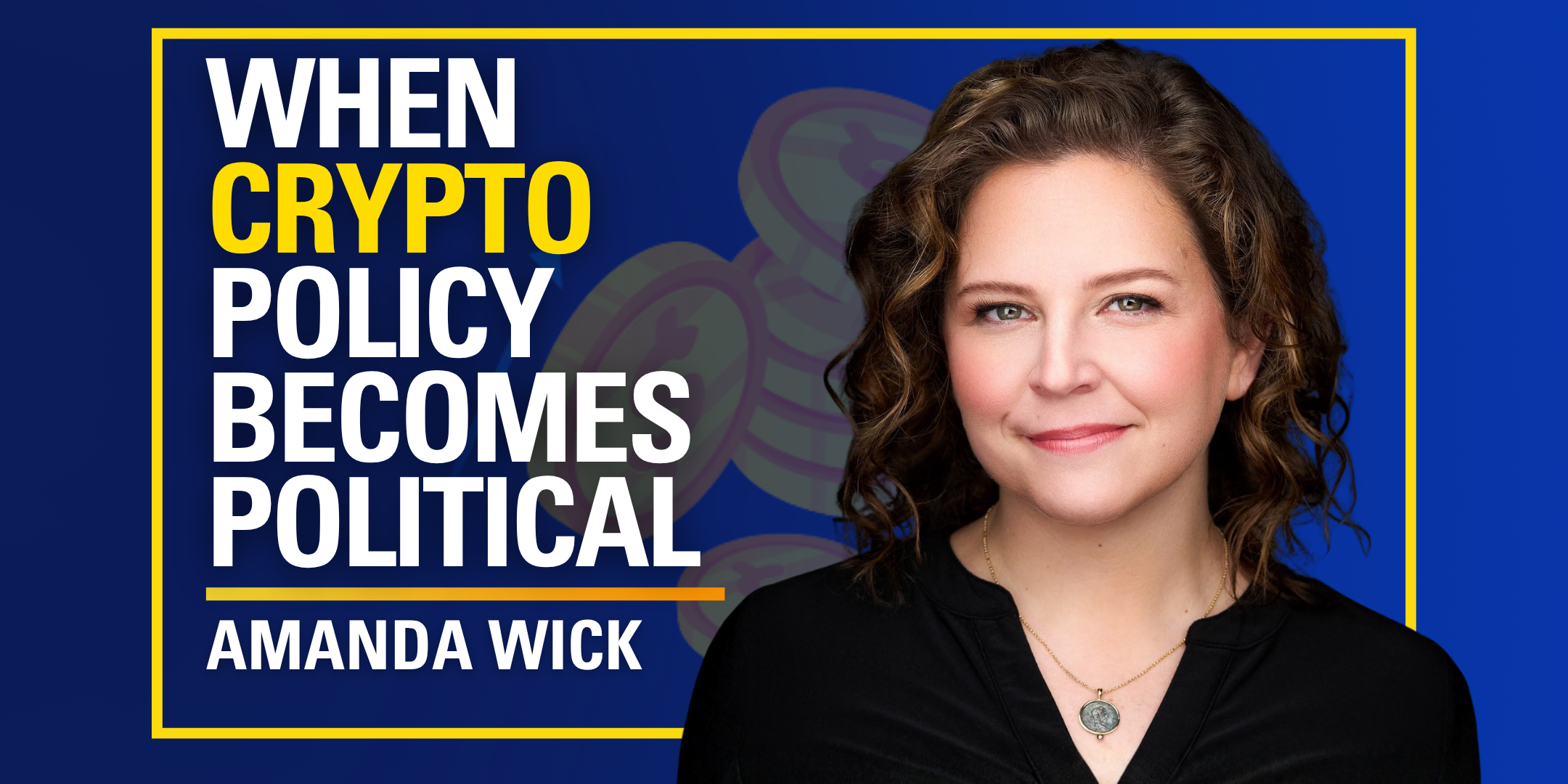
In this episode of Around The Coin, host Stephen Sargeant sits down with Amanda Wick, author of The Catalyst and Founder & CEO of the Association for Women in Cryptocurrency. Amanda brings a rare blend of insider expertise and visionary thinking to the financial landscape. She is the founder of the Association for Women in Cryptocurrency; a global non-profit organization which aims to build a global network of women and male allies in the cryptocurrency, blockchain, and web3 industries who will advocate for the equal inclusion of women in the future of digital finance.
As a former U.S. Department of Justice prosecutor and senior investigative counsel for the House of Representatives, Amanda has been on the front lines of tracking illicit finance and studying America’s political and economic dysfunction. Combined with her deep understanding of how money moves in both legitimate and underground economies, she is uniquely positioned to analyze the disruptive changes shaping the future of finance.
Host: Stephen Sargeant
Guest: Amanda Wick
We are also available via:
Buzzsprout • YouTube • Quora • Medium • X • Facebook • LinkedIn • Soundcloud • Apple Podcast • Spotify • Player FM
Episode Transcript
Stephen: Biggest takeaways from the book. What is something you're like, "Hey, if you didn't have a chance to read the book, this is the main concept you have to get away"?
Amanda: People are the only answer to turning around the ships that are headed for waterfalls. The government did this to us. We want our country back.
The government's not gonna save us. Regulators aren't gonna save us. Like, the system is built to not make radical change, and even when there's radical change, it's reactive, and it's rarely what you need. So in the US, we'll be lucky if, when everything's burned to the ground, responsible people come in and rebuild.
That's the hope. But for everywhere else, people can rise together, and if we can get enough people who care together to do something, a concerned group of citizens could actually make change. But if you're waiting for your government, your regulator, your elected representative That's not the answer.
Stephen: I'm your host, Stephen Sargeant, and this is the Around The Coin podcast. But this is a special series of in-person interviews. As you can see by the intro, how impactful it is to speak to some of the best in the industry. We have Amanda Wick, who is the author of "The Catalyst."
She's also a world-renowned speaker, thought leader, and she actually created the Association for Women in Crypto to bring equity and diversity back to the conversation around blockchain. She now leads the Americas for a travel rule solution, Verify VASP, and we go deep into the economy, into the US, what happened on January 6th.
This is an impactful conversation that we recorded all the way back in May of last year, 2025. And I wanted to bring this to light because most of the things that she talks about is as relevant today as they were 18 months ago.
This is a powerful conversation. I want you to see firsthand the brilliance of Amanda Wick and how much she brings to the table, and how much she understands as a lawyer and as someone that's worked for a blockchain analytics company and someone that's seen in depth from the public sector and the private sector side.
You will definitely enjoy this podcast, and this will be a series of the next couple of episodes of some real thought leaders in the space where I get to sit down with them in person, but it still has the Around The Coin essence of payment, tech, crypto, and everything in between. Enjoy the episode.
No, but I, I'm here to talk about the book.
I wanna hear about, like, what makes you decide to wake up one morning and be like, "I'm gonna write a book"? Or is it, like, you've been dying to write a book, but you haven't had a chance to slow down and be like, "How do I organize all these thoughts are around..." Like, I'm sure you had the chapters kind of in your mind, like, "I'd love to talk about this.
I'd love to talk about that." Or was there something where, like, you know, somebody's gotta say something, and nobody's saying anything, so I'm gonna be that person?
Amanda: Well, like, all of the above.
Stephen: Yeah.
Amanda: You kinda hit on every single thing that happened. I don't, I don't know that I would've coughed all those up the way that you did.
That was good. Before I went to work for the January 6th committee, I had a mentor. She had been a political appointee that I worked for when I was at DOJ. And I asked for her advice because I think people don't realize that if you're a career employee, it's a non-political position. Like, it actually used to have strict limitations by law on what you could express politically.
The Hatch Act used to be a, a thing. I mean, it's still on the books, but I don't think it's enforced. Um, certainly wasn't under Trump one, and it definitely doesn't seem to be under Trump two. But so, like, it was a very apolitical position, and going to work on the Hill, like, for the legislative branch, for the January 6th committee, was probably the most political thing that I had done and thought I would ever do.
And so she basically said, you know, one, if you do this job, you will be choosing a side. Like, whether you're an independent, whatever your party affiliation is, it doesn't matter, everyone's gonna assume you're a Democrat just because of the nature of the work. Like, if you're not going to work for Liz Cheney, the assumption is you're, you're a Democrat on the committee.
And so I was like, well, of the two, the way that they're going right now, if those are my two choices, I'm probably okay with the, the one, that, that assumption given how things are trending on the right. And the second thing she said was, "Take copious notes because absolutely people will ask you to write a book."
She was wrong. Nobody asked me to write a book. But I do have a terrible, like, like, my memory is weird in terms of what I remember and what I don't remember. And so I took n- uh, books of notes. Every meeting, every conversation, things I wanted to remember, jokes. Because the thing in my mind was they made a movie with Adam Driver called The Report that was about one guy on a congressional committee sitting in a closet, like, researching, I think, like, the torture memo or something you don't think they were gonna make a movie about the January 6th committee, and I wanted to remember everything.
Um, and so I wrote down, like, everything. I took thousands of pictures. Like, I basically just have this, like, repository, and I, I meant to, like, catalog it and make it, and I'm behind, and, like, half the committee staff were kind of like, "Thought you were gonna make a photo album." And I'm like, "It's sitting on my phone in my iCloud."
But I think I had like three or four of those, like, journal books, just tons of notes.
Stephen: What made you decide to do this? 'Cause, you know, you were in the public sector before. You come to Chainalysis, you know, working in the private sector, fast-paced private sector. What made you decide to go... Like, I'm sure you were balancing out, like, there's probably gonna be great things about doing this, you know, an unbiased, more unbiased person than the average person, but there's also gonna be pushback.
As you said, you have to choose a side. There's gonna be pushback no matter, you know, what conclusion you come up with.
Amanda: The problem was is that, um, I didn't apply for the job. I w- This is actually a funny story you'll appreciate. There was some reporting that crypto was involved in the funding of January 6th, largely because of a marketing piece that somebody at Chainalysis had put out that I hadn't seen before it went out.
And the way that they phrased it kind of suggested that crypto from this dead Frenchman had gone to this guy, Nick Fuentes, who was at January 6th. So the press picks it up. Mm, delicious clickbait. Put it out there, make it sound like, you know, crypto funded Jan. 6th. I get this call from a friend of mine.
"Hey, the staff director on the January 6th committee is looking at, like, crypto possibly being involved. Would you advise them?" On possibly getting a crypto investigator. And knowing what I knew, I was like, "Yes, I would love to talk with them." And so I got on the phone and was like, "Hey, you know, there may be...
This may be the tip of a giant iceberg. This may be the tip of a nothing burger. Like, you should do some due diligence." And as I was explaining to them, like, how to handle this, the chief investigative counsel said, "Well, we need a lawyer who knows how to do traditional financial investigations and crypto.
We need somebody to do anything financial related on the committee. And you know, I looked at your LinkedIn profile and you seem kinda perfect for the job." And so all of a sudden- LinkedIn
Stephen: for the
Amanda: win, right? Yeah.
Stephen: LinkedIn for the win. Gotta update your profile,
Amanda: people. I was like, the first time a LinkedIn profile ends up getting you the job you want, uh, or didn't even know it was out there.
Um, and to be honest, I was really hesitant. There were a number of reasons to do it and a number of reasons not to do it. I think the reason I ended up doing it is because I knew the f- five, maybe 10 people that could do the job who had the crypto and the tradFi investigation experience, and all of them had families.
All of them had high-paying... None of them could quit their jobs and take the peanuts that the House of Representatives pays people to work. It is, like, criminal salaries. And you would
Stephen: have to quit your job for the... Just so we understand, you would have to quit your job even.
Amanda: Yeah. They wanted a full, like, because the DOJ had criminal investigations, they wanted a full cut of, like, nope, you can't detail, you can't come from another agency.
You have to be employ- This was for some of the staff. I think Cheney had somebody who was, like, a detailee. But for all of the s- like, 99% of the staff that was hired, we had to quit our jobs and come over. There might have been some exceptions to that, but especially for the DOJ people, those of us that were formers, even if we were already gone and at a private sector company, which I was, they wanted us to quit our jobs and come work.
And I would've had to. I couldn't have I couldn't have stayed. Maybe I could've taken a leave of absence- It's just not gonna happen ... but like, yeah, it, it just functionally wasn't g- Like, you had to quit.
Stephen: What was your view of January 6th from the outside? And maybe can we set the tone? Were you more on the Democrat side?
Were you more on the Republic side? Before any, you know, elections, where did you normally put most of your votes in, in the past? 'Cause y- I think Donald Trump was a Democrat before he became a Republic, so I think there's, you know, there's certain lines that people draw and then there's sometimes people are like, "Hey, I'm going with policy," or, you know, what makes sense to me.
Amanda: Yeah, so that's where I had gotten, because I think when I was younger, I remember my dad used to joke that I would be a Democrat until I got my first paycheck, 'cause he's... My parents have been Republicans, like, for my whole life. And he was right to a certain extent, not so much when I got my first paycheck.
Um, but I did get more and more independent the older I got, and especially when I became a prosecutor and the national security and domestic, uh, security, like, justice issues became more important to me, or at least something that was more on my mind that I was more looking at. And so certain of my policies, you know, I think people in the United States would call it social Democrat, fiscal conservative.
And those people, there's a lot of us, and we tend to basically say we're independents, because on some- for, for one poli- Like, I was a big McCain fan. I liked, I liked McCain. There were certain things I agreed with him on, there were certain things I didn't agree with him on. By the time the election came around, right, it...
You just went by the person and certain policies and what resonated with you. Now that the two parties have become so divided and polarized, and in some ways extreme, that I think a lot of us that would be fiscal conservatives, social Democrats, moderates, independents, whatever you wanna call us, we're, like, lost in the middle, and we're homeless with, with no party that kind of reflects our values.
Stephen: And when you look at January 6th, did you feel... When you look at something like that and they say, "Hey, do you wanna come join?" You've been in the public sector. You know how things work there, whether it's too slow or maybe, you know, everyone has their own incentive or their own agenda. It... Why get back into a situation where that's definitely gonna be at play, just by the nature of the position?
Amanda: I had been in the public sector in the executive branch. That is very, very different than being in the legislative branch. And I remember, you know, there were a lot of us that were former DOJ, which was executive branch, and they brought us in 'cause they needed people who knew how to conduct investigations.
And we came in, and there were a lot of Hill people who were from, like, the legislative branch. And I remember talking to one of my colleagues who was on the Hill, and, you know, they had told us, every single one of us from DOJ, that it was going to be a non-partisan investigation. Wherever the facts led, that's where we were gonna go.
And the Hill people were like, "It's adorable that you believe that." Like, that is just... You thought that this wouldn't be, involve politics. Like, you thought you were gonna come to the Hill and politics wouldn't be involved? And when they said it out loud, I was like, "Yeah, we were idiots." We were absolutely cock-eyed, optimistic, rose-colored glass-wearing idiots.
But also, I wasn't paying attention the way that they were to what was happening in the country. Like, I had come from Chainalysis, where my life for the last year was crypto, blockchain, Web3. I didn't know what QAnon was. I wasn't sitting, digging through conspiracy theories or paying attention to essentially the disinformation deluge of crap about the election being stolen.
I just was like, COVID, crypto, blockchain. If it wasn't that, it really wasn't on my radar. And so when Jan 6 happened, I was actually kind of embarrassed and horrified that I, like, didn't know how bad it had gotten, that a third of the country had been conned into believing that the election was stolen.
And-
Stephen: And do you feel, on January 6th, do you feel it was properly portrayed in the media, from a media sense? Obviously, you have connections that are probably a lot closer to that part, part of the public sector. But from, like, the outside looking in, do you l- believe like, "Oh, it's another narrative." You know, there was a lot of narratives, a lot of conspiracy theories during COVID.
So did this look like, "Oh, a distraction. Oh, like, this is s- this is something that we should be alarmed about, whether it's one person there or 1,000 people there," like, "This is something that we need to talk about"? Or was it like, "Hey, did Trump stage this? Did the other side stage this?" Like, what did you feel when you were watching it?
Like- I think- There's people with onions, I think, and b- making themselves cry. Like, I think there was, there's a little bit of dramatics with everything, right?
Amanda: No.
Stephen: No.
Amanda: Like, I think that very question reflects how bad things have gotten in terms of social engineering and the lack of ground truth. You should be able to watch hundreds, several hundred people climb and attack the Capitol, and it kinda speaks for itself in terms of what's happening.
It's not a peaceful protest. The number of videos that came out afterwards or the, well, the number of FBI under... All of the BS that came out afterwards that was just propaganda to dilute the fact, that I will never forget how I felt when I turned on the television and watched the first non-peaceful transition of power- in certainly in my lifetime, maybe in the history of the United States.
I can't remem- like, maybe since, what, 1776? And the only way that you kind of get people to get over the cognitive dissonance of how horrifying that is is to slowly seed BS, conspiracy theories about who was... Because otherwise, it was horrible. It was embarrassing. It was terrifying. Every bad word that you could use is what an objective person looking at that would say.
Regardless of who's right on the right or the left, it was a horrible thing that should not have been done. If you wanna protest on the Ellipse, for whatever reason, you think the election was stolen, you don't like Biden, you wish Trump had won, that's the First Amendment. Knock yourselves out. Could've been there for hours.
I'm fine with that. You wanna march to the Capitol, stand outside, hold a sign? Okay. If you wanna climb the scaffolding, attack Capitol Police officers, break glass, go inside, and then literally hunt down your elected representatives, threatening to kill them and smear feces on the wall, the only way that you are not abjectly horrified by that as a country is to start pretending that was anything other than the lowest point of embarrassment that we've had in hundreds of years.
So you say, "Oh, it was undercover agents." You ignore the fact that it was a lot of off-duty police officers and military. You ignore the fact that it was tons of right-wing protesters who just got s- just caught up in all of the BS, and you whitewash one of the worst events in our history, which is terrifying from a social engineering perspective.
And I think when you look at the evolution of what people were saying, um, Speaker McCarthy, McConnell, what people were saying even the day of when his own kids, Kushner, uh, Fox, Hannity, "Stop it. This is out of control. This is terrible." Even the people who, for a moment, had the objective ability to let a little bit of morality, patriotism, knowledge of right versus wrong when it seeped in Weeks later, the cognitive dissonance and the ability to just step and throw all of that out allowed them to whitewash that, and that to me is actually the horror.
It's, like, worse than the attack, is that our country is so diseased that there are people who would say that it wasn't an attack, that it was a peaceful pro- like, all of that, that's what should scare the bejesus out of people.
Stephen: I think what you're saying is right, and I think emotionally, I think a lot of people did get caught up.
I know when, you know, the whole Black Lives Matter movement happened, I was a lot more emotional than what's happening with, you know, Israel and the Gaza Strip. I can be absolutely honest about it. You get caught up 'cause now I'm thinking back to my youth and getting pulled over by cops. Do you think that's where we are, you know, this is the reason for writing the book is, like, I don't even think we realize we're getting caught up.
We're just so emotional that we're not even thinking straight. We're just caught up with the emotion of it all.
Amanda: I had a friend in law school who was Muslim, is Muslim, and, um, after 9/11, years later, she started this group called Millions of Conversations, and it analyzed what the hate industrial complex has been doing in America since 9/11 and what they started with Islamophobia and basically giving everyone a common enemy.
It's a lot of money in that, and they just turned the same machine onto the left liberals, right? Libtards, whatever you wanna call them, and it's just a playbook. It's just a very profitable playbook, and I saw this video on Instagram the other day where Bernie Sanders, like, 20 years ago, was lecturing to some high school class, and he was basically like, "Look, the Republicans have had a single goal s- for decades.
Lower taxes for the rich, get rid of Medicare, get rid of Social Security, get rid of social safety net. How do you do that? You have to divide all of the not, the have-nots so that they don't focus on the haves." So you have to, you know, blame it on affirmative action. You have to make it about women getting uppity and make it about...
right? You just have to divide, divide, divide, divide, and it's working incredibly well, and the number of haves in the United States who are financially illiterate, don't understand how the system works, and are perfectly comfortable voting against their own economic self-interest. And I think the problem of what's happening now is the rise of domestic violent extremism, of right-wing extremism, of Christian nationalism, of neo-nationalism generally, which I talk about in the book.
It is creating this, um, toxic blend of people who are being fed this narrative in a filter bubble that is not a coincidence, and it's very difficult to break people out of that. You know the concept of, like, a, a massive cyber attack, right? Everybody talks about... And, and I was at a conference, and I even asked this question, "What's the level of cyber attack?"
Like, is it gonna be a 9/11? That, what's the level of cyber attack that the US is gonna need before it gets its act together to actually have a cybersecurity policy? 'Cause Colonial Pipeline didn't do it, right? Yeah. Waiting hours in line for gas, nobody cared, right? Mm, sad, and then everybody moved on. Yeah.
No cybersecurity, like, standards or, like, urgency. So what's the level of crisis? And I'll never forget the guy on the panel said, "See, I'm so glad you asked that question, because the answer is that's never gonna happen." China, Russia, North Korea, every single one of them know one catastrophic event unites us.
Death by a thousand cuts or frog slow-cooking in a pot dies slowly but surely. And there was a movie recently with Julia Roberts and Ethan Hawke, I can't remember the, the name of it, but, uh, did you see it on Netflix? Where basically, like, I don't wanna give it away, spoiler alert. But they just have to seed enough destruction for America to implode.
And I talk about in the book, going all the way back to the '80s, how the Russian KGB basically said, "We just need to basically sow disinformation in the United States, and it will tear itself apart from the inside." And that's what it's doing. So why would you, why would you do one big event? Why would you have another 9/11?
All you... I mean, look at January 6th. Right. We literally attacked ourselves, and then people on the right whitewashed it and pretended that we didn't just have the closest thing to a civil war since the American Civil War. How, how bananas is that?
Stephen: You mentioned two things I wanna... One that got me thinking.
Do you think part of the problem is, like, self-excellence? Like, we're not worrying about ourselves. We're so easy to blame, so now the media, governments, you know, right-wing, left-wing, they just give us people to blame. They just give us an organization, uh, a complex, a color, uh, a gender. Ev- They're just throwing different things at us to blame, and it's like every week there's some- someone new to blame, right?
It's Trump one week, it's, um, Weinstein, Harvey Weinstein the next week. It's P. Diddy the following week, and it's like everyone's just blaming, blaming. Like, when are we gonna start to, you know, stop pointing fingers and point thumbs at ourselves? Like, we, we need to c- watch what we consume, watch what we eat, watch what we're educating ourselves with, wa- watch what we're watching constantly every day.
Is that what we need? Like, is... If you had to give one key takeaway for the book, would that be to, for people to start looking at themselves and making sure they're a good person versus, like, showing us who all the bad people are?
Amanda: I would never do that, only because inherent in pointing a finger is three fingers pointed back at you.
Yeah. I have so many faults, right? Yeah. Like, would I love to be the best version of myself? Absolutely. Do I think humanity actually trends down when left at a natural state? Absolutely. I think it's really hard work to be a good person. I think it's a lot of work. Um, I try. Some days I get it right. I think the thing that people didn't realize, or at least didn't think about, was that democracy as a concept is a great idea.
It takes a lot of work. It took work before social media, and it's kind of like being on a treadmill, and then social media set the incline to, like, 10, and we were really out of shape. Um, and so when people say survival of the fittest, I'm like, "Okay, except that we're not that fit," literally and figuratively in the United States, right?
Yeah. Like, I... And I say that as somebody who's trying to get back to fit, right? I just think that people don't realize that everything about capitalism, unfettered, unbridled capitalism, which we've largely had thanks to kind of a abject failure of antitrust law for the last 10 or 20 years or so, in the US especially, is just driving towards harming the consumer, harming g- the populace as a whole, harming the climate.
Like, nothing about the system is built for surviving, for being the best version of ourselves. That's, that's not what capitalism rewards. Even everything that you just said Consumerism suggests that you should buy all of the things. What else is there to justify a $20,000 watch? Yeah. Or right, a $5,000 purse that's ruined if your kid pukes in it, right?
Like, there's just things about our society that the machine only runs if we're frankly not the best version of ourselves. Um, and so yes, I- at some point, something's gotta give. We either live in authoritarian capitalism, where benevolent dictators give us just enough to be happy, and if you're lucky enough to be one of the haves, which most of us aren't at this point thanks to a ginormous wealth inequality gap, most of us are the have-nots.
Stephen: Where are we right now? If you, at the start of this book, you mentioned, you know, America's day of reckoning, January 6th. Have we changed much since January 6th? Where we at are today, and do you s- feel that we're worse off or better off than we were, were on January the 6th?
Amanda: I think it depends on what metric you use.
Um, one of the heartbreaking statistics that I read was that at the time that January 6th happened, I think 31% of the country believed that the 2020 election was stolen. And that number post the January 6th committee has actually gone up.
Stephen: Is that reinforced because of the way Trump seemingly had a landslide in the following election?
Amanda: No, it had nothing- No? ... to do with that. Yeah. Okay, that- It was before. No, no, it, it was before that, right? Yeah. It's been, like, steadily increasing. Okay. And part of it has to do with the fact that if I just drill into you, drill into you, drill into you the election was stolen, the election was stolen, when the election was stolen from you.
If I just say it all the time, eventually your brain just wears down. And if the countervailing view and evidence aren't continuously pumped into you, you just believe, like, what you're gonna hear. And this is the problem with filter bubbles, right? So there are people, friends, family, relatives, who just kinda sit in, whether it's the Fox News, OAN, Newsmax, whatever your bubble of ch- Yeah
MSNBC bubble, whatever bubble you're sitting in that feeds you this narrative that is neither objective nor fact-based, but is actually very driven towards convincing you of a viewpoint. You're not ever going to get objective truth. You're gonna get what somebody's feeding you to believe. And I see this on Twitter all the time when I stupidly open the app just to check if I got a message, and some jackleg's on there talking about how the January 6th committee destroyed evidence.
I'm like, "What evidence?" Video depositions. I'm like, because they're literally transcribed on PDF online because video takes too much Are you blind or illiterate? Because those are the two populations that I would feel bad for if they were unable to watch. But if you can read or see, they're there. But somebody told you in some stupid Washington Times article that there was destruction of evidence, so you run around say- they just repeat.
They're just like parrots that just repeat this crap. And if you spend an hour talking with them, and I slowly pick away and Socratically question them and don't come into... Nobody has the time for that.
Stephen: Why are people so passionate about politics? Like, we're seeing people risk their lives to kidnap somebody that's wearing a MAGA hat.
Or like, but like our own kids are not that passionate, our own lives are not that passionate, but like we're gonna live and die for Trump, or, you know, we're gonna fight vigorously for B- Like, I don't understand this, this- I've never been that passionate over politics. I'm sure there's things I am passionate about, but why are people so pa- like, where they're risking literally their lives, their homes, their careers many times, for the way they've been caught on video over politics?
Amanda: They have been cranked up. Part of my job on the Jan 6th committee was to analyze the thousands of emails that Trump Digital sent. Sometimes they were sending them up to 25 times a day. 25 emails a day. When somebody just pushes you and pushes you and pushes you and pushes you, it's very... I mean, and the left does this, too, right?
Like, kind of in a softer, gentler, less effective way, but like they're kinda like, "Ah." I mean, you know, "The sky is falling. The sky is falling." And the problem is it is, except that you've kind of let it fall, and now you're surround- you're in a dumpster fire with so many problems where it's very difficult to kind of say, "Pay attention to this thing," or we can have a nuanced conversation.
There's no more nuance. Yeah. It's just everything's on fire. And if you're just constantly told, "This is burning, this is burning. The death of the nuclear family, like, the rise of this," right? Da, da, da. All of these things. And conservatism especially feeds on fear. Fear of change, fear of new, fear of different, fear of evolution.
Fear, fear, fear, fear. Just make people afraid. And that is a really potent thing, and if you're sitting there, you don't like being afraid, so what do you do to combat fear? You surround, you, you get informed in your filter bubble that's giving you all of the BS, right? Like, you maybe stock up on guns, maybe cans of food, gold, right?
You see-
Stephen: Toilet paper.
Amanda: Toilet paper. I mean, you just see these like very human, understandable reactions to what is induced, purposeful fear.
Stephen: Do you think this could have happened on January 6, 2019? Like we're a year after the pandemic, people are upset, frustrated. You mean
Amanda: before the pandemic?
Stephen: Yeah. Could this have happened, like this happened January 6th, 2021.
Could this same thing have happened two years prior to that, before the pandemic, before people were forced to, you know, be at home, you know, talk to their dying loved ones over the phone 'cause they couldn't go to the hospital? You know, we were locked pretty much, you know, away from, you know, people lost their jobs, family members.
C- the media was at a all time, what people would say was at a all time, you know, on their angle. And I think 2021 is when people started to like start looking differently at the media, at the government. Could this have happened? Could the same play have happened? Would you think Capitol Hill being insurrected would have happened two years prior before the pandemic when everyone's gainfully employed, people are, I would say, remotely happier?
Amanda: So the only reason why I would say no Is because if you, if people were to actually do their research, and that's a big thing in crypto, right? DYOR, and so few of them actually do it, um, for the things that they don't like or don't wanna hear controver- countervailing views on. But if you actually did the research in terms of what was happening, it would've been very hard for Trump to have convinced people that the election was stolen without what happened in the pandemic.
Because what ended up happening was in the pandemic, you had a bunch of states that were scrambling to figure out, how do we basically follow laws that didn't envision a mass pandemic? How do we allow people to vote without having to come in person and die in order to vote? And so some states made calls in terms of, well, we're gonna, uh, allow absentee ballots, and we're gonna allow counting to go until the votes are counted.
We're not gonna have an arbitrary cutoff date, right? Like, and states basically did the best that they could trying to figure out, how are we gonna do this? And that was fertile ground for right-wing commentators and Trump later to say, "Well, this was all a giant, you know, plan by the left to get votes." And it's like, no, dude, you told people to stay home, you giant fat moron.
Like, if you hadn't told your followers to stay home, you wouldn't have seen the red tide or the red wave, or whatever they called it. Like, literally, there were Republican commentators that it was such BS what they were saying that they literally one of the guy... One of the Fox News guys called Arizona and was like, "I cannot pretend that this is not..."
Like, y- he told them to stay home, so of course red votes were going to be counted first in person because that's who showed up. And then the mail-in ballot, like, there was a perfectly logical explanation if you took the time to actually do your own research. But instead, COVID and the voting and all of the par- trying to make a secure election in a pandemic just gave them a plethora of crazy stories, whether it was Georgia and the ballots and all of the, and Dominion Voting.
They literally ended up having a lawsuit where, I think it was OAN or Newsmax, I can't remember which one, had to apologize and rescind the BS that they said. And there are still people who believe that those voting machines were run by a Kraken in Venezuela or some... Not... Like, there are legitimately people who think these cra- Like, and they're, and they could be watching this and thinking like, "Well, I have..."
I'm like, "I'm not blaming you-" Right ... for drinking the Kool-Aid. Somebody poured it down your throat I just wish for a moment you would stop and think, "Why did somebody pour that Kool-Aid down my throat? And should I investigate where the Kool-Aid came from?" But if you're literally so hopped up on Kool-Aid that you can't even ask that question, the problem with being in a cult is that you don't even ask that question.
And people think this isn't a real thing, and I'm like, we have a Supreme Court justice in the United States whose wife was in a cult. She escaped the cult, and then Ginni Thomas did a tour and was on television explaining how she escaped from a cult. And now she's back in a cult because there is something about some people, and it's not intelligence, it's not education level.
There's a thing That opens you up. It's the same thing that allows some of us to be scammed, romance scams. When you want something, when you're looking for something, a tribe, companionship, love, your people, whatever it is, misinformation, disinformation, conspiracy theories, romance scams, it just goes right in and gets you.
Stephen: You s- asked something why, you know, why are people pouring Kool-Aid down your throat? Your first chapter is on money matters, and I know that's not the point of the chapter, but we're seeing that a lot of the things that drive these actions is not just politics. People are being funded to make this commentary.
People are, like, what we've seen, I can't remember the group, but there was a group out of Russia, propaganda in Texas, paying, you know, $4 million for them to put out pro-Trump or pro-this. W- but should we start fol- From your, you know, financial crime investig- Should we start following the money and less about the politics for once?
Amanda: I feel like those of us in financial crime are always like, "If you followed the money, your life would be so much easier. Everything would be explained if you just followed the money," right? And we live that life, and we know it as, like, a truism. Politics, left or right, doesn't matter. Follow the money, and you will find the answer.
But it is disturbing how many people... And I don't think it's a coincidence. Like, we wanted to investigate who was funding the litigation, all of the lawsuits that people were bringing on behalf of the Trump administration, and Liz Cheney shut it down. Too many conservatives outside of Trump that we would be looking into.
But if you wanna figure out who the network is, of who's propping this up, who's feeding the misinformation and the disinforma- And it's a network. I mean, there are incredible social media, um, professors and, and, like, network analysts who are looking at it, and they can show you when Turning Point says this, and Don Jr.
says this, and surrogates say this, and it's, like, just a mass network that feeds on itself, and it's wildly effective. And if you don't wanna dig into who it is and why they're doing it, fine, but the mistake that people like Liz Cheney make is thinking that Trump is somehow the end-all be-all of this. He is a symptom of a disease, and if you do not treat the disease, there will be another Trump.
There will be 5,000 people that come in with Trump. Like, I think people don't think about the fact that when Trump basically did what he did leading up to January 6th, and whether you say he irresponsibly made a comment, incited people to riot, whatever. Like, when he said, like, "Let's march on the Capitol," fine.
But when he s- for me, when he sat there for hours and did nothing, watching what was happening, that was, for me, the complete and abject failure in responsibility that he had, was he could've stopped it at any time, and he sat there watching people attack our Capitol Regardless of his intention for the comment, he absolutely allowed that to happen.
And my thing was is after January 6th, anyone in the administration who was still there found it very difficult to get a job. If you stayed too late and you were still there when Jan 6 happened, you were persona non grata for a little while. People were like, "Ooh, it's a little, it's a little toxic to hire you."
They just had to wait, right? And then all of a sudden it became okay because the people that were coming in after Trump with Project 2025 and the true believers, January 6th was the start. It was not by any means the, the finish. They had no problems with it. So when you think about the constitutional crisis that we got to with bunches of fake electors and everything that they were gonna do to manipulate the transfer of power to a president who had not in fact won the election And then he comes back.
When people are now like, "Oh, we're facing a constitutional crisis," I'm like, "What did you think was going to happen after there were no ramifications for an insurrection, fake electors, hang Mike Pence?" W- you thought he was gonna be less emboldened? You thought they were gonna, you thought they were gonna bring in the people who had scruples and a fear of the rule of law?
N- who did you think was gonna come in with him? You thought the clown car, the Rudy Giulianis of the world were the scary thing? That's who was there when Trump won. Who did you think was gonna sign up for Trump two?
Stephen: What are your thoughts on Trump two? You know, there's, especially you're coming from the crypto industry, you know, many people are like, "Trump."
Oh, I
Amanda: know.
Stephen: But is there... I feel there's a worry, 'cause, like, we went from far left- Yeah ... to far right. That's very scary. Yeah.
Amanda: Take out the left and the right thing.
Stephen: Yeah.
Amanda: Right? Because, like, I hate that. Like, it's not a political thing-
Stephen: Right ...
Amanda: in the sense of- I
Stephen: wasn't e- I wasn't even talking about political sides.
I just meant like from one side- Yeah,
Amanda: like from
Stephen: one side- ... to the, it's a pendulum, right?
Amanda: That's the thing. I will say the left right part does need to be acknowledged, because if the Biden administration hadn't been so bad on crypto, we would not be here. We 100% would not be here if there had been objectivity, if there'd been a good relationship with the industry, if Gary Gensler hadn't been just the absolute worst, worst chair in SEC history.
Like, i- no question. If there had been any attempt at engagement, even when we ran the Crypto for Harris group, which was really trying to just engage and t- and say, "Hey, you should turn the ship if you want a policy on emerging tech, if you want crypto voters. If you want a plan for the future of digital finance, crypto cannot be one party."
And the Harris campaign just completely crapped the bed. So, like, I have zero respect for the Democrats for how they handled crypto, how they continue to handle crypto. It is incredibly frustrating. That vacuum of leadership has created, right, the pendulum swing all the way to the other side, where now we have the crypto president- Yeah
who has a meme coin.
Stephen: Coins.
Amanda: His own meme coins. I mean, she technically has her own coin, right? Yeah. Yeah. I mean- She can
Stephen: just bucket ...
Amanda: it's Melania. It's, she's an independent- The White House has coins. Yeah, yeah. She's an independent woman. He has Trump coin. She has Melania coin, right? Like, um, I wanna respect her independence.
Um, and I think they're separate companies that emitted. But he's got Trump coin. He's got stablecoin. She's got M- right? Like, we've got- A president
Stephen: with his own meme coin When Trump creates a meme token that plunges 90%, 80% in value You
Amanda: mean when he does a ru- when there's a rug pull, when, when Trump has a rug pull?
Stephen: Very few people say something. If that happens in Argen- Argentina and Venezuela, we're looking at them like they're the most corrupt governments that have ever existed.
I never really thought about that 'cause I think it was Argentina just recently tried to launch a coin, and then, like, it was, like, some 20-year-old kid from America was like, "Yeah, do this coin," and it, it completely backfires. He's like, "Well, I, I didn't really, wasn't really involved with..." But we're looking at them like, of course.
But this happens in America, and nobody talks about it. Nobody cares because the momentum is there for the entire industry, even though speculators lost out on that me- Like, how
Amanda: would- So to be clear, people do care.
Stephen: Yeah.
Amanda: It's just a question of How much bandwidth do you have to care? Like, if today it's a pump and dump scheme, and it's deporting an American citizen and sending him to El Salvador, or it's tariffs that are gonna cause your, you know, the price of goods to go up, or it's people being detained on the street, or it's my friends who are people of color who are American citizens who are being put into secondary every time they fly in and out of the country, or people outside of the country who are afraid to come in 'cause they could be detained, or the elimination of habeas corpus, or the erosion of the rule of law, or getting rid of the Hatch Act, or the e- elimination of fact.
What do you wanna care about today? You can just literally set people on fire, and then what is there to care about? So in crypto, you have an industry that's literally like, "We've been crapped on for so long that, yes, we are finally getting some signs of objectivity, and it came with autocracy. But we had no functional choice for crypto and democracy."
So for people in the industry, and I hear this all the time, I shouldn't have had to choose between my livelihood and democracy. That I put on the Democrats, on the leadership, 'cause there were some Dems, Ro Khanna, Wiley Nickel, there were some who were absolutely, like, screaming, "You need to turn the ship.
Like, have a different direction on emerging tech." But this is where we're at, where a lot of the crypto industry in the United States is literally like, "Why? Why? Why can I only get an emerging tech policy with autocracy? Why does it only come with these folks?" Like, why can't we get education and engagement with Dems on the left?
And that is a fundamental brokenness in a partisan system that if the Democrats' position is, well, anything that Trump likes is bad, take that policy over the waterfall with you.
Stephen: Is this a snapshot of the administration where people are seeing things and like, "Ooh, that's chaos. It could've been communicated better."
But the alternative to that was nothing was happening. Everyone says that about DOGE, right? We love DOGE. We don't like the way it's happening. But, you know, the administration's saying, "Well, nothing was happening." So you ca- like, you have to either go this way or nothing happens and we end up for... Like, that seems like the kind of pathway of the Trump administration.
We're gonna make things hap- it's very startup-like. You know, move fast, break things. Break things. Yeah. But we're moving, and people are like, "They're moving in the right direction." But then other people are like- We're moving ... just because we're moving fast doesn't mean- We're moving. Yeah. Are we
Amanda: moving in the right
Stephen: direction?
Just 'cause we're moving- Yeah ... quicker to a solution that may not work out doesn't mean we're making progress, and that's why, I think that's the dichotomy we have right now.
Amanda: But this is the thing, right?
We had stagnation Yeah Um, and if we didn't have stagnation, we had such crappy marketing on behalf of the D- I remember being in an airport, Philly I think, and there was this sign on the wall that basically said, "All of this infrastructure and, you know, uh, breastfeeding stations and all of these things courtesy of Biden."
And it was s- And I was like, "Well, it's a good thing you put that little sticker on the wall 'cause I'm sure that's telling the millions of people traveling through this airport who was responsible for all of that stuff." And the thing is, is like I talk about in the book how the left and democracy is crap at social engineering.
Like, if humans are sheep, which I personally think we are, and I think that's a premise more people should accept, but if you just accept that humans are sheep, especially now that we have big data and we have so much data That means that there's a responsibility in herding sheep, and the right is exceptionally good at herding sheep where they want them to go.
Unfortunately, largely through misinformation and disinformation, because the only way you get a bunch of have-nots to consistently vote against their economic self-interest to protect the haves is to lie to them and to misinform them.
Stephen: Why is that not their, in their economic interest? You've said that a few times.
Why is whatever's happening now not in the best economic adminis- um, economic perspective for the average person in the US?
Amanda: The average person in the US is paying more for things, is- does not have a bunch of money in the stock market, so, like, when the Dow goes up, that is not, like, benefiting them directly.
The concept of trickle-down economics has been disproved time and time and time again, but it holds on just, like, i- it's just impossible. There are things that people know to be true that no matter how much data you give them, they refuse, they just refuse to let go of it, right? Cognitive dissonance, all k- I talk in the book about, like, tons of psychological things that are built into humans that make it very difficult for us to let go of those ideas.
And I think the problem is, is that we are looking at the largest wealth inequality gap in history globally, and that doesn't get resolved generally, historically, peacefully. Because at a certain point, people figure out, like, life gets bad enough, and then they rise up violently and take back from the haves.
But right now you've got this really interesting thing, especially in the United States, where thanks to religion, you know, nationalism, and a number of things that create this kind of like toxic cocktail of no, no, no, this is where God, the universe, fate, whatever, whatever, you know, this is just your lot in life, and the people responsible for it aren't the haves.
It's insert otherism, sometimes phrased as DEI, which covers everything. The beauty of DEI when you think about it, right, like Hitler had to say Jews, Blacks, handicaps, right, Catholics. But what if you just clump them all together in DEI? And then you don't have to specifically identify the group, and then it just is this amorphous blob of people who are responsible for all your problems.
Stephen: I thought DEI was used from the People that associate themselves with DEI so that they could get more traction for, like, marketing themselves
Amanda: You mean the movement?
Stephen: Yeah. I thought that- Or you mean the concept? Yeah. So, so it was, like, so hard to, like, put where you were. Like, I think they used to use the word marginalized community was, like, kind of like their, the word that they used to...
I could be wrong. I'm not... I, I don't like to go too down, too down that rabbit hole. But you made a point that, you know, that they were being labeled to blame versus they were labeling themselves in order to get more exposure to the opportunities out there.
Amanda: I have no idea who created DEI. Yeah. But, like, as somebody in the gender advocacy space, right?
I would've said, "Oh, the concept made sense," right? Like, if, if what you wanted and, and data showed that diversity was better as opposed to homogeneity, if what you wanted was equity as opposed to inequity, and if what you wanted was inclusion as opposed to exclusion, I don't know a lot of people who are like, "No, I want homogenous, inequitable exclusion."
And yet when you say, "Okay, then we should want diversity, equity, and inclusion," but now I, I was talking to, uh, a lawyer the other day who, who literally was triggered by DEI.
Stephen: In a bad way?
Amanda: Oh, yeah. Like, because it's a woke term- Yep ... that's ruining the world. Yeah. And when you poke at that a little bit, and I remember he happened to be Jewish, I happen to be Jewish, and he happened to be Israeli.
I'm not Israeli, obviously, I'm American, but when we were having the conversation, I said, "I'm just... I'm curious, how do you feel when you watch the propaganda videos online about the Free Palestine movement and the movies, like the videos that they make about Israeli apartheid and all the horrible things that Israel does?"
And he's like, "Well, it's very upsetting because it's just a lot of misinformation and disinformation." And I said, "I, I totally understand why you'd feel that way." Could you do me a favor? And the next time that you see one of the videos in your feed about how DEI is the scourge and cause of everything wrong, what if you were to watch that video with the same skepticism that you watch a free Palestine video?
Because in one of those scenarios, you identify and care with the minority, and since you're a white male, in the other situation, you might identify more with the majority in a DEI discussion. Do you think that it would impact your feelings on DEI if you actually associated free Palestine with DEI? Like, the same way that people are being fed very purposeful misinformation and disinformation to take a stance and a belief.
Stephen: What are your thoughts about the whole free Palestine? Like, people dressing up like Hamas, this kind of, like, anger towards-
Amanda: Do you know what? I don't have them, only because I refuse to take a position on something that I haven't, like, adequately researched, and the time that it would take to cut through all of the crap that's out there.
I, I remember when Elon Musk, he, he had a PAC that, during the election, put out two ads for, for, against Kamala Harris. And in Michigan, he put out Kamala Harris supports Israel, and in, I think Pennsylvania, in a highly Jewish area, he put Kamala Harris supports Palestine. Same exact picture completely opposite messaging.
So much of what we see now is just complete garbage, and I, I have relatives and stuff who spend a bunch of time, and the time that it takes to dig through the propaganda on each side to get to the truth of what's happening. And, and as a Jewish person, I will say as a Jewish American, I think we should be able to criticize the Israeli government's action, and I'm not antisemitic, and I'm not anti-Zionist.
But that discussion, the ability to have a nuanced discussion about disagreeing with policies that a government takes, right? We should be able to have that, and it's horrifying to me the lack of nuance in that discussion and the lack of, like, ground truth.
Stephen: We can't have those discussions anymore. I feel like we should have the same discussions around Black Lives Matter.
I never really got a good sense of Black Lives Matter from the time, the movement itself, not the overall like, "Hey, I think we need to start looking a little bit closer on p- police brutality," and that conversation around that. But the whole Black Lives Matter, like my sister was at an event, Black Lives Matter event.
Somebody there was white. A Black person came late. They said the white person must get up and so that Black person could sit down. And to me, th- th- this is a wrong message to send to any community, whether Black, white. It's like, if they were there on time and they, they're obviously felt that it was important enough for them to be there.
And my wife's white. Like, you're not gonna tell my wife she's gotta get up now because somebody, doesn't matter what color they are, came late, and now this is more, they're more important because of the col- It's like it's, it's really hard for me to wrap my head around this. And with Israel, I agree with the whole Israel, Gaza.
Like, you... There's, I think we have to be able to agree that no matter what side, no matter what religion you're on, that I think it's gone too far, but there's no way of stopping it now. I don't know why people are so strong to take sides. Like, obviously Israel sometime in 1935 or whenever did something wrong, but like if they killed somebody, and I'm in Gaza and they killed my nephew, obviously now I'm gonna be mad at Israel.
Like, it's just gonna go back and forth. It's like gangs in South Central, uh, California, South Central LA. Like, it's gonna go back and forth. We don't really know who started it, but we can agree that nobody wants either side to be killing their family.
Amanda: I think the problem is, going back to your example with the Black Lives Matter- It's always, I think you know 'cause we know each other well enough that it's, it's that time that it ends up at stoicism, right?
Like at some point it's going to that. And there's this virtue in stoicism, the idea of temperance, and there's four: temperance, justice, courage, wisdom, right? And if you think about life as just a balance, as a goal of all those things, the concept of temperance, that nothing is good in extremes, that nothing's ever right in extremes, and we have lost that.
And I think when civilization loses that, there are massive ramifications. And I talk about in the book the decline in institutional trust and people around the world not being able to trust institutions, whether it's governments, the press, even academics to a certain extent, right? Like, just massive d- declines in institutional trust.
Stephen: How do you measure that, by the way? Is it just like a sentiment? Is it like-
Amanda: No, there's actually a, a study ... a study? Yeah ... uh, I think, I think it's called the Edelman. I'm trying to remember. Like, uh, the E- the Edelman score or the... They, they do this, like, I think every few years, maybe every 5 or 10 years. I can't remember.
But there's like a trust rating, and they actually like they poll across, I think, over 100 countries. They look at trust and, and they've been doing it, I think, for, like, 20 years actually, so it might be annually for the last 20 years. But, like, you can actually go and see, and, and I talk about in the book, like, the numbers of some things just cratering, right?
I think the scariest one, um, is the trust in the press be- I mean, in the United States, freedom of press was a big thing, and when you look at what's happening now, especially in the United States, it's pretty scary. I was, uh, talking to somebody who just went to a conference, and there was a documentary filmmaker who made a movie about January 6th, and they could not get an insurance policy for defamation and, you know, because of the fear that Trump and other surrogates wouldn't bring legitimate defamation actions, but they would actually just bring completely illegal, baseless defamation.
Not illegal, baseless defamation claims. Because they can sue and be wrong, and it still costs money, drives... Right? And so you have this real problem of What do you do when... I, I, people just don't understand when we talk about the erosion of norms and the rule of law, that's what democracy is
Stephen: Do you blame media though?
Do you blame the press? Because if they're not saying the story that will get them the views, they no longer have anything to sell, therefore they won't be the leading voice to give out any information or tell any stories. So they're almost in a, and I'm, I'm not like saying what they're do- what they're doing is this is the way they should go about it.
But they're essentially- No, they're- They're essentially running a business, and it's like, well, you're either in business or you're running your business a little bit on the shady side, but at least it gives you opportunities sometimes give the right message out there versus now what's the alternative?
We're listening to just Joe Rogan, just Elon Musk, just all in, just a 17-year-old, 18-year-old jumping up and down on TikTok. Like, what would be the ideal situation?
Amanda: Newsroom from Aaron Sorkin, circa 2012, 2014, but that doesn't exist. It's not real, right? I mean, they were warning. That show was warning people about what would happen, and most of it was, I think, it was on from 2012 to 2014, so it was largely based on events from like 2008 and 2010.
But if you go back and watch that show now, they were warning people, "This is what happens when you erode the, the fourth estate. This is what happens when credibility and..." And I think there's this incredible opening scene that's gone viral that a lot of people don't even know what it is, where Jeff Daniels talks about how America is no longer the greatest country in the world.
We used to be because we were informed And he talks about how that lack of information has caused a lot of the problems in America, and I do blame the press for that. And some people track it back to the invention of for-profit media, the invention of right-wing media like Rush Limbaugh, and the proliferation of this false narrative for a, you know, a political viewpoint or a moral viewpoint, whatever you wanna call it.
And some people pinpoint it to that and say, "This was the beginning of the end."
Stephen: Pharmaceutical companies. Without pharmaceutical companies, none of these media agencies are in business anyway.
Amanda: Well, and, and the paid advertising aspect- Yeah, yeah ... right? Which is what Newsroom talks about, and the fact that paid media had this massive impact on what you consumed and how it was delivered to you, right?
The best example of this that I tell people is if you ever leave the country, if you leave the United States, and sadly, a lot of Americans don't even have a passport and they haven't left the United States, and I've been really privileged to be largely outside of the United States for the last few years.
But when you watch CNN World, I remember the first time I watched CNN World, which is what people outside of the United States see, and then you come home and you see CNN. I was watching CNN World, and I was like, "You are capable of doing good, accurate reporting. You just choose not to in the United States."
It's not like a failure. It's not like CNN's incapable. You're delivering it to people outside of the United States, so what is it about the American market that you can't make enough money off of us, or we're just not willing to watch objective, honestly deli- Like, what is it that we're not, that we don't deserve or we're not entitled to, or we don't get CNN World?
Because if the, if Americans got CNN World, if we got Al Jazeera, if we got BBC, if we... And, and some of these are even, like, a little left or a little right, but certainly closer to the center to the, than some of the garbage that's in the United States. It is just so frustrating. I mean, I watched on the Jan 6th committee.
I remember this reporter who interviewed us, and our press guy authorized it, and I said to him, I was like, "If you take away one thing for this article, take away the fact that the committee is not investigating financial crime. We are investigating the facts of what happened, and if we stumble on financial crime, we can report it to DOJ."
What did they pro- produce? An article titled January 6th Committee Investigating Financial Crimes.
Stephen: Where else would you live?
Amanda: I
Stephen: think it's so easy to say like, "Oh, US, I'm gonna move to Canada." The Google searches to move to Canada are up. Ain't nobody leaving the US to go anywhere.
Amanda: Oh, I don't think that's true at all.
Stephen: The- where are people... Now, I know there's a lot of expat communities all the way around the world, but I think the vast majority of peop- those people just left. I don't think they just, they didn't talk about leaving. They just got up and left.
Amanda: No, that's right.
Stephen: Yeah.
Amanda: And that's- So where- To be clear- Yeah
that's what happened in 1920s, 1930s Germany. Nobody talked about and had some big old plan. They just s- read the writing on the wall- Right ... got up and left. Right. You don't make some gi- I have friends that have already gone to Singapore, they've gone to UAE, they've gone to Mexico City, they've gone to Uruguay, they've gone to Canada, they've gone to the UK.
They've gone to places where people bitch about their own governments, but in their minds, it's better and safer than what's happening in the United States. And the thing is, is the grass is always greener somewhere else. People in those countries, friends in Singapore would say, "Hope you don't like chewing gum.
Hope you don't like, you know, flicking a cigarette butt over your balcony." And I'm sitting here thinking, "I would happily give up gum, and I don't smoke cigarettes."
Stephen: Yeah.
Amanda: And it seems like an amazing place. I absolutely would consider Singapore. I would happily go with a benevolent dictator who believes in a semblance of democracy and equality of life over a crappy dictator who is just totally happy with a gross wealth inequality gap and probably sliding towards, you know, Handmaid's Tale.
Stephen: Does the money have a lot to do with it, too? 'Cause it's easier to deal with that when you have a little bit more money to enjoy life- Oh ... versus like being in the US, being struggling paycheck to paycheck, in complete debt and credit cards. I'm assuming US and Canada are very similar with- Yeah ... our finances.
There, it's fine. Like, I could go to Bali, I could go to Thailand, I can go... And like even just normal places, I can go, you know. Is it make more sense? D- did they get m- more quality of life? It is all those other things. It is the safety issue. But to your point, when I go to Dubai, and I'm in, you know, a train station, and I don't have to deal with people drinking, eating, smoking, ready to dropkick me, stab me.
Like, those are real things that happen in Toronto. Those are real things that happen in the US. Um-
Amanda: I put my phone... Like, I had... I was in Spain. I was in Madrid. Was at a club after a conference. Me and a, a woman, we hid our bags. Didn't know that the club was gonna open up to the public at midnight. Our bags were gone within 15 minutes.
Everything. I was literally homeless for two days. Nothing but the clothes on my back I was in Dubai after that and was terrified to put my phone down, and Suzanne was like, "You could put anything down here. Nobody's stealing anything 'cause they'd lose a hand." And I put my phone down and didn't have to worry about my phone just being out, and I- it was just such a surreal thing, right?
Because on one hand I was like, "Well, this is magical," and then I thought, "But you lose a hand," right? Like-
Stephen: But is it-
Amanda: But you also can put your
Stephen: phone down ... we ta- we talked a lot about intent is do they have the right intent, though? They're like, "Hey, you know, we're- we know we're a little bit extreme, but you're gonna get the quality of life."
Where the US, it feels like, and North America, it feels like we're intentionally allowing the chaos to happen. It feels like, to your point in some of the, the communications, we're actually, like, driving some of this chaos. We're encouraging some of this chaos. So the- the intent doesn't feel like, oh, we want people to feel safe.
Like, even right now, if I go to a mall, my wife and me are on eye duty. Be careful next to any jewelry store 'cause there's a good chance, broad daylight, there's gonna be six kids that run in there with hammers and sledgeham- Like, this is real in, in the jewelry stores. And we see that in San Francisco.
We've seen it in New York. Like, that doesn't feel like the government has the right intent for us as a so- society. What are your thoughts around that?
Amanda: The government intended well, right? In the sense of... Well, even when we say government, all it is is a social contract. All any of this is, democracy, representative governments, all it is a social contract among people, and it's run by people.
And over time, at least in the US, 'cause I'm much more familiar with the US than the Canadian system, but ag- disagree with me if- if- if- if it makes sense, but the people who became our elected representatives, for the most part with some minor exceptions Felt like people who were in it for all the wrong reasons, and then the system became the swamp.
Like, you know, a minute ago, I don't think you meant to, but you came so close to quoting Ronny Chieng when you were like, "These people who will die for their country." And he has... I don't know if you've seen his- No ... recent com- He does this amazing bit where he's like, "I wish that you would channel that energy to die for your country into doing your homework."
Yeah. Right? Like, it's, it's easy to die. It's harder to do math. Right. Right? And, and I don't know why in America we've got, "Oh, I'll die for my country."
Stephen: Yeah,
Amanda: yeah. But you won't up skill. You won't do your homework. You won't do work. Yeah. Like, you won't do math. You
Stephen: won't, you won't, you
Amanda: won't- Right? This is why we're losing to Asia, right?
You won't, you
Stephen: won't take- It's like you won't- You won't take the government check. You won't...
Amanda: Yeah, it's like-
Stephen: You'll, you'll refuse the government-
Amanda: Yes. It's like- You'll fight
Stephen: for the government-
Amanda: You'll fight for the country, but you won't do math ... but you won't- Um, and I think it, it's, it's, you know, sometimes comedians say the things that we really need- Right
to, to say out loud. Um, but it is a, a very weird thing that we say all this as if, a- as if we don't have an ability to choose it. And I talk to people all the time. Some of my friends are thinking about running for office, and I... And, and they're like, "I would never have considered this, but look at, look at what we have."
And I'm like, "But the only way that we change this in a democratic country is for all of the people who have a problem with it to replace all of the people who are the problem." And that's basically a paper revolution. But to get that, to organize that, that's a lot.
Stephen: But that's hard because even if you were to get to that utopia, you have to give a little bit something to the people that don't want the change.
Like, we see that- It
Amanda: would never- ... politics all the time ... it'll never be utopia.
Stephen: Yeah. It will never- But even if, to get to that point, like even right now, for Trump to get some of the things that he wants, he has to give in to some of the Democrats' demand, or otherwise he won't be able to get to the place where he needs to.
What are your thoughts about that? In government, you have to kinda give and take, and give a little here. Even though you know what's wrong and you're trying to fix the system, you kinda have to, like, pad the... You know, you have to give the bouncer a couple dollars to get in the club in order to, like, change, make
Amanda: change.
I think that's the corrupt capitalistic view of it In the sense that if you look at Singapore-
Stephen: It's a sy- it's a system as well, though. It is a system- Yeah ... that we're living
Amanda: in. If you look at Singapore, if you look at UAE, if you look at kind of, for lack of... I mean, UAE is a benevolent dictatorship.
Singapore would say it's a democracy, but it's had, like, the same party, I think, in power for, like, 20 years or something. But if you look at those countries, it's not so much that they're, like, paying the bouncer and, you know... I, I'm gonna carve out UAE because I think as long as you have slavery, that's a, that's a different conversation.
But let's just use Singapore for an example. Singapore has a standard of living where if you are a w- you know, food worker, the housing that you are provided is X. If you're this level, it's at, right? It's like, it's a tiered society in the sense of everybody has a place, everybody has a function. It's not a utopia because your life as a food service worker is not going to be the same as somebody in finance.
But your life is going to be pretty good in the sense that you're entitled to healthcare, and not going bankrupt if you get sick, and having a roof over your head, and some, like, fundamental truths that as a human you deserve this, right? Like, we should treat you this way because you're a f- you're a stitch in the fabric of society, and that in the West, especially in America and Canada, has been lost.
And I think I, you know, I stole this from, I wanna say Michael Moore in his movie, um, the one where he talked about the healthcare system, and I'm blanking on the name, but he has this line at the end that, like, "This is always going to be broken as long as we remain a me society instead of a we society."
And the thing about capitalism in the West is there's this beautiful thing, the American dream, right? And it is very me-focused. And the minute that we let it become not just about what you could achieve, but at the expense of others by climbing on others' backs and tearing everyone else down in order to get up That was a problem.
And so I think this question of if you look at... It's, it's a... You said, "Where would you live?" I would say I would try to find a society who in that social contract acknowledges that in between me and in between we is some balance of the individual versus the collective, and that is where I think America and America for sure is failing.
Stephen: Do you think it's hard to get there 'cause there's too much money going around? Like, I look at Binance as a really great use case. You know, Binance, billions of dollars worth of penalties, but you don't see overly that many people talking negative about Binance. And I think the reason is, is because Binance is indirectly paying this law firm, indirectly paying this financial institution, this blockchain investigations company.
Like, there's so much money that's going around that nobody wants to take their own money out of their pocket to make a point that, hey, Binance... There are gonna be independent people, but the US government with all their spending, it's like they're paying so many people. How come there's so, still so much, like, fight against the system, fight?
Like, I feel like there's so much money going around the system, or is it not just going to the right places, and that's where people are like, "Hey, where's mine? How come, how come, you know, in Ireland some..." And I, I'm gonna use, I, I don't know the exact example. It was some play, DEI play in Ireland's getting 75 million, but, like, hey, they're locking me up 'cause I, I took a pack of sugar at the local grocery store.
Amanda: All right. So w- so I'm gonna go back to the Binance- Yeah ... thing for a second. I do think there were a lot of us, myself included, who when I, uh, left the government, 'cause obviously we can't say anything while we're in the government. When I left the government, we were very concerned about what was happening at Binance.
Uh, you could call it an exchange. Some people called it a transnational money laundering organization. At the time, right, it was unclear, uh, the, the, the line of distinction between the two But it's an interesting thing because last year at DACOM, the Solidus Labs conference, Noah Perlman, who was the chief compliance officer, and it wasn't Chatham House, it was in front of press.
So-
Stephen: He's a... I like him. He's a good guy.
Amanda: And he was the CCO for Gemini.
Stephen: Yeah.
Amanda: And he used to be. And he, and I'm paraphrasing, but he said something to the effect of, "You know, I've never asked the Winklevii this question, but they made a concentrated decision to be based in the United States, to have compliance, to follow the law."
And I would ask them now, given where everybody ended up in terms of market share, if they would make the same decision now In the same way that we were talking earlier about the right and Trump being a reflection of the vacuum of leadership on the left, binance is a reflection of the world's, but the United States in particular, but it should be the world if you believe that FATF is a thing, right?
We don't actually care about money laundering and terrorist financing.
Stephen: We really don't.
Amanda: We really don't. I mean, you and I are in compliance, and we watch every day financial institutions that just make- the wrong call, right? And if we really, really cared about money laundering and terrorist financing, no, binance wouldn't have been able to operate as long, and it certainly wouldn't be number one in market share.
But now they're under a monitorship. They say they're cleaning things up. I personally am kind of like, "We'll see how it goes. It's a glass house."
Stephen: So- It's easy to clean things up when you have all that money. Like, you know my business coach says- They've got- ... like, "Revenue first. You get the revenue, you can make your business as good as you want."
Amanda: They've got really good peop- Tigran's still there. I don't, I ca- I don't even know who's still there because, uh, some folks have turned over. But like, they've got people there- Yeah ... who want to turn that ship around, who are working to turn that ship around, and they're living in a glass house, so we're gonna see in their illicit finance rates if they turn it around.
That's the thing I like about CryptoCompliance over TriFi. Yes. But going back to what you said, it's like we gotta start examining... Like, you, you gotta just dig a little bit deeper. Finance is a reflection of the actual joke that the world kind of puts emphasis. And, and this is the thing about Trump that's interesting.
He's kind of like, "All right, so if we don't care about money laundering and terrorist financing and corruption, then why not just do it? Why not just cut off the National Cryptocurrency Enforcement Team and write a memo saying we're not gonna enforce AML/CFT in regulatory, uh, aspects of exchanges? Why not just stop enforcement of the Foreign Corrupt Practices Act?
'Cause isn't bribery just kind of like, you know, what is it, the art of the deal? What if we just stop corporate transparency and we don't enforce the Corporate Transparency Act, and we just do what we want?" And the interesting thing will be, and this is what I am, like, just watching with bated breath, is that the United States is gonna have its FATF review in early 2026, and this global body that supposedly is the Financial Action Task Force is going to see the United States fall behind on multiple things that would raise cause for concern.
ChatGPT puts it at a 10 to 15% chance that America gets graylisted.
Stephen: Impossible.
Amanda: Mm-hmm.
Stephen: Impossible.
Amanda: Not impossible.
Stephen: Impossible. Name, name a country that big that has ever been graylisted.
Amanda: Oh, this is fair because of politics. But for the first time in a very long time, lots of countries hate America Lots of countries hate America.
Lots of countries want off the dollar. And a really easy way to, if not get off the dollar, but certainly crap on the dollar and make America miserable, wouldn't have to gray list us. All you would have to do, say if you were Canada, France, or Germany, or any of the large member states of FATF, is just say, "Enhanced due diligence on transactions coming out of America because we have insufficient AML CFT corruption controls."
So we'll see.
Stephen: What's, what's your view of FATF? BS or no?
Amanda: I don't know. We're going to find out in 2026, aren't we, FATF?
Stephen: FATF only goes after under-resourced co- countries, I feel
Amanda: like. And that's really freaking unfair. Like,
Stephen: right? Like, if you look at the countries, like, you could probably combine the top 10 countries on the gray list, and they don't do as much l- money laundering as the UK, as the United States, as Germany, as Spain, but they just don't have the right policies and guardrails in place.
Are they free and clear and doing well? No. But if you look at the list, if you went by based on how much funds are you actually laundering- If I- ... in the global national system-
Amanda: Yes ...
Stephen: I'm assuming, like, those wouldn't be the countries on the first list.
Amanda: If I was the UAE, and I had just spent, mm, I don't know if it's billions, certainly millions, maybe double or triple digit millions to get off the gray list, because countries like America took the moral high ground of our money laundering and terrorist financing requirements.
If I had just spent that much money to get off the gray list, and I just wa- and I'm, am watching America just sink to... What moral high ground does America have right now to enforce anything in FATF? If you were a country, why would you listen to a single thing FATF says if FATF doesn't actually stand up for being against money laundering and ter- You either are, or you be honest and say you're useless.
And in fact, our global financial system thrives on money laundering and terrorist financing, especially money laundering. In fact, God only knows how much of global finance is in fact illicit funds, because I think it's above the 5% that everybody loves to tout that number. I think it's way above that, and we just don't have a good way of measuring it.
But I think those of us who have been in law enforcement, who have seen how much dirty money flows and how much crime goes unprosecuted, unreported, uncalculated, I think a lot of us would say that 5% is absolute BS. And if FATF wants to be real and legitimate, we'll see in early 2026 what it does in response to a major, largest economy in the world- Absolutely drawing back on AML, CFT, corruption, corporate transparency.
And yet, the book is all about this ...
Stephen: new topic. I know. I love it. Biggest takeaways from the book, from doing the book, like, what, what is something you're like, 'Hey, if you didn't have a chance to read the book, this is the, like, parting words. Like, this is the main concept you have to get away.' What's your, like...
And is it hard to write a book? 'Cause you kind of have to, like, always talk about the themes of the chapters. Like, you see the, like, gurus that write the book, and then, like, they get on podcasts, and they're like, they have that one... They have the script, man. They know exact, "I was born in this, and I, you know, then I, and then this happened, and then this is why I ended up writing the book."
And you're like, "Okay." And then you hear them on another podcast, and it's the same thing.
Amanda: I feel like that, like, I feel that way when people ask me how I got into crypto. Yeah. And every time I tell the story, I feel like a broken record, but it's a, it's a good question to ask. And I wish I had a different story every time, but it turns out I got into crypto, like, the same way.
Yeah. So if you ask me the question, you get the same answer. So I try not to be that broken record. Yeah. The thing about the book is there are eight catalysts that I talk about, and if people ask amazing... I mean, you covered so much ground. I don't think I've talked about this stuff with a lot of other people, certainly not all the January 6th stuff.
But I think, going back to your question of what's the one takeaway, when I got to the end of the book, the book was originally written for policymakers and regulators, and it talks about, you know, policies that they should do. Think just do, right? It has advice. But at the end It turned out a lot of people in my life wanted to know about this.
Citizens, like concerned citizens, people around the world who looked at what hap- was happening in America and were like, "Am I crazy, or does that seem really, really bad?" And I think the thing that I have had the privilege of is being at all these conferences and meeting amazing people who can feel that we're coming up on a movement where people are the only answer to turning around the ships that are headed for waterfalls.
The government's not gonna save us. Regulators aren't gonna save us. Like, the system is built to not make radical change, and even when there's radical change, it's reactive, and it's rarely what you need. So in the US, we'll be lucky if when everything's burned to the ground, responsible people come in and rebuild.
That's the hope. But for everywhere else, people can rise together, and I think that's, at the end of the book, spoiler alert, but there's basically, like, a call to action that I'd like to find those people who want to join together globally. And basically, if you go to thecatalystmovement.org, you can sign up, and there are conferences that are based on this, the Black Swan Summit that just happened in Perth, Australia.
You know, conferences that basically are trying to be Davos for people who actually give a crap. But, like, the question of, like, how do we actually turn this around? What are we gonna do in response to AI? Like, how does humanity basically save itself? The answer is people, and if we can get enough people who care together to organize, to do something
If you look at Greta Thunberg, if you look at Aaron West, if you look at people who have started movements to try to do something, I think if we find enough people, a concerned group of citizens could actually make change. But if you're waiting for your government, your regulator, your elected representative That's not the answer
Stephen: I'm curious, what are your thoughts now?
DEI is a bad word. It went from something that we thought more subconsciously about, like, hey, you know, where are we getting our pool of talent from?
Amanda: Mm.
Stephen: Let's look at it. Oh, you know, we're law enforcement. We're getting our pool of talent, and it's 99% white. Like, maybe we should look at where... It went from, you know, some- It's a, yeah
really great conversations to like, hey, like, where are we getting our talent from? And then just like any good thing, we went way too far, and now it's like, hey, you have to put in. And you're a firm believer of this too because you want more women to be on. Hey, if we have a panel of five, six people, even my bias now is like, guys, we had six men on a panel.
Like, we couldn't find- Si-
Amanda: yeah, five or six men, that's too shame, right? Yeah, you couldn't find one person. Two, three, I'm kind of like, okay. But when you get to, like, five or six men, I'm like, come on, this is embarrassing.
Stephen: Does this actually work in your benefit, or does it hurt you? You're a nonprofit. Do you feel companies are, like, doubling down and supporting you even more now?
Or the companies that were like, "Hey, look at me supporting AWIC," is now like, "Oh, I don't have to support them anymore. We kind of moved past DEI and Black Lives Matter. Let's go on to, you know, who's running the AI train"?
Amanda: So I will say two, two things 'cause I wanna come back to your, your, your, your, um, DEI being a bad word thing.
But I will say there were very... I, I would say there were no companies that ever sponsored us performatively. Yeah. Because we've been doing stuff since the beginning. If there are women's groups that you could sponsor that are performative, like meh, like they get... They, you know? I mean People enjoy their events, fine, great.
But, like, are they doing anything to move the needle on gender advocacy? Questionable, right? The- not their mission, not their focus, right? Like, I'm not judging. I'm just saying you could give money to them and nothing's really gonna probably happen in gender equity.
Stephen: And can I say, like, from what I see from the outside looking in, none of the companies that sponsor you are like, "Hey, look at us sponsor."
They're just action-based. Yeah. They're like, "We're sponsoring you. We provide you the venue. We're making sure you have event." That the people that work there are actually delivering things like podcast support. Like- Mm ... it's real s- I was gonna- It's not like, "Hey, look at what we're doing and how much we spend."
They don't even mention. And that's why- Me too ... I had to go to your list to be like- Yeah ... "Oh, all these companies sponsor you?" Like...
Amanda: We do ROI reports at the end of each year. We measure how much their... 'Cause their, their sponsorships comes with employee membership. So we tell them, "Here's what your employees are using.
Here's the professional development. Here's the business we've referred to you. H- like, we, here's the tickets that we... Here's all the positive ROI that we've given." And a bunch of them are kind of like, "We love that you do this, but you're doing good things, and that's why we support you." Those companies find us eventually, and the sponsorship l- l- like, we have quality, not quantity.
There were certain blockchain analytics companies that supported us, and there were certain ones that didn't. And everybody knew exactly why who did and exactly why who didn't.
Stephen: Why didn't they, do you think?
Amanda: I don't think it was a coincidence where Women in Crypto started. Um, there were some companies that were just better for women in the industry.
There were some companies that just struggled and still struggle with their culture of inclusion, not just for women, for people of color, for LGBTQ, right? Like, it, inclusion is a, is a tricky thing. Um, there are some companies that prioritize it. I think back to when Julian Sawyer at Zodia took the stand against the thing that happened at Copper.
Remember where the, the people, and it is a Sushi incident, but it was like a naked pe- basically- Wow ... took a principled stance and was like, "Our industry should be better than this." Yeah. And that's a really rare thing for people to do, especially CEOs to do, to take a stance and say, "We need to be better," right?
And so to your point, I think some of the companies that are finding us are s- quietly saying, "What you're doing is important because we want more women on the other side. When crypto gets globally adopted, we want women to glo- we don't get global adoption with 50% of the world being a part of this." So I do think there are companies that are intentional about inclusion from a, this is a, a industry necessity.
If we don't get women into crypto, you can't get global adoption if it's, if crypto bros are the only fans, right? Yeah. You want women in digital finance. You want women in the future of emerging tech. So those companies do eventually find us, and I feel for them because they get hit up all the time by lots of different groups, right?
And so we have to prove who we are and explain what we do, and what we do is different, right? Um- But what's interesting, going back to something you said earlier when you said the DEI thing being a bad word, I do think that some companies are kind of having to decide who they are and who they wanna be, and they don't have to be that vocally.
They don't have to scream from the rooftops, "We're supporting the Association for Women in Crypto." We even have some folks just make a donation to us. They don't wanna be sponsors. They just say, "Here's money. Do what you're doing. We don't like... We don't wanna be... You don't have to list us as a sponsor, just corporate donation."
Um, which is fine. I don't... Right? That's, that's support. Support is support. But I think it's interesting what you said about DEI being a bad word because I remember when I started the Association for Women in Crypto, and we launched in October 2022, a month before the fall of FTX, and a friend of mine at a really big crypto company came to me and said, "Oof, it's a tough time.
Would you consider changing the name? Because women in crypto, I... You know, right now we're trying to kind of like avoid crypto." And I was like, "Uh, no. I mean, unless you wanna pay for a massive rebrand. I mean, the website alone was 10K out of my pocket, so if you wanna pay for that." But I think if you just kind of give it time, I think we as an association, especially being more kind of crypto LinkedIn than crypto Twitter, and being really heavy on advisory, consultant, risk management, I like to think that we are the best aspects of crypto, and we could bring the name up.
So if you support this, if you support us, if you have faith, I think crypto can weather the storm.
Stephen: You're one of the few associations that didn't go with the let's battle the opposite, right? Like, most women associa- I've been on a lot of women in association calls, and the first thing they talk about is men, and what the men aren't doing, what they could be doing better.
Where you're like, "Hey, if w-," and a, a lot of the conversations you have around the podcast is, like, it's not just about blaming men. It's like, well, how can we help men help us that want to? And let's put it out there. And I think that's... Not saying that's the reason why you're successful, but- It's part of it
finally a men has, like a person like me is like, hey, I'm not exactly, like, running down the streets and saying, "Equality," but I'm just like, "Yeah, I support." I don't wanna be the only man on a stage of six, six guys, and I also wanna, like, help the people that have helped me. Like, many of those peoples in the association have helped me, whether I was a man, woman, like they hel- they're just great people to be in the industry.
Amanda: We had our first male member, Ari Redbord at TRM Labs. We had over 100 male allies, including you, sign the Male Ally Pledge. When I started the association, I... It was just an idea. I couldn't fundraise, I couldn't... I literally had to self-fund because of the rules in the house. So I basically launched with 50 people who were ba- betting on I would do what I said I would do.
And the day that I started, and the day that I could fundraise, I went to Glenn Pomeranz at BDO, and he literally bet on me and said, "You do the things that you say you do, and you do them well," and just wrote a check. The number of male sponsors, whether it was, um, Seth Ducharme at Bracewell who helped us with the, with the podcast.
The number of male sponsors who have had our back, who have helped us, and I'm not saying there's not women, like Julie Friszman at Norton Rose Fullbright. We would be nowhere without her, right? Like, we've had incredible female sponsors, 50 female founding members. Like, it's been a combination. But I have from the beginning said we will never be a women's only group.
You cannot solve inclusion with 50% of the people, and you can't solve inclusion without the people who can help you the most. And it is not about men who are doing bad things. Half the time it's unconscious bias. If you know it's unconscious bias, you're gonna get upset at people because they do something unconsciously, subconsciously?
That just seems ridiculous, right? Now, do we have Men that I run into who are just misogynists, yes. Do we invite them to our events? Absolutely. One can hope, right? Um, but the guys that come to our events that get involved, tons of girl dads, tons of guys that are kind of like, "I don't like work- I don't like working in a sausage fest."
I, I, I- No. Literally somebody said that. No, no way. Yeah, 100%. I get men all the time who are like, "You don't think I want differing viewpoints?" Like, that it doesn't get exhausting kind of hearing the same things. Like, we need more women engineers, we need more women in product, we need more w- like, we need more women.
Stephen: But even some of the bros can't handle the bro talk all the time. Right. And so it's like sometimes you're just like, "I need... I'm, I'm not a feminist, but I need something a little softer- Yeah ... than the same bro culture." And then when you see things, once you've opened up your eyes and like, I think it was, I can't rem- I think it was, uh, the coin- it was Coinbase.
Uh, they had the picture and it was like 15, 20 guys and they're like, "Hey," like, "look at us." And I think it was you
Amanda: that sent me the picture. It was. It was a couple. No, the- International Women's Day. Yeah, the- 2023, Brian Armstrong tweeted a time immemorial picture.
Stephen: Future of crypto.
Amanda: Building back better- Yeah
in crypto, and it was him and I think 10 guys. And yes, I posted on, on LinkedIn about it, and it did go LinkedIn viral, if that's a thing. But it was just... And you know, the thing is, is ironically, if you look at Brian's organization- Yeah ... it's all run by women. Yeah. Like, his COO, his CCO, they have been woman run for a very long t- like, internally people were like, "Well, Coinbase is..."
And I'm like, and here's the thing, that's great 'cause he knows- Yeah ... clearly, like, the most competent. Like, he hired competent people. Yeah. They happen to be women The fact that he didn't think to include any of them in Building Back Better is a testament to how easy it is to just invite your bros, right?
Like, like the people you want... Like, it takes intentionality to think, "Maybe I should invite women to have a different viewpoint." And he is a quintessential example of somebody who just either doesn't want to or refuses to think about the, the, what he's missing and what he's losing. And the hyp- the hypocrisy of it to me is he clearly knows for his company, 'cause he hires and lets some of the most brilliant women in the world operate his company and run it.
But for performative, you know, who's in the room when it happens, he's just lazy.
Stephen: I have to agree.
Amanda: And that's- Awesome ... just heartbreaking.
Stephen: What's the future? What's the future look like? If this- does this book have a sequel in mind? Like, what's, what's the lo- what's the lost chapter? You're like, "I have a chapter in mind.
It's not quite ready yet," or it's still, "Hey, I'm still in the process of it." Or what's the first thing that you think in the next two years you won't be able to... Like, you wouldn't... If you had an opportunity to strike a chapter out of the book because you think something will change in the next two years and you're like, "You know what?
I think this part won't survive two years- Oof ... and I might have to re- rework that chapter. I'm hoping I'll have to rework that chapter. Because although I think I'm right in this instant, I hope I'm not right, you know, in the short term."
Amanda: I would probably say, um- The book assumes that America is headed over the waterfall, and I really, really want to be wrong about that.
But at the rate that the Democratic Party is going and at the rate that the Trump administration is going, um, I really worry that the book will actually be right. Because the book, you know, spoiler alert, talks about the rise in authoritarian capitalism and that that is where we are headed if things don't change, both America but other countries.
Um, and people don't realize how much of the world currently lives under authoritarian capitalism. The book envisions a movement in the sense that I think there's hope, and I would really love to be, I don't want to say wrong, but I would really love if the people who read the book feel it provides good information, that it comes from an objective place of we don't have to accept either broken side, left or right, in, in any country.
That in countries that are democracies, we have a chance to turn this around. And even in countries like Singapore, there are people who believe in this, who are passionate about this, that essentially some part of humanity that is basically blockchain for good, if you will, has to rise up and do something.
Whether it's create their own country, a new country, take over a country, I don't know. But something's got to give, otherwise the slide into authoritarian capitalism is going to happen. And then unfortunately, a lot of the haves that we talked about earlier who do have the wherewithal to leave the United States, to leave c- they're gonna go somewhere, and the question of where they go and what communities they create and where they go to basically take refuge, and I've thought about that.
But the part of me that fought, that fights the fights that need to be fought even if you lose, like Crypto for Harris I think democracy is something worth fighting for. I think the question is, is how many people, if any, will fight for it? Because if we don't get a critical mass of people who think democracy is worth fighting for, it does disappear.
Stephen: Last question. Do you think it's no longer a matter of, like, when this happens or if it happens, but the speed in which it happens? 'Cause we saw China had a very long-term strategy, and it seems like we're, we're now at that later stage of their long-term strategy, and they're starting to eat up a lot of the US in a lot of the categories, including tech, including AI, and just including the, the love for the country.
I think a lot more people in China love China than a lot of people in the US love the US. Could be wrong in that. Might be a little bit more forceful in that country. But they're on the long, they had a long-term horizon. They knew exactly what they were doing with a lot of their strategy, where I think America felt like we took all the short, short-change transactions, right?
Short-term, short-term gains, and now we're dealing with, like, the long-term consequences. Do you agree if we don't change sooner or later, like, that China might come in and win the whole show?
Amanda: Yes. And the thing is, is that if you go back to something that we talked about at the very beginning, China has always been a collective.
It's always been a we society, and not a we society because one Chinese person looks one way or the other, but because they actually have a nationalism that's built on a culture, and America does not have that. When people say, "I'm proud to be an American," what that means to different Americans is very different.
Because if they were actually proud to be an American, if it, if, if it was about America, it would be about all the things that America was actually truly beautiful for: democracy, being welcoming to immigrants, being a melting pot, the separation of church and state, not having a national religion, not being a Christian nation.
But a lot of times, the people that you e- hear saying that stuff, all the things that they love about America are literally the things the Founding Fathers came here to destroy and fight against. The idea when people say that we're a Christian nation, Founding Fathers would be rolling in their graves that, that the idea that they wrote into the First Amendment the separation of church and state, that hundreds of years later, people would be rolling it back together again.
I think they'd say, "Then just move back to your monarch in the UK. Why did you even... Why, why did we bother to leave if our des- if, if you were just gonna ruin this experiment that we had?" And I think that is the tragedy of America, is that democracy in America is very much on the precipice of a failed experiment.