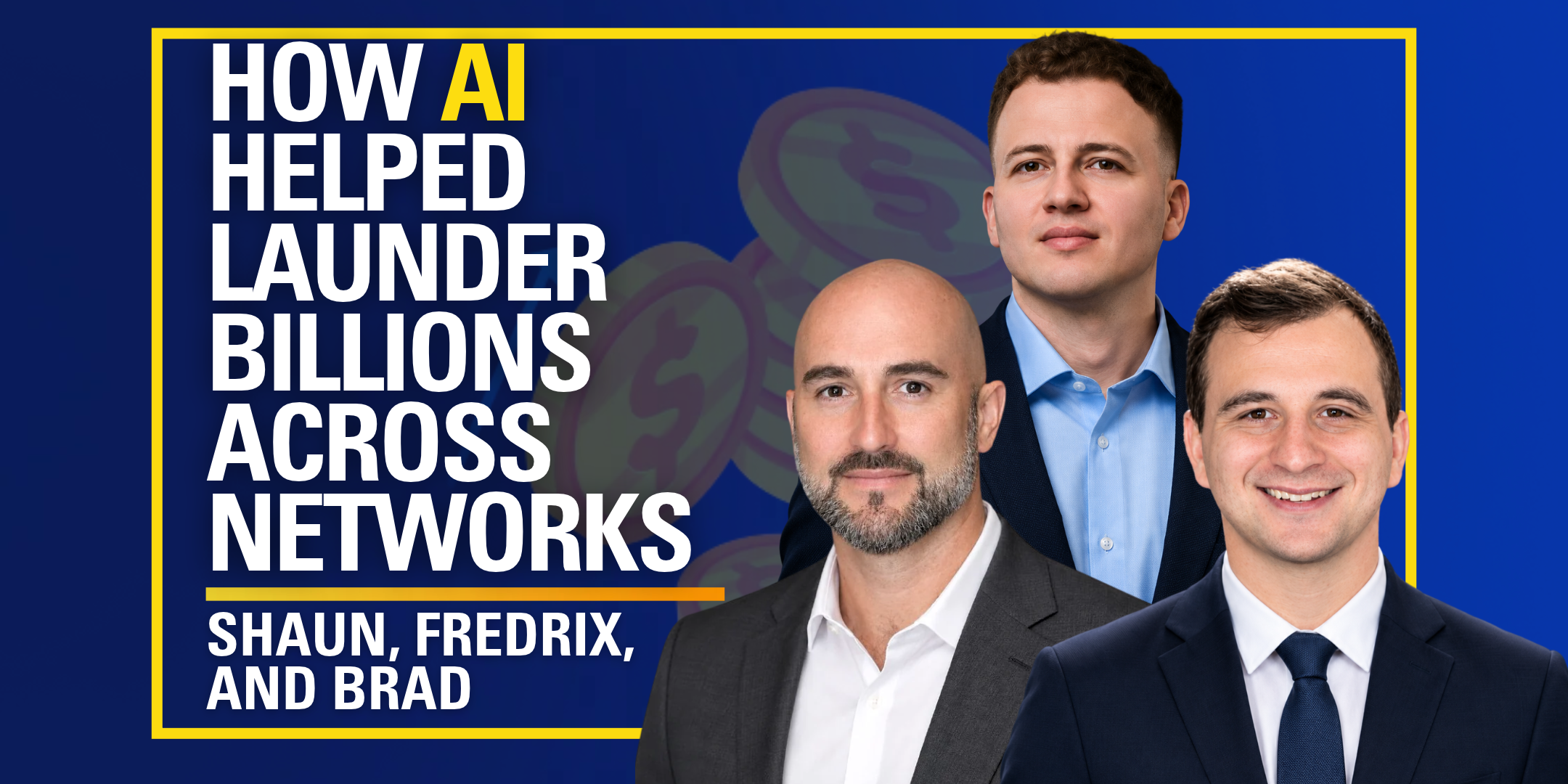
The $6.3 Billion Binance Hack (Pt. 2) | How AI Helped Launder Billions Across Networks - Shaun, Fredrix, and Brad | ATC #638
The $6 billion Binance hack raises serious questions about crypto security, blockchain intelligence, and the growing sophistication of cyberattacks. But what really happened behind the scenes, and what can investigators uncover that the headlines often miss?
In Part 2 of this special two-part series, Stephen Sargeant welcomes Shaun Magruder, Founder and CEO of Valken Industries, Fredrix Vazquez Ortiz, Senior Investigator at Inca Digital, and Brad Kay, Director of Blockchain Intelligence at Inca Digital, for an in-depth roundtable discussion on the Binance exploit and its wider implications for the crypto industry.
The conversation explores how investigators approach large-scale crypto theft, trace suspicious transactions across multiple blockchains, and identify patterns that could reveal more about threat actors. The guests also discuss the potential role of AI in facilitating illicit fund movements, the challenges of relying on automated blockchain analytics tools, and why human expertise remains essential in complex investigations.
Beyond the technical details, the discussion examines the importance of cooperation between private companies, law enforcement, exchanges, and stablecoin issuers. From faster response times and coordinated asset freezes to stronger internal security and intelligence sharing, the guests explain why collaboration will be critical as cyber threats continue to evolve.
Host: Stephen Sargeant
Guests: Shaun Magruder, Fredrix Vazquez Ortiz, and Brad Kay
We are also available via:
Buzzsprout • YouTube • Quora • Medium • X • Facebook • LinkedIn • Soundcloud • Apple Podcast • Spotify • Player FM
Episode Transcript
Stephen: You get the phone call, you see $6 billion. What's the initial reaction when that phone call comes to Blocktrace and says, "SOS,
Shaun: we need your help." The first 48, what happens at that time? Initially, it just looked like a normal hack, an organized hack, very sophisticated.
Brad: A lot of people are simplifying this down to just a job interview equals 6 billion stolen.
Fredrix: AI, particularly in agentic sense, is being used to facilitate and launder the stolen funds. They're able to generate new addresses, or they can disperse these funds through multiple networks.
Stephen: Some unique thing that you saw in this exploit. Nobody's actually talking about it, or is the industry under attack?
Elizabeth (AI): Disclaimer: The views and opinions expressed by the host and guests are their own and do not necessarily reflect those of Around The Coin. This episode is for informational and educational purposes only and does not constitute financial, investment, legal, or cybersecurity advice. Discussions surrounding the Binance hack, blockchain tracing, alleged threat actors, stablecoin freezes, and the potential use of AI in cyberattacks and illicit fund movements reflect the participants' perspectives and available information at the time of recording. Some details and investigative findings discussed remain unverified or subject to further investigation. Around The Coin does not independently verify every claim made by its guests and encourages listeners to conduct their own research and consult qualified professionals before making decisions based on the information presented.
Stephen: This is your host, Stephen Sargeant, the Around The Coin podcast. This is part two of a two-part series where we talk all about the Binance hack and some of the aspects of what's going on in the industry. This is actually an Around The Coin first, where we bring on multiple guests, multiple disciplinaries, multiple backgrounds, and investigation techniques and skills, and use of crypto.
We're gonna start by going around the horn. Quickly tell us who you are, what you're working on, and then we're gonna go deep into what happened at Binance, what's happening in the industry as a whole, and what seems to be, like, an attack on crypto with multiple hacks, exploits. Many of the top blockchain analytics tools are, you know, not operational as we record this episode, so it should be a fun one.
We'll start with Shawn.
Shaun: Hey, how's it going, everyone? Uh, thanks for having me on. I'm the, uh, founder and CEO of Vulcan Industries and creator of, uh, blockchain intelligence platform, Follow the Sats. Really excited to be here and look forward to discussing it with the group. Awesome. Frederics?
Fredrix: Hi, everyone.
Thank you, Stephen, for inviting us. I'm Frederics. I'm an ACE investigator at Inca Digital, here with Brad as well, and I love everything crypto. I build my own toolings. We're building some cool thing- things at Inca, and I'm happy to join.
Stephen: Brad?
Brad: Yeah, likewise. Stephen, thank you for having us on. So, I'm the director of blockchain intelligence at Inca.
Previously worked in exchange security at Coinbase, and have done, like, a lot of hands-on investigations and kind of various, various stuff over time at Inca. So yeah, nice to meet you all, and thank you for having us on again.
Stephen: I feel like we have a nice , you know, group, especially exchange security might be one of those topics we bring up in this conversation.
Shawn, I want to start with you, because at Blocktrace, your team probably was outsourced by either the public sector or private sector to help track down funds when something like this happens, and, you know, internal exchanges don't have the resources or skill set. Like, give us, like, you get the phone call of something like this happening.
You see $6 billion. Like, what's the initial reaction when that phone call comes to Blocktrace and says, you know, "SOS, we need your help." Walk us through, like, the first 48. What happens at that time?
Shaun: Yeah, um, so I mean, one of the first things that we do, we obviously want to look at the withdrawal times, transactions, pattern of life analysis.
What type of address did they, you know, cer- or what a- what type of wallet address did they use? In this case, there were several different blockchains affected. Uh, we focused immediately on Bitcoin, because everyone else was, uh, had already focused on Ethereum and EVM chains, and had already written full-length reports.
And so we took a slightly different angle. We really wanted to fingerprint the hacker So the different spending patterns, what type of wallet addresses, what did that peel chain look like? And so we're an AI first, or Follow the Sats is an AI first, uh, platform. So the graph is really a secondary benefit to folks who love using graphs to trace things out.
So in this case, we dove directly into AI prompting and passed along the address and said, "Hey, AI, go, go out and fingerprint the hacker, and let's go see if the hacker rehearsed this." And so we found one pretty good lead, and so we really wanted to focus in on... I mean, all of the engineers here, if you do-- Frederick, I know you mentioned that you use your own, you know, you build your own tooling, and Brad, you probably do, too.
But we rehearse things. We test things in a sandbox first before we go deploy them out in the real world. We really wanted to go look for some type of rehearsal where the hacker potentially tested this on the live network several weeks prior. So we really checked the entire blockchain going back six months, so we're talking millions and millions of different addresses.
The full report was written up on blocktrace.com, services-based entity. I mean, all of the findings are there. But after fingerprinting, we found one positive lead. There were, you know, transactions conducted several weeks prior to the actual event. That was the angle that we took on this, and there were some regulated exchanges and businesses that hacker eventually transacted with.
So the, the fingerprint began to change once money was spent out Several weeks passed, and, uh, we knew that the money no longer matched the fingerprint, so we, we suspect and assume that those are different recipients, different from the actor itself. We weren't claiming that this was the hacker. We're just saying that this is a pretty strong lead given it just matched the characteristics of the original wallet.
Stephen: I love that. Brad, I wanna go to you because you worked within an exchange at some point in security, and you see something like this happening, you know, at your exchange. Is it all hands on deck? Is there a special team that's outfitted to be like, "Hey, something bad happened. This is the team that goes out and starts the incident response.
This is the team that's taking and fielding the law enforcement requests," or even reaching out to law enforcement, "This is the team that's talking to the stablecoin companies." 'Cause from what we saw in the Binance hack, it seemed like some of the, you know, private sectors were the ones that were getting in contact with the stablecoin companies.
There was no court order for these stablecoins in regards to it. So what are your thoughts about that whole process?
Brad: It's, it's an all, a all hands on deck situation. Every single team across compliance, risk, legal, security is locked in for... until it's kind of at least a, a bit remediated. And this was obviously an interesting situation itself because especially on EVM with the delegations that occurred, they had to kind of do a whole separate fix than a normal private key leak would actually entail.
So yeah, to answer your question, it's, I mean, it's all hands on deck. It is especially interesting the timing of the freezes, how quick it occurred compared to some of the more private civil matters where you're working with these issuers and kind of the, what it entails to get to that burden of evidence.
Stephen: Frederic, I'm curious, what are your thoughts? Because I'm sure that you work with maybe some private sector companies that are using Inca Digital to try and, you know, at least come up with the forensic evidence to go after stolen or lost funds. I'm sure you're running into sometimes an industry that says, "Hey, when we run into C- Circle, they're not giving over any freezes easily.
And even with a court order, they're still kind of objecting and putting in roadblocks." Is this a bad precedence? 'Cause they have a class action lawsuit because victims of the DYUF protocol said, "Hey, when it was 256 million, you didn't take any action when you were supposed to, and now that it's Binance, you are taking action."
How do we balance this approach of, yes, we don't want $3 billion of stablecoins going into DPRK, but also there's, you know, a Nebraska grandmother that just lost her life savings after working for 30 years, and you've taken zero action even with a full report and almost a court order.
Fredrix: I think that was a great point, Stephen.
And as you mentioned, on my prior works experience, I've dealt quite a lot with those settings that you're explaining right now. You can come up with, like, a wealth of evidence to these issuers, right? And you react quite expeditely. You, you prove your points as how, you know, like, you, you have even attestations from the victims themselves saying like, "Hey, you know, like these are stolen funds."
And you know, you particularly identify the threat actors involved. Essentially you can have a trove of evidence. Unfortunately, the reality is the issuers don't- really act as quick as it did for Binance in this case, right? I think there's obviously some legal nuances that they probably have to worry about, which is understandable and why we're faced with challenges to, for them to act quickly.
You know, the current Binance exploit definitely set a precedence that they do have the capability to react Quick. So now we're at a point where what needs to be integrated in the ecosystem, whether it is tooling or whether it has to do with certifications or assigning particular players in the space to have that capability or have that authority to react that quick.
I think that's the fine line where we might probably start seeing some of that stuff moving along the process, but this is heavily dependent on the issuers themselves, right? I think everyone in the space can agree with me that this is something that has... that a lot of investigators, investigative firms have been trying to push for, but the ball is on their court, right?
And hopefully with what happened with Binance and how quickly they react, which is a great thing, right? We don't want these funds to go to threat actors. Maybe there's discussions now that might move the needle towards our benefit.
Stephen: Sean, I want to go to you because you work so closely with the public sector, so you might have a little bit more leverage when you're, you know, working with the law enforcement or the public sector to try and arrange freezes.
You might have a little bit more leverage than maybe, like, a ZeroShatter or Inca Digital that's working specifically privately outside of the law enforcement or public sector ecosystem. Should there be... We talked yesterday on, you know, part one of this about there being some kind of framework like, hey, provide us this information, it has to be certified by at least this organization or a seal or a nonprofit, and, you know, it has to reach this threshold of financial loss.
Or on from your side, is it like, hey, this is a national security risk. When $3 billion goes out, whether we can confirm it's DPRK or not, we're not gonna take any chances. What are your thoughts around that?
Shaun: Can you, uh, elaborate a little bit on the question itself? Because I know that... Are you talking more about- Yeah, just elaborate.
Yeah. Look-
Stephen: I just wanted to know what your thoughts are, like, with the stablecoin issuers and working with the public sector. Like, how easy is it to get freezes when it- you're working with public sector, and now that you're probably dabbling a little bit more building the platforms, should there be some kind of framework that internationally we all follow if we're looking for these stablecoin issuers to freeze?
It seems like court order was, like, kind of that minimum threshold, but obviously in the case of Binance, it c- that kind of went out the door.
Shaun: Yeah. I actually post about this on LinkedIn. I, I think it was yesterday or the day before yesterday. You know, I mean, we, we saw the private sector come together incredibly fast.
I mean, Binance is obviously one of the largest exchanges globally in the world, right? They have contacts at Tether, they have contacts at Circle. They're a large holder of all these, you know, digital assets, and so it naturally will be well-connected. And the same thing can't be said for the smaller individuals who do lose funds.
You know, we're talking of thousands. I, I'm sure everyone here on the call has encountered somebody across the way who became victim to some type of hack, scam, wallet drain, whatever it is. But... And we do need to... I mean, it'd be nice to have a framework where we do work closer and more closely with private sector entities like Circle, like Tether, centralized digital assets who do have the ability to freeze wallets, right?
From their perspective, it's also a liability because you can't just go willy-nilly freezing wallet addresses Right? So it would be nice if there was some type of organization, whether it be a nonprofit, that's unbiased, by the way, does not have any type of connection to a tracing tool company. This is a truly neutral party where we could apply for a membership, for example, and we're all part of this network where we do work together.
Because oftentimes, and we're gonna see this more as AI evolves, as cyber evolves, as the internet grows, you know, moves over to the next stage, which is what we're currently seeing. We're seeing hacks all over the place. As vulnerabilities begin to increase, I think the vulnerabilities are already there.
AI is just identifying them, right? But as, you know, we need to be able to work together and move really, really quickly, 'cause like you pointed out, sometimes public sector doesn't move as fast. And so if we can work together and issue a temporary freeze, and that request comes from anyone within this neutral organization that I was referring to, then Circle, Tether, these companies ought to even just do a 24-hour freeze while we wait for public sector to catch up with an actual, you know, court-ordered, a freeze order, for example, to, to allow the investigation to fully get worked out in the interim, right?
Stephen: Yeah, and freezes aren't indefinite. Like, I think there could be that, and there are temporary hold orders that put in place, but it seems like some of the stablecoin issuers contest those pretty heavily as well, which makes it very tricky.
Shaun: Yeah, I've just seen so many different times over the course of our work, again, everyone here has seen it, where we receive a web request, for example, or somebody submits something via a form, "Hey, you know, I, I got hacked.
My life savings is gone. I need some help. I've already submitted a form through IC3. I don't know anything about cryptocurrency. I'm just an investor. It's all my money gone. I need help." You know, these kinds of things. I mean, there are companies out there that are scamming these people too on top of that.
So this is why I always, I was very hesitant to bill people and charge people for that type of work because we didn't want to re-victimize them, and oftentimes they don't have any more funds to even pay for the investigation or pay for a private sector company to write up a report, for example. But You know, at the end of the day, I feel really bad for these victims, and if, again, we could have some type of network where we do work together.
And I mean, it was, it was a perfect example of private sector coming together when, uh- Right ... with the Binance hack. Let's see more of that. I would, I would be very happy with it.
Stephen: Yeah. Brad, I wanna go to you, because a l- a lot of the discussion yesterday is around, you know, a lot of people say, like, how can you recover $6 billion fairly easily, right?
Without any real damage or loss of business. And a lot of the conversation was around, well, a lot of their transactions are connected to illicit activity. A lot of their compliance wasn't a priority. Admittedly, CZ admitted they didn't prioritize it. Prioritizes technology. And, you know, they took a couple of penalties and some jail time, but they also got a good majority of the market share, where you've worked with exchanges have always prioritized regulation and compliance, and they probably don't see that same market share, and maybe they value security a little m- more, where they haven't had the huge hacks like a Bybit and a Binance.
I'm curious, what are your thoughts about these exchanges are like, "Hey, let's just go after market share. We'll have enough to take care of the, like, the CISO and compliance aspects after." But it seems like Binance is setting this weird precedent of like, you don't have to worry about compliance or security, and you can still lead the industry.
Brad: Yeah. No, that's a completely fair point. And before I get to that, I wanna touch on Sean's point, 'cause he made a really good one, too, as far as the processes for the stablecoin issuers. So, like, their processes, as far as what we know, it's pretty much a black box. And their kind of risk analysis, it- their willingness to comply increases with the amount of risk that it entails.
So this is obviously a nation state actor that we're dealing with. As a licensed money transmitter They have an obligation to actually, from time of alert to response, needs to fall into a specific timeframe, similar to how banks and other custodians are structured as, as money transmitters. So I would say on top of the collaboration, it would be useful for there to be some type of framework for these issuers, because a lot of the time they end up blacklisting after the alert comes through of something.
They, they blacklist the wallet that doesn't have any money in it, and we've seen that far too many times. But yeah, on the topic of kinda exchange security and overall market share and how they go about that, I think there's definitely some areas that Binance has funds coming through where they're not from the most legitimate of sources.
Um, and I think some people on LinkedIn, such as like Richard Sanders, can kind of go a little more in depth on, on the sources of that volume. But yeah, it's a very good point for, like, kind of the overall market share and how these different exchanges, whether abroad or within the US, are going about their marketing and what kind of market makers they'll onboard and the actual...
Within each platform, there's difference. You can have swap services and whatnot. So just the willingness of risk they take on is a lot higher, I would say, than an exchange that's in the US.
Stephen: Frederick, so I'm curious. You mentioned that you love building your own tools. We just saw, and hey, I'm, uh, probably one of the biggest fans of Chainalysis, but publicly they've notified everyone that their tool's been down because of a security incident, maybe even tied with an attack, you know, closely related to DPRK.
We don't know exactly the reason. But if you're solely using one blockchain analytics tool, you're at a standstill at a time where you need to know and identify certain funds are moving towards your exchange or crypto payment service provider. Talk to me about a lot of the companies coming to you may have their own tools.
What is your approach with the blockchain analytics tools? Do you tell them to get other ones? Do you try to find more of what's a product market fit for the type of transactions or the business model they have? Because sometimes people buy tools based on the marketing, but the tools are way more powerful than they even need as, like, maybe someone that does, you know, like, as an on-chain financial institution that's really just interacting with other institutions and not really, like, retail or, you know, private customers.
What are your thoughts around the tooling, and how can we get better on making sure that we have that coverage during a time like this?
Fredrix: Yeah, I think from our perspective, and particularly we're working, you know, like these type of investigations, like the Binance hack and, you know, like s- some of the ones that relate, like the Bybit exploit, right?
You see these large onset of transactions throughout, right, many blockchains, many services, many toolings. Not to say that current forensic toolings aren't capable of, like, capturing that activity, but I think it's... We're at a point in this industry where you can't just solely rely on those toolings to do the heavy lifting for you.
You know, like, here at Inca, we do build tooling around aggregating multi-source data, right? It's not just particularly on the blockchain, right, what you're seeing on the blockchain. I mean, s- some of that stuff is super helpful, and it can take you from point A to point B. But if you trying to be actionable and have some impact, and particularly, right, like, and this is a point that I would love to talk about, like, how people are discussing how, you know, the threat actors are using agentic AI for, to move the assets, right?
May- maybe that's a topic for later, but you just can't rely on a single tooling. I think what's interesting about blockchain industry and ecosystem, clients can come to you with a, you know, let's say a particular client on a particular market within crypto can come to you with a very specific ask that would completely be different from a client that is even within that same market or spectrum, right?
Like, so, and like I mentioned, not to say that the forensic tools are not equipped for that, but I think honing in and building tooling in s- that fits in a structural way for these companies, it's a rather better solution than just finding a forensic tool or a tooling within crypto that will solve all your needs, 'cause we know everyone in this space understand that that's not gonna be particularly true.
Stephen: As much as we hope it would. And I've heard about Inca, and, you know, I know you're pretty humble. But Inca's been building, I heard, around AI and machine learning from, like, 2011. It's been, like, really under wraps, the kind of work that you guys have been doing when it comes to technology layered on top of your investigation skills and operational skills.
And Sean, I, I think you're on the same board, where you were very early. Like, you're a technologist, it seems, by heart. Where are we in the state of blockchain analytics tool? Like we see TRM Labs is all source intelligence. They've kind of coined this new term. To public sector, like, "Hey, your contracts are not just covering you on chain, they're covering you wherever you go," it seems like.
What is this move to all source intelligence, and is that the future of crypto? It's not gonna be just like, "Hey, crypto investigations." It's gonna be like, "Hey, we're gonna do your investigation whether you have a device in your hand or a ledger wallet, or it's just an on-chain address we have."
Shaun: Yeah, I mean, I think what we're seeing is, I talked about this with someone earlier today, in 2017, 2018, there were a lot of graph first based companies.
You logged in, you got dropped into a graph, you dropped your crypto address, you were able to see your counterparties and visualize the transactional flow, those kinds of things. Then couple years after that, they released APIs. Now they've released MCP servers, right? So you can connect your ChatGPT instance or your Claude instance into the backend, which by the way, MCP is basically an API, and so optimized for chat.
I think what we're seeing now is that AI runs as a product alongside graphing-based tools. I think you'll still need graphs for courtroom settings where you have your evidence, you have to talk to a jury, you have to explain things to, in a court setting, to the judge, you know, whatever. "Yep, the funds moved from point A to point B.
Here is the amount." Okay. All right, everyone understands. But I think a graph is really the side effect of AI now. So you essent- I mean, you can do what we did with Follow The Sets. Again, not, not trying to push any particular platform. This is, you know, I don't have access to Chainalysis or TRM Lab, so I had to go build my own, right?
But AI, being AI first, I just said, "Hey, look, fingerprint this hacker. Look at all of the digital wallet information that you can find. Look at all the fees, look at all the transaction fees, look at the address type, come up with a signature, and then go find another signature that's very similar to that going back no more than six months, and it found one.
And so I think what we're gonna see is... I know Anka Digital is working on AI things. Uh, Greg, Greg, Greg Favatto there, a good friend of mine. You know, they're working on great things. I think we're gonna see that more companies are gonna go AI first, and we're just gonna simply pass an address, and not just blockchain-related information, like you mentioned, all source, right?
So as it relates to investigations, we always look for common denominators, right? Overlap. A Bitcoin address might point to an IP. An IP points to MaxMind database. Now you're able to get a region, a location. That location now pivots. Now you can go to AdTech data. That AdTech data now gives you the location of someone's phone.
Now you're able to pivot around that and get pattern of life and figure out where they live, where they travel, where they work. I mean, that's where we're at. That's
Stephen: where we're at. Where they run their route home. I know, I was worried. I have Life360, so where I pick up my kids, how I drive them, how, how...
Now my kids know how fast I'm driving, which is even, you know, a worse indicator, I think.
Brad: Yeah. Also, just to chime in, for, in general, all investigations that you end up doing, it's gonna involve both on-chain and off-chain intelligence. So kind of this all source thing is something that people have Including, like, have been doing for years.
It's nothing new. All investigations need to have both, especially if you're going in a civil suit or whatnot. On that, on that point with regard to AI as well, I will say at Inca and personally over the years, AI is incredibly good and has improved a lot at not only decoding contracts, but being able to...
It can decompile unverified contracts byte for byte, find previous examples over time of testing like Sean was referencing. They're-- It's very good at that. But one thing that also you will find with a lot of these tools, and is a big hurdle with the automated tracing, is kind of wallet attribution and these terminus points.
You can paste a wallet address and say go seven, 10 hops out, but if you don't have the proper wallet attribution or you have kind of conflicting attribution, it leads to a lot of false positives. And so that's one of the big things that to look out for in the upcoming, upcoming kind of months and years, is that deconfliction and being able to properly label those terminus points and lower the false positives.
Because not every OTC decentralized exchange or market maker is gonna be labeled, and so tracing through that can lead to a lot more addresses being attributed as bad than they should be, which is the, another risk of AI not understanding the full scope of it, so you kind of have to have these harnesses within your workflows to, to actually get a good result.
Stephen: And the human expertise, and I think that's where- Exactly ... you guys are all- The
Brad: human expertise in, in general, just being able, reviewing it and then going back and saying, "Okay, this, this, this, and this led to this false positive result. We need to go back and think about the core data behind this," is a big thing.
Like you were saying with only having one provider, aggregating across multiple providers for this attribution is incredibly, incredibly important because one provider can tell you it's an exchange, another can tell you it is interacted with a sanctioned entity or is a whole 'nother operation. So, like, having that and deconflicting not only from one source is incredibly important for both private and public sector to do.
Shaun: That's a good point, Brad. You know, I second that for sure, right? Quality of data is so, so important, and I think this is where the private-public partnerships really come in. I mean, we can only guess. We can do our own open source intelligence work on our, our AI attribution teams that are constantly scouring the web, tagging addresses.
But at the end of the day, the only folks who can really attribute it with 100% guarantee is gonna be the exchange itself or public sector who issues a subpoena to the address to determine and check to see if it is actually an exchange address. I think if you have a public sector team that works really well with you, you can enhance the data within the platform, you know, and maybe that data doesn't sit online, maybe it sits offline in a shared environment or something like that.
But quality of data is so, so important, I think, as the world matures, the technology matures- Right ... and we begin to use AI more heavily.
Stephen: Frederick, so I want- jump to you just before we forget about the AI. So we s- you know, a lot of the reports are saying AI was used in order to facilitate these attacks, Mercado, Bitcoin.
We're not 100% sure how far, but we're seeing a lot more attacks, a lot more sophistication, and that's probably to do with the evolution of AI. But we also, and I know Inca does this well, is like, you're also using AI to combat some of this financial crime, or at least try to identify it. Where are we in the criminals using AI versus the good guys using AI, and who seems to be winning at this stage, in your opinion?
Fredrix: I mean, just to simplify, definitely the threat actors. No, but I, that, that's definitely a great point, Stephen, and that's something I wanted to touch on, too, right? Like, we, we keep seeing these discussions or conversations around, like, particularly coming out of the Binance exploit, right? Like that potentially where AI, particularly in an agentic sense, is being used to facilitate and launder the stolen funds.
They're being Quite a lot of speculation around North Korea trader, trader group in particular, right? That it's using this AI agents to move assets across different blockchains. It's particularly reflected as funds are, are being moved in some of the blockchains and some of the transactions that we're seeing.
And quite honestly, it's becoming increasingly difficult to keep up, right? I wouldn't rule out that for actors, it's entirely possible that they're incorporating AI into their operation. But I think we're also overlooking something much more fundamental here. The infrastructure to do this already exists, and it has existed for quite some time.
Most of the services, whether we're talking about a, the centralized exchange, a cross chain bridge, a swap aggregator or even an instant swap exchange, they already provide APIs, SDKs. You can interact with their smart contract without having to go through an UI interface. Someone with sufficient technical knowledge or background can already build these systems and execute transactions, move funds between blockchains, interact with multiple servers, and just distribute these assets across wallets without having to initiate any of these transactions manually.
Now, granted, AI could potentially make things or that process more sophisticated or even help them with selecting different routes, which I think that's some of the things or indicators we're seeing on-chain, or how to react to failed transactions. But those capabilities, we need to distinguish from what's already observed.
Automation itself doesn't necessarily mean that it's evidence for AI. As we discussed in the past, the Bybit exploit in February 2025, it's a, it's a great example for why that distinction mattered. We already saw North Korea already moving funds in a substantial amount of ways through multiple blockchains, bridges and thousands of addresses.
To me, that demonstrate that the infrastructure for large scale programmatic laundering was already being developed or already in place actually, even well before the latest Binance exploit. But what we're seeing with Binance might be a significant evolution in the scale or, like, the complexity of the operations themselves.
Rather than necessarily saying completely new capability that was enabled by AI, I don't think that's something entirely just factual for that aspect. It's not simply when it comes to AI, right? Like from a distinctive perspective, the really challenge here, it's not just like the amount of transactions, it's the ability to continuous how they're able to generate new addresses.
You know, they can disperse these funds through multiple networks, through whichever bridge of their preference or service. And you know, faster than any investigator or compliance can actually coordinate a response. We can sit here and talk about how, A, we can build the greatest tool that it's gonna like automate or in an automated fashion through agentic or even AI allow us to keep up.
And as you mentioned in the past, there's definitely the human aspect to all this to make that differentiation to when it's worth- With looking into or, like, taking particular actions. But, you know, quite frankly, the bigger takeaway for me isn't necessarily whether they're using AI agents or how AI could help us tackle this particular problem set.
It's that they're already leveraging an ecosystem that is highly programmable, right? So how do you combat that? From our perspective, it's shifting that focus from just tracing and chasing these assets all the way to when they reach a particular service, whether it's a, a bridge, centralized service. It's more so having particularly safeguards around these endpoints that have the capability to then look at the activity more in a pattern, an OSINT manner, where this data is combined and aggregated, even if it is through agentic use or even through AI use.
But the goal is, like, you can't just rely on your typical exposure-type analysis or just tracing how the funds move up to the point where it reaches a service, because there's not gonna be a way for anyone to keep up, not even with AI use.
Stephen: Sean, I'm curious with you. Tell us something... You know, I've seen a lot of TikTokers talk about this Binance hack.
They're all on Instagram. They went from, like, the Learjet crash to now the Binance. Like, they're all experts now. Tell us something interesting or some unique thing that you saw in this exploit. You're like, "Hmm-" You know, it's not a big deal, but nobody's actually talking about it or nobody's, you know, come up with this concept.
Is there anything that you saw that you're like, "Oh, this is kinda interesting. This is a little bit different than the last time"? One of the answers that we had yesterday was, like, hey, this is... The only thing different is that this is the same thing that keeps on happening, and that's it. That might be the, the biggest takeaway.
But I'm curious, did you see anything unique in this investigation or the hack itself?
Shaun: I would say that initially it just looked like a normal hack, but as the investigation, the internal investigation at Binance kind of evolved, you kind of found out that there might have been an employee involved who had a romantic relationship with the hacker.
I think that was the latest thing I read. But maybe- Yeah,
Stephen: is that the... I didn't hear that one.
Shaun: But m- maybe it's one of these self-proclaimed experts that came up with that. I don't know, right? So I've, I haven't b- independently verified that. You know, there was some rumor of that. But I think it was the broad.
I mean, it covered so many different blockchains, right? So this was obviously organized, an organized hack, very sophisticated. I don't, you know, I don't think that the wallet... I mean, I knew that when, when Bitcoin was affected and Ethereum was affected and all these other digital assets, I knew that it wasn't a vulnerability within the wallet software itself.
I knew it was an attack from within, an insider type of thing. That was before the news even came out on that, I kind of already thought that it was an inside type of hack, some kind of override in the system. I mean, it was obviously quite sophisticated, but I think we're gonna be slightly vulnerable, at least for the foreseeable future, everywhere.
Why? Because a lot of people are deploying AI internally on their Dev Boxes, and AI is just pulling in random libraries to go accomplish whatever the, uh, human has prompted it with. Like, "Hey, go build me this that go generates this report." Okay. AI goes out, finds a library, a suitable library for it, installs it locally, whatever it needs to do.
And what AI doesn't know is that it's inadvertently installing a backdoor on the host machine. I think what we're gonna see is a compliance layer on the AI side. I know that's getting away from the question, but it was just interesting to me how sophisticated it was. Now, that's it. I mean, I don't know if that, if that helps, but, um-
Stephen: No, I think that- Yeah
that's really helpful, and it's, it's kinda interesting that a lot of people can see from the outside what's happening before maybe some of the internal employees kinda know what's happening, which is a little bit scary. And this is what Amanda Wick talked about yesterday, is, like, these big glass houses that we have and, you know, a lot of the organizations just kind of put up their hands like, "Eh."
But it's like people are seeing from the outside what's happening. It's not like it's a bank where you don't know if there's a Like, as a regulator, I don't know if you have a sanctioned person within your bank. I'd have to subpoena you and get that information, but now we see, like, what sanctioned entities are interacting with a crypto payment service provider or an exchange.
Brian, I kinda wanna go to you and see, like, what's something that you saw throughout this that you were like, "This is interesting." And then even more of a broader question is, like, is the industry under attack? Uh, like, you might see it maybe from the uptick in requests, you might have an interesting aspect of, like, the type of requests that are coming through.
Is it more sophisticated from, like, "Hey," they knew exactly where it was gonna be, they knew who my friend and brother were to, like, prompt me to click on this link. Like, are you seeing a upgrade in sophistication or just even an attack frequency or scale that we haven't seen ever before?
Brad: I would say it's pretty much the same TTPs that we've seen over the years.
Not much has changed with regard to how they're getting in, but for me, I think there's two key things that stuck out to me. One of them was on the EVM side, a lot of people blaming EIP-7702 for this actual hack, and, like, in my opinion, the reason why they did that Just coming from an exchange, usually there's whitelisting and some type of transaction limits on ordinary transfers from wallets, whilst still allowing some type of delegation.
So the reason why I believe they used that 7702 delegation was it was just the most effective way for them to extract money, 'cause it was Binance's busiest wallet, and also a consolidation destination. So as far as that goes, a lot of people are blaming the underlying tech with Ethereum, the 7702 delegation, you know, but it created persistent access to the other Binance wallets without ever obtaining a private key, which is-- was incredibly important.
So as much as, like, people would wanna blame 7702 and, like, uh, it's easy to blame, delegation was, like, definitely the most effective approach for EVM in particular. The next thing I would say, a lot of people are simplifying this down to just a job interview, and job interview equals six billion stolen.
Like, there's a lot of s- that's still unknown that won't be known until better forensics are done and that's actually returned, and it's-- What's most interesting to me is the September to October foothold they had. Like, how they evaded EDR and how long and sustained the targeting was internally within Binance.
Obviously, people wanna blame the actual engineer, but if for people blaming the engineer, they should ask themself why it took months for DPRK to actually execute the hack if only one dev had access to move that money. They pivoted internally very much within the system, and there wasn't obviously proper EDR endpoint controls to limit it.
So I would say it's the mindset. That kind of mindset is, is what leads to so many of these hacks. Binance, I will say it, they have a relatively complex system, and with a lot of moving pieces in as far as how they custody funds, how they're doing their controls. They have very, very big teams that do this.
It's not as simple as one device, one box, all the money that people are making it seem. And on that point, with this, I think people are conflating different things. So Trader, Trader are kinda the big boys, which is what this is being attributed to, but a lot of people are keep referring back to this Contagious interview from the...
which are basically skids or d- or IT workers. And it kinda reminds me similar of Tyler Greer with the Bybit hack. Like, a lot of people were blaming him entirely for it, but there's other internal controls and p- ways the attacker pivoted internally that should've been prevented that led to this. 'Cause that-- If you're, if you work in security, you have to assume that people and devices are gonna get popped, and you have to eliminate the damage if it happens, you know?
So that's kind of, I guess, my overall point with that, and I'll shut up now.
Stephen: No, I, I love it. We have about five minutes left, so I really wanna talk to everyone and give them a final takeaway that everyone should have listening to this episode. But I actually wanna ask Frederic really quickly, maybe you can Talk to this point of like these illicit actors are sitting on these platforms for months at a time before...
It's not like they got in, got the private key, and they're out. They're sitting there. You know, a lot of people are like, "Hey, like, why are they there?" And then, like, I feel like the attackers are going after people like you, right? People that like to build things, maybe have certain type accesses, you know, maybe unhappy with your work.
No, I'm joking. But, but they're going after the builders internally like you that might be dabbling or using their work computer to do some really creative things. How can we prevent this from happening, like a DPRK actor sitting within the ecosystem For months at a time without being detected
Fredrix: I mean, quite frankly, Stephen, I don't think there's a answer to this.
Like, a straight answer is gonna tell us exactly how to go on about it. I think this is a very multilayer discussion. Quite frankly, you know, we're sold to, like, the controls that, uh, you have within your organizations for, like, individuals. We know as developers, we are essentially in the weeds of building things where we can from where we can and how we integrate it all into one piece, and that expose you to these particular scenarios where you can be faced with essentially downloading something that is malicious, that you have no clue, or that maybe you're taking the right measurements to your understanding.
But there's obviously layers of security that need to be implemented, which I, I'm not sitting here and saying that Binance did not have that. I can't really speak to that, but I think it would certainly just come down to how strong is that security, how isolated those boxes or those devices will essentially mitigate.
So I think maybe the answer is building structure on how we isolate these components so that when something like that happens again, we're not seeing essentially hopping from one device to another and compromising your entire structure.
Stephen: I love that. Sean, final thoughts, but a little twist. You have to incorporate what you're working on in those final thoughts.
So give us a final takeaway for everyone listening, and then tell us how your company could support that takeaway maybe.
Shaun: All right. Sounds good. And just really quickly, looks like that was proven false, by the way, that romantic relationship. I shared that-
Stephen: Shocked. Shocked. Shocked that they always have to add in the romantic, you know?
Just in case there's a Netflix movie, they gotta add in the romantic storyline.
Shaun: Yeah, exactly. I mean, it's the age of misinformation, right? You know, it's the misinformation age. You know, my final takeaway is let's work together more closely with public sector, private-public sector partnerships, and then private sector partnerships internal to private sector, right?
I would love to see a lot more companies. Although, yes, we're all competitive to a certain degree, we need to do a better job of working together. I would like to see Tether and Circle working together more. We just have to come together es- we're gonna see hacks increase, at least for the, the time being.
As AI begins to evolve, the networks are gonna also become more robust. We're in the shaky stage of new technology here, but it's gonna lead to stability in the longer term to where AI is not gonna be able to do everything it can get away with right now. So we're gonna have bad AI, we're gonna have good AI.
No different than good actors, bad actors. What we're working on at Follow The Sats is we're just gonna con- you know, again, it's an AI first platform. We welcome victims who can't afford a, you know, several thousand dollar license. There's a free tier, so I'd love for people to be able to take advantage of the technology.
If you've been a victim of a hack, feel free to log in, uh, do some tracing in there. There's a free tier, so you can absolutely make use of that. That was the reason why we released it. I wanted to be able to help victims of hacks to be able to have, like, a self-service platform. Hopefully we'll adopt new blockchain in the near future.
And again, if you have any requests or so, just submit them through the web form. Be happy to help any way that we possibly can. We wanna help the little guy, for sure.
Stephen: Awesome. Thanks, Sean. Brad had to jump, but Frederic, he left it to you. He left it, all the pressure to you. I think you had a pretty good takeaway, but maybe some stuff that you're seeing at Inca.
What's a big takeaway? Especially, you know, we're probably gonna see, like, knock-on scams where people are gonna be like, "Hey," like, "do you have a account at Binance? Move your funds here to be safe." We always see those, like, the knock-on effect. And what are your final thoughts and key takeaway here, and maybe just some things that you're building at Inca?
I know you guys are heavily into AI and multi-source intelligence before it was a nice, cool word that used this year. But let me know what you guys are working on as well.
Fredrix: Yeah, no, 100%. I think where Inca can definitely help is on how those, the funds are being moved. Identifying those patterns, right, even as they go through services that can help stop that activity.
Even if they move from one route to another, that is still identifiable. And coupled with different source type that's not just blockchain intelligence, I think that's where Inca can definitely help greatly, providing that solution to essentially services and exchanges where it could be more impactful in terms of freezing or stopping funds from moving or, or having a dent on how these threat actors are freely moving assets on-chain.
Stephen: Awesome. We appreciate it. Thank you guys all, especially Inca Digital team, Sean, and what you're building. This has been amazing. This is our second part of a two-part episode, going deep into the Binance hack. And not just the Instagram, TikToky you know, romance, spyware storylines. Really getting deep into what's happening behind the scenes.
I think you guys really brought up some interesting points that wasn't brought up in the first episode, so this gives people a huge listen. A lot more questions probably than the answers I feel that we have, but this is awesome. Thank you for joining the Around The Coin podcast for podcast first, and having back-to-back episodes of a roundtable-style discussion around Binance hack and beyond.
Shaun: Thank you so much, uh- Thank you, Stephen ... for having us.