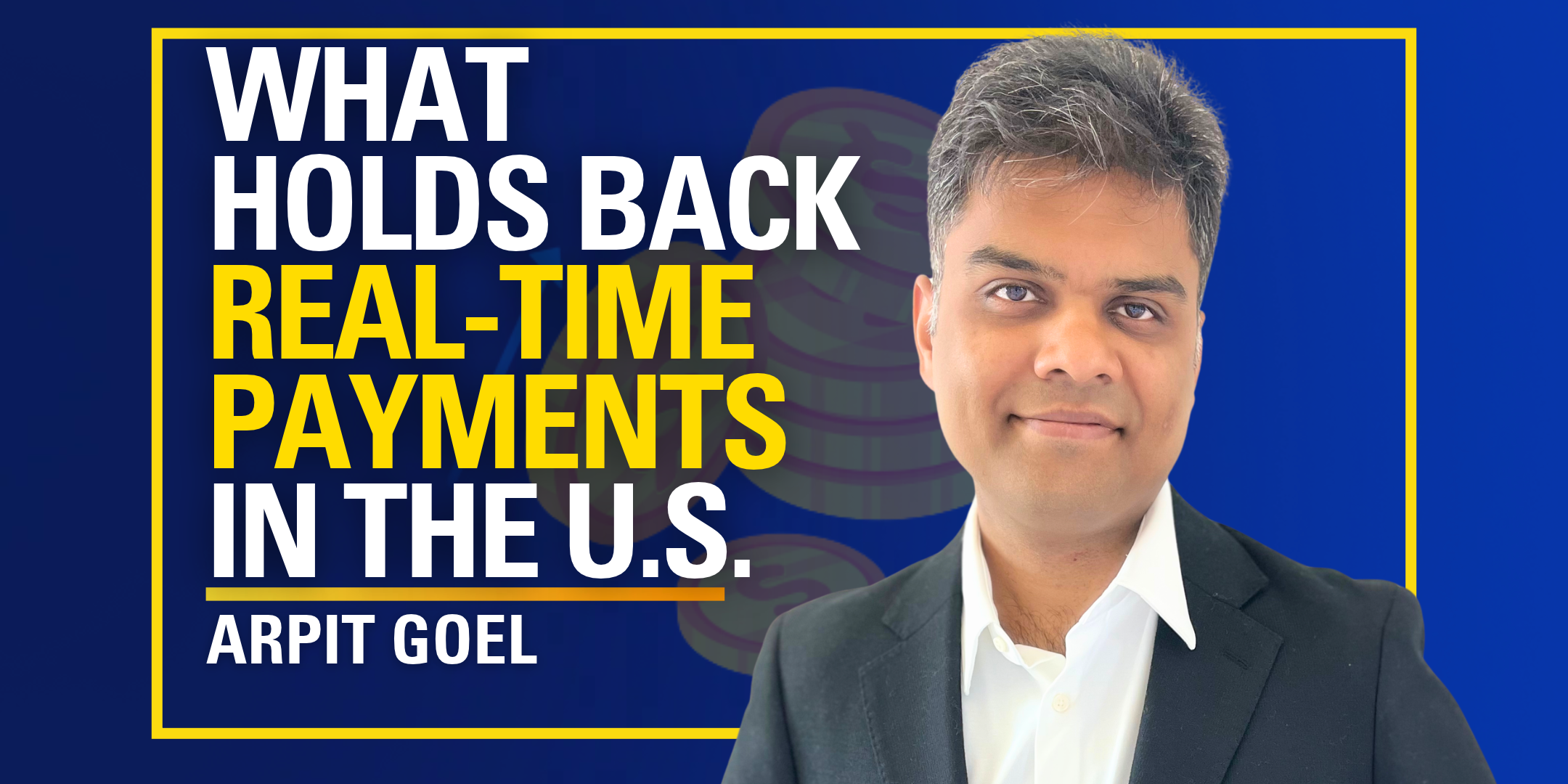
What Holds Back Real-Time Payments in the U.S. - Arpit Goel | ATC #636
Host Stephen Sargeant interviews Arpit Goel, founder and CEO of Root. He is a serial entrepreneur and technologist specializing in scaling transformative platforms. He is the Founder and CEO of Root, where he is modernizing enterprise money movement via Bank-to-Bank payment infrastructure.
Arpit’s track record of execution is anchored by a PhD from Stanford University and the successful exit of his previous startup, Gamma, which was acquired by Palo Alto Networks. Following the acquisition, Goel served as a Vice President and General Manager at Palo Alto Networks, leading a high-growth division and scaling it into a market leader. Today, Arpit leverages that expertise in large-scale systems and enterprise growth to bridge the gap between legacy banking and modern digital payments.
Host: Stephen Sargeant
Guest: Arpit Goel
We are also available via:
Buzzsprout • YouTube • Quora • Medium • X • Facebook • LinkedIn • Soundcloud • Apple Podcast • Spotify • Player FM
Episode Transcript
Stephen: This is your host, Stephen Sargeant, the Around The Coin podcast, and today we're gonna get to the root of the payment problem in the US. Actually, we're gonna be speaking to Arpit Goel, who's the founder and CEO of Root, which is a payment infrastructure player helping real-time payments all the way from the biggest payroll providers down to creator economies. He's gonna talk about all about the payment gaps that we see in the US and sending money abroad. What happens to idle capital? We talk stablecoins. We talk agentic payments. We talk a little bit of philosophy. We go deep into what's really happening behind the scenes, that lower layer from unbanked to underbanked all the way to what the future looks like in payments. And remember, Arpit has been in AI since 2011, so he has some interesting aspects and insights on what the future has, and have we hit that AI peak?
This is a really fun episode. We always have fun when we go to the Bay Area to talk to some of our friends that are serial investors, technologists.
This is a fun one, and it incorporates everything you guys love: payments, regulations, and agentic AI. Hope you enjoy it This is your host, Stephen Sargeant, the Around The Coin podcast, and today we're gonna get to the root of payments. Actually, we're speaking to the founder and CEO of Root, Arpit Goel. You're a serial entrepreneurial. You're definitely very technologically savvy and you're specializing in platforms.
I wanna go into a little bit of your background. Maybe just tell us a little bit about yourself. Then I wanna jump into some of your early work experience, and then let us know, like, what is going on in this space. So tell us a little bit about yourself and how you ended up in payments.
Arpit: Yes. Thank you, Stephen, for having me here. Think you gave a high-level background already. So I'm a serial entrepreneur. I'm based in the Bay Area. I've almost always only built companies, so the way I like to introduce myself sometimes funnily is that my longest tenure has been a, a PhD, where I spent five and a half years at Stanford.
My second-longest tenure has been my undergrad, in computer science in IIT Delhi. That was four years. My third-longest tenure was my first company, which was Gamma. It was a data security company which was a very quick, exit into Palo Alto Networks. And my fourth longest tenure, was spending time at Palo Alto Networks, where we integrated our data security business into their business and grew their business 5X in two years.
And now I'm the founder of Route, where I've been, I incorporated this company about two years ago, so I'm crossing my last tenure and making this my second last tenure very quickly. How did we land into payments? So, as you can see, right, I don't have any background that I correlate to. I always find new markets where there is a lot of momentum happening and a lot of regulatory change happening.
That's always my reasoning for starting a company in that space. The reason we picked data security as a market in 2018 was the same. There were lots of privacy and data security regulations coming at the same time, and it was a motivator to start a company in that space because everybody was trying to solve a problem in that space.
Like, the CISOs were confused how to solve the problem. So we ended up creating a data security for SaaS applications use case, which became very useful for like Palo Alto Networks became our customer, and then they acquired us pretty quickly. After Palo Alto Networks, I spent time investing in a lot of companies, so I'm also like an angel investor.
So I invested in about a dozen companies as a first check. And while diligencing one of them, I ran into this payments problem where I le- realized that the US payments ecosystem is probably 20 years behind. Whenever money needs to move, it goes through a bunch of intermediaries. So the high-level message I give $100 trillion originates in the US every year, and it takes three to five days and maybe 30 to 50 bps before it lands into the destination.
Right. So that's the opportunity here.
Stephen: You know
Arpit: think 100-
Stephen: you, you started very early in AI though. You were in AI when you were a PhD student at Stanford. That's 2011.
Arpit: That's
Stephen: what were some of the innovations at that time? Like, what were you working on? Looking back then to where AI is now, could you e- ever expect the amount of technological evolution that we've had in the last three years since you've been in this space, you know, o- over 15 years ago?
Arpit: I mean, so look we saw all of it happening. Most of the research was happening, like one of my friends, he wrote the paper around neural networks dropouts. One of my friends he, he helped coin the RNN framework, right? So we, we were in the trenches there, and in fact, Gamma was an AI for data security use case, right?
AI, you are right, it started... A lot of people don't know this. They think that it started in 2020 or in '21, but it-- but the real foundations of the AI were probably being laid in 2000s, and in 2014 is when, or 2013 is when OpenAI was actually incorporated as a company. So what I tell a lot of people that if you want to get into a new wave, right?
So a lot of-- when I, when I, when we go ar- go around recruiting, there have been situations where people have come and said that, "Arpit, why are you not doing something in AI when you have that AI background?" and stuff like that.
Stephen: That was gonna be my number one question actually on the podcast
Arpit: Yeah. So I, so I say that, "Look, I already did it." So we already did it.
2018 we started, and by the way, 2018 was late. It wasn't early because to- OpenAI was started in 2014. So if I, if, if I'm starting a new company in 2022, it cannot be on something that was supposed to be started in 2014. We are already late in that game. So I literally told this to a friend that, you know, the AI wave is at the peak right now, It's not a rising tide. You can only crash the wave. You cannot rise more. So the new wave will not look like a wave right now, and you have to find a new wave if you're starting a company.
Stephen: Since
Arpit: reason I would not, that's what, that's the reason I would not go back to AI, because most of the AI companies, there's a lot of M&A going to happen in the next one or two years because the foundation- foundational model companies who actually started in 2014, they're going to eat up the entire space
Stephen: I'm curious, you're investing in companies, you live in the Bay Area. Is there any, what's the next wave that you're seeing? What's the thing that... You know, and it might not, it might not hit that peak. It might never, ever take off. But is there something that's very interesting? Is it you know, some of the inventions and exploration into n- the ne- the brain and neural what Elon has built?
Like, what are you seeing that you think could possibly be a next wave or potentially more than one thing, the next waves of innovation?
Arpit: Yeah, I mean, so let me first create a frame around that question, right? So the next big wave, and it's not one wave, m- the next big waves will have to be at some core infrastructure level, right? If we are talking something around software, right? The, the point is that the application layer is completely dismantled, right?
You can spin up an application within an hour if you want. So if somebody is saying that I'm creating a new application, a new workflow, a new form of solving a problem at the application layer, it's gone. You cannot create a big... You can part rop. It's like lot of website companies emerging after the dot-com bubble, right?
So that we will, we'll help you create a website, right? That's where application development is right now. So you have to go multi-layer down and look at what are the core infrastructure problems and try to solve them. So now the question becomes: What are the core infrastructure problems that you can solve?
So one of them is money. So how money moves in the US hasn't changed for the last 30 years. So th-that is what we are pouncing upon and a lot of other companies are pouncing upon. The other infrastructure problems I mean, so like, like defense happens to be a very big big thing because of all the geopolitical tensions that are emerging.
The third is obviously the demand for compute and inference is increasing so much that somebody who owns creation of the chips or creation of optical fibers, like one of my friends is building a company where he's trying to replace the, the data center fibers which are electrical to optical. Right? That's like an infra problem he's trying to solve, right? One of my friends is building a company where they are trying to design-- redesign the chips inside the data center
Stephen: All right
Arpit: because when the compute demand is high, you cannot place the chips the way you used to place with the electrical fibers and assuming the optical fibers will come in, so that's like another infrastructure problem.
My brother-in-law has a company which basically is a water company. They provide water purification for their data centers because 30% of data center work is is with is, is with water as a, as a energy component. So energy, defense, core infrastructure, and money is where I'm pursuing
Stephen: I'm curious, you said, you know, you were investing in companies and you saw one of the biggest challenges was around payments. Funny enough that I know a lot of payment companies that found the biggest challenge was around, around regulation, and that's why they moved out of the payment sector into regulation.
Tell me about, like, what is Root and what was that ultimate gap that you saw in the industry that you were trying to fill with Root?
Arpit: Absolutely. And they are-- the, the question you asked is actually very interconnected. So the reason regulation happens to be the biggest bottleneck for payments companies is because every payments company tries to be in the flow of funds. So if I have to send your money to, let's say, David, who is our common friend, there are two ways.
One, I just give you the ability to send money from your bank to David's bank, or I say that, "Stephen, first give me your money. I will do whatever I want to do with it, and then someday later I will give it to David."
Stephen: Right
Arpit: Everybody loves the second path because it's, it's the, it's the assets under management path, right?
The first path is the hard path. But if I can solve the first path, we don't run into any regulation, we don't run into any compliances, we don't run into any risks and liabilities, because I'm just letting money move from source to destination. So I have a very interesting analogy around this, which may be related to the first question that you asked, that the largest companies in the world have always been pure infrastructure companies.
Whether you say a l- looking at the US capitalistic history, right? So if you look at Vanderbilt, he built railroads for the US connecting cities. Then Rockefeller came, and Rockefeller built the pipeline network for delivering oil and gas. Then J.P. Morgan came, and J.P. Morgan, people think that he built a bank, but that was not his first invention.
His first invention was with with Thomas Edison, and they built General Electric, which is basically the electrical transmission lines. So now if you look at all these big infrastructure companies, they were-- What was their goal? Their goal was that the asset that is traveling on this infrastructure goes from point A to point B in the fastest way possible, right?
Like, Vanderbilt never wanted to slow down cargo moving on the trains. Rockefeller never wanted to slow down the oil and gas moving on oil and gas pipelines. J.P. Morgan never wanted to slow down the electricity that moved on the transmission lines. But money is the only asset in the world where the infrastructure owner is incentivized to slow down the movement of money.
Stephen: You seem to have carved out some really unique industries in that you're providing these services to, including the creator economy around staffing and workplaces. How did you fall into these categories, or is that a result of some of the, you know, hiccups that you ran into while transacting in maybe some of the businesses that you were invested in or working with?
Arpit: Let's first accept the fact that money moves slow, and it costs to-- it costs pretty high to move money, right? These are the two things. Now, willingness to get money fast is everybody, right? Everybody wants to make sure that if you are a creator or if you are receiving a payroll, or if you are a small merchant who is receiving a credit card payment for for let's say like food or some salon or something like that, right?
Everybody wants to receive money fast. But now the question that we started with is that how do we-- which industries are the ones that will resonate faster in the US? Because US ecosystem is broken in a way where today if I go and say that I can send money to you in five seconds from my bank to your bank, most likely you will say this is not possible.
People don't even know whether it's possible or not. So we wanted to attack industries where they-- where-- which I call is that, which are very which are dominated by the, the credit industry. So like, daily pay workers, right? They are on-demand wage. In the US, there has been these these daily pay loans, loan companies that charge very high APRs to just give them money four days before or three days before, or sometimes seven days before or whatever, right?
So there, the market was ripe, where the recipient is willing to pay to get money faster, and hence, if we can just let their employer or their payroll company send money to them faster, we have a business case created. Because in the US, we-- it was important to create an incentive around the scheme. Over time, it will be adopted in, in every place.
So that's how we started designing the industries where we want to attack the use case of instant five-second settlements 24/7/365.
Stephen: That makes a lot of sense from, like, a real-time perspective, whether you- you know, you're a restaurant and you need to, you know, buy food for the next, you know, for the next day. Construction, you, you mentioned daily workers, especially in construction, e-commerce. All that delayed capital brings in other intermediaries and, you know, that d- it, it further increases the cost of money that you should be receiving, right?
Like, those payday loan companies charge 20, 30, 60% annual interest depending on where you live, and that just makes, you know, it further dilutes the funds when it's just really a process of the payment that's the issue, not the actual does my employer have the money and can I receive it? It's just that whole process that takes so long and costs both sides, I'm assuming, more money.
Arpit: That's correct. That's correct. So wherever there is a friction on both sides, that becomes a starting point for us. But over time, our goal is that in the next five to seven years, if everybody experiences what five-second, 24/7/365 payments looks like bank to bank, then there is no going back Right? Every single transaction will happen through this framework
Stephen: You know, you have an interesting, like, return on investment ROI calculator on the website, which lets you see how much savings and revenue growth you could have had using Root. Do you have any idea, as a data scientist, do you have any idea of, like, some stats about how much your average customer is saving or how much, like, you would love to get people...
Like, what is the possibilities of how much they could save using Root?
Arpit: I mean, so, I think the math is very simple, right? So let's-- as I said, the $100 trillion originates in the US, and it takes three to five days and 30 to 50 basis points to land to its destination, right? Now, let's say you are a marketplace or an e-commerce company or a payroll company, and instead of $100 trillion, you are moving $100 million, right?
So if you're moving $100 million, then what is the value of three to five days of cash flow, right? You multiply it with the annual interest rate of 5% with one week divided by 50 and you look at the 30 to 50 basis points as a cost. So it will come out, come out to be something like 36 million approximately, right?
So that's how we would calculate. It's pretty simple to calculate. Now, that 36 million is the opportunity, and the opportunity is both in terms of time and cost, right? There is a value of increasing the speed of money because somebody is taking a loan to cover up for the three to five days, right? And that is not even in the calculator.
The calculator is a hard ROI of just saving those three to five days and saving those 30 to 50 b- bips. And that's how we calculate in the ROI
Stephen: It doesn't account for, you know, if you had that $36 million active and ready, you could invest it in other things, right? Other inefficiencies. You could grow your business so much more. You can invest in, you know, maybe more expensive products or services. You don't really think about the opportunity cost that you're giving up because your money's tied up for almost a week, and that's every time you do a transaction, you're waiting a week for your money possibly
Arpit: That's correct. That's correct. And that's the ultimate goal of the instant payments ecosystem. Like US government is, has been working hard to get instant payments active in the US, right? On the separate... And the stablecoin companies have been trying to create a new framework, a new protocol to allow instant payments across the globe, right?
The liquidity problem runs very deep. So for instance, if you are a payroll company and you want to onboard a big client, you need to pull money from their bank into your bank and then push money to the workers. So ACH pull followed by an ACH push. ACH pull is risky because it ta- it can take three to five days to settle, and that's the, that's one of the reasons why delays happen, because under the hood we are using ACH rails, right?
So the bank actually expects the payroll company to keep a very large chunk of cash as reserves so that they can activate the ACH pull for a high value. Why does a bank do that? Because bank is also taking a risk with the Fed. Bank needs to keep a lot of deposits with the, with the Fed so that Fed can allow them to clear the transaction through the TCA trails or the ACA trails.
So this liquidity problem runs all through the system. And the fundamental issue, and that's where the biggest secret sauce or non-secret sauce is. The fundamental issue is that historically, the way banks operated was that they had a 4:00 PM cutoff because they had to go home, right? And they did not...
Stephen: One or the oth- one or the other.
Arpit: And they did not work over the weekends, right? So which means that I have to submit my sys- my set of batch before 4:00 PM. You have to submit your set of batch before next day 11:00 AM. And the third recipient site has to submit their set of batch or accept their set of batch before 4:00 PM the next day.
And if any one of these moves a little bit, it suddenly becomes 4-11, 4-2, 4-4, 11-4, right? It goes from one and a half days to two and a half days. And if there's a weekend, it suddenly becomes four days or five days. But now with automation, all we need to do is make sure that the messaging protocols can talk to each other And have the agent do all that work on behalf of the person who was supposed to make the button clicks.
And we get away from the batch ecosystem to a real-time messaging ecosystem. The challenge of the real-time messaging ecosystem is that every bank, Fed, TCH, everyone has a different language when it comes to accepting or sending messages. So we are trying to be that unifi-- u-uniform translator across the varying messaging ecosystems.
That's the way to think of us
Stephen: I'm curious though, 'cause you mentioned stablecoins. People say that stablecoins will help release some of this, you know, idle capital that you're talking about and how much it costs money, and there's, you know, more and more stablecoin companies trying to get to this real-time payments. What do you think the advantages or disadvantages, you think, in using stablecoins to solve this problem versus, you know, maybe an API, API-focused approach like you're taking?
Arpit: I mean, so look stablecoins is built on blockchain as a technology, right? And the the reason again, we can, we can be controversial about this, but I always said this, that Bitcoin the technology behind Bitcoin was awesome, but Bitcoin as a, as a instrument of payment has its gaps. Like it's, it's almost like tulip mania according to me.
So-
Stephen: disagreement about the payments aspect of Bitcoin for most people
Arpit: I mean, the reason Bitcoin became famous was because of anonymity, right? It basically was the was a smuggler's tool, right? Instead of using paintings, I could use Bitcoin to, to transfer whatever stuff, bad stuff, right? So that's why it became very popular, but the technology behind it, the blockchain, was u- was always useful.
Now, what is stablecoin? Stablecoin is basically Bitcoin with blockchain, but pegged to the dollar. It's one is to one, right? So they have to keep those reserves with the Fed, otherwise they can... the, the value of the stablecoin can go down, right? So they're trying to mimic actual currency like a, like, like a INR or Ch- Chinese yuan or so on, so on and so forth, that you need to have federal reserves so that you can back it one is to one.
So now if you decouple the backing and the blockchain, the blockchain is very useful because it's basically a new protocol where anybody can join and accept settlements, right? So it becomes a different messaging protocol that everybody agrees upon. And the way to agree upon that is that you join that chain or you join that chain's protocol.
So for instance, all the banks are releasing their tokenized deposit protocols where they allow other banks to join, and instead of it being a Nostro setup where one bank has an account with another bank, they all participate into this permissioned or permissionless chain to validate, accept, reject transactions. So it becomes a decentralized or a distributed ledger. So from that lens, it is very good, very useful. It's trying to come up with a new messaging protocol. It's a competition against Swift, right? So from that perspective, we are agnostic. This is just another message, messaging protocol. So like we are working with the banks tokenized deposits framework so that maybe we can use it for faster settlements in certain cases.
Otherwise, we are working with Swift to do Swift-based settlements. Otherwise, we are working with regular PACS, BAIN, CAMT messaging protocols that the banks and the Fed have to settle them on those parts. Now, where do stablecoins and banks actually converge? Right. That may be a question that you may be thinking of or people are thinking of.
So this is something I've been very consistent about in the last two years. I had an argument with a friend two years back on stablecoins. It was just when I was starting Root. So I said... And, and my PhD was AI and game theory, right? So I use stable equilibrium a lot in my description of things. So I jokingly said there is only one stable equilibrium of stablecoin issuers, and that is they have to be regulated like a bank So now if you look at all the g-- all these intelligence acts that have come in the last few years, whether you call it the Clarity Act or Genius 1, Genius 2 or Clarity 2 or whatever, they've all been pointing in the direction that the stablecoin issuers need more regulation, need more oversight.
Otherwise, they will be tethered, like they will be, the value of the issued currency will go down, right? So some of them are following, like Circle is actually very actively following. They got a they got an they almost got an approval to get a national crypto bank license, national charter, right?
So they are working toward it. That Tether is tethered. Tethered like they, they made their money their own way and, and they forgot what is right and what is wrong. So that is the equilibrium, in which case for us, we are still the, the messaging protocol connection across various messaging protocols.
Stephen: And I'm curious, you know, when you look at the United States, you know, especially we're seeing, you know, the race against China in AI and energy, why do you think there's such an inefficiency in the US compared to, like, India's UPI or Brazil's Pix? Or, you know, are we closing that gap with things like FedNow and almost getting to this real-time payments across the board?
Arpit: I mean, look I'm glad that you s- agree to the gap, right? So first thing is that the Fed has to agree to the gap. UPI is making waves, right? UPI is, is a poster child that I think US should look at. In fact, I think six weeks ago I was at a panel and somebody asked a similar question, but in different vein, that what should the US policymakers be doing so that we can also get some level of UPI adoption in the US?
Because the intention is there. They, they know it's important. In fact, why it's important is, I'll give you a very simple analogy, right? 40% of SMBs in the US, they refuse to accept credit cards. An SMB here is like a salon shop or maybe a restaurant or a grocery shop. A lot of people think that the reason that they refuse to accept credit cards is because of the fees But it's not because of the fees, it's because of the delays, right?
They need the cash most on the weekend, but when-- and they get the maximum transactions done on the weekend, and that's when money spent on Saturday doesn't land until Tuesday. And they have to use the cash to buy purchases for the next weeks of stuff, right? Everything happens on the weekends. So weekend lines of credit happens to be a very big business in the US.
Almost at 15% APRs, companies are making weekend lines of credit. Now, what happens is that SMBs, when they start refusing to electronic forms of payment, suddenly somebody comes and tells them that now you can do tax evasion. the record? There's no receipt. So US is noticing that there's high levels of tax evasion because electronic forms of payments haven't been accepted.
Now, if you look at India. In India, obviously only less than 3% of population or 5% of population file their-- file for ITRs or income tax returns before UPI. And just ask Gemini, what is the rate of increase of ITRs in the U- in, in India after the UPI launch? You will see a crazy exponential.
Stephen: Right
Arpit: So the US government understands this.
They want to solve this. So now going back to my point on the panel when this question was asked, I said it's always... Steve Jobs said this, right? "Good artists copy, great artists steal." So rather than reinventing new frameworks, why don't we see what worked and just try to copy that as much as possible and go for it in the US?
And that's where I think there's a little bit lack of acceptance that there is something that worked, and we just need to follow it as fast as possible rather than playing this semi-capitalist democracy game where we have to drive incentives so that people adopt it. Right? What Brazil, India, even UK did is they released open banking charters and said that, "Mr.
Bank, if you don't follow these RFCs, you are not a bank." So some level of top-down I think will help the government, will help the country, will help, will help the economy, will help the banking ecosystem too. And that will need some policy level modifications.
Stephen: I remember we were producing a podcast and someone came with a stat that, like, 5% of Americans are either unbanked or underbanked, and I had to Google it after. Like, I think this person's exaggerating a little. But it, it, there significantly seems to be a high amount of Americans are unbanked or underbanked.
Do you think this, you know, impacts the way money moves in the United States and ultimately, you know, impacts, you know, some of these delays or the regulations around it?
Arpit: I mean, so the unbanked, underbanked debate was a real debate 12 to 15 years back, and Chime is one of the most successful companies who basically latched onto that trend. And the fact is that 15 years back, we used to say 5% to 10% of the US population is unbanked. Now we have added another word, which is underbanked, right?
So that's just a way to say that we have made a lot of progress, right? And Chime played a very big role in making, in making that progress and pushing those boundaries. So I would say yes, 5% of US population is still underbanked, not unbanked. Unbanked would be much smaller. And, Rather than worrying about unbanked population, the biggest worry for the regular SMB owner or the regular unba- underbanked person is that they are getting hit with overdrafts And running paycheck to paycheck in a-- sometimes in very high credit at the risk of completely losing whatever they have, right?
Because there are some covenants around credit especially given that they're underbanked and they don't have a great credit score and stuff like that. So there is a trend that happened in 2026. The amount of debit spending significantly over- or surpassed the amount of credit spending. It always happens whenever there's a recession.
So we are going through some sort of a recession right now in the last one and a half years, and it will continue for the next one year as well. And, and that should be a, a, a wake-up call, right? The reason developing countries did not accept credit... Like in India, we never had credit. We were using cash, and we jumped to UPI, which is also an alternative to cash because money goes from source to destination. Debit actually increases the liquidity in the system. Credit reduces the liquidity in the system, right? So I do think that the average American is, is, is finally getting educated because of the, of the excessive use of credit that it ultimately, penultimately hurts. The millennia the, the new generation of whatever that is, I don't know, gen something, that is is choosing debit as a form of payment.
And if we can replace debit with a faster interbank transfers, it's good for the banks under the hood because it's already debit, it's not credit.
Stephen: Are you concerned, you know, I s- you know, I think a lot of people see the vision that you have of real-time payment settlement, instantaneous transactions. Are you worried about things like buy now, pay later? Or do you think that based on what you were saying about debit and credit, more people are moving towards like spending the money they do have, not spending the money that they may have in the future?
Arpit: I mean, so look everything has its time and place, right? So credit generally is useful for creditworthy people, right? So for instance, I like I, I have made-- I, I've sold companies, I've made money, but still my-- I live in a mortgage, right? So that, that is a decision because I am creditworthy, right? I could have just paid out for the entire house, but I'm creditworthy.
The problem is it's a great way for the, the, the, the credit issuers to make money by offering by educating the people. I mean, what's the right way to say it, right? When I came to the US, one of my friends who was here, So when I came to the US, I did not have a Social Security number. I did not have anything.
Even to get a phone line, I had to ask a friend. So I got a phone number from Texas, Austin, why-- although I've always been in the Bay Area. And one of my friends recommended that I don't pay credit card bill in full. I said, "Why? If I have the money, why should I not pay it in full?" He said, "It builds your credit history by not paying it in full."
Like that doesn't add up. How does a credit history build by not paying something in full? It should build up more by paying it, paying it in full. So some of these mechanisms that they have created are forcing you to default, right? And then it becomes a habit, and during recession you learn that it was a bad habit, and you come out of it.
So things are useful and necessary sometimes, like BNPL is useful and necessary sometimes. But the crazy enormous rates they offer, like 68% for a phone purchase, I don't know if that will last because once people start realizing that debit is a lot better they will go back. Or if money starts moving faster, there is more liquidity in the system, you need-- you can avoid having too much of BNPL credit.
Stephen: Can you talk to me about some of your regulatory requirements? Obviously, you know, th- that's huge going from sending payments within the US to now sending it cross border. Y- I think you're, you know, supporting over 120 countries. What is the regulatory landscape like for an organization like yours, and is this more of an inters- infrastructure technology play, so maybe you're n- don't have as heavy as requirements as other players in this space?
Arpit: that's correct. So, we are non-custodians, so we don't need to take money from your bank, hold it with us, convert it into another currency, and send it there. We don't need to do that. What we say is, we work with large corporations, large enterprises, who generally have bank accounts in different countries, and we educate them that instead of they using an intermediary, it's better that we set up virtual accounts with their banking partners or with their banks in local currencies, do treasury management across those currencies for them, and do local disbursements using local rails for doing payouts.
So that completely keeps us away from the regulatory and compliance burden. We don't need to have an MSB FinCEN, we don't need MDLs. We are non-custodians
Stephen: And I'm curious from a payment lens, like how important are partners? You always see like infrastructure players have to have partners, especially maybe in emerging markets outside the 180-- I just checked, it's 180 markets you're serving. What do, what is that partnership ecosystem like and how important is it for you to be a part of that as a non-custodial actor in the payment space?
Arpit: A partnership ecosystem is probably the most important. And fintech is interesting, right? Everybody is a friend until they are an enemy, right? So it's very important to pick partners who see through the vision, and hence one of our biggest frames has been that we, we try our best to partner with banks, right?
Because banks... The best thing that banks have is that they are they're the most pure forms of custodian, right? So for instance, a bank is supposed to maintain actual assets, maybe it's gold or maybe it's silver or maybe it's some form of assets, for the cash that they are holding, right? In, in US, that asset happens to be one is to one pegging with the dollar, right?
Or, or for banks, there are some relaxations around that, but they have to keep certain money with the Federal Reserve. So we try to do a lot of our partnerships with the banks primarily. Again, we are agnostic to the partner. It's not like we are sending clients to one bank versus the other. Our preference is that customers should stay with their choice of banks.
But if for, if for whatever reasons we don't have the integration with that bank or the bank has not opened up their SFTP servers or their APIs to root, then yes, we have a network of banks that we are integrated with, and the customers can choose one of those.
Stephen: And I'm curious, you know, with instant payments, with any payments comes fraud. What are the biggest emerging fraud threats or any intel, data, trends that you notice, especially 'cause you're servicing clientele all the way from maybe a content creator on YouTube all the way to maybe some of the biggest payroll providers in the ecosystem.
What are you seeing in the fraud landscape?
Arpit: So there are two main sets of fraud here. One, let's say you are a creator, but somebody, Actually, not even two, there is only one lens of fraud here because both, both the fraud lenses are connected to one single lens. So you are a creator, somebody takes over your account and puts their bank card information.
So it's an account takeover, takeover on the recipient side. That is one vector, one ve- one very big vector. Now, the same vector applies on the sender side. When I'm sending money to you, somebody takes over my account and decides to send money to someone else, or decides to send you more money than I was supposed to send you.
Right? Apart from that, most of the things are mistakes. Like maybe I sent you more, maybe I've sent you for the wrong reasons or something like that, and they are reversible easily. But this account takeover fraud is probably the most important vector, which even UPI hasn't solved it yet. So last year, there was a big attack that was created around UPI around account takeover.
So the way UPI solved it, and we are trying to replicate that for what we are building here, is every transaction. Let's say I'm sending money to you. I'm sending with your details. First, I've verified your details fully. You-- We have KY-KYC'd you, we have account verified you, we know it's you. Then every transaction has a lot of information in it, which is amount, recipient, name, account number, routing number or whatever.
As much metadata as we have, we would create a transaction bound cryptographic hash of the transaction, bound it with the identity of the sender, let's say an OTP or a biometric. And once that transaction reaches the bank, we've ensured that the bank got the same transaction because we have that one-way hash established.
So we call it like a strong customer auth or a transaction bound auth mechanism. That's how we, we minimize and make sure that I authorize that transaction. So it's almost like authorize that payment, especially for high value transactions.
Stephen: You talked a little bit about mistakes there. You know, we've-- I think any payments company will say that they're trying to remove friction. Any company is trying to remove friction between their customers and, you know, their process of what they're either selling or the service that they're providing.
Do you think that we need to add back maybe a few more friction layers for some of these, especially younger consumers or even elderly consumers to better protect them? Or do you think that the friction just has to be in certain places versus there being no friction at all?
Arpit: I mean, so look what's a, what's a good analogy, right? Like what is a card? What is a credit card? If you fundamentally think what is a credit card? Credit card is nothing but a tokenized account and routing number. With the card present is that you are authorized to hold that card, right? So it's li- it's literally like a physical way of doing a, a transaction bound auth, except that credit cards can be stolen, the numbers can be stolen, they become card not present, and suddenly it goes into different kinds of risk. So, so you are right that as part of reducing the friction, we have we have opened opportunities for more fraud. But the only thing that needs to be added, right, when the agent stuff comes, right, which is already happening, like, like, like credit card is nothing but an agent that is transacting on my behalf.
It's already software doing the transaction. I'm just authorizing the software to do the transaction through the card present tap, right? So instead of that card present tap, it becomes some sort of a biometric auth for high-value transactions. And there are situations where I will allow a variable recurring transaction to happen without auth, but that may be for low value.
That's like a subscription payment, which already happens, right? So that's how the world will really evolve. The most important thing will be to have the secure auth mechanism that can tie my identity and prove to the bank that I initiated the transaction, or the holder of the currency initiated the transaction
Stephen: You know, you made a point at the start of the podcast to say, like, for over the last 25 years, especially in the US, we haven't really moved any innovation through the payment landscape and it still feels archaic. What are your thoughts about, like we haven't really figured it out. Now you're trying to figure out as ma- as well as stablecoin pr- service providers and other crypto companies and payments companies.
Are, are we ready for agentic finance where the agents are moving the money, where we haven't even figured out, you know, a seamless way for humans to move the money yet?
Arpit: So agentic finance is a real thing. Now which lens do you see the agentic finance on is the question. So for instance, somebody shopping on your behalf, I think we are not ready for that. That's too far away. But n-now, now let's, let's take the problem that we have talked about thus far to the banks.
For banks to power instant payments in the US, they need 24/7 liquidity management desks. And that is the fundamental reason, which is that because they leave at 4:00 p.m. and they don't work on the weekends, somebody is not available to do the LMT or the liquidity management trading for the banks.
That can totally be replaced by agentic finance And that suddenly ensures that the, that the liquidity in the system has increased, and hence real-time use cases, real-time payments use cases can, can come up. So in the last 20 years, we have made a lot of progress on tokenization. So like credit cards are tokenizers.
They're basically tokenizing the account number. But when I say the actual money movement, the infra-- the plumbing to move money, move move money hasn't changed. I mean, the actual transactions still happen through rails that were built in 1970 and 1980s. And to change that, agentic finance can be very, very good, very useful because this is a real problem.
Banks are not able to support 24/7 liquidity because they don't have automation to support it or automation to do intra-bank messaging transfers. Because ultimately, what is money, right? Money is a, a giant database that trusts each other. There's nothing-- It's nothing else, right? I mean, just think about it.
It's we have re-- we have actually reduced money to nothing but a giant database that trusts each other. Earlier, it was backed by gold, backed by oil.
Stephen: barely trust each other
Arpit: Yeah, yeah. So b-barely trust each other, and that bare, bare trust is basically making them speak the same language under a common unified auth mechanism
Stephen: And I'm curious, how do you look like making sure that your company's adaptable for this new wave of an agentic economy? How do you plug into it? How do you think about it, especially with, you know, y- over a decade worth of experience playing in the AI space?
Arpit: I mean, so, y-you're right that payments is a race. I, I-- like one of our investors, right? I met him in New York. He's he's a big shot in the fi-finance industry, and he was saying that payment, payments is a race against time, and it takes forever to change behavior and stuff like that. So I said, "Yeah."
His name is Vasan. I said, "Vasan, yes, you are right. Payments is not a race against time, it's a race toward time." It takes time to let people understand and feel comfortable with what you are doing and what you are not doing. And, and that's complex. The trust building takes time. The most important thing is, if I were to take a step back, is like actually one of, one of the podcasts I did recently, they asked me that, "Arpit, do you have any advice for payment leaders?"
I think it was Greg Myers. Yeah, Greg Myers asked me, "Do you have any advice for payment leaders?" And I thought of the question and the answer at at the same time, and I said, "Look, not biasing with my experience or our team's experience, but a lot of payment leaders have very little security background." So they don't think that a part of trust building is actually having security in the blood. They are not even thinking. So for me, if somebody comes up with a que- with a like we recently talking to a big real estate customer who was considering doing ACH pulls for some transactions, big transactions.
I said, "Are you nuts?" Like every transaction is 500K or 1 million, and the consumer has a 60-day return window. You know the li- amount of fraud that will happen by just taking on that, that risk. So short answer is that yes, it takes time, but the biggest thing is that we have-- the way to build trust is to never get compromised.
And as my previous CEO, Nikesh Arora, says it publicly, he says that there are only two kinds of companies in the world. One who know that they have been compromised, and the others who don't know that they have been compromised, right? It's a, it's a great pitch for a cybersecurity vendor. But that's actually partially quite true.
So being at the forefront of cybersecurity allows you to build a lot of trust in payments, which will happen to be one of the biggest things as agents enter the, the transaction mechanisms. And that's the only way to
Stephen: fintechs in the world get compromised in, in ways that they probably wouldn't expect, right? Not their core infrastructure, but just the way they communicate with law enforcement or what looked to be law enforcement. So we're seeing there's several ways to get compromised, not just where you hold your customers' money
Arpit: That is correct. And and like this big Bank of America thing that happened, like, just two weeks back. It, it's ultimately connected to the... I like to say the, it's, it's just the Synapse thing coming back again and again. So I started Root when I saw what happened to Synapse. Synapse was a custodian, like they said that we are AWS for payments or something like that.
But they were actually a custodian. They were, they were holding cash on behalf of clients, right? And this BaaS thing became a big thing three, four, four to, four to six years back, where every bank was like, "We'll become a sponsor bank, create wallets, create whatever, hold custody." So our fundamental mission is to be against custodianship.
We are saying that money can actually move from source to destination. Nobody should be in the middle, right? And hence, all we need to prove is that we are secure enough That you can authorize or there are policies that there, there's a limit to amount of transaction you can do and things like that. I mean, I really like Zelle.
Zelle is a great product. It's less advertised in the US for the last 10 years or whatever. Very few people talk about Zelle, but that's probably the most efficient product, except it has run into some fraud issues because they didn't have the auth layer properly tightened, right? So we are starting with businesses as our customers, and we say we are Zelle for businesses or, or a m- more secure Zelle for businesses.
And we deal with this auth layer a lot tightly than the-- than just the messaging layer
Stephen: And if you think about, like, the game you used to play in school, Broken Telephone, the more people you add in the middle, the, like, that's not the financial transaction that you want, is more intermediaries, more people to touch the money. You really just wanna get it from point A to point B, and, you know, that reduces the you know, in that whole bad scenario, it's like, well, who has the money?
Well, there's three or four intermediaries involved, and now you have to go find where the money went to.
Arpit: Yeah. I mean, that's a, that's a great analogy, right? The broken telephone. I call, somebody picks up their wire, then somebody calls, picks up wire. That's how money is moving right now, except that those connections have cutoffs. So, it happens only at, at 4:00 PM. It happens only at 11:00 AM. It happens only at 4:00 PM.
Right? So that's why the delays are happening. But that's a great analogy, where it's a broken communication network, which can be automated as long as we can make the source and the destination have the same messaging or we can translate the message between the source and the destination without going through the hops.
Stephen: Yeah, that makes a lot of sense. You know, you had a really great LinkedIn post around, you know, mentioning four juggernaut payments companies, Ramp, Rain Revolut, Rippling. They all started with R, but you said the main thing they had in common was, like, a regulatory licensing and global money infrastructure was really their moats.
Do you think that compliance has turned into now a competitive advantage in the payments landscape? And how does Root, which you wanted to be included in that group at some point, how do you gain that moat you know, especially if you start two or three or a decade after these other companies?
Arpit: So short answer, we are not competing against those companies. In fact, we have a video on our website you can go to useroot.com/demo, where in seven minutes on stage, I built a Venmo application from scratch using the Root MCP servers. Not only did I build the application, I connected to a live bank account, gave scopes to the API keys, then I showed the application to, to people on the stage.
I created my, my account inside that Venmo. I s- sent money to that Venmo wallet. I asked an audience m-member, "Say a number between one and 100." They said the number, somebody said 25, and I sent like 25 cents to my head of engineering, who was sitting in San Jose, and I was giving the demo in New York.
Then I called him on FaceTime, and I asked him to open his bank application and show how much money he got, and it had 25 cents on it. So the point that we are making is, we have made it very easy to launch the next Ramp, the next Rippling, the next Revolut, the next Venmo, or next whatever payments application you want, as long as you have one bank account.
That's the message we are giving. So we are not competing against the Ramps. We are saying that build the next AP automation that you want for whichever industry vertical you want. Build the next payroll automation you want for the next industry vertical you want. Build the next wallet infrastructure you want for the next vertical that you like to build on
Stephen: If we were to have this conversation a year from now, what would success look like for Root and how do you get there?
Arpit: I mean, so a year from now is a, is a short window, right? A year from now is almost like an investor asking how much money has-- have you made in revenue and the Excel sheet and stuff like that, right? But let's say five years from now, I think US has 400 million people. If we have made 100 to 200 million people touch, feel what instant five second 24/7/365 settlements looks like, that is success.
Because once you experience it, you cannot go back So that would be the goal, that how do we get 50% of the U.S. population just experience it, either they receive it or they send it. And again, doesn't have to be through Root. Root is just powering the the plumbing. It can be through bunch of customers of Root.
Like right now we have bunch of customers. Some of our customers have-- are platforms who have onboarded dozens of their customers, and each of their customers have onboarded thousands of their users who are getting paid. So it's, it's a full network that is being built from scratch through the Root plumbing.
Stephen: And I'm curious, is, you know, you go to a lot of conferences, you're speaking on panels. Is there anything you're hearing out there that, in the payments world that you don't technically agree with but it sounds as a good soundbite and that's why a lot of people are probably saying it looks good on paper to investors and decks?
Is there anything that you're like, "I don't really agree with this, but it seems like everyone else does"?
Arpit: I mean, so look how should I say this? So I, I did a, I did a PhD, right? So in PhD you do research, right? And I had a, a joke with one of my entrepreneur friends once because there is this topic of category creation in entrepreneurship. So I, I completely disagree with category creation. There's nothing like category creation, right?
And the joke I say is that even with the word research, people think it is novel, but it is a combination of two words, which is re hyphen search. So a true researcher gives a lot of citations in their paper. They know that they actually took the ideas from a lot of places and combined it and created a new term and say that this is novel or a new way of looking at things.
So as an example, what is agent ecommerce? Right. It is nothing but subscriptions. I've-- I, I, I'm already subscribed to Amazon. I can go click and buy. How is it any different from that? Maybe just the chat interface changes. So things like that, I don't think there is anything to disagree upon. But yes, people are coming up with unnecessary marketing terms, terminology all the time.
But fundamentally that thing has already been done or already been searched, and they have just researched it a little bit more and coined a category around it. And there's a lot of that happening
Stephen: As a marketer, I find I tell my clients to do the same thing. Like, you need to come up with a good concept that, you know, people attribute to your organization and your company, even if it's very similar to what's happening already in industry
Arpit: correct. Yeah, so that's, that's part of marketing. So we should agree that category creation is marketing, right? But it's not like I've created something new from scratch. It's alread-already an amalg-amalgamation of things, and agentic commerce is a good example. There's a lot of talks around agentic commerce, but how is it different from buying something on Amazon through a chat interface?
Stephen: Before I let you go, I wanna ask you, you know, you're an investor, you're in the Bay Area. Is there anything that what some might call nerdier friends or d- is there anything that people are doing that seems like on the fringes now, but it's probably something that we'll all be doing in five years, whether that's I- I- Ayahuasca retreats or, you know, microdosing LSD?
Is there anything that's happening out there that you're like, "Oh, th- this is fairly weird, but we could probably see people doing this." Pickleball. Is there anything that you're seeing?
Arpit: I'm a big student of history, right? And instead of saying what I'm observing now, I'll tell you what I observed 14 years ago. So this happened. This is a true story. 12, 12 to 14 years ago, I was in my PhD program at Stanford, and I was living in a house, and my my roommate or my housemate was also a PhD student.
Every Friday, we used to sit down and grab a beer and talk about what's going to happen a decade from now. So we-- so 12 years ago, me and my friend are talking about what happens a decade from now. So he's from Mexico. If he sees this podcast, he will remember this entire story. He's from Mexico, I'm from India, and he was a phenomenal biker.
Phenomenal biker in the sense that once we had a Thanksgiving break, I asked him, "What are you doing?" He said, "I'm going to Portland." I said, "Okay, what will you go-- What will you do at Portland?" He said, "No, I will bike for six days, and on the seventh day I'll catch the bus and come back." So he was that kind of a biker.
Okay. So we are sitting and we are talking what happens 12 years from now. So, we talk about life at Google, life at Facebook, and that AI will come, everything will be automated. Nobody will have much work to do, right? That's, that's the topic 12 years back. So, so then, then the question is what will we do?
And the point we make is that there are still people like you who just love biking so much. There are people who bike from San Francisco to Google. They spend some time, grab lunch and stuff, and bike back every day. They just do that 60 miles every day or 60 miles two times every day. And then he raises an interesting point.
He said that when he was young, he used to bike 20 miles to get to school, right? And I used to walk a lot to get to my school, right? So it becomes a suddenly a philo- a philosophical topic, saying that 12 years from now, the only way to survive is to have a lot of hobbies because everything is automated.
Like going, going back, going back to your question on playing pickleball or something like that, right? But the hard thing is, is it, is it easier to do something out of necessity or is it easier to do something out of hobby? And that's the question that this generation needs to think through, because no surprises, it's easier to do things out of necessity.
It's harder to do when you don't have a mission or a meaning to it So yes, it's coming. The meaning of work is dissipating, and you have to be really motivated to do what you want to do, otherwise the meaning of money will also get dissipated over time. There will be there will be enough for people to stay okay, but obviously enough is never enough.
That will have its consequences. But that's coming because a lot of stuff will be taken care of, or is already taken care of. I mean, 70 years back, work meant sit standing 12 hours or working 12 hours. That's what work meant. Now work means doing podcasts for two hours, right?
Stephen: When you say it like that. My wife's probably listening in the background like, "Yeah, you're working."
Arpit: Yeah. It's like sitting and talking for two hours, that's work. And if you have three podcasts a week, you are done with your week for a lot of people, right? So, the, the, the hard work that you have to do to do the work has reduced, and that is going to reduce further.
And hence, you better learn to play pickleball, learn to play piano, learn to... It's like the industrial revolution stuff, right? After industrial revolution, arts takes over. So we need to build those things or have something that we are truly nonstop 24/7 on, and we are doing it for the work, not for the outcome, not for the money
Stephen: But I also think there's an opportunity where we're probably gonna make life harder, right? It's why people are running ultra-marathons and, you know, people are hiking up mountains and going, like challenging themselves even more 'cause like, you know, they always say like hard men make like soft kids to ki- ma- the kids and soft kids make hard times, that kind of analogy.
So
Arpit: I mean, that's the thing, right? That's what me and my friend were discussing, that he, he just biked six days to Portland and took the bus and came back, and that was his Thanksgiving break, right? During Stanford PhD. So yes we, we-- the f- the interesting thing is, it's harder to make life harder when the life is not hard
Stephen: Right. Yeah, that's true. The
Arpit: That, that was,
yeah, that was the message that we alluded to.
That it's much harder to make life hard when life is actually good. It's, it's, it's easier a necessity to have a hard life than you need to have a hard life to do the basics.
Stephen: I think you make a good point when, you know, the millionaires are like, "Yeah, my kids fly economy 'cause I don't wanna spoil them." It's like they're flying. They're still flying. At the end of the day, our, our, our parents, it was a treat f- you know, for us to be able to fly. Our pa- this was such a great conversation.
Where's the best place for people to find... I l- I love your LinkedIn posts. Are you also, you know, very active on Twitter? Where's the best place for people to find you or run into you in the Bay Area?
Arpit: I mean, the best place is my office or my home. I am not active on Twitter yet but we're pretty active on LinkedIn. And yes, email and website we have where people can contact me, useroot.com. Yeah, our office is in San Jose downtown if anybody wants to come hang o- hang out with us. We're a team of builders always building fully into the problem statement and very excited about trying to change the, the liquidity mechanics in the US.
Stephen: Arpit, this was awesome. Thank you so much for joining Around The Coin today
Arpit: Thank you so much, Stephen. It was very nice talking to you.