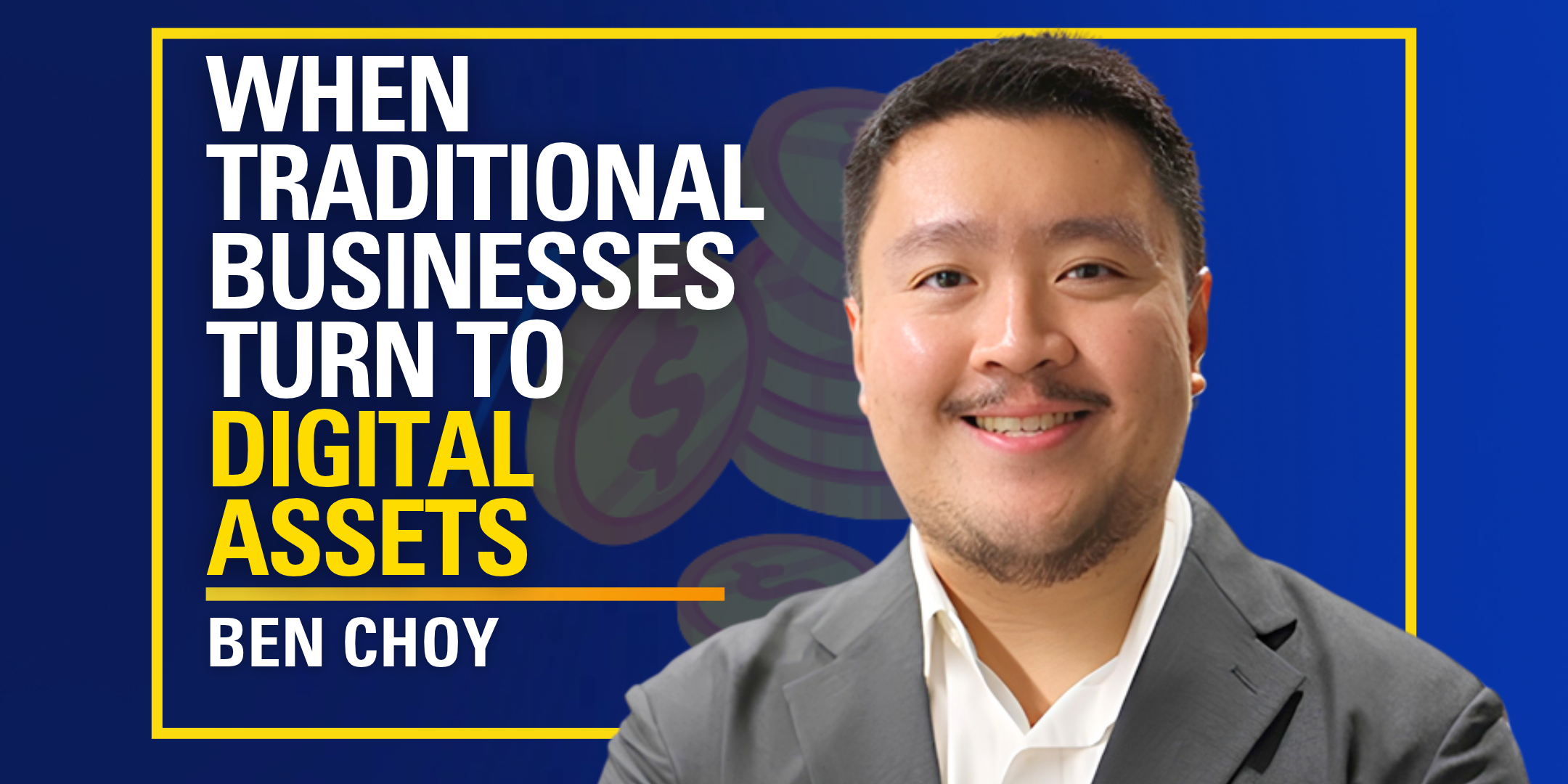
When Traditional Businesses Turn to Digital Assets - Ben Choy | ATC #635
Join our host Stephen Sargeant as he sits down with Ben Choy, General Manager of MENA at BitGo, with a proven track record in driving growth and expansion in the payments and digital asset sectors. He previously served as Strategic Government Relations and Country Manager for the UAE at HTX, where he was instrumental in driving the exchange’s expansion across the Middle East and APAC regions. Prior to HTX, Ben was Regional Head at Singapore-based fintech firm Liquid Group, where he successfully established and scaled its operations in Riyadh, Saudi Arabia. Before relocating to the Middle East, Ben Choy was at the Monetary Authority of Singapore (MAS), managing policy, supervisory and sector development matters relating to digital assets and payments.
Host: Stephen Sargeant
Guest: Ben Choy
We are also available via:
Buzzsprout • YouTube • Quora • Medium • X • Facebook • LinkedIn • Soundcloud • Apple Podcast • Spotify • Player FM
Episode Transcript
Stephen: This is your host, Stephen Sargeant, the Around The Coin podcast. Today, we're venturing into the MENA region. We're gonna talk to
Ben Choy, who's the general manager of MENA at BitGo, one of the biggest infrastructure players in the game.
You know them for their custodianship, their stablecoin infrastructure and payments. They do a little bit of everything, and he's gonna talk to us about what is happening, whether it's Dubai, Abu Dhabi, and other regions within MENA. He's been at Token24
He's gonna be bringing his go-to-market and his regulatory working for the Singapore Monetary Authority. We're gonna talk about
stablecoins agentic payments We're gonna talk about custodianship and everything and all the trends happening in the world today in the digital asset space, especially in the MENA region.
He even gives us a little bit of juice about some of the emerging regions there and what we should look out for from a regulatory perspective. This is a really fun episode. Ben is very knowledgeable about what is happening in the digital asset space, and I know you'll enjoy it. This is your host, Stephen Sargeant, the Around The Coin podcast. We're in for a treat. We're going all the way to the UAE perspective. We're speaking to Ben Choy, the General Manager of MENA at BitGo. Ben, maybe explain how did you... You know, you've had a long history, especially working for a regulator in Singapore.
Give me some idea of what were some of the things that you were working on back in those days, 'cause that's super interesting. I feel like the Singapore regulator was very early on with innovations and all the projects they were working on. Tell us your little trip into crypto and what you were maybe touched on when you were working for the Singapore regulator.
Ben: Yeah. Well, this-- thanks for having me on the show, first of all. This really was kind of... It feels like a lifetime ago when, when I was in the regulator, right? But one of the very interesting things that I worked on when I was in the regulator was this thing, you know, called the Payment Services, Payment Services Act.
The entire effort was basically combining two pieces of legislation, the Money Changes and Remittance Business Act and the Payment Systems Ordinance Act into a single omnibus framework that kind of regulates and governs payments activity in the economy in Singapore, right? So this was, I think, maybe about ten, ten years ago now when we first started working on it.
And at the time, you know, working with money changes and, and remittance businesses was very, very, very, very manual kind of sector. We were just about starting to see the, the rise of what they called at the time, Fintech you know, apps that you can use to send money, apps that you can use to change money.
It was just about coming online. It was just a, a time to, to get involved in the industry where, you know, we were at an inflection point. Things were slowly changing, things were slowly evolving. Technology was being introduced at pace. So from the regulator's perspective from policymaking perspective, it was very interesting to sit down look at the kind of developments that are happening in the industry and see how, you know, you can work together with industry to, of course, manage the risk, but also at the same time help the sector grow, help the sector develop with the intention of, you know, making payments easier, faster, more accessible for, for the general people on the street.
So that was something very interesting that I was working on, and really was a very nice inflection point, very nice time to come into the space, if you will. Yeah.
Stephen: When you started to see like crypto or maybe even stablecoins back then being, you know, talked about or on the balance sheets of some of these early fintech adopters, what were your initial thoughts, do you think, especially from working from a regulator side?
Ben: Look, from a regulatory standpoint, right? Like, I think we looked at it from a risk-based perspective, right? You have this new technology coming online with the potential to revolutionize the financial system. And at that point in time, and this was, this was like ten years ago we were really looking at it holistically and trying to scope it down into what matters from a regulatory treatment perspective.
And you know, it was a general consensus at the time that let's focus on the key risk, right? We want, we want innovation. We want the economic development that, you know, cryptocurrency can bring. But the key risk here really when, when we delve into really the bedrock of what this means, it was value transfers and money laundering, right?
The risk that it posed. So I think at that time the Payment Services Act was scoped r-rather narrowly to focus on the anti-money laundering component of cryptocurrencies. And, and that, that really was it. W-we did not, or at least the team didn't really go too far in terms of the regulatory treatment.
We just focused on making sure that the AML provisions were there and that was it. And we wanted-- It, it was a deliberate Choyce to make sure that the sector grew and developed in Singapore at that time. This was ten years ago, so my memory might be a bit hazy. Yeah.
Stephen: Talk to me about the UAE. If you had to go on stage right now and give me, like, the state of blockchain in the UAE. It seems like a lot of the fire has come back to the US and a lot of the hype and the building is coming back to the US with the induction of the Genius Act and with the CFTC and SEC trying to work on clearer guidelines.
Where are we with UAE and blockchain and crypto technology? And, you know, give us the state of the union if you had to from the U-- reporting live from the UAE.
Ben: Well, I, I would say that the UAE really has moved simply beyond attracting digital asset companies and they've really pushed forward into developing a regulated institutional market regulated frameworks around the technology. The regulators have really pushed forward or pushed out the frameworks in an effort to give regulatory clarity to the industry.
And this in turn, right, really then attracts companies like BitGo to set up a base where we can operate from a point of confidence, right? So we know that the rules are, are set. We know the rules of the game. The, the board's not gonna change. So we, we have the confidence to then make the investment in the country and, you know, really just set up shop there, if you will, right?
So again, we've moved simply beyond attracting digital asset companies, right? We, we really start seeing use cases pop up in the ecosystem here, right? Payments, settlement, value transfer, you know, these always remain the major use cases. And we're starting to see activity expand into, you know, treasury, liquidity, tokenization, and, and the capital markets application as well.
So it's, it's really within the span of, I think three to four years, grown exponentially. And I think it's only going to grow more over the next three to four years
Stephen: You know, I did consulting, blockchain investigation, crypto compliance, and I feel like everywhere I turned, every company I worked with, BitGo was mentioned. Whether it was custodian, whether it was stablecoin infrastructure, payments it feels like BitGo has a piece of the puzzle anytime you're conducting any kind of value transfer on-chain.
What makes... You know, what are the biggest reasons customers are coming to BitGo, maybe even specifically in the UAE or the MENA region?
Ben: Well, BitGo is a, you know, digital asset infrastructure services provider, right? We've been around, I think since twenty thirteen. We, we're, we've been in this space for the longest time, and security regulated infrastructure remain our core differentiators, right? The fact that BitGo's been around for such a long time gives institutions the confidence to work with BitGo.
Our regulated footprint and breadth of infrastructure you know, allow institutions to work with us with confidence and trust that they're working with a reputable partner and that their, their end users assets will be kept safe and be put to work at the same time when they work with BitGo
Stephen: What are some of the challenges? You talk about working with some of these institutions. Obviously, a lot of them were on the sidelines for a long time, maybe more entering the space with everything that's happening in the US. What is the main challenge or hurdle that you, BitGo has to assist them with in overcoming in order to get them to dabble into digital assets?
Because they're c- especially with so much customer demand probably going to some of these larger institutions.
Ben: Yeah. Look, I, I'll speak from my point of view dealing with institutions that, you know, m-might come from a more traditional bent, right? I think the biggest challenge is really still education. I think a lot of these companies look at it as, "Yeah, look, there, there's some use cases here that, you know, could help us streamline our operations here."
They're at the very periphery level, right? They're saying, "All right. Look, I, I have one particular use case, potentially value transfer across markets. I have one particular use case potentially for you know, helping a end user of mine make payment in maybe a different jurisdiction," right? All these are, I think, very...
Like, don't get me wrong, these are important use cases. They're functional in nature but they're not systemic. So what-- where we come in is like when we work with all these traditional companies, we really try to kind of provide them use cases from, if you will, a systemic perspective, right? What, what do I mean by that?
It's like treasury management. Big companies always have a hesitation pu-putting, you know, digital assets on their balance sheet, right? "Well, it's so volatile. This is something that, you know, our accountant's not not, not, not equipped to work with. Well, what's the, what's the taxation treatment?"
You know? So these are the kind of challenges that we face when we app-- work with or, you know, approach more traditional financial institutions, traditional firms, traditional companies. It, it's always education first, right? They approach us and, and we engage them on the basis of, you know, periphery, periphery use cases.
But when we meet them and we sit down with them, we always go and try to dive deeper and say, "Hey, guys, you know, there's an entire ecosystem out there that you are at risk of potentially missing out on if you don't hold all these... If, you know, if you don't change and potentially start adopting digital assets as part of your core day-to-day business operations, as part of your core treasury operations.
There's a whole world out there that you can explore and, you know, BitGo is here to partner with you. We are the most secure, the most trusted institutional partner, and, and we're here to, to help you kind of take that step into the next, the next world," if you will.
Stephen: You know, I think BitGo's one of the largest, you know, digital asset providers when it co- especially when it comes to custodians playing a key role in its business. Can you explain where, where does custody fit in the evolution of things like stablecoins? And we're seeing now every asset is being tokenized.
You know, where does BitGo fit in that kind of custody chain?
Ben: Yeah, look, Stephen, I think first of all, BitGo is a broader digital asset provider, right? We, we're not just a, a custodian. Custody remains core. BitGo now spends trading liquidity, settlement, stablecoins, and broader institutional infrastructure. But having said that, right, custody remains foundational because institutions need secure regulated infrastructure to hold and move assets before all digital assets can, can really be used and adopted at scale.
And we see this when we deal with, with our clients, right? When, when they were a three-man shop it was fine to choose whatever service provider was the cheapest. But as they grew, as their clientele became more sophisticated, more demanding, right? We're talking about putting maybe a couple hundred million in, in AUM.
The their clients start asking questions about where, where do these assets go? How am I protected if you go bust, right? Or if, you know, something happens to you, how am I protected? And because the, the, the end users are becoming more demanding we see them start taking custody very seriously you know, and it remains the core of whatever they want to do, right?
So from three-man shop, the cheapest service provider, you know, whatever, you know, custody, we don't really they don't really think or, or really look too deep into that. But as they mature, as they become more sophisticated, as their clientele expands, yes, custody becomes core, right? And moving forward into the evolution of stablecoins and RWAs as they scale, right, you know, custody remains the core foundation enabling stablecoins and RWAs and all the broader users that we spoke about to really take that next step into institutional scale.
Stephen: Have you seen more attention and more interest in the BitGo product, especially since we've had these recent cr- huge crypto exchange hacks? We're still plagued by DeFi protocol hacks and exploits. Are you seeing more and more companies, you know, pushing forward to a more secure regulated custodian to hold their funds versus on, you know, traditional crypto exchanges or even in DeFi protocols that might yield a higher interest or higher yield?
Ben: Yeah, look, 100%. As these firms start to scale, right, they take risk management a lot more seriously, right? They take institutional controls how assets are stored, accessed, and moved you know, a whole lot more seriously. Every time an incident happens you know, it's, it's as a, as a whole, it's bad for the sector.
So I think our, our message to, to the sector really is that you know, in order for, for the sector to really develop, to really take that next step to institutional scale we need to start looking at governance, access controls, operational processes, and transaction infrastructure. These, you know, let's work with reputable infrastructure service providers to help you take that next step to grow and scale
Stephen: And I'm curious, you know, when you get so large as BitGo has gotten, it's c- sometimes, you know, innovative, you know, cool features are something when you're focused so much on security and, you know, helping large institutions. Is there any unique features from BitGo, any innovation that you're seeing happening behind the scenes or that, you know, maybe even customer features that they're asking for from the BitGo team?
Ben: Well, look, as the, as the ecosystem kind of matures we really start to see our clients ask about putting their assets to work, right? So it used to be just, okay, custody and then, you know, as they get a little more sophisticated, all right, let's put a, let's put a, a trading element on top of custody.
But as we scale, like BitGo's a little bit of a pyramid, right? As the foundations, the wallets. On top of that, there's a regulated custody layer. On top of that is a, is a trading layer. But as we scale, as we grow our clients want more. Our clients want to obviously take that next step into financing.
Our clients want to take that next step into really putting the assets to work. I won't go into the specifics of the products that are gonna be rolled out here into the UAE market. But what I can tell you is that our clients want to do more with their assets. And it's our job as their infrastructure services provider to allow them to take that next step
Stephen: In general, do you think it's hard to build when we go through such hype cycles? Like staking at one point was huge, you know, a year and a half ago, not so much during the crypto winter. Is it hard to build, you know, features that customers want in real time? Because by the time you can get it to market, you know, the market's shifted to something else and, you know, we're all on Pump Fun making our own meme coins.
Ben: well, I'm gonna give you my personal opinion, right? I wouldn't characterize it as hard to build in, in, in that sense. I think what really matters is that we are here for the long term, and we take the long view, right? What is the long view? The long view is that eventually digital assets and the traditional financial system might eventually reach a point where they're, they're intertwined, right?
We're, we're here to drive institutional adoption, right? We're not really here to chase hype cycles. We wanna build products that work. We wanna build products that have application. We wanna build products that eventually help scale digital assets at the instit-institutional level, right?
So I think, you know, from my perspective at least you know, it's really about taking the long-term view, figuring out, you know, what's a potential-- what's the gold standard for institutional adoption in digital assets? And let's work towards that. Yes, you know, there's an element, again, comes with the industry there's an element of hype and, you know, different products coming out at different times, and we do try to meet our clients' needs on, on that front.
But at the same time, we should also, you know, take a long view and aim for the future and, and what drives institutional adoption and, and what will be, you know, value-adding to the future financial system.
Stephen: You know, you have a regulatory background, you also have a very good go-to-market, you know, background in business development. Do you finally feel like we've reached a sweet spot when it comes to regulations and innovation, where you're able to build in areas like the UAE and have those guardrails in place, but also don't have the fear of, like, enforcement actions being taken against you like they had in the US when there's kind of unclear guidance or when there's maybe overarching themes when it comes to enforcement?
Ben: Well, I, I have the benefit of having sat in both seats, right? And I will tell you that the tension never goes away, right? The regulators always... Again, they have consumer interest at heart, right? They have well, anti-money laundering requirements that they need to uphold. And for the record, I think these are fantastic things.
But as an industry, I think the industry potentially has better answers than some of these regulators. And it's very important for regulators to reach out to industry to tap on industry knowledge on how to tackle these issues so that, you know, it becomes I wouldn't say win-win, but more like happy marriage, right?
And, and, and to your point I think the UAE regulators have done a good job engaging with the industry. They have solicited opinions from industry leaders. They have a very vibrant association, or at least there's a, there's a very vi-vibrant association that engages regularly with the regulators.
And there is definitely the dialogue and exchange of ideas that happen. But it's not to say that the tension has gone away. The tension will always be there, right? But it's about how the regulators and industry come together to manage these tensions that I think are more important
Stephen: Do you feel like there's an influence from the US, the way the US goes with their regulations that has an influence in the MENA region? Or has the MENA built up such a great regulated environment that it doesn't-- it's not influenced as much by the changes in the US, especially when it comes to stablecoin regulation?
Ben: Well, that's a tricky question. I think in general, There will always need to be kind of like a reference point, guiding North Star, right? And just given the size of the US economy and the influence that it has it will always be held up to kind of as a North Star for economies all around the world and regulators all around the world, right?
So to a certain extent, yes, there, there are-- there will always be kind of that US influence there in, in how, you know, regulators go about their thinking. But at least, you know, what I see here in the UAE is that while, while there may be some influence there, you know, they go about looking at other jurisdictions as well, right?
How-- what are the best practices that are incorporated around the world to kind of tackle these emerging risks, right? And they do their best to kind of incorporate them into frameworks and Well, to cut a long story short, I think it's a more nuanced approach in the UAE. It's not just, yeah, everything the US does, we follow.
It's more of like, look, at some point, the guiding, the guiding North Star for the, the global economy would be the US because of size, right? There are some principles that then filter down that affect everybody, and I think we make a-- we take that, we incorporate that into our policy thinking and decision-making process.
But at the same time, we also reference other jurisdictions around the world, see what they are doing, what's the best practice here, here, here, what has worked well, what hasn't and then incorporate that into the eventual frameworks.
Stephen: You know, what's interesting is BitGo secured OCC approval to convert to a federal chartered national trust bank. Do you feel that crypto's turning more into traditional financial institutions versus traditional financial institutions getting more involved into crypto?
Ben: Well, to a certain extent, yes, and I'll speak for, for my, my personal opinion, right? I think personally, eventually that is gonna happen. And that for me personally might kind of be an ideal end state, right? Where the world of traditional finance and the world of digital assets kind of marry together.
Best of both worlds. And then we can really say that, look, we've entered the next era of the financial system. But I'm speaking for myself here
Stephen: I'm curious, you know, you're on the ground there in the UAE and the MENA region. What would the next phase of institutional digital asset adoption look like? Is it gonna be just re-tokenization of every asset? Is it gonna be enablement of more, you know, traditional financial institutions getting into DeFi?
What do you think this next stage of mass adoption's gonna look like?
Ben: No, I think we spoke a little bit about the differences in, in periphery use cases and sys-- you know, I, I call it systemic use cases. But I think the next stage really would be firms that really adopt digital assets as part of their, their, their day-to-day process, right? Yes, tokenization will play an element.
We tokenize real estate, sure. But in my view, right, just because something is tokenized doesn't necessarily... Like the ideal state would be just because something is tokenized doesn't necessarily means worthy of attention. What I would like to see as a individual is like, yeah, look my title deed, for example is tokenized.
Cool, right? But it's still a title deed. And yes, I can do many other things about it, but at the end of the day, it's still a title deed, and the tokenization aspect kind of takes like a back seat, right? Because that's become systemic. It's become incorporated into our day-to-day lives. We, we just go about everyday lives with a better com- better at ease, if you will, to technology.
Better ease of access, ease of transfer. It just makes life better for everyone because say, "Hey, my title deed has been tokenized on the blockchain," right? And I, and things... The ideal state for me is that I, I won't even think about it
Stephen: Right. And I'm curious, you know, one of the biggest challenges is traditional institutions getting into DeFi. Have we figured out a compliant way where they can still meet their regulatory and compliance requirements, but they can still take advantage of the unique features of DeFi protocols and, you know, more Web3 native financial products?
Ben: Oh, Stephen, I will skip that question if you don't mind.
Stephen: Yeah. No, no, no, no
Ben: Yeah, yeah. That's super, like, that's super touchy, super tricky,
Stephen: Yeah.
Ben: especially in the UAE. Yeah
Stephen: you know, as we wrap our heads around RWA and stablecoins, we're already starting to move to agentic payments. We, we barely wrapped our head around crypto and blockchain and payments, and we've moved to the fact that we're not even gonna be involved in transactions, and agents will be.
What part do you think BitGo's gonna play in this advancement in payment technology, and what are your thoughts about this new agentic payment landscape? Are you trusting an agent to purchase your next travel arrangements?
Ben: Well, that's a, that's a, that's an interesting question, right? Like, I think innovation is, is focused on solving institutional operating challenges and connecting infrastructure. So I think for us, there will always be a use case for BitGo and, and our products within the market. Agility payments, at the end of the day, they exist to make consumers' lives easier, right?
That, that touch point between, say, a purchasing decision that touch point between, say, a, a, I don't know, transaction on, on, on your laptop. But at the end of the day, fundamentally, the infrastructure still needs to be in place, right? BitGo has what we call the Go Network. It's a, it's a network that is off-chain.
It positions BitGo as kind of like the digital clearinghouse between different institutions that are within our ecosystem, and the pipes always need to run. The pipes always need to run well in order to facilitate what goes on in, in the wonderful world. So if you, if you kind of look at it from a plumbing lens, right?
Like the pipes are always gonna be there. The pipes are always gonna have-- need to, need to flow, right? And I think that that's where BitGo comes in in the future.
Stephen: And I'm curious, you know, it's because BitGo is such an important infrastructure piece for the entire crypto landscape globally, how do you continue to work with all these partners? 'Cause there's a lot of, you know, things plugging into BitGo and partner ecosystem, especially as, you know, the manager in your region, how do you build these partnerships with other organizations and work with them to create, like, a smooth and seamless, you know, blockchain infrastructure?
Ben: Well, I think for us, you know, we-- in our client engagements, we really focus on what the clients need, right? Like, every time we go into a, a meeting, we try to understand what they're getting-- what they're trying to get out of working with a company like BitGo and adopting digital asset infrastructure, right?
Which is why I say like a lot of ti-- a lot of the times when we go into these meetings the use cases are periphery. Yes, we want to fulfill the, these periphery use cases, but at the end of the day we always go in there to try and position BitGo as like, "Hey, look, these are some of the things that you can do with BitGo to really take that next step into digital asset world."
Specific to, to, to, to all these institutions, like we try to, to come up with or really come up with a solution to what they are trying to achieve. So it's always at the end of the day, the client first, right? We go to our clients and we sit down with them, we understand what they're trying to achieve, right?
And then we take BitGo's products and solutions and say, "Hey, look, if you deploy this in a certain way you're able to achieve your outcome here," right? So it's always about working with the clients, putting the clients first making sure that they have regular touch points and ensuring that, you know, they achieve what they set out to achieve, but then also come away with the understanding of, "Hey, actually, I can aim to do so much more."
Stephen: Right. I'm curious, you know, 'cause y- you know, you've been based in Singapore, I feel like the APAC region's a little bit more advanced and, you know, accepting of not just blockchain, but also AI. How does your go-to-market strategy differ maybe in the MENA region versus w- where it would be in, like, Singapore, the APAC region?
Ben: Well, look, for, for me fundamentally it would really come up to the makeup of the economies, right? The structure of the, the economies are different. If you look at, say, the, the, the UAE economy versus the Singapore economy, right? The, the structural makeup is different. And because the structural makeup is different the use cases be slightly different across the board, right?
Specific to the UAE, right, I would say that we're still very much looking at value transfers as a kind of core, right? And the go-to-market's a bit different because you need to first understand the structural makeup of the economies to then understand kind of maybe some of the limitations that you might, might run up against.
So we tailor our go-to-market strategies a-according to e-each economy and target sectors in respective economies which then provide us kind of like the most potential addressable market growth, if you will, right? May-maybe let me concretize this a little bit more. So
Stephen: that word.
Ben: yeah. In the UAE, you know, I mentioned earlier that given the nature, the makeup, the structure of the economy, value transfers still play an outside role, right?
You have ninety percent of the population here are expatriate workers. So value transfers naturally take up a large segment of the economy. So what do we do as BitGo? You know, I brought up the analogy about maybe pipes earlier. We then approach these payment service providers to a-adopt digital assets as kind of a medium of transfer, right?
We give you the pipes, you make do with it what you will. So that's one of the strategies that, that maybe differs from, you know, the APAC specific team. Like, I, I don't wanna speak for the APAC team but really it's about understanding the structural makeup of the economy the differences of the economy, the value that flows in and out of the economy and then tailoring your GTM strategy to then address needs that you see in each economy in order to position yourself for success.
Stephen: Outside of UAE, is there any other regions in MENA that you're keeping your eye on? Maybe there's been changes in the regulatory environment, maybe more innovation or more builders moving to a certain region. Is there anywhere else? I feel like every time people think UAE, like or think MENA, UAE is the, the number one place that comes to mind.
Is there any other regions that you see doing interesting things in the region?
Ben: Yeah, actually. Earlier this year, my team and I were on a visit to Jordan. So Jordan is an economy that just recently, I think, rolled out legislation, regulatory frameworks that, that cover crypto. And, you know, given that we always look forward we were very keen to take a visit to the country, sit with the regulators, understand their perspective, see how BitGo can contribute to, you know, the growth of the digital asset sector there.
Jordan is, to be, to be clear, is not new to the digital asset space, right? Interestingly enough, some of our biggest clients here in the MENA region are Jordanian, and they were kind of like the first companies getting involved in digital assets in the MENA region. And they came out of Jordan, right?
So, look, Jordan's a very, very interesting country. It's a very, very interesting development that we see on the horizon. And there is a lot of business activity that we see there that potentially we would like to partner with and work with, you know, to help move that, that segment of the economy forward.
Stephen: Interesting. And as, you know, the regulatory space clears up there in places like Singapore what are-- what is the environment on the ground? Is there a lot more meetups? Has it kinda dissipated since the price of crypto's gone down? Are you seeing more conversations around tokenized assets with maybe some of the more institutional players?
What's happening on the ground with, like, your customers? Do you feel that there's more interest, or because of the prices going down, some of those pilot projects, some of those new, you know, blockchain divisions are kinda siloed right now and maybe on the shelf until the market picks back up a little?
Ben: Oh, no, not at all, actually. We've, we've seen a serious uptick in activity over the past couple of months. I-- look, it may seem counterintuitive, but even though the price of BTC is going down, I think we've reached a point where structurally the, the, the sector is in The, the links are not as close as it used to be when, when, you know, say, the sector was, was new and things were just coming up, right?
We're seeing interest to build, right? We're seeing interest adopt at scale. And these interests are coming from like institutional financial institution-- like financial institutions, right? Reputable institutions that have been around for like fifty, sixty years. And all these conversations happen regardless of whether the price goes down or, or go up, right?
And I think a lot of the conversations are happening because people realize that, look, you know, we are kind of on the cusp of a structural transition and firms need to start taking adoption seriously. Firms need to start positioning themselves to take advantage or, you know, not be left behind by the structural change.
And all these tokenization real-world assets, these are just the beginning, right? And I think people are starting to recognize that. And because they start to recognize that you know, we really see an uptick in institutional conversations that we're having. And it's a bit counterintuitive because, yes, the price of BTC has come down, but I think there's, there's been kind of a bit of a decoupling already since I don't know, two, three years ago.
Can't really put my finger on when it was, but I think there, there has been a decoupling, right? The, the market's becoming more institutional. People are-- who are entering the space now are serious about a-adoption at scale, right? And to build, building is, building is a long process. And people are starting to take the long view and starting to build regardless of whether, whether the price of BTC you know, drops to eighty K, for example.
Stephen: Right. You know, BitGo f- BitGo feels like it does everything. Like, when you look at the website, it's like there's not an industry, there's not a sector, there's not a product that it doesn't feel that you guys cover. Is there anything that you can confidently say that, hey, when customers come, you're like, "Hey, we don't do that.
We may have partners or other, you know, institutions that can help you here, but this is something that we just don't do"?
Ben: that's, that's a very interesting question, sir. Look, I'm gonna give you the, the easy answer, right? BitGo is a r- institution that is reputable, it's regulated. You know, we operate regulated businesses all over the world. There's one thing that we'll never do is we'll not get involved in any kind of irregular business if I were to use the nice word, because again, we, we're here for the long term, right?
And we're here as your reputable, regulated, trusted institutional partner, right? All these other, again, I, I personally use the term funny business, right? All these funny businesses is not BitGo's game. We would never do that
Stephen: W- what are some emerging trends that you're seeing especially in your region going into 2027 that maybe you personally are keeping your eye on, whether it's a concept or a project, or that some of your, you know, something within BitGo is like, "Hey, this is something that we're really focused on going into next year"?
Ben: Well, I'll s- I'll speak for kind of what I see in, in this region, right? And I think in this region The trend that I'm seeing is really traditional companies starting to think seriously about digital asset adoption. I, I know this is obviously then, but like, like think about it, right? For example, we've been talking to shipping companies.
Shipping companies are like the most traditional or the traditional type of business. And, you know, it's very cash heavy. You know, it's always about banking networks, et cetera. And we're starting to see them like think about, "Hey, look, how can I start adopting digital assets to streamline my operations, operationalize you know, value transfers between the different ports that I have in different areas of the world," right?
So this is something that we're starting to see pop up very strongly in, in the Middle East. A lot of payments businesses as well they're, they're starting to like really take digital assets seriously at, at more of a systemic level than just say a functional level, right? So again, I suspect this is not the sexiest answer.
It's not the
Stephen: Well, supply chain is, I think supply chain is, especially with tariffs and everything else, supply chain is one of those topics that people are focused more and more on. And with the margins getting slimmer, digital assets is a way where you can cut down some of those co- as you say, those costs that are involved with dealing with, you know, fiat currencies and, you know, the transfer between intermediaries
Ben: Mm-hmm. Exactly. That's why I think we- we're starting to see, like, a lot of all these conversations start happening this year. And, and, and people, and, you know, the real traditional firms are really getting interested and getting excited and getting spun up on, on digital assets, which I think is a good thing for the industry
Stephen: How do you keep up to date with what's happening in the industry? Where do you go for your alpha? Is it podcasts? Is it meetings with your business units or, you know, the teams are going to the conferences and, you know, feeding you back what's happening at the pulse of the industry? How do you keep up with what's happening in the industry? sure crypto Twitter
Ben: Oh, man.
Stephen: up with on its own, so is there any other places you're getting your, your strategies, your topics, your hot topics?
Ben: Look, for me, it's just about meeting... Like, again, there, there's a whole bunch of things that I look and read every morning when I wake up. There's no one specific publication that I would point out, but yes, I read a lot but I also meet people a lot, right? There are events that happen in the UAE from time to time.
I go down there, I speak to people. I try to understand what their use case is. You know, we speak to our clients, our partners, and say, "Hey, look, what are you-- what's on your mind? What's, what are you thinking of? How can we help you today?" Right? And a lot of all these just feeds back into kind of, my consciousness, if you will, and I say, "All right.
Look, client A is thinking about this, client B is thinking about this." Like, you know, how can we position ourselves to take advantage of this? So it's, it's really about, you know, having conversations. It's about reading well, reading widely and having in-depth conversations
Stephen: If somebody was listening to this podcast and didn't really know about BitGo before they listened to it, what's one key takeaway you wanna remind them about? You know, obviously regulated, trusted, secure is, is something that you got across really well in this conversation. Is there anything you wanna remind people that, hey, like BitGo is your, maybe your first call if you get into digital assets especially if you're a traditional financial institution?
Ben: Look, I would tell people that BitGo builds infrastructure and to tap on kind of like the analogy of, you know, building a pipe, right? Like we've built the pipes that run the digital asset economy, right? And we're the best in the business, and we've been around for the longest time. So work with us to power your digital asset journey.
Stephen: I love that. Where's the best place to find you, Ben? How can people get ahold of you? I know you're reading a lot, but how can people reach out to you after this podcast?
Ben: well, you can reach me through the BitGo office in the UAE. Or you can drop me an email like benchoy@bitgo.com. So anytime, you know, you wanna meet for coffee, I'm here. Let's, let's catch up and let's have a nice conversation.
Stephen: I love that, Ben. Thanks so much for sharing so much in wealth of information around what's happening in the UAE and the MENA region in general. Thank you so much
Ben: Thank you for having me, Stephen. Appreciate it.