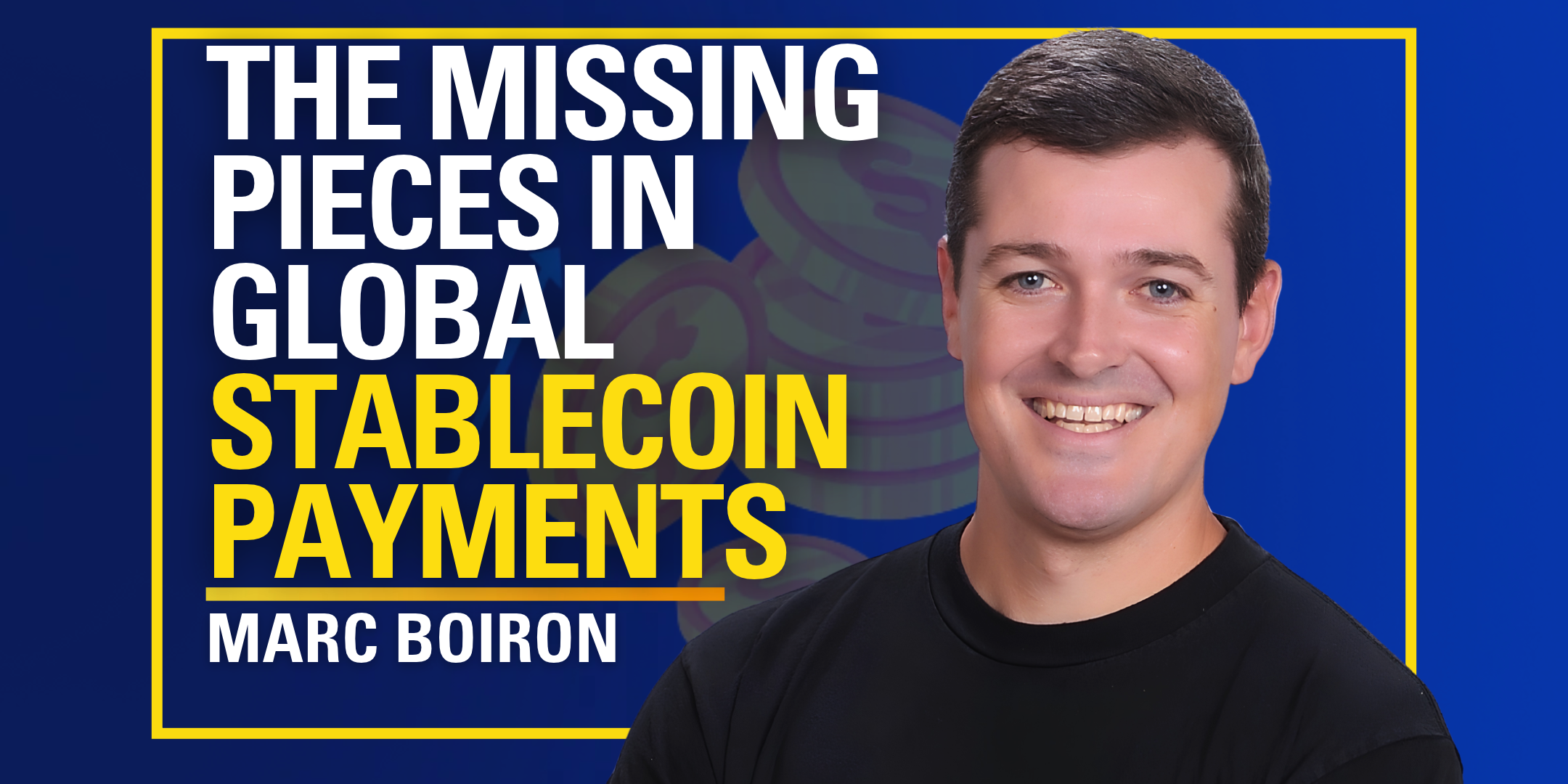
The Missing Pieces in Global Stablecoin Payments - Marc Boiron | ATC #639
Host Stephen Sargeant interviews Marc Boiron CEO of Polygon Labs, where he leads the development of financial infrastructure designed to move money onchain. Previously, he served as Chief Legal Officer at Polygon Labs and dYdX Trading, bringing extensive experience in financial regulation, stablecoins, payments, and digital assets. He is a leading voice in blockchain payments and the future of global financial infrastructure.
Host: Stephen Sargeant
Guests: Marc Boiron
We are also available via:
Buzzsprout • YouTube • Quora • Medium • X • Facebook • LinkedIn • Soundcloud • Apple Podcast • Spotify • Player FM
Episode Transcript
Stephen: This is your host, Stephen Sargeant, the Around The Coin podcast, and this is gonna be a fun episode. We got the
CEO of Polygon, Marc Boiron. He's a Canadian, and we're gonna talk all about stablecoin and payment infrastructure. Polygon is no longer just a blockchain company. They are absolutely dominating the payment infrastructure game, and we talk about why.
What are the hassles with payments? What are the struggles? We get into stablecoins, regulation. We get into agentic payments, and we also talk about this cybersecurity crisis that's happening in 2026.
And we focus on Marc as a CEO, coming from a legal background and how he leads a team, what he's looking for in potential employees.
So if you're looking to get into crypto. This is probably one of the best podcasts to listen to, especially if Polygon, but you haven't heard of what's happening in the Polygon ecosystem. And he does an exclusive announcement right here on the podcast, but you gotta listen.
Hope you enjoy We're fresh off a two-part Binance hack story, the first time ever on the Around The Coin, and then we get greeted by the CEO of Polygon, Marc Braun. Marc, tell us a little bit about yourself. Then we're gonna go into your background a little, then we're gonna get into all the exciting things, how the whole industry has changed, and we're gonna hear what's happening with Polygon, the Open Stack, all these cool, you know, features and projects that you're working on under the Polygon Labs label
Marc: Cool. Well, thanks for having me. Really excited to, to be Um, Yeah, I mean, background, I've been the CEO here for the uh, four years or so. And I'm actually a lawyer by background, so I was the chief legal officer at Polygon before that. Uh, Chief legal officer at dYdX before that, and, and a financial services lawyer.
Been in crypto for the last 10 years now. Um, And you know, the w- the way that I often describe it, because people often say like, "How is it that you go from being a lawyer to being the CEO?" And you know, what I, what I often say is that, you know, when you are a partner at a law firm, all you are is a glorified salesperson, right?
So I just view it as I went from, you know, a sales function to being the CEO, not from like a lawyer to being a CEO. Most people don't view it that way, but for me it's like literally I was like four years out of law school selling, selling, selling and, you know, that, that's really what my career was
Stephen: That was gonna be one of my questions. I was a paralegal once, so I'm like, you know, lawyers are not they, they're great at getting through law school, articling, finding the big job, but, like, coaching others and bringing along a team is not necessarily their strongest suit. So that was gonna be one of my questions, like, how do you transition into a CEO role where now every department's reporting into you?
Usually CFOs make that transition, but it's really cool. Talk to me a little bit, 'cause you were at Penn State Law, like between twen- 2008 and 2012. Was there any discussions, you were working, like, doing tax assistant, working on the Nidalee Lions Fund. Like, was there any discussions around crypto in or outside of class during that time?
Marc: No, crypto like literally was not a thing. It didn't, it didn't exist at all. I, I think I, I discovered crypto actually near- purely out of like technology interest, frankly, like it's probably early 2015. Um, And, and frankly, when I started reading about Ethereum, I was just like, "This is the coolest technology possible."
And it was really like a technology thing that was interesting to Um, Ended up getting interested in like the story of like Bitcoin from like a store of value more than anything else. But uh, to me, Ethereum was um... You know, there's this thing that you can now do where humans can be removed from the loop of what you can do, and that's because you have this, this kind of like autonomous global computer that can allow things to be executed that humans used to have to do uh, and do it in like a trustless way.
And I just thought that was like the coolest thing in the world. And when I applied that to like the legal context, I was like, "Oh, this is a total game changer." Um, And so I just thought it was cool, really.
Stephen: I really feel like back at that time, lawyers were the, like, last profession to, you know, come around when it came to cryptocurrency, using their logical brain, the rules, the regulations at the time. What was the discussion like as you were learning it within the legal community? Was there a lot of, like, pushback, or did you kinda see it from, like, the technology side first, not with, you know, from the lawyer side?
Marc: Yeah. So it was definitely, definitely from the technology side, but I will forever remember 2017 as, as the, just the funniest year for me because, you know, through, through 2000, um, '15, '16, I was really, like, learning about kind of Ethereum and, you know, early 2017, I was like, "You know what? Like, I need to take a bet on some area of the law.
There's too many lawyers out there. They're all doing the same thing. I need to do something different." And so I was like, "You know what? I'm gonna take a, a bet on this." And, you know, at the time I was at a law firm that had about, you know, 200 lawyers, maybe like 60, 70 partners, and, you know, I, I started doing this thing and, and suddenly I started getting more and more cust- yeah, like, uh, clients coming in.
And, and some of the partners were like, "Mark, what are you doing? Like, this is this crazy crypto thing. Like, it's just gonna disappear." And I'm like, "No. Like, the, the fundamental technology just makes too much sense. This is not going to disappear." And the funny thing is, within, like, probably nine months, I had a bigger book of business than I think every partner at the law firm other than one or two of them.
Um, And I still remember going back and ended up, like, leaving and going to another law firm as a partner, and, and all I could think was, "Guys, I just, like, propelled my career forward by, like, eight years by making this bet," um, instead of, you know, continuing to just chug along, looking at, at agreements, doing our thing.
And it ended up working out pretty well, and I think they were all proven wrong. um, it was very uh, a interesting time of them basically saying, "You're crazy. This is, like, a complete scam, and, you know, your career is gonna go in the toilet."
Stephen: They're probably still banking on that. They're like, "Hey, crypto's down, Mark."
Marc: mean, I still, you know, I think, I think this might be like the last year or two might be the first time in, in 10 years that like as crypto has like not done phenomenally well that I have not heard people coming out of the woodworks and being like, "Oh, crypto sucks." It's like the first time where I'm like, you know, you don't really hear from anybody.
It's kind of crypto's here and crypto's here to stay, and it's not going anywhere, and people have recognized that.
Stephen: Yeah, and the institutions are finally here, although that's not having the, you know, the same correlated, you know, upswing in price that we always thought it would. I'm curious, everybody knows Polygon. We've all heard about Polygon. It's kinda like this L2 behemoth of a blockchain, but it seems like the company's evolved.
I think all, you know, crypto-native companies have evolved over the last, you know, three to five years. Tell me, demystify what, you know, people might think Polygon is, if I just said the term, to, like, what you are today, what you've built and the infrastructure that is underlying the n- the new ecosystem that we're seeing with the blockchain and the Gentic
Marc: Yeah. I think I'll start off by saying you should think of Polygon as a payments company, really. Like when somebody, you know, a few years ago when somebody said, "What do you do?" I'd say, "Oh, you, you know anything about crypto? I'm in crypto." Uh, And, and when somebody asks me now, I say, Honestly I'm in fintech."
And, you know, that's, that's like a, a very much like an evolution of crypto. But like, what, what does that really mean, right? You go back to the roots of what Polygon was. It was like we, we needed to evolve with what things were, right? We start with Ethereum being, you know, slow and expensive, and we really needed a way to like have a blockchain that could be fast and cheap.
And so Polygon came and was that fast and cheap blockchain. And, you know, if you're back in 2020, 2021, you wanted to deploy a DeFi application or frankly do anything somewhere, you did it on Polygon because it was like the fast and cheap option. But as with every industry, like things mature and change, right?
And so we've suddenly got tons of fast and cheap blockchains that came on, and now suddenly Polygon's just one of many fast and cheap blockchains. What that ends up doing, as with everything, is like block space becomes less valuable. People don't want to pay for it. And so if you look at like what does it cost for a transaction today, it's like a hundredth of a cent.
Well, you don't grow to like a, a massively successful uh, ecosystem making a hundredth of a cent on transactions, right? You, you need something more. Now theoretically, by the way, you could if you were literally owning all transactions in the world, but I actually like fundamentally believe you're going to have multiple chains that are gonna be successful.
And so the thing that we did was we really like moved out of just saying, you know, the only thing that we do is provide a blockchain, to actually we, we provide this blockchain and support this blockchain, but there's a lot more that you need to be able to be successful and, and specifically successful in an area.
And for us, it was payments. We were already really strong in payments, and so we decided to double down on that. And so for us, what that meant was like, okay, you've got this one foundational layer being the blockchain, but you know, if you go to somebody, and we've experienced this, and you say, "Hey, start, start doing payments on, on, on this blockchain," they're like, "Cool, thanks.
Like what else do I need to do?" And you're like, "Okay, it's okay. Just... you just need an on-ramp, you just need a wallet, you need an RPC provider, you need an indexer." And, and, you know, 18 months later "Um, okay, I think I'm ready to launch," or, "I've given up by now." And so what we decided to do was why don't we just go and, and do that, right?
So we made some acquisitions. So we've got, you know, we're licensed in the US now, allows us to provide the on-ramps to actually get money onto the Uh, We bought a wallet company, allows us to actually hold those funds like on the wallet. You can earn on, on the wallet. Um, Got some interop built in so you can go between cha- chains, not just on Polygon, because people will want to be on multiple chains.
And so now when you actually like launch, what Polygon allows you to do is move money globally through a single API And it just happens that the best way to move money globally today is through blockchains uh, including Polygon as a chain. So really, we are a fintech in, in, you know, focusing on payments um, so that we can move money globally seamlessly for companies, because today moving money sucks, honestly, and we can make it better
Stephen: And yeah, and you know, people have been saying that they solved that problem over the last decade. When I have to pay somebody in the US from Canada, it still sucks, it's still expensive, and it still takes a long time. And I'm I actually say this all the time. We were talking um, about how I'm, I'm, I'm Canadian as well. And, you know, it's, it's funny when, when I'm like-- when I'm in person in the US and somebody asks me to send them uh, and, and sometimes I'll have a friend that's like, "Hey, can you just send me USDC?"
Marc: And I'm like, "Can I just Venmo you?" Because it's just so much easier. But when I have a family member in Canada who wants me to send them money or vice versa, I'm like, "How-- Like, what, what's the system you guys use again? Like, I can't remember what it is." And I'm just like, "Can I just send you USDC? Like, it's so much Um, And like the same thing, I have a, a sibling in, in uh, family in France. If any time I need to like do anything, I like beg to use stablecoins because it is so much easier. Except in the domestic context where I'm like, "It's not easier, actually. We have existing systems that are better." Uh, And so I think there's that, that bifurcation where like the cross-border system is really still broken and complicated, and we can really simplify that
Stephen: And the fact that we've had to resort to like PayPal to send money and then like PayPal's holding the money in escrow 'cause you put it was a product and service and not a gift to a friend. Like this is, you know, it... You know what's interesting? I was listening to the interview you did with Garrett at The Block, and you were saying that, you know, Polygon isn't competing with other chains like Solana.
You're like competing with payment companies or, you know, other blockchains on their payment layer. So what does this mean if you had to pinpoint Polygon's competitive advantage, like over other companies, and what would that be to- in your eyes?
Marc: Yeah. Like when we think of, of competitors, we think of the Stripes of the world as our competitors, not, not blockchains, right? It's really who is able or, or starting to be able to provide a complete uh, global money movement solution, right? And I think Stripe's trying to do this by buying Bridge and Privy and, and having-- working with Tempo.
Uh, I think there's a few others who are, who are trying to do the same Um, To me, that's really like the area where, where we compete, and I think some degree with, with banks who are, you know, have uh, built out correspondent banking networks. And those are frankly the ones that feel easier um, because it is very legacy technology.
Um, I really don't think of the chains as being kind of where we compete at all. I think that, you know, that is a one piece of technology that is really good to provide settlement for money movement, but it is just one piece of, of what we need. And so um, when I'm asked kind of like, "Hey, do I need to like out-compete this, you know, one blockchain?"
I'm like, "No." Honestly, if that one blockchain is, is something that people want to use, we'll integrate it into the Open Money Stack and, and they can use that. Our job is that we do want Polygon as a chain um, to be used, and we think it's actually the best chain for payments, and we need to make it the best chain for payments.
And if it is, then, then maybe there is enough of a differentiating factor that folks choose to use it. If it isn't, then they're not gonna use it. They'll use another chain
Stephen: And what was interesting is I saw that, you know, you were supporting Solana and the Open Money Stack. Maybe you could explain, like, what is the Open Money Stack? Such a cool name, by the way. I have a lot of content ideas. There's like these old school, you know, big chain gold chains like promoting the Open Money Stack.
What, what is the Open Money Stack for outsiders that are looking in?
Marc: Yeah. So the Open Money Stack is, is kind of what I've been describing a little bit in the background, which is uh, single API that allows for global money movement, primarily via stablecoins. And so really what it does is it-- I, I kind of view it as like the stablecoin's AWS moment, right? So if you go back to, you know, the early 2000s, you had all of these different pieces of technology that you used to be able to, like, launch a, a product of, of any kind.
Uh, And then eventually what you had was AWS that said, "Hey, I'm gonna package all of these different components together, and you can launch whatever you want on AWS," period. And this is similar to, to what we've had in, in the stablecoin space, is you've had chains, you've had wallets, you've had um, on-ramps and off-ramps to be able to get your fiat into stablecoins, and then you've had interoperability solutions to go between them, and then all of the, like, various small services that you need to make that happen.
This is-- the Open Money Stack is taking all of that, putting it into a single API, where now you're saying, "Hey, I want to go live and move stablecoins, you know, in the next week anywhere in the world." And you can do that through that single API. I don't know that there's another solution out there that actually allows you to do that as, as efficiently or as quickly.
Um, It's something that actually translates really well on, like, the agentic side of things as well. Um, You know, we, we have, like, an agent kit that, you know, uses basically this API, and you can have an agent connect to, like, this, this single API and be able to do the exact same thing in, like, a headless way.
And this is something that, you know, when you think of it from an agent's perspective, it's like, okay, I don't need to go connect, like, multiple different APIs and figure out what works and work with different chains. And so it's one solution that works with, like, multiple chains um, and the ability to just immediately just start moving stablecoins.
So that's really the key with Open Money Stack. Make it easy to move stablecoins globally,
Stephen: Oh, what is the big use case? Is it merchants that are using it? Is it organizations that are trying to sell around the world? What's the biggest use case that you're seeing? And then is there any emerging trends that you're seeing with, you know, the political instability in so many different countries? I, I can't remember the country.
I think just, you know, just got a haircut, couldn't get access to their funds. They're bringing politicians in the street. Like, what are some of the use cases you're seeing?
Marc: Yeah, yeah. um-- So the, the core ones that we're focused on are, are fintechs, banks, and marketplaces, right? So, you know, fintechs are always providing solutions to moving money globally for their customers, and so we want to make that as easy as possible for fintechs to offer that, right? Most fintechs don't integrate stablecoins right now.
If they do, it might be like a little bit of a side product. It's not something that's deeply integrated. Through our API, they can just really deeply integrate it. Similarly with banks, right? You think of, like, the number of banks that currently use the correspondent banking network to move money, but, like, don't actually benefit from that.
Now, they don't want to touch their own licenses to be able to, like, move this money, and so they want a company that is licensed who can help them do that, which is what we can do. And then that third category is marketplaces. To me, this is one of the most exciting ones. It's, it's kind of uh, you're starting to see it, but it's, it's gonna take a long time to play out, is really, you know, a, a creator marketplace, for example.
It could be a, a developer marketplace where you've got many parties and many people in many different countries that need to be paid out. Um, And the question is like, how do you do that? And the easiest thing, frankly, is be able to pay them out via stablecoins, and they can receive it in the wallet. They can start earning on it, but they can also off-ramp it if they Um, We, we-- The Meta actually just launched creator uh, in the last few, few uh, on Polygon. You can pay out in the Philippines and, and Colombia. Uh, You can bring a wallet to, to Meta platform and, and get paid out in stablecoins. That's like the very beginning of what I expect to see on a much bigger kind of case with marketplaces.
That being said, like, those are the three a-areas where we've kind of like started focusing on. There's so many use cases from like treasury management use cases to like, really, I think like probably one of the most exciting ones down the line is going to be like everything agentic related in some way.
Like, you think of like tokens for inference. I mean, this is something that like streaming payments is going to be an absolute like huge demand. Like, what, what's the most annoying thing when you're using any AI product right now? It's when you need to go like top up um, effectively um, yeah, tokens basically to be able to like use it.
Like, you should just have a service where you're streaming as, you know, the, the, the need for tokens comes in, you're just paying for it. And this is something you can't do in the traditional system that you can uh, with the open money stack. You're not seeing huge demand for it yet, but I think it's something that we are going to see huge demand for soon.
Stephen: Yeah, it's an unlimited TAM when everybody's using multiple agents, hundreds of agents. It's so funny, when you say the word marketplaces, like 15 years ago, like that meant eBay, and then like just five years ago, marketplaces like meant OpenSea and NFT marketplace. And it's funny, as soon as you say marketplaces now, I'm thinking like prediction markets.
It's so funny how that one word evolves over time to what's the first thing that comes to your mind. Super interesting. And, you know, at the start of this year, you acquired Coinme and Sequence which appear to be the foundation of Open Money Stack. It opens up the doors that you said to the USA.
Where do we stand with the Ur- USA regulatory path? I know Genius is in its last, you know, couple months of being implemented. And how does this shape stablecoins? I know CFTC and the SEC is trying to create a pathway, like how does this regulatory, the midterms, how does this all affect, you know, Polygon and stablecoin infrastructure in the US?
Marc: Yeah. I can't say this was like planned when we started like doubling down on payments, but one of the nice things about doing that is you've actually removed a lot of uncertainty that exists in crypto in general, right? So you look at like the CLARITY Act, for example, that failed to pass. Like that, that had a lot of um, I'd say benefits for crypto more broadly.
But when it comes to stablecoins, you already have the Genius Act that, that passed. We already know what that looks like. And, and thus you are fighting around things like yields being shared or not shared. To me, these are like little details. Stablecoins are 10X better money. Yield makes it 100 X better money, but like 10X better money is still 10X better money, right?
And with, with, with Genius now being implemented and, and we've seen kind of like the in- initial kind of implementation rules around that, like you can freely use stablecoins right now, and I think you have a lot of clarity and confidence on the ability to do that. I don't-- You don't hear enterprises talking anymore about like whether they can touch stablecoins or, or, you know, how they can use stablecoins.
I think they feel like very, very confident in, in their ability to do that. Um, And so, you know, I think the, the-- I think we have clarity around like how you can issue more stablecoins. Um, And, and, and really like that's why you're seeing an explosion of like OCC charters as an example. Uh, And so we're in a spot where, you know, I, I, I've been asked internally like, "What do these midterm elections really mean for us?"
And I said, "Honestly, I don't think these midterm elections matter for stablecoins in, in any way really whatsoever." Much different from like the broader crypto market where I expect that momentum is going to build um, o- over the next two years until the 2028 elections into, um, more uh, I'd say like Democrats that are actually the heads of different committees and are able to start, um, focusing efforts on crypto-related stuff over the next two years.
Even if nothing actually happens, it prepares for something to happen in 2028 in a way that like wouldn't have happened otherwise. But I don't think this really frankly does anything when it comes to stablecoins. I think we're in a really good spot there.
Stephen: I think you're very optimistic. I think, you know, just even looking at the pendulum and, you know, it looks like it's swinging back hard the other way. But now, you know, crypto isn't this thing that wasn't being brought up. It's already, like, sprinkled into legislation. It's already being utilized. So I don't think the pendulum will swil- swing all the way back where the, you know, Coinbase is getting sued or, you know, you know, Polygon is wrapped up in lawsuits or anything like that.
So I think we have a nice base level as, like, both sides real- realize this is bipartisan. We b- we, we-- it's here. People are using it. Governments are using it. We have to push it forward. I'm curious, as a CEO, when do you decide to build versus acquire? And, you know, the huge acquisitions as you talked about, MasterCard, Stripe, Kraken, does that pressure you more to think of acquisition as you're building out the infrastructure versus trying to build it in-house?
Marc: Yeah, I think there's, there's two things that really matter in this is one is can we do a better job building rather than buying? And the second is how long would it take us to, to do that thing, right? And so when we look at licenses across the entire US, it is very clear that it will take us a significantly longer time to go ahead and actually like acquire those, like build those licenses effectively one by one than, than executing on, on an acquisition for all of those licenses.
And ultimately, like there is no significant like quality difference. Like it, it, it is what it is, right? And so to me, that's a very clear acquisition opportunity. I think that when we're talking about technology, that's where kind of two things end up mattering there is, is there really something that is so hard to build, which you really need to question with AI today.
Is it so hard to build? Generally, it's not, that an acquisition makes sense. But number two would be, are you bringing in people that are going to allow you to execute in a way that, that you couldn't? So I think an example of this would be, know, uh, with Coinme. So you, you can... The, the licenses are, are, are good, but you need to operationalize licenses.
Like it's very different from like having a license and then going to, okay, but I also have an entire compliance program, an entire compliance team, and you know, a, a, a way to like onboard customers in a seamless way based off of all of that. And those are the kind of things that take a really long time, and frankly, are underestimated in, in how long they take to, to build.
So for me, it really, really comes down to like, is there an expertise that exists there that would take us too long to build, or frankly, a cultural difference that we need to like shift that we can do quicker through an acquisition that we couldn't do if we were just building it ourselves.
Stephen: I, I love that answer. And, you know, one of the interesting things, I think by the time this episode airs, SoFi is now a national bank issuing its own stablecoin and selling its whole card program on SoFi USD, which now runs on Polygon, which is exciting, right? SoFi is just such a juggernaut when it comes into anything to do with finance, especially in the US.
But when banks like this start issuing their own dollars on chain, are they customers, competitors, both? Like, how do you view them from the lens of Polygon? They're building on you, but they're also building in your world of payments.
Marc: Yeah. So, so a couple thoughts on this. First, SoFi is so unique, honestly. It's, it's one of those banks that almost doesn't feel like a Uh, It's, it's really done a frankly phenomenal job from a branding perspective, but also just historically a product perspective. Um, Like really, really Um, So yeah, seeing them like have their stablecoin on, on Polygon is, is really, really cool.
Um, I, I think there, there's a couple thoughts on this. First, we service businesses, right? And so like for us, we've first of all never issued stablecoins. We don't even offer issuing stablecoin in the Open Money stack. This is pretty intentional. We want to remain very agnostic when it comes to stablecoins.
There are many of them. Customers want different ones for different reasons. We don't need to compete with them on that front. But second, like a lot of companies who overlap with us in one way or another, and I honestly, I don't think SoFi overlaps with us that much at Um, They, they need products that we are offering and, and we need their products.
And so one of the unique things about payments is that there is so much cross-collaboration where you are competing really, really hard in one area, but then in another area you're actually collaborating. And the simple reason is you're talking about a, a globe that has a very diverse payment system um, across the, the entire set of it.
In different countries, you've got different needs, and within those countries there's lots of different solutions that don't like just automatically become available the second you get licenses. And so you need to work with others really, really well. And so there's, there's some folks that I would consider to be like very direct competitors who we currently use uh, and who use us.
And I think that'll continue to be the case for our entire existence as a, as a payments company. I don't think it's very true of SoFi. I think SoFi, it's really more of a, a, a relationship that is just mutually beneficial
Stephen: I think you have to in payments. Like I saw that in the Open Money Stack, you onboarded Tron right before you onboard Solana, which seemed like comp- competing chains or competing networks. But you kinda-- It's just like if you offer, if you're a merchant that says you accept credit cards, like if you offer Mastercard and not Visa, like you're really losing out to a good percentage of that.
It's rather have both of them and have optionality, I'm assuming. Do you view that the same way with providing optionality to your customers?
Marc: Yeah, I mean, that's-- You just ended that perfectly, right? It all-- It's all about the customers. It's, it's that simple. What do customers want and what do they need? And if my customers want a solution that a competitor offers, then we should bring the solution in that a competitive, competitor Um, If there's a, a technology stack that is similar to one that we have, such as a blockchain, that there's a lot of money on and a lot of users on, true of Tron, true on Solana, true of a few other chains, like let's bring those in as well.
Key is just delivering the customer experience that is expected and, and I think that's something that we can do by being really open with who we work with
Stephen: I'm curious, you have a background, been around securities law and financial regulation for a lot of your career. How much is your strategy at Polygon driven, especially around the payment side, driven or even molded by regulation and balance that with innovation? Like, how much is it, like, do-- Are you-- Have a competitive advantage because you have an understanding of the way financial regulations work, that you can move a little bit more steadily than a company that's dealing with regulation for the first time because they're extremely crypto native?
Marc: Yeah. There's, there's actually a lot a lot of folks have, have kind of wondered how much, you know, my legal background leads to us doing certain things. And, and frankly, it's, it's not actually that relevant. Like I, I-- When we, when we like really decided to get licensed and regulated, like never once did I think like, "Oh, I'm a lawyer.
Like we should..." Like it's just like it never entered my mind. That being said, there are advantages to the fact that I actually deeply understand this stuff, right? Like we 100% can move better, like faster. Like I, I, you know, if somebody wants to offer a product, I will understand the legal implications of that product very quickly.
And instead of needing to wait like months, there's certain situations where I know we can move forward. And there's little details we need to figure out and the lawyers like dig into, but like big picture, I know we can go execute on that. Whereas a lot of others are going to spend literally months, maybe, maybe weeks, but, but often months digging into like, "Hey, can we do this or, or can we not?"
And being able to shortcut that is a massive advantage, especially again, going back to like an AI world where like we know we can go develop this thing, which used to take maybe, let's call it three months to go develop something, and so you just run legal alongside it. Now you can develop that same thing in a week, and so you can't run legal around, like alongside that in a week.
And so being able to understand this is a feature that because of X, Y, or Z we can offer now is a huge advantage. And then our, our legal team can go and do that kind of confirmatory Um, So in, in that sense, it's been helpful even though that wasn't really like the, the core intention in, in getting into like regulated money movement.
Stephen: And you can talk legal. I think a lot of the time that's spent you know, in projects is that legal doesn't speak, you know, product and product doesn't speak legal. Because you kind of speak both languages, I'm sure those conversations, you know what the legal re- like, what legal's gonna be concerned about versus just hearing a no from them and, you know, pouting and coming back and saying you're doing it anyway kind of thing.
I- Yeah, this happens a lot, hon- honestly. Like, I, I, I, I'm one of these, CEOs who's in basically every single Slack channel in the company. So I, I look at everything that's happening, and it's, it's not uncommon that I will see a response that is like, "Oh, this looks like a blocker." And I'll just jump in and I'll say, "Hey, let's get on a call real quick and let's talk about it."
Marc: And, and we find a solution a few minutes later, frankly, because I, I do Uh, And in that way it's, it's really helpful to moving fast.
Stephen: You implied in your interview, I think it was Foresight News, that, you know, today's regulated on and off-ramp infrastructure might become obsolete or unnecessary over the next decade as more money moves natively on-chain. I would love to hear your thoughts of where do you envision or what do you envision happening with some of these big on and off-ramp exchanges especially?
Marc: Yeah. I mean, look, if we l-- fast forward 15 years from now, you should be in a world where, I mean, we can baseline to like it's undebatable that money moves better on-chain. Like, if you've got stablecoins and you want to move them, you can move them faster on-chain than you can in any other way. And so really what you're left with is like how do you get to that point where all that money is on-chain?
And the answer is really it's bridging the off-chain world with the on-chain world. And right now you have to do that because all of this money is off-chain. But two things are gonna happen over the next 15 years. Number one is more people are going to move money on-chain and then keep it on-chain.
They're gonna be able to earn on-chain, they're gonna be able to like, frankly, they'll just have more confidence in the on, on-chain world. Frankly, the on-chain world will be more hidden from them. They won't even like know that they're holding stablecoins, but they will be. And so as that money just comes on-chain and they spend it on-chain, they invest it on-chain, you don't ever move it off-chain.
So suddenly, like the amount of money that needs to go through ACH and wire and SPAY and whatever else, like actually becomes you, you just don't need it anymore. Um, And then the second one is I think that those bank rails themselves are going to start becoming less relevant when banks upgrade how money is held.
They stop holding it in, you know, their, their centralized ledgers, and they start holding it as tokenized deposits, for example, right? And so now when you're actually moving money, you've got on-chain money in banks in the form of tokenized deposits, and then you've got on-chain money in the form of stablecoins outside of banks.
And really all you're talking about is going from one form of on-chain money to another form of on-chain money. And suddenly, I'm not saying banks don't exist. I like-- fractional reserve banking, whether you like it or not, is like a huge propellant of the economy when you can lend out 90% of money that like otherwise you couldn't.
Like it, it's not going away. So you're gonna have banks, but their money's gonna be on-chain, stablecoins are on-chain, and you're really talking about moving between them as money leaves banks. And so you get to a state where suddenly no money is in the, the off-chain world anymore. And, and this will be better for everybody, especially internationally and domestically.
It'll probably replace existing rails, not because it's better, but because like uniformity is actually easier. So like you go and you say like, "Why are we actually using like the, this off-chain system that exists today? Like, why is Venmo using that?" For example. Venmo's just gonna say, "Wait, I already have Polygon and Tron and Solana plugged in under the hood.
We are using them for cross-border money movement. People have all of their money in this on-chain money. Why don't we just keep it all there and rip out what currently exists and just have everything move on these blockchains, including for domestic transactions?" And there's no reason not to do that.
And, and so I think we end up in a point where just all money is on-chain in whatever timeframe, whether that's 10 years, 15, or 20 years.
Stephen: I think you're right. You know, we're moving-- we have it-- we're moving it on-chain, we're using it on-chain, but then we, we have to make some payment over here or something over... We have to move it into fiat in order to facilitate that, but it's still going back on-chain at some point. It's like, yeah, how do we remove some of that?
You know, ex- it's an expensive process, too. The more inter- one thing I've learned about finances, the more intermediaries usually it means more money the customers are spending. I'm curious, we all saw what happened with Binance. We saw even Chainalysis was going through an incident, a huge incident report.
Even Jensen, our guy at NVIDIA, is getting caught up in a huge security issue. W- you know, for the last 15 years, all I've heard CEOs, usually a planted question of, "What keeps you up at night?" It's usually around, like, cybersecurity. And now it's g- you know, getting in more into in-person security as well.
You know, what are your thoughts with everything that's happening around, especially nation state sponsored? How do you protect yourselves, your users, the companies that are trusting you as well?
Marc: I think this is a really good question. I, I think uh, if you are not scared of cybersecurity threats today um, as a CEO, I, I think you are completely overlooking one of your most important risks, like period. And this has always been a big risk, but like if it's not basically number one right now, I think you're, you're missing something.
I think the thing that we've had a benefit of at Polygon is that we've been in this state for eight years now, ever since we've existed. You know, when you have a, a bridge that has, you know, billions of dollars sitting in there and you see bridge hacks that happen like every month, if not more often um, it's something that you pay particular attention to.
And, and one of the things I think we got pretty lucky with is the the security approach that we've taken has always been a Web2 and Web3-centric approach. And what I mean by that is I think a lot of people in crypto were very focused on just on-chain security threats. But the reality is like most security issues that exist on-chain actually result from off-chain security threats.
And I think this is becoming more and more evident to people. And so one of the things that I think we've done a good job of is really, you know, we, we, we have constant training around this for the, for the Um, You know, there's a lot of like, frankly, barriers to like using our systems because of that, which, you know, is not convenient from like a daily use perspective, but is really important.
And so I, I think we've done a pretty good job here. It's something we've been really focused on for, for a long time, and, and that makes me feel good. That being said it's, it's one of those things that like you can't believe you are impenetrable. Nobody actually is. And you know, I think of the work that our security team is doing.
I, I would argue that our security team might have built the most state-of-the-art AR, AI like based defense and, and review uh, around like our, uh, kind of production releases and just our security in general. That being said, the thing that I'm reminded of all the time internally is no matter what we've done from an AI perspective, there's like 100X the number of people um, using different prompts, throwing more money than we could possibly ever throw at the problem trying to attack us.
And so the belief that you can, you know, solve every problem with confidence all the time from a security perspective, I think is pretty naive. And what you need to make sure is that you are following best practices across the board, period, and doing the best job that you can, especially on the like the most vulnerable systems that, that you have.
And um, yeah, something I, I think uh, a, a lot uh, uh, I think we're, we're well-positioned for it. But um, you know, at the same time, you're basically always crossing your fingers and saying, you know, "Hopefully we are doing a good enough job."
Stephen: It's one of those weird things where you can do everything right in the business, but if you do the one thing wrong with security, that could end, you know, it could overshadow everything else that you've done great. I'm And it's usually honestly not the core, like, security team, right? It's, it's usually one person who ends up getting socially engineered who, you know, didn't do X that they were trained to do uh, and, and it results in somebody, you know, getting into the system and then, you know, it just happens that it's a system that like, you know, there was some issue with your monitoring and you didn't immediately see it.
Marc: And it's, it's just-- it's, it's, it's never like the... It's always like the five things happened that, that, that ends up being the issue. And, and really this is why you do training, this is why you have best practices. It's like you, y- you can let the one thing happen, and that one thing happen again. Do people click on phishing links all the time?
Like, yeah, like that, that happens all the time. If that's the thing that ends up creating like some security vulnerability for you, then, then you have a problem. Like, it, it better be two, three, four things that have had to fail for that to actually create the types of issues that we're seeing, not one thing failing, because that's a serious problem.
Stephen: I think it's even more scary is how long these attackers are staying within the system. You know, weeks, months before they're even, you know, conducting these attacks, which Years in some which is extremely scary, I think, for a lot of companies. It's like, how long were they there for? And, you know, when, when you can stay somewhere for a long period of time it's even worse 'cause you can build trust.
And then once you build trust I think that's where it goes off the rails. You mentioned with the open money stack around agentic. It feels like finally we figured out like crypto payments and stablecoins, and now it's like we're already moving into like what's the next iteration of that. At least it still has, you know, some anchoring to blockchain.
But what are your thoughts? How do you, you know, build Polygon to not only service the needs that we have today, but to service the needs that non-humans and the decision-making that non-humans are gonna have tomorrow?
Marc: Yeah. I think this is such a good question and, and I think if I were to say that I know the answer to this, uh, uh, frankly, Polygon would probably be the most successful company uh, in the world. And, and anybody who knows the answer to that would, would feel that way. And I think the answer is nobody knows the answer to this, right?
And so I think the, the, the best things that you can do is there, there's a baseline set of requirements that I would say, right? It needs to be incredibly easy for an agent to use your system for whatever an agent wants to do in commerce, period. Right? And, and I think that's like the baseline that needs to exist.
That's a baseline that, that we already have. The, the big question is what is the thing that is going to suddenly take off and result in, you know, trillions of transactions, frankly, in like probably a monthly basis by agents uh, on-chain. And, and most likely it will be on-chain. It could also be off-chain.
That's another area that we have to like pay attention to is like, you know, you're seeing, uh, you know, card networks are doing a really good job of, of, you um, helping facilitate this transition to the agentic world. Definitely not doing it perfectly, but, but helping facilitate it. And so, you know, I, I, I think a lot about like where are the bets that we should take in like the agentic payment space.
And, and I think the answer is that taking too big of a bet today in any one area doesn't make sense because there's too many uh, I'd say like issues around agents that still like limit it or from a broader infrastructural issue. So for example, if you go all in um, uh, I'll call it like m- merchant-focused agentic payments today, I think that's like probably a mistake.
I mean, Stripe is probably best positioned to do it, and I'd ar- argue Stripe's failing pretty miserably at it right now, right? Like you go and you try to use Instinct or Muse to like make a payment using Link, for example, is pretty bad experience. Um, I mean, much better experience than like six, nine months ago, but pretty bad experience.
Now, a part of that might have to do with like decisions that um, we could make or that Stripe is making, you know, for example, in their case around like how they handle cards and spin up new virtual cards for payments and, and all the issues around that. But the other problem, and this is where I, I have issues like making a huge bet right now, is the actual experience, right?
Like I go um, you know, and I want to, you know, buy some winter clothing and, and this is something that I like literally tried to do the other day. And so, you know, I tell Muse to go do that, and then the first thing Muse does is tell me the obvious thing, which is, "Oh, by the way, I can't use Amazon." And I'm like "Um, okay, great.
Now why don't you go find me stuff elsewhere," right? And then it goes finds me stuff elsewhere, and then it like gives me a bunch of options. And so like the whole experience to even like Forget the payments portion of it. The whole commercial experience is just not there yet. So this is all a very long way of saying we need to, like, make bets and, and like create an environment where, like, the open money stack is the choice for agents.
But I think what we really need to be careful of is making big bets where you either hurt your brand um, or you, you frankly spend a bunch of money on something that isn't ready for it. And, and I'd argue that we don't know when things are gonna be ready. It could be honestly in a month from now. You know, you could have Amazon that changes the entire game just like that.
Um, But, but it could also just be that Muse continues to just frankly get so much better. I mean, Muse is great already to be really clear, but when it comes to like the actual like buying experience,
it's not there.
Stephen: that last mile. is where it gets tough. Even ChatGPT, I'm trying to rewire my-- or r-reorganize and rewire our garage door opener, and I got a message like, "Oh, sorry, you're right. I got too confident." Like, what do you mean? Like, we're dealing with wire, we're dealing with wires here. You gotta be-- You can't be saying you got too confident.
You better be confident which, which wire to pull. I wanna talk to you... You know, you talked, you know, to CoinDesk about profitability and, you know, expecting that your regulated payment side of the business is gonna be profitable in 2027. Not too many, you know, blockchain analytics. A lot of companies are not talking about profit because they have revenue, they have VC backing, but they do-- they're not profitable.
What are your thoughts? Do you still feel that this is a realistic goal of being profitable on the payment side in 2027?
Marc: Look, we, we realistically launched our product uh, probably six months ago s- or so. And um, you know, we, we talk often internally about is this, is this actually the fastest growth of a payments product um, that, that we have seen? And it's because frankly, there is a very latent desire for these kind of solutions to be easy to use.
Um, And so as we continue to see that growth, it's very hard to imagine how we don't reach that point in, in 2027, which is something that's, that's really, really exciting. Um, Look, we, we think of like where are stablecoins today compared to where they will be. And there's two different things that we need to do.
One is we need stablecoin-based payments to continue to increase. And they have been increasing like triple-digit percentages every year. So that alone provides like very significant growth. And I'd argue that the only reason it's not quadruple-digit percentages is because the experience hasn't actually been good enough.
It's been too hard to bring together all of these pieces, something that goes away with the Open Money Stack. And so I, I think that we can actually start seeing like quadruple-digit growth from simply having a solution that is much easier to um, in a global way. And uh, yeah, I'm, I'm really excited about it.
One of the things that's really unique in, in kind of what we do is just the multiple um, areas where we can generate revenue, right? So it's not just limited to, to ramps, and it's not just limited to going like USD to USDC, which is very low margin and doesn't do much, but it's being able to do the FX portion of it, the crypto portion of it, both of which have significantly greater margins.
Being able to provide the wallets, being able to provide the interoperability. These are all different areas where you start seeing like, yes, we have one product, the Open Money Stack, but multiple services that actually are each generating a portion of that revenue. Uh, And so I think it's something that from a timing perspective is really, really good for us, and we're uniquely positioned to, to be able to do well, I think.
Stephen: I'm curious, what do you think the future of payments is gonna look like? Is there any worry as well, like if these agents all get together and they're like, "Hey, why don't we just create our own network for payment? We don't need to go through blockchains or any..." Like, is there any worry that the agents might just bypass all the marketing efforts, all the building that, you know, these important blockchains are doing and create their own?
Do you ever have those thoughts, or is that seem like a little dystopian?
Marc: Yeah. No, I, I think, look, the two areas that, that you always need to think about is, is banks coming together. Well, probably three areas. It's governments coming together, banks coming together, and agents coming together. Those are the, like, the three. Okay, governments, like, you could just stop thinking about it.
Like, not,
Stephen: They haven't even figured out how to handle their own it. Um, banks, I, I think there are um, I can't remember what the number is, but it's definitely over 100,000 banks around the world. I'm very confident that we are not getting 100,000 banks that are coming together to create a network. Now, in fairness, you could take the, you know, five biggest banks and you'd cover 80% of the money movement globally.
Marc: But I'm very um, that those banks are each working on their own solutions. Um, They're not working on, on one solution together. And that is actually a very good thing for Um, And then lastly, you've got agents. And I can't see a reason why an agent would need to build a, a network when they have networks available.
The thing is, like, agents are weirdly, like, lazy, right? So they're, they're not lazy in the sense that, like, the amount of compute that they assume that they, they use and um, if you take, like, the years that it would take for humans to do what agents do in, in hours, they don't seem lazy. But when it comes to the tooling that agents actually use, they're incredibly lazy.
If they have tools that work for what they want, they're going to use them. And so this is actually part of, of the thought process around the Open Money stack, which is making it open. Which is, if you tell an agent, "You have to use only Polygon as a chain," well, that, that agent, you know, might start looking for other solutions and trying to figure out...
I'm not sure they'll want to build their own network, but, but they'll try to figure out other solutions. When you tell them that you actually can go and do the, the easiest thing, connect to one API, and you can just move money across all these different networks anywhere in the world, agents usually love that.
So I'd consider agents to be, like, particularly lazy, and if you give them a solution that works well for them, I think we lower the risk of that happening.
Stephen: If someone's listening to this podcast, what's one key takeaway you want them to remember, you know, going forward when they think about Polygon or associate, you know, a conversation around blockchain and Polygon? What's one key takeaway you want them to take with them?
Marc: Yeah. Polygon, Polygon's a payments company, and we make it the easiest to move money around the world. Forget, you know, Wise and uh, Stripe and forget, you know, Airwallex. Like, Polygon's gonna be the best way to move money around the world
Stephen: I love that. It appears you don't take yourself too seriously. I, I see the, some of the marketing . You even have a joke, a compilation I saw on LinkedIn where your marketing team says you, you talk about every other company, but you don't say Polygon as often as you say some of the other blockchains. How do you, you know, stay professional, keep professional, because you're talking to TradFi, and you're talking to some of the crypto's biggest players, but still keep this, you know, accessible personality as a CEO?
We don't see this very often. You know, I think many people would say from the outside looking in, many CEOs in the blockchain space are very polarizing or have, you know, very specific takes on things. How do you keep this balance of, like, this vibrancy but also like, hey, when it's time to get to business, we are a payments company, and let's, you know, let's run these payments through the network?
Marc: Yeah, I, I, I think a lot of it honestly just comes to being Um, You know, one of the things that, that I've always done is, like, every employee that has joined Polygon, I always sit down and, and chat with them. Um, And I, I connect with people no matter where they are in Polygon, like, all the time. And people are always surprised by this, and I'm, like, surprised that people are surprised by this.
Um, Like, to me, this is such an obvious thing, right? And this carries out externally as well as, as internally, and I just put it in the bucket of, like, be a good person. Uh, I'm just a person. Uh, Everyone else is just a person, and so treat people like people and, and treat them well. And I think that's really that simple.
That's how I think about it
Stephen: I love that. What are the types of employees or who are the types of employees you're looking for? Are you looking for TradFi experience? Are you looking for crypto native? We didn't get to it, but you did talk, you know, you, you released this LATAM report and we're seeing some crazy statistics. So what are the type-- Where are the type of employees that you're looking for right now?
Or are you using AI to get, you know, lower headcount? I'm joking.
Marc: No, I, I was-- AI just makes me wanna hire more. Um, I-it-- 'cause, like, we have foc-- I mean, I, I've been obsessed with pushing AI through our org for, you know, 12 months now. And what it's resulted in is, like, every single one of our employees who are just incredibly AI native. And to me, I just want, like, more because they do more.
Like, I, I, I was talking to somebody actually uh, the other day and, and they were asking me, they're like... 'Cause, 'cause people will say, like, "What do I do with AI?" And I say, "Just replace yourself." And when they hear that, you know, their, their initial instinct is, "Oh, so you can let me go." And I'm like, "No, no.
If you can replace yourself, you've just become so incredibly valuable to me that I, like, never want you to leave." And, and this is really, like, how, how I think about AI. So, like, I want incredibly, like, AI forward people. Um, Second is one of the unique things about Polygon is this payments expertise combined with blockchain expertise.
We have so many people, if you look at their backgrounds from, like, Visa and Mastercard and Stripe and, you know, Airwallets, like all of those backgrounds combined with people who have been at Polygon for, you know, eight years and, and have been at, you know, name a blockchain and, and they've been there, right?
And so bringing those two things together is incredibly unique. But ultimately, frankly, the thing that I care about most is, like, as much as I'm like, I want people who are, are happy and, and going to do well, honestly, I need people who are gonna grind their asses off. Um, Payments is an incredible competitive space, so is crypto, and you need to work your absolute ass off because if you are not, somebody else at another company is going to be out-competing you.
And people are always like, "Nah, you can just work smarter." And I'm like, "No, work your ass off and work smarter." It's not like one or the other. I don't understand this idea. So it's like, be AI native, get ready to, like, work your ass off, be super smart, and, like, I want It's really that simple.
Stephen: Yeah, working smarter in crypto and payments is working your ass off. I think we've all figured it out. There's a lot of shortcuts, but working your ass off is usually the best one. Mark, what is the best place for people to find you? Are you on LinkedIn? Are you, are you sucked into the, the realm of crypto Twitto- crypto Twitter?
Where's the best place for people to find
Marc: You can, you can find me in both. You gotta walk, walk both worlds, right? So you can just find me Mark Boron on, on LinkedIn or 0xMarkB uh, on, on Twitter and 0xPolygon to find Polygon on Twitter
Stephen: Mark, this is the best. You are just a vibrant human being. I love just the, the thought of, like, having a conversation. I'm like, this guy's just always out there, just positive vibes only. This is amazing. Thank you so much for joining the Around The Coin podcast
Marc: Thank you. This was an awesome