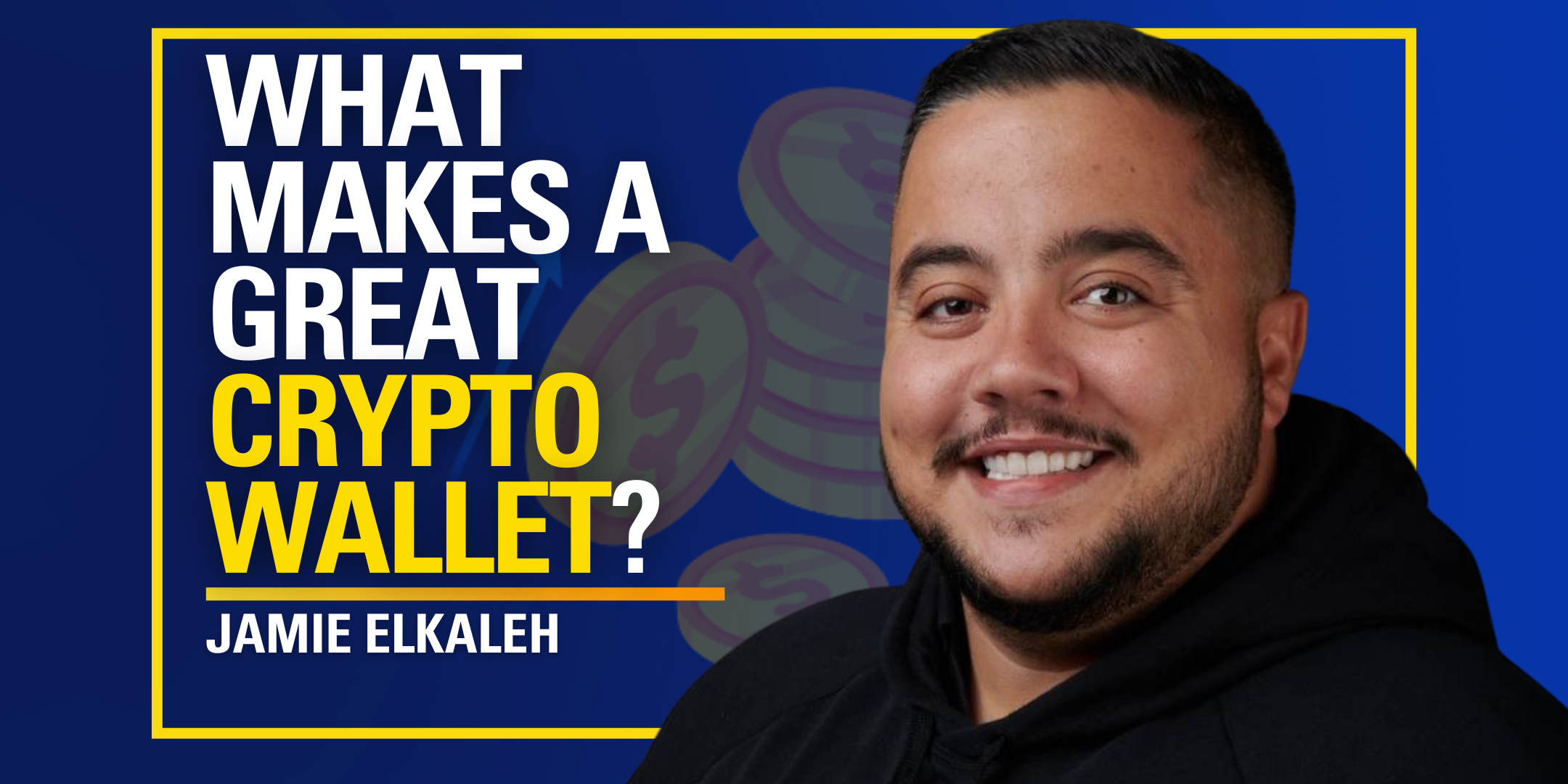
What Makes a Great Crypto Wallet? - Jamie Elkaleh | ATC #592
Join host Stephen Sargeant on this insightful episode of the Around The Coin podcast as he chats with Jamie Elkaleh, CMO of Bitget Wallet. one of the world’s leading non-custodial crypto wallets. He played a key leadership role in the company’s 2025 rebrand and global expansion strategy, helping scale the platform to over 80 million users across 130+ blockchains. With a background in performance analytics from professional sports and a track record in crypto education, Elkaleh brings a strategic, user-first approach to brand, growth, and adoption. He is also the founder of two on-chain learning platforms and a member of the Forbes Council, where he advocates for inclusive innovation and blockchain accessibility.
Host: Stephen Sargeant
Guests: Jamie Elkaleh
We are also available via:
Buzzsprout • YouTube • Quora • Medium • X • Facebook • LinkedIn • Soundcloud • Apple Podcast • Spotify • Player FM
Episode Transcript
Stephen: This is your host, Stephen Sargeant, the Around The Coin podcast. We finally have an episode that's not talking about crypto wallets. Ah, just joking, of course we're talking about crypto wallets and today's a special day 'cause we have Jamie, the CMO of Bitget Wallet, who goes deep into everything marketing, but also a lot of the technicalities around the Bitget Wallet and the infrastructure it's building around the world.
We get into things like TVL. We get into dedicated crypto innovation and balancing investor protection and compliance. We talk a lot about the different jurisdictions like Asia and eu and how the Bitget Wallet is being used around the world. This is a really interesting conversation. Jamie comes from an exciting background of sports and analytics and bringing all that knowledge to the Web3 space.
So this is a fantastic episode to learn all about crypto wallets, but to get a better idea of how it integrates in some of the biggest infrastructure in Web3. Reach out to Jamie. He poses a little bit of a challenge at the end of this episode for anyone that wants to take him up on it.
Reach out. Let us know what you think of this episode. We'll talk soon.
Stephen: This is your host Stephen Sargeant The Around The Coin podcast in continuation with the podcast is amazing focus on everything to do with wallets and wallet infrastructure, especially around stable coins and crypto payments going all the way around the world. We have Jamie from Bitget Wallet. Jamie, do a little of light introduction, maybe how you got into crypto and then I'm gonna dive deep into the marketing aspects.
You're the CMO, uh, I'm a marketing person myself, so I think we're gonna have a fun conversation on how we can approach, uh, marketing in Web3.
Jamie: Yeah, I mean, first and foremost, thank you very much for the invitation today. It's a pleasure to be here with you on this podcast. Uh, I've seen and heard lots of tremendous things. You've had some great guests, so it's an honor to be amongst them. So thank you very much for the opportunity. Uh, so hello to everybody that's listening.
Hello to Steven. Uh, my name is Jamie l Carley. You can hear by my accent, of course, that is a thick northern English accent, but I'm currently stationed here in Dubai. Now my journey in into the Web3 space. It's quite unconventional to say the least. Uh, and it actually began in professional sports. Now from the age of 16, I worked in professional sports for 11 years as a performance coach, performance analyst, pretty much doing everything, uh, you can imagine alongside professional squads from the age of 16, which was just crazy.
But actually it ended up in a really high level position job within, within the industry, which was pretty insane, uh, from a young kid who's just kind of trying to earn his stripes. Uh, so that took me on, on many paths all the way up to Super League, which of course in Rugby league is the top, uh, division, the top competition, uh, in the uk.
Uh, and I had the honor of working at Warrington Wolves, salt Red Devils whole Kingston Rovers, and then eventually the England National Squad, which was, which was insane. So for that, of course, there's lots of different dynamics, lots of different attitudes. Um, that basically taught me a lot about life as, as a man, as a human being.
But also about kind of like how to make best of situations from a data point of view, uh, and from a relationships point of view. And I think when you think about marketing, uh, a lot come back to that very often in terms of the way you communicate. But then my journey into the Web3 space is a little bit different, you know?
Uh, I was getting married. Uh, it was very expensive. I think all weddings are right, you know, you always think blind me, what, what am I spending all this money on? Uh, and I just thought there's, there's gotta be something different with money here. And I actually spoke to my wife and every penny mattered then, even though I was working in professional sport.
It's an average wage, you know, this isn't soccer or football. Wherever you're from in the world, however you call it, you know, this is rugby league in the north of England. It's not like Hollywood standards. This is rough and ready. Everybody's kind of getting paid a decent wage enough to live and have a nice life.
That's it. There's no way you can just afford a wedding. Straight up. So I was thinking I need something a little bit more. So this is where I started looking at alternatives like stocks and shares. Now the story gets a little bit different there. Steven, sorry to, I'm gonna get to the end point here. I actually just before COVID got a job with Manchester City and as part of that we got gifted some
Stephen: like the pinnacle for you? Well, I have to ask, was that like the pinna, like we all think of like when we're younger in the dream jobs, was that like a kind of like a dream job for you or was it like just a natural progression based on the experience you had at the top of like the rugby leagues?
Jamie: that's a great question. I think if I was more, if it was Manchester United, I'd have probably, and that's maybe just the, the, the competitive side of me there. If it was Manchester United, then maybe, I think it was maybe more of a natural progression, but also an opportunity that I didn't want to kind of let go at the time.
It was just a great opportunity and I'm always one that you should always jump at things that you get the chance to do, right. So for me it was something a little bit different. Obviously football, I've gotta be honest, a secret between me, me and you now Stephen, is, I don't even know most of the rules around football.
I'm a rugby league man, so it was just a bit of a strange breed coincidence. But anyway, uh, I got the stocks and chairs, uh, and frankly I was thinking, what is this thing and why am I basically celebrating 4 or 5% gains in a day? This is not exciting at all. I need something extra. Uh, and then actually, this is where it gets really cool.
My next door neighbor, she was a 60-year-old woman, was talking to me as I was putting the bin out and she goes, Jamie, you need to look at this thing called Bitcoin and crypto. So I was thinking, this lady's crazy, like, what you talking about? I went back in the house, went straight on TikTok as a pretty, like all younger people do.
Back then I was much younger, um, you know, and had a look. And the same night I went and knocked on a door with a pen and paper, uh, took all my notes, said Tell me everything, you know, and then fell in love with the space and pretty much the rest is history. So went and trade, started trading crypto. Uh, decided to actually document my journey, so I became a content creator over on TikTok.
YouTube and Instagram people followed me on that journey, you know, trading from 200 pounds all the way down, all the way up. And we had some fun with that. But as part of that, became like a marketer, I created my own marketing company, you know, got to work with the likes of finance. Uh, it was tremendous.
It was a great journey that, you know, helped me. I mean, back then, you know, you talk about content creators, back then there was nowhere near as many people making content back then. I think in the UK there was like three or four of us, you know, consistently making content about Web3 services or, or the crypto space.
And for me it's always been about education. It's not always been about shilling projects and getting onto things. It's about, hey, this is what I'm doing. I think it's quite cool. Come and check it out. So yeah, a little bit unconventional, Stephen, but that's my journey. Um, and I guess that's what brought me into marketing.
And then to hear at Bitget wallet.
Stephen: I love that. What kind of rugby? Because I know there's like two kinds of rugby's where it's like the guys with the white suits that like point when you kick it through the uprights and then there's like the other kind of rugby where you like die for tries, which are, are those two different types of rugby's and
Jamie: Yeah,
Stephen: I've seen both on tv.
Jamie: I think, you know, obviously, uh, you know, in American Canada, you have like a Australia, sorry, American football, I was gonna call it Aussie football, uh, American football, that's pretty similar to rugby, but you just pass the ball backwards. It's the same, no pads, no gear, no shields, just a mouth guard.
And then you play rugby, you know, you tackle each other and you, you pass the ball backwards. It's quite fun.
Stephen: I love it. What kind of metrics were you looking, especially as a marketer now, I'm sure KPIs and metrics is a huge thing. What kind of metrics were you analyzing back then when it came to like the rugby athletes and other sports athletes?
Jamie: Yeah. So you'd look at many things, honestly. Uh, and, and let me break it down into a few different components because, you know, in any walk of life, it's now become apparent why we did things in rugby that are actually transferrable, you know, into. Marketing a, a, a great wallet. You know, we'd always look at what we do well, you know, you're only as good as your strengths, but you're actually only as good as your weaknesses.
So keeping a constant eye on your data metrics, your key skill sets as to how you perform day to day, second to second, minute to minute. So when I was talking to players, we're talking about how do you attack off your left foot, your right foot? How do you tackle, how do you pass the ball? It's the same in Web3.
You know, how fast are we processing trades? How quick are we getting partnerships? How many users are getting onboarded? How we're onboarding those users? Where in the world are we onboarding them? It's very similar in terms of the methodology, but where it gets super, super interesting from a marketing perspective is how we used to analyze the opposition.
And I think analyzing and understanding the landscape of your opposition, that has to be your biggest asset as a marketer. You know, if you are all about creativity and storytelling and creating your niche and fully understanding your brand, it brings me back to my rugby days. Say, for example, we're at Haw Kingston Rovers.
We are playing, uh, Warrington Wol, which is another huge team, uh, over in England. We know how we need to position ourselves or prepare that week for a win, for the, you know, to get that ultimate execution. It's the same at Bitget Wallet. We know what we particularly do well. We know what services that users want because we listen to them.
We know how to interact with them, and we know how to position ourselves against our competitors. When you get to that level and you understand your strengths, your weaknesses, and where you kind of lie within the competitive landscape of wallets, for me, you get that marketing success and you're super clear with your vision.
Stephen: before we jump into Bitget Wallet, you were actually the country manager at Bitget. What made, to your point about like advantages and competitive advantages and weakness, there's so many crypto exchanges out there. Can you let us know a little bit about where Bitget positions itself currently in the market and how they were able to get traction at the time?
I'm assuming they came out, uh, very similar to the times of like Binance and Bitfinex. Uh, I was at Bitfinex for five years. Uh, I remember when Bigge kind of like came onto the scene. I'd love to know your thoughts about where Bigge positions itself in the market.
Jamie: Yeah, it's really interesting when I started Bitget, they weren't even in the top 10 when it comes to like crypto organizations or exchanges. And I think what became apparent was listening to users' needs at the very ground level. And what do I mean by the ground level? Like in the communities, living, breathing, eating with the people that are using the services.
If I was to summarize kind of Bitget and Bitget wallet. It is representative of the people that use it. It understands the user's needs and understands actually, you know, frankly, security matters more than most. So security accessibility is crucial. Let, let me just quickly talk, we'll probably talk about this later on, but the perfect example of that, and it, it, it circles into wallets.
No, it starts off, let's go back maybe six, seven years. People frankly just wanted access to DeFi services, but it was incredibly complex. If you wanted to bridge good luck, if you wanted to get involved, you probably had to read 16 books and 25 YouTube videos to even consider getting involved. So this was kinda like the birthplace and where you cut, saw a lot of centralized exchanges, really, boom, take off and rocket.
And, and the reason they did that was because they made something that was super complex, very easy for users to come and interact with for the first time. Now we talk about custody. That's, that's, that's another conversation. If you talk about centralized exchanges in its purest form. They create a resource or a bank for users to frankly be able to trade in a very sophisticated way where I just clicking a few buttons, being able to execute it perfectly.
Now, where Bitget, I believe became a thought leader was understanding this process and principle super early and introducing UEX. Now, UEX is a hybrid between DeFi services of course, and then on chain, uh, sorry, uh, centralized services, bringing everything on chain. Now, when you do bring everything on chain, it sounds very cliche, very out there, but what it means if you can take those DeFi services and make it feel centralized from an accessibility point of view, you get to where wallets are performing to now, and, and in my opinion, wallets are no longer just wallets.
They are that central hub for users to come and transfer assets. So if you wanna put a bridge between a token on Ethereum to Solana or b and b, why should you have to go and do six or seven different transactions and wait half an hour? It should literally be two or three clicks. You should be waiting one to two minutes maximum, and it executes almost instantly.
It's the same with one of the processes we put together called Get Gas. You know, try selling an Ethereum token when you've got no eth. It's impossible. So Bitget recognized as super, super early. We introduce GET Gas. Get Gas, gives you the ability to pay your gas fees in USDT for example. It's unknown within the industry.
So this hybrid model where we get to, I think Bitget did a tremendous, tremendous job with Bitget Wallet of recognizing this, understanding the user's needs and actually kind of shaping the future of the way in which the markets are starting to lead to.
Stephen: And I think if you think of it as a new user, the less different applications you go go to, the less places you have to connect your wallet leads. You know that attack vector that we see hackers go after starts to minimize. 'cause you're staying in one ecosystem and I'm assuming doing everything via your Bitget wallet.
But Coinbase, Kraken we're coming out with their wallet. Was that the kind of gap you saw is that there wasn't this kind of connectivity into DeFi and the ability to do everything from one one wallet? Is that why Big came out with their own wallet service?
Jamie: I mean, yes and no. I, I think that the ability, I mean bit, I, I would challenge anybody I know you've had other wallet guests on who do a tremendous job and just actually two days ago I was over in India, uh, with the COO of Trust wallet, and we were having a great fun and great laugh, and it was competitive, but fun in terms of the communication style.
But I would challenge anybody in the space. come at us at Bitget wallet and say that they provide more from a user's point of view, whether that be insights, connectivity to different ecosystems and chains products, and frankly, the ability to now earn on balance. And, and I really wanna touch on this, Steven, because this shapes the future and we are really super bullish in 2026 on payment and earn.
And the reason that we are is this is where our niche is, you know, every wallet you can go and trade assets, you know, you can go and trade across over 130 chains on ours, matter of clicks, not an issue. Perfect. We've already summarized that very well with the example earlier, but where it gets super cool is the ability to pay and earn.
Now I'll break them down if, if that's okay, if I've got time to quickly, uh, go over that
Stephen: Yeah, I think everyone listening is like, how can I make money? How can we make extra money? Everyone's like, everyone's like, please, Steven. Let him go on. Let him go on.
Jamie: I mean, let, let me start with earn then I was, I was gonna go with PayPal, let's go with earn. Now, when you actually hold Web3 assets, digital assets, you know, the days of just having them sat there doing nothing earning money, it's, it's, it's not there. You know, if you were to have it in your bank account, you may be getting a mere small percentage over a long period of time and you're probably just waiting.
And, and there's nothing wrong with that, by the way. I think very often in the Web3 space, uh, you know, we villainize or we talk really poorly around traditional services when actually we can learn an awful lot from 'em. And we definitely did with this service. So right now in our wallet, you can go and, and you can state your stable coins and by staking those stable coins, you can earn up to 18% a PY.
And that is an association with, are they, uh, and it's a fantastic initiative, but it gets cooler, you know, the days of staking and locking it up for days, weeks, months, or even years. They're a thing of the past two. Steven, you know, for us, we really wanted to gamify this and show users. You can actually earn in real time.
So if you wanna go and put like two or five or $10,000 in there right now and you can stake it, but 10% I think, or 18% dependent on the campaign, do go and check them out. It changes all the time, but the minimum you're gonna get is, is 10% on your stable coins. You can actually earn in real time and withdraw at any time.
So the ability to then pull that away, watch it grow, it's super flexible when it comes to the user's needs. So that earn ability is absolutely huge. And then when you couple that up with our pay plans, the payment is something that I absolutely love and I'll talk about like a personal reason for that at the end, if that's okay.
But the reason that I love it is the connectivity to people. You know, there's two ways right now that you can pay in your Bitget wallet using crypto directly in the real world. And it's super exciting. Now if you are in Europe, latam or apac, you can simply go and get your Bitget wallet card in association with MasterCard.
Now, in Europe alone, that gives you access to 150 million merchants. You can go and spend that in 150 million places. Incredible. But you can actually go and spend that right now at 0%. You know, you are. We've got a 0% fee for spending USDT and USDC in Europe, which is just in insane, but it does actually get much cooler.
If you look at the likes of Brazil, now they've got a government rolled out system called picks. If you go shopping and you wanna buy some groceries, you scan a QR code and you pay traditionally from your bank account for that, you know, groceries or that whatever you've bought, milk, bread, whatever it may be.
Well, now we integrate it into it. The reason that we integrate into it is we understand. Where users have needs, we need to succumb to those needs. We've done the same in Vietnam, we've done the same in Philippines, and we have plans to do it in many other areas around the world. Now while we're on that topic of around the world, you know, you can tell maybe by my surname, it's not an English surname.
You know, I'm super proud of my heritage. My mum is English, but my father is Egyptian, uh, and my grandmother is from an area of the world, like it's quite remote. And some of our family members don't have access to any form of traditional services. And I mean by that is bank accounts. Now what Web3 World does is it gives people access to financial services that, you know, frankly they never had access to before.
This is where it gets super, super, super cool. So in the example of my family in rural part of Cairo in Egypt, they now not only have the ability to earn, because they never could do that in a traditional setting from a banking setting. They now also have the ability to access the worldwide web. And that may sound crazy in 2025, but actually in, in the example that I've used very often with my grandmother, if she needed medical supplies from Amazon for the first time, she can go and use the Bitget wallet card and she can order it opening up a whole new world for her, for her everyday life.
So it's much more than just your sophisticated Web3 user. This actually surfaces the need, you know, of, of billions of people around the world in a very creative way.
Stephen: I think if those, Vietnam, Brazil, Philippines, when you look at the chain analysis, you know, grass adoption report or their, you know, geography index report, those are like the top three countries around the world that have this grassroots adoption of crypto. And I'm assuming that stable coins is probably driving a lot of that traffic.
You mentioned earning and staking. Uh, I'm assuming stable coins has a lot to do with that, especially if you can earn on top of those stable coins that you have in your possession.
Jamie: Yeah, absolutely. And I think the, the people understand, you know, everyday people understand the need for stable coins. You know, we can go and transact, we can pay, we can earn. But in some of the countries we're talking about here, you talk about their native currency. It's the same in Turkey. By the way, Venezuela it is so, so volatile. I, I met the one person in Turkey once. He was a retired fireman from the uk. He moved out to Turkey to retire. He put his whole pension in a Turkish bank and in the space of three years, it was worth a quarter of its value. If you move back to the uk, that's just down to the native currency.
Now you give people a chance to have change and that change may be holding a foreign currency for the first time. You know, my grandma, my family in Egypt, they don't have access to hold US dollars for the first time. Stable Coin, for example, you know, years ago. Now they do, and they can beat local inflation.
They can not only beat it, they can now earn on it by using a product that's fair and free for all.
Stephen: And I am curious, where do you see the inflows going? Like or the outflows? Is it Europe to Asia, Europe to to latam? Like where do you see some of these high volume of transactions and flows going using the big at wallet?
Jamie: I mean, it's a really great question and I think this probably brings me on some of the most beautiful points within the wallet. You know, of course, being self custody wallet, we don't actually know fully the presets of our users. They can be anywhere in the world, frankly. You know, this is the beautiful thing about being on chain.
You are on chain, you keep your anonymity, you know you're totally independent from the world where actually you get access to fair and free finance. If I was to talk from like a social perspective, because this is where we can get the metrics on social media and some other forms of campaigns we can clearly see across apac, across Africa and latam.
There's an influx of users now using all our services for the first time, and we welcome that with open arms.
Stephen: And I am curious now, regulatory wise, you've mentioned a lot of jurisdictions, many of those jurisdiction, you're in Dubai, I know Vara, A DGM. You guys have a lot of regulatory clarity. A lot of that now is transpiring in the US and even in Canada where I'm based. What are some of the regulatory obligations because it is a self custody service.
What are some of the regulatory obligations the wallet has and how do you deal with some of those cross border or what we call the sunrise issue where travel rule in some areas, harsh regulations in others, and the lack of any regulations in certain jurisdictions.
Jamie: Yeah, I mean, first and foremost, there isn't a kind of like a one size fits all category when it comes to this kind of thing. Uh, we ultimately, we respect every single bit of local regulations and legislation on the ground, uh, and we tailor our approach accordingly, whether that be marketing or access, uh, when it comes to some of our services.
Uh, maybe brings me onto a separate point that I do wanna touch on within regulations and, and I actually brought this up in India. You know, I think that some governments, some agencies around the world, they do a tremendous job of supporting organizations like ourselves. And supporting is the key word here.
'cause very often it's interpreted, um, as enforcement strategies or bullying or it's not like that. You know, let's be super clear. The majority of instances, it's the support mechanism, actually how we can benefit them as a country. Uh, and I think in India, I came off the stage the other day and the first person that shook my hand was a member of the local parliament, said, thank you very much.
I wanna learn more about the Web3 space because I need to be informed on what you just talked about. And, and they're not saying that from a place of, Hey, I need to stamp the foot down. I need to kind of create some law to make your life hell. It's genuinely because they see from the way in which we talk, not just the positivity and everything like this.
Actually from a technological point of view, this is the future of finance. And if they don't embrace it quickly and understand it, you know, they're gonna get left behind. And the sooner they do that, the better.
Stephen: And what does it do? You see a huge knowledge gap when you go into certain countries where, you know, they don't, the regulators just don't understand the technology or the technology's evolving every day. And I think if you went to, you know, conferences over the last five years, there's so many buzzwords, there's so many, we're gonna do this and we've done this, that it's hard for regulators to keep up with what is hype and what is actually being built on, you know, in the scene.
Uh, how do you look at the regulators and what, how they're dealing with, you know, trying to create regulation that's not gonna be expired by the time the the pen drives.
Jamie: Yeah, I think it's a good, that is a great question, by the way. And I think a lot of the issues that come from a regulator's point of view, they come from traditional standards. Um, my, my reference to that is the majority of issues come from the web, two traditional banking sense. And the attitudes towards it.
I would say they're not, they're never, nobody's ever closed off fully to Web3 because I think in, you know, in 2025 or 2026, you are absolutely crazy if you just go crypto, I'm switched off to that thing. Because if you hear it, whether it's Donald Trump, whether it's something on social media, you, you can't miss it these days.
It's somewhere you'll have seen it or some heard of somebody talk about in some concept. So I think the door is well and truly open, whether you think that's a good or bad thing that Trump and these guys are involved in it, that's one thing or do, but it does bring awareness to the space for good people like ourselves to hopefully help inform people.
Let, let me give you an example. You know, if we were to go to some areas of the world or some countries within Africa, their attitudes to the freedom of finance or access to finance would be very different to say somebody right now in the uk. And it's very different because frankly, their current access in a traditional web two setting looks very different. And I mean, by that, it means it's all around services, whether that be insurance. You know, the ability to actually earn on your balance. Because for, for a lot of people, you know, the bank is under the mattress, you know, around the world. They're stacking cash. That's, that's the access that they've got to a bank.
That's it. They don't trust the
Stephen: Rightfully so, 'cause they don't trust the value of their own currency and they don't trust the government that they're situated in as well. So, you know, when you've been burned enough times, like you look at places like Greece and Venezuela and you know Argentina with the hyperinflation, you have to kind of understand why people have their money under their mattress at those times.
Jamie: A hundred percent. A hundred percent. Uh, I mean, for me it's super interesting. Like I say, you know, we talk about regulations, we talk about regulators. I would say they're always warm. Uh, the key standout points that I would say is the questions that they ask. And I think that the angle of which the majority of the time do come from, it's from a caring place.
It's from a lack of understanding. Listen, we talk about financial education. I'm from the uk. I went to school in the uk. The UK schooling system did not set me up for the majority of life, whether that be paying tax access to banking, anything like that, you know, basically I came out half useless and probably if you spoke to some people, they would still say that I am semi useless, which is fine.
But there's a really serious point around this. I think governments now for the first time are looking to implement some form of blockchain education into curriculum, and this is definitely happening in uk and they're looking around AI technology within that. And I think the moment that we get to this level.
You know, we talk about regulations being two ways. You know, enforcement is not the port. It's more support. Well, actually we can support as an industry, we can provide great educational resources. Things like this podcast, we can provide actual time and energy to people that are willing to learn to learn for the first time in a, in a really consumable way.
You know, you talked about earlier using these crazy big words, coming and making huge claims that just frankly put people off, you know, make crypto relatable. I, I was gonna try and try and like trademark that phrase at one point, you know, Trump's got his like, make maggot make America great again. You know, I just wanna make crypto relatable because I think it's super important and it's the only way for us to grow.
And I strongly believe that, you know, if we do this with regulators and they fully understand the concepts of which we're trying to roll out, n you know, none of us are, are trying to push one token. Let's be super clear on this. We're trying to push technology and we're trying to push on chain data. And on chain data is super important when it's used the right way.
Stephen: what are some of the metrics you're market or where are some of the metrics you follow? You know, we've had a lot of L two, uh, companies come on this podcast and they're talking, you know, all of them have their grant programs and tokenization and airdrops, and it's like, those seem like very unsustainable methods to gain users or developers to build on your platform.
What are the metrics that, you know, you hold dear, obviously users is gonna be important, but this is the activity of the users versus dormant accounts. Like how do you measure success in your job?
Jamie: Yeah, I mean success is users not only coming and downloading the application, taking a look for the first time, but constantly using our services, but actually a range of our services. So I think something we've done pretty poorly, and this is probably rare that somebody's talks about this, uh, on a podcast, is actually showcase the capabilities of our application.
If you were to go and download Bitget Wallet right now, you know, we have kept it quite direct in the last 12 months. Actually, if you come play with our application, some of the user feedback, let's talk about meme coins and meme coins. I think I, I love to talk about 'em 'cause they're the gateway for the majority of people into the space.
But we launched something called meme scan. And Meme scan gives you the ability to, you know, salona, for example, trade across all of its launch sites and as you trading across all of its launch site. So you don't need to go to pump phone or any of these. You can do it directly in your book, get wallet. It gives you live analytics.
So it will scan the developer's, uh, contract or wallet address, and it will tell you how many tokens that they have issued in the past, how many of them have scanned or rugged or they've sold tokens on. And it will also give you key metrics around that, that token. So it'll be top holders, percentages, the amount of sniping holdings, things like this.
Now this is really critical information that we provide as a wallet and it's critical because actually it gives people choice and educational resource. Now, the point that I wanna make around this. Is really that as a user, you need option. You need choice. You know, frankly, every wallet you have access to every single token within the market.
You know, that's the beautiful thing about wallets. You integrate a chain, you can bring in the token, you can trade it, you can trade it openly on the markets, but users want to go to the place where they can get the best insights, keeping things fresh, keeping users willing to come back. It works from a product perspective.
You need to keep it fresh. You need to keep it fresh by listening to users on the ground, implementing the suggestions that they make and making the services look like them. I think as an organization, as a team, we're very proud of the culture we've created and we're very proud of that culture because frankly, if you look internally, we're all users of Bitget Wallet, and I think that speaks a lot about the end product that users see.
You know, how can you build something if you don't truly understand it, and actually you're building it for yourself, right?
Stephen: and I think what's interesting is just like when you buy a new car, like you know, you know the basic features, but if you don't know that, hey, if you press this button, it's gonna unlock the traction control and you can fly off the line. Like if people aren't teaching you the full potential and use of the wallet, it's kind of hard to expect users just to kind of figure it out on your own.
So I think it's important you kind of go through some of the use cases. And to your point, a lot of that is just really education where I think not a lot of people talk about.
Jamie: Yeah, absolutely. Education's great. I mean, even recently we rolled out Crypto 1 0 1. Crypto 1 0 1 is basically everything when it comes to using, not just our wallet, any decentralized, uh, kind of finance tool, uh, breaking down everything. Uh, I don't know if you're familiar with our Crypto For Everyone Campaign.
We wanna make sure that everything, you know, all Web3 services are relatable and accessible for everybody. And we have a duty of care. We have a duty of care to users, whether you use Bitget Wallet, or whether you use any of our competitors to actually make you a more informed user. Uh, you know, because in the end of it, I'm pretty confident you're coming back to us.
Stephen: I, I'm curious too, you talked a little bit about, you know, your family members and banking, the unbank, you've been in crypto. We both bank crypto long enough to know. That's been a narrative for a long time, but it doesn't seem like we're making any progress or, you know, really banking enough unbanked or underbanked people.
What do you think of this concept? What's holding us back? Is it the ux? Is it the education? Is it like the regulations where you can only do so much because they don't have the proper IDs to onboard them on a crypto exchange? Because a lot of the crypto exchanges are treated just like banks, so it really leaves them in the same spot.
Uh, what are your thoughts about banking on bank? Have we been making progress? What have you seen from the ground floor?
Jamie: Yeah, I think it's, it's actually been a really big cliche word that people use to make themselves sound busy until recently, and that probably sounds quite critical, but it's the truth. I mean, just this week again, I was in India and I was in India for the conference, the Indian blockchain week, which was great, but actually we did something super cool.
We launched a marketplace for users to now on ramp in association with USDT marketplace Now that allows Indian users to basically use the Indian Rupe to on ramp for the first time. You know, by the way, at the lowest market rate. So we, we under caught everybody, which is awesome for the users, but actually it paints a whole ecosystem and this is what was lacking in the past.
Now Indian users can on ramp, they can trade, they can pay, they can earn, and of course then they can off ramp and hopefully with their profits, enjoy something in the real world. Just last week I was on, literally, it's called Commercial Road. It's crazy, it's wild. I tweeted a video of me. I actually bought like five, six different people coffee.
I was just wanting to try out the Bitget wallet card. It's quite a fun video. Go and check it out on my Twitter. Um, I bought them a coffee directly with my Web3 assets and they were blown away. But the reason I wanted to try it is 'cause I thought, how cool is this As somebody that's from Dubai heading over to India now, I don't even need to take their native currency.
I don't need to swap like hard cash. I can just take my crypto, take my literally on my phone, on my Apple Pay, scan it on devices and pay directly with crypto. And that for me, I, I is the future of finance. This is really making a difference. And frankly, you know, I didn't need to do anything too crazy than have a smart device.
You know, I think there's another issue around that. You talk about banking underbanked and there are incentives or there are initiatives. Uh, which of course we are taking part in from a, a, a charitable aspect to give people access to finance for the first time. And we'll be making more announcements on that and doing more cool work all around the world.
Because very often people make the misconception that this is in kind of like societies deprived areas or countries, you know, realistically, there's even people in Central London right now who don't have access to banks or are underbanked that they can also be provided with services that we're talking about here.
Stephen: I was speaking to somebody yesterday, actually, Joel, from the Dash, uh, organization or Dow, and we've talked about like 5% of the USA is underbanked or unbank, like we're talking about millions of people in probably one of the leading countries around the world, and they have 5% of their entire, uh, population is underbanked or unbanked.
And that's like, that's what's crazy to even think about and you don't hear that enough in conversations. I'm curious, you know, you just mentioned Twitter. Crypto seems to be going through a transition from like meme Coin DJ to like, you know, financial institutions and EFTs and you know, round tables at the White House.
I wanna run a couple thoughts or statements across and hear what your, like, hear your high level opinion. Uh, one of the thoughts is that the death of Twitter for organic growth. What are your thoughts on Twitter? You know, crypto, Twitter at least, uh, uh, what are your thoughts on about organic growth on the platform?
You seem to post a lot there as.
Jamie: Yeah, I mean, Twitter is a, an incredibly helpful tool when it comes to education and a, and a voice. Uh, I think how you use that voice is critical. I think some people clearly often, you know, they manipulate this or they twist a narrative, but I think that's down to the user. You know, users probably need to make more of a stand against this.
They need to follow people that provide better insights and value to the wider space. For me, I'm super proud that Bitget Wallet. We create so much valuable content across all of our social media platforms, and we angle this in a specific way with education based at all times. Now, of course, if I was to put my content creators hat on, I know for sure who I would follow and who I wouldn't.
But if I was to give the users some advice is follow everyone. The more you follow, the more intel, the more information you can soak in and you can make an informed decision. You know, we always talk about do your own research, not financial advice. The best bit of research you can do or best bit of information you can get is follow everybody.
Be informed, draw your own conclusions. Go and study. Follow people that make you ask questions. And Twitter certainly does that. It's the freedom of expression, which is a good thing. I think it really is a good thing because it, it shows people, it shows organizations true values and, and what they stand for, but actually it gives users choice and, and that's what matters most.
Stephen: You know, you said you started creating content on TikTok. Are you surprised about the rise of TikTok and like these micro influencer ecosystems? I think we're going away from the millions of followers that were got, you know, by doing trends and tricky little algorithm hacks, and I think there's a real push.
And from a marketing, like who are you hiring when it comes to micro influencers or who are you partnering with when it comes to a marketing or even like a more of a ecosystem play, like who's big at wallet, partnering with what blockchains, et cetera.
Jamie: Yeah, I mean, first and foremost, TikTok is an incredible tool, but actually it's the principle of TikTok that is the incredible tool, no matter which platform it's on. I think YouTube have done a great job with shorts as well. You know, frankly, the majority of people, I'm gonna sound pretty offensive here, they're lazy.
They want as much information as possible in a short period of time, and they're not prepared to get their hands dirty and basically consume whatever it takes to be able to make that happen. Right? So TikTok, whether it be a 15, 22nd or one minute clip. Now you can go and consume the same amount of content than you probably could have done in a 10 to 20 minute, you know, video over on YouTube.
Now, this is why TikTok was super successful. You know, it wasn't people doing crazy dances and things like, frankly, if I want to learn how to fix something in my house, I'm quite lazy. So I'm heading over to TikTok. I'm figuring that thing out as soon as possible. It's the same with
Stephen: so right. I want the 45 second video. I don't need the five minutes of everyone explaining to me the tools that like gimme the, gimme the gist, gimme the one area that I'm struggling with, that we know that I'm struggling with when I have to jump my car or change my own oil.
Jamie: What I think this did, this, this mentality it, it educated a lot of marketers and it educated our brands significantly. What you say matters and how you portray it matters more. You know, of course you've gotta present yourself well, you've gotta speak well, et cetera, et cetera, but actually the messaging is crucial.
People just wanna know. What is this thing? How does it benefit me? Why should I be connected to it and keep it short and snappy? You know, we very often talk about creating an emotional attachment, storytelling being creative. TikTok, you can do that in 15 seconds. So as a marketer, you need to stay fresh.
You need to understand trends, you need to ride those trends hard. You need to understand the current market and understand your user's needs and push your brand accordingly. So for me, I think TikTok is an incredible asset. We, of course, work with hundreds, if not thousands of short form content creators.
I think it's a super, super important part of the process. The reason we do that is we want users to tell their story. Uh, I think that's just as important as a brand. You know, we have our narrative and we really wanna push that across and, and portray that. But users stories are just as valuable, if not more valuable than our side.
Stephen: Because they're gonna say things in a way that you couldn't plan. Like you could do all the messaging and the brand planning, but they're gonna say things that are uniquely to their situation based on their jurisdiction, their age, their cultural, their societal norms. I think that's something that you can't plan in any campaign that just comes out naturally and it probably scales a lot more than you having this strategic narrative going out there to the world is that they just say things or they use a certain slang that you're like, oh, I didn't even know that existed in that region.
Uh, that's really interesting.
Jamie: And it keeps me off TikTok because my wife actually told me it's embarrassing 'cause now I'm a dad to have your dad on TikTok. So you know, stay off at Jamie and focus on what you do best and let other people do what they do best. And I'm a big believer in that now or enforced
Stephen: Well, how are you gonna get your parenting tips if you're not on TikTok? I'm trying. I'm curious, does the central exchange to wallet conversion funnel still work? To your point, there wasn't a lot of, you know, people diving into DeFi, so they had to go through that kind of centralized exchange going to BCA and bca, opening them up to a whole new world of DeFi using their wallet.
Does that funnel still work? Are people fi, are they finding the wallet first before they even find Bette? Uh, what are your thoughts on that?
Jamie: Yeah, the funnel absolutely works and I think that you know, by the way, whether it be a Bitget wallet or a a Bitget exchange or it could be a competitor, it doesn't matter. The process is the same. I think it's about providing people with opportunity, providing people with challenges, and I think those challenges are super important because challenges make users get educated and, and what I mean by challenges is how we now overcome every day IRL challenges.
How am I buying my groceries? And that challenge now, it's not cash, it's not your MasterCard or your Visa card. You might be using your, your, your crypto card for the first time, you know, as an exchange. I think that the, there's an argument, right, of course, around self custody and, and how you see that as a safe thing or not safe thing.
That's a, a, you know, you take the lid off that, you could talk about that all day long. But actually the funnel is super creative and it's super important for the entire ecosystem. And it's super important because, you know, traditionally to off-ramp you needed to use a central entity. You don't need to do that anymore.
You can use a wallet. If you wanted to trade simply, traditionally, you would go to a centralized wallet. Well, you don't need do that anymore. You can go to wallet. So I actually think that there's, there's room for both. There's room for many more options. By the way, you talk about Asta, hyper liquid, all of these amazing ecosystems that are developing, and where they say is super interesting, by the way. I think it's very close-minded that you know the opinion of CFI DeFi wallets, exchanges to just say, no, we don't need them. Actually, the ecosystem needs a wide range of services because users aren't easy. Users are not simple, they're very complex, they have complex needs. You need to understand those needs.
And frankly, if they enter the space for the first time and they keep coming back, the entire space wins. Now how the future looks, it may be challenged and changed by regulations and we have to wait and see how that plays out. And we look forward to seeing how that plays out. Of course, at Bitget Wallet, we take that very seriously.
You know, we've put great infrastructure and systems in place, such as our deposit protection scheme, uh, which makes users are protected up to $300 million, you know, with their assets. If they interact with the Bitget wallet service, which of course puts safety first. And this helps regulators, helps with users.
Understand when you put the educational tools and frankly they can go and have fun with our systems, you know.
Stephen: Did you see that erosion, like you just talked about safety and security and especially with transactions, did you see that erosion, obviously cascading from like FTX and Celsius, that erosion and trust in centralized exchanges where more people were moving the DeFi because they didn't trust? I feel like we've gone reverted back to that because of such services, like what Big AT Wallet has.
But did you see that trust erosion and do you still think there's some residual when it comes to trust? You mentioned some of the, the APRs, uh, and the APIs for some of the, you know, staking services. You know that word yield I think still stings some people till to to today, uh, with some PTSD, what are your thoughts about where we are in the trust in the industry and more specifically when it comes to centralized exchanges?
Jamie: Yeah, I think we always villainize our own space. Uh, I think, you know, if there was no Web3 services or no crypto, there would still be crime. There'd still be theft. There'd still, frankly be some awful people in the world. Um, you know, the argument of of Web3 or crypto enabling that I actually don't agree with, I think that we do a tremendous job of protecting users and actually competitors talk.
When there's a, a, a strange wallet, let's say, or a wallet that has been engaged in dangerous activity or illegal activity, we talk to each other and we make sure that those wallets don't have access to some of the services that we have. From a security point of view, you know, we treat that super, super, super seriously.
Of course, we've got our $300 million fund, but actually from a technological point of view, we have full-time people, huge teams monitoring on chain analytics and data monitoring trends, making sure that we're on top of things and frankly, making sure that the lights come on at the end of the day. And that's the super important part of everything.
You know, we talk about trust Time is the biggest feeder of trust. We're eight years old that that's a huge achievement as an organization for us to be getting to this point. We talk about regulations. Let's talk about F-T-X-F-T-X. Were one of the most regulated signed off companies, not just in the web, three space in the financial sector.
They almost bought a Swiss bank. What you can't escape is bad actors and bad actors. They're in every industry and they shouldn't tar a full industry because of one person or one group of people's bad actions. That would be my thought process on that.
Stephen: What do you feel your responsibility is? You know, you know, Tyler gets a lot of flack for contributing to money laundering. Obviously, when you're the biggest stable Coin, there's technically gonna be a lot more crime. Using your token or using your stable Coin, what are your responsibilities as a steal custodian wallet?
Looking out into the ecosystem when you see something happening that really is outside of your purview as a wallet service provider, but you also want to protect the ecosystem, how far do you go into interacting with, as you said, some information sharing, whether it's illicit actors using wallets or using some of your partners.
How? How far do you guys kind of look at like, Hey, we're responsible for this, or we can do our best efforts, but at the end of the day, it's a self custodian wallet. We can only do so much.
Jamie: I mean from a legal perspective in terms of like break people breaking the law, users come first, you know, users, security and safety matters more than anything as an organization. Now there is an element of we are a self custodial wallet with open networks and open chains. Of course there's gonna be tokens that come on, but we have things called risk warnings, and we always notify users and educate users around risks of interacting with contracts and also with certain tokens within that.
I think that we take our corporate responsibility super seriously, and I think we encourage users to go and educate themselves in the right way. I think as much as we take a lot on our hands, the users also get the brief from our side, Hey, you need to do your own research. You need to understand the tools that you are using, and we make sure we have the relevant popups.
Stephen: When you mentioned that meme scam, I'm like, that sounds really interesting because like you, at the end of the day, it's very speculative industry when it comes to meme coins, but at least you can educate yourself like, Hey, this is the, this is the risk you're running. You don't have to do much other, they're not gonna do any more research than that anyway on the 90% of the time, but at least you let them know like, Hey, like this is exactly what you're dealing with.
Because at the end of the day, I don't think any of our jobs is to stop people. It's like saying, Hey, what if we stop people investing in Tesla when everyone's saying the price was gonna go down and they're gonna go outta business? It's like you can't stop people from making speculative or what they feel are legitimate investments, but you can educate them.
And I think that's really all the industry can do.
Jamie: Ab. Absolutely. And the super cool thing about that meme scan capability is. You know, we've seen it live. I've been doing live streams where I've traded with some of our community and had fun, and you see them coming through and said, this person, or this wallet address is connected to over 2000 launches, like 1,900 of them scammed.
Whereas if you were on another site, and I'm not gonna name names, the launch site that is not competitor, the launch site, you don't get these insights. You might have bought that token. You may have jumped in and not known. And then all also like it's crashed down. So we give users choice, we educate them, and frankly we encourage them to come back and we encourage them to come back because frankly, you know, having those insights within seconds, because seconds matter when you're trading, you know, it's the difference between getting in at a lower price or a higher price.
It's instantly in front of you. You can make that decision in seconds and then auto buy or click the button, sell your purchase button. So for example, if you're trading 9.5 salon at a time, one click, you've bought it. After looking at those insights, we've simplified everything to those kind of measures, which is super important from a user's perspective.
Stephen: It's a difference of are you or are you not? Exit liquidity.
Jamie: Yeah,
Stephen: that is the difference at that time. You know, as we end this podcast, I'm curious, at the start of last year, your article around some of the trends in 2025, stable Coins, real World Asset Tokenization on Chain experience, the introduction of AI with DeFi, can you share some of those high level thoughts and how they progress throughout the year?
Jamie: Yeah. I mean, this year I think we have seen the stablecoin boom, uh, and I think we've seen the stablecoin boom across every industry and sector that we've spoken about Within that, you know, you talk about real world assets, you now have the ability to trade on the open market 24 7, and that's an insane capability possibility even this week, by the way, I, I've become an adult this week.
I'm super proud of myself. My father messaged me buy this stock, so I went and bought it using my crypto assets, which didn't please him too much, but actually. I found it super interesting because when he's saying that he's being halted, uh, on trading 2 1 2, I'm able to trade openly, take my profits while he's crying, waiting for the next morning to be able to, to execute his trade.
I think that was super interesting, but bring me back to stable coins. Stable coins, the, um, ability to transact openly. Free remittance is on the up. Remittance is on the up from a traditional payment point of view. Frankly, people are sending money internationally more than they ever have to certain areas of the world.
We're like, let's look at India. Pakistan. These countries are absolutely booming from a remittance point of view. I mean, just here in Dubai, over 60% of the population in this city are sending money back to India and Pakistan, and they're doing that via traditional methods. And those traditional methods are slow and they're costly.
I think stable coins and Web3 services, they beat both of those. It's instant and it's literally sense to be able to send them assets. You see local providers now in Dubai. They're now accepting crypto to send it to people in those countries. So they're almost trying to form wallets within wallets within the industry that they have within the web two sector.
So it's super interesting, uh, and I'm super bullish on that. I think something that we did talk about in the past was around use of AI and AI agents, and we use that as an application and we use it as an application to learn behaviors, uh, from our users. And what do I mean by that? You know, you look at a lot of the on chain data and social media infrastructure. You know, when users are tweeting and talking about a project, and then you start to see a price action and price movement that forms our hot picks. And every single day we'll tweet about them. We'll categorize that in the application, and I think we categorize very well. But this isn't just from on chain data.
This is from every part of the way in which we learn about our users interact within the Web3 space. Who's tweeting about it? Who's putting an Instagram story on it? Who's actually buying this? Who's telling their friends about like, we can track this data. We get so all on a publicly available, you know, resource that helps us provide our users with, in my opinion, outstanding insights for the very first time.
And E every single one of our competitors implemented this from the back of us doing it. And I think that it is a very good thing that we provided users.
Stephen: am curious what your thoughts on, you know, I produced a podcast with Chain Lysis and I believe it was Absolute Labs, and they were talking about this like wallet relation, you know, like CRM, but like wallet relation, man relationship management, where it's like no longer emails and you know, phone numbers.
You're using wallet addresses as a form to advertise. What are your thoughts around that? You, obviously, you are the wallet service provider, so you have a lot more, you know, purview over the interactions that you see with your wallet services. But what are your thoughts about this revolution of like, Hey, no longer are you gonna have to worry about having this huge email contact list when you can airdrop people like about a new product or a service that might have an on chain aspect to it.
Jamie: Yeah, this is the future. I, I think we all know that the future is on chain. The future is on chain because it gives people the ability to scale, uh, as, as a resource, as a, as a marketer, as an organization, but actually. Embed themselves and integrate themselves with ecosystems that are not afraid to hide from minor detail.
You know, there's a lot of governments, frankly, around the world that will benefit tremendously by spending people's money, their budget, on an open platform so that they're fully accountable for those spends. It's the same with organizations if they're willing to communicate and market on an on chain public database.
For me, that's an organization that I would consider because they've got nothing to hide. They're promoting it openly on the subject quickly of emails and social side. Even last week, we integrated social login. Now, users, they don't need a seed phrase. They can come on with their Google Mail account. They can open a wallet directly with it, and that's their full access to their crypto.
We're breaking down barriers of entry. We talk about the use of email. We talk about breaking down web two. Actually, let's build with web two. Let's bring those users across, make it simpler than ever for them to come into the Web3 space and interact with our services.
Stephen: And I'm curious, you know, what are you writing for in 20, you know, you're probably preparing some notes for your 2026 edition, uh, of trends. What are some of the trends you're gonna be writing about for, you know, when you write your blog post for the start of 2026?
Jamie: Yeah, all thing pay and I think all things breaking inflation. I see 2026 as a, as an incredibly vital year if the world on many levels. You know, we talk about macro economic economics, and we talk about the way in which the world is moving. The world's been a bit of a frightening place in 2025, but I actually think that we've built a lot of infrastructure, not just as an industry, but wider afield, to support people in better ways.
I think we're learning more about users' behavior and ultimately that behavior brings data. So I'm super bullish on data and I'm super bullish on payment methods and the ability to earn. For me, that's gonna shape 20 20, 26, uh, as a, as a wallet. You know, the payment aspect is going to become huge in terms of our outlook and the way in which we position ourselves as an organization and brand, and we continue to develop products that matter for people at the right time.
The way we do that is listening, understanding and traveling, going to these places, experiences as a, I'd never been to India before. I can tell you I came back with 10 15 ideas for the team. We're already looking at different possibilities and concepts. How can we improve ourselves as a wallet and how can we improve ourselves on how, in terms of payment methods via Web3 services.
In that jurisdiction, it's exactly the same. We're investing in people, we're growing our teams regionally, and I think being bullish on people for data to bring me back to the data point, is super important. Having people on the ground, holding events and understanding users' needs.
Stephen: And I am curious, I, I think, you know, I, we've created some content for someone that also just went to India. It was one of the fat round tables and there were, I think it was called U bpay, where it's like, hey, these merchants on the street are being able to tap, and I'm assuming you're, you see something like that and you're like, yeah, we can tap right into that.
But what if the person doesn't have to go to a bank to get money to put on this card? What if they can do everything? What if they can get paid in crypto and you know, then pay other farmers in crypto? I'm assuming those lights probably go off for you as well.
Jamie: Yeah, exactly. I think you're reading my mind. I think, of course we have to be super straight on this. We respect the local laws and regulations, but you know, the possibilities are endless. In the case of of UBN, it was wonderful to see, from my perspective, as someone who's passionate about this form of technology, you know, we can just flick a switch and we can make that baby work.
We just need to figure out how to make it happen.
Stephen: And I think you see it now in every day. Like, you know, I was at my kids' Christmas market and you know, in the gym they have all these vendors and it's like, well, nobody has cash anymore. And they, they're pulling out their Stripe card. It's like, yeah, that is the future. If you're going to a flea market or a farmer's market, you have to figure out easy ways to pay.
It's not just for the convenience of the users. It's like that's a lot of lost money on the table if you don't have a way for ev to receive payment from people that really want your products and solutions. I'm curious, you know, you're a con, you're a content creator. I'm a content creator, but we also probably consume a lot of content that drives a lot of our ideas and creations.
What is some of the content you're consuming now, whether that's books or podcasts or things I've just like helped shape the way you've built the marketing plan there at Bitget Wallet.
Jamie: Yep. So I am actually looking at Web two brands. The perfect example right now is Christmas. Christmas is right around the corner. And the way in which they position themselves around product. So as a British person, I'm always looking at Coca-Cola, marks and Spencers, John Lewis. Now they do a wonderful job of connecting their products and services with people in an emotional way and sharing that capability or that emotional attachment to the brand.
Now let me, let me bring this kind of like apparent to wallets. We know that quarter one next year, it's gonna be challenging for people. Traditionally always is the end of the financial year. They're looking for alternatives. They're looking for something different, or maybe they've set themselves a new goal that they wanna achieve something or try something different for the first time.
Now watching these examples and consuming that style of content, it teaches me an awful lot and it teaches me an awful lot because I know that if I'm gonna start positioning my brand and elevating it to those levels, I truly need to understand what users are consuming. Now, if I go back to myself and I'm looking at Christmas, I'm getting all excited.
Woo, Christmas is coming. Fantastic. There's a much deeper value to the content that you create and that content that you create is every year I'm waiting for those adverts and I'm waiting for those adverts because I cannot wait to interact with those products and services. It's, it's awesome to me. And the second bit of content that I'm always consuming it is around sports.
I think that's obviously because of my background, but actually the, the data around sports right now is, is wonderful. You know, you, you talk about like fantasy football and the ability to go and track players' performance and have fun with it now, why not? Can we bring that kind of mindset and thought process in terms of analysis of our on chain behaviors in the future and have those conversations with our friends?
You know, I can go on WhatsApp right now. I can ping my friends. Wow. Can you believe Mohammed Salah came on in the second half in the Liverpool game this week? He was pretty awful. He is. He's been rated an eight. Well, why can I not go to them? Hey, I placed a trade last week. I can't believe how poor it was.
I'd give myself this score. I think having that kind of banter, that attitude, that, that flexibility, I'm quite bullish on. To be honest. I think people are more open-minded to having that kind of criticism and thought process and yeah, it's gonna be interesting. But I'd say that that is the style of content that I like to consume at the moment.
Uh, it's very user led and I think it's very user focused. I think that's important, and I think it's important to learn a lot of lessons from.
Stephen: A word of advice like catalogs. They, they've, you know, they've really skipped out on the catalogs. This year we could barely find the catalog to cut out items for our kids' Christmas list. So if you can create a catalog of all the things that big at Wallet can buy, I think you, you know, when you're taking about these large institutions, the Coca-Colas and the Walmarts and like, there, there's, they're, they've gotten away from catalogs.
Maybe it's 'cause I'm in Canada and we did have a postal strike, so don't, don't bet the farm on my cat, on my, uh, catalog idea.
Jamie: you're making 'em sound like they've gone cheap. They, they're not getting it printed anymore. I don't know what's going on.
Stephen: Yeah, it's either that or they have, they're like, Hey, we're not, you know, sending out a million catalogs when nobody's there to deliver them. So keep that in mind. Keep that in mind as well. One last point, you know, I was speaking to Joel Valenzuela from, uh, the dash dial yesterday, and he talked about, you know, stable coins, the hype is gonna go away because whether it's a digital asset in stable coins, when inflation happens, or when the value of the, the dollar that it's pegged on starts to devalue, like they're not gonna be as attractive anymore and people are gonna look for other ways to your point of earning money on their crypto versus losing it due to inflation.
What are your thoughts on that? Like the stable Coin, although it helps with the transfer of payments when you know the value of fiat dollars start going down. So will the value of these stable Coin.
Jamie: Yeah, no, it's a great point. I think we're talking about, you know, huge issues within the world around inflation, the way in which huge political figures are obviously impacting the wider world. I think very interestingly in the Web3 space, the all of our, if not majority, of our stable coins are pegged against the US dollar.
It's gonna be super fascinating in 2026 if various other currencies start to come apparent. You know, in in the UAE, will it be the Digital Durham in in Great Britain? Will it be the digital pound, the digital Euro, for example? Will that happen and what impact will that have? I mean, frankly, the issues of which you've just described.
They vary country to country. They vary, you know, continent to constant. How we bridge that is critical. No matter what. Users still need the services that we've discussed today on this podcast. I think the, the tool in which they use to access those services as a service provider, we will give them the best possible option.
What that option is, nobody truly knows in the future, but we'll make sure we're placed with that.
Stephen: And where's the best? To find you, Jamie, this has been an amazing conversation. Uh, we're gonna tell people not to go to your tiktoks so your wife doesn't get mad at you for sneaking on your TikTok when you see all these extra followers from the podcast. But where's the best place for people to reach out to?
Jamie: I mean, I'm already private on TikTok and deleted that section of my life. So you can head on over to Twitter. It's just Elkaleh, so E-L-K-A-L-E-H on Twitter. That's my surname. Or of course you can head on over to Bitget Wallet Drops a Follow, and you'll see my face, all of our content there all of the time.
But yeah, this has been a wonderful podcast, Steven. Very free flowing, very raw. I know very often you get questions. We brief them, we create bullet points. Uh, we rip the script up today and we just went for it. And I, I've really appreciated this conversation.
Stephen: You know, it's funny, we, when I look at the incoming guests, we don't take a lot of CMOs or marketing professionals because, but I've listened to a couple of your interviews before and I was like, yeah, like although he's a marketer just like me, it's education. He's leading with education. And if people can come away with learning something, that's what marketing in my opinion truly is.
They learn something and you buy yourself the opportunity for them to come back to you and learn something more, come back to you to use the tools or use the wallets. So that's really one of the few reasons why we don't have very many marketing professionals on the podcast. And why I really wanted to have you on.
Jamie: Oh, I appreciate that. That's super kind. And I'd also like to extend a, an offer to you. I would like to come to you or you are more than welcome to come to me. We can figure that out. And I'd like to spend a day with you and I'd like to show you exactly how, you know, not just at Bitget Wallet, but how users can use crypto to surface their everyday needs.
And I think that that would make an awesome feature for you to have that experience to maybe come away then without me on there. Share with your users and your, your listeners exactly what we did, exactly how it worked and, and give a real neutral kind of opinion back to users. Because I think that you are the exact style of person who's open, honest, transparent, to really help us progress the way in which payments have seen and perceived within the Web3 space.
So that's an open invitation.
Stephen: I am a fun hang 'cause I nap a good portion of the day. I take a lot of naps and eat a lot of food. So I think I'm a pretty fun hang. But you're gonna have to deal with the, you know, the kids in the background. So definitely let's make that happen. Let's spend a day probably, I prefer to come out to Dubai.
Send, send the bighead jet. We come out to Dubai.
Jamie: Yeah, let's make it happen. Let's do that. That sounds great.
Stephen: Awesome. Thanks Jamie. Great conversation.
Jamie: No, thank you very much for your time.
Jamie: But I would challenge anybody in the space. come at us at Bitget wallet and say that they provide more from a user's point of view, whether that be insights, connectivity to different ecosystems and chains products, and frankly, the ability to now earn on balance.
.png)